
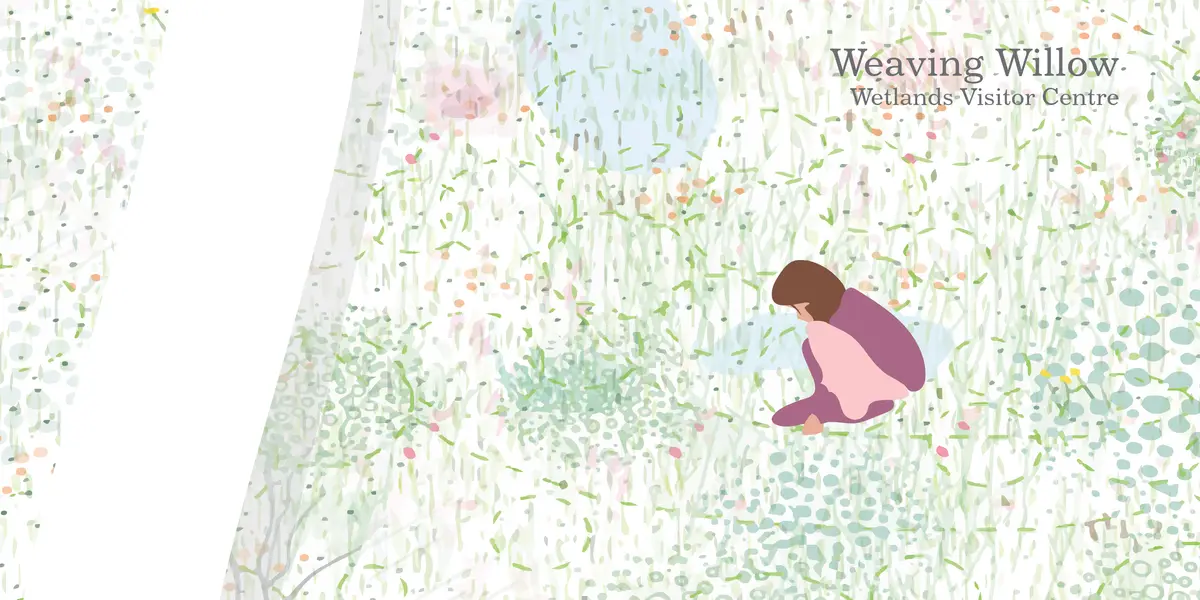
Weaving Willow
Wetlands Visitor Centre

Over the centuries, the human settlements that were located near the wetlands have developed specialized cultural traditions, that were based on the sustainable exploitation of different wetlands resources. One of the traditional crafts related to the marshland settlements is basket weaving. Because of the natural flexibility stems of wetlands plants have, they are suitable for shaping and weaving into baskets or other useful products. Among others, willow is very commonly used as a material in basketry. Important part of the economy and income of wetlands settlements comes from the woven crafts that have had, and still do, an extensive use in everyday life.
The woven baskets were essentially used for storing and transporting food and other goods, and although the basic use has changed, and woven objects are still very popular. Nowadays, when the movements that are trying to keep traditional crafts are on the rise, the woven baskets and other objects are very appreciated, expecially in interior design. There are also a lot of artists that have experimented with modern forms and shapes made by the principles of basketry. Those pieces of art represent the connection between the traditional and the contemporary, as the project itself does aim to achieve in its programme.
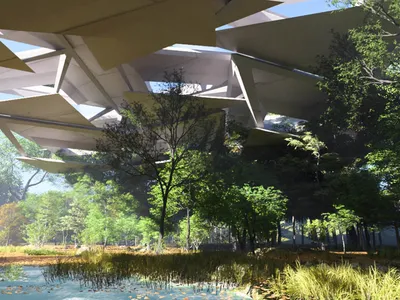
The form aims to connect the wetlands and the location site by gradually letting the wetlands in the object itself. And the other way around.
The object and wetlands are woven into each other.
Weaving, observed as essentially act of intertwining twigs and strands of a plant, stems or grass into an object, is in this case observed abstracted of the strands and twigs, and as a intertwining of two wholes - the wetlands - as natural environment, and a building - a man made object that is inevitably disrupting nature by only its being. As a result those two wholes are let into each other, by gradually reducing themselves in opposite directions.
The atriums and cut out circles represent the wetlands in an object. The object itself has to exist, and the final form of its disintegration into nature are the pathways in the wetlands site.
The disintegration and the disruption of a perfect grid that nature in a way is, were explored throughout the series of iterations and models represented in the project.
The goal is to make an object seem like it is floating, with every part of its facade being transparent. It overlooks the wetlands site, but also the flower meadows around.
The programme connects the educational center for learning basketry craft, and the open space gallery, that extends over the whole object. Those two parts are interconnected and mutually communicate. The exhibited art is both modern art made by weaving, and traditional woven baskets of many shapes and sizes. Part of the object that has the primary function to hold basketry classes, also has its small exhibition space, for learners to compare their work. The transparent learning rooms can also be used for other purposes - meetings and small scale conferences. The process of preparing and weaving willow is followed in the floor plan. The willow garden for growing and selling willow trees, the room for storing it, and a pool for soaking the twigs before weaving.
By intertwining the modern and the traditional, and a man-made object and the environment, the Weaving Willow Wetlands Visitor centre represents the connection and symbiosis between nature and building.

Popular Articles
Popular articles from the community


FCC Arquitectura Expands a Portuguese Granite House with a Board-Marked Concrete Wing
In Portugal, JV House pairs a cleaned-up whitewashed and granite dwelling with a timber-shuttered concrete extension, courtyards and a garden pool.


Aquadapt: An Underwater Habitat That Rewrites Its Rooms by the Hour
Curved modules ring the seabed while one shell shifts from breakfast room to cinema, farm and football pitch as residents' needs change.

graciastudio Turns a Viewless Tijuana Lot Inward Around a Courtyard of Concrete, Timber and Trees
In Tijuana, Jorge Gracia's GA2 House stacks a timber-clad private floor over exposed concrete and replaces a missing view with a planted interior patio.

Singing Woman: An Opera House That Performs Before the Curtain Rises
Ovidiu Cristian Pavel's conceptual opera house translates Estonia's choral identity into a sculpted waterfront landmark facing the Baltic Sea.

Similar Reads
You might also enjoy these articles
The Rhythm of Seasons
A Farmers' Market Connecting Nature and the City

More Than a Building-Designing a Living System
More Than a Building-Designing a Living System
Base Beyond
DESERT COMPOUND ARID: TOURISM OF ABSENCE AND ABUNDANCE

Explore Environmental Centre Competitions
Discover active competitions in this discipline


Challenge to reimagine the Iron Throne

Photograph architecture without architects

Illustrate the lost glory of Angkor Wat - Render Challenge

Design challenge to reuse E-waste
Comments (0)
Please login or sign up to add comments
No comments yet. Be the first to comment!