
While Mecca Flats might be gone, it's not forgotten
The demolished Chicago building, once memorialized by poet Gwendolyn Brooks, has been transformed by multiple artistic interventions

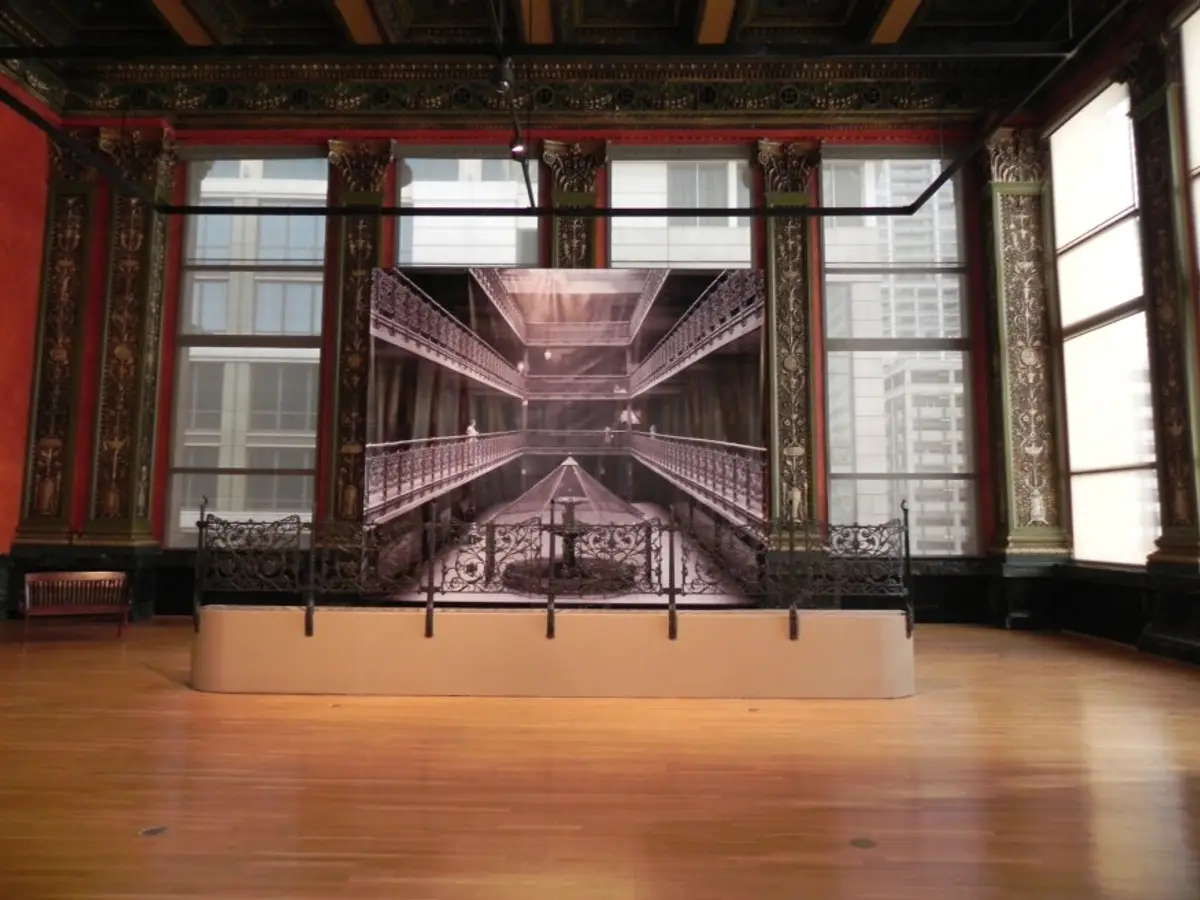
The Mecca Flats building, located in the Bronzeville neighbourhood of Chicago and formerly the centre of the city's Black Belt, is captured in haunting black and white photographs that transport viewers back in time. Built as a hotel for the 1893 World's Columbian Exhibition, the building later served as apartments for Black residents before being demolished in 1952. The large scale of the photographs, which were exhibited at the Chicago Cultural Center in 2014, allows viewers to almost step into the empty, sunlit building, which has been lost to history due to the narrow-minded urban redevelopment practices of the past.
 courtesy Chicago Department of Cultural Affairs and Special Events (DCASE)
The story of Mecca Flats and S.R. Crown Hall, a building designed by Ludwig Mies van der Rohe and built as part of the Illinois Institute of Technology's campus, is being given new depth with the addition of colourful shades. In 2018, during routine maintenance of the campus heating system, floor tiles were discovered beneath Crown Hall that shed new light on the long-demolished Mecca Flats. As a result, several projects by Chicago-based artists have taken on the task of reimagining the significance of Mecca Flats, bringing to life a neglected piece of Chicago's urban history and imagining a world where the construction of Crown Hall did not require the destruction of Mecca Flats.
“The prevailing view of architecture somehow argues for the destruction of Mecca Flats ... which is a useless task for us,” Roland Knowlden, an IIT-trained architectural designer and artist, says, rejecting the common notion that the Mecca's demolition was a necessary evil in the creation of Crown Hall. “The harder task is to imagine what would have happened if they didn't knock down the building.”
 Courtesy Roland Knowlden Artwork by Roland Knowlden
Currently working as an architectural designer at Future Firm in Chicago, Knowlden graduated from the architecture program at IIT in 2020. During his time at the school, he met Davey Friday in Crown Hall, a notable building on the Modernist campus designed by van der Rohe, who served as the dean of architecture at IIT from 1938 to 1958. The two quickly connected over their shared passion for combining art and architecture, and they will be exhibiting their collaboration, "Buried Beauty, Broken Block," at Chicago's Roots & Culture Contemporary Art Center from November 11th to December 17th. The exhibit draws inspiration from the intersecting worlds of Mecca Flats and Crown Hall.
 Courtesy Davey Friday Art work by Davey Friday
An exhibit featuring anatomically-inspired drawings by Friday and reconfigured maps by Knowlden was held in Crown Hall in mid-August. The exhibit, titled "Mies Killed Jazz: A Midterm Review," was open to the public and showcased the ongoing collaboration between the two artists. Their works explore the connections between changes in urban design and the human body. Knowlden's pieces focus on micro-scale urban designs, while Friday's background in biology allows him to delve into the impact of the city on the micro-scale of the body. The exhibit presents a balance between the two perspectives, coming together to examine the relationship between the individual and the larger urban fabric at a specific site.
When fourth-generation Bronzeville resident Michael Jordan visits the site of his grandmother's former apartment in the now-demolished Clarence Darrow Homes, located south of IIT's campus, he imagines what it would be like to see the Mecca Flats reanimated. For Jordan, understanding the destruction of Chicago's public housing is a way of understanding the deeper layers of the past that public housing itself has obscured. By demolishing multiple generations of buildings, Chicago has erased the memory of the generations of Black people who have lived within just a few square miles.
 Courtesy Floating Museum Floating Museum rendering
“I remember seeing [public housing authorities] set the dynamite off to bring some of the towers down, and now that history is gone, but this is where people lived their entire lives,” Friday says. “My grandma told me all the time, ‘I love the projects,’ that [they were] awesome, beautiful, transformative. But talking about urban renewal, I can only imagine what Chicago in the Black Belt would have looked like in the 1940s.”
Upon Mies van der Rohe's arrival in Chicago in 1938, he was forced to leave his home country, Germany, due to the rise in **** violence. When he got to Chicago, he noticed that the school, IIT, looked way different than it does now. Back then, the school was called the Armour Institute and it wasn't nearly as big as it is today. The school was mainly concentrated in one red-brick building that was constructed in 1893. However, over the next few years, Mies put his stamp on the school by expanding it and making it into what it is today. Not to mention, during this time frame urban renewal was also occurring and transforming the area around IIT.

In the years immediately following World War II, the number of buildings on the IIT campus increased at an average rate of two per year. This pace continued until 1968 when construction activity began to slow down. Of the twenty buildings erected during this period, all were designed by Mies van der Rohe himself. These buildings were designed to fit into a master plan that subverted traditional approaches to university campus planning. The plan emphasized a simple, open design that would be flexible enough to accommodate changes in the way buildings were used, while still maintaining a coherent overall structure.
The construction of the Illinois Institute of Technology (IIT) campus was meant to bring a sleek, rectangular design to the urban landscape. However, the reality of the situation was more complicated due to the surrounding area. The western edge of the campus, located on Wentworth Boulevard, had long been a racial dividing line between the predominantly black neighbourhood of Bronzeville to the east and the white community of Bridgeport, home to Mayor Richard J. Daley's political machine, to the west. The completion of the Dan Ryan Expressway in 1961 further cemented this division. Additionally, the development of public housing projects such as the Robert Taylor Homes and Stateway Gardens resulted in the demolition of overcrowded apartment buildings in Bronzeville and the construction of a row of uniform residential buildings.
The university purchased Mecca Flats in 1941, a building located at the intersection of State and 34th Streets. Originally built as apartments following the 1893 world's fair, Mecca Flats exclusively housed white families until the mid-1910s. However, as the neighbourhood's racial composition changed, the building became home to thousands of Black residents, packed into just 96 units. Its unique design, which included Chicago's first open-air courtyard accessible to the street, contributed to what one scholar described as "forced private togetherness" as the building began to house more residents than intended. This overcrowding inspired Pulitzer Prize-winning poet Gwendolyn Brooks to write In The Mecca, in which a woman finds her daughter murdered inside the building and encounters the building's diverse Black residents.
The university purchased Mecca Flats in 1941, a building located at the intersection of State and 34th Streets. Originally built as apartments following the 1893 world's fair, Mecca Flats exclusively housed white families until the mid-1910s. However, as the neighbourhood's racial composition changed, the building became home to thousands of Black residents, packed into just 96 units. Its unique design, which included Chicago's first open-air courtyard accessible to the street, contributed to what one scholar described as "forced private togetherness" as the building began to house more residents than intended. This overcrowding inspired Pulitzer Prize-winning poet Gwendolyn Brooks to write In The Mecca, in which a woman finds her daughter murdered inside the building and encounters the building's diverse Black residents.
Despite the importance of its architecture and culture, IIT always planned to demolish the Mecca Flats building to fulfil its large-scale development plans. However, the residents fought for 15 years to save the building, a significant struggle against the widespread urban renewal that affected Black urban areas during the post-war period. Despite their efforts, the university neglected the building and it was eventually demolished in 1952, forcing more than 1,000 people to leave.
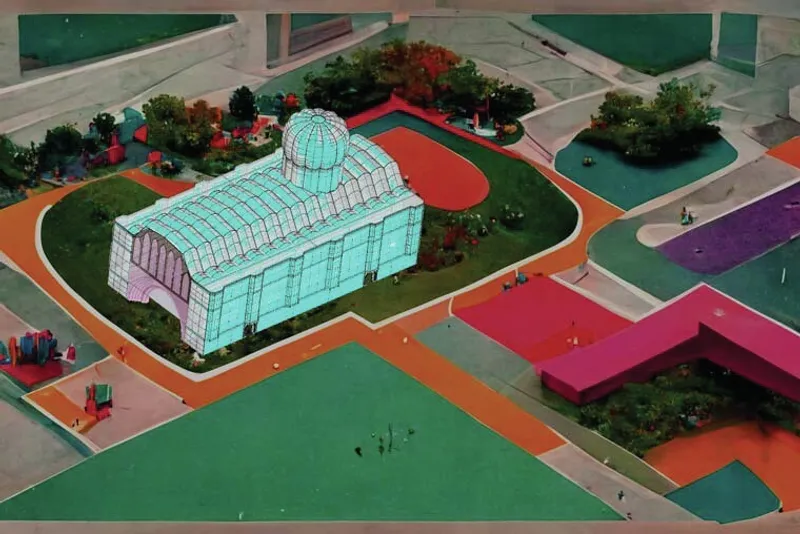
The Chicago-based collective Floating Museum, made up of seven artists, sees Mecca Flats as a site with enduring significance, similar to Knowlden and Friday. Through their project Floating Monuments: Mecca Flats, the group plans to recreate the building in inflatable form as a way to bring its physical presence back into the cityscape. Co-principal Andrew Schachman, a former professor at IIT, was present when the basement tiles of Mecca Flats were discovered in 2018. He believes that the uncovering of this recent history, in which many living today witnessed the destruction of the Flats, reflects America's tendency to forget its past and focus only on progress, leading to the erasure of many architectural landmarks.
“When you erase the physical context, you lose the sense of where those events happen, and there's no way of framing things,” Schachman says. “In Europe, you have buildings that have been around for 500 years and a layering of histories, but here the city replaces itself constantly.”
A new version of Mecca Flats, called the Floating Monument, is scheduled to be unveiled next year. This version will travel to various locations within the Chicago Parks District, and although visitors will not be able to enter the space, they will be able to view the large-scale recreation of the building from the outside. The creators of this project are also working with archivists to provide a deeper understanding of the historical context in which Mecca Flats was a central hub of vibrant Black culture in Chicago's Black Belt during the early 20th century.
“Bronzeville was a space that allowed Black folks to express themselves without a white lens,” Avery R. Young, another Floating Museum co-principle, says. “Mecca Flats was a cultural institution, an architectural gem, and an urban palace, and we’re sharing that history with the public, so what they may have not thought was significant becomes significant in our presentation.”
The 2014 Chicago Cultural Center exhibition brought Mecca to the attention of many in Chicago, but it wasn't until 2018 when the discovery of basement tiles beneath Crown Hall that a new level of contemplation about the building's significance arose. Previously, black-and-white photographs depicted the building as a victim of urban renewal, locked in the past and unable to change. However, the discovery of the tiles sparked discussions about the role of the Illinois Institute of Technology in the redevelopment of Bronzeville.
At a recent event discussing the discovery of the Mecca Flats, John Vinci, an IIT graduate and renowned architectural preservationist, made controversial comments about the building. He called it a "failure" and downplayed IIT's role in its neglect, instead claiming that Crown Hall was "probably the most democratic building that was ever built." These statements shocked many in the audience, but Michelangelo Sabatino, interim dean of IIT's College of Architecture, acknowledged the school's involvement in the demise of Mecca Flats and its previous silence on the topic. He said, "I think 20 years ago, [if] they had unearthed these pavements—I don’t think anyone would have paid quite the same amount of concerted attention."
Former IIT student Knowlden argues that it is impossible to talk about Crown Hall without mentioning Mecca Flats. While many buildings, lives, and histories have been erased from urban landscapes due to redevelopment, the presence of these two architectural monuments – one still standing and one now discovered – in the same location forces us to remember the past.
“If you tell the story of Crown Hall without Mecca Flats, it has no tension within the reality that we live in,” Knowlden says. “The truth makes Crown Hall and Mecca Flats my two favourite buildings and makes them both more powerful and compelling, even though their stories are conflicting.”

Popular Articles
Popular articles from the community


Play: Fragments of Their World
Familiar architecture becomes modular playground design, creating safe spaces where displaced children can learn, connect, imagine and play.

Little Red Riding Hood: Architectural Design as a Journey Through Fear, Light, and Storytelling
Little Red Riding Hood reimagines the fairy tale through architectural design shaped by fear, light, scale, memory, uncertainty, and choice.

Co-life: Sustainable Architecture for Age-Friendly Community Living
Co-life reimagines sustainable architecture for seniors through courtyards, rammed earth, shared gardens, and spaces designed for belonging.

Lunar Spiral: Space Architecture Shaped by the Mathematics of the Universe
Lunar Spiral reimagines space architecture through Fibonacci geometry, lunar regolith, levitating habitats, and self-sustaining Moon living.

Similar Reads
You might also enjoy these articles

Day and Night Park: A Time-Based Urban Newsstand in Beijing
A temporary urban newsstand in Beijing blending travel, light, and reading through poetic colors, compact form, and community-focused design.

Modernist Patio Renovation in El Masnou, Barcelona by Oliver Segura Arquitectura + Cebrià Arquitectura
Modernist patio renovation blending tradition and innovation with a movable pool, leveled floors, and Catalan materials in El Masnou.

Alto Residencial Coop: Cooperative Housing Development in Santiago de Compostela by Carbajo Barrios Arquitectos
A linear cooperative housing complex blending white volumes and perforated metal façades, enhancing community living, natural light, privacy, and urban integration.

Vil Genis School by BPA ARCHITECTURE – Massy, France
Vil Genis School in Massy, France, features sustainable design, south-facing classrooms, community integration, accessible spaces, and modern educational architecture.

Explore Cultural Architecture Competitions
Discover active competitions in this discipline


Challenge to reimagine the Iron Throne

Photograph architecture without architects

Illustrate the lost glory of Angkor Wat - Render Challenge

Bring back Drive In's
Comments (0)
Please login or sign up to add comments
No comments yet. Be the first to comment!