

White Cube Atelier Wraps a Rotating Mixed-Use Volume in Timber on a Tight Corner in Maku
A 1,000 square meter cube pivots to meet a dual-cornered site in northwestern Iran, softened by a wooden skin that speaks to the schoolchildren next door.


Architecture in small Iranian cities rarely gets international attention, which makes the Ramand Mixed-Use Building in Maku all the more worth examining. Designed by White Cube Atelier under the direction of Reza Asadzade and Shabnam Khalilpour, the project poses a deceptively simple question: how does a cube settle into a site defined by two corners without betraying its own geometric identity? The answer, completed in 2024, is a controlled rotation, a slight pivot of the volume that lets its faces address both street frontages while generating angular terraces and wedge-shaped interstitial spaces.
What lifts Ramand beyond a formal exercise is the choice to clad the pivoted cube almost entirely in timber. Surrounded by schools, the building's daily audience is children, and the architects made a deliberate material decision to trade the potential severity of a pure white or concrete box for a warmer, more conversational presence. The result is a building that reads as both disciplined and inviting, its wooden skin aging and weathering in a way that will only deepen its relationship with the neighborhood over time.
A Cube That Turns to Meet Its Corner
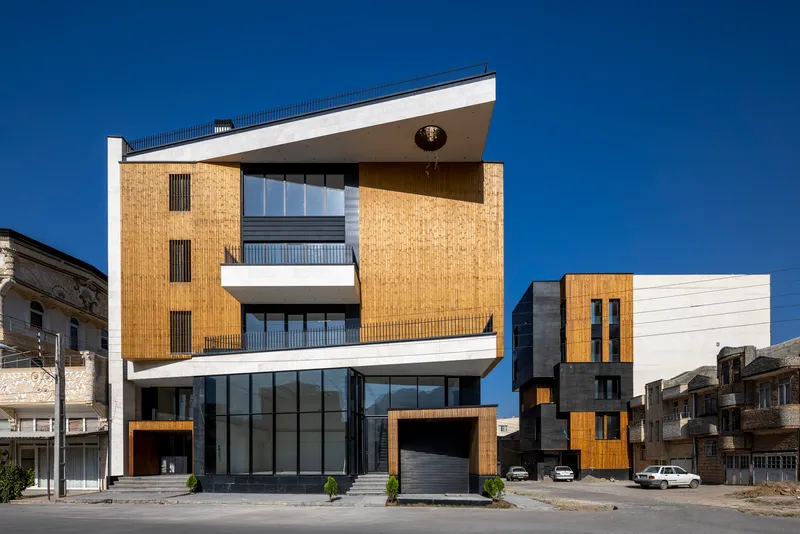
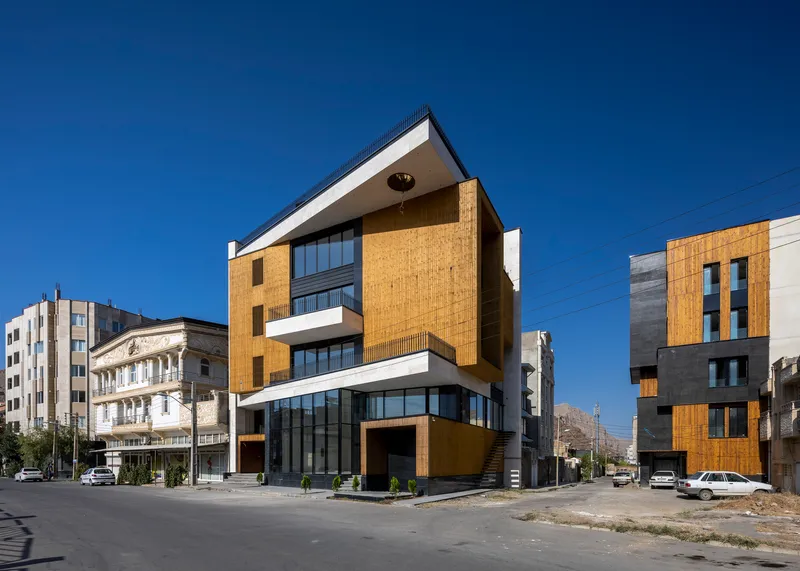
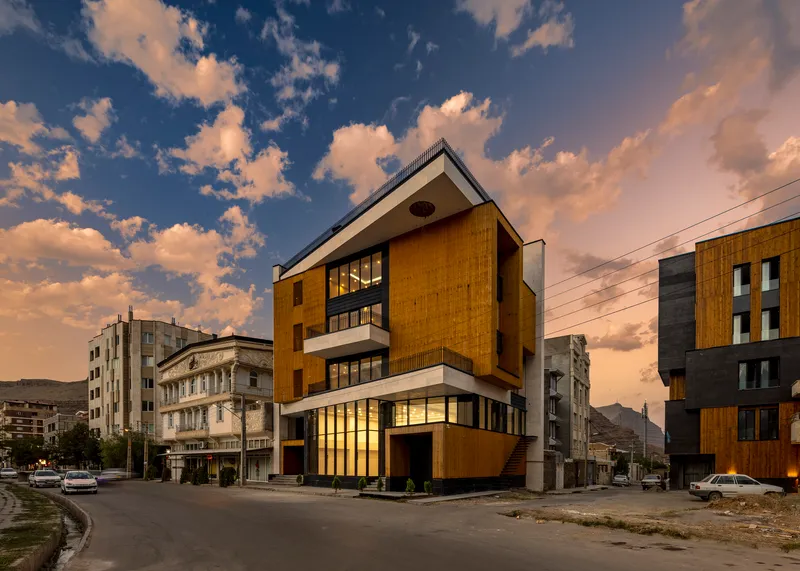
The dual-cornered site is the generator of every formal decision. Rather than chamfer or facet the building's edges to conform to the lot lines, the architects rotated the entire volume, allowing its planar faces to create angular relationships with each street. The ground floor reads as largely glazed, pulling back from the timber and brick envelope above, while the upper levels project outward in stacked white balconies that catch light at different angles throughout the day.
From the street, the alternating rhythm of brick banding and horizontal white panels at one corner transitions to vertically layered timber at the primary facade. The rotation is subtle enough that you might miss it at first glance, but its effects ripple upward: terraces become triangular, fenestration patterns shift, and no two elevations behave identically.
Timber as a Social Material
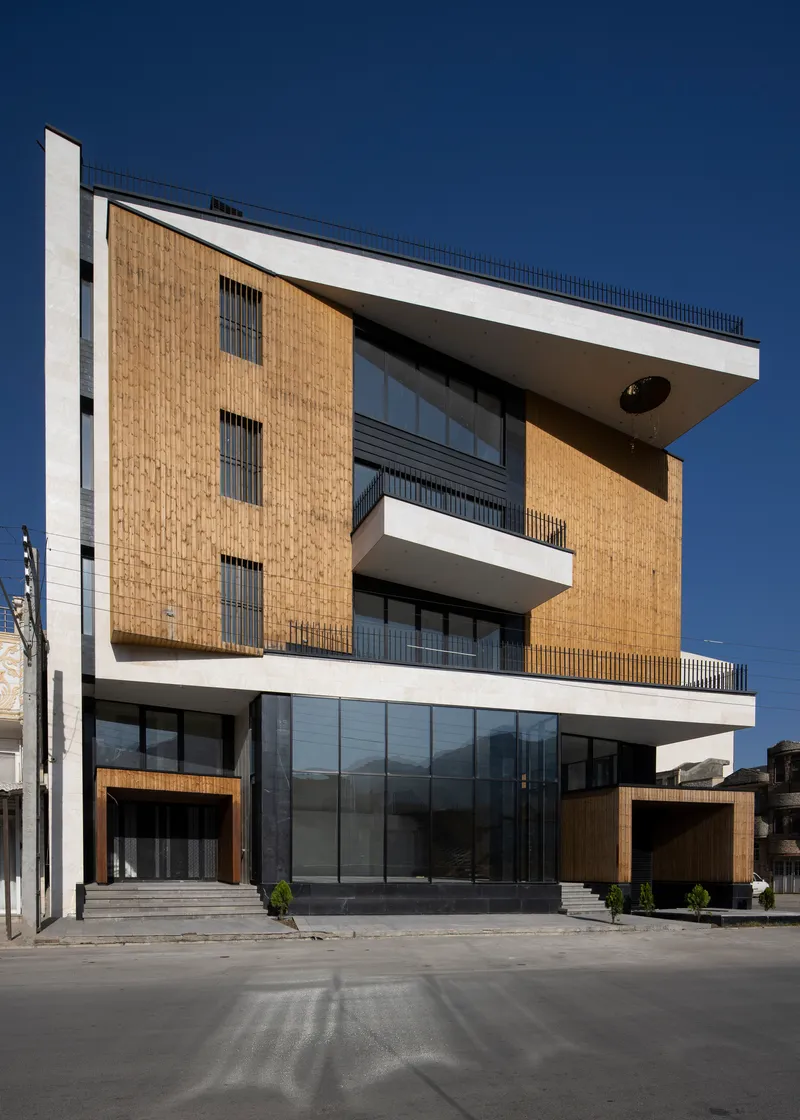
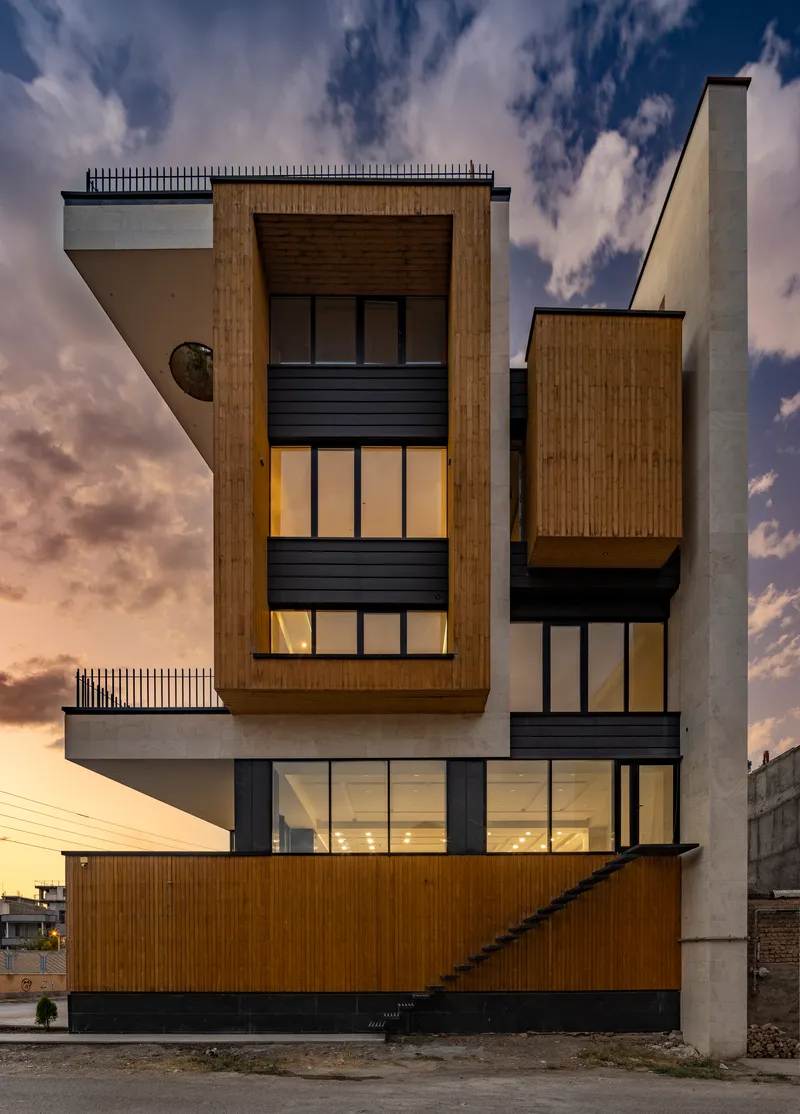
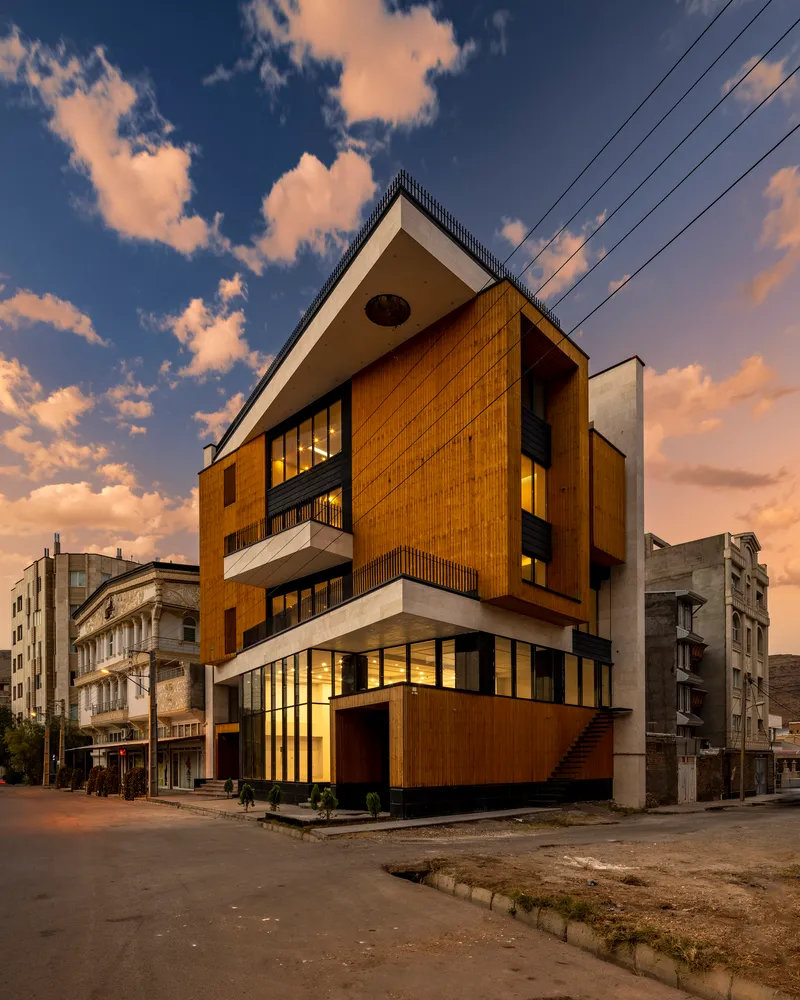
The timber cladding is not decorative. It is a deliberate softening strategy, a way to defuse the potential austerity of a geometrically rigid cube sitting among low-rise school buildings. The vertically oriented panels create a layered depth across the facade, catching raking light at dusk and casting fine shadow lines during the day. At night, the illuminated timber glows against the darker metal panels at the rear elevation, turning the building into a lantern visible from the surrounding streets.
Wood is not an obvious choice in this part of northwestern Iran, where masonry and concrete dominate. Its deployment here signals an awareness that architecture does not exist in isolation from its social context. The children walking past this building every day encounter a surface that is tactile, warm, and legible, rather than a blank monolith demanding deference.
A Ground Floor That Performs Double Duty
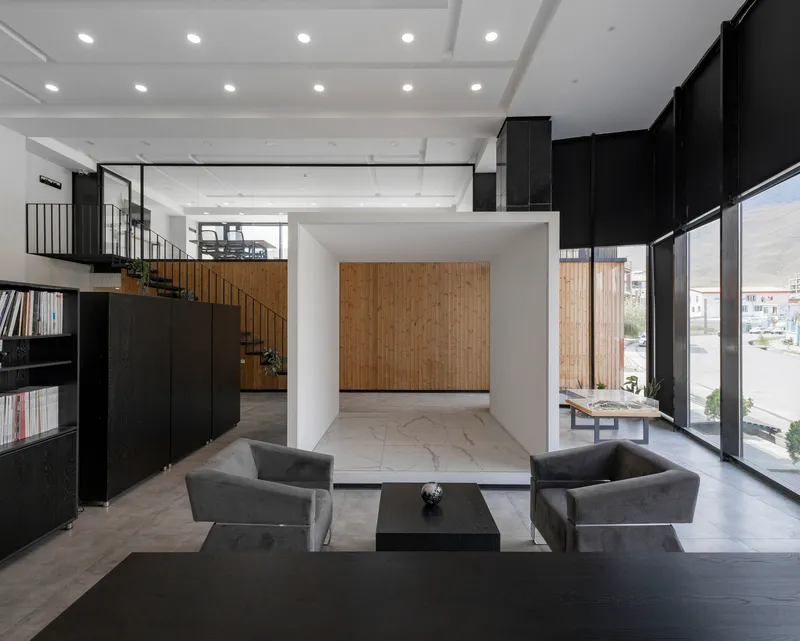
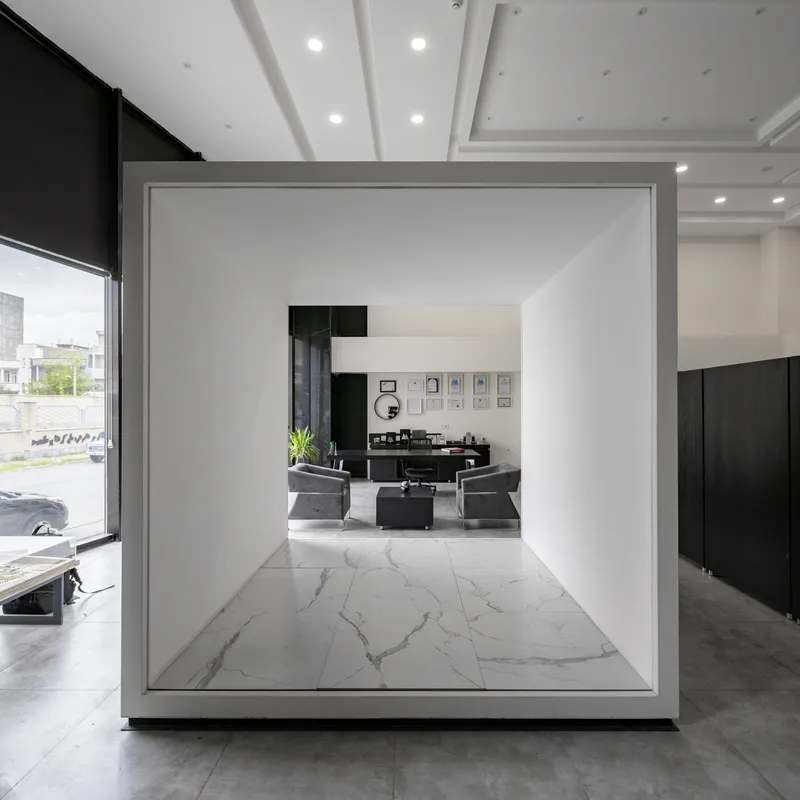
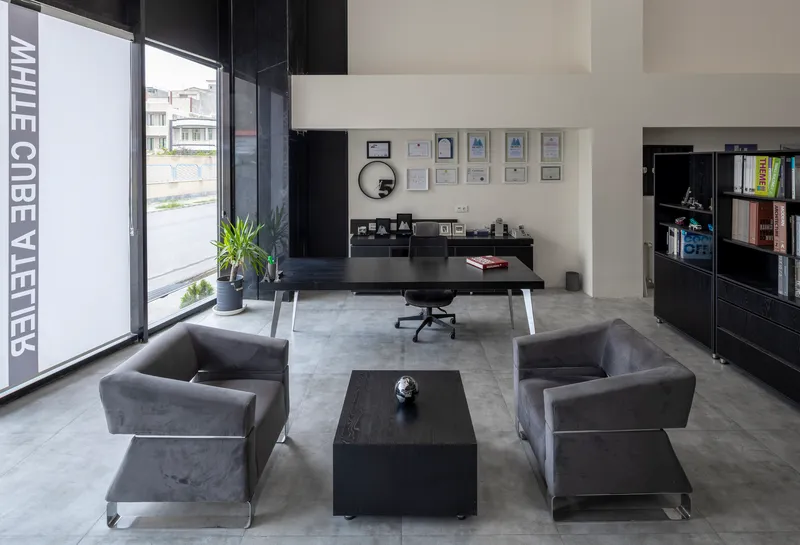
The ground floor houses the building's commercial and reception functions, and the architects have treated it as a sequence of framed thresholds rather than a single open volume. A double-height lobby with a coffered white ceiling and black walls leads into a showroom space where freestanding white box volumes sit on veined marble flooring, creating room-within-room conditions. The effect is almost gallery-like, which is fitting for a firm whose name, White Cube, directly references exhibition architecture.
Full-height glazing at the reception area collapses the boundary between interior and street, while grey upholstered seating and restrained black furniture keep the palette controlled. The marble flooring provides visual continuity across the entire ground plane, tying together spaces that serve quite different programmatic purposes.
Vertical Circulation as Spectacle
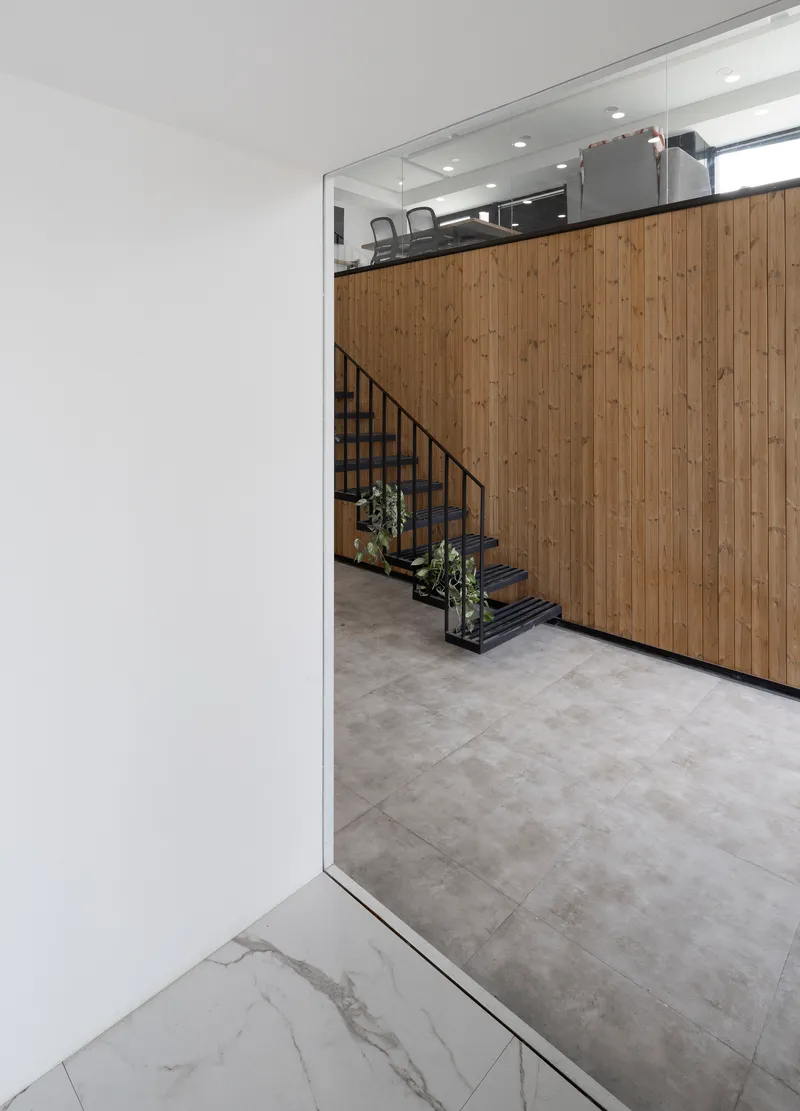
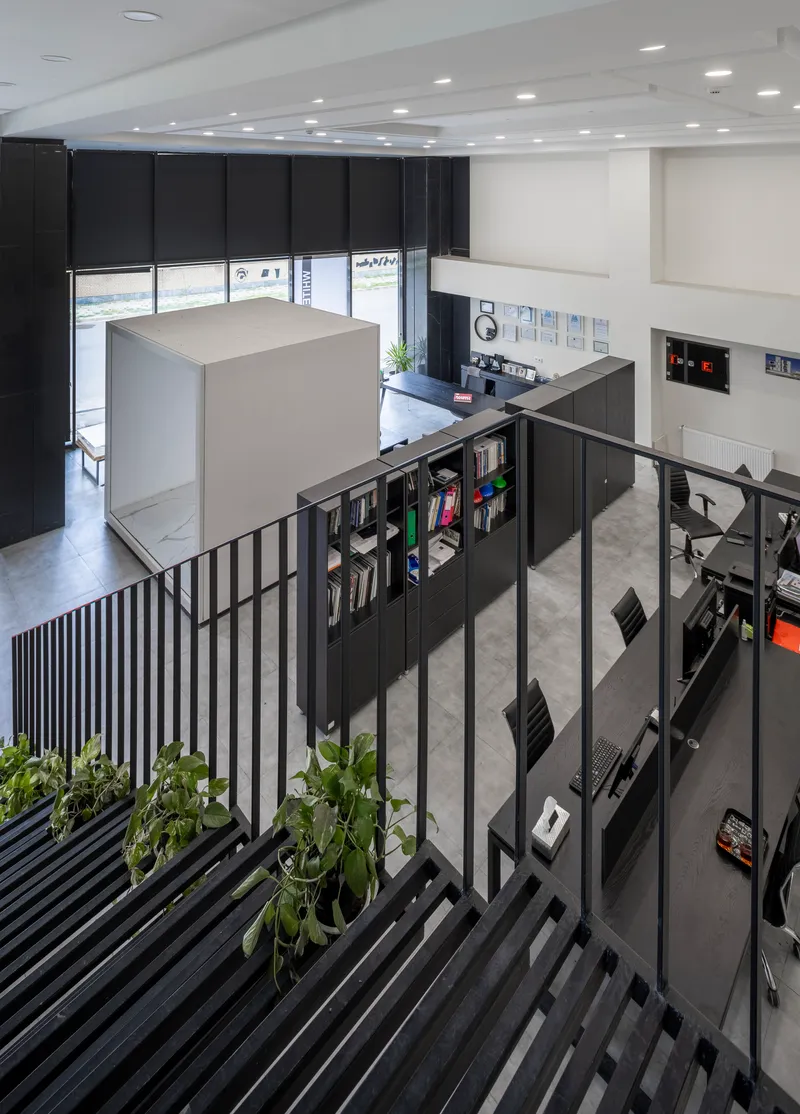
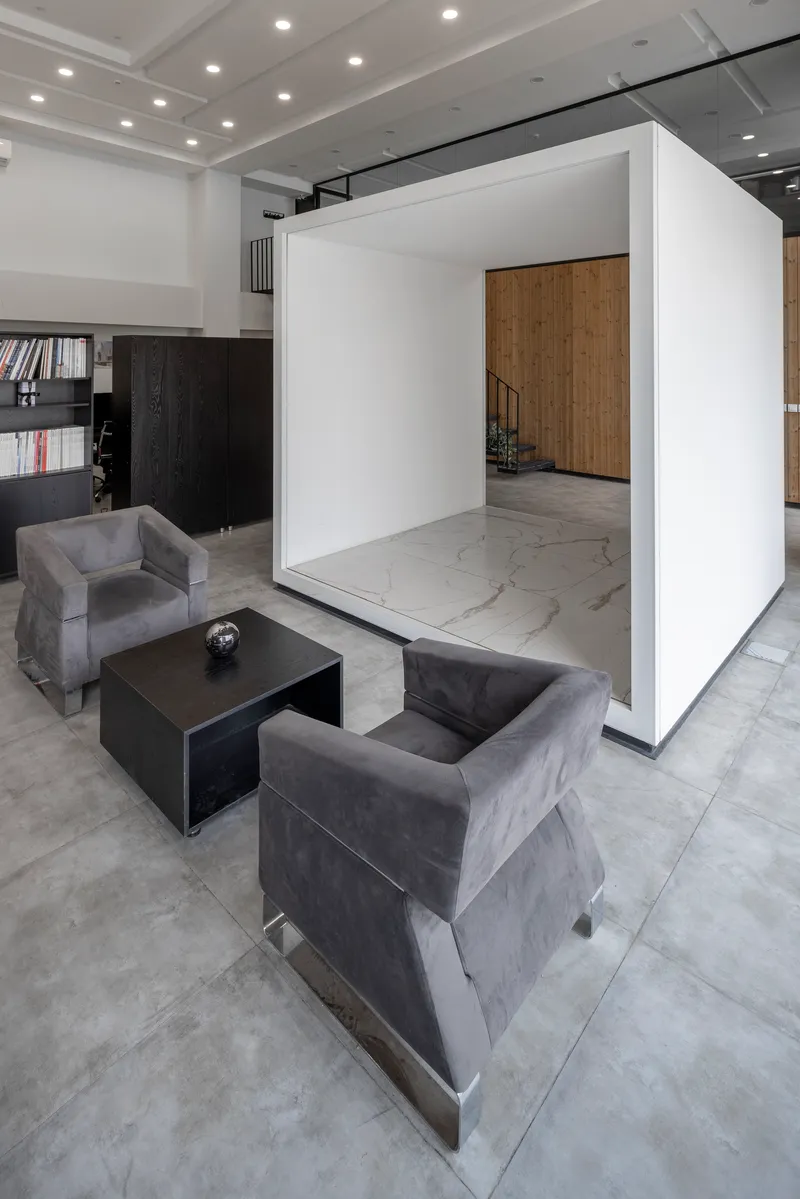
The staircase is the building's most expressive interior element. Clad in the same timber that wraps the exterior, it threads through the full height of the section, visible from the marble-floored entrance through a precisely placed doorway. The continuity of material between outside and inside collapses the usual distinction between facade and core, making the staircase feel like a piece of the building's skin folded inward.
At the double-height library space, a steel stair with planted treads descends past black shelving, introducing a momentary shift in material register. The planted steps are a small gesture, but they introduce biological time into a space otherwise defined by sharp geometric discipline. Looking down through the stair, you read the full sectional ambition of the project: five floors connected by a continuous diagonal cut that pulls daylight deep into the plan.
Interior Warmth Within a Disciplined Frame
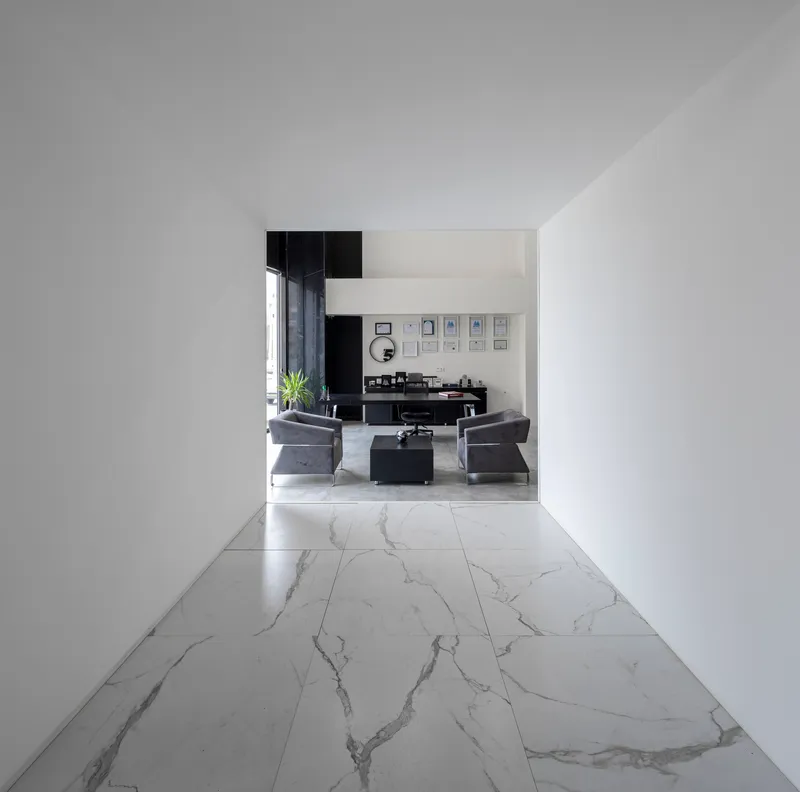
The interior palette oscillates between stark white corridors and warm timber accents, a push and pull that keeps the spaces from settling into either clinical minimalism or rustic coziness. A white corridor lined with veined marble tile leads to a seating area hung with framed artworks, establishing the kind of curated domestic atmosphere that mixed-use buildings in smaller cities rarely attempt.
The coffered ceiling in the double-height lobby deserves particular attention. It is an old technique deployed with new precision, breaking the ceiling plane into a modular grid that absorbs sound and gives the tall volume a human-scaled texture. Against the black walls, the white coffering reads as an inverted topography, one more instance of the building turning a simple geometric move into spatial richness.
Plans and Drawings
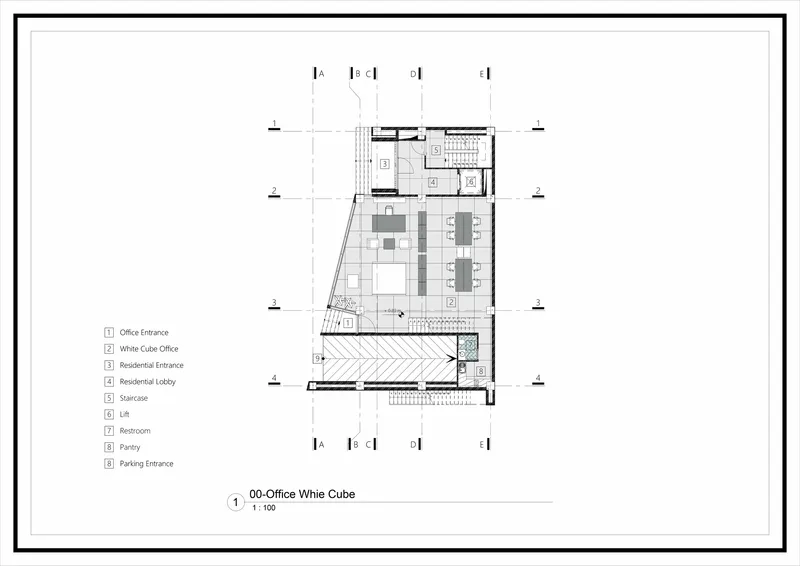
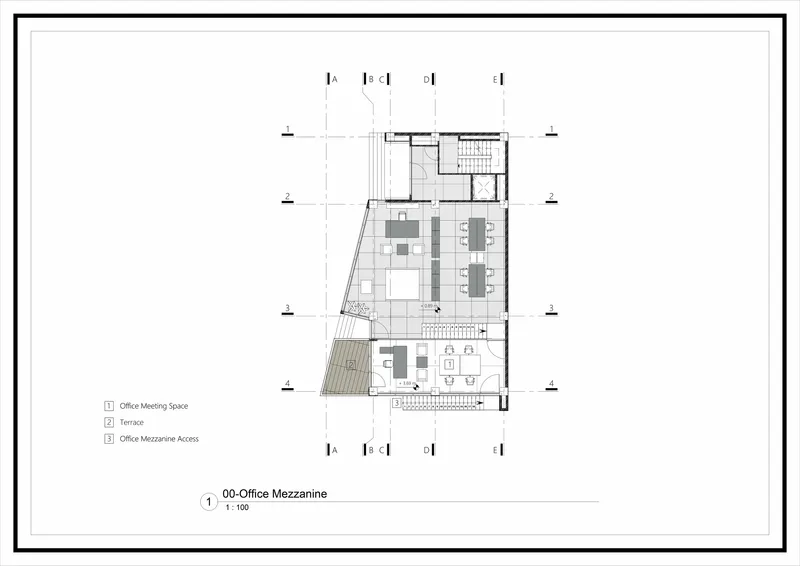
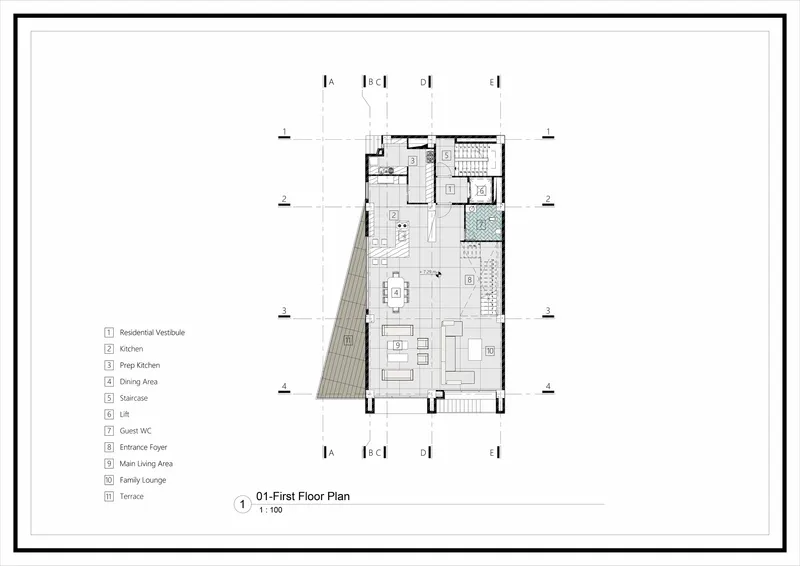
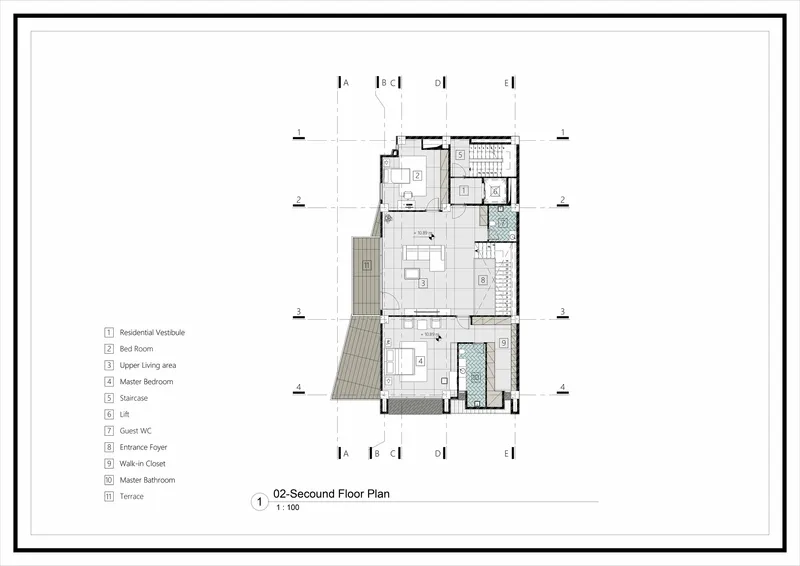
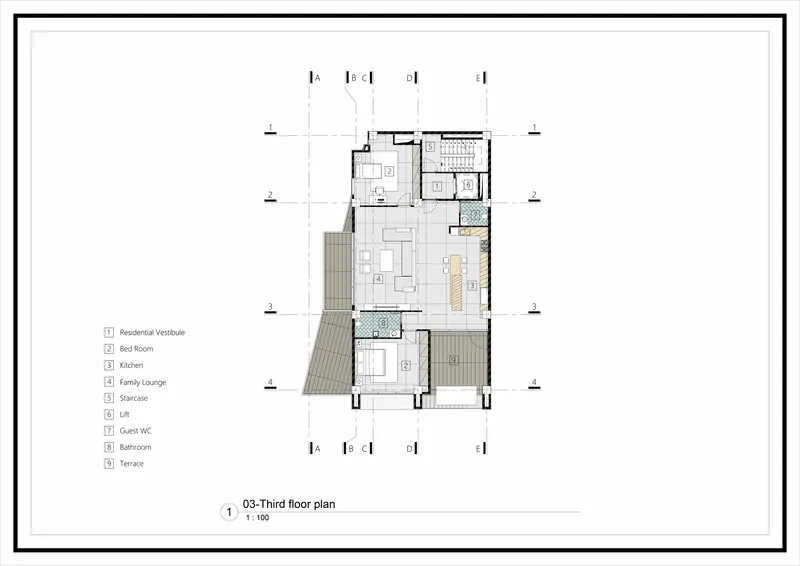
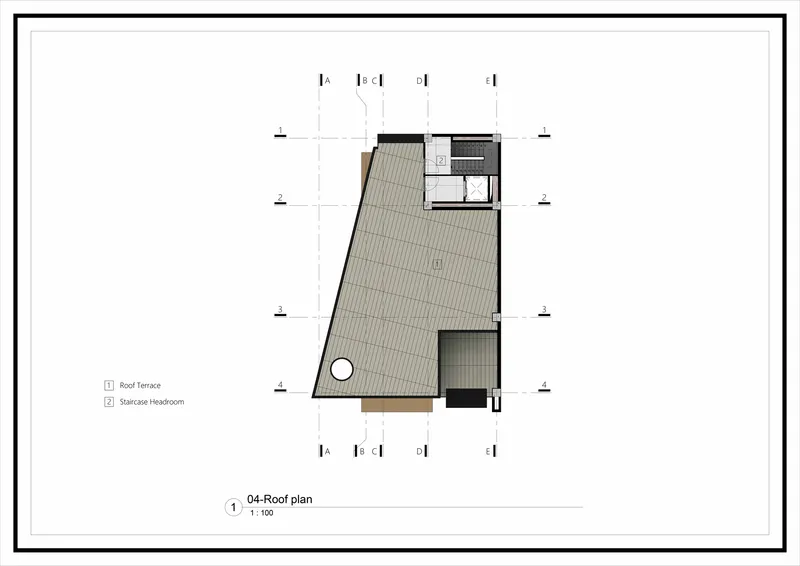
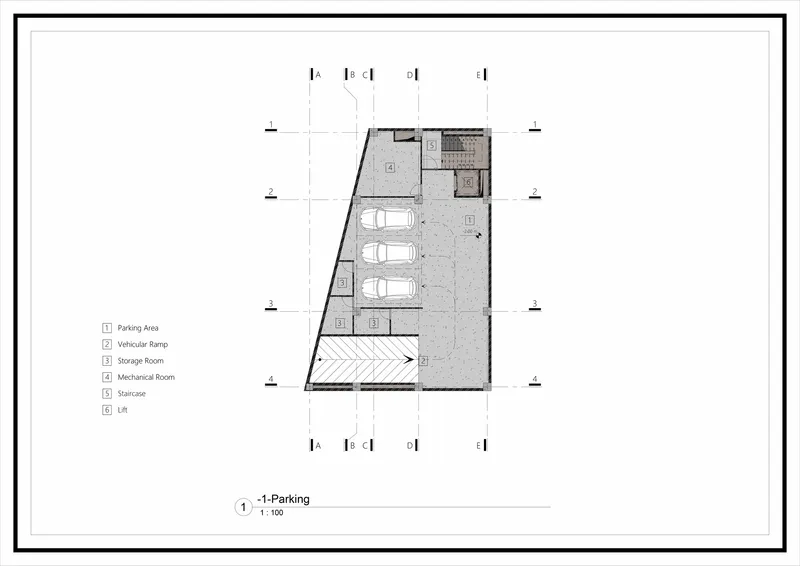
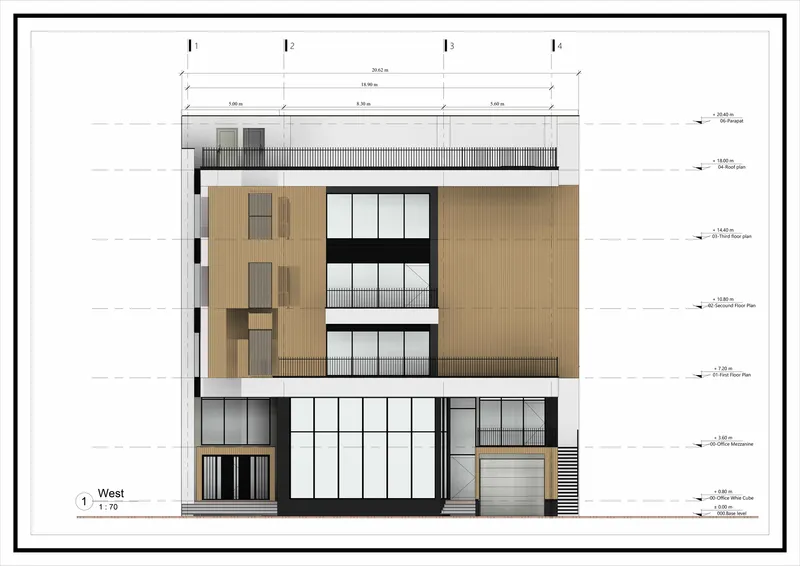
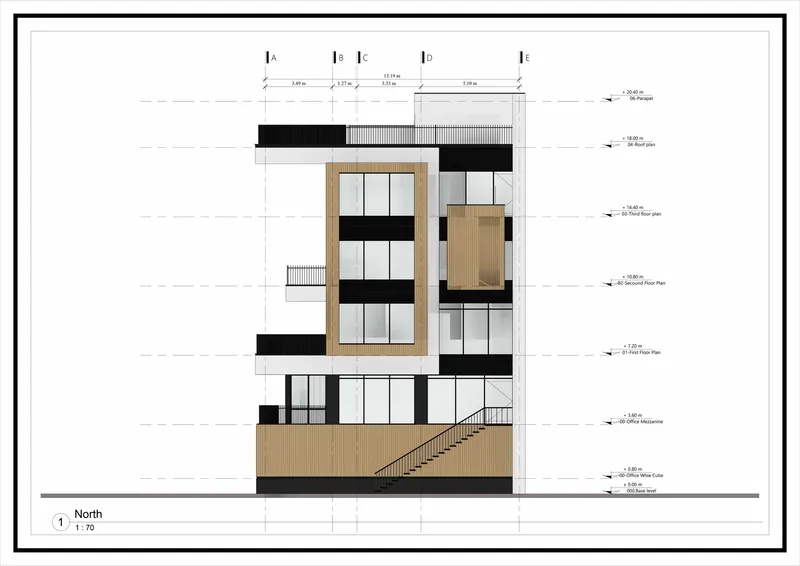
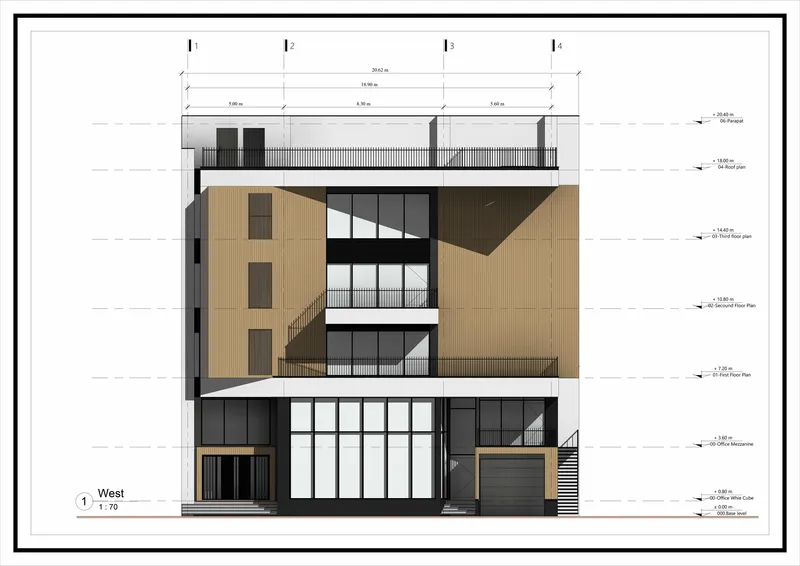
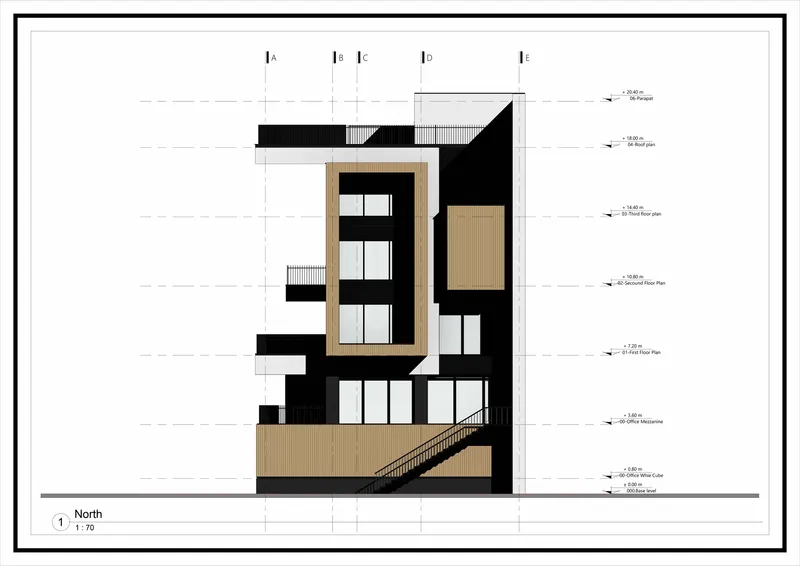
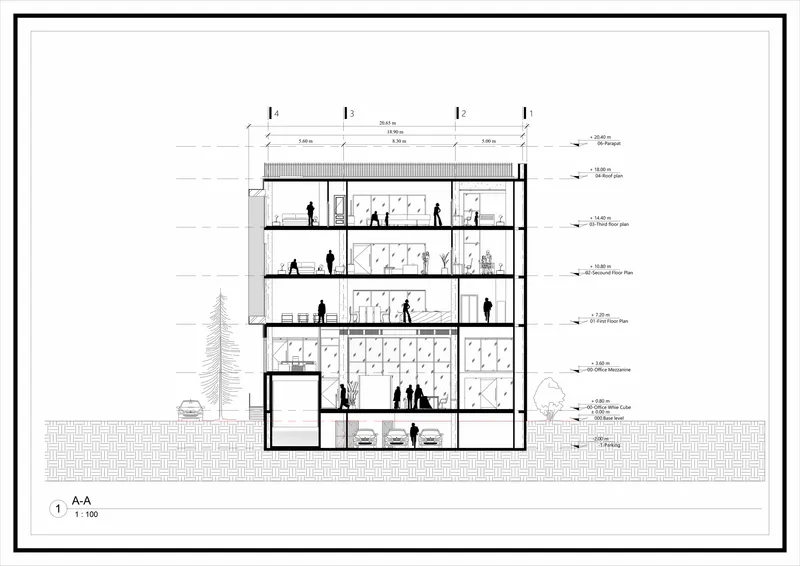
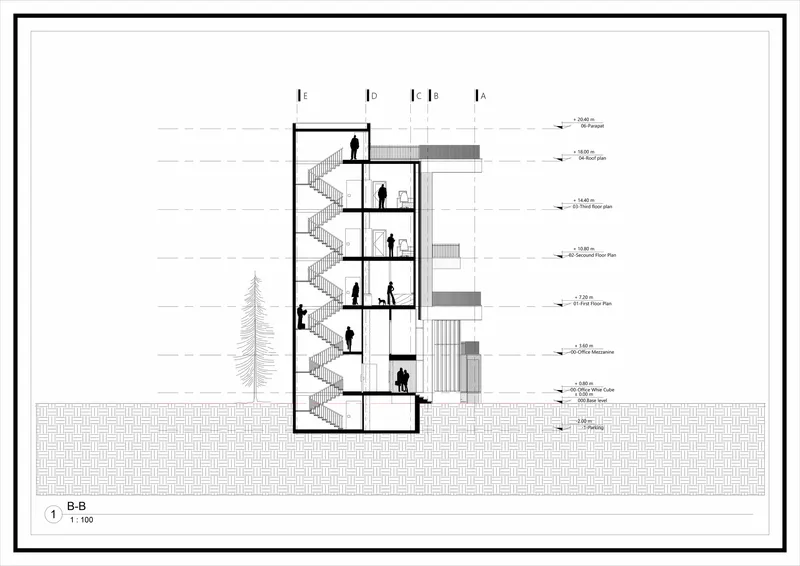
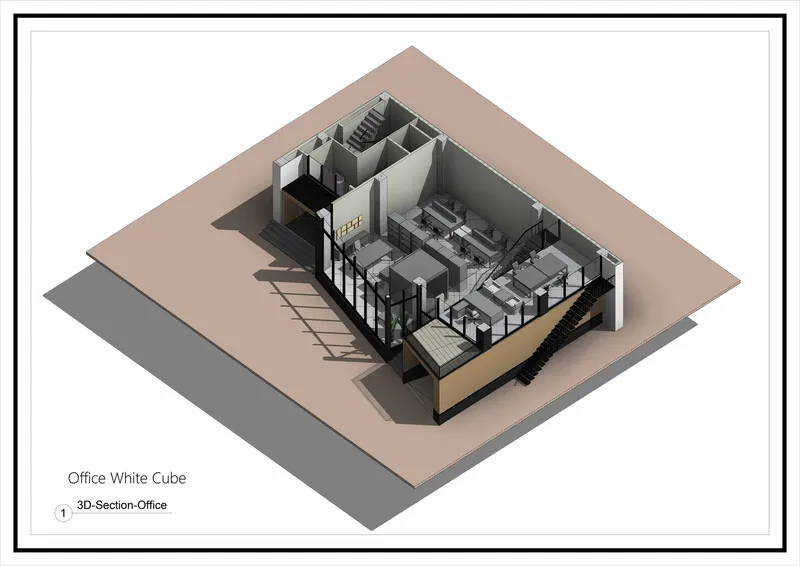
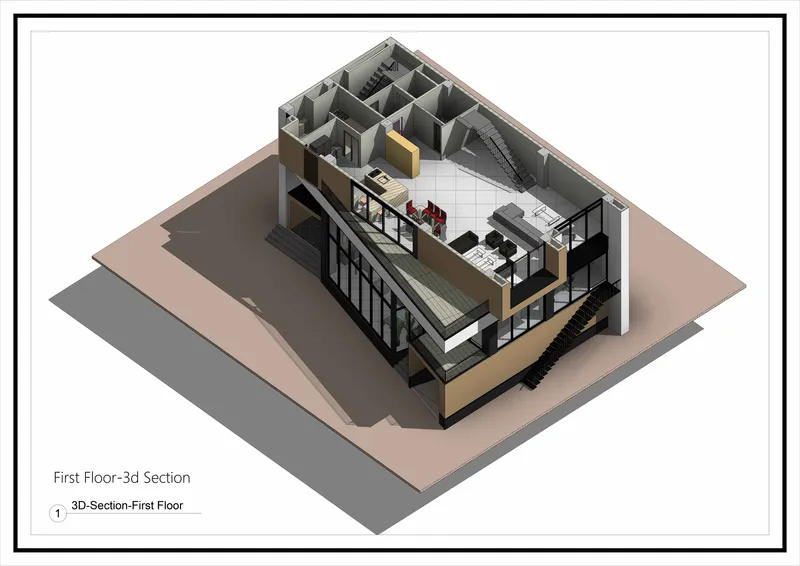
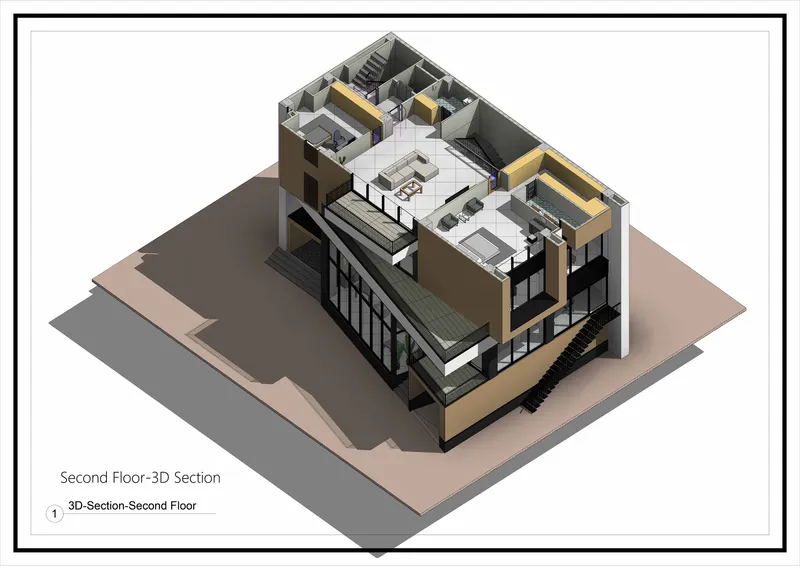
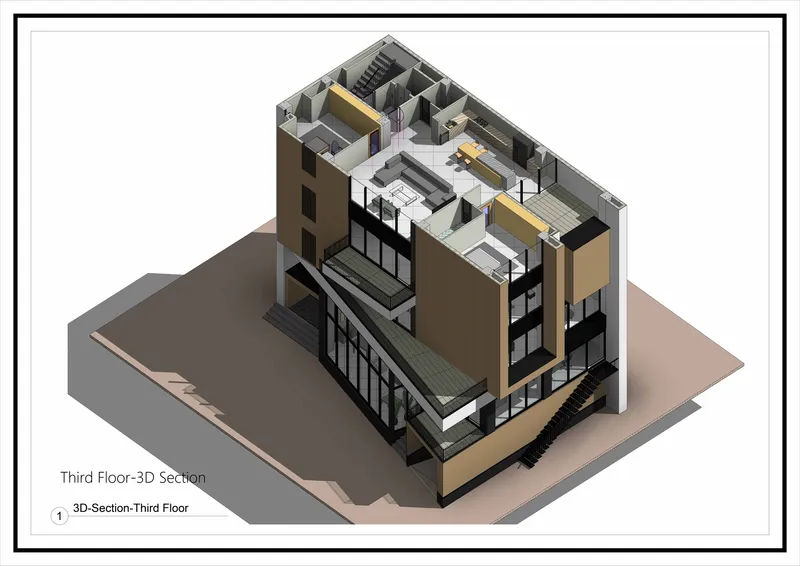
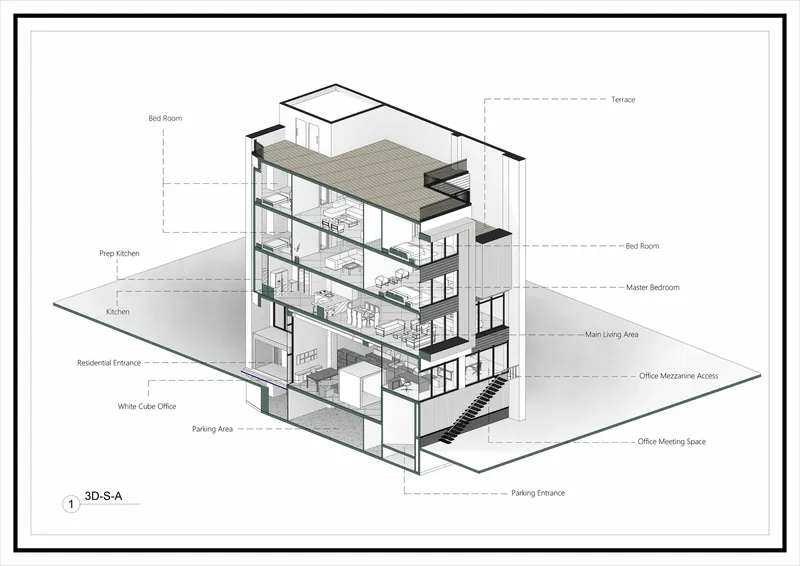
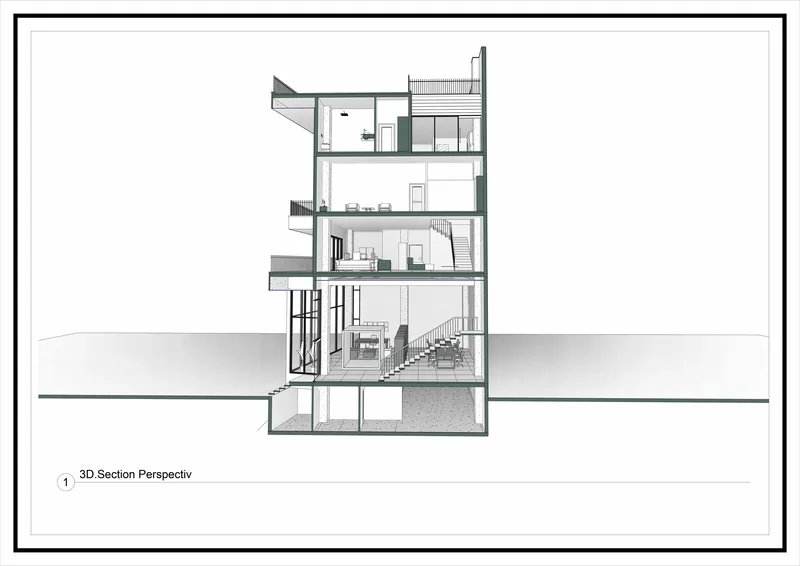
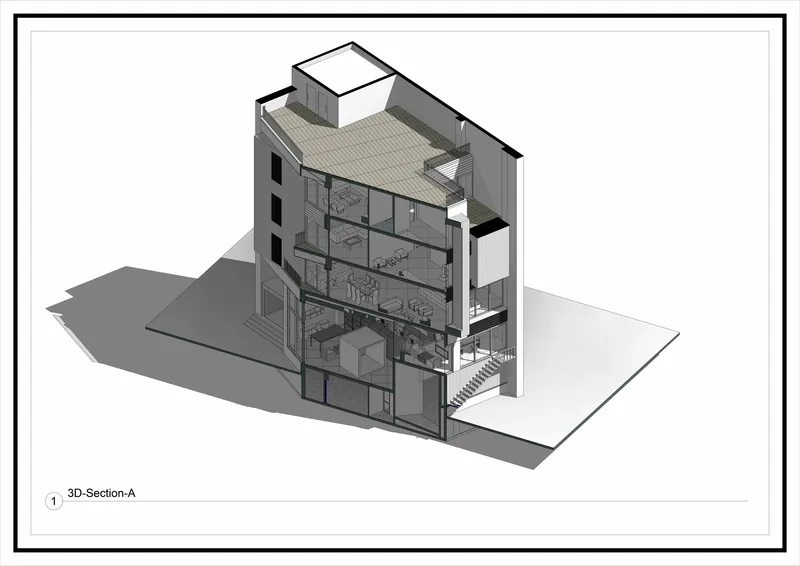
The floor plans reveal the full consequences of the rotation. The ground floor and mezzanine serve commercial and office functions, with a lobby, terrace, and meeting spaces organized around the central staircase. From the first floor upward, the program shifts to residential, with a kitchen, dining area, bedrooms, and a family lounge distributed across three levels. The triangular terraces that appear on the first and second floors are direct byproducts of the cube's angular relationship to the site boundary, spaces that a conventional alignment would never have produced.
The sections are particularly instructive. They show a continuous diagonal staircase connecting all five floors from the basement parking level to the roof terrace, with the double-height spaces visible as spatial voids that pull light and air downward through the section. The axonometric cutaways expose the programmatic stacking: parking below grade, then offices with workstations and yellow accent walls, then residential above. The exterior stair at the building's edge appears consistently across elevations and sections, marking the vertical circulation as a compositional element on the facade, not hidden infrastructure.
The west and north elevation drawings confirm what the photographs suggest: the wood paneling is treated as a continuous surface system, interrupted only by precisely positioned window openings and recessed balconies. The shadow studies embedded in the alternate elevation set show how the rotation generates a diagonal shadow plane across the primary facade, an effect the architects clearly anticipated and exploited.
Why This Project Matters
Ramand matters because it refuses the false choice between geometric discipline and contextual sensitivity. In a city like Maku, where vernacular construction and budget constraints typically flatten ambition, White Cube Atelier has produced a building that is formally rigorous without being hostile to its surroundings. The rotation is not a gesture for its own sake; it generates the terraces, the angular views, and the dynamic shadow play that give the building its character. The timber skin is not applied warmth; it is a social decision with material consequences.
At 1,000 square meters, the project is compact, and that compactness works in its favor. Every move counts. The staircase is both circulation and spatial event. The terraces are both byproduct and amenity. The mixed-use program, offices below, residence above, is conventional, but the sectional ambition that connects them is not. For architects working in comparable conditions, constrained sites, modest budgets, peripheral cities, Ramand offers a clear lesson: the intelligence of the plan can compensate for what the budget cannot buy.
Ramand Mixed-Use Building by White Cube Atelier (Lead Architects: Reza Asadzade and Shabnam Khalilpour). Maku, Iran. 1,000 m². Completed 2024. Photography by Parham Taghioff.
About the Studio
Share Your Own Work on uni.xyz
If projects like this are the kind of work you want to make, uni.xyz is a place to publish your own, find collaborators, and enter design competitions.


Popular Articles
Popular articles from the community

Faces of the Soviet Avant-Garde: Turning Moscow's Street Names into an Open-Air Museum
A network of sculptural installations across a Moscow residential district transforms forgotten architect names into spatial encounters with cultural memor

The Amber Palace Opera: A Geological Fiction Surfaces on Tallinn's Baltic Waterfront
Pierre Brillard reimagines a Baltic legend as a public landscape, opera house, and waterfront promenade rooted in Tallinn's coastal identity.

Opera on the Sea: Driftwood Logic Shapes a Timber Opera House on Estonia's Coast
Trevor Orgill's opera house translates the entangled drift of floating timber into a civic building where wood, water, and music converge.
Tsunami Convergenics: Turning Catastrophic Ocean Forces into Underwater Housing Infrastructure
A speculative underwater settlement off the coast of Onagawa, Japan, treats tsunamis and typhoons as energy sources rather than threats.

Similar Reads
You might also enjoy these articles

Pixel Gardens: One Repeated Module Stacked Into a Terraced Social Housing Tower for Famagusta
Salem Bader's shortlisted housing tower builds a vertical neighbourhood from one repeated module, offsetting units to carve terraces, light and air.

Bao Huynh Watercolor Atelier: A Serene Art Retreat in Hội An
Bao Huynh Watercolor Atelier in Hội An blends multifunctional art spaces, sustainable design, local materials, and family-friendly living in a serene environment.

Atelier Macri Concept Store Interior Design by CASE-REAL
Atelier Macri store features a "ko" counter, walnut wood details, cork displays, blending retail, gallery, and seamless customer experiences.

Manuel Vargas Izquierdo Stadium and High-Performance Sports Center: Architectural Excellence in Jalpa de Méndez
The Manuel Vargas Izquierdo Stadium blends sustainable design, inclusive sports facilities, and cultural-inspired architecture, revitalizing Jalpa de Méndez’s public spaces.

Explore Mixed-Use Competitions
Discover active competitions in this discipline

Challenge to reimagine the Iron Throne

Photograph architecture without architects

Illustrate the lost glory of Angkor Wat - Render Challenge

Design challenge to reuse E-waste
Comments (0)
Please login or sign up to add comments
No comments yet. Be the first to comment!