

Winkelhaus: A Curved Concrete Home Shaped by Terrain
Estudio kmmk's debut Swiss project bends a single-family house around a hillside in Winkel, merging robotic fabrication with site-driven form.


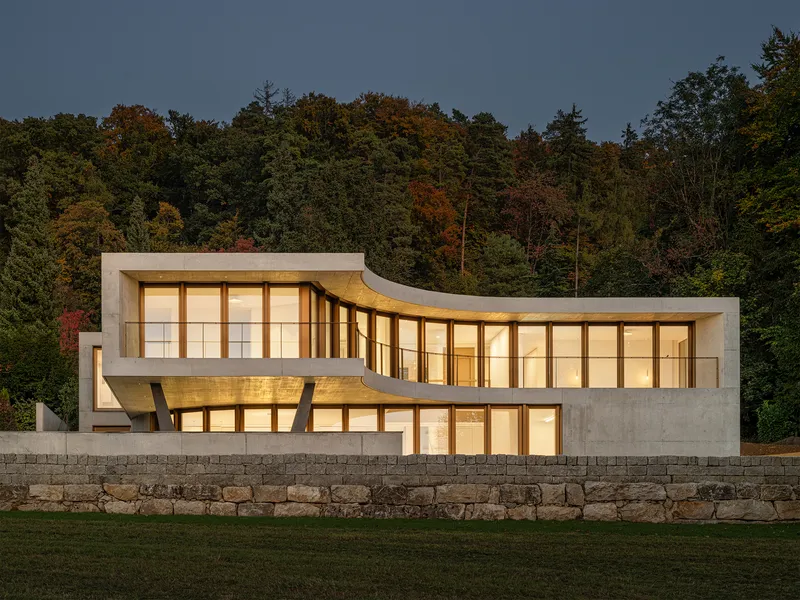
Most houses on sloped sites fight the terrain or ignore it. Winkelhaus, the first built project by estudio kmmk in Switzerland, does neither. Instead, architect Frederico Martins Montanha bent the entire plan into a sweeping curve that follows the contour of a wooded hillside in Winkel, producing a residence whose roof, walls, and pool all share the same arcing geometry. At 643 square meters, it is a substantial house, yet the curvilinear silhouette keeps it from reading as a monolith, distributing its mass along the slope like a slow exhalation.
What makes Winkelhaus genuinely worth studying is the collision between its handcrafted aesthetic and its fabrication method. The building's curved concrete walls were developed through a robotic printing process, translating clay study models into full-scale ribbed elements. The result is a house that looks sculpted, almost geological, while being produced with a precision that hand-forming simply cannot match. It is a quiet argument that digital fabrication does not have to produce digitally obvious architecture.
A Facade That Moves with the Hill
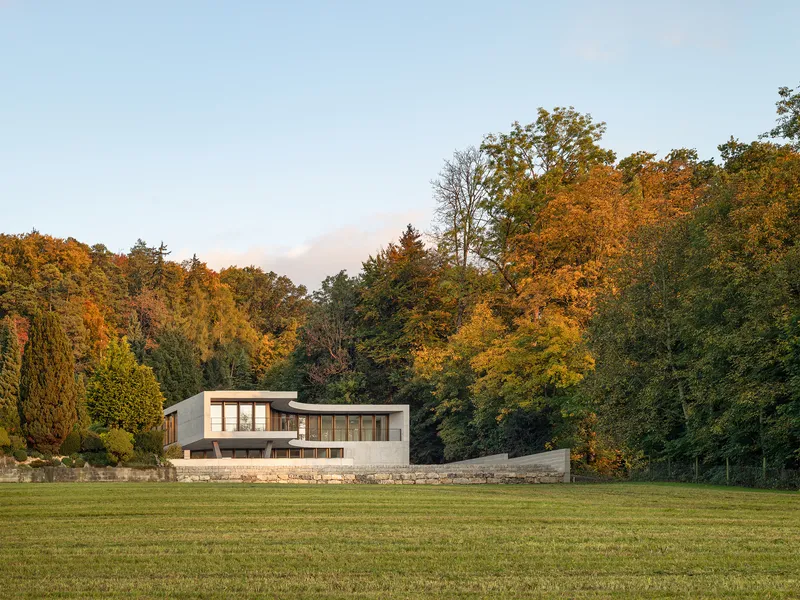
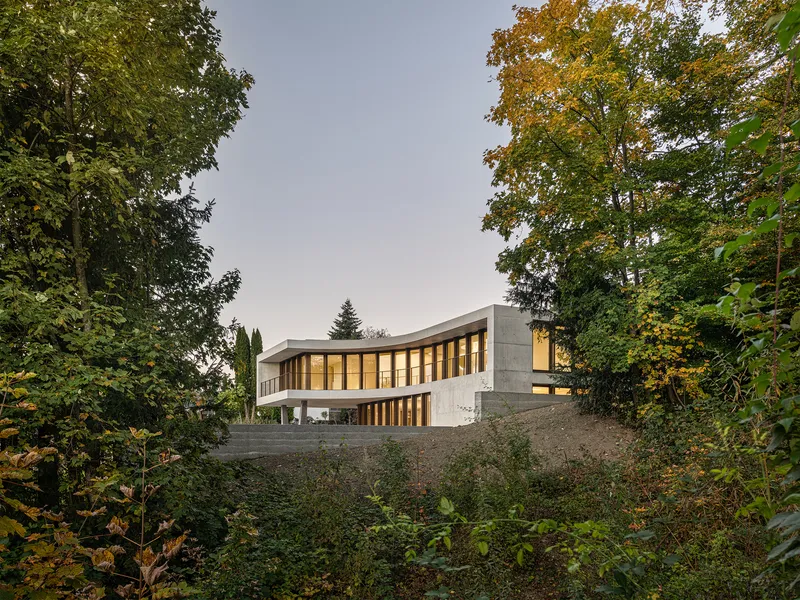
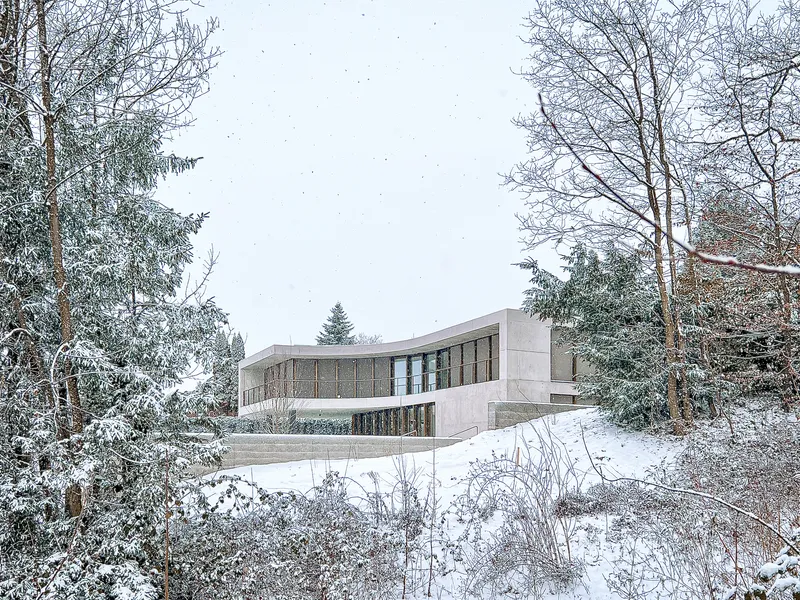
From a distance, the house reads as a long, low band of concrete and timber threading through autumn and winter landscapes alike. The undulating roofline never quite settles into a single gesture; it rises and dips in response to the interior volumes below, making the facade an honest register of what happens inside. Vertical timber-framed glazing punches through the concrete at irregular intervals, catching light from the wooded slope behind and pulling the surrounding tree canopy into the composition.
Under snow, the house gains another register entirely. The warm timber screens and exposed concrete take on a mineral quality against the white ground, while the curved soffit of the terrace becomes a sheltering canopy. A stone retaining wall at the base anchors the building to the geology it sits on, ensuring the transition from built form to earth is gradual rather than abrupt.
Entrance and Threshold
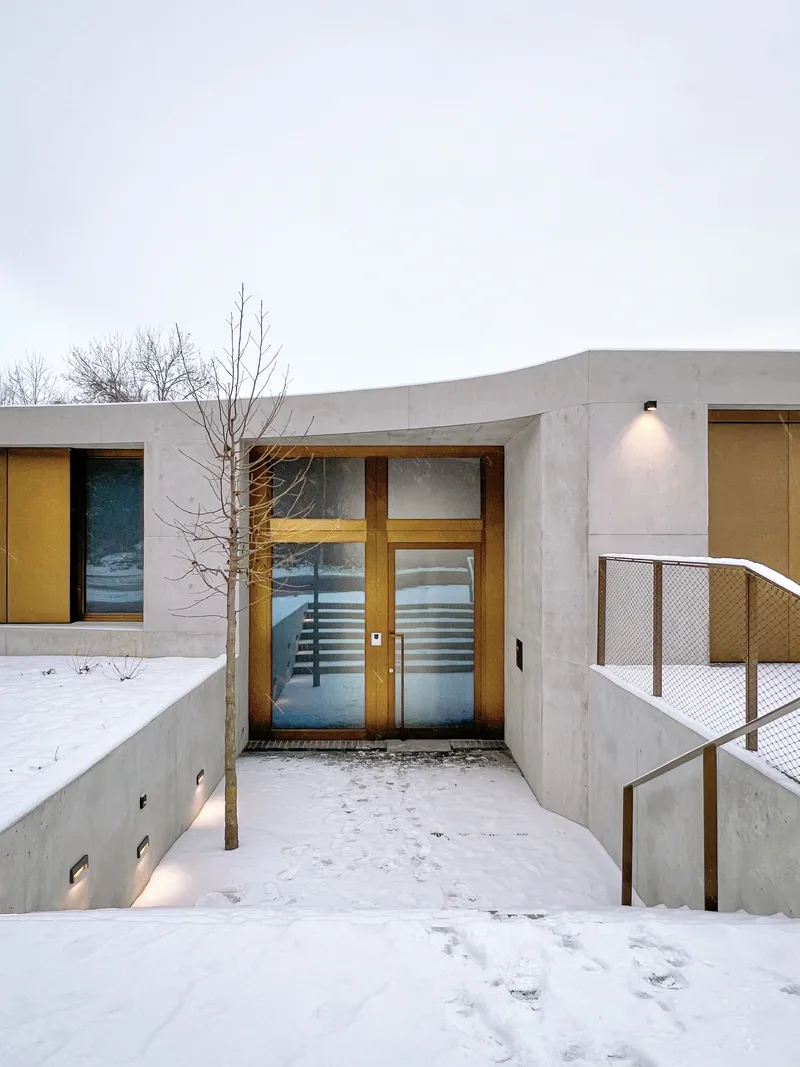
Arriving at Winkelhaus in winter is a particular experience. The entrance is set within a recessed concrete portal, flanked by timber double doors and a simple metal railing, all dusted with fresh snow. There is no grand porch or overstated canopy. The threshold is compressed, almost cave-like, before the interior opens up. This sequence of compression and release is one of the oldest spatial tricks in residential architecture, and it works here because the curve of the building naturally tightens the approach.
Double-Height Living and Vertical Drama
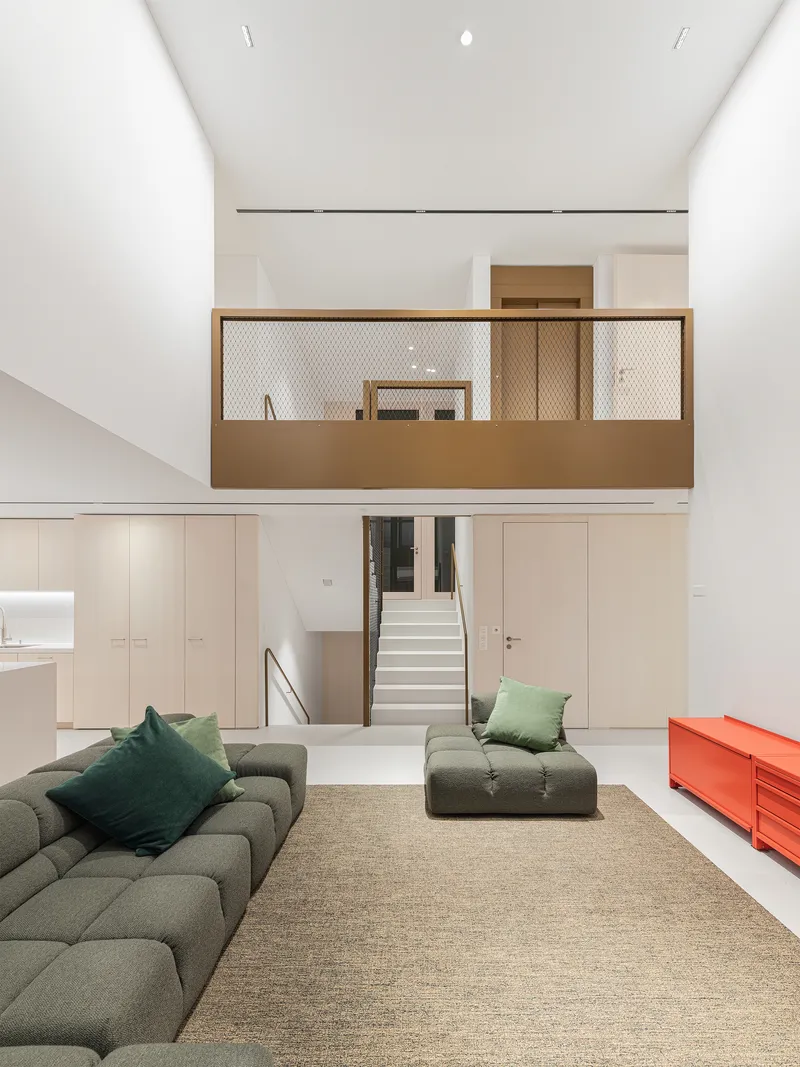
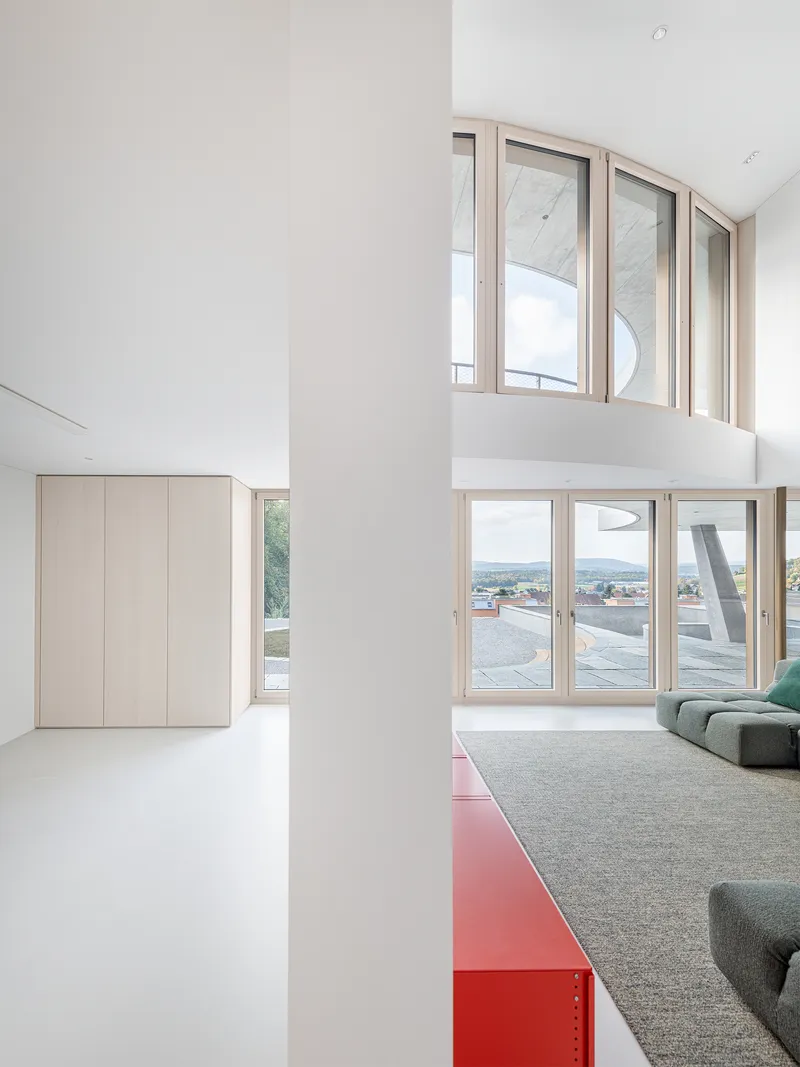
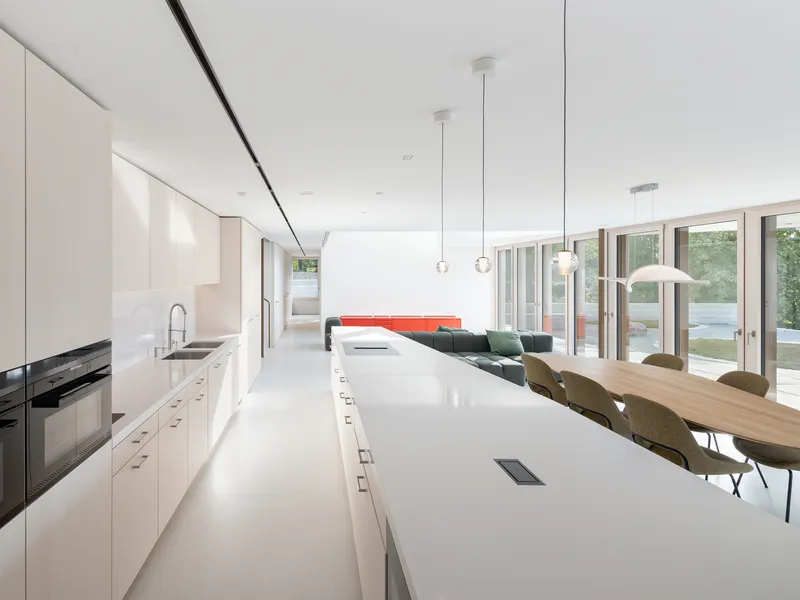
The heart of the house is a double-height living space that stacks two very different moods. Below, built-in storage and a staircase define a grounded, functional zone. Above, a suspended timber and mesh balcony hovers like a treehouse platform, creating an intimate mezzanine that borrows the full volume of the room without enclosing it. The mesh railing is a smart choice: it provides safety without killing the visual connection between levels.
Tall, stacked timber-framed windows pour light across the living area, and a red metal bench offers a deliberate accent against the otherwise restrained palette of white, concrete, and wood. The kitchen extends into a dining area with direct garden access, keeping the social spaces fluid and horizontal even as the section plays with verticality. Pendant lights over a white island mark the transition from cooking to gathering without a wall in sight.
The Pool and Terrace Sequence
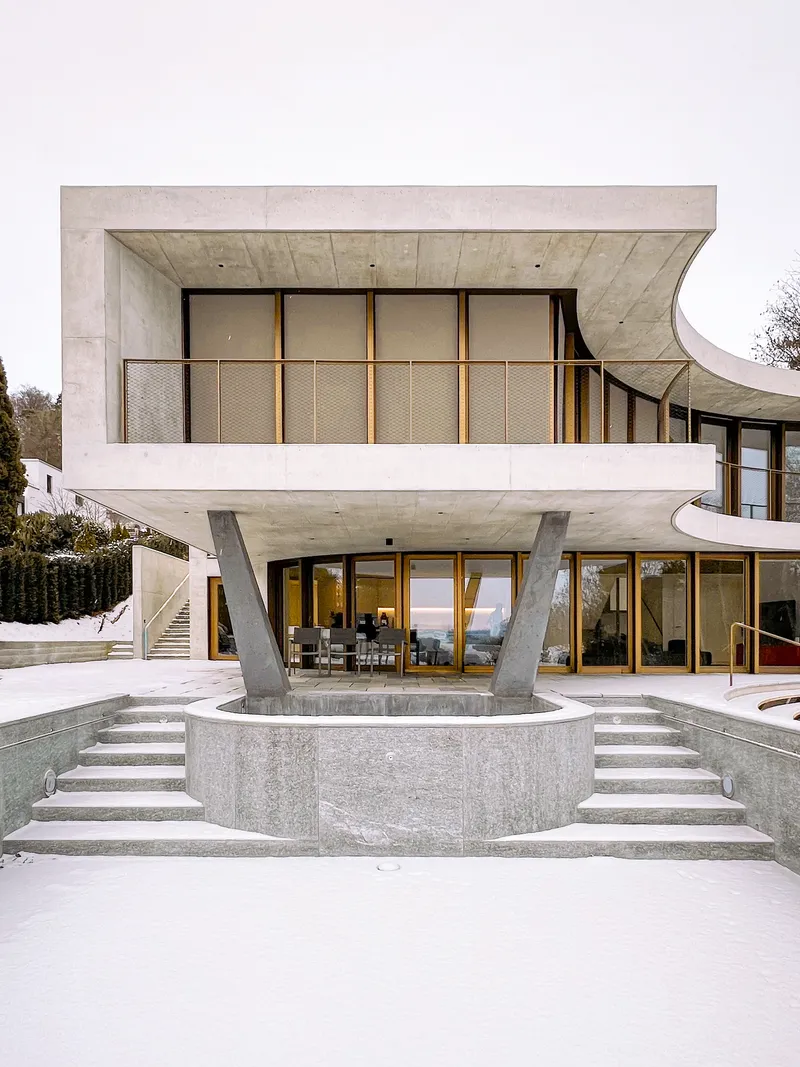
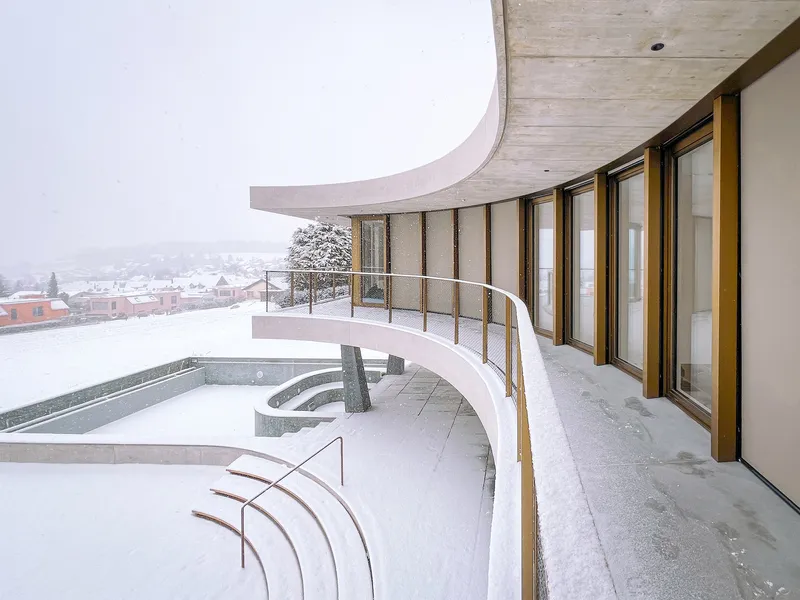
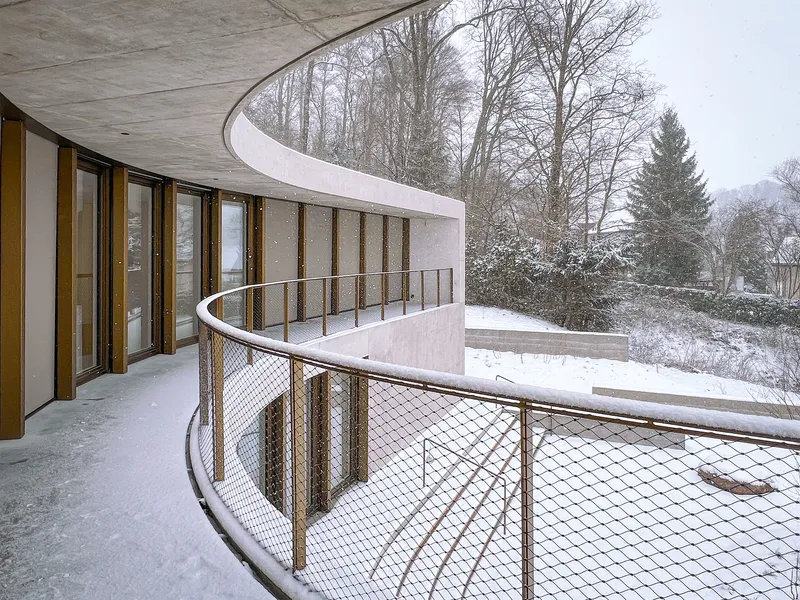
The outdoor spaces are where the building's curve pays its biggest dividend. A concrete pool basin follows the arc of the facade, with symmetrical stepped access descending to water level and a cantilevered terrace overhead. The geometry is tight but not forced; the pool feels like a natural extension of the plan rather than an afterthought bolted onto a terrace. From the curved balcony above, mesh railings and vertical timber screens frame views of snow-covered rooftops and distant hills, turning the terrace into a year-round lookout.
In winter, these outdoor spaces do not shut down. The timber soffit provides shelter from snowfall, and the concrete surfaces age well under freeze-thaw cycles. There is something satisfying about a house that treats its outdoor rooms as seriously as its indoor ones, and Winkelhaus commits to that idea across every season.
Private Rooms and Material Restraint
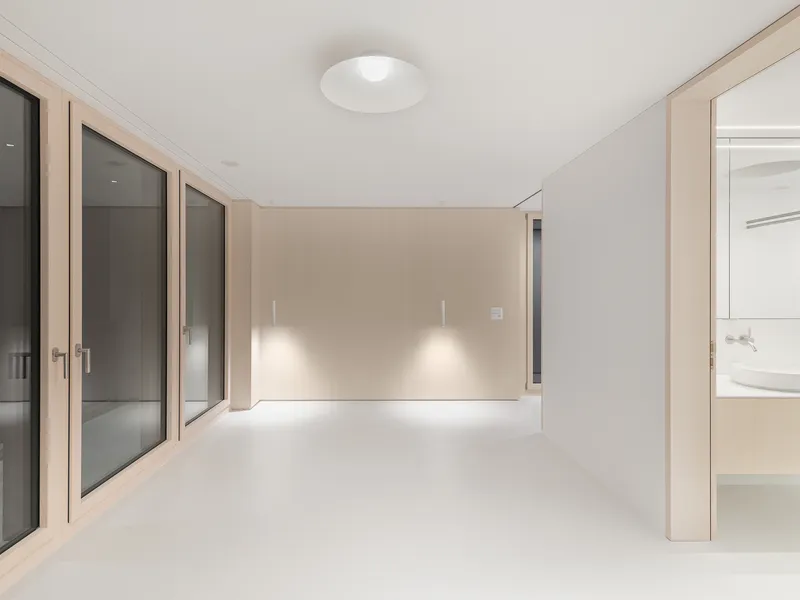
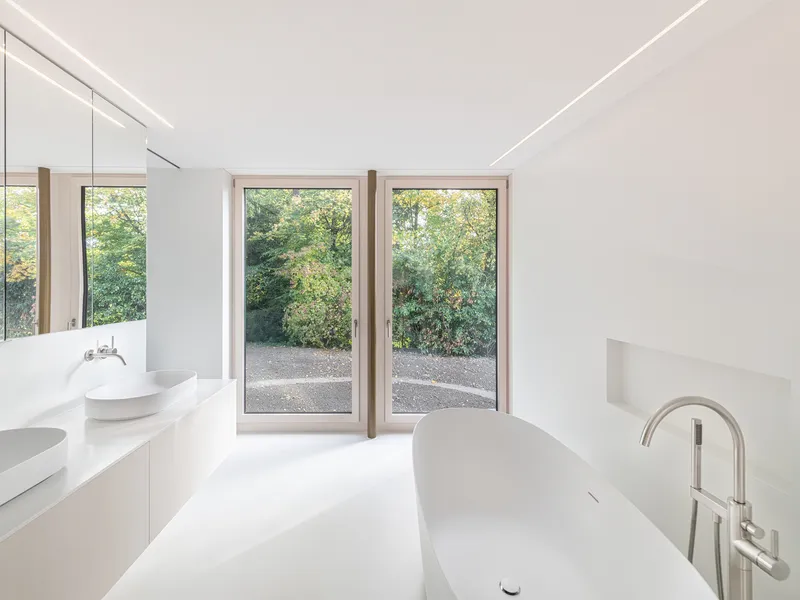
Away from the public volumes, the house quiets down. A white hallway with a flush ceiling light leads past timber-framed glazing to a bathroom where a freestanding tub sits opposite doors opening directly onto the garden. It is a deliberate luxury: standing water, bare trees, and natural light without any visual clutter. The material palette stays consistent throughout, white plaster, warm timber frames, and concrete, so the transition from social to private never feels jarring.
From Clay to Robot: The Fabrication Story
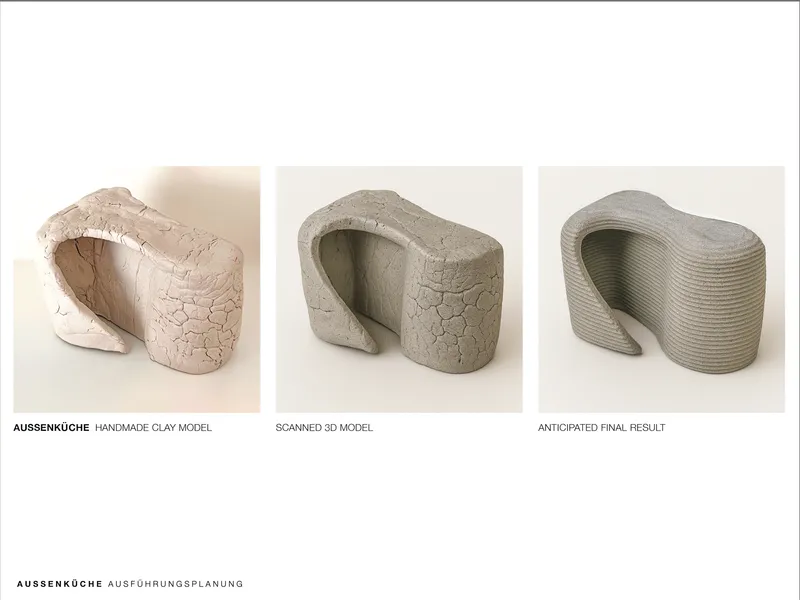
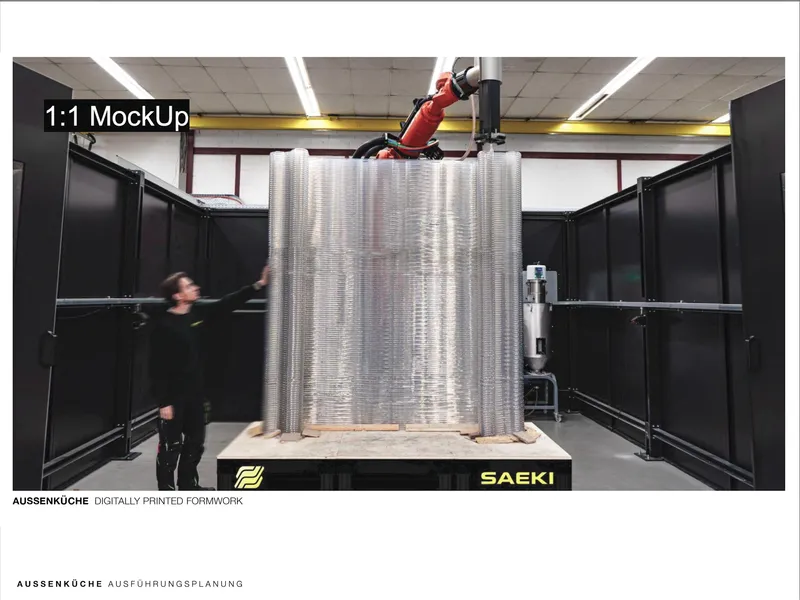
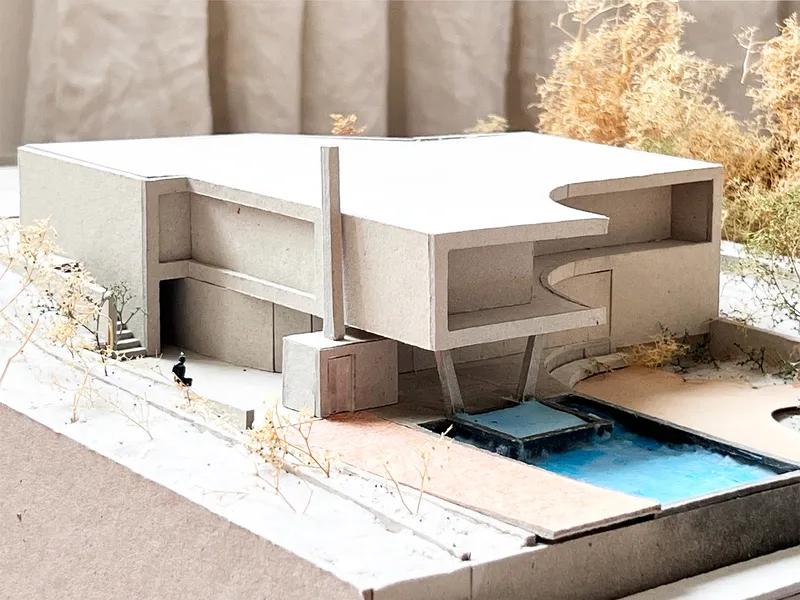
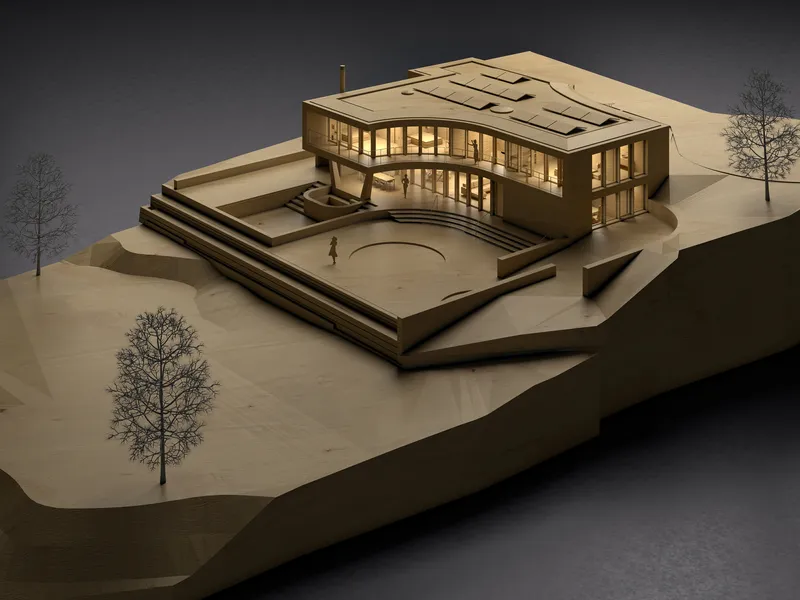
The design process for Winkelhaus moved from hand-formed clay models through a three-step progression to robotic fabrication. The clay studies captured the intuitive curve that the architects wanted; the robotic arm then printed full-scale ribbed curved walls in a fabrication workshop, translating sculptural intent into buildable components. The physical model, with its cantilevered structure, courtyard, and water feature, served as both a design tool and a proof of concept.
This workflow is worth noting because it resists the common assumption that robotic fabrication leads to faceted, obviously digital forms. Here, the robot is in service of a shape that originated in wet clay. The ribbed texture of the printed walls even echoes the finger-marks of the handmade model, collapsing the distance between craft and computation in a way that feels honest rather than performative.
Plans and Drawings
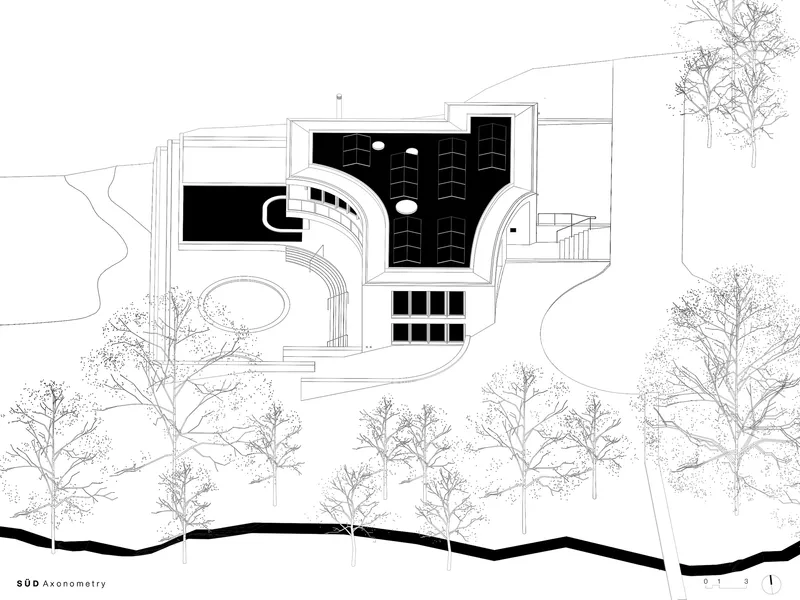
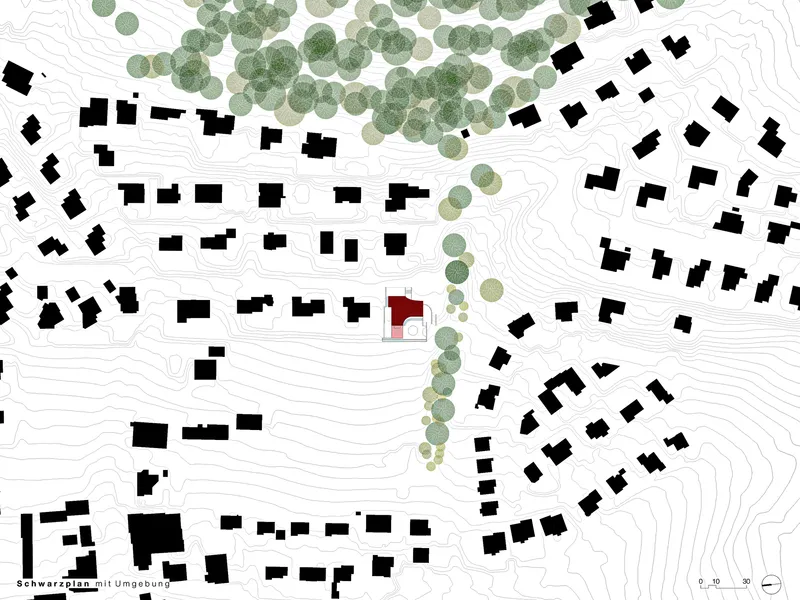
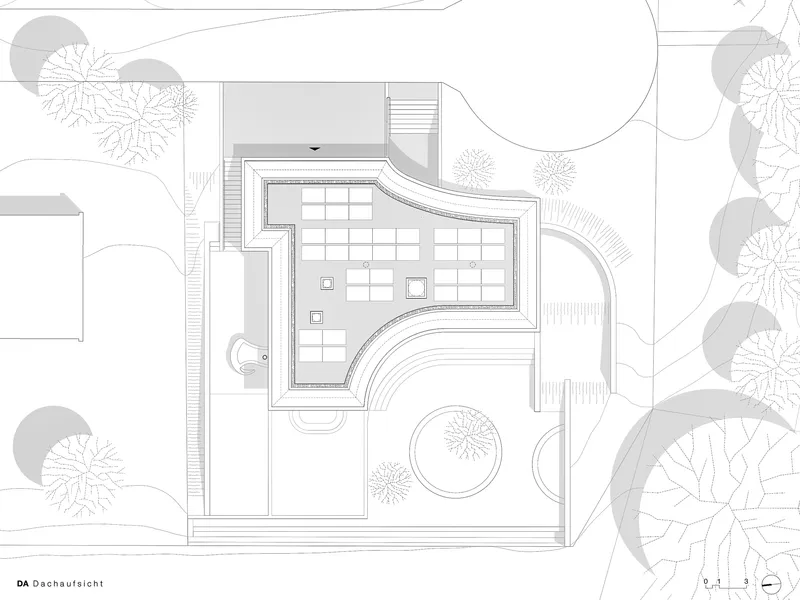
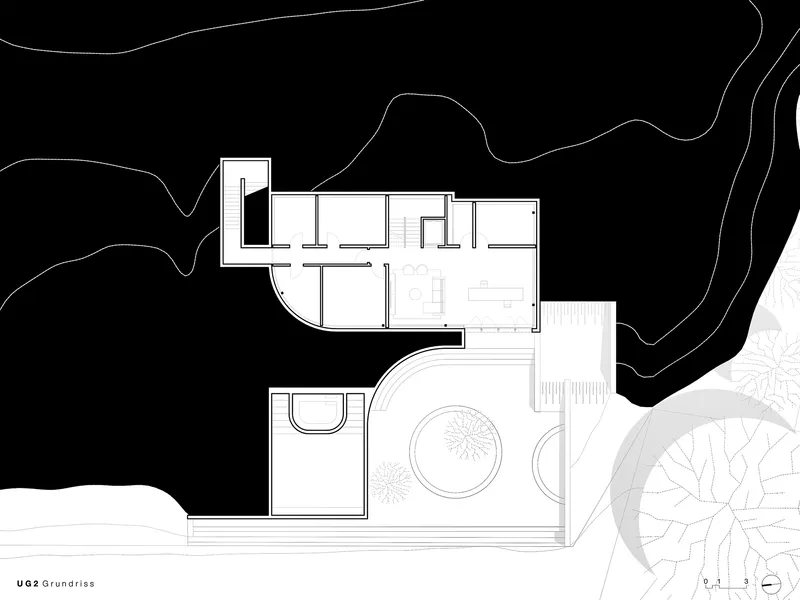
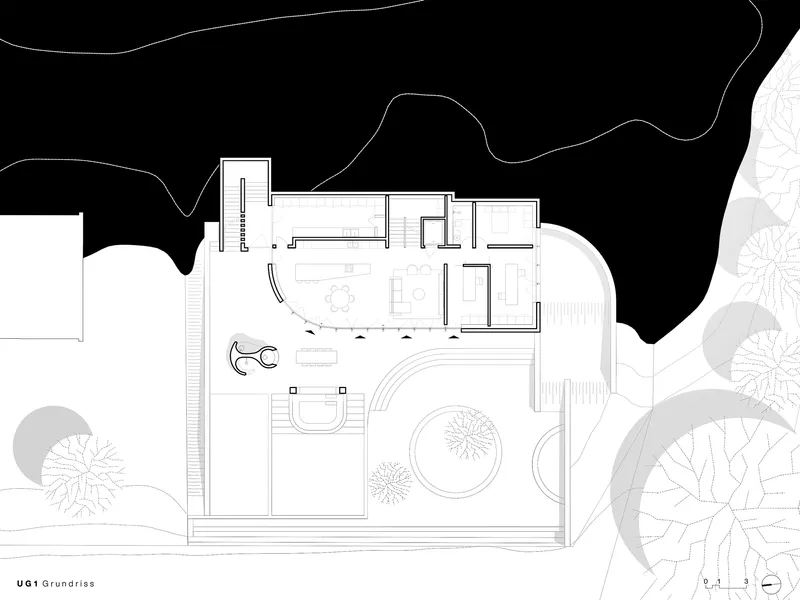
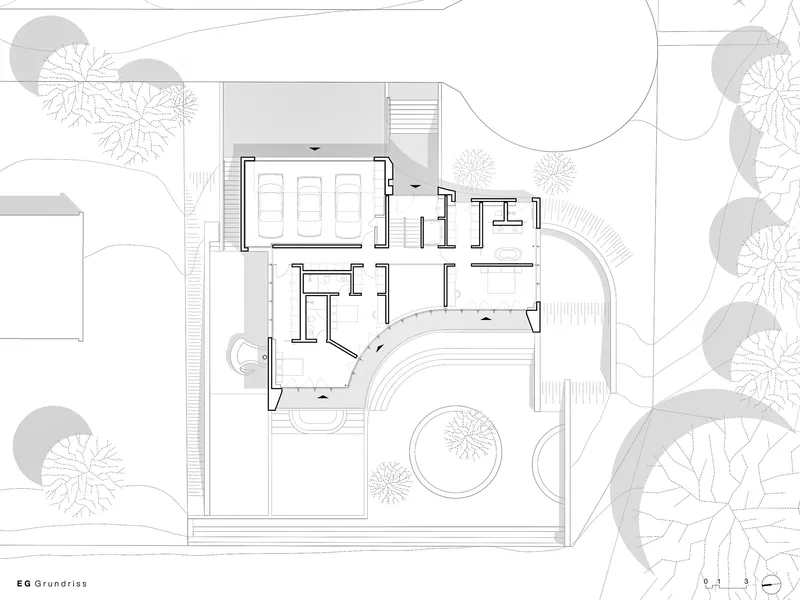
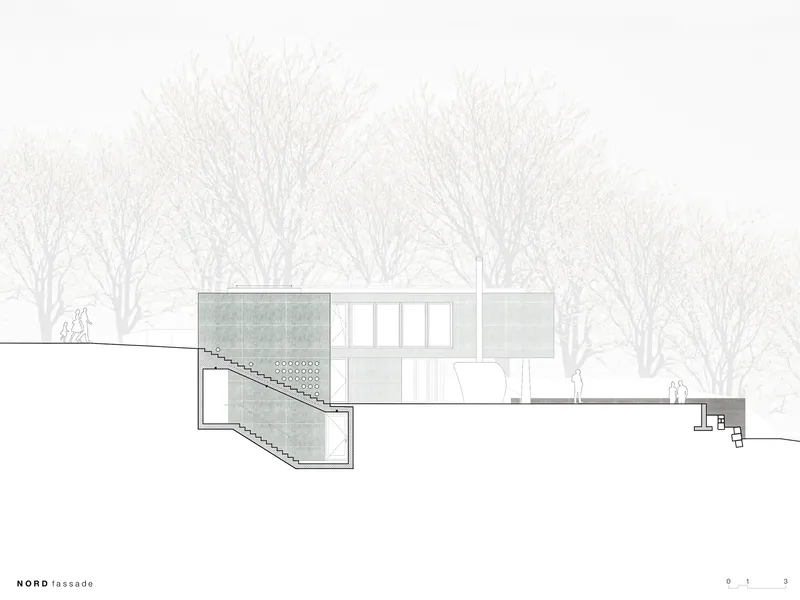
The axonometric drawing makes the site strategy legible in a single glance: the building wraps around the hillside, enclosing a courtyard while remaining open to downhill views. The site plan confirms how tightly the footprint nests among existing structures and mature trees, respecting setbacks without retreating from the slope edge. Floor plans reveal a rational interior organization despite the curving envelope, with the garage and entry on the uphill side and living spaces opening to the garden and pool below.
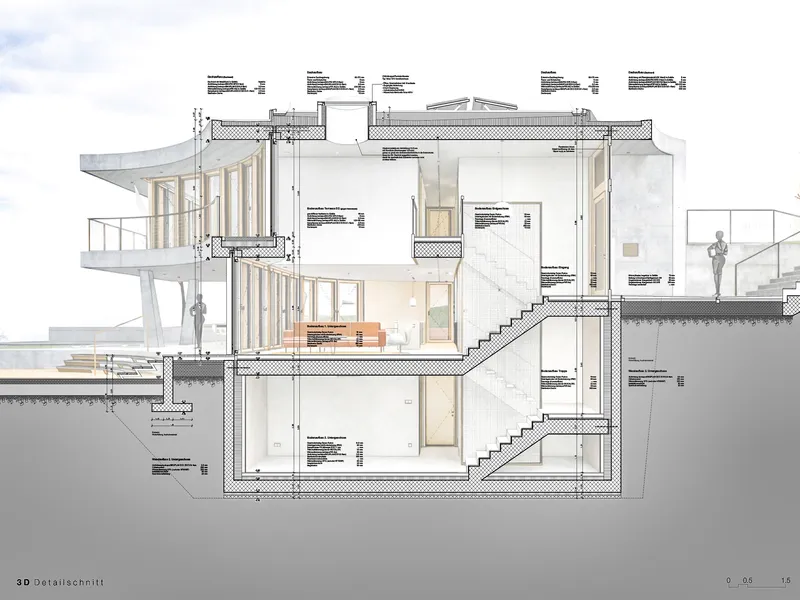
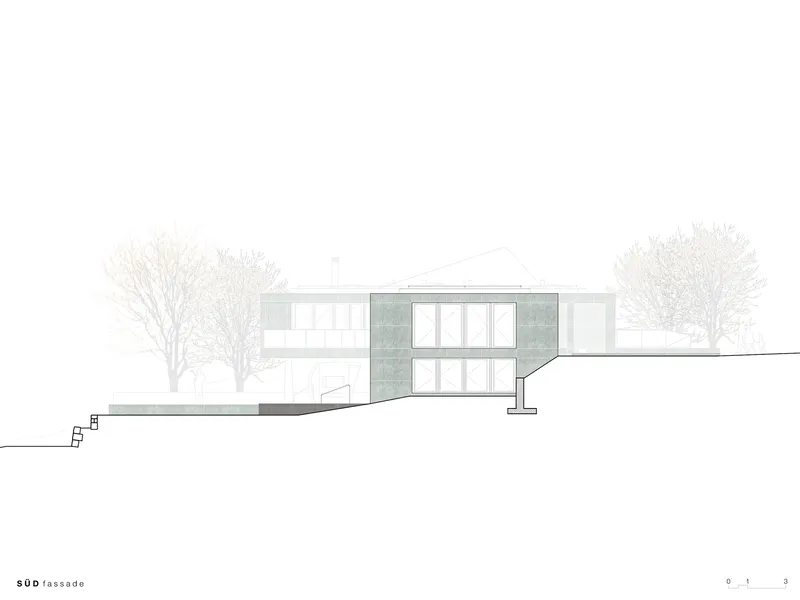
The section drawing is perhaps the most revealing: it shows how the multi-level interior spaces step down with the terrain, using staircases to negotiate grade changes that the curved canopy smooths over from the outside. South and north elevations confirm the two distinct faces of the house. The south is glassy and open; the north is sheltered and opaque, with an exterior staircase linking levels along the slope. The roof plan, with its interior courtyards, demonstrates that even the fifth facade was considered as a designed surface.
Why This Project Matters
Winkelhaus matters because it demonstrates that robotic fabrication can produce architecture that feels warm, site-specific, and materially grounded. Too many digitally fabricated projects wear their process on the outside, prioritizing novelty over habitability. Estudio kmmk has done the opposite: the technology is invisible in the finished house, absorbed into a design that responds to topography, climate, and the rhythms of daily life in a Swiss village.
As a debut project, it also sets a clear position for the studio. The curve is not arbitrary decoration; it is a structural and spatial strategy that resolves a sloped site, organizes outdoor rooms, and gives every major space a different orientation. If this is what the first project looks like, the trajectory is worth watching.
Winkelhaus by estudio kmmk, lead architect Frederico Martins Montanha. Winkel, Switzerland. 643 m², completed 2026. Photography by Archibatch and Frederico Montanha.
About the Studio
Share Your Own Work on uni.xyz
If projects like this are the kind of work you want to make, uni.xyz is a place to publish your own, find collaborators, and enter design competitions.


Popular Articles
Popular articles from the community


Manzana Morphosis: Stretching Barcelona's Grid into a Living Landscape for 2050
A radical reworking of the Eixample manzana turns density into a tool for generous public space, vertical ecology, and environmental performance.
Tsunami Convergenics: Turning Catastrophic Ocean Forces into Underwater Housing Infrastructure
A speculative underwater settlement off the coast of Onagawa, Japan, treats tsunamis and typhoons as energy sources rather than threats.

Opera on the Sea: Driftwood Logic Shapes a Timber Opera House on Estonia's Coast
Trevor Orgill's opera house translates the entangled drift of floating timber into a civic building where wood, water, and music converge.

Temporary Home for Dogs: A Reversed Zoo Rethinks Animal Shelter Architecture
In Bucharest, a sinuous corridor and freed landscape flip the logic of containment, designing a shelter that works to make itself unnecessary.

Similar Reads
You might also enjoy these articles

Pixel Gardens: One Repeated Module Stacked Into a Terraced Social Housing Tower for Famagusta
Salem Bader's shortlisted housing tower builds a vertical neighbourhood from one repeated module, offsetting units to carve terraces, light and air.

Bao Huynh Watercolor Atelier: A Serene Art Retreat in Hội An
Bao Huynh Watercolor Atelier in Hội An blends multifunctional art spaces, sustainable design, local materials, and family-friendly living in a serene environment.

Atelier Macri Concept Store Interior Design by CASE-REAL
Atelier Macri store features a "ko" counter, walnut wood details, cork displays, blending retail, gallery, and seamless customer experiences.

Manuel Vargas Izquierdo Stadium and High-Performance Sports Center: Architectural Excellence in Jalpa de Méndez
The Manuel Vargas Izquierdo Stadium blends sustainable design, inclusive sports facilities, and cultural-inspired architecture, revitalizing Jalpa de Méndez’s public spaces.


Comments (0)
Please login or sign up to add comments
No comments yet. Be the first to comment!