

larob. studio für architektur Builds an Office That Doubles as a Classic Car Showroom in Nürtingen
A sculptural concrete volume near Stuttgart merges open workspaces with a private automobile collection along curved, ramped interiors.


There is something quietly absurd about parking a vintage car next to a desk and calling it an office. But that tension between the utilitarian and the aspirational is precisely what makes the new headquarters by larob. studio für architektur in Nürtingen, near Stuttgart, worth paying attention to. Completed in 2023 under the direction of Prof. Michel Roeder, Matthias Baisch, and Sven Gritzbach, the building houses a functioning office alongside a rotating display of classic automobiles, all threaded together by curving ramps and held inside a monolithic concrete shell.
What elevates the project beyond novelty is the rigor of its spatial logic. Rather than treating the cars as decoration tacked onto a standard floorplate, the architects treated the entire building as a single continuous surface, one that slopes, turns, and opens to light in ways that serve both the vehicles and the people who work among them. The result is an interior that feels more like an inhabited sculpture than a conventional workplace, a space where circulation itself becomes the primary experience.
A Concrete Cantilever Sets the Tone
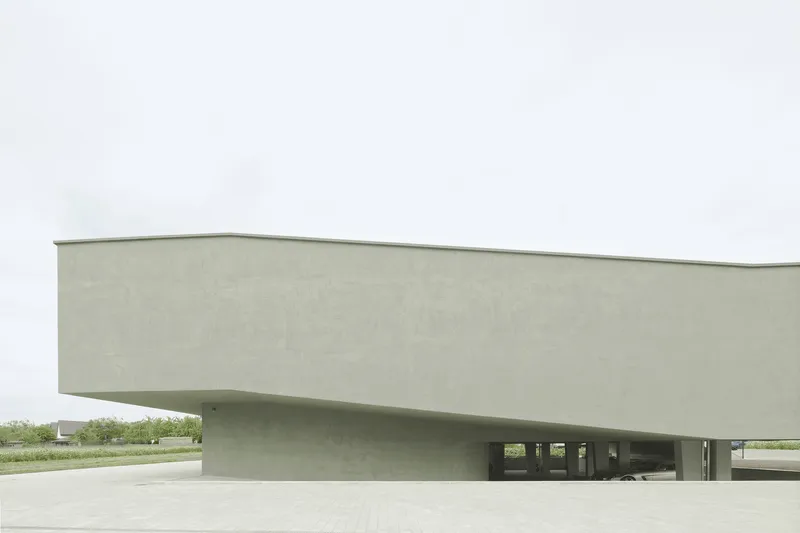
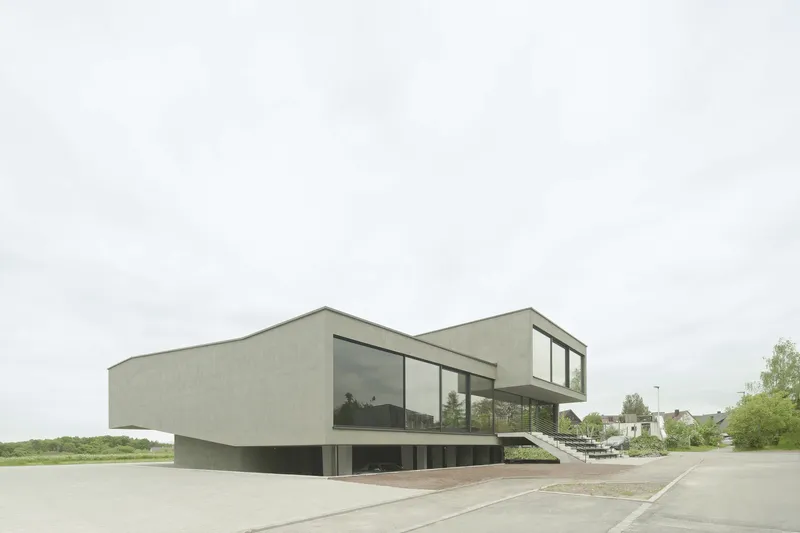
From the street, the building reads as a single, weighty concrete volume hovering above a recessed ground floor. The cantilever is pronounced enough to create a generous sheltered plaza beneath, a threshold that blurs the line between public ground and private interior. The glazed openings punched into the upper mass are restrained in number but generous in proportion, suggesting that whatever happens inside is not meant to be entirely hidden.
The overcast skies typical of the Swabian Alb foothills flatten the building's tonal range into a near-uniform gray, which only sharpens the reading of its geometry. There is no cladding, no applied color, no signage competing for attention. The architecture does all its talking through mass, shadow, and the drama of structural suspension. It is a quiet building that nonetheless commands the corner.
Circular Skylights and the Logic of Light

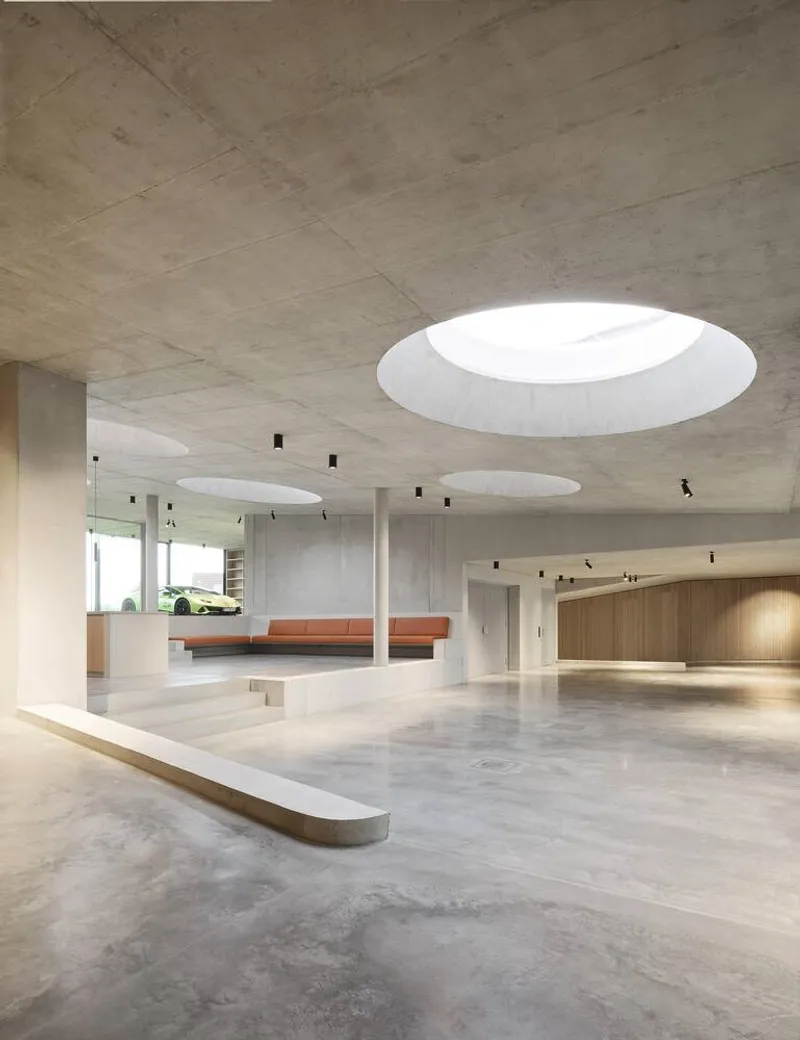
Inside, the exposed concrete ceiling is punctured by a series of circular skylights that pull daylight deep into the plan. The effect is theatrical without being heavy-handed: shafts of diffused light land on the polished terrazzo floor and wash across white columns, giving each zone its own microclimate of brightness. In a building where large glass fronts already contribute ambient light, the oculi function less as necessities and more as spatial events, moments that pull your eye upward and remind you of the section above.
The decision to leave the concrete soffit raw rather than concealing it behind a suspended ceiling is significant. It maintains an honest reading of the structure and, more practically, amplifies the sense of volume in what might otherwise feel like a low-ceilinged parking deck. The finish is precise enough to qualify as finished architecture on its own terms, not roughness left behind out of budget constraint but texture chosen for its tectonic honesty.
Material Dialogue in the Corridors
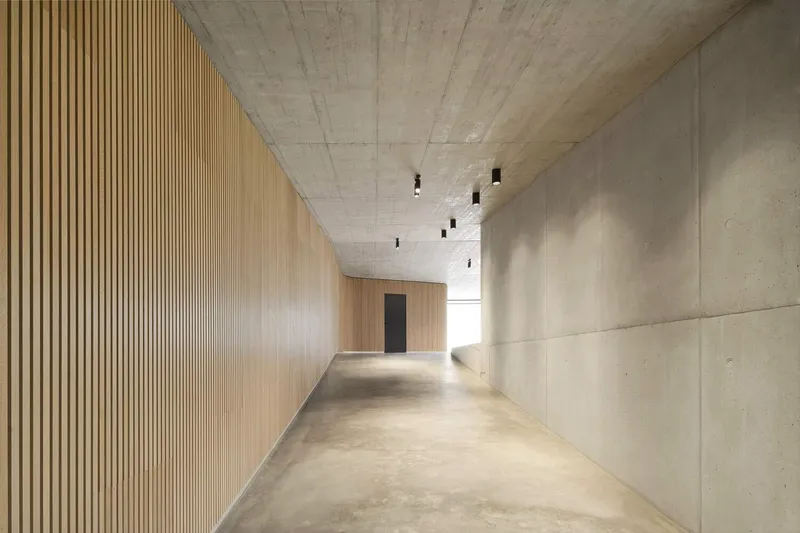
A corridor lined on one side with vertical timber slats and on the other with smooth plaster panels captures the project's material strategy in miniature. Warmth meets coolness; rhythm meets stillness. The timber screen likely conceals services or secondary rooms while maintaining visual permeability, and the plaster wall provides a clean datum for wayfinding and display. Together, they channel movement without confining it.
This contrast echoes throughout the building. Concrete against glass, terrazzo against raw slab, automobile paint against matte surfaces: the architects understood that a space housing both office workers and collector cars needed a palette restrained enough to accommodate the visual noise of the vehicles themselves. The architecture acts as a neutral frame that sharpens whatever it holds.
Why This Project Matters
Hybrid programs are everywhere in contemporary practice, but most of them simply stack one use on top of another and call it mixed. What larob. studio für architektur achieves here is genuine integration: the cars are not in a separate gallery appended to the office, and the office is not a conventional floorplate that happens to overlook a showroom. The ramped, continuous section makes both programs co-dependent, each lending meaning to the other. It is a persuasive argument that program can be a design material as potent as concrete or light.
For a mid-sized German studio working outside the spotlight of Berlin or Munich, the project also demonstrates that ambition is not tied to geography. Nürtingen is not a place most architecture audiences could locate on a map, yet the building holds its own against far more publicized offices-as-statements. That is the mark of conviction in the design idea, not reliance on context or hype to carry the narrative.
Working Among Classics: New Office Space by larob. studio für architektur (Prof. Michel Roeder, Matthias Baisch, Sven Gritzbach), Nürtingen, Germany, 2023. Photographs by Brigida González.
About the Studio
Share Your Own Work on uni.xyz
If projects like this are the kind of work you want to make, uni.xyz is a place to publish your own, find collaborators, and enter design competitions.


Popular Articles
Popular articles from the community


Manzana Morphosis: Stretching Barcelona's Grid into a Living Landscape for 2050
A radical reworking of the Eixample manzana turns density into a tool for generous public space, vertical ecology, and environmental performance.

Temporary Home for Dogs: A Reversed Zoo Rethinks Animal Shelter Architecture
In Bucharest, a sinuous corridor and freed landscape flip the logic of containment, designing a shelter that works to make itself unnecessary.
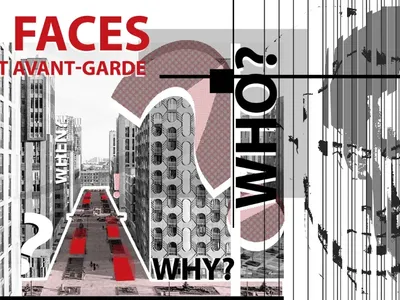
Faces of the Soviet Avant-Garde: Turning Moscow's Street Names into an Open-Air Museum
A network of sculptural installations across a Moscow residential district transforms forgotten architect names into spatial encounters with cultural memor
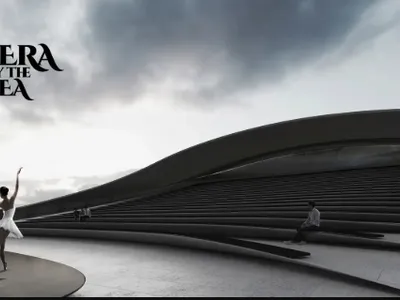
Opera by the Sea Estonia: Three Shells Dissolving Architecture into Tallinn's Coastline
A winning opera house proposal replaces monumental form with interconnected shells that blur the boundary between building, park and Baltic Sea.

Similar Reads
You might also enjoy these articles


Hodi-Mandai Geram
Project Function: Preservation and revitalization of the Intangible heritage and socio-spatial identity of the Hodi by Housing, Cultural Memory Center, Sacred Grove, landscape, local tourism economy


Olio Towers: A Mid-Rise for Performers That Fuses Housing, Rehearsal, and Stage
Located blocks from Houston's Theater District, this modular tower stacks living units around a central performance atrium.

Oasis: Modular Green Housing Carved into Dhaka's Urban Fabric
A shortlisted Plugin Housing entry reclaims unauthorized settlements in Dhaka with stepped concrete volumes, green roofs, and ventilation-driven design.

Black Hole: A Floating Megastructure for the Post-Physical Era
Emiliano Mazzarotto envisions a spherical, self-scaling arena where e-sports, digital hotels, and holographic stadiums replace traditional public space.

Explore Automobile Design Competitions
Discover active competitions in this discipline

Challenge to reimagine the Iron Throne

Photograph architecture without architects

Illustrate the lost glory of Angkor Wat - Render Challenge

Design challenge to reuse E-waste
Comments (0)
Please login or sign up to add comments
No comments yet. Be the first to comment!