
X in Box: Modular Street Furniture That Lets Tehran's Citizens Redesign Their Own Plaza
A system of reconfigurable benches, planters, and cubes transforms Vali Asr Plaza from transit corridor into adaptive public living room.


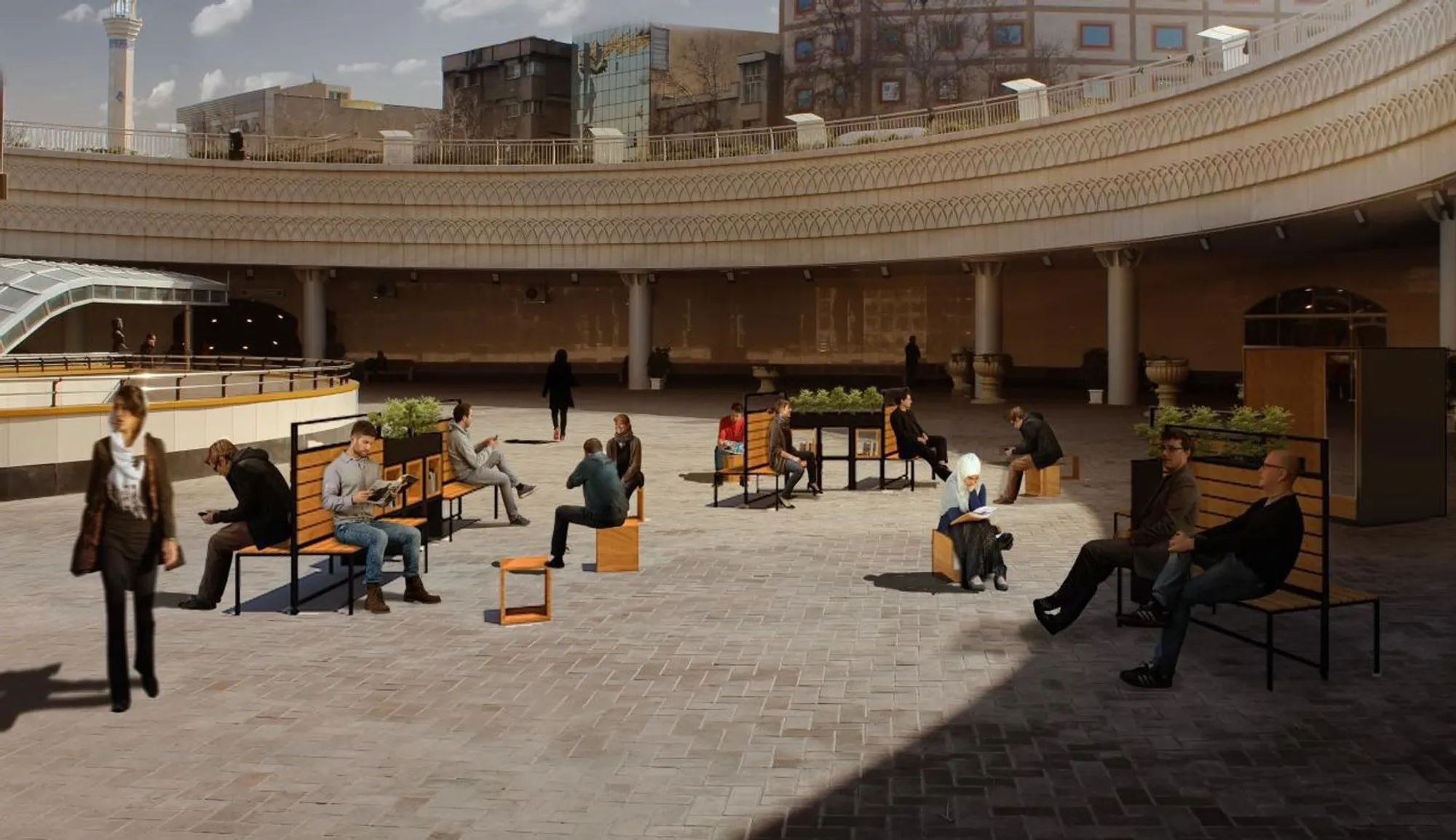
Most urban plazas are designed once, built once, and left to age. X in Box proposes something different: a kit of movable, foldable, and rotatable furniture units that hand spatial authorship to the people who actually use the space. Placed at Vali Asr Plaza in downtown Tehran, the project turns a transitional zone between metro station and city street into a reconfigurable social surface. Benches roll on wheels and fold on hinges, planter boxes inject greenery into concrete surroundings, and multi-use cubes serve as stools or storage depending on the moment. The result is a plaza that never looks the same twice.
The project is the work of three designers: Ali Nazari, Ali Malakootinia, and Saeed Hatami. Vali Asr Street is Tehran's oldest and most significant urban artery, and the plaza sits at its intersection with the Vali Asr Metro Station, surrounded by theaters, bookstores, and Tehran University. The audience is ready-made: students, commuters, and cultural visitors already flow through this node daily. X in Box intercepts that flow and gives people a reason to stop.
Anchored at Tehran's Cultural Crossroads

The site diagram makes the strategic logic clear. Vali Asr Plaza is not a peripheral park; it is a transit interchange embedded in a cultural district. Metro lines deliver foot traffic directly to the plaza's edge, while the surrounding blocks house institutions that define Tehran's intellectual life. The designers read this context as an opportunity: rather than competing with the cultural programming around the site, the furniture system provides a neutral, adaptable ground plane where those activities can spill outdoors. Reading, discussion, informal gathering, and simple rest all become plausible in a space that was previously just a passage.
A Furniture System, Not a Fixed Layout
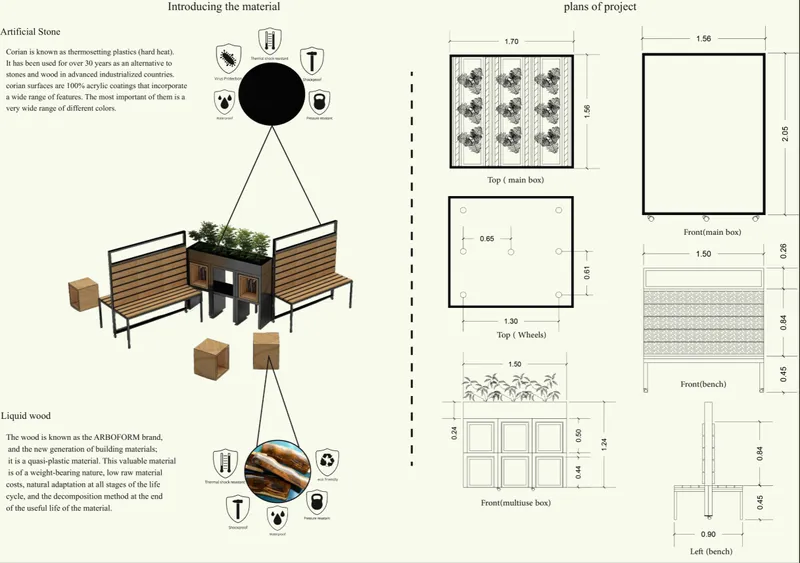
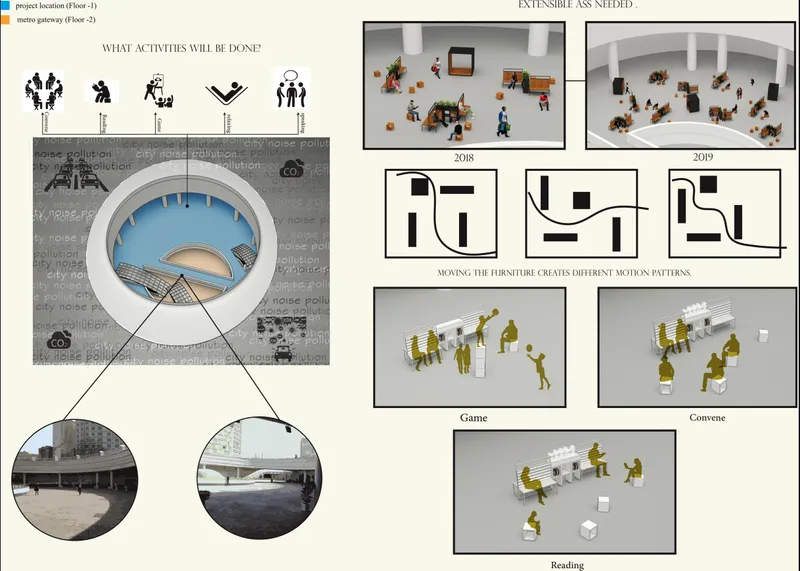
The axonometric and plan drawings reveal a modular vocabulary built from a few repeating components: benches with integrated planters, cubes that double as seating or storage, and hinge mechanisms that allow units to fold into compact configurations or expand into longer arrangements. Dimensioned assembly drawings show how these elements lock together, while the presentation board's circular floor plan illustrates one possible arrangement populated by human figures at varying scales of social interaction, from solitary reading to group conversation.
What distinguishes this system from typical street furniture is its deliberate incompleteness. There is no single correct layout. Each user encounter generates a new spatial pattern, shifting circulation paths and creating pockets of shade, enclosure, or openness. The designers describe this as transforming "interstitial spaces into meaningful experiences," and the drawings support that claim: the furniture is light enough to reposition yet substantial enough to define territories within the larger plaza.
From Flat Pack to Public Space in Four Steps

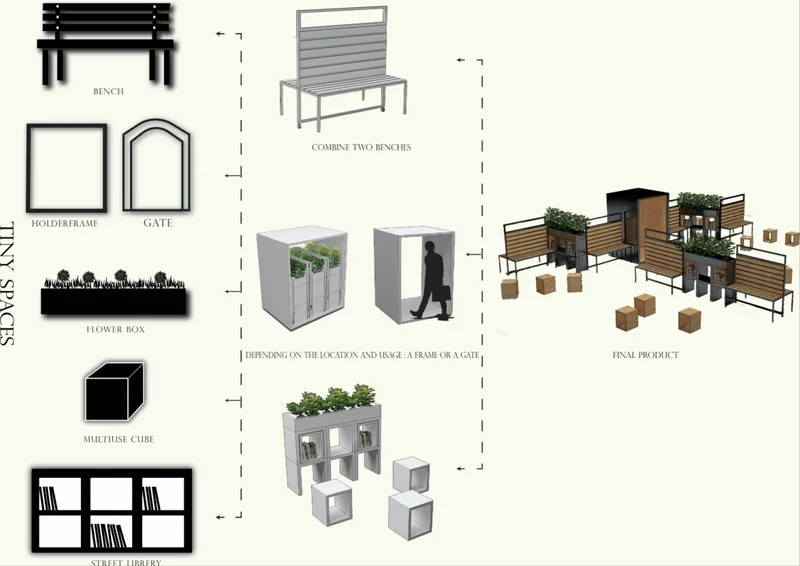
The exploded axonometric sequence breaks the assembly into four legible stages. Individual components, structural frame, planting tray, seating surface, and storage cavity, stack and interlock without requiring specialized tools or permanent fasteners. The companion assembly diagram shows how these discrete units cluster into larger formations, with planters softening edges and cubes filling gaps. The logic is additive: one unit is a stool, three units become a bench, six define a small social room open to the sky.
Material selection reinforces the system's outdoor durability. Structural surfaces use Corian, an artificial stone that resists water, viruses, thermal stress, and pressure. Organic-facing components employ Arboform, a bio-based liquid wood with low raw material costs and eco-friendly decomposition. Together, these materials balance longevity with environmental responsibility, a combination that keeps the furniture viable across Tehran's hot summers and cold winters without frequent replacement cycles.
Why This Project Matters
X in Box challenges a stubborn assumption in urban design: that public furniture must be bolted down, permanent, and identical across an entire plaza. By introducing wheels, hinges, and modular joints, the designers shift control from the architect's drawing to the citizen's hands. The plaza becomes a living test bed where spatial configurations evolve daily, responding to weather, crowd size, and spontaneous events. That participatory dimension is rare in Tehran's public realm and worth serious attention from municipal planners.
Equally significant is the material strategy. Choosing Corian and Arboform signals that sustainable architecture does not have to look provisional or cheap. These are engineered materials with real performance data, applied here to a humble typology, the park bench, that rarely receives this level of material thinking. If the system proves replicable, it offers a template for other transit-adjacent plazas in Tehran and beyond: lightweight, user-driven, and built to last.
View the Full Project
About the Designers
Designers: Ali Nazari, Ali Malakootinia, Saeed Hatami
Enter a Design Competition on uni.xyz
uni.xyz runs architecture and design competitions year-round that reward proposals with spatial conviction and real site intelligence.
Project credits: X in Box by Ali Nazari, Ali Malakootinia, Saeed Hatami.




Popular Articles
Popular articles from the community


Co-life: Sustainable Architecture for Age-Friendly Community Living
Co-life reimagines sustainable architecture for seniors through courtyards, rammed earth, shared gardens, and spaces designed for belonging.

The Ocean Hive: Sustainable Architecture for a Self-Sufficient Civilization at Sea
The Ocean Hive imagines sustainable architecture at sea, where modular habitats, algae, wave power and ocean waste sustain a growing colony.

Riyadh For All: Intergenerational Urban Design for Active Aging in Rabat
Riyadh For All reimagines urban design in Rabat with intergenerational co-living, adaptive courtyards, and Moroccan cultural exchange today.

Hill & Cross Opera: Sculptural Opera House Architecture Shaped by Tallinn’s Landscape and Identity
Hill & Cross Opera reimagines opera house architecture in Tallinn through its sculptural hill, civic plaza, glass wave and a luminous cross.


Similar Reads
You might also enjoy these articles

The Musturak Paradise: Senior Living Architecture for a Connected Future in Temara, Morocco
The Musturak Paradise reimagines senior living architecture in Temara via private homes, social spaces, culture, community, and shared care.

The Leaf Center: Cultural Center Architecture for Social Integration in Amsterdam
Cultural center architecture becomes a bridge at The Leaf Center, connecting international students with Amsterdam through art and exchange.

Conexión: Biophilic Design Reimagines High-Rise Living in Hong Kong
Conexión reimagines high-rise living in Hong Kong through biophilic design, green facades, shared spaces, daylight, water and nature within.

Wander to Wonder: Modular Playground Design for Children in Kutupalong Refugee Camp
Wander to Wonder uses modular playground design to create flexible, imaginative play spaces for children in Kutupalong refugee camp.


Explore Furniture Design Competitions
Discover active competitions in this discipline


Challenge to merge furniture with learning

Design challenge to equip cities with modern furniture

Competition to design a workstation for architects

Packaging challenge - Design meets sustainability
Comments (0)
Please login or sign up to add comments
No comments yet. Be the first to comment!