

Xutian Market Weaves Community Into a Village Edge
Multi-Architecture turns a rural market at the foot of Luofu Mountain into a generous public threshold between village life and landscape.


At the foot of Luofu Mountain in Huizhou, where streams carve paths through rice terraces before settling into village ponds, a small market building has become something far more consequential than its 1,092 square meters might suggest. Xutian Market, completed in 2025 by Multi-Architecture, sits at the boundary between a traditional settlement and its agricultural landscape, acting less as a building and more as a charged threshold: part market hall, part community stage, part covered ground.
What makes this project genuinely interesting is its refusal to be monumental. In an era when rural revitalization projects across China often impose conspicuous form on quiet contexts, Multi-Architecture has produced a structure that earns its presence through hospitality rather than spectacle. The curving roof traces the edge of an existing pond, the columns are slender enough to disappear, and the ceiling plane does nearly all the architectural work. It is a building that exists primarily as a generous underside.
Reading the Village From Above
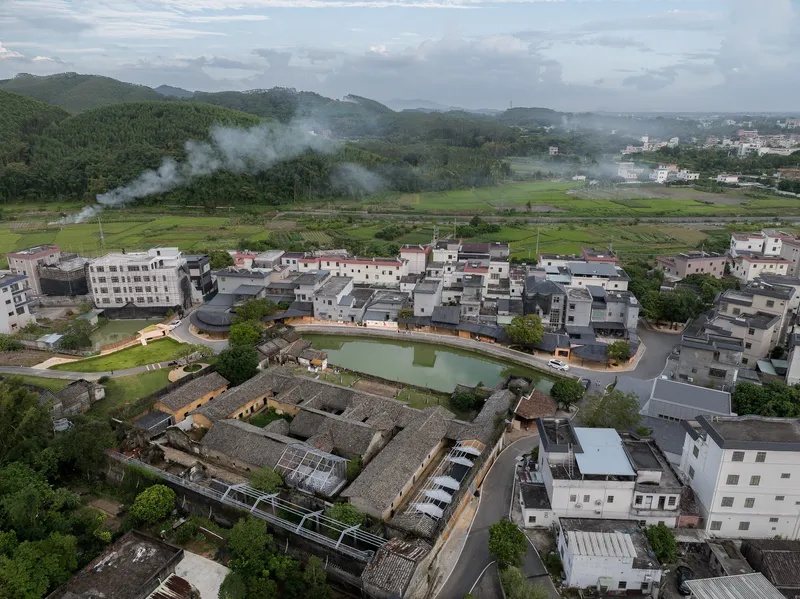
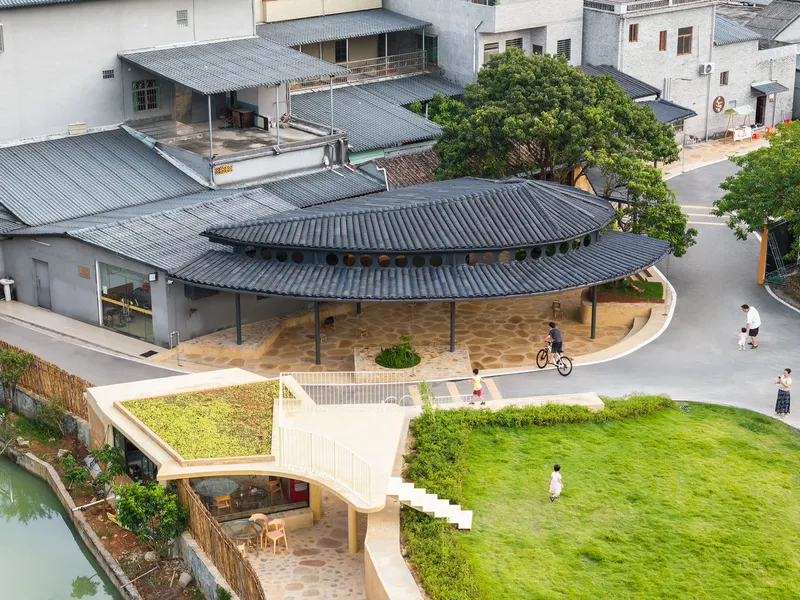
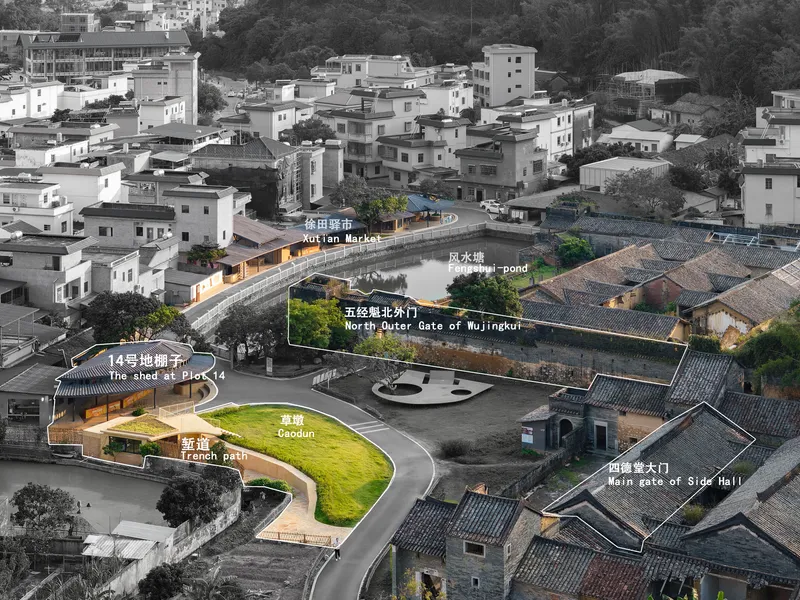
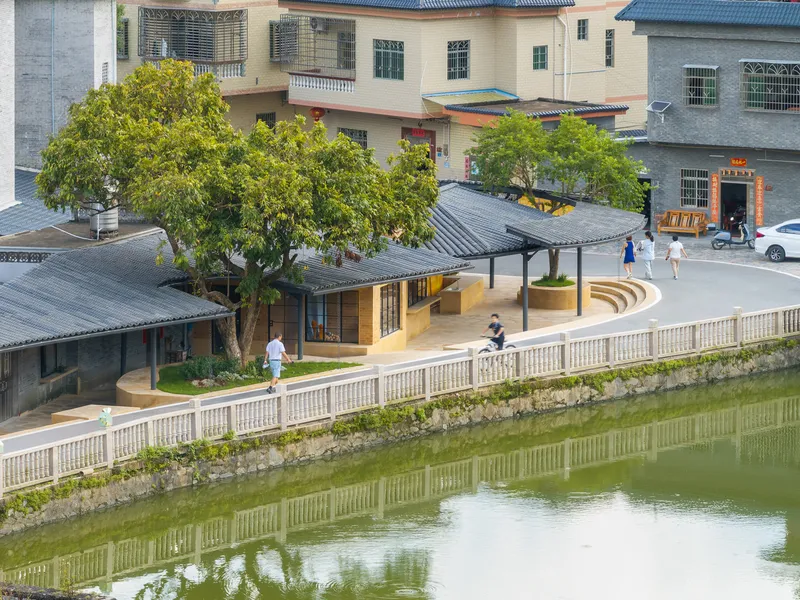
The aerial photographs reveal just how carefully the market has been slotted into an existing grain. Huizhou's vernacular settlement pattern, clusters of pitched tile roofs organized around ponds and courtyards, remains remarkably intact here. The new structure hugs the western edge of a central water body, its curved plan echoing the pond's geometry while its tile roof blends with the surrounding residential fabric. At dusk, warm light spills from beneath the canopy, and the market reads as a lantern at the village's social center.
The green roof on an adjacent volume helps it recede even further, a deliberate move to keep the visual hierarchy of the village intact. Nothing towers. Nothing competes with the mountain ridgeline in the distance.
A Roof That Does the Work

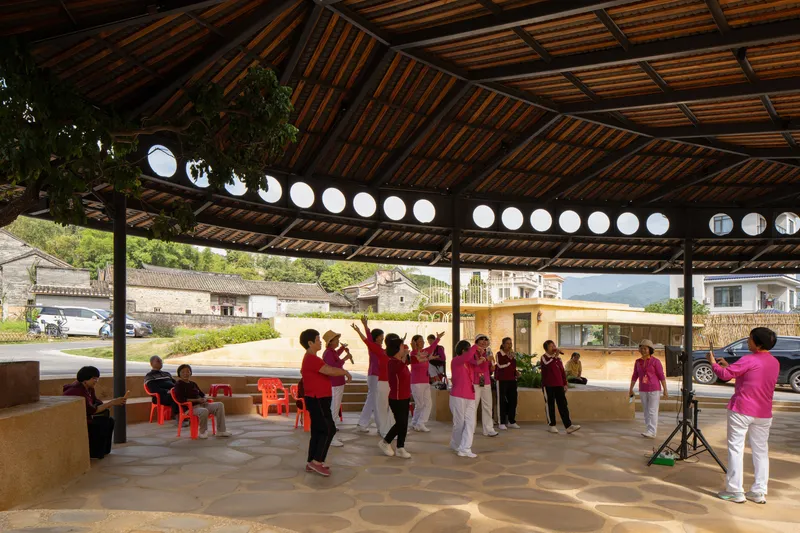
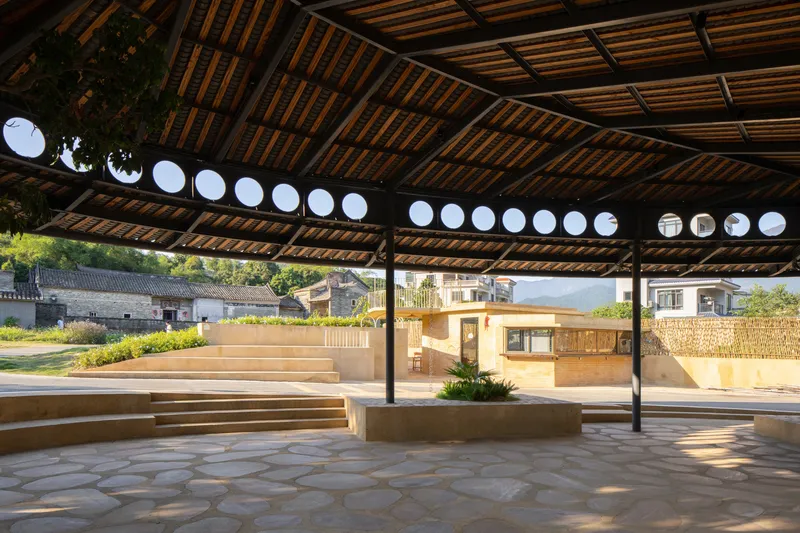
The bamboo-and-timber ceiling is the project's defining element. A continuous lattice of bamboo rafters spans between steel beams, punctuated by circular openings that allow light, air, and rain to pass through. These oculi give the canopy a playful, almost textile quality, turning what could have been a flat commercial shelter into something closer to a perforated forest canopy.
For a market building, this ceiling performs on multiple registers. It provides shade without enclosure, filters harsh subtropical light into dappled patterns on the flagstone floor, and creates a visual rhythm that children and vendors alike seem to respond to. The photographs show groups gathering directly beneath these openings, drawn to the circles of sky as instinctively as one gravitates toward a clearing in dense woods.
Stepped Ground and Flexible Occupation
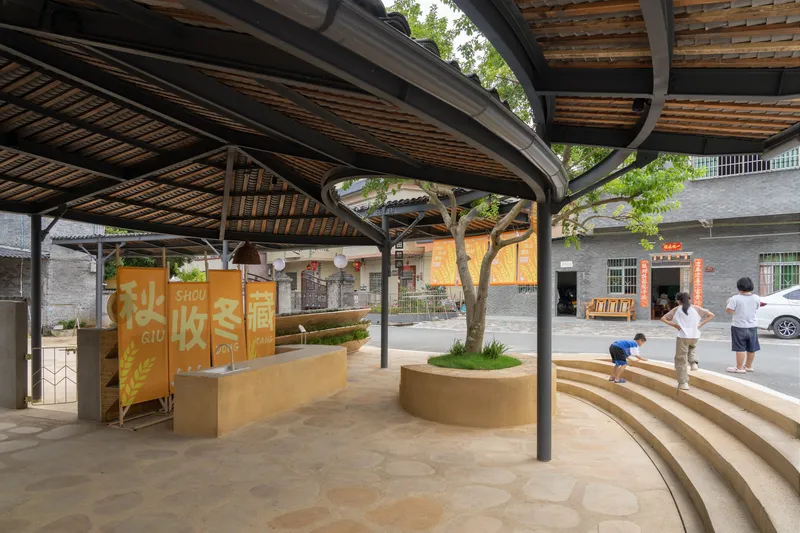


The ground plane is anything but flat. Multi-Architecture has carved the floor into a series of curved timber steps that double as seating, display platforms, and planter beds. This terracing transforms the market into an amphitheater when no goods are being sold. Integrated planters bring vegetation directly under the roof, and a rain chain hangs from the ceiling structure, channeling water from the oculi into the landscape below.
At dusk, residents sit on the terraced steps facing the village road, watching daily life unfold from a sheltered vantage. The architecture does not prescribe a single mode of occupation; it offers surfaces and edges that absorb whatever the community brings to them. That flexibility is harder to design than a fixed program, and this project manages it with real grace.
Materiality and Structure
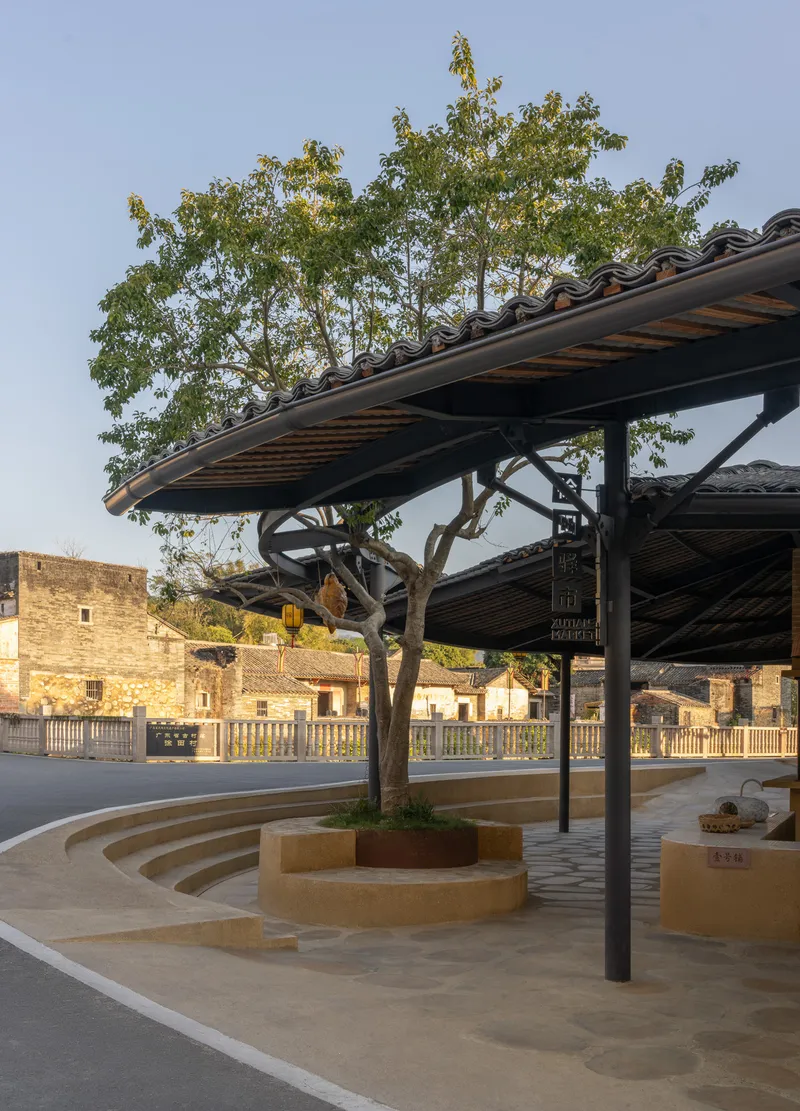


The structural strategy is legible and restrained: slender steel columns carry the roof loads, while diagonal bracing is exposed as an honest detail rather than hidden. Where trees penetrate the canopy through circular planters, the structure cantilevers away to give the trunks room. The result is a deliberate hierarchy: the steel frame does the heavy lifting, the bamboo ceiling provides texture and atmosphere, and the rammed earth walls of adjacent passages anchor the palette to local soil.
Passing between a rammed earth wall and a cylindrical column, you feel the compression that makes the open pavilion beyond feel so expansive. Multi-Architecture understands contrast as a spatial tool, not just an aesthetic one.
Courtyard Life and Pond Edge
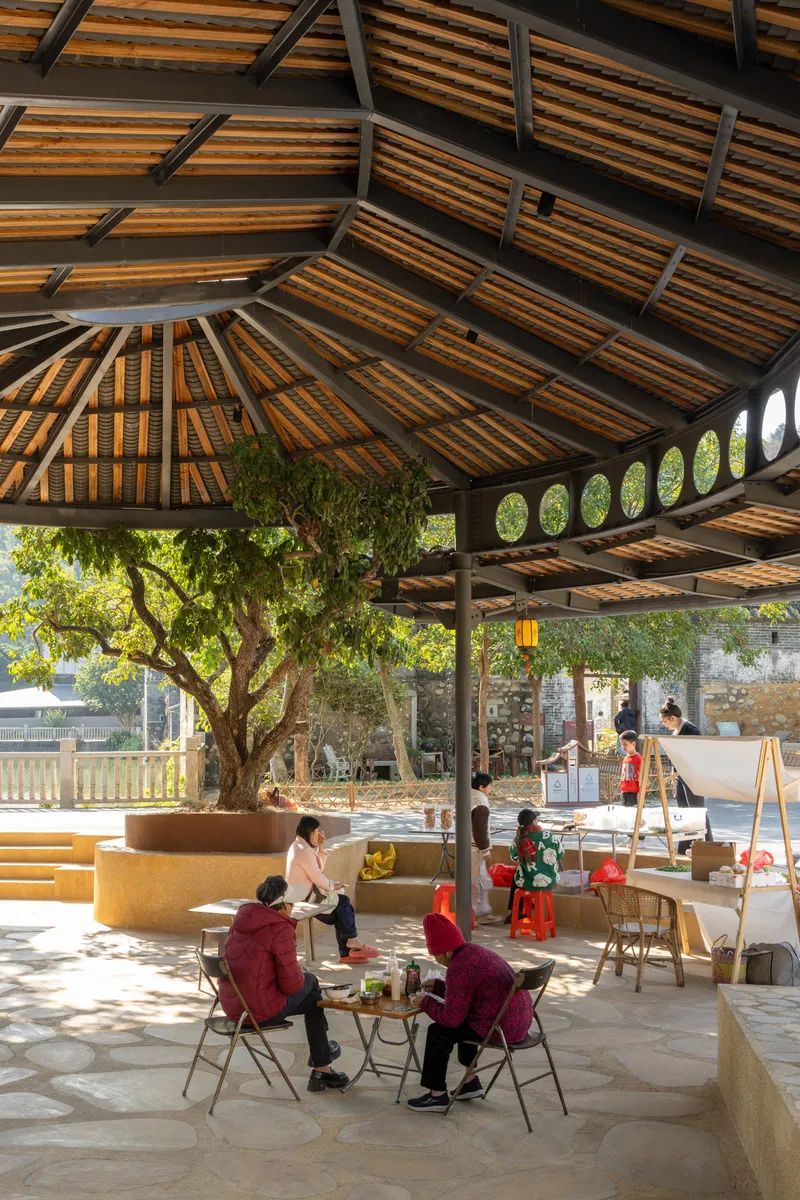
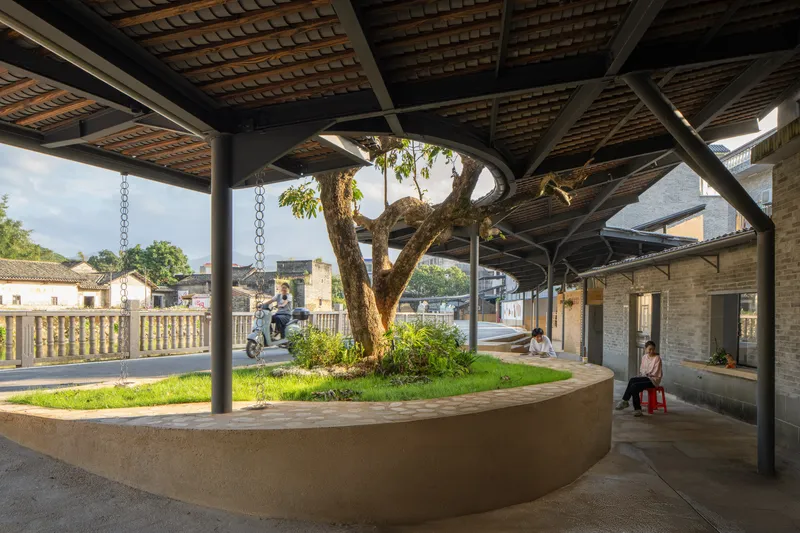
An interior courtyard with a latticed timber roof and circular tree planter creates a more intimate gathering space where residents sit at tables, eat, talk, and simply linger. The courtyard is a distinctly different room from the open market canopy: lower, more enclosed, with filtered light creating a cooler microclimate. It demonstrates the project's range, the ability to modulate between exposure and shelter within a compact footprint.
Along the pond, curved tile roofs extend down to a white balustrade, forming a waterfront promenade. Covered walkways thread between market spaces with curving planter beds that guide circulation without resorting to walls. The entire sequence from pond edge to market floor to stepped seating is continuous, navigable, and open to the village on multiple sides.
Framing the Landscape
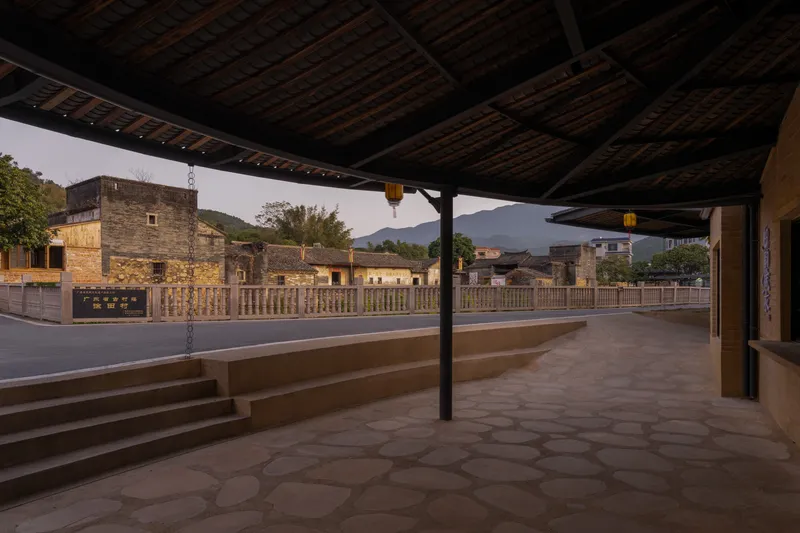
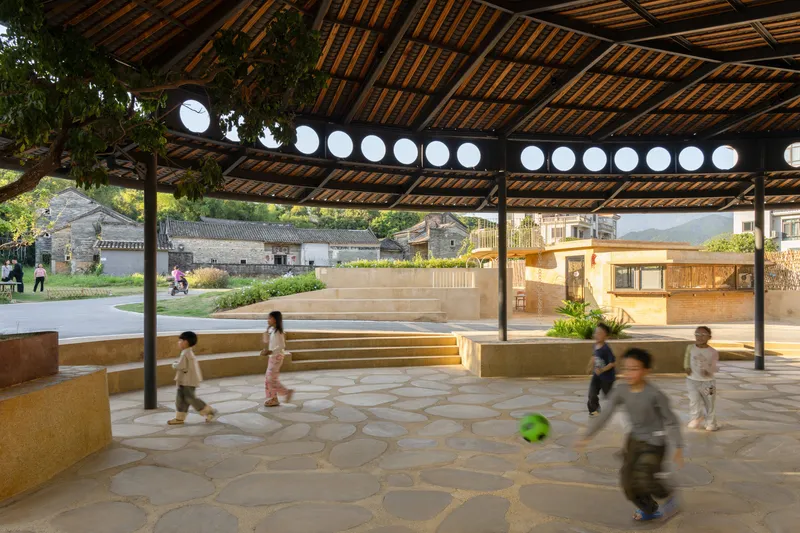
One photograph stops you: a stone platform under a timber ceiling, steel columns framing a view of Luofu Mountain in the evening light. The composition is classical in the best sense, not because it mimics tradition, but because it understands that the purpose of a roof in this landscape is to frame what lies beyond it. Children playing in the middle distance, a raised timber platform beyond them, the mountains dissolving into haze: these are the real subjects of the architecture.
Multi-Architecture has not built a destination. They have built a frame for a place that was already there.
Plans and Drawings
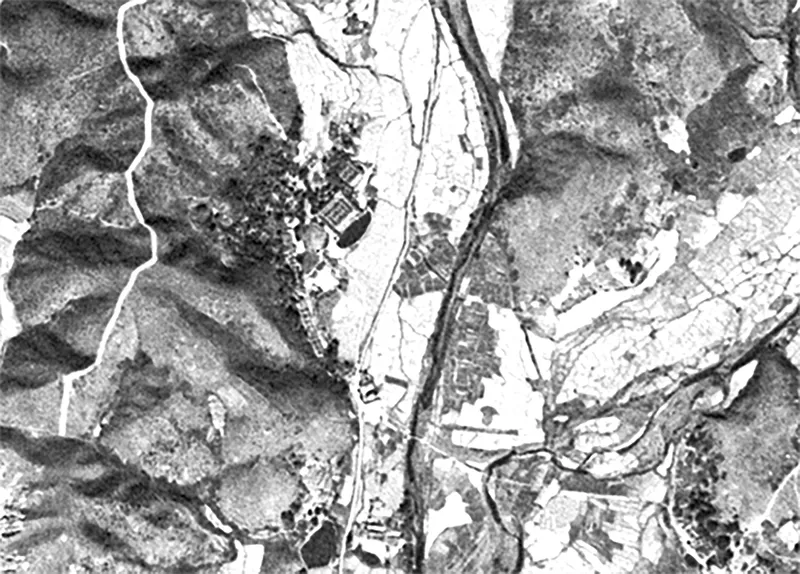
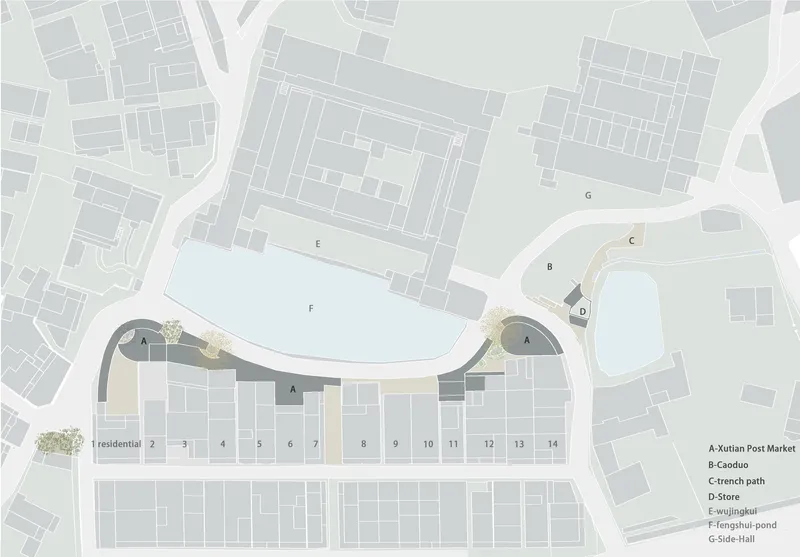
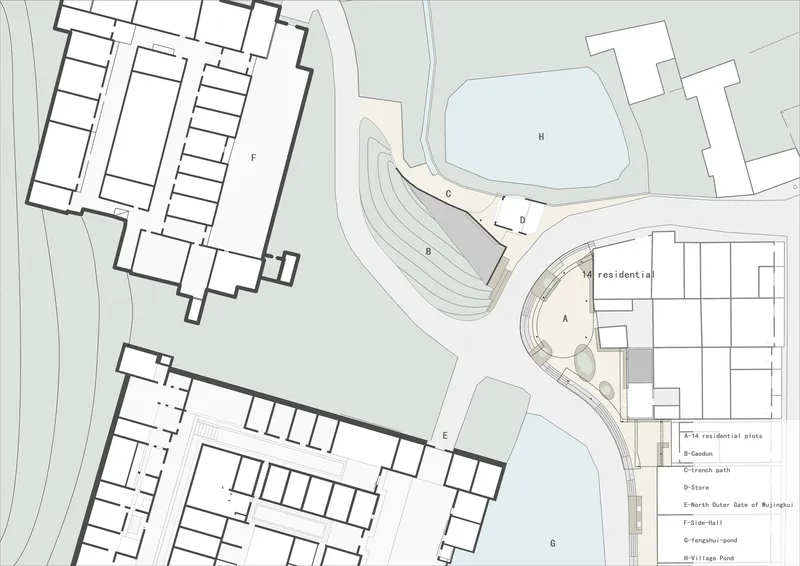
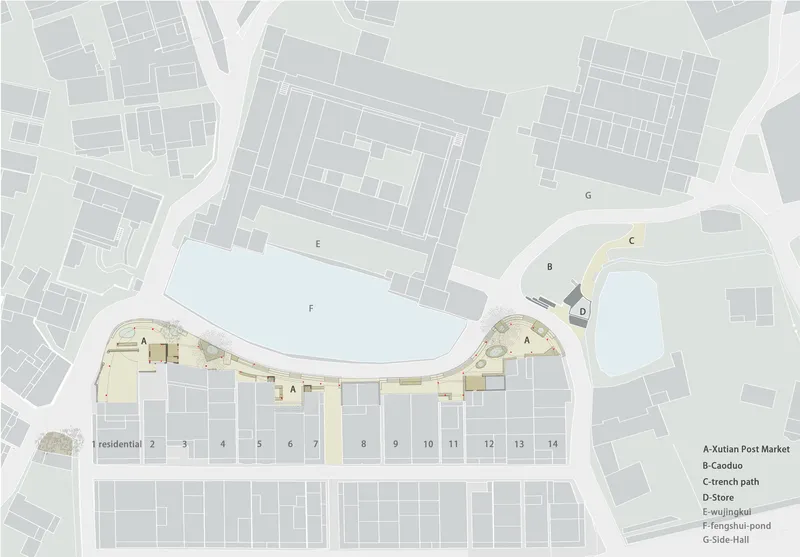
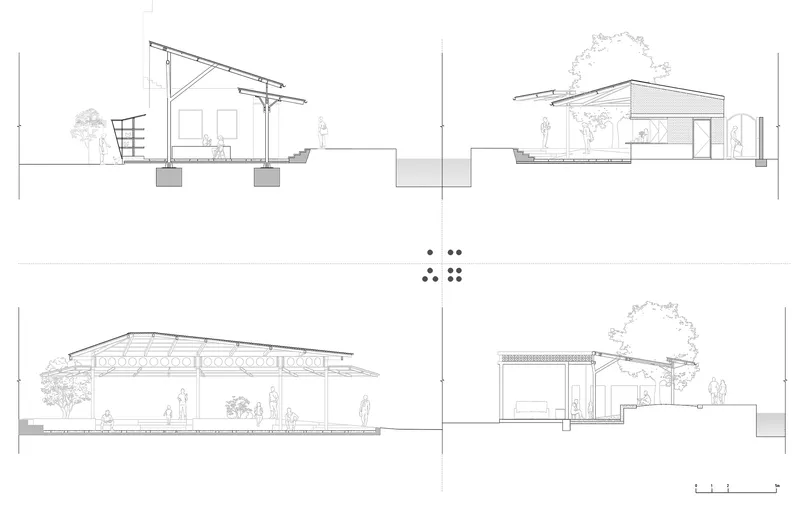
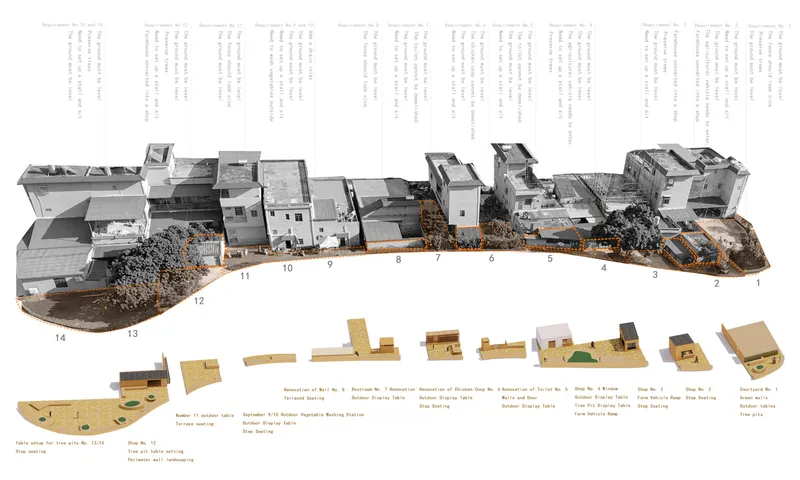


The site plans and sections reveal the strategic intelligence behind the project. The aerial site plan positions the village within its river valley, making clear how settlement, water, and agriculture interlock. The floor plan shows a market hall threaded by a trench path that winds through residential units, dissolving the boundary between commerce and domestic life. Section drawings illustrate how the pitched roofs and raised platforms negotiate subtle grade changes, keeping the market level with the pond while stepping up toward the village core.
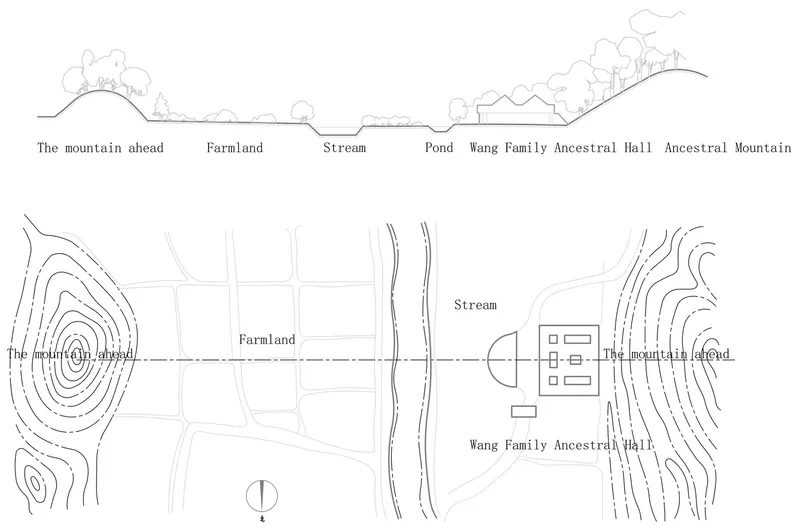
An exploded axonometric of the housing blocks shows how the broader masterplan treats each unit as a variation on a courtyard type, calibrated to local conditions. Comparative site plan studies of twelve different village layouts suggest that Multi-Architecture approached Xutian not as an isolated commission but as a research project into the typology of Hakka and Cantonese settlement. The ancestral hall section, nestled between farmland, stream, pond, and mountain, captures the cosmological diagram that underlies these villages: a structure is never just a building, it is a mediator between water and earth, cultivation and ritual.
Why This Project Matters
Rural China is littered with well-intentioned community buildings that photograph beautifully and sit empty. What distinguishes Xutian Market is its aggressive porosity: there are no doors, no thresholds that require permission, no program so specific that it excludes spontaneous use. The building works because it is fundamentally a piece of ground with a roof over it, generous enough to be claimed by vendors one morning and children the next. That sounds simple. It is not.
Multi-Architecture has demonstrated that adaptive reuse and new construction can coexist when the new structure operates at the scale of infrastructure rather than icon. Xutian Market does not ask you to notice it. It asks you to stand under it, look at the mountain, buy some vegetables, and sit down. In a discipline addicted to signature form, that kind of restraint is the most radical move available.
Xutian Market by Multi-Architecture. Huizhou, China. 1,092 m². Completed 2025. Photography by Siming Wu.
About the Studio
Share Your Own Work on uni.xyz
If projects like this are the kind of work you want to make, uni.xyz is a place to publish your own, find collaborators, and enter design competitions.


Popular Articles
Popular articles from the community


graciastudio Turns a Viewless Tijuana Lot Inward Around a Courtyard of Concrete, Timber and Trees
In Tijuana, Jorge Gracia's GA2 House stacks a timber-clad private floor over exposed concrete and replaces a missing view with a planted interior patio.

FCC Arquitectura Expands a Portuguese Granite House with a Board-Marked Concrete Wing
In Portugal, JV House pairs a cleaned-up whitewashed and granite dwelling with a timber-shuttered concrete extension, courtyards and a garden pool.


Aquadapt: An Underwater Habitat That Rewrites Its Rooms by the Hour
Curved modules ring the seabed while one shell shifts from breakfast room to cinema, farm and football pitch as residents' needs change.

Opera on the Sea: Driftwood Logic Shapes a Timber Opera House on Estonia's Coast
Trevor Orgill's opera house translates the entangled drift of floating timber into a civic building where wood, water, and music converge.

Similar Reads
You might also enjoy these articles

LAVA Architecten Gives Vocational Education a Sawtooth-Roofed Face on a Mechelen School Campus
In Mechelen, Belgium, a 2,053 m² STEM school on a 6×6 m grid turns workshops and classrooms into rooms that can be rearranged as teaching changes.

KEMA Studio Turns a Derelict Marvila Attic into a 60 m² Lighthouse Apartment Above Lisbon
In Lisbon's Marvila district, a rebuilt roof, four skylights and two plywood volumes turn an unlivable attic into a bright home facing the Tagus.

Pixel Gardens: One Repeated Module Stacked Into a Terraced Social Housing Tower for Famagusta
Salem Bader's shortlisted housing tower builds a vertical neighbourhood from one repeated module, offsetting units to carve terraces, light and air.

Bao Huynh Watercolor Atelier: A Serene Art Retreat in Hội An
Bao Huynh Watercolor Atelier in Hội An blends multifunctional art spaces, sustainable design, local materials, and family-friendly living in a serene environment.

Comments (0)
Please login or sign up to add comments
No comments yet. Be the first to comment!