
YOD Group Wraps a 1,500-Seat Event Hall in 28 Tons of Suspended Brick Near Lviv
Emily Event Hall turns a lakeside forest clearing outside Vynnyky, Ukraine, into a projection-mapped arena built for spectacle.


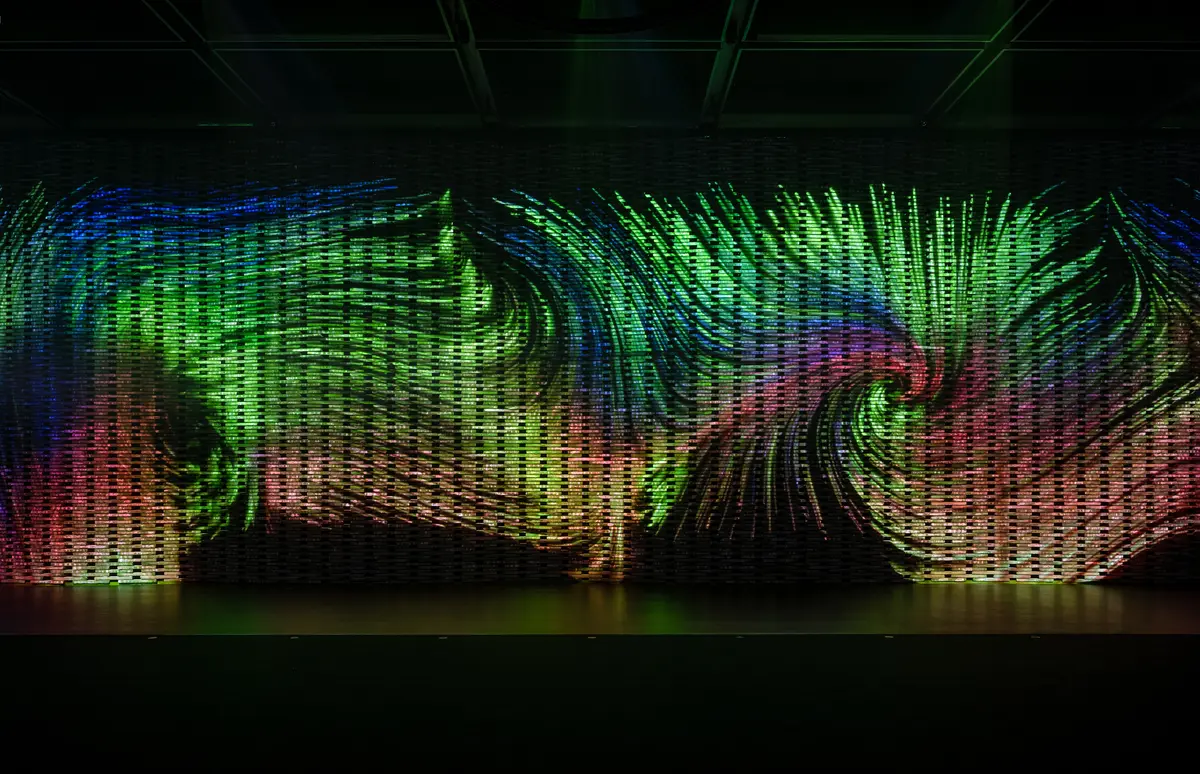
Most event halls are boxes dressed up with drapery and colored light. Emily Event Hall, designed by YOD Group and completed in 2022, reverses that logic: the architecture itself is the spectacle. A 60-meter-long, 7-meter-high wall of custom bricks, each unit threaded onto metal strings and hung without additional structural support, becomes a 1,500-square-meter media screen when 38 synchronized laser projectors paint it with moving imagery. The wall is not decoration applied to a building. It is the building's reason for being.
Situated within a premium hotel complex beside a lake in a forested area near Vynnyky, just outside Lviv, the 2,900-square-meter facility is reportedly the largest and most technically advanced event space in western Ukraine. Lead architects Volodymyr Nepiyvoda and Dmytro Bonesko conceived it as what they call a "magnifying glass for emotions," a space whose defining trait is adaptiveness. A sliding facade allows equipment to be reconfigured for galas, conferences, or concerts. Tables and chairs, custom-designed by Kateryna Sokolova, can be arranged in dozens of layouts or removed entirely. The architecture does not prescribe a single use; it absorbs whatever is asked of it.
The Brick Wall as Instrument
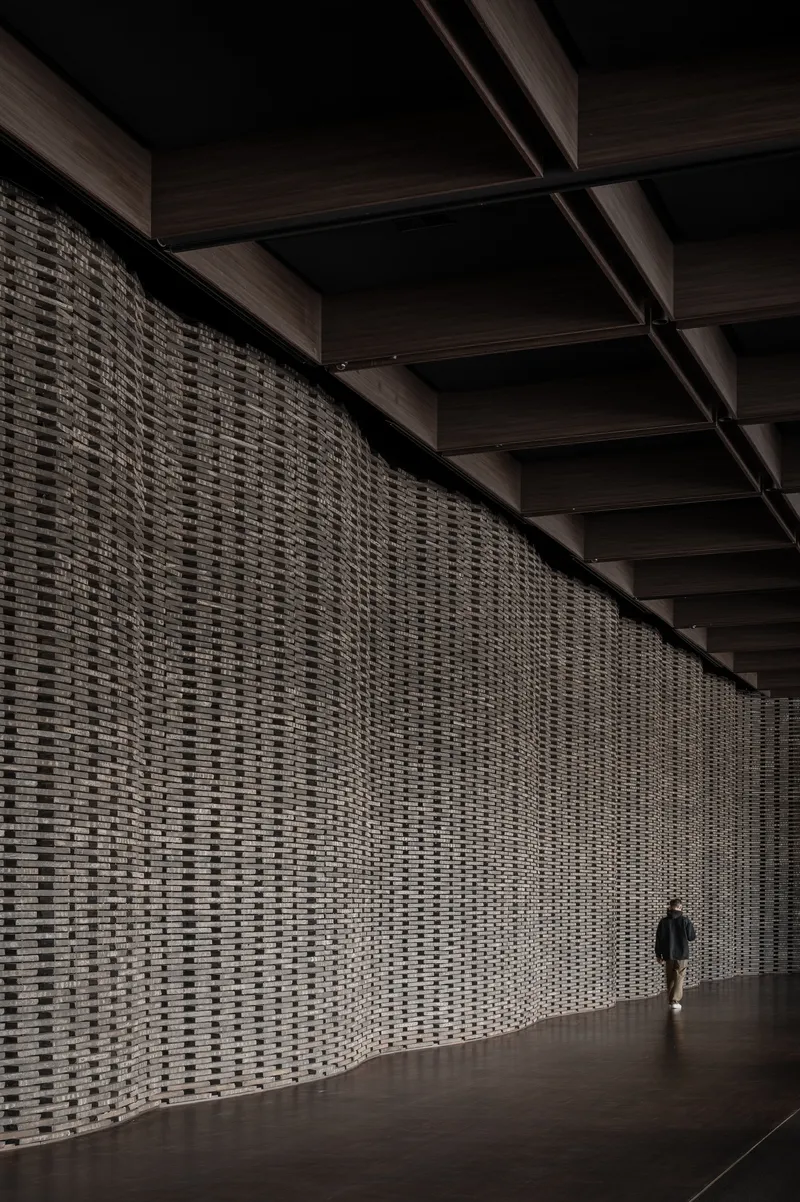
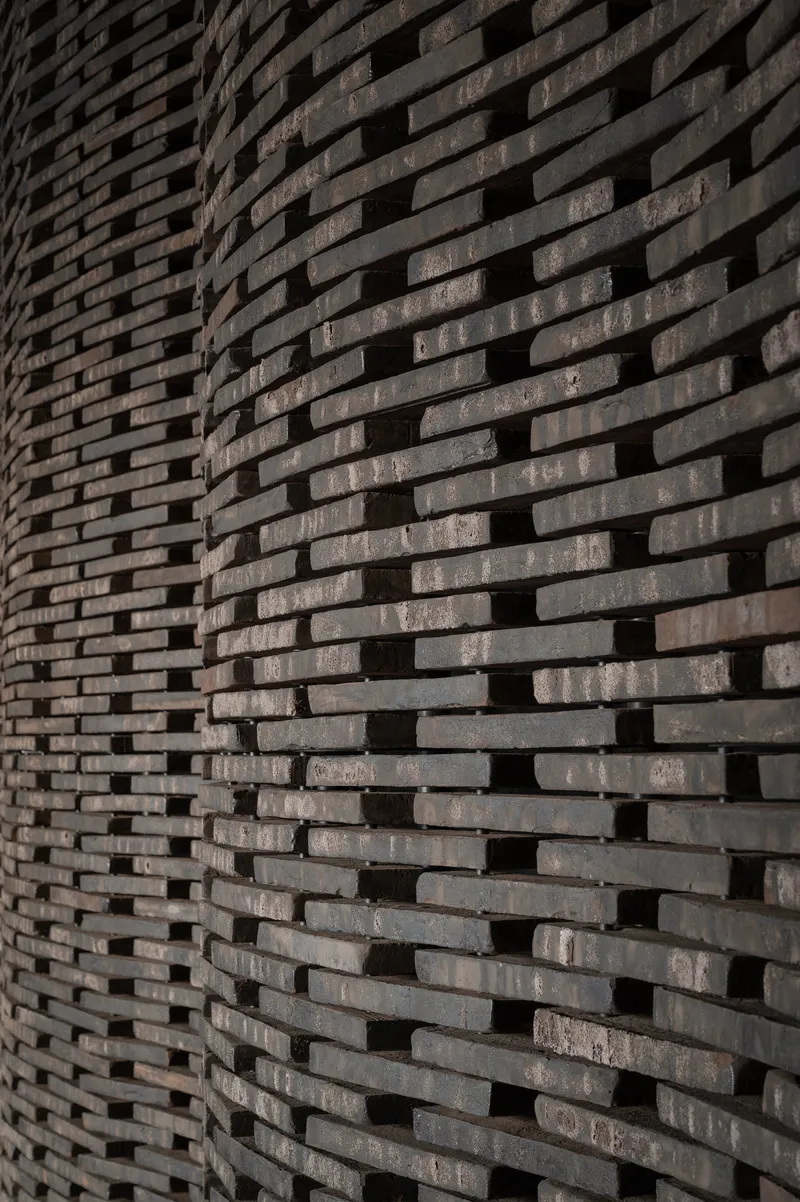
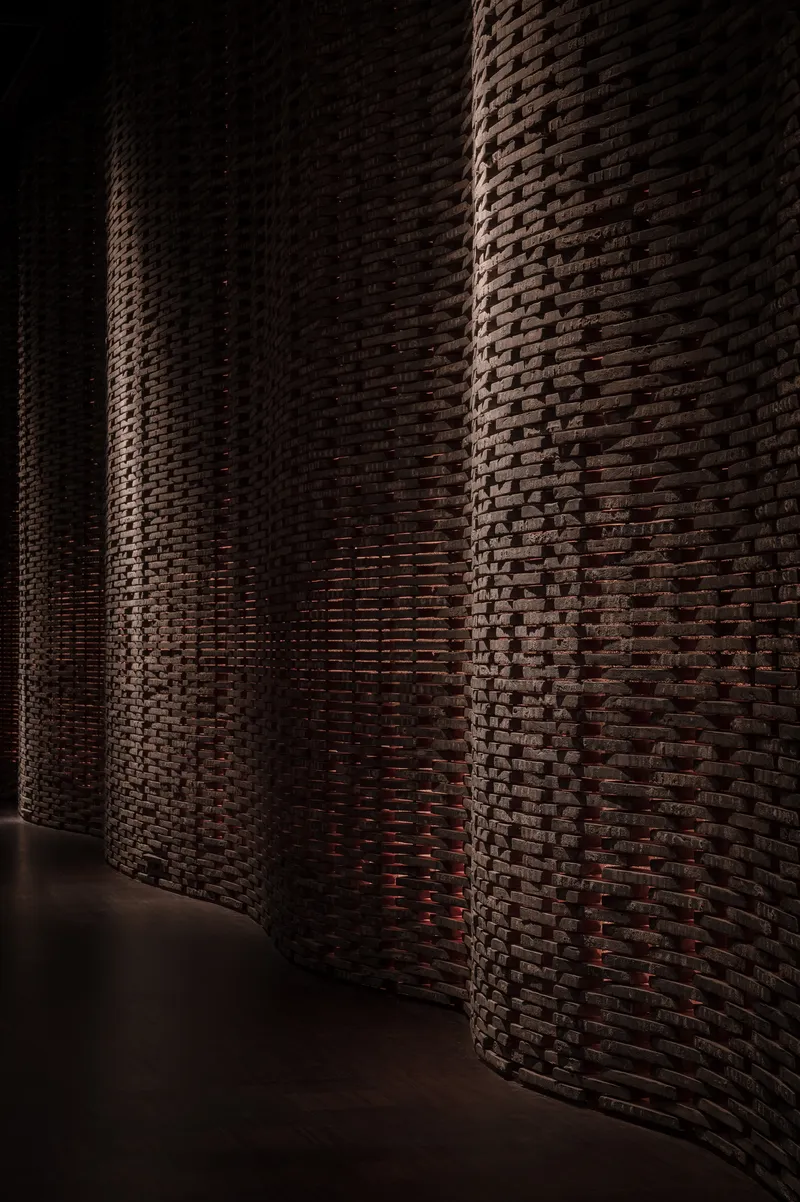
Twenty-eight tons of custom-made long bricks, suspended on metal strings in an openwork construction, form an undulating screen that runs the full length of the main hall. The staggered courses create a rhythmic texture that catches light and shadow in dramatically different ways depending on viewing angle and time of day. In daylight, the wall reads as a monumental piece of craft, somewhere between masonry and textile. At night, it transforms completely.
The basket-weave pattern visible in the corridor views is not merely aesthetic. Its depth and irregularity give the projectors something to grip. A flat wall would bounce light back evenly; this wall absorbs, refracts, and fragments projected imagery into something textural and immersive. The decision to use brick rather than a purpose-built screen material is the project's most provocative move, trading pixel resolution for physical presence.
Projection-Mapped Spectacle
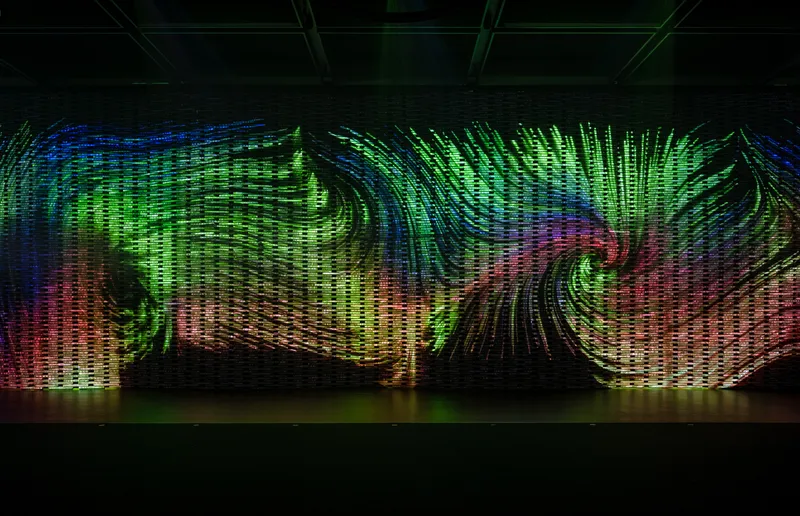
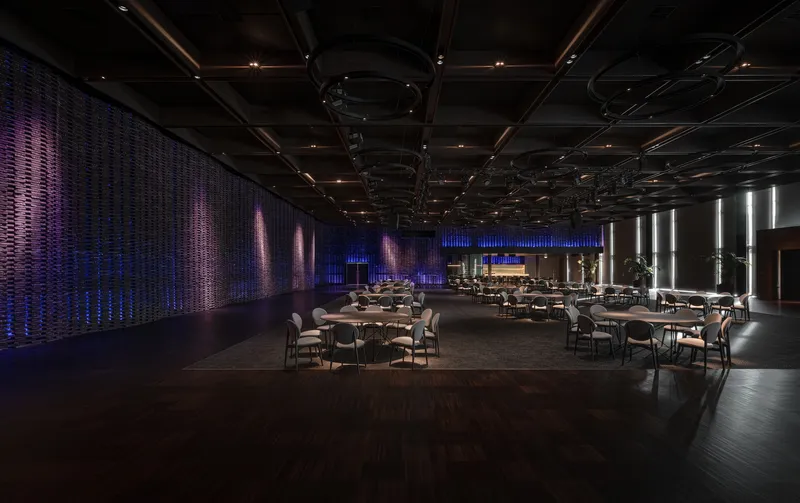
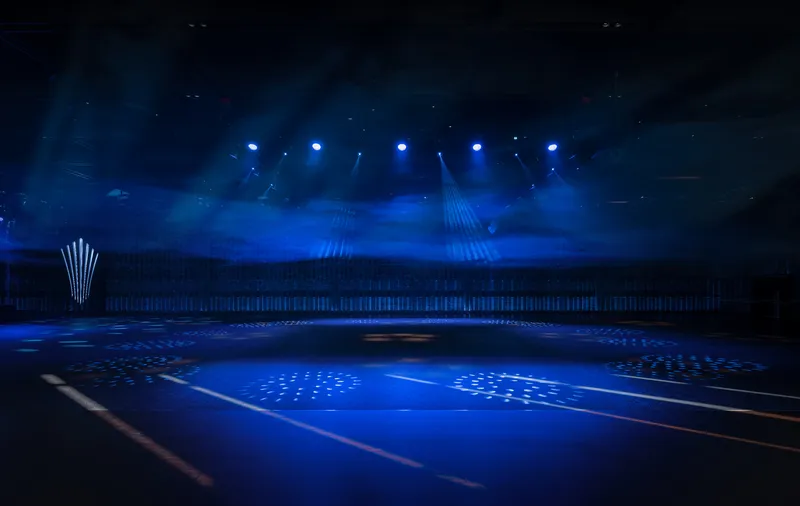
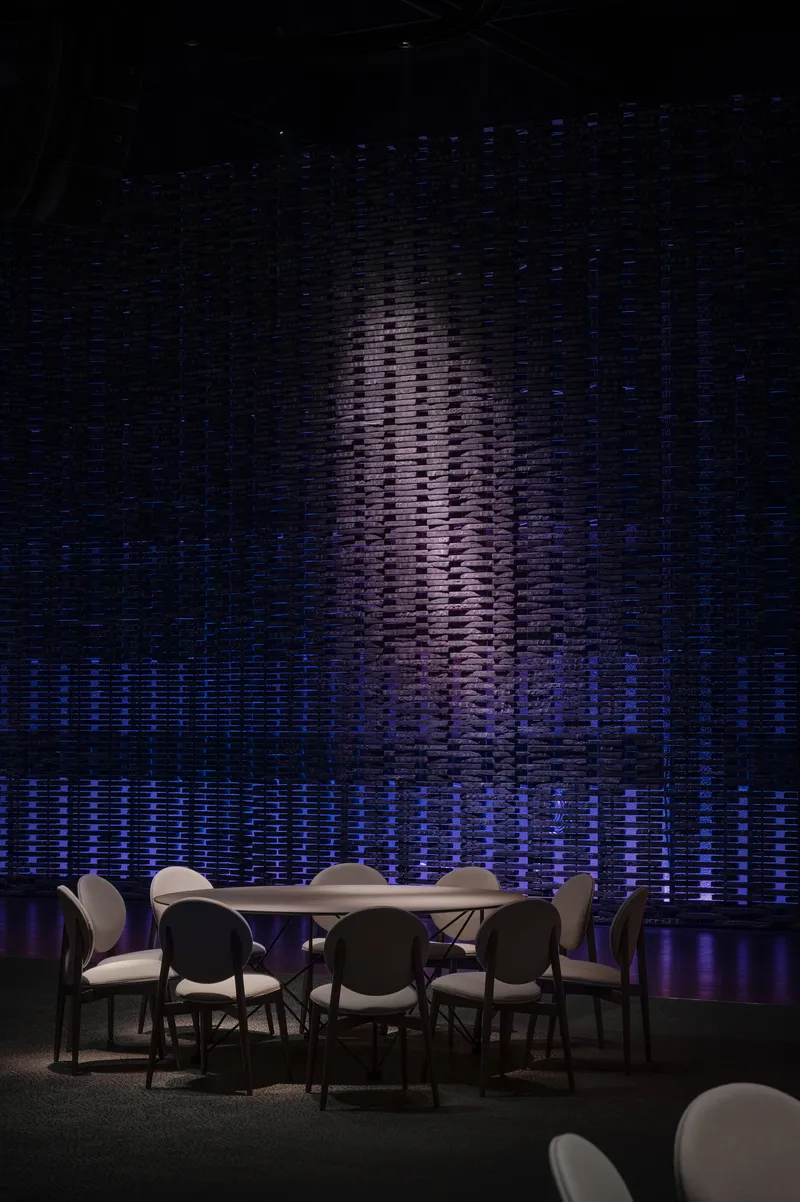
When the 38 laser video projectors fire in unison, the brick wall becomes a single continuous image surface of 1,500 square meters. The wavelike patterns and chromatic shifts visible in the evening shots show the wall operating as a full-room experience rather than a stage backdrop. Blue and purple washes extend into the atmospheric haze of the arena space, collapsing the boundary between wall and air.
What makes this more than a large screen is its materiality. The projections interact with the brick's relief, so colors pool in the recessed joints and skate across the protruding faces. The result is closer to a luminous landscape than a video feed. For a venue designed to host everything from weddings to corporate presentations, this adaptability is key: the wall can be celebratory, corporate, intimate, or overwhelming, all within the span of a single evening.
The Hall in Use
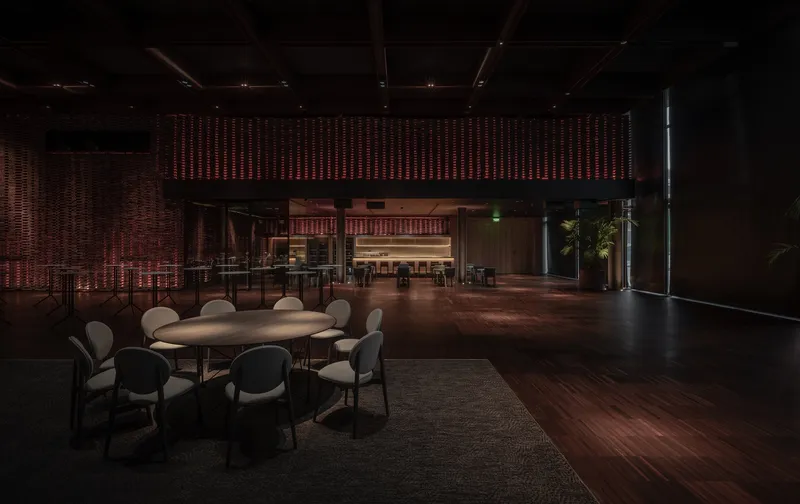
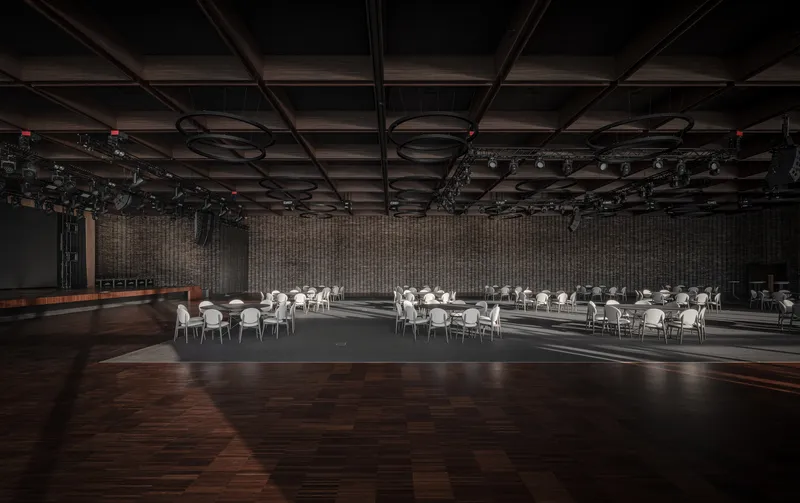
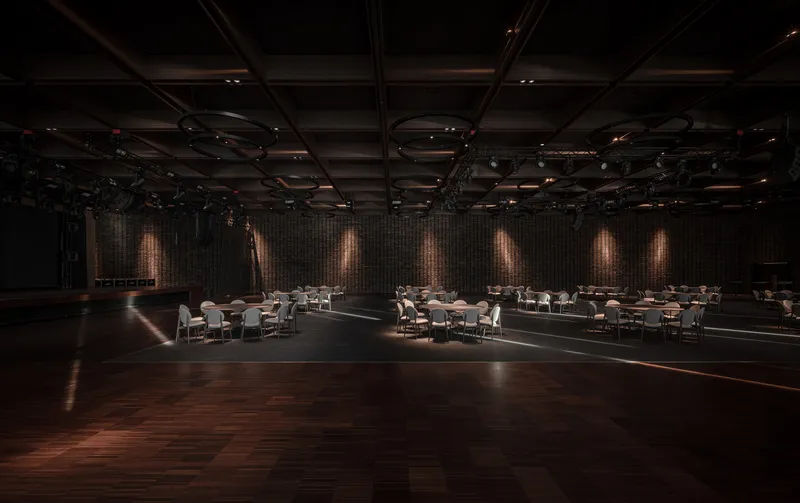
The main hall accommodates 1,500 guests, and the interiors are deliberately neutral when the projection system is off. A coffered timber ceiling conceals a truss and winch system that allows rigging to be reconfigured for different event types. Round banquet tables scatter across dark timber flooring, their arrangement flexible enough to shift from formal dining to open-floor concert seating.
There is a stage backed by dressing rooms and technical premises, but the hall is not oriented around the stage alone. The woven screen wall wraps the room's periphery, making the entire enclosure performative. When dressed for a gala with backlit brick segments glowing behind the tables, the space reads as an interior carved from warm, luminous stone. When stripped for a concert, with haze and blue stage lighting, it becomes something closer to a nightclub or arena. That range, delivered without portable scenography, is the hall's strongest argument.
Exterior and Approach
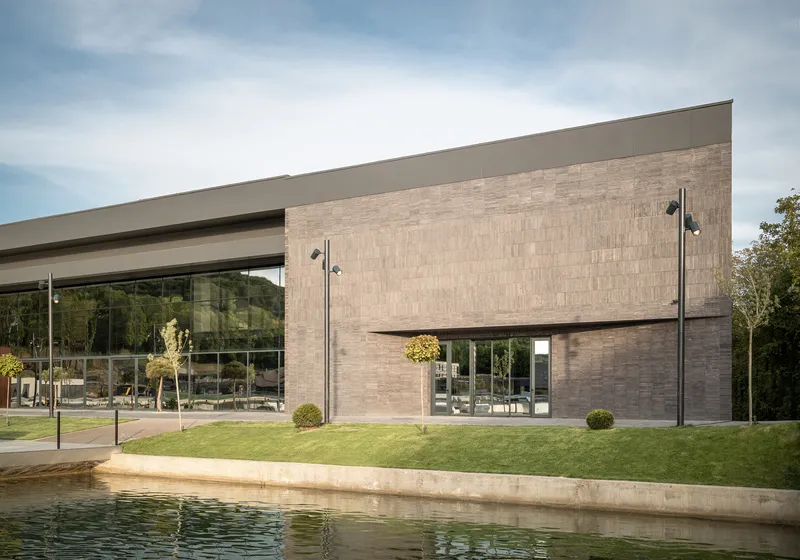
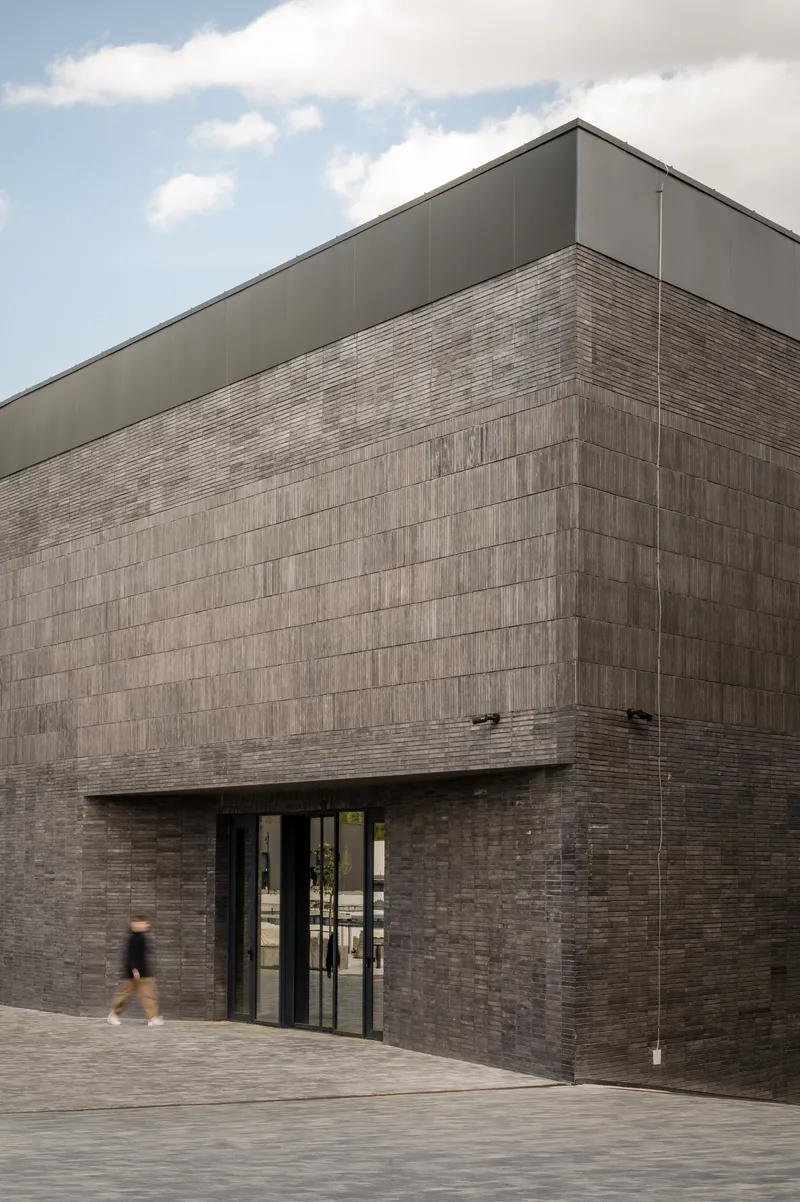
From outside, the building declares its materiality clearly. Horizontal brick cladding in two tones, a cantilevered volume over a reflecting pool, and generous glazed surfaces establish a restrained, almost corporate aesthetic that gives no warning of the interior theatrics. The recessed glass entry doors and the figure passing through them in the corner view convey a scale that only becomes apparent once inside.
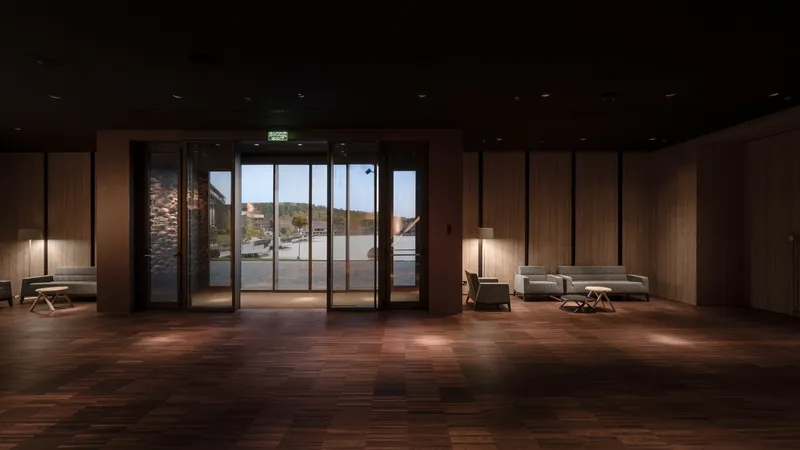
A wood-paneled foyer with glazed doors opening onto an exterior courtyard serves as a decompression space between arrival and the main event. The afternoon light falling through these openings is warm and quiet, a deliberate palate cleanser before guests enter the controlled darkness of the hall. The landscape setting, near a lake and surrounded by forest, reinforces the sense that you are leaving one world and entering another.
Interiors Beyond the Hall
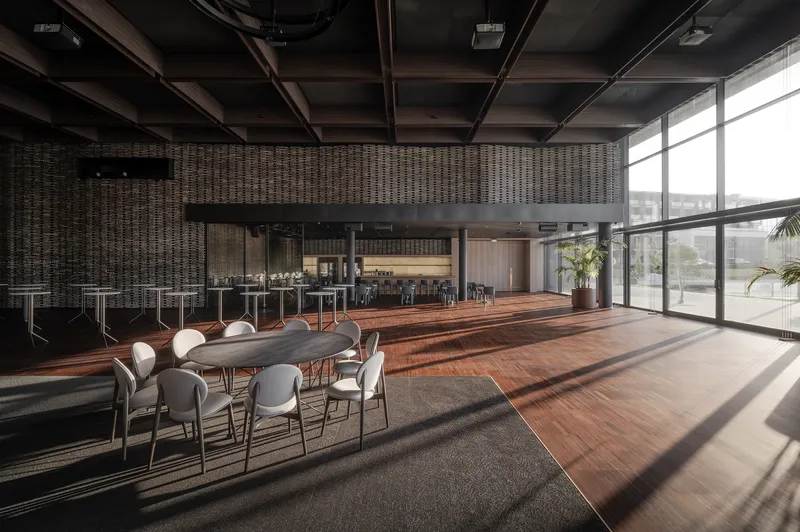
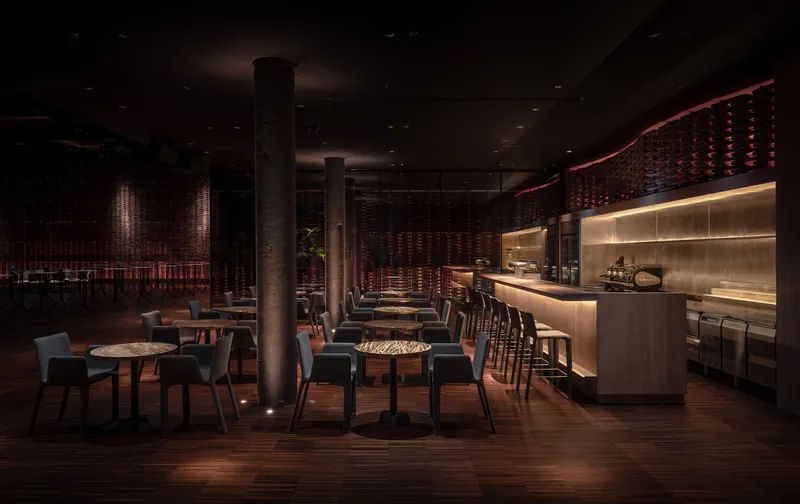
The dining area with its exposed timber ceiling beams and floor-to-ceiling windows is the antithesis of the main hall: bright, natural, legible. It functions as one of several satellite spaces, including a lounge zone, bar, wardrobe, and children's room, that orbit the central arena. The bar area, with its curved woven ceiling feature and backlit shelving, picks up the basket-weave language of the main hall's brick wall and translates it into a softer, more intimate register.
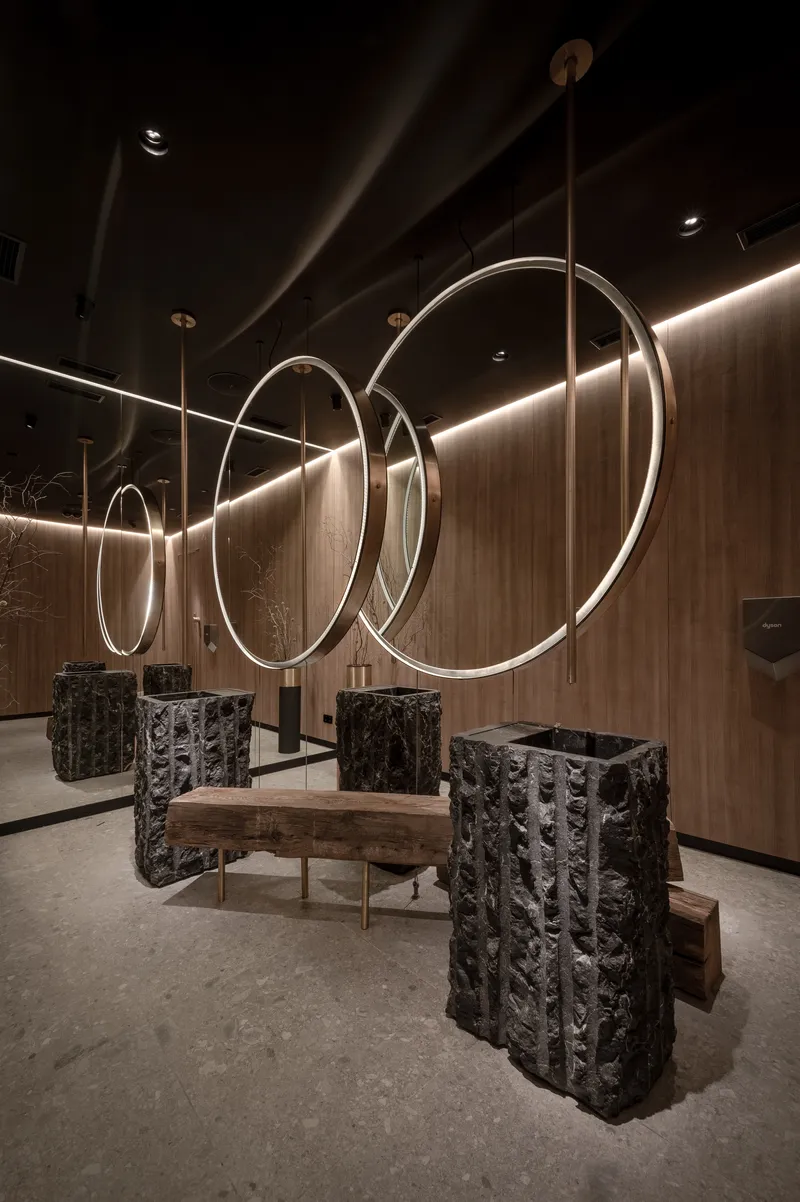
The lounge space, with its circular metal light rings and textured black stone seating blocks, introduces a deliberately moody atmosphere. These secondary rooms are not afterthoughts. They extend the logic of adaptiveness into every corner of the program, giving guests zones of varying intensity and social density.
Craft and Detail
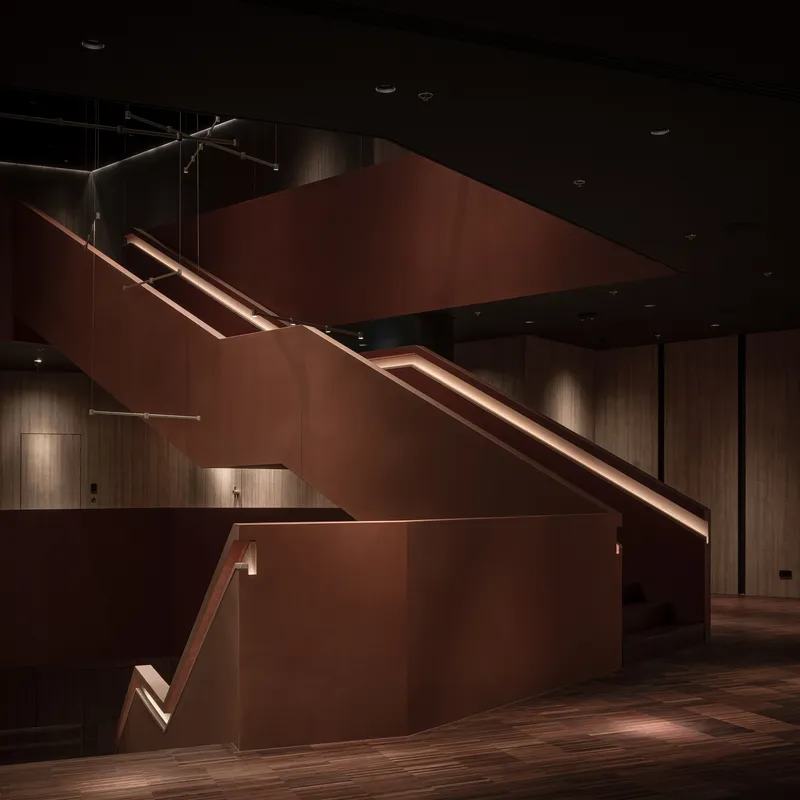
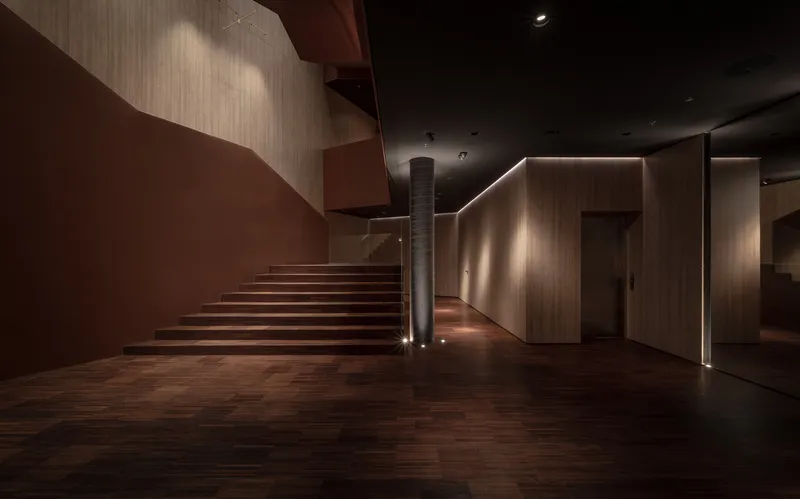
A folded copper-clad staircase with integrated handrail lighting reveals the level of finish YOD Group applied throughout the building. The cantilevered timber staircase in the lobby, rising from wood paneling under recessed linear lighting, is equally considered. These circulation elements are treated as sculptural moments rather than functional connectors, and the material choices, copper, dark timber, blackened metal, maintain a consistent palette.
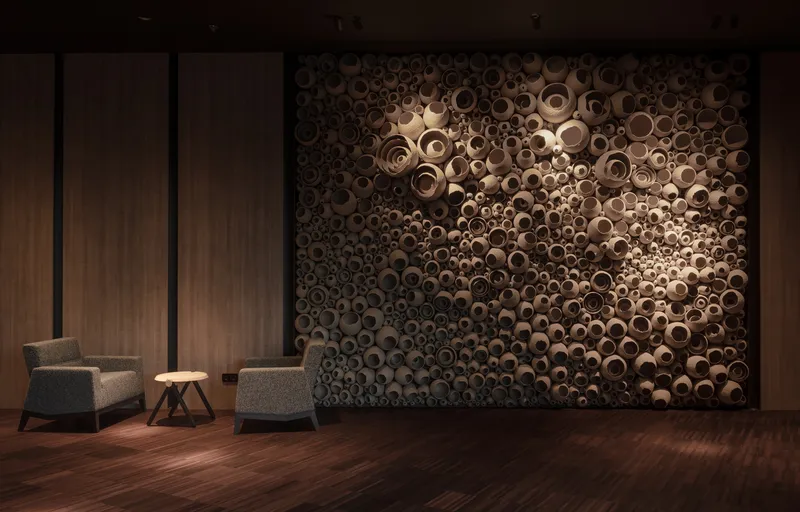
The sculptural wall installation of clustered cylindrical timber tubes, visible in the lounge area, adds an organic counterpoint to the geometric rigor of the brick screen. These moments of handcraft are essential: they prevent the building from reading as purely technical infrastructure and remind visitors that this is a space designed for human gathering, not just projection mapping.
Texture as Identity
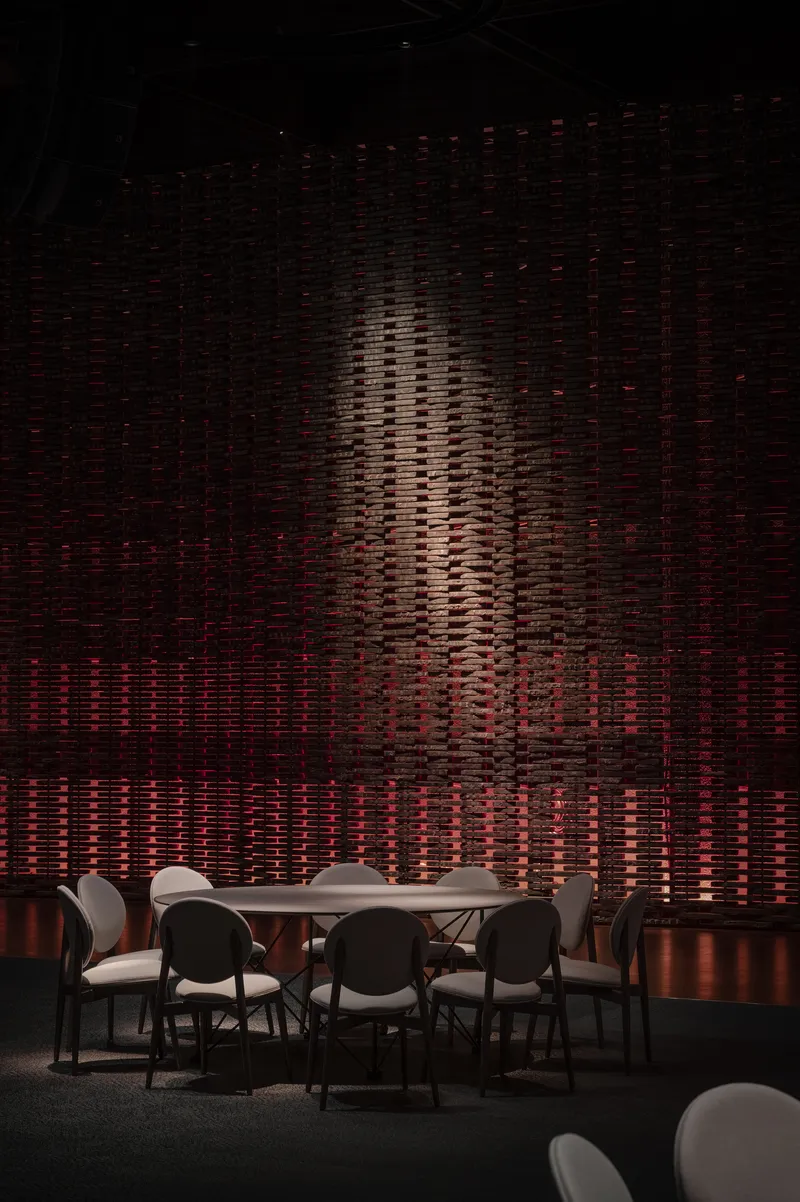
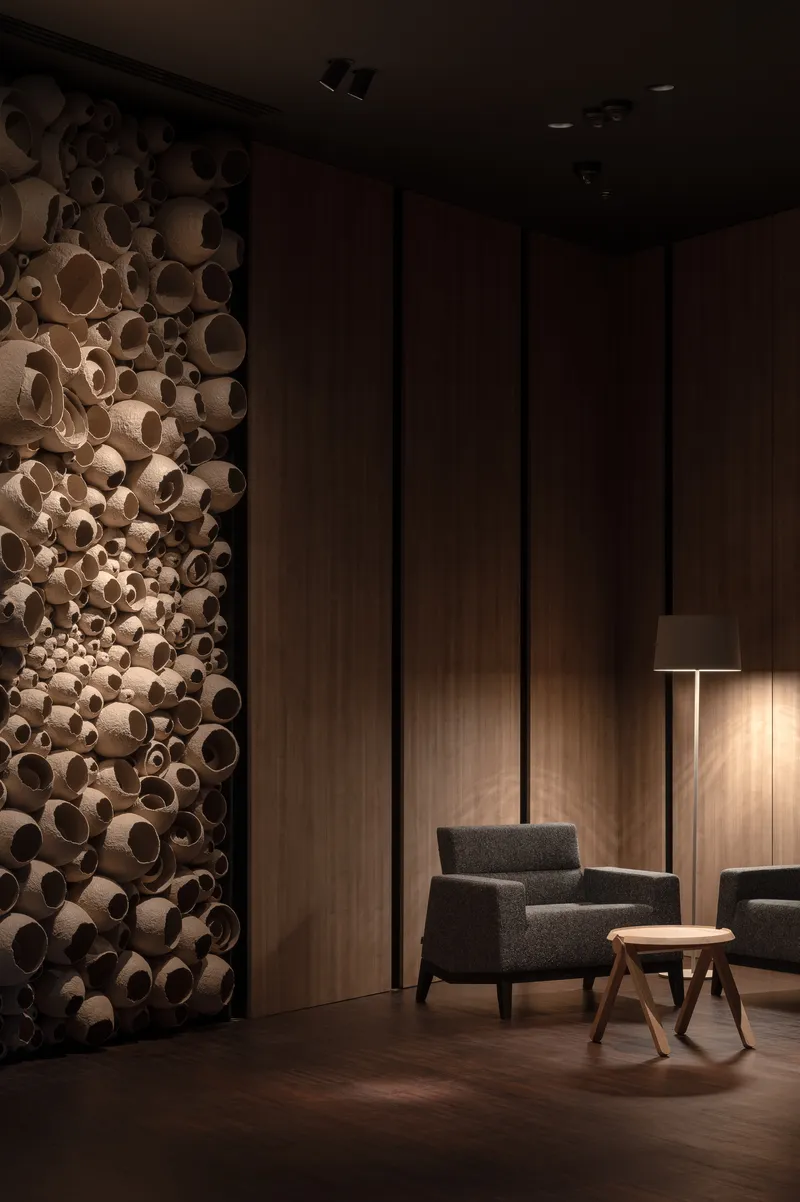
Several walls throughout the venue feature vertical relief patterns that respond to colored lighting. Lit in amber and red, the pattern evokes geological strata. Lit in blue and violet, it becomes alien and crystalline. This sensitivity to light is not accidental; every textured surface in the building is designed to be read differently under different conditions. The timber cylinder sculpture beside a wood-paneled wall shares this quality, shifting from warm and domestic in natural light to something more mysterious under controlled spots.
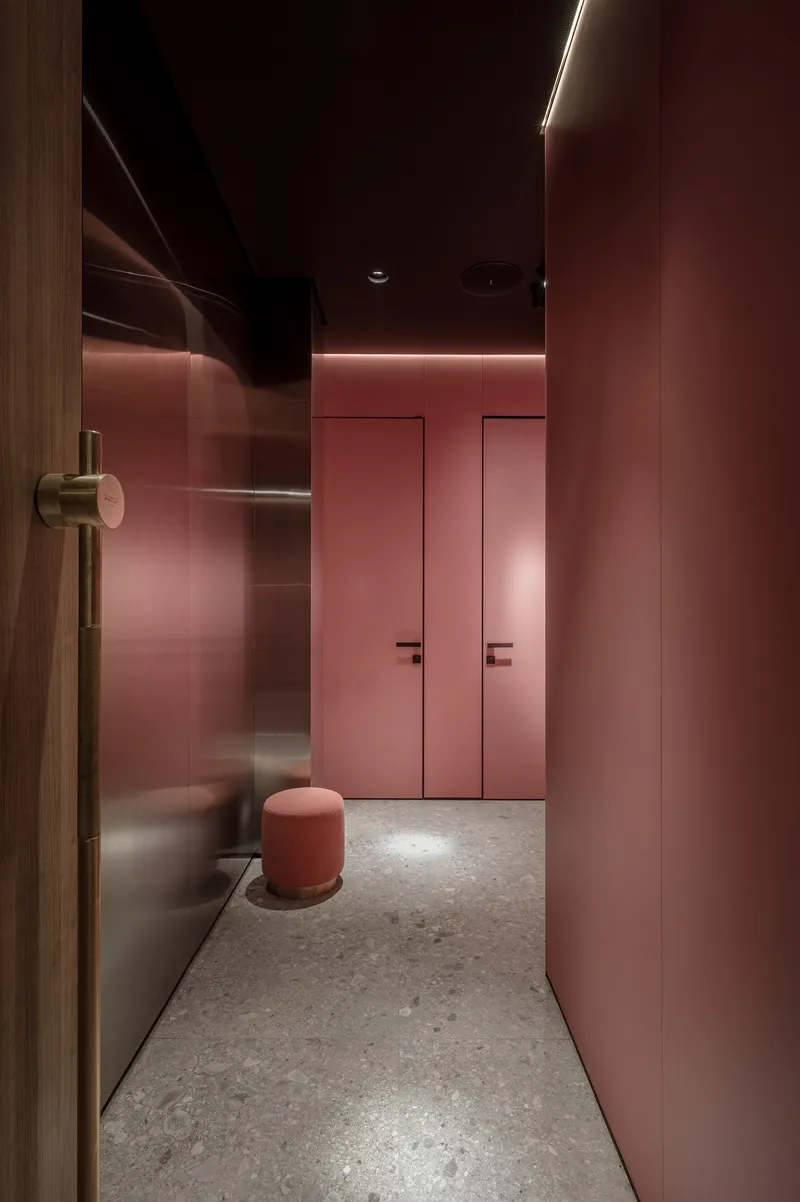
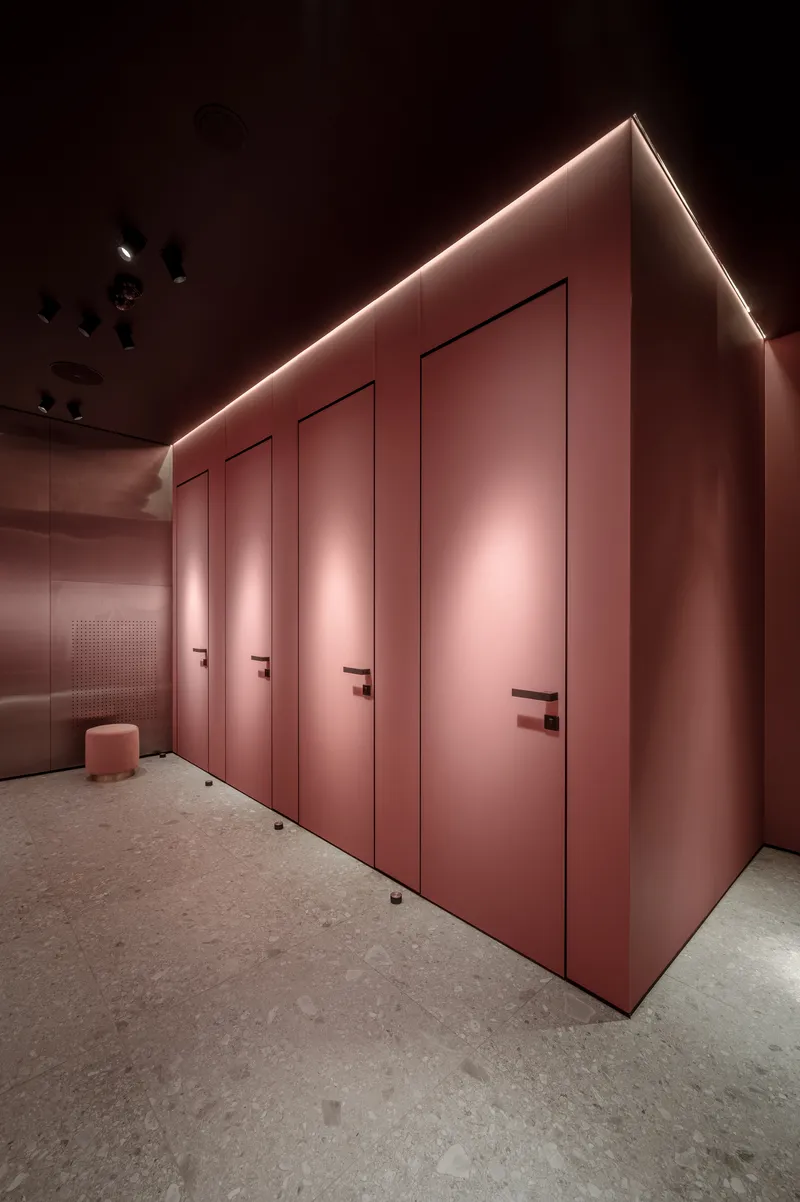
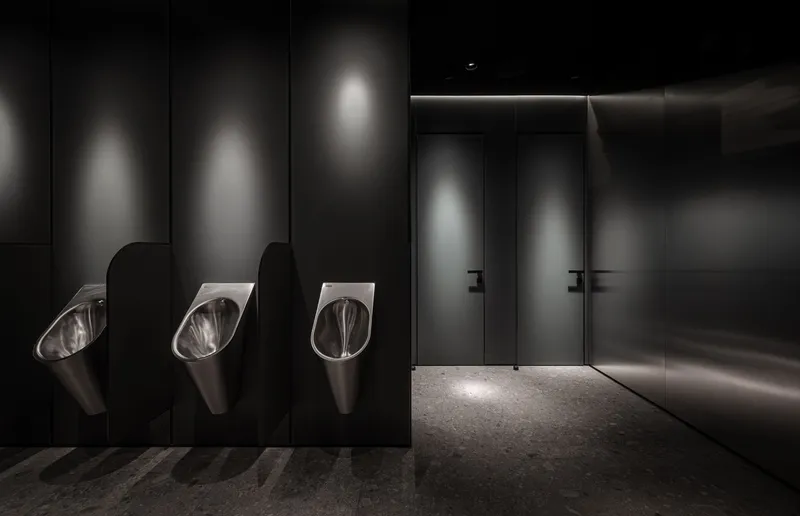
Even the back-of-house areas carry this commitment to atmosphere. Pink-paneled corridors with concealed LED perimeter lighting and flush doors create a surreal, almost cinematic quality in spaces most buildings would leave utilitarian. The restroom interiors, with backlit wall panels and dark surfaces, maintain the same attention. When a building cares about how its restrooms feel, it is usually a sign that the design team understood every room contributes to the narrative.
Why This Project Matters
Event architecture tends to be disposable: big rooms with flat walls, endlessly draped and re-draped. Emily Event Hall takes the opposite position. By building the spectacle into the structure itself, specifically into 28 tons of brick threaded on steel and lit by 38 synchronized projectors, YOD Group made a venue that does not depend on rental scenography to create atmosphere. The architecture does the heavy lifting, literally and figuratively.
Completed in 2022 near Lviv, the project also carries weight as a statement of ambition for Ukrainian cultural infrastructure. It is not a concert hall or a museum; it is a privately commissioned multipurpose space that could have been anonymous and profitable. Instead, YOD Group made it architecturally specific, materially rich, and technically inventive. That a venue designed for weddings and conferences can also serve as one of the most compelling projection-mapped interiors in Eastern Europe speaks to the potential of treating every building type as worthy of serious design attention.
Emily Event Hall, designed by YOD Group (lead architects: Volodymyr Nepiyvoda and Dmytro Bonesko), Vynnyky, Lviv region, Ukraine. 2,900 m², completed 2022. Photography by Yevhenii Avramenko.
About the Studio
Share Your Own Work on uni.xyz
If projects like this are the kind of work you want to make, uni.xyz is a place to publish your own, find collaborators, and enter design competitions.


Popular Articles
Popular articles from the community


Opera on the Sea: Driftwood Logic Shapes a Timber Opera House on Estonia's Coast
Trevor Orgill's opera house translates the entangled drift of floating timber into a civic building where wood, water, and music converge.
Extended Shell: Retrofitting Kolkata's Balconies as Living Urban Thresholds
A modular retrofit system recovers the social and environmental intelligence of Kolkata's historic verandas for contemporary Park Street residents.

Cloaked Colonization: A Mobile Underwater Habitat That Moves Like a Fish
Micah Abaya's shortlisted EHC Pacific entry reimagines ocean settlement as a dispersed network of self-sustaining architectural organisms.
Temporary Home for Dogs: A Reversed Zoo Rethinks Animal Shelter Architecture
In Bucharest, a sinuous corridor and freed landscape flip the logic of containment, designing a shelter that works to make itself unnecessary.

Similar Reads
You might also enjoy these articles

Pixel Gardens: One Repeated Module Stacked Into a Terraced Social Housing Tower for Famagusta
Salem Bader's shortlisted housing tower builds a vertical neighbourhood from one repeated module, offsetting units to carve terraces, light and air.

Bao Huynh Watercolor Atelier: A Serene Art Retreat in Hội An
Bao Huynh Watercolor Atelier in Hội An blends multifunctional art spaces, sustainable design, local materials, and family-friendly living in a serene environment.

Atelier Macri Concept Store Interior Design by CASE-REAL
Atelier Macri store features a "ko" counter, walnut wood details, cork displays, blending retail, gallery, and seamless customer experiences.

Manuel Vargas Izquierdo Stadium and High-Performance Sports Center: Architectural Excellence in Jalpa de Méndez
The Manuel Vargas Izquierdo Stadium blends sustainable design, inclusive sports facilities, and cultural-inspired architecture, revitalizing Jalpa de Méndez’s public spaces.

Explore Exhibition Hall Competitions
Discover active competitions in this discipline

Challenge to reimagine the Iron Throne

Photograph architecture without architects

Illustrate the lost glory of Angkor Wat - Render Challenge

Design challenge to reuse E-waste
Comments (0)
Please login or sign up to add comments
No comments yet. Be the first to comment!