
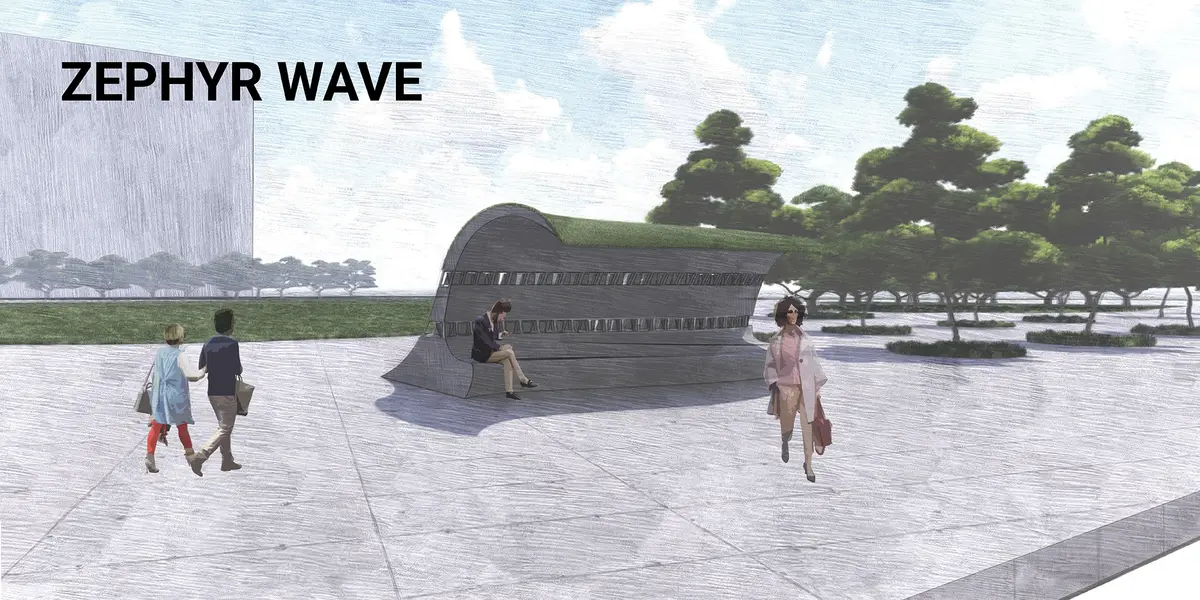
Zephyr Wave
Bus Stop Design
Zephyr Wave is a single modular energy efficient bus stop utilizing mini turbines to power the hub but also incorporate passive cooling techniques. The concept is to create an aerodynamic model with modern and organic features which is influence by waves. The waves also have its purpose for shading, but it also allows the use of a projection onto the floor for interactive activities. For the site, Dallas was chosen for its issue with urban heat island effect where the city becomes really hot due to its dense concentration of pavement and buildings. The bus stop purpose is to use self-efficient passive cooling techniques to aid users waiting for the bus in the hot climate.
The project went through four iterations where small changes were made with the forms of the waves. We wanted the form to be non-symmetrical and show a constant change. Our team first researched on the issue of some sites and decided to go with Dallas, TX to address the urban heat island effect. From there we focused on how to make the bus stop energy-efficient to supply electricity to itself. Which brought up the idea of utilizing the turbine element to supply cooling but also energy generation. The project then focused on the turbine element with the additions of a green roof to provide more passive cooling but also incorporating a technology piece to make the bus stop more interactive. The technology we decided to include was an interactive projector which would project the activity onto the floor, shaded by the wave form roof.
For materials, we decided to keep it very minimal and went with glass and hemp concrete to address sustainability and making the bus stop carbon negative, low maintenance / durable, thermal mass temperature control, fireproof, and is more environmentally friendly than other materials.
The objective of this project was to create and design a bus stop to aid with very hot climates in urban areas where the urban heat island is developed. The project also wanted to address more on being self-efficient and carbon negative which is done through the turbine element and materials.
.

Popular Articles
Popular articles from the community


Cube Design Draws an Ecological Corridor Between Two Shenzhen Hills with the Nankai Building
Beside Shenzhen's container docks, the Nankai Building pairs stacked balconies with a climbing green screen to connect two hillsides across its height.

FCC Arquitectura Expands a Portuguese Granite House with a Board-Marked Concrete Wing
In Portugal, JV House pairs a cleaned-up whitewashed and granite dwelling with a timber-shuttered concrete extension, courtyards and a garden pool.


The Amber Palace Opera: A Geological Fiction Surfaces on Tallinn's Baltic Waterfront
Pierre Brillard reimagines a Baltic legend as a public landscape, opera house, and waterfront promenade rooted in Tallinn's coastal identity.

ETEH Reworks the Shared Spaces of São Domingos School in Brazil Around Timber, Color and Hanging Plants
At São Domingos School in Brazil, 436 m² of hall, refectory and library are recast with timber joinery, a yellow and blue code and trailing greenery.

Similar Reads
You might also enjoy these articles

Vereda Arquitetos Renovates a 40-Square-Meter Apartment Inside Niemeyer's Copan Building
A compact unit in São Paulo's most iconic residential tower gets a material overhaul that pairs exposed concrete with bold blue Formica.

Shakur's House: Exposed Brick as an Interior Organiser in a 168 m² Mashhad Residence
Brick moves indoors in this Mashhad residence, where masonry walls, glass partitions and teal planes sequence a compact home without closing it off.

Day and Night Park: A Time-Based Urban Newsstand in Beijing
A temporary urban newsstand in Beijing blending travel, light, and reading through poetic colors, compact form, and community-focused design.

Modernist Patio Renovation in El Masnou, Barcelona by Oliver Segura Arquitectura + Cebrià Arquitectura
Modernist patio renovation blending tradition and innovation with a movable pool, leveled floors, and Catalan materials in El Masnou.


Comments (0)
Please login or sign up to add comments
No comments yet. Be the first to comment!