
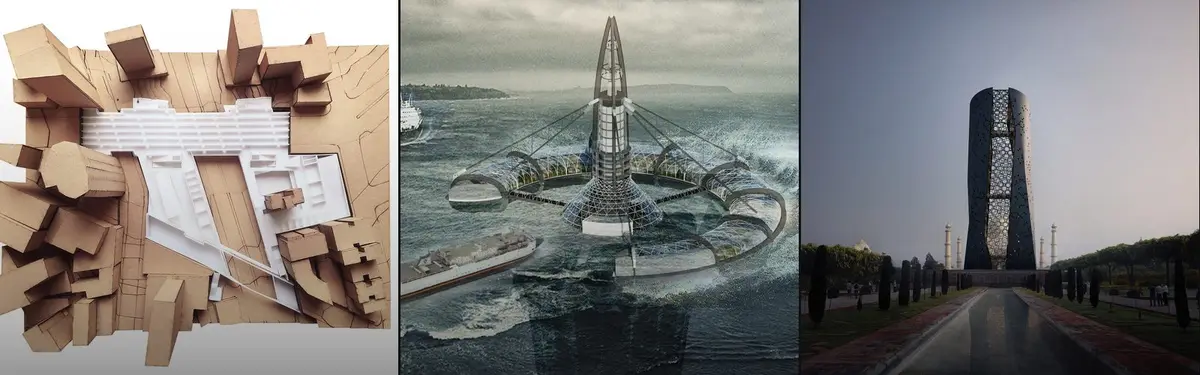


Art Direction
Strategic visual and conceptual direction that shapes design projects from concept through execution.
Art direction is the work of deciding how a project should look and feel, and then making sure every image, set, page or render follows that decision. An art director sets the visual style, palette, mood and references, and guides the designers, artists and photographers who carry them out. The aim is a body of work that tells one story instead of many unrelated ones.
What is art direction?
Art direction sits between an idea and its execution. A brief says what a campaign, film or building proposal must communicate; the art director turns that into visual rules: which colours, which kind of light, which camera angles or typefaces, what the images should leave out. The role exists across advertising, publishing, film, television, theatre, fashion, the web and video games, and in each field the art director supervises the visual style of a production and how it communicates.
In advertising and publishing, an art director usually works with a copywriter as a creative team. Together they devise the concept, the "big idea", for an advertisement; the copywriter is responsible for the words and the art director for the visuals, and a creative director typically oversees the pair. In magazines and books, art directors decide layouts, commission photography and illustration, and keep a publication recognisable issue after issue.
In film and television, the art director heads the art department and works directly below the production designer, alongside the set decorator and set designers. The production designer owns the overall look; the art director turns it into drawings, schedules and built sets. In games, an art director sets the style that concept artists, modellers and animators follow, so that thousands of assets feel like one world.
Art direction is not the same as graphic design, although many art directors start as designers. A graphic designer solves a specific layout or identity problem. An art director decides what the whole set of images should feel like and judges each piece against that intention.
Architecture has its own version. A competition entry or a set of marketing visuals needs someone to decide the time of day, the weather, the palette, the human figures and the order in which images appear. That is art direction, whether or not anyone holds the title.
A short history of art direction
The title grew out of print advertising. The Art Directors Club was founded in New York by Louis Pedlar on August 13, 1920, to make sure advertising was judged by the same standards as fine art, and it organised the first juried exhibition of advertising art in 1921.
"[A]rtistic excellence is vitally necessary to successful advertising."
Earnest Elmo Calkins, quoted by The One Club on the founding of the Art Directors Club
Mid-century agencies changed how the role worked. Bill Bernbach of DDB is credited with pioneering the pairing of art director and copywriter, in which either partner can contribute to the concept, the copy or the visual approach. That team structure is still standard in agencies today.

Film adopted the term early. The title "art director" was first used in 1914 by Wilfred Buckland, for the head of a film's art department. Large silent productions showed what the job could do: D. W. Griffith's Intolerance (1916) gave each of its four parallel stories its own distinctive colour tint in the original print, an early case of colour used to separate narratives. On Gone with the Wind, David O. Selznick felt William Cameron Menzies shaped the look of the film so much that he gave him the new title of production designer.

The Academy Awards have recognised the work since the first ceremony on May 16, 1929. The category was called Best Art Direction until 2012, when it became Best Production Design for the 85th Academy Awards.
Art direction in architecture and visualisation
Architects were directing the mood of images long before computer renders. Giovanni Battista Piranesi studied architecture and stage design, and his imaginary prison etchings of 1749 to 1750 show monumental, half-impossible interiors lit from several directions. The National Gallery of Victoria describes how he used a sketchy etching style to evoke the play of light and shade.
"Piranesi constructs the scene like a stage set, using multiple light sources and perspectival vanishing points for dramatic effect."

In the twentieth century, the American delineator Hugh Ferriss specialised in renderings of other architects' buildings, made to promote projects to a wider audience. His 1929 book The Metropolis of Tomorrow collected conté crayon sketches of tall buildings, including step-by-step studies of the building mass that New York's 1916 zoning law allowed, rendered as dramatic studies in light and shadow. The American Society of Architectural Illustrators still awards a Hugh Ferriss Memorial Prize through Architecture in Perspective, its annual juried competition for architectural illustration.

Today the same decisions are made in 3D visualisation. An architect or visualiser art-directs a set of renders by fixing the time of day, sky, lens, palette and people before production starts, then holding every view to those rules. On a competition board, art direction also covers sequence: which image opens the story, which drawing explains it and which one closes it.
Key principles of art direction
Concept and narrative
Every strong piece of art direction starts from one idea that can be said in a sentence. The visuals then serve that idea. In architecture competitions the narrative is often a metaphor, a memory or a site story, and the images exist to make it felt.

Visual consistency
A series of images should look as if one person made them, even when a team did. Consistent lighting, camera height, line weight, typography and post-production are what make a board or a campaign read as a single piece of work.
Colour and mood
A limited, deliberate palette sets emotion faster than any caption. Warm dusk light, cold overcast skies or a near-monochrome scheme each tell the viewer how to feel about a space before they understand its plan.
Collaboration and briefs
Art directors rarely make every image themselves. They write visual briefs, gather references and mood boards, and review work from photographers, illustrators, modellers and set builders. Clear briefs save more time than any software.
Editing
Choosing what to leave out is as important as choosing what to show. A tight edit of five strong images usually beats twelve average ones, and it keeps the narrative from being diluted.
Art direction on uni.xyz
The art direction topic on uni.xyz holds more than 100 projects, almost all of them architecture competition entries in which the visual story carries the design. They are useful precisely because each one had to win a jury's attention through a few boards.
The most liked project in the topic is PRAKOSHTH by Shivani Dolas, Prashansa Parashar and Sajal Patidar, an entry to the Bharat Bhavan 2020 competition. Sited in Ranchi, Jharkhand, it merges tangible and intangible built forms with the landscape to create a platform for fine arts, literature, theatre, cinema, dance and music.

A cluster of entries to The Black Taj competition shows how many different visual stories can grow from one prompt. Legends attributed to the seventeenth-century traveller Jean Baptiste Tavernier say Shah Jahan wished to build a black twin of the Taj Mahal for himself, a project that was never achieved. The winning entry, Presence in Absence by pranav, treats the Taj Mahal as architectural poetry and pursues a space that is bold yet calm. The Broken Tomb, an Honorable Mention by Marta, Chiara and Marta, reads the Black Taj as a memory of pain and agony, a cracked void that serves as a window onto Mumtaz's life. The Exemplar of Mughal Architecture by Pratik Changela, Kishan, Abhishek and Jeet, a Runner-up, takes a metaphoric approach meant to make people think repeatedly, unfolding different layers of history each time.

Making a New Ruin by Yat, another Honorable Mention, takes the form of a ruin to draw attention to the absence of the Taj, and frames its own images in photographic terms.
"Like a great photograph that arouses speculation of what happened before and after the moment it was taken, it is to be completed only by the imaginations of its visitors."
Yat, Making a New Ruin (project statement on uni.xyz)
Thesis projects show the same instinct at a larger scale. The Ship of Theseus: As a Social Plug-in, Mumbai by Kaushal Tatiya, a winning entry in the UnIATA '19 competition, uses the ship of the old paradox as a metaphorical protagonist for identity on Mumbai's industrial edge. FLOWING TIME by Xiangyu Zhang, Yaohong Liu, Ziyang Qi and Xiaoxi Gu, an entry to the Circle of Life competition, builds a cemetery around the Chinese tradition of respecting the deceased and the feng shui custom of siting cemeteries between mountain and water, with a name meant to suggest the infinity of time.
Challenges and future directions
Image tools have changed faster than the habits around them. Real-time engines and AI image generators can produce dozens of attractive views in an afternoon, which makes consistency and restraint harder, not easier. The art director's value shifts toward choosing: one lighting logic, one palette, one sequence, and the discipline to discard images that are beautiful but off-message.
There is also an honesty problem. Mood can flatter a weak design, and juries and clients have learned to distrust renders that look like film stills. The strongest art direction in architecture makes the idea clearer, showing how a space works as well as how it feels. Sustainability and accessibility claims in particular need drawings and diagrams, not just atmosphere.
Finally, art direction is increasingly shared across media. A single project may need a board, a short film, a social post and an interactive model, and each must still feel like the same project.
Art direction for students and designers
Students can practise art direction on every studio project by writing a one-page visual brief before making any images: the idea in a sentence, three reference images, a palette and a rule for light. Thesis angles include the visual language of memory and ruins, cinematic sequencing of architectural space, or how set design techniques can inform exhibition and retail interiors.

Competitions are the quickest training ground, because a jury judges the story in seconds. Browse current briefs on uni.xyz competitions, and look at related topics such as concept art and game design to see how other industries build visual worlds.
Frequently asked questions
What does an art director do?
An art director decides the visual style of a project and makes sure every image, layout or set follows it. In practice that means writing visual briefs, choosing references and palettes, guiding designers and artists, and reviewing their work.
What is the difference between an art director and a creative director?
In advertising, an art director usually works with a copywriter on a specific campaign, while a creative director oversees one or more of these teams and is responsible for the agency's overall creative output.
What is the difference between art direction and production design in film?
The production designer is responsible for the overall look of a film. The art director heads the art department under the production designer and turns that vision into drawings, budgets and built sets. On small films the two titles are often used interchangeably.
What is art direction in architecture?
It is the set of decisions that shape how an architectural project is presented: the mood, palette, lighting and sequence of renders, drawings and boards. It makes sure a set of images tells one consistent story about the design.
Is there an Oscar for art direction?
Yes. The Academy Award for Best Art Direction was renamed Best Production Design in 2012, starting with the 85th Academy Awards.
References and further reading
- The One Club Launches ADC Centennial With Year-Long ADC100 Celebration, The One Club for Creativity
- Giovanni Battista Piranesi, The well, National Gallery of Victoria
- American Society of Architectural Illustrators, ASAI
- Art director, Wikipedia
- Academy Award for Best Production Design, Wikipedia
- Intolerance (film), Wikipedia
- Hugh Ferriss, Wikipedia
- Mehtab Bagh, Wikipedia


