


Bridge Design
Bridge design across pedestrian, cycling, and urban crossings, from movable river spans to inhabitable connectors linking city streets.
Bridge design is the discipline of shaping a structure that carries people, vehicles or water across an obstacle such as a river, valley, road or railway. It brings together structural engineering, which keeps the crossing standing under every load it will meet, and architecture and urban design, which decide how the bridge looks, how it meets the ground and how it feels to cross. A well designed bridge solves a span problem and also gives a place a new public edge.
What is bridge design?
At its simplest, a bridge is a deck held up by beams, arches or cables. The design task is to choose which of those systems suits the span, the ground conditions, the traffic and the budget, then to refine every element until it is safe, buildable and worth looking at. Engineers lead on structure, foundations and load analysis. Architects and landscape designers increasingly lead on form, approaches, lighting, materials and the experience of the person on the deck.
Bridge design overlaps with infrastructure design, but it is narrower and more visible. A pipe network or a substation can be hidden; a bridge cannot. It sits in the open, often over water, and becomes a landmark whether or not anyone intended it. The most remembered bridges are those where engineering logic and architectural intent are the same thing.
The field also sits close to urban design. A new crossing changes how a district works: which streets fill with people, where shops open, how far a short walk can reach. Many proposals discussed below treat the bridge as a public space with a view rather than a line between two banks.
A short history of bridge design
The Romans turned the stone arch into a system. The Pont du Gard, built in the first century AD near Nîmes in southern France, is an aqueduct bridge with three tiers of limestone arches standing 48.8 metres high. It carried water to the Roman colony of Nemausus and is one of the best preserved structures of its kind.

For centuries stone and timber were the only serious options. That changed in Shropshire, England. The Iron Bridge first spanned the River Severn at Coalbrookdale on 2 July 1779 and opened to traffic in 1781. With Abraham Darby III responsible for the ironwork, it became the first major bridge in the world made of cast iron, with a single span of about 30.6 metres, and its success encouraged the use of iron as a structural material.

Steel and wire cable then pushed spans much further. The Brooklyn Bridge in New York, designed by John A. Roebling and completed by his son Washington Roebling with the engineer Emily Warren Roebling, opened in 1883. According to the New York City Department of Transportation, its main span is 1,595.5 feet and it was the longest suspension bridge in the world at the time. In 1937 the Golden Gate Bridge opened in San Francisco; the Golden Gate Bridge District gives its main span between the towers as 4,200 feet, and according to Wikipedia it was the longest suspension span in the world until 1964.
The late twentieth century made the cable-stayed bridge a favourite for long, elegant crossings. The Millau Viaduct in southern France, designed by a team led by the engineer Michel Virlogeux and the architect Norman Foster, was completed in 2004 with a structural height of 343 metres, and was the tallest bridge in the world for about two decades.
Types of bridges
Bridges are usually classified by the way they carry load. The standard classification names six basic structures plus a family of movable types.
Beam bridges
One or more horizontal beams or girders span between supports. They are the simplest and most common type, and they are generally used for spans shorter than about 50 metres.
Arch bridges
A curved arch works in compression and carries the deck above it, below it or through its middle. The arch suits stone and brick, which is why Roman and medieval bridges were nearly all arches, but it is now built mostly in concrete or steel.
Truss bridges
A truss is a frame of connected triangles. It is stiff for its weight, which made it a standard for railways.
Cantilever bridges
Beams or trusses are fixed rigidly to a pier and project outwards without support beneath them, often meeting a matching arm from the opposite side. Scotland's Forth Bridge, completed in 1890, is the famous steel example.
Suspension bridges
Large curved cables hang between tall towers and the deck is hung from them. Bundled steel wire made very long spans possible, which is why suspension bridges hold most of the records for span length.

Cable-stayed bridges
The cables run straight from the towers to the deck, in a fan or harp pattern. They use less cable than a suspension bridge for a given span, need no heavy anchorages, and the deck can be built by cantilevering out from each tower.
Movable bridges
All or part of the deck moves to let tall boats pass. Bascules lift on a counterweighted hinge, swing bridges rotate horizontally, lift bridges rise between towers, and a few rare designs tilt. Movable decks suit working harbours and appear in many member proposals. The Unlocking Bridge by Alicja Maculewicz and Emilia Dzięgelewska uses a swinging arm that serves cyclists and pedestrians across the harbour when open and creates a new shortcut through a bay of Christiania when closed.

Key principles of bridge design
Loads and spans
Every bridge must carry three kinds of load: its own weight (dead load), the traffic crossing it (live load) and the forces of its surroundings, from wind and temperature change to floods and earthquakes. Span length drives the choice of type: beams for short gaps, trusses and arches for medium ones, cables for the longest.
Materials
Stone and brick work only in compression, so they belong in arches and foundations. Steel is strong in both tension and compression, which is why it appears in almost every truss and cable. Reinforced and prestressed concrete is cheap, durable and mouldable. Timber, often as glued laminated sections, has returned for footbridges where its warmth and low carbon footprint matter more than span.
Context
A bridge has to fit its banks, its river traffic and its skyline. On uni.xyz, The City Link by María Camila Leal Acevedo, Josue amaya gonzalez and ROAM ESTUDIO shows this principle well: the team describes a structure in dialogue with its surroundings that recalls the history of Danish architecture, combining current structural and tectonic techniques with vernacular form.

Pedestrian experience
For people on foot or on a bike, the quality of a crossing is measured in gradients, widths, shelter, lighting, views and places to stop. A deck that is pleasant to linger on attracts use; a narrow, windswept one gets crossed as fast as possible. That idea runs through almost all the member work below.
Pedestrian and cycle bridges
Footbridges range from simple boardwalks over marshland to urban crossings that reshape a waterfront. They carry lighter loads than road bridges, so they can be slimmer and more expressive, but they are also more sensitive to vibration. London's Millennium Bridge, a steel suspension footbridge, began to sway on its opening day in June 2000 because walkers fell into step with its movement, an effect its engineers called synchronous lateral excitation; it closed for almost two years while dampers were fitted, as the history of the bridge records.
Movable footbridges add drama. The Gateshead Millennium Bridge over the River Tyne, opened in 2001 and designed by WilkinsonEyre with the engineers Gifford, was the world's first tilting bridge, and its architects' project page notes that it won the RIBA Stirling Prize in 2002.

Cycling has changed the brief for older bridges too. The New York City Department of Transportation reports that a two-way protected bike lane opened on the Brooklyn Bridge in September 2021, taking over one lane of vehicle traffic. Uni.xyz has a separate collection for pedestrian bridge projects, and much of the work there follows the brief this section describes, where the crossing is itself the destination. A member statement puts the ambition plainly:
"This bridge will bring people together and unite those with varied purposes, enabling all walks of life to enjoy the interconnected public spaces."
Bryce Jarman, Stephen Travers, Liam Ryan and Caitlin Chin, project statement for Interconnected
Their Copenhagen proposal, which sets out to celebrate cycling, separates a fast commuter deck from a slower leisure path that winds through planted terraces above, all wrapped in one organic shell. For designers working on cycling bridges, that split by speed is a useful model.
Bridge design on uni.xyz
The largest single body of bridge work on uni.xyz comes from The City Link competition, which asked for a new pedestrian and cycling bridge in Copenhagen. The entries show how many ways a single brief can be read.
The most liked project in the collection is The Vayu Bridge by Shubham Jangid, Shailin Dayani and Harsh Khodiar, which won a People's Choice Award in The City Link competition. The team frames it with three words, free spirit, happy locals and hygge, putting the mood of the crossing ahead of its mechanics.

The Unlocking Bridge, discussed above under movable types, received an Honorable Mention in the same competition. Its swinging arm makes the bridge, in the team's words, dual in its nature.
Our editorial on Link Tree Bridge looks at a shortlisted City Link entry by Фаиль Гильманов, whose branching steel supports rotate up to 90 degrees when a boat needs to pass. The journal reads the branching geometry as load-bearing logic made visible, and records that the juror Silvia Rizzo praised its clear ideas while questioning its scale. Another shortlisted entry, The Six Guardians by Susan Hoekstra and Roman Birrer, breaks the crossing into six planted inverted pyramids and two floating platforms, so the walk over the water becomes a walk through a small forest.
The Sailing Ship Bridge by Eizo Nagasawa is a rare cable-stayed proposal among the student work: a sail-like mast anchors fanned cables that carry the cycling route, and a docked sailing ship becomes part of the bridge's opening sequence, drawing on Denmark's sailing heritage.
Not every crossing is a movable span. Space Bridge, by Евгений Зайцев, Taras Chepikov, Egor Vorobev and настя шкарупа, widens a pedestrian river crossing into a deck large enough to hold several activities at once, then lets its central section open for river traffic after commuting hours. Our editorial sums up the argument in one line:
"Most bridges are judged by how quickly they get you off them. Space Bridge asks the opposite question: what if the crossing were worth lingering on?"
UNI Editorial, Space Bridge: A Movable River Crossing That Doubles as an Elevated Urban Square

Some of the strongest work leaves Copenhagen. Commercial Bridge, a thesis by Aafreen Fatima, turns the link between Commercial Street and Brigade Road in Bangalore's central business district into a linear building of retail, leisure, cultural and civic space, filling a stretch that lacks walkable continuity. Puliya by Saheel Birewar, an entry to the Parasitic Architecture 2020 competition, sees transit infrastructure such as bridges in dense cores like Chandrapur as sites for public life.
Challenges and future directions
Bridges are long-lived and expensive, and their failures are public. Wind is the classic risk: the Tacoma Narrows Bridge collapsed in 1940 because its designer did not account for wind-induced flutter. Footbridges face the subtler problem of crowds moving in step, as London learned in 2000.
The design challenges ahead are mostly about people and carbon. Cities are reallocating road space to bikes and pedestrians, which means retrofitting existing crossings as well as building new ones. Embodied carbon is pushing designers to use less steel and cement and to reconsider engineered timber for shorter spans. And the cultural expectation has shifted: a crossing is now expected to work as public space, with shade, seating and views, rather than a corridor to hurry through.

That expectation has a cost: a deck loaded with cafés and gardens is heavier and harder to maintain, and the Link Tree jury comment about scale is a reminder that ambition must still fit its setting.
Bridge design for students and designers
Bridges make strong thesis and competition subjects because they force a clear structural idea and a clear public idea at once. Promising angles include retrofitting a road bridge for walking and cycling, a movable crossing for a working harbour, a footbridge in engineered timber, or, like Marcos Bresser's thesis on viaduct crossings in São Paulo submitted to UnIATA '18, using existing infrastructure to repair a neglected district.
Test the structure early with simple models and design the approaches as carefully as the deck. Browse movable bridge projects for mechanisms, look at public space work for programme ideas, and find a live brief among current architecture competitions.
Frequently asked questions
What are the main types of bridges?
The six basic structural types are beam, arch, truss, cantilever, suspension and cable-stayed bridges. Movable bridges, including bascule, swing, lift and tilt bridges, form a further group defined by how the deck moves rather than how it carries load.
Which bridge type is best for long spans?
Suspension and cable-stayed bridges achieve the longest spans because both rely on high-strength steel cables. Suspension bridges reach further; cable-stayed bridges use less cable.
What loads must a bridge be designed for?
Designers consider the dead load (the bridge's own weight), the live load (traffic, including braking and acceleration) and environmental loads such as wind, temperature change, floods and earthquakes. Long, slender bridges also need checks for vibration.
What makes a good pedestrian bridge?
Gentle gradients, enough width to stop without blocking others, separation between walkers and cyclists where both are heavy, good lighting, and a deck that is stiff enough not to sway under crowds.
What was the first iron bridge?
The Iron Bridge at Coalbrookdale in Shropshire, England, first spanned the River Severn in 1779 and opened in 1781. It was the first major bridge in the world made of cast iron.
References and further reading
- Bridge, Wikipedia
- Pont du Gard, Wikipedia
- The Iron Bridge, Wikipedia
- Brooklyn Bridge, New York City Department of Transportation
- Design and Construction Stats, Golden Gate Bridge, Highway and Transportation District
- Millau Viaduct, Wikipedia
- Millennium Bridge, London, Wikipedia
- Gateshead Millennium Bridge, WilkinsonEyre


Popular projects
View all 96 projects


Latest journals
View all 42 journals

Space Bridge: A Movable River Crossing That Doubles as an Elevated Urban Square
A widened, transformable pedestrian bridge that splits for river traffic off-peak and folds cycling, rest and wayfinding into one civic deck.
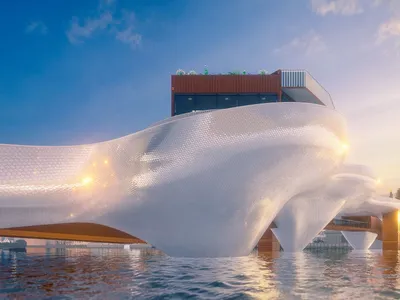
Interconnected: A Copenhagen Bridge That Gives Cyclists Two Speeds and a Park in Between
A layered cycling bridge for Copenhagen separates a fast commuter deck from a slow leisure route that winds through elevated gardens and a café.
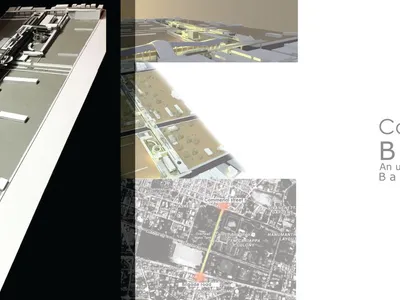
Commercial Bridge, Bangalore: An Inhabitable Spine Stitching Commercial Street to Brigade Road
Aafreen Fatima's thesis turns a bridge into a mixed-use public realm, shifting from open shopping street to enclosed mall across Bangalore's CBD.

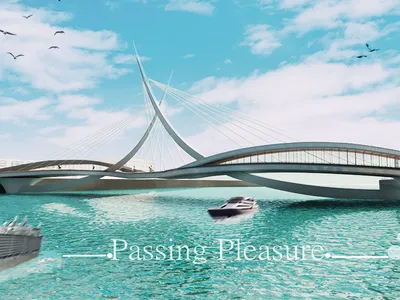
Passing Pleasure: A Pedestrian Bridge Designed to Make You Stay
Hani Mansurnejad reimagines the urban bridge as a layered civic stage for cycling, pausing, and social life along a Copenhagen canal.


