

Passing Pleasure: A Pedestrian Bridge Designed to Make You Stay
Hani Mansurnejad reimagines the urban bridge as a layered civic stage for cycling, pausing, and social life along a Copenhagen canal.


Most pedestrian bridges ask one thing of you: keep moving. Passing Pleasure asks the opposite. Conceived as a civic landmark rather than a piece of transit infrastructure, the project layers sidewalks, a dedicated cycling route, and public pause zones into a single curving structure that spans a canal. The bridge opens horizontally to let ships pass, then closes again, folding interruption into the rhythm of urban life. It is a crossing that doubles as a destination, a connector that functions as a social condenser.
Designed by Hani Mansurnejad, the project draws its formal language from the organic patterns of Copenhagen's Christiania district, translating the area's curving streets and textured surfaces into a fluid architectural volume. The result is a bridge that refuses to be neutral. It takes a position: that contemporary cities need infrastructure capable of generating social life, not merely facilitating movement from point A to point B.
Timber Curves and a Stepped Pavilion at the Water's Edge

The waterfront approach sets the tone immediately. Curving timber benches follow the edge of the promenade, guiding visitors toward a stepped pavilion that mediates between the level of the city and the plane of the water. The material palette reads as warm and tactile against the overcast sky, a deliberate contrast to the hard grey infrastructure that typically defines canal crossings. These ground-level elements are not afterthoughts; they are integral to the project's argument that a bridge's influence extends well beyond its span.
Three Layers of Program, Zero Conflict

The exploded diagram reveals the bridge's organizational logic with precision. Three distinct layers occupy the cross-section: pedestrian sidewalks along both edges for social movement and observation, a central cycling route ensuring uninterrupted and safe bicycle flow, and dedicated public pause zones tucked between the two. Colored activity circles map cafés, seating areas, temporary installations, and observation points onto the plan, showing how welfare-oriented functions are distributed across the bridge's length rather than concentrated at its ends.
This tripartite configuration is the conceptual backbone of the project. By separating fast movement (cycling) from slow movement (walking) and stationary activity (pausing), the design eliminates the pedestrian-cyclist conflicts that plague so many shared bridges. Each layer operates independently while remaining visually and spatially connected to the others, reinforcing the idea that diverse activities can coexist within a single continuous structure.
A Cable-Stayed Deck That Reads as Urban Signal
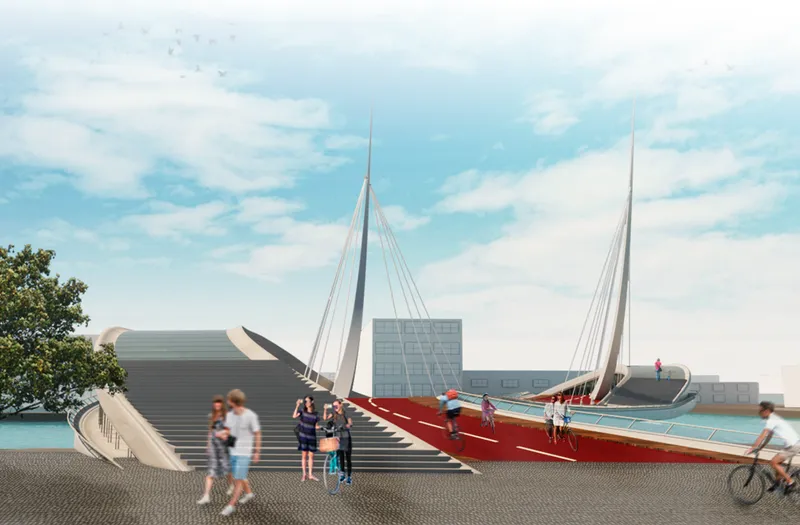
In perspective, the bridge asserts itself. A red deck stretches between waterfront zones, held aloft by cable stays that give the structure a taut, energetic silhouette. Cyclists and pedestrians share the crossing but occupy clearly differentiated paths, and the bridge's visual identity is unmistakable from a distance. Mansurnejad treats cycling not as a utilitarian function to be accommodated but as a cultural act to be celebrated. The bold color and prominent structural expression make the bridge a visible symbol of progressive urban mobility, one that strengthens the relationship between citizens and their city.
An Arched Structure That Opens for the Canal

The physical model reveals the engineering ambition. A two-part arched system, supported by bay posts and restrained by cable elements, allows the bridge to split and open horizontally when ships need to pass through the canal. A sailboat glides beneath the span in the model, demonstrating the clearance and the structural articulation required for the movable mechanism. Urban blocks line both banks, establishing the bridge as a connective tissue between existing neighborhoods rather than an isolated sculptural object.
What makes the opening mechanism compelling is Mansurnejad's insistence that the bridge remains active even when split. Programmed edges, visual connections across the gap, and the spatial drama of the event itself turn each ship passage into a moment of collective urban theater. The interruption is not a failure of continuity but a designed feature, a spectacle that draws people to the bridge precisely when it cannot be crossed.
Why This Project Matters
Passing Pleasure takes a familiar typology and asks it to do significantly more work. Pedestrian bridges are among the most underdesigned elements in contemporary cities, typically reduced to structural spans with railings. By layering social program, cycling culture, and movable engineering into a single fluid form, Mansurnejad demonstrates that infrastructure can generate public life rather than simply service it. The project's spatial strategy, with its clear separation of movement speeds and its distributed pause zones, offers a replicable logic for waterfront cities struggling to reconcile pedestrian comfort with sustainable mobility.
More broadly, the project challenges the assumption that a bridge's value is measured solely by the efficiency of its crossing. Here, the crossing is almost incidental. What matters is the lingering: the coffee at a canal-side café, the view from an observation point, the pause on a timber bench as a ship passes below. In reframing the bridge as a civic stage, Passing Pleasure makes a quiet but forceful case that the best infrastructure is the kind people choose to inhabit long after they have finished crossing.
View the Full Project
About the Designers
Designer: Hani Mansurnejad
Enter a Design Competition on uni.xyz
uni.xyz runs architecture and design competitions year-round that reward proposals with spatial conviction and real site intelligence.
Project credits: Passing Pleasure by Hani Mansurnejad.


Popular Articles
Popular articles from the community


Manzana Morphosis: Stretching Barcelona's Grid into a Living Landscape for 2050
A radical reworking of the Eixample manzana turns density into a tool for generous public space, vertical ecology, and environmental performance.


graciastudio Turns a Viewless Tijuana Lot Inward Around a Courtyard of Concrete, Timber and Trees
In Tijuana, Jorge Gracia's GA2 House stacks a timber-clad private floor over exposed concrete and replaces a missing view with a planted interior patio.

David Ortega Stacks a Two-Story Mexico City Penthouse Around a Steel Stair and a Pergola-Shaded Roof Terrace
In Colonia Roma, a 300 m² penthouse uses oak joinery, a planted steel stair and a slatted roof pergola to make a new-build apartment feel like a house.

Singing Woman: An Opera House That Performs Before the Curtain Rises
Ovidiu Cristian Pavel's conceptual opera house translates Estonia's choral identity into a sculpted waterfront landmark facing the Baltic Sea.

Similar Reads
You might also enjoy these articles
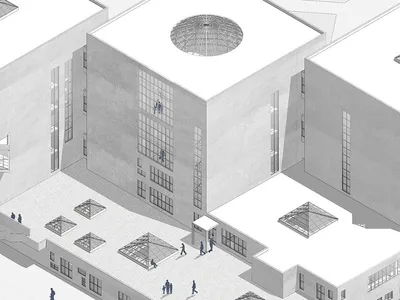
Yenisei Monitoring Center: A Sun-and-Moon Sphere Anchors a Research Campus on Siberia's Great River
In Krasnoyarsk, shifting square blocks, a glazed central sphere and descending window rhythms turn river science into a public spectacle on the Yenisei.
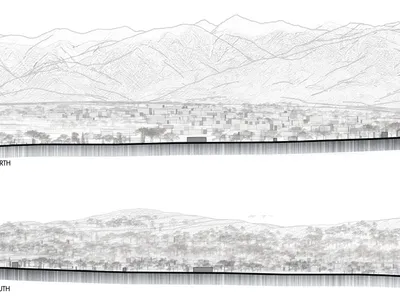
Andretta Artist's Village: A Node-Based Masterplan That Lets the Hills Write the Plan
A cultural landscape strategy for Palampur's artist colony threads studios, residences and stages along a porous spine shaped by the Dhauladhar terrain.
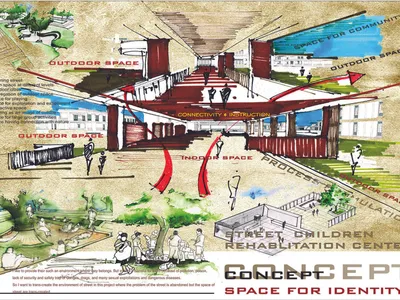
Street Children Rehabilitation Center: A Brick Campus That Eases Children From Street to Safety
A low-rise courtyard campus where learning streets, uthans and shaded verandahs stage a gradual passage from street into protective, family-scale life.

The NEON Culture: A Field of Pavilions Built for the 24-Hour City
Smaran Alva spreads galleries, stages, clubs and markets across a varied site, treating light, sound and ramped movement as the real building materials.

Explore Pedestrian Bridge Competitions
Discover active competitions in this discipline

Challenge to design locus for the upliftment of human rights

Design challenge to reuse E-waste
Comments (0)
Please login or sign up to add comments
No comments yet. Be the first to comment!