
Sailing Ship Bridge: Infrastructure as Maritime Memory in Copenhagen
A cycling bridge that folds around a sailing ship, turning Copenhagen's waterfront into a layered public space rooted in Viking heritage.


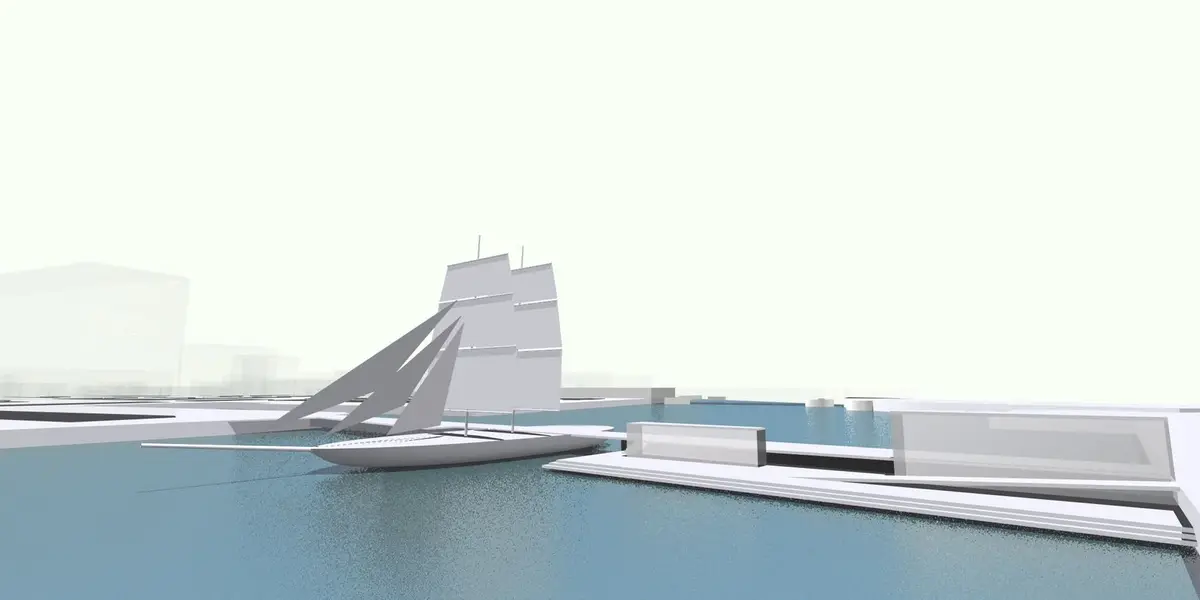
Most movable bridges treat their opening cycles as interruptions. The Sailing Ship Bridge treats them as performances. Conceived for Copenhagen's harbor, this conceptual proposal fuses a cable-stayed cycling route, a docked sailing ship, and a tidal floating deck into a single adaptive system that never fully shuts down. When the bridge opens to let marine traffic pass, its three components separate but remain individually active as public spaces, turning what would normally be dead time into a moment of civic spectacle on the waterfront.
The project is designed by Eizo Nagasawa, who positions the bridge as an argument that sustainability is cultural as much as it is technological. Denmark's Viking origins and deep sailing traditions are not decorative references here; they are the structural logic. The sailing ship is not a sculpture bolted onto infrastructure. It is an architectural component that cyclists ride alongside, that pedestrians board, and that physically participates in the bridge's movement sequence.
A Mast as Structure: Cable-Stayed Geometry from Sailing Heritage
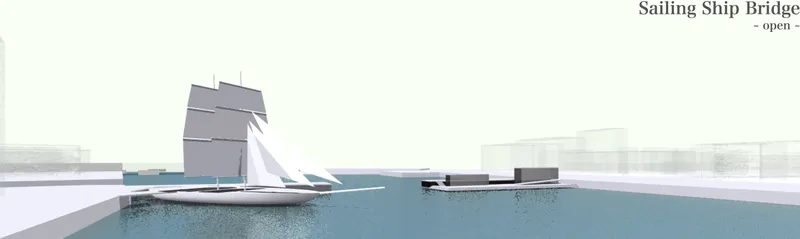
The bridge's most immediately legible gesture is its sail-like tower, which rises from the deck and anchors a network of tensioned cables that support the cycling route on either side. The structural language borrows directly from rigging: cables fan outward from the central mast at varying angles, distributing loads the way stays distribute wind force on a vessel. The result is a slender profile that reads as nautical rather than industrial, grounding the bridge in Copenhagen's harbor context without resorting to literal mimicry.
From an angled vantage point, the tensioned supports reveal their asymmetric arrangement, responding to the different span lengths on each side of the mast. The cycling road itself is pile-supported for structural independence, ensuring that even when the sailing ship element detaches during an opening cycle, riders maintain a safe, stable surface. Designed for a cycling speed of approximately 20 km/h, the route deliberately includes rest spaces that invite users to slow down, feel the wind, and register the waterfront as something more than a blur of blue.
Connecting Two Promenades Across the Canal
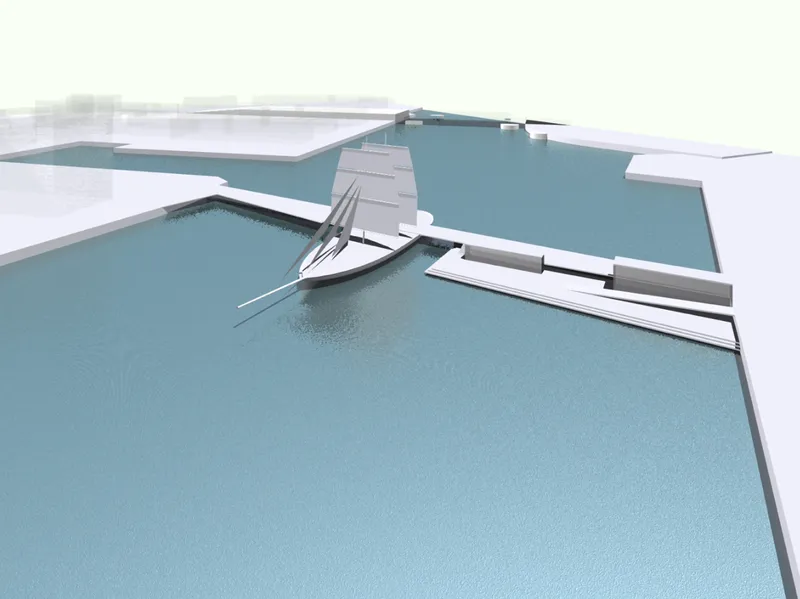
Seen from above, the bridge's role as urban connector becomes clear. It stitches together two waterfront promenades that would otherwise require a long detour, transforming a gap in the pedestrian and cycling network into a direct, experiential crossing. The aerial perspective also reveals the layered composition: the fixed cycling path, the sailing ship element docked alongside it, and the floating deck closer to the water surface all occupy distinct elevations while sharing a single corridor of movement.
This layering is what separates the Sailing Ship Bridge from conventional movable bridges. A typical bascule or swing bridge offers one datum: you are either on the deck or you are not. Here, three datums coexist, each with its own spatial quality. Riding across the city, stepping onto a historic vessel, or sitting at tidal level near the water's surface are three genuinely different experiences available within the same piece of infrastructure.
Low Profile and Floating Deck: Keeping Close to the Water
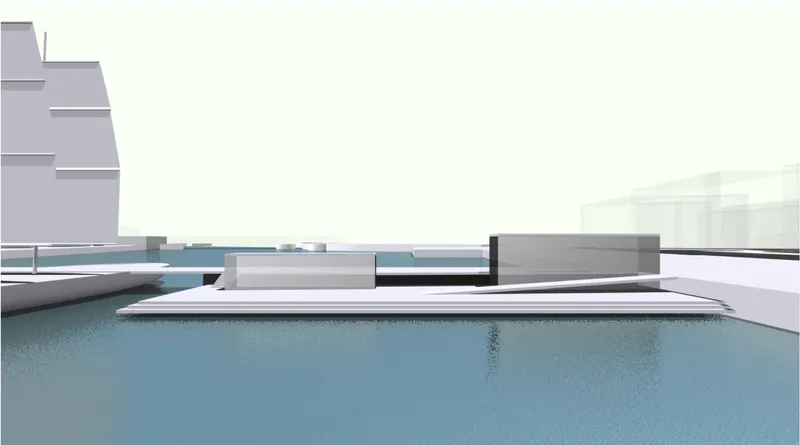
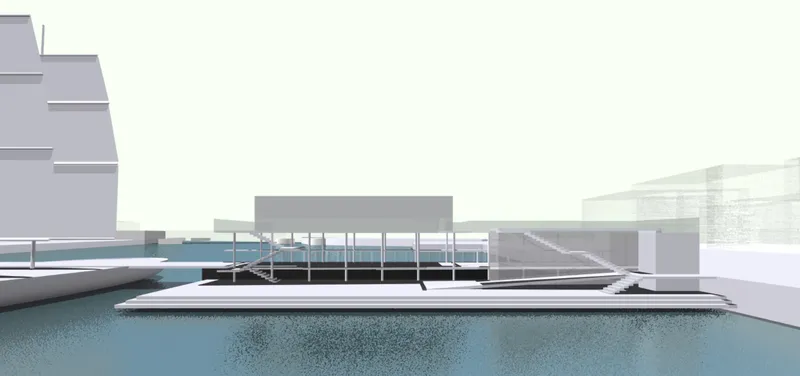
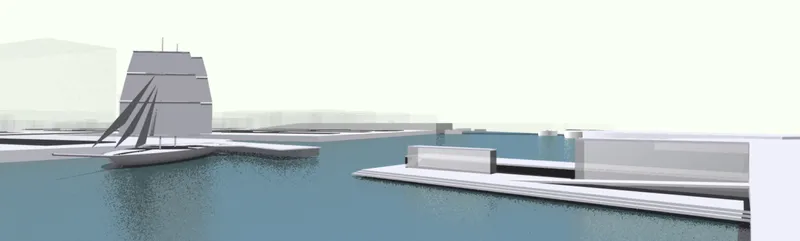
The side elevation reveals just how low the bridge sits relative to the harbor surface. A central pavilion, wrapped in glass, occupies the midpoint of the deck and serves as a sheltered gathering space. The deliberate horizontality keeps the crossing intimate; users are not elevated above the water but held in close contact with it. The floating deck component, visible in the longer view, adjusts its level according to tidal changes, maintaining a consistent relationship between visitors and the sea across seasons.
The glass-walled pavilion and adjacent staircase visible at one end of the platform suggest a programme that extends beyond transit. The stairs provide direct access down to the floating level, reinforcing the idea that the bridge is a destination, not merely a threshold. The folded bridge mechanism, which allows both sides to fold inward using internal rollers when the sailing ship moves, is designed so that the opening choreography reads as a performative urban event rather than an inconvenience. Even at rest, the mechanical joints and hinge geometry are legible, giving the structure an honest, working-harbor character.
Sustainability as Emotion, Not Obligation
Nagasawa makes an argument that is easy to state but difficult to design for: sustainable transportation choices are driven by emotional connection, not infrastructure alone. Copenhagen already has world-class cycling networks. What the Sailing Ship Bridge adds is narrative. Riding alongside a vessel that represents low-carbon mobility, resilience, and harmony with natural forces reframes the daily commute as an act of cultural continuity. The bridge proposes that pleasure, imagination, and memory are legitimate design parameters for infrastructure.
By reusing and reinterpreting traditional forms rather than inventing purely abstract ones, the project also challenges the assumption that sustainable design must look futuristic. Denmark's sailing ships appeared in churches, in public memory, and on the open sea long before carbon accounting existed. Embedding one into a functioning bridge is a way of saying that the knowledge we need for a resilient urban future is partly inherited, not entirely invented.
Why This Project Matters
The Sailing Ship Bridge matters because it refuses the binary that plagues most movable bridge design: open or closed, active or idle, infrastructure or public space. By composing three independent but interconnected elements, Nagasawa creates a system that is always partially operational and always partially social. The bridge opening is not a disruption; it is a reason to stay.
More broadly, the project offers a model for how cultural identity can do structural and programmatic work in infrastructure design. The sailing ship is not an ornament. It carries loads, it moves, and it defines the bridge's opening sequence. When heritage operates at that level of integration, sustainability stops being an abstract metric and starts being something people can see, touch, and ride across every day.
View the Full Project
About the Designers
Designer: Eizo Nagasawa
Enter a Design Competition on uni.xyz
uni.xyz runs architecture and design competitions year-round that reward proposals with spatial conviction and real site intelligence.
Project credits: Sailing Ship Bridge by Eizo Nagasawa.


Popular Articles
Popular articles from the community


ETEH Reworks the Shared Spaces of São Domingos School in Brazil Around Timber, Color and Hanging Plants
At São Domingos School in Brazil, 436 m² of hall, refectory and library are recast with timber joinery, a yellow and blue code and trailing greenery.


Manzana Morphosis: Stretching Barcelona's Grid into a Living Landscape for 2050
A radical reworking of the Eixample manzana turns density into a tool for generous public space, vertical ecology, and environmental performance.

David Ortega Stacks a Two-Story Mexico City Penthouse Around a Steel Stair and a Pergola-Shaded Roof Terrace
In Colonia Roma, a 300 m² penthouse uses oak joinery, a planted steel stair and a slatted roof pergola to make a new-build apartment feel like a house.

FCC Arquitectura Expands a Portuguese Granite House with a Board-Marked Concrete Wing
In Portugal, JV House pairs a cleaned-up whitewashed and granite dwelling with a timber-shuttered concrete extension, courtyards and a garden pool.

Similar Reads
You might also enjoy these articles

Aquadapt: An Underwater Habitat That Rewrites Its Rooms by the Hour
Curved modules ring the seabed while one shell shifts from breakfast room to cinema, farm and football pitch as residents' needs change.

Play: Fragments of Their World: Remembered Architecture Rebuilt as a Modular Playground for Refugee Camps
Tom Gardner abstracts domes, arches and towers from the homelands of displaced families into a kit of child-scaled play parts for camp settlements.
REBIRTH: A Circular Settlement Where Afghan Widows and Their Children Rebuild Life Together
A shortlisted Resile entry turns the circle into a protective ring of timber and brick, gathering homes, classrooms and gardens around a shared landscape.
The Main Dream: A Recycled Plastic Kit That Lets Refugee Children Build Their Own Playground
Thirty-centimetre interlocking cubes that connect on three axes turn play into construction, letting children author the spaces they occupy.

Explore Cycling Bridge Competitions
Discover active competitions in this discipline

Challenge to reimagine the Iron Throne

Photograph architecture without architects

Illustrate the lost glory of Angkor Wat - Render Challenge

Design challenge to reuse E-waste
Comments (0)
Please login or sign up to add comments
No comments yet. Be the first to comment!