
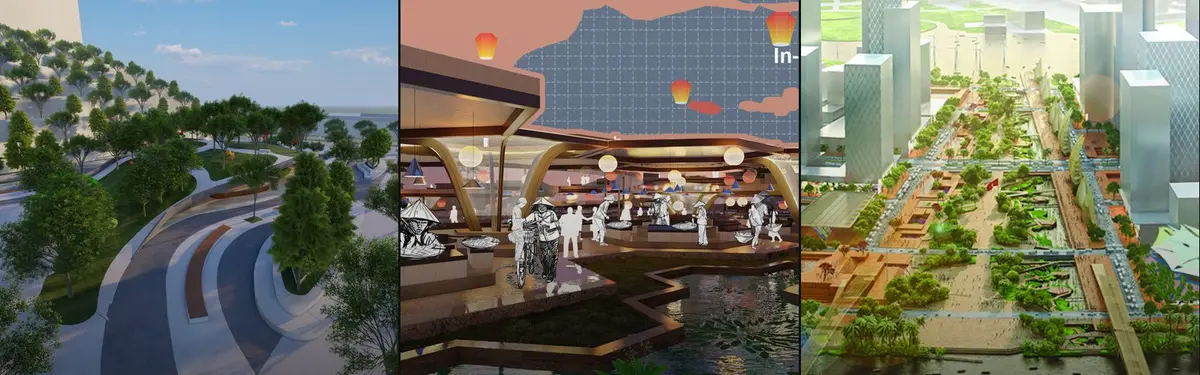


Open Air Market
Design and architecture of open-air markets, from spatial planning to structural innovation and cultural integration.
An open-air market is a market where traders sell from stalls, carts, tables or mats in the open or under light cover, usually in a street, square, vacant lot or riverside rather than inside a dedicated building. The type includes weekly and other periodic markets, daily street markets, bazaars and souks, night markets and farmers' markets. For architects and planners, it is one of the oldest forms of public space and one of the hardest to design well, because so much of its life is temporary, informal and run by the traders themselves.
What is an open-air market?
A marketplace, in the broad definition used by Wikipedia's article on the subject, is a location where people regularly gather to buy and sell provisions, livestock and other goods. Local names vary: a souk (from Arabic), a bazaar (from Persian), a tianguis in Mexico or a palengke in the Philippines. Some markets run every day, while periodic markets take place once a week or on specified days.
The Project for Public Spaces offers a useful way to place the open-air market among its neighbours. In What is a Public Market?, Kurt Wheeler separates clusters of street vendors, which may not be formally managed but follow norms set by the vendors themselves; open-air markets, which are formally managed, often seasonal, and often use pop-up tents; covered markets under a permanent shed, pergola or pavilion; and indoor market halls. This article focuses on the first three. Market halls are a related building type and appear here only as context.
"Open-air markets can activate underutilized spaces such as vacant lots, parking lots, and streets on a temporary basis, transforming them into lively community places in short order."
Kurt Wheeler, What is a Public Market?, Project for Public Spaces (2025)
Open-air markets also overlap with retail design, since the stall is a shopfront at its most basic, and with public space, since the same ground often serves as a square, a playground or a parking area when trading ends. The local market and the fish market are two of its most common forms.
A short history of open-air markets
Markets are older than most of the buildings around them. In ancient Greece, market places operated within the agora, the open civic space of the city-state. Between 550 and 350 BCE, Greek stallholders clustered by the type of goods they carried, with fish sellers in one place and clothing in another. The stoa, a freestanding colonnade with a covered walkway, served as both a place of commerce and a public promenade, and in Athens officials oversaw weights, measures and coinage so that buyers were not cheated.
In ancient Rome, trade took place in the forum. Trajan's Market, built around 100 to 110 CE beside Trajan's Forum, comprised multiple buildings with shops on four levels, and the Roman forum is described as arguably the earliest example of a permanent retail shopfront.

In medieval England, annual fairs, almost always tied to a religious festival, traded high-value goods, while weekly or fortnightly markets dealt mainly in fresh produce and necessities. Across European market towns between the 13th and 15th centuries, regional markets were held once or twice a week and daily markets were common in larger cities. Over time, permanent shops opening every day gradually supplanted the periodic markets, while peddlers and itinerant sellers filled the gaps. The periodic market survived far more strongly elsewhere, and the weekly haat of rural India still gathers producers and buyers on a fixed day.

Night markets have their own lineage. According to Wikipedia's history of the night market, the concept goes back to China's Tang dynasty, whose government placed strict sanctions on night markets in 836; restrictions eased towards the end of the dynasty, and night markets spread during the Song dynasty. Today they are typically open-air markets, popular across East and Southeast Asia and in Chinatowns elsewhere. The farmers' market, where producers sell directly to consumers, is another open-air form, and the Project for Public Spaces counts it, along with flea markets and street markets, as a public market.
Key principles of open-air market design
Designing an open-air market means designing for a place that changes by the hour. The principles below recur across practice and in members' work on uni.xyz.
The stall module and the grid
The stall is the basic unit, and its dimensions set the rhythm of aisles, services and structure. A uni.xyz journal on Studio D'Arkwave's market in Anning, on the outskirts of Kunming, describes a reworked jiezi, the local open-air street market, laid out on a 3-metre modular grid that keeps stall organisation flexible and clear. Steve Davies of the Project for Public Spaces, writing on Hanoi, argues that clean, well-lit and well-functioning stalls with storage hidden from customers help vendors sell more.

Shade, rain and light cover
Most open-air markets need protection from sun and rain without becoming closed buildings. A light roof can do this while keeping the market porous. Bubble Markets, by Raymond Hernandez, Gepo de Mesa and Gabriel Brioso, an Editor's Choice entry in the Street City Vietnam competition, proposes a porous, bubble-like space for Ho Chi Minh City's street market culture. Louie T. Navarro's shortlisted entry in the same competition, covered in the journal The market as a place to gather, spreads a folded solar roof over an open single-level grid.
Water, drainage and hygiene
Fresh food markets produce water, waste and smell, so paving falls, drains, washing points and toilets decide whether a market stays usable. Hygiene was a central driver in the Targ Błonie journal: the Polish town's renovation of its historic open-air bazaar set out to address outdated sanitary conditions and missing market infrastructure while keeping the site's social role. In Vietnam, Davies notes that the World Bank had invested in some 500 markets to make meat stalls more sanitary.
Loading, access and the service edge
Every market has a front for customers and a back for deliveries, and the two often compete for the same street. In Hanoi, Davies found that 70% of customers at one market arrived by motorbike and only 4% parked them, riding straight down the aisles. Separating loading, parking and pedestrian movement is therefore as much a part of the plan as the stall layout.
Informality as a design input
Many of the world's markets are self-organised. UN/DEFINED: Thu Thiem Market, by Nurin Abdullah, Hossam ElYamani, Ahd Farrag and Anna Thum, builds on what the team calls organised informality, depending on the participation and collaboration of the local community and fishermen, with adaptable buildings at human scale. Designing a framework that traders can complete is usually more durable than prescribing every stall.
The market as public space
UN-Habitat describes public space as a crucial component of sustainable cities, supporting social inclusion and economic exchange. Markets do both. The Anning project above turns this into a schedule: jiezi markets traditionally trade for only half a day, so the site works as a market in the morning and as a park for walking and children's play in the afternoon.
Open-air markets on uni.xyz
Members have published 36 projects and 25 journals under this topic, with a strong cluster of market redevelopments in Indian, Bangladeshi, Vietnamese and Chinese cities. Many start from an existing market and its traders rather than from a blank site.
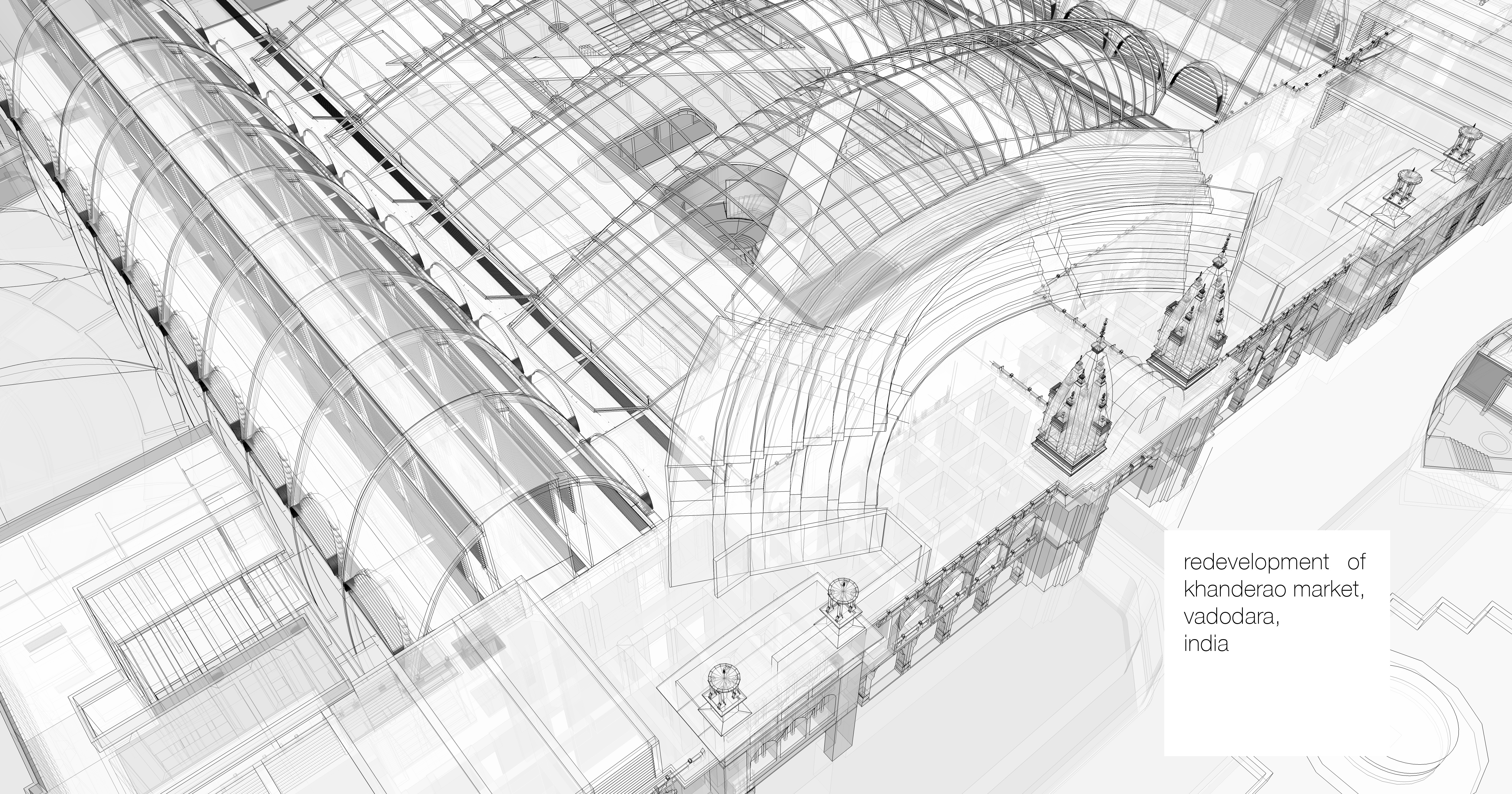
In India, Harsh Chauhan's thesis, Redevelopment of Khanderao Market, Vadodara, India, sets out to sustain the heritage value of Khanderao Market while reorganising the existing market, adding to the Vadodara Municipal Corporation programme, developing the edge and solving parking problems. Palak Bhattad's a day at the bazaar... addresses the Old City Market of Amravati: along a 10-minute walking trail, defunct plots are identified for interventions, a masterplan declutters the street, and a new market typology relocates activities.
Bangladesh is represented by two theses. fariha bushra's RE-DEVELOPMENT OF RANGPUR CITY MARKET, which received a Best in Region award in UnIATA '22, argues that the economic infrastructure of the bazaars must become more integrated and responsive, and asks how far architecture can be part of the solution. Apu Das's RE-THINKING A WHOLESALE DRY FISH MARKET, for the trading hub of Saidpur in Nilphamari, starts from the decline of traditional marketplaces and the loss of public space in Bangladesh.
"Growth centers and bazaars are the economic lifelines of Bangladesh."
fariha bushra, RE-DEVELOPMENT OF RANGPUR CITY MARKET

The Street City Vietnam competition produced many of the topic's projects. Besides Bubble Markets and UN/DEFINED, Shaedon Wedel's Lines of the Land is an urban fish market under an arching greenway bridge that draws on the terraced forms of Vietnamese fields, and Suzanne Sharp's Serenity Market in Thu Thiem uses gardens and breaks between stalls to give people who experience sensory overload a place to pause.
Night trading has its own entry. The Twilight Market journal covers a shortlisted Urbanscape: Symbiosis entry by Xinyue Li, Yuru Chen, Summer Wang and Zitong Zeng for Guangzhou's Haizhu Bridge, where between 3 and 6 a.m. vendors, recyclers and elderly residents gather at what is known locally as the Tianguang Market. The team proposes modular stainless steel pavilions that bring shelter and light to a market that had neither.

The editorial journals add built references, mostly covered markets that keep an open-air spirit. In Hangzhou, Office Canopy of Architecture removed planter barriers from a standard neighbourhood market near the Xixi Wetland and added a curved timber soffit that reaches out over the pavement. In Wuxi, MINAX Architects built Bloom Liutan Market in under a year using prefabricated steel on an awkward triangular site. And in Poland, Aleksandra Wasilkowska, who has researched informal bazaars and temporary stalls for over 15 years, turned the open-air bazaar of Błonie into a park and market hybrid.
Challenges and future directions
The largest challenge is how to upgrade a market without destroying it. Davies reports that Hanoi's former policy, since stopped, was to demolish markets and replace them with shopping centres, pushing the wet market into a basement with little foot traffic. Modernisation that ignores how traders and customers actually behave tends to empty the market it was meant to save.
"it's these personal relationships between vendor and customer that bring people back, often every day."
Steve Davies, A New Vision for Hanoi's Wet Markets, Project for Public Spaces (2019)
A second challenge is the status of informal vendors. India's Street Vendors Act of 2014 requires a Town Vending Committee to survey existing vendors, bars eviction or relocation until that survey is complete, and allocates space through designated vending zones. For designers, that turns the survey of who already trades where into a legal starting point, not an optional study.

Climate adds a third pressure. Heat, monsoon rain and flooding all fall hardest on traders who sit outdoors all day, so shade, drainage and raised platforms are becoming basic infrastructure rather than amenities. Finally, competition from supermarkets and online shopping means markets increasingly need to justify themselves as public places as well as shops.
Open-air markets for students and designers
Markets make strong thesis subjects because they combine building, landscape, infrastructure and social research on one site. Useful angles include upgrading a weekly market without displacing its traders, a kit of stalls and canopies for monsoon or heat conditions, a fish market that reconnects to its waterfront, or a site that changes use between morning trade and evening leisure. Strong submissions map trading hours, delivery routes, water and waste flows alongside the drawings, and show how the site works on a non-market day as well as at peak trade. Related reading on uni.xyz includes the fish market topic. Briefs on streets, markets and public space appear regularly in uni.xyz competitions.
Frequently asked questions
What is the difference between an open-air market and a covered market?
An open-air market trades in the open or under temporary cover such as tents and umbrellas, and can often move, expand or shrink. A covered market operates under a permanent shed, pergola or pavilion, which protects traders from the weather and can extend the trading season. An indoor market hall goes further, enclosing the market inside a dedicated building.
What is a periodic market?
A periodic market meets on set days, such as once a week or on festival days, rather than every day. In medieval European market towns, regional markets were typically held once or twice a week. The weekly haat in India is a familiar present-day example.
What is a night market?
A night market is a street market that operates mainly at night and is usually more about strolling, eating and browsing than the business of a day market. The tradition began in China and night markets are now common across East and Southeast Asia, typically as open-air markets.
What is the difference between a bazaar and a souk?
Both words describe a market or market district. Bazaar comes from Persian and souk from Arabic, and the souk is associated with West Asia and North Africa.
How big should a market stall be?
There is no single standard. Designers usually start from the goods sold and local practice, then set a repeatable module; the Anning market journal on uni.xyz, for example, uses a 3-metre grid. Clear aisles, storage out of sight and access to water and light matter as much as the stall size itself.
References and further reading
- Marketplace, Wikipedia
- Night market, Wikipedia
- Street Vendors (Protection of Livelihood and Regulation of Street Vending) Act, 2014, Wikipedia
- What is a Public Market?, Project for Public Spaces
- A New Vision for Hanoi's Wet Markets, Project for Public Spaces
- Public Space, UN-Habitat


Popular projects
View all 33 projects


Latest journals
View all 25 journals

The market as a place to gather: a fish market that leaves its lot to meet the water
A shortlisted Street City Vietnam proposal spreads a folded solar roof over an open single-level grid and lets the market spill onto a stepped waterfront.


Office Canopy of Architecture Turns a Standard Hangzhou Market into a Park by the Xixi Wetland
Near Xixi Wetland in Hangzhou, a three-storey market sheds its planter barriers for timber canopies, play pockets and a planted roof rim.
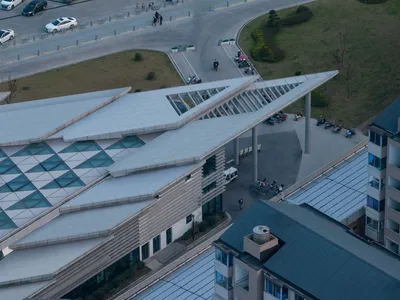
MINAX Architects Folds a Farmers' Market into a Stepped Diamond on a Triangular Wuxi Site
Bloom Liutan Market rethinks the civic marketplace as a terraced, louvered structure that respects its neighbors' sunlight in central Wuxi.
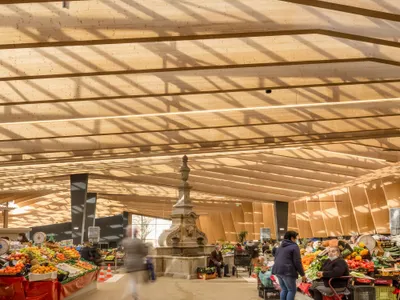
APTO Architecture Wraps Braga's 1956 Municipal Market in a Parametric Timber Canopy
A generative design process and 8,300 square meters of solid wood panels transform a dictatorial-era market into a civic landmark in northern Portugal.


