
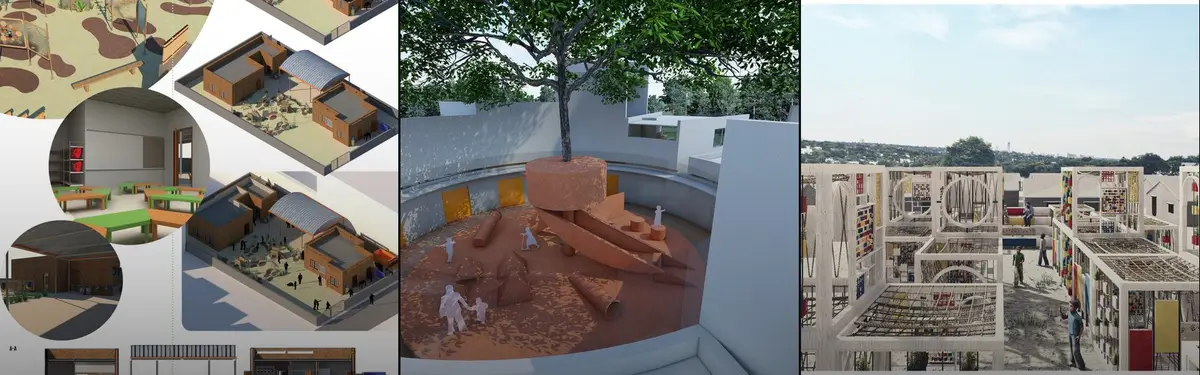


Playground
Playgrounds and recreational spaces designed for exploration, movement, and imaginative play across diverse environments.
Playground design is the planning of outdoor and indoor places made for children's play, from a sandpit on a street corner to a landscape of mounds, climbing frames, water and planting. A good playground offers challenge, choice and company: it lets children test their bodies, invent games and meet each other, while giving adults a reason to stay nearby. Designers shape it through layout, ground, materials, safety standards and the balance between fixed equipment and things children can move.
What is playground design?
A playground is a dedicated, bounded place where play is the main purpose. That separates it from the broader field of play space, which includes any street, courtyard or park where children happen to play, and from design for children in general, which also covers schools, furniture and healthcare. Playground design brings together landscape architecture, product design and child development. The designer decides how the ground rises and falls, where shade falls, what is fixed and what is loose, how carers sit and watch, and how the space meets the street.
The type ranges widely. There are equipment playgrounds built from catalogue components, natural playgrounds built from earth, logs, boulders and planting, adventure playgrounds staffed by playworkers where children build with timber and tools, schoolyards, hospital and rooftop gardens, and temporary playgrounds for disaster zones and refugee camps. Some serve toddlers only, while others are designed for teenagers, families or every age at once. What they share is a brief that is easy to state and hard to meet: make a place children choose to return to, that stays safe enough without becoming dull.
A short history of playgrounds
Purpose-built playgrounds are a product of the industrial city, when streets became crowded and dangerous. One of the earliest forms was the sand garden. Marie Elizabeth Zakrzewska introduced sand gardens to Boston after seeing the German sand gardens she observed while visiting Berlin in the summer of 1885, and the idea grew into the American playground movement.
After the Second World War, Amsterdam turned leftover city spaces into a network of public playgrounds. Jacoba Mulder, head of design at the city's public works department, initiated a playground at Bertelmanplein, and Aldo van Eyck designed it in 1947: a sandpit with a concrete rim, tumbling bars, jumping stones and benches set out with careful precision. According to an essay in the Docomomo Journal, it was so successful that van Eyck went on to produce almost 800 playground designs over 30 years. Climbing domes and sandpits based on his designs can still be found in Amsterdam's parks.

A different line began in Denmark. The landscape architect Carl Theodor Sørensen noticed that children preferred piles of scrap to the playgrounds he designed, and in 1943 the first junk playground opened at Emdrup in Copenhagen. The English landscape architect Marjory Allen, Lady Allen of Hurtwood, wrote about Emdrup and helped spread the idea to British bomb sites, where the name adventure playground was adopted to make it more palatable to local authorities.

The sculptor Isamu Noguchi approached play as landscape art. His first playground design, Play Mountain of 1933, was never built, and a model shown to Parks Commissioner Robert Moses in 1934 won only hostility, according to the Noguchi Museum. Decades later he completed Playscapes in Atlanta's Piedmont Park in 1976, the only playground he built before his death.
"Play Mountain was conceived as a way of building on a city block in New York a mountain, which would, in fact, be an enhanced area for children’s play."
Key principles of playground design
Risk and challenge
Children seek out risk: height, speed, balance, hiding. A playground that removes it entirely gets ignored or misused. The aim is to keep the risks children can see and judge, such as a high climb or a wobbly log, while removing hazards they cannot, such as head traps, sharp edges or rotten timber. The UK's safety regulator puts it clearly.
"Play is great for children’s well-being and development. When planning and providing play opportunities, the goal is not to eliminate risk, but to weigh up the risks and benefits."
Health and Safety Executive, Children's play and leisure: promoting a balanced approach

Inclusive and accessible play
An inclusive playground lets children with different bodies and minds play together, not side by side in separate zones. That means step-free routes to a real share of the play features, transfer platforms, wide ramps, ground-level activities, sensory variety and quiet retreats for children who are overwhelmed. Seeds by Ana Soni, an Editor's Choice in the Autistic care competition, imagines a nursery where each child's diversity becomes a guiding axis for the spaces.

Natural play
Natural playgrounds use topography, water, sand, logs, boulders and planting in place of, or alongside, manufactured equipment. They change with the seasons, offer endless small discoveries and age well when designed for wear. FUN-GO by Paulina Mejía, fernanda velazquez, Alonso González and Luis Daniel Piña Garcia is a playground conceived to reconnect children with nature.
Loose parts
Loose parts are materials children can carry, stack and rearrange: crates, planks, tubes, fabric, sand and water. They turn a playground from a fixed script into a kit. Our journal on The Main Dream describes a shortlisted Re-imagining Play 2020 proposal of 30-centimetre recycled plastic cubes that connect on three axes, so children can build walls, shelters and seats and remake them the next day.

Safety surfacing and standards
The ground under equipment matters as much as the equipment. The US Consumer Product Safety Commission says most playground injuries occur when a child falls onto the ground, and its public playground safety checklist asks for at least 12 inches of wood chips, mulch, sand or pea gravel, or safety-tested rubber mats, extending at least 6 feet in all directions from play equipment. In the UK, the HSE notes that industry standards such as EN 1176 offer benchmarks for these judgements. Check the standard that applies where you build, and treat it as a floor, not a design method.
Play for all ages
Playgrounds work better when carers, older siblings and grandparents have a role beyond the bench. PLAY FOR ALL by Riham Faragallah, a People's Choice Award entry in Playground - E | 2021, builds its equipment around interaction between children and parents. Seating with views, shade, swings sized for adults and spaces for teenagers to hang out widen who a playground is for.
Playgrounds on uni.xyz
Members have published dozens of playground projects on uni.xyz, many from competitions on kindergartens, refugee camps and urban play, alongside our journal reviews of built work.
Nutrogarten by IC Studio is the most liked project in the topic. It was entered in Supergarten and received the People's Choice Award. It starts from the idea that the environment should be the best teacher for children and uses curiosity to raise their creativity as they discover their surroundings. From the same competition, Cube Land by mojtaba Hooshangianshirazi, mahsa pakshir, rokhsareh shakibayi and Amjad Sadri, a winning entry, combines play, movement and visual experience with the kindergarten's circulation and micro-spaces, shaped by Maori culture and the region's climate.

The Re-imagining Play 2020 competition asked for playgrounds in refugee camps and produced a strong body of work. Our journal on Mineral Cave, by Nicholas Lim, Teresa Liew and koh yanhao, explains how a compact vertical structure for the Samos camp in Greece uses coloured translucent surfaces so that shifting daylight makes the interior feel different every hour. Labyrinth of Sanguinity by Hrushikesh Shah and Madhav Joshi, a winning entry in the same competition, designs a deliberate distraction, moving children from the negative chaos of the camps toward a positive chaos of happiness through a dynamic form.

OAK PLAYGROUND by Jovana Stojevic and Ivan Raskovic, a winning entry in the Urban Living Room competition, is a playground inspired by the myths and stories of Hyde Park. Two entries to Child Play let children write the rules. SWIRL by Gülsüm Karahan, Ahsen Zeynep Doğan, baha tekin and Haticetül Kübra saraoğlu, an Editor's Choice, invites children to explore many different play areas and create their own games, while triPLAY by Bahar Okuyucu, Fatih Erdil and Ayça Metin uses flexible modules that children combine together to build social skills and awareness of nature.
Among built projects, our journal on ZAV Architects' playground in an olive orchard in Minoudasht, Iran, shows Cheshm Cheran Bazi, completed in 2025: a 450-square-metre raised network of platforms, spiral stairs, slides, trampolines and bridges that follows an existing agricultural metal grid and curves around the trees without removing a single row. Another review covers Studio KRAFT's Vertical Playgarden at a Budapest primary school, where more than 500 pupils share a tight courtyard; the timber and steel structures climb the edges so the central sports court stays free.

A third covers Padilla Nicás Arquitectos' rooftop garden at a maternity and paediatric hospital in Madrid, with 1,240 square metres of play under white concrete canopies, initiated by the Juegaterapia Foundation to give hospitalised children a reason to go outside and play.
Challenges and future directions
The first challenge is space. Dense cities rarely find new land for play, so playgrounds now go onto roofs, school courtyard edges and small leftover corners. The second is climate. Our journal on Medellín's Tejiendo Hogares network describes small hillside playgrounds that combine play equipment with rain gardens, permeable paving and planted strips to manage runoff, so a swing set is also a drainage decision. Shade, water play and surfaces that do not overheat are becoming basic requirements rather than extras.
The third is standardisation. Catalogue equipment is quick to procure and easy to certify, but it produces near-identical playgrounds everywhere and leaves little for children to change. Natural play, loose parts and staffed adventure playgrounds push back, though they need maintenance budgets and, in the last case, trained playworkers. Finally, the competition work on refugee camps shows how much play matters where it is least provided for, and how cheap, modular and locally built structures can bring it there.

Playground design for students and designers
Playgrounds make strong student projects because they are small enough to detail fully and rich enough to carry research. Good thesis angles include a playground for a refugee camp or disaster site, a schoolyard that keeps its running space, a natural playground in a public park, or a loose-parts kit that a community can build and store. Observe children before you draw: where they gather, what they ignore, what they break. Test your design against a safety standard and an access audit, then ask what a child could still change. Look through educational play for related projects and enter a live brief on the uni.xyz competitions page.
Frequently asked questions
What makes a good playground design?
A good playground offers a range of challenges for different ages and abilities, mixes fixed equipment with natural and loose materials, gives carers somewhere comfortable to sit, and provides shade, water and safe surfacing. Above all, it leaves children room to invent their own games.
What is an adventure playground?
An adventure playground is a staffed site where children build, dig and play with tools, timber and scrap materials under the eye of playworkers. The idea began at Emdrup in Copenhagen in 1943 and spread to Britain after the Second World War.
Who designed Amsterdam's famous playgrounds?
The Dutch architect Aldo van Eyck designed hundreds of public playgrounds for Amsterdam, starting with Bertelmanplein in 1947. They used a small set of simple elements, such as sandpits, tumbling bars, jumping stones and climbing domes, arranged differently on each site.
What surface is safest under playground equipment?
Loose-fill materials such as wood chips, mulch, sand or pea gravel at sufficient depth, or safety-tested rubber surfacing, cushion falls far better than concrete, asphalt or grass. The CPSC checklist recommends at least 12 inches of loose fill extending 6 feet around equipment.
What is an inclusive playground?
An inclusive playground lets children of all abilities play together. It offers accessible routes to play features, ground-level and sensory activities, and quiet spaces, rather than a separate corner for disabled children.
References and further reading
- Sandpit, Wikipedia
- Aldo van Eyck and the Amsterdam playgrounds, Vincent Ligtelijn, Docomomo Journal 61 (2019)
- Adventure playground, Wikipedia
- Play Mountain, The Noguchi Museum
- Playscapes, Wikipedia
- Children's play and leisure: promoting a balanced approach, Health and Safety Executive
- Public Playground Safety Checklist, U.S. Consumer Product Safety Commission


Popular projects
View all 61 projects


Latest journals
View all 66 journals

A-Maze!: An Anganwadi Courtyard Where Play Panels Draw the Routes and the Lesson Plan
Angled play panels, looping team routes and a shuffled kit of tunnels and beams turn an Anganwadi courtyard into a game children learn by moving through.


Juguemos en el Parque and Alcaldía de Medellín Stitch Climate-Aware Playgrounds into Hillside Barrios
Across Medellín's peripheral neighborhoods, Tejiendo Hogares turns leftover corners into permeable, color-coded play spaces that also manage stormwater.

Studio KRAFT Stacks Timber Treehouses Along the Edges of a Crowded Budapest Schoolyard
In Budapest's Terézváros, a timber playgarden climbs the courtyard edges so 500 children keep their sports court and gain quiet places to retreat.
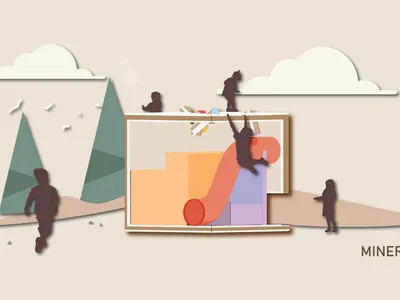
Mineral Cave: Sunlight as a Playground Material in a Refugee Camp
A compact, vertically oriented play structure uses coloured translucent surfaces and shifting daylight to create sensory architecture for children in Samos


