



Social Housing
Affordable housing design addressing community needs, displacement, and inclusive living spaces.
Social housing is housing let at below-market rents by public bodies, such as city councils and national housing agencies, or by non-profit organisations such as housing associations and cooperatives, to people who would struggle to afford a home on the open market. It is defined by who owns it and how it is allocated rather than by any building type, which is why it ranges from Vienna's courtyard blocks to Singapore's towers and transitional homes for refugees.
What is social housing?
Three things usually distinguish social housing from other homes: rents are set below market levels, the landlord is public or non-profit, and homes are allocated by need rather than by the ability to pay. The words vary by country. Britain speaks of council housing and housing associations, the United States of public housing, and Vienna of the Gemeindebau, the municipal building.
It overlaps with, but is narrower than, affordable housing, which can include privately owned homes sold or rented at a discount for a limited period. Social housing is meant to stay affordable for the long term because the landlord does not need to make a market return. It is also one specialised part of the wider subject of housing design, with its own constraints: tight budgets, long lifespans, public scrutiny and residents who often cannot simply move if the building fails them.
The idea rests on a principle written into international law after the Second World War.
"Everyone has the right to a standard of living adequate for the health and well-being of himself and of his family, including food, clothing, housing and medical care"
For architects, the practical consequence is that social housing has to work for decades, for households the designer will never meet, on a budget that leaves little room for error.
A short history of social housing
Modern social housing grew out of the overcrowded industrial cities of the nineteenth century, but its defining models came after the First World War. In Vienna, the Social Democrats who took control of the city in 1919 began a programme now known as Red Vienna. According to the history of Red Vienna, more than 60,000 new municipal apartments were built between 1925 and 1934, paid for partly by a dedicated housing construction tax. The city's housing operator, Wiener Wohnen, describes the aim as replacing dark, unsanitary rooms with bright flats that each had a kitchen, a hall, and their own toilet and water supply.
The best known of these estates is the Karl-Marx-Hof, built between 1927 and 1930 to designs by Karl Ehn. It held 1,382 apartments, yet only 18.5 percent of its site was built on; the rest became gardens and play areas.

Britain took a parallel route. The Addison Act of 1919, passed after the "homes fit for heroes" campaign, first required councils to provide housing and gave them subsidies to do it. By the late 1970s almost a third of UK households lived in social housing. Singapore faced fast population growth and overcrowded housing in the 1950s. Its Housing and Development Board, set up in 1960 to take over from the Singapore Improvement Trust, began with emergency housing and resettlement, started selling flats in 1964, and in 1989 introduced an Ethnic Integration Policy that caps the ethnic mix of each estate.
The cautionary tale is Pruitt-Igoe in St. Louis, 33 eleven-storey blocks designed by Minoru Yamasaki and first occupied in 1954. Poorly maintained and increasingly vacant, it began to be demolished in 1972.
"the day Modern architecture died"
Charles Jencks on the demolition of Pruitt-Igoe, The Language of Post-Modern Architecture, as cited on Wikipedia

Later historians have pushed back on that verdict. They point to the city's falling population and the local housing authority's financial problems as much as to the architecture. The lesson most designers now draw is less about towers than about money for maintenance and management.
Key principles of social housing design
Good social housing is not a style. It comes from a handful of commitments that recur in the best estates and in member projects on uni.xyz.
Dignity first
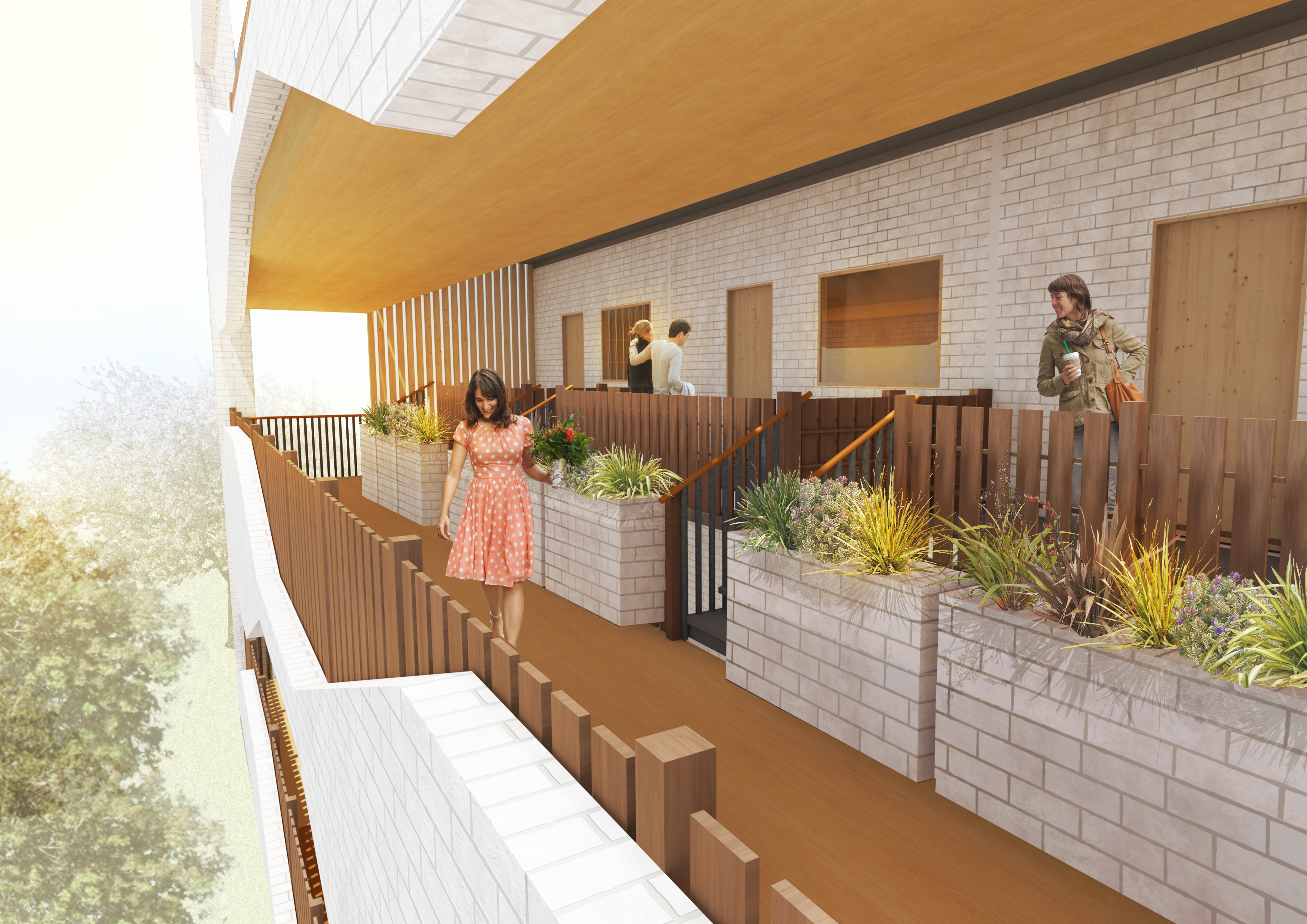
A social home should not look or feel like a lesser version of a market one. That means daylight, privacy, good proportions and an entrance a resident is glad to use. Homey Hub by Jiaying Hew, a youth housing scheme from the Hustle Hub 2019 competition, was renamed from "Hustle Hub" because its aim is to make young residents feel at home rather than hustling to survive.
Mix tenures and households
Estates that house only the poorest households are prone to stigma and decline. Mixing household types, ages and incomes keeps estates part of the city rather than apart from it. Singapore goes further and caps the ethnic proportions of residents on each estate so that no group is concentrated in one place.
Make shared space count
Courtyards, galleries and gardens are where neighbours meet, but only if they are designed to be used and overlooked. The journal on JVST's Steenzicht 1A in The Hague describes 118 social-rent dwellings set around a shared garden raised over parking, reached by stairs from the street so that it works as a semi-public room.

Design for change
Households grow, shrink and age over a building's life, so plans that can adapt last longer. Weaved City by Lulu Hasan, Labeeb Jan and Safa Shukkur, a People's Choice Award entry in the Hustle Hub competition, sets out to accommodate patterns of tenancy that nobody can anticipate at construction.
"Our lifestyle isn't fixed, so why should our spaces be?"
Weaved City team, project statement (Hustle Hub)
Plan for maintenance and retrofit
Social housing is held for generations, so durable materials and buildings that can be upgraded matter more than first cost. The journal on [To] SHARE covers a proposal by Dong Cao, Zaw Latt, Yaning Zhang and Ming Xu, winner of the Retro - Fit 2020 competition, that wraps a Housing and Development Board block on Stirling Road in Queenstown, Singapore, in a steel exoskeleton carrying movable balcony rooms, without touching the original structure.

Social housing on uni.xyz
Members approach social housing from many directions: compact units for crowded cities, youth and student housing, homes for workers, and shelter for people displaced by war and disaster. A selection follows.
Plugin Housing Challenge by saeid alitajer, maryam hoseini and Maryam Ghaseminasab, entered in the Plugin Housing Challenge 2020 competition, is the most liked project in this topic. It proposes single and double occupancy units for crowded urban areas, with adaptive furniture that reduces the need for more space.

HOME FOR THE ESCAPED by Denis raj, a winning entry in the UnIATA '18 competition, designs transitional housing for Rohingya refugees. Its stated goal is a more humane environment that restores dignity and identity to people who have lost their homes. Sojourners Asylum by taha khanijazani, anahita niknejad, Mohadeseh Hamidi and Mehdi Khakzand, a winning entry in the Shifting Horizons competition, takes a similar line, stressing self-sufficiency and a socially interactive setting so that residents who have left everything behind feel at home.
HustleHub Moscow by Jiří Valenta and Igor Nesterov, a Runner-up in the Hustle Hub 2019 competition, frames affordable housing around social life, for people who want to meet others with similar thoughts and feel connected to a place.

Several projects work with households at risk of losing their homes. Eco-Homes: Enhancing the Urban Poor of Sattola by Nazifa Subha, entered in UnIATA '25, proposes modular homes for Dhaka built from recycled concrete and salvaged materials, with courtyards, rooftop farms and an Anti-Eviction Grid intended to prevent displacement. BEYOND "LIVING" by Mahlaqa Fahami rethinks housing for ready-made garment workers in urban Bangladesh around co-living and income generation for every household, and AABHAS by Pranjal Tak designs modular, mobile, co-created homes for migrant workers, with a creche, workshops and safe spaces.

Youth homelessness was the subject of The SafeHouse competition. HE[x]AL by Christopher Chua Yan Jun, Abhilash Mohan, Nabila Fatharani Azka and Yifan Goh, an Editor's Choice, proposes a safe, transitional home for homeless teenagers in Jackson, Mississippi, built around trust, dignity and ability.
Challenges and future directions
The largest challenge is supply. In Britain, the Right to Buy legislation has sold council homes to private occupiers since 1980, and new social housing has since been built mainly by housing associations. Where stock shrinks, allocation narrows to those in greatest need, which can concentrate disadvantage and feed the stigma that mixed estates were meant to avoid.
Maintenance is the second. Pruitt-Igoe showed what happens when estates are built without the money to run them, and many post-war blocks now face a choice between retrofit and demolition. Demolition often scatters existing tenants, which ties this debate closely to urban renewal and its history of displacement. Retrofitting for energy and comfort is increasingly seen as the fairer and lower-carbon option.
Location is the third. Affordable homes on cheap land far from jobs simply move the cost to commuting. The journal on Casa Selva in Tulum describes 200 affordable apartments for hospitality workers priced out by the tourism economy they serve, built at the edge of town and kept below the forest canopy.

Social housing for students and designers
Social housing rewards research. Before drawing, find out who is on the waiting list in your city, what rent they can pay, and what happened to the last estate built there. Strong thesis angles include retrofitting a post-war block instead of demolishing it, housing a specific group such as care leavers, garment workers or refugees, designing flexible plans that cope with changing households, and testing low-cost construction that can still last. Compare your proposal with built work: the uni.xyz journals on urban housing cover many recent social schemes in Europe. Briefs on youth housing, refugee shelter and compact living appear regularly among uni.xyz competitions.
Frequently asked questions
What is the difference between social housing and affordable housing?
Social housing is owned by a public body or non-profit and let at below-market rents, usually for the long term, to households allocated by need. Affordable housing is a broader term that can also include privately provided homes sold or rented at a discount, sometimes only for a limited period.
Who builds social housing?
Traditionally city councils and national agencies, such as Vienna's municipal housing department or Singapore's Housing and Development Board. In many countries, including the UK, most new social homes are now built and managed by housing associations and other non-profits.
Why is Vienna's social housing so admired?
Vienna has kept building and maintaining municipal housing for a century, since the Red Vienna programme of the 1920s, and its estates such as the Karl-Marx-Hof combine large numbers of homes with generous courtyards, gardens and shared facilities.
Why did Pruitt-Igoe fail?
Pruitt-Igoe was long blamed on its modernist design, but later studies stress St. Louis's falling population, poor maintenance and the housing authority's financial problems. Most designers now read it as a warning about funding and management as much as about high-rise form.
What makes good social housing design?
Homes that offer dignity and daylight, shared spaces that people actually use, plans that adapt as households change, durable construction that can be maintained, and a location close to jobs and services.
References and further reading
- Universal Declaration of Human Rights, United Nations
- Red Vienna, Wikipedia
- Die Geschichte des Gemeindebaus (in German), Wiener Wohnen
- Karl-Marx-Hof, Wikipedia
- Public housing in the United Kingdom, Wikipedia
- Housing and Development Board, Wikipedia
- Pruitt-Igoe, Wikipedia


Popular projects
View all 54 projects





Latest journals
View all 74 journals

rue royale architectes Sets Four Gridded Social Housing Blocks Around a Shared Garden in Bron
In Bron, near Lyon, a strict concrete grid filled with timber-lined loggias gives 5,791 m² of social housing a calm, generous relationship with its landsca

JVST Wraps a Raised Public Garden in Brick and Green Block for 118 Social Homes in The Hague
In The Hague's post-war Zichten district, Steenzicht 1A trades open slab planning for a courtyard block lifted over parking and opened to the street.


Slum Autonomy - A Paradox: A Balcony That Gives Rehoused Slum Dwellers Back Their Own Way of Using Space
A bamboo-railed balcony for rehabilitated slum housing in India turns loose wooden planks into seats, beds, shelves and a corner for worship.
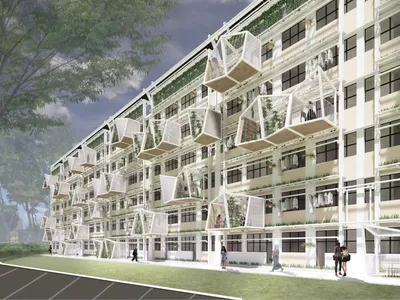
[To] SHARE: A Movable Balcony System That Treats Facades as Shared Infrastructure
An Uber-for-balconies concept retrofits a Singapore public housing block with a modular exoskeleton of mobile, shareable rooms.


