


Waterscape
Design and architecture projects that engage with water as a primary spatial, ecological, or experiential element.
A waterscape is a designed setting in which water is the main spatial and experiential material: channels, pools, fountains, cascades, stepwells, wetlands and flooded squares shaped by architects and landscape architects. Waterscape design works across scales, from a single reflecting pool to a city-wide strategy for storing and cleaning rainwater, and it treats water at once as an image, a climate tool and a piece of infrastructure.
What is waterscape design?
Waterscape design is the practice of composing places around water. It asks how water is brought in, held, moved, displayed, cleaned and released, and what people feel and do around it. A fountain in a courtyard, a rill that measures out a garden axis, a sunken square that floods after a storm and a boardwalk across a reed bed are all waterscapes.
It sits inside the wider field of landscape design but has its own technical core: hydraulics, waterproofing, water quality, evaporation and safety. It also borders several neighbours. Waterfront design deals with the edge between a city and a sea, lake or river. Water-sensitive urban design handles the whole urban water cycle, much of it underground. Underwater habitats and aquariums, often grouped under ocean architecture, design for life inside water rather than around it.
What unites waterscape work is attention to water as something you see, hear and touch. Still water reflects and calms; moving water masks noise and cools the air; falling water marks thresholds; hidden water makes discovery possible. A good waterscape chooses which of these qualities it needs and supplies the water to make them happen, in a way the site's climate and budget can sustain.
A short history of waterscape
The oldest designed waterscapes are gardens of irrigation. In Persia, the charbagh divided a walled garden into four parts with waterways, traditionally read as the four rivers of Paradise mentioned in the Quran. The channels watered the beds and gave the plan its order at the same time.
In al-Andalus the same idea took the form of long courtyard gardens. At the Generalife in Granada, the Nasrid country estate beside the Alhambra, the Patio de la Acequia is organised around a central canal, and excavations found outlet holes along its sides that once watered the gardens. The arching jets visitors photograph today were installed much later.

The Mughals brought the charbagh from Iran to the Indian subcontinent in the sixteenth century, and in Kashmir they adapted it to slopes. At Shalimar Bagh in Srinagar, laid out under Jahangir and opened in 1619, a central channel called the Shah Nahar runs through three terraces fitted with fountains, and a canal links the garden to Dal Lake. Each drop between terraces became a cascade.

In western India a different tradition grew from scarcity. Stepwells are wells, cisterns or ponds reached by long flights of steps down to the water level, built to cope with seasonal swings in water supply. The Rani ki Vav at Patan, built in 1063 by Rani Udayamati, is laid out as an inverted temple, with more than 800 sculptures lining its descent.
The modern chapter is about storms as much as beauty. Water-sensitive urban design, a term used particularly in Australia and the Middle East, set out to integrate stormwater, groundwater, wastewater and supply into urban design, and in 2013 Rotterdam opened the Benthemplein water square by De Urbanisten, a public square that doubles as a storm water basin.
"The water square Benthemplein holds a twofold strategy: it is public space and storm water storage combined in one space."
Key principles of waterscape design
Make water reachable
A waterscape is worth building only if people can get close to it. Steps, ledges, stepping stones and shallow edges turn water from scenery into a place. The stepwell is the extreme case: an entire building designed as a route down to the water table.

Jiaqi Ma's Hide-and-Seek, a winning entry in the Stepwell ll competition, starts from the feeling of searching for water down a flight of stairs and gradually finding its traces, a story of something hidden.
Store water where people already are
Rain that would overload a sewer can be held in public space for a few hours. The Benthemplein square is dry most of the time and used as a recreational space; in heavy rain its sunken basins hold the water. Melbourne Water describes water sensitive urban design as an approach to planning urban areas that makes use of stormwater and reduces the harm it causes to rivers and creeks.

Clean water in plain sight
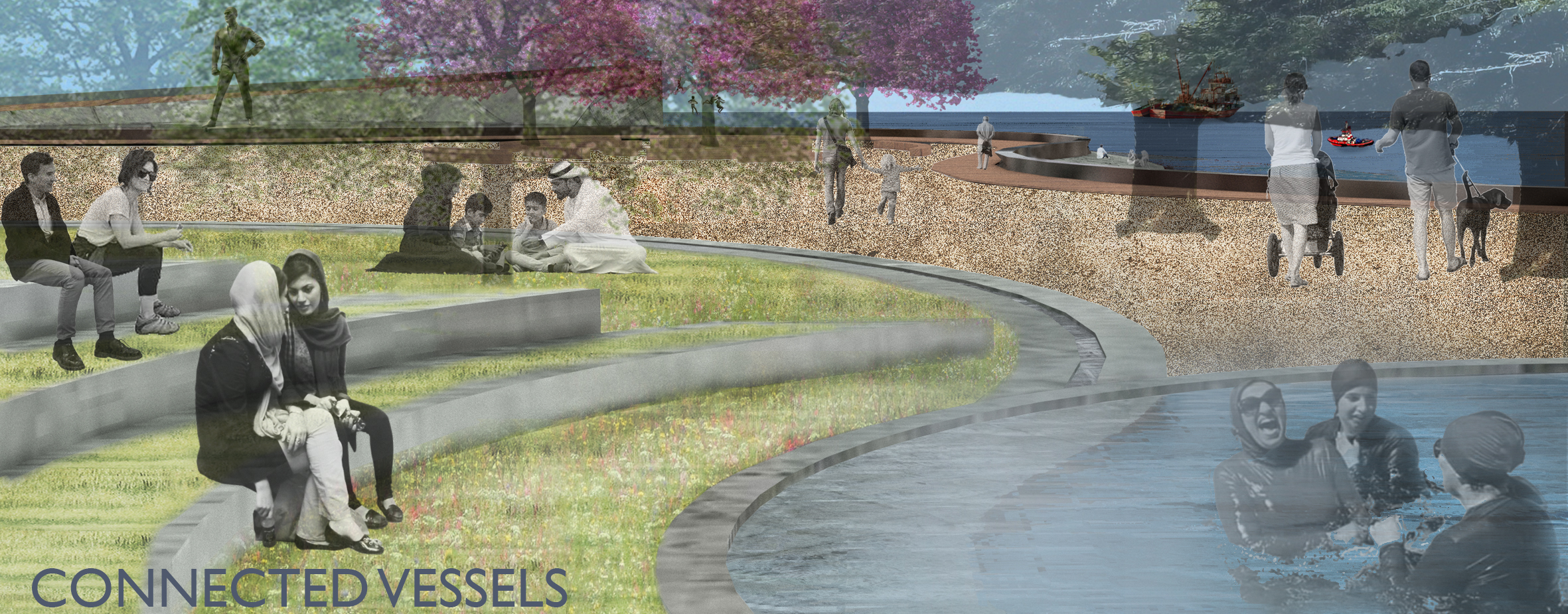
Reed beds, biofilters and settling ponds can be designed as landscape rather than hidden as plant rooms. In Connected Vessels, Shai Haber-Thaler moves water through the site in an open loop: it is collected, directed into an on-site cleansing system that purifies it on one side and releases it on the other.
Choose the right movement
Still water reflects architecture and sky; running water cools and masks traffic; falling water marks a change of level. The Mughal cascade, the Andalusian rill and the reflecting pool are three answers to the same design question.
Design for the dry season
Every waterscape spends time empty, frozen or low. Basins should still read as places when dry, and supply should match the climate: harvested rain, recycled greywater or treated seawater rather than drinking water wherever possible.
Waterscape on uni.xyz
Many of the waterscape projects on uni.xyz were entered in the Ripple competition, and several of them deal with scarcity and recycling.
The most liked project in the topic is WaterCell Park by Andra Gheorghiu, Alexandru Pomazan, Alexandra Burecu and Irina Panait, which received a People's Choice Award in the Ripple competition. It is a regenerative intervention in one of Istanbul's best-known neighbourhoods, opening the site toward the sea and a panoramic view of two continents, with water recycling features and varied spaces to explore.

Also in Istanbul, Cape in Flow by Duygu Kalkanli, Mert Akay, Melih Bozkurt, Ebru Erbaş Gürler and IstanbulON ITU was an Editor's Choice at Ripple. It reads the city's long relationship with water as a "flow" and recodes that idea through strategies at both micro and macro scales. Jay Jieping Wang's WATER WOUND, a winning entry in the same competition, visualises the two sides of the global water crisis: the shortage of fresh water and sea-level rise.
"This project is aiming to stimulate people's sensitivity of the growing water 'wound'."
Jay Jieping Wang, project statement for WATER WOUND
Other Ripple entries take a quieter line. Yang Tong's Ocean Heart uses a solar still to treat seawater for landscape water and irrigation before it returns to the sea, around three waterscapes of swirling water, still water and sculpture. Blob effect by Sujeen, an Editor's Choice, leads visitors on a one-way trip through spaces that recall the past overuse of water.
The journals add detail. Mono in Mist, by a team from National Chiao Tung University and named Runner-up at the Pause competition, rebuilds the defensive wall of a Japanese castle in Fukuoka out of water and mist. The wall isolates three sunken meditation gardens through sound, vapour and a softened line of sight rather than thickness.

TAO's Chenhu Wetland Art Center, a 2,774 m² building near Tonghu Provincial Wetland Park outside Wuhan, is built from scattered white walls clad in panels embedded with shell and conch aggregate, leaving the building porous to wind, water, light and the flight paths of birds. In Dubai, the Brazil Pavilion at Expo 2020 by MMBB Arquitetos, JPG.ARQ and Ben-Avid flooded its floor with a thin sheet of water drawn from the idea of the Amazon's seasonal river flood, so visitors waded through the exhibition.

Wetlands recur as sites. Mila Dimitrijevic's Weaving Willow Wetlands Visitor Centre, from the WIC competition, treats a building and a wetland as two wholes to be woven together, and Breathing-scape, named Winner at Breathe Free, coils a looping path around two curved bodies of water in a park designed to clean the air.
Challenges and future directions
Water is expensive to keep beautiful. Pumps, filters, linings and joints need maintenance, standing water can breed mosquitoes and algae, and decorative fountains in dry cities can waste the resource they celebrate. Safety around deep water limits how close designers can bring people, especially children.
Climate change sharpens both sides of the problem: more intense storms and longer droughts. That is why the most interesting recent projects use water that would otherwise be lost. Ahmet Senel and Alper Mete Dülger's The Cistern takes a cultural centre underground against the harsh desert, collecting water, preserving it and giving it back to nature. LifeCycle by Shabbar Raza and Shahzeb Amjad, which received a People's Choice Award in the RISE, RESIST, REMEMBER competition, combines modern and traditional ways of collecting water.

Expect more water squares, rain gardens and restored streams, more dual-use basins that are playgrounds most of the year, and a revival of stepwells and tanks as both heritage and working infrastructure.
Waterscape for students and designers
Waterscape briefs reward students who can draw a water cycle as clearly as a plan. Strong thesis angles include a public square that stores a defined storm event; a contemporary stepwell or tank for a water-stressed town; a wetland park that treats a city's runoff in view of visitors; or a waterfront that works at both high and low water. Start with where the water comes from, where it goes and what happens in the dry months, then design the experience. Related topics include architecture for water and water sensitive design, and the open uni.xyz competitions regularly include water briefs.
Frequently asked questions
What is a waterscape in architecture?
It is a designed setting in which water is the main element, such as a fountain court, canal garden, reflecting pool, stepwell, wetland park or water square. The term covers both the visual composition of water and the systems that supply, clean and drain it.
How is waterscape design different from landscape design?
Landscape design covers the whole outdoor environment: ground, planting, paths and ecology. Waterscape design is a specialised part of it that focuses on water features and water systems, and it needs extra knowledge of hydraulics, waterproofing and water quality.
What is a water square?
A water square is a public square designed to hold storm water temporarily. Most of the time it is dry and used for sport or play; during heavy rain its sunken basins fill and hold the storm water for a while. Rotterdam's Benthemplein, completed in 2013, is the best-known example.
What is a char bagh?
A char bagh, or charbagh, is a Persian four-part garden divided by water channels or walkways. The Mughals brought it to India, where it shaped gardens such as those of the Taj Mahal and, adapted to terraces, Shalimar Bagh in Srinagar.
How can a water feature save water?
Use harvested rainwater, recycled greywater or treated seawater instead of drinking water, recirculate water through filters, shade pools to reduce evaporation and design basins that still work as spaces when dry.
References and further reading
- Watersquare Benthemplein, De Urbanisten
- Introduction to WSUD, Melbourne Water
- Rani ki Vav, Patan, Gujarat Tourism
- Charbagh, Wikipedia
- Generalife, Wikipedia
- Stepwell, Wikipedia


Popular projects
View all 57 projects


Latest journals
View all 71 journals

Thermal Blue: A Hot Springs Complex Where Five Buildings Turn Inward Toward the Steam
Timber boardwalks, glazed treatment rooms and green roofs organize a terraced bathing landscape in which every building looks back at the water.

Circle of Nature: A Concrete Ring Lifted Over Hveragerði's Steaming Water
A closed circular plan on slender piers turns a hot spring into a shared centre for bathing, film, performance and quiet reflection.

Breathing-scape: A Moss-Canopied Park in China That Treats Clean Air as a Shared Public Room
Winding trails, moon gates and arch bridges thread a park where tree-like moss canopies are proposed as filters for some of the world's most polluted air.

Mono in Mist: A Castle Wall Rebuilt in Water Hides Three Sunken Meditation Gardens in Fukuoka
Below a public park of pools and mist, a waterfall-ringed basin turns meditation, hotel rooms and a castle-wall metaphor into one descending journey.


