
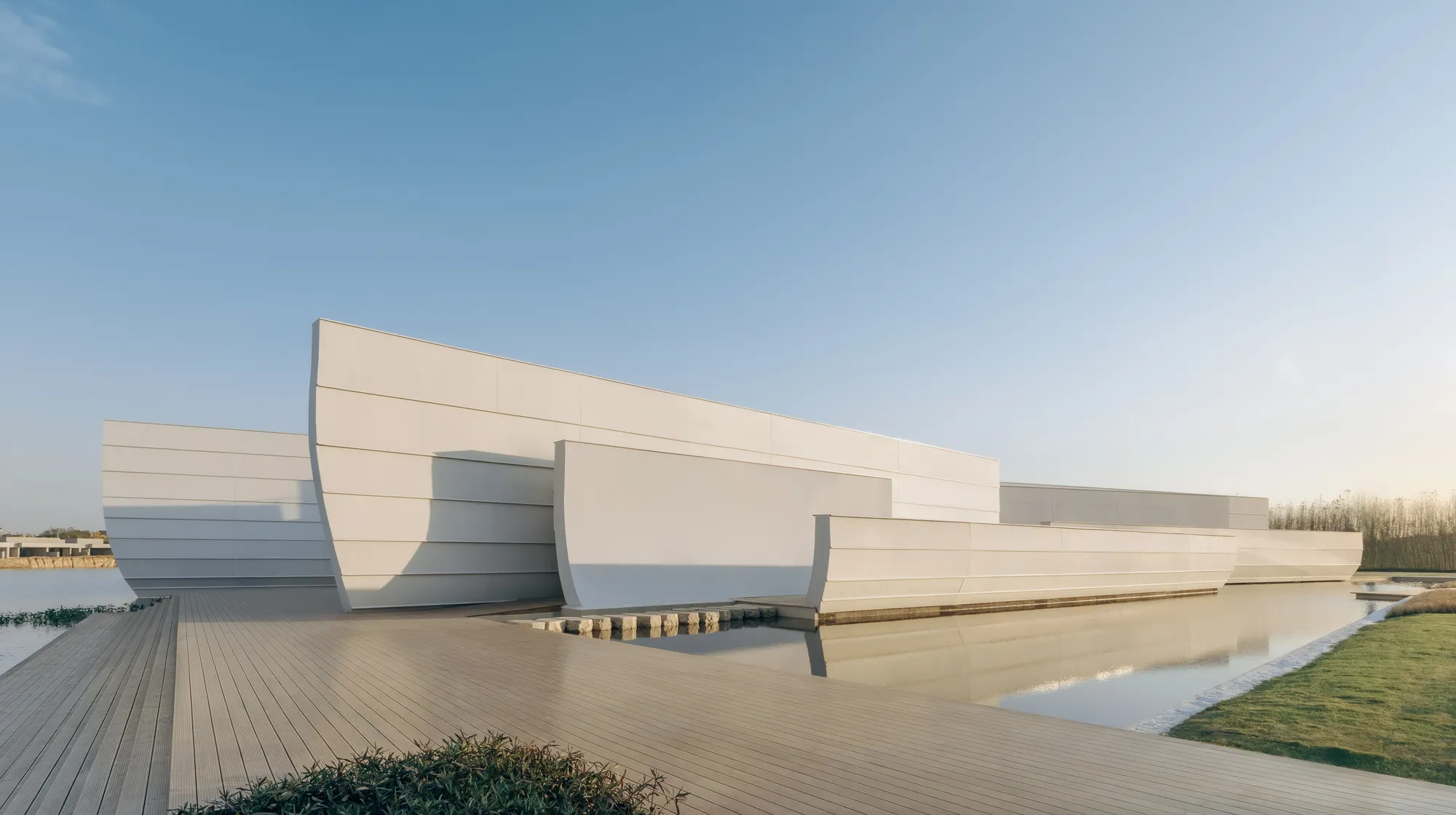
TAO Scatters a Field of White Walls Across a Wuhan Wetland to Build an Art Center That Breathes
On a triangular slip of land where lake meets road, dispersed GRC walls blur the line between architecture and shoreline in Caidian District.


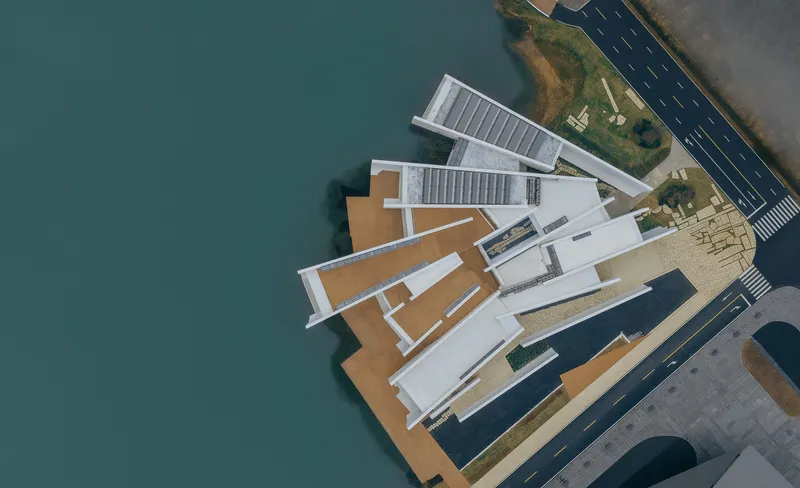
An hour outside central Wuhan, in the Caidian District farmlands surrounding Tonghu Provincial Wetland Park, TAO (Trace Architecture Office) has completed a 2,774 square meter art center that refuses to act like a building. The Chenhu Wetland Art Center sits on a triangular parcel where the natural shoreline of the lake collides with an artificial road fork, and instead of planting a single volume on that charged seam, TAO generated the entire project from one element: the wall. Walls disperse, thicken, curve, rise, and pierce through roofs, producing a porous field of white forms that, from the air, read less like a cultural institution and more like organic bodies drifting along the shore.
The strategic decision here is legible and radical. By refusing a continuous enclosure and working instead with a constellation of walls clad in white GRC panels embedded with shell and conch aggregate, TAO has delivered an art center whose spatial logic mirrors the wetland it inhabits. There is no fixed center, no rigid perimeter. The path through the building bends and divides, offering continuous glimpses of the lake rather than a sealed gallery sequence. It is a building designed to be porous to wind, water, light, and the flight paths of birds, all without sacrificing the functional intensity an art center demands.
A Landscape of Walls
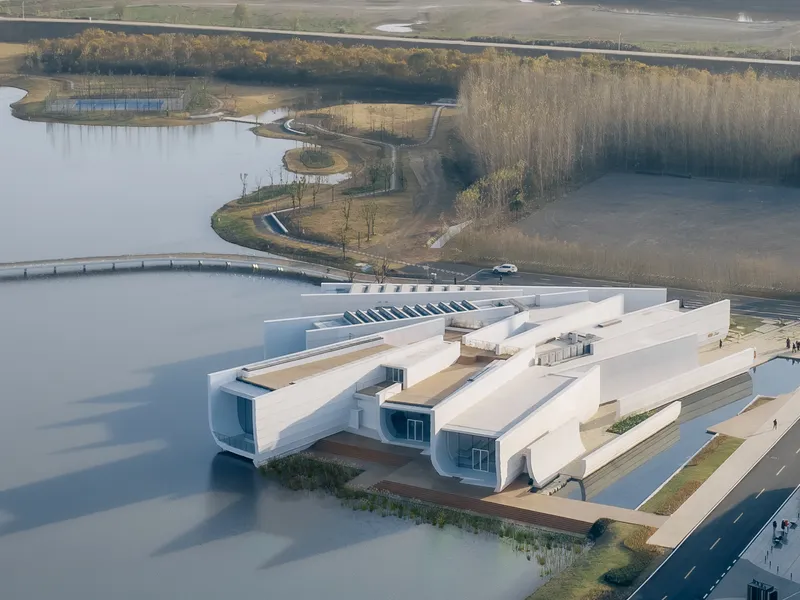
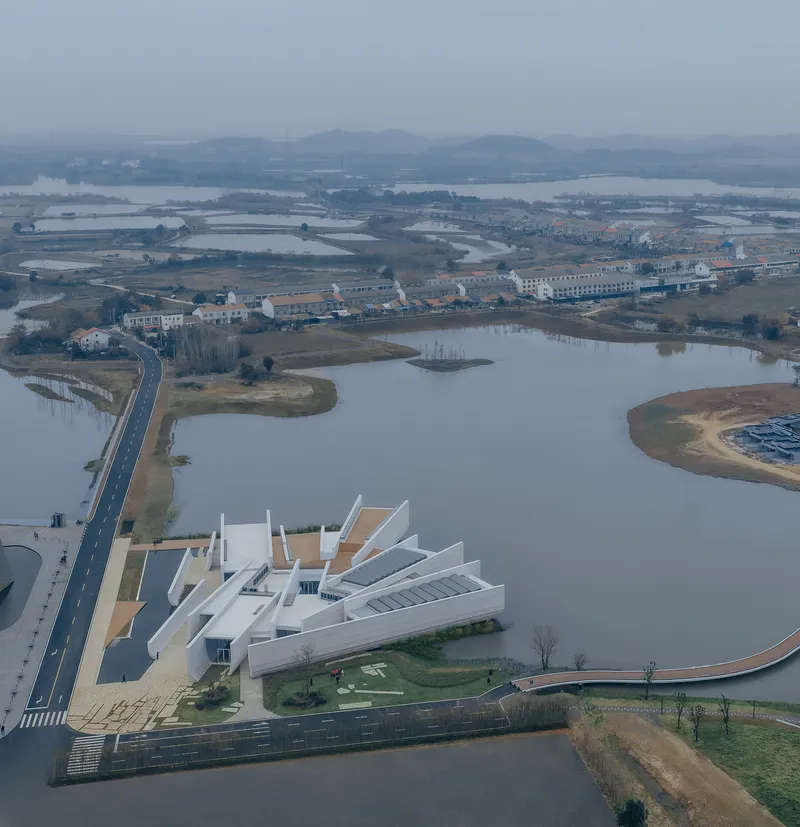
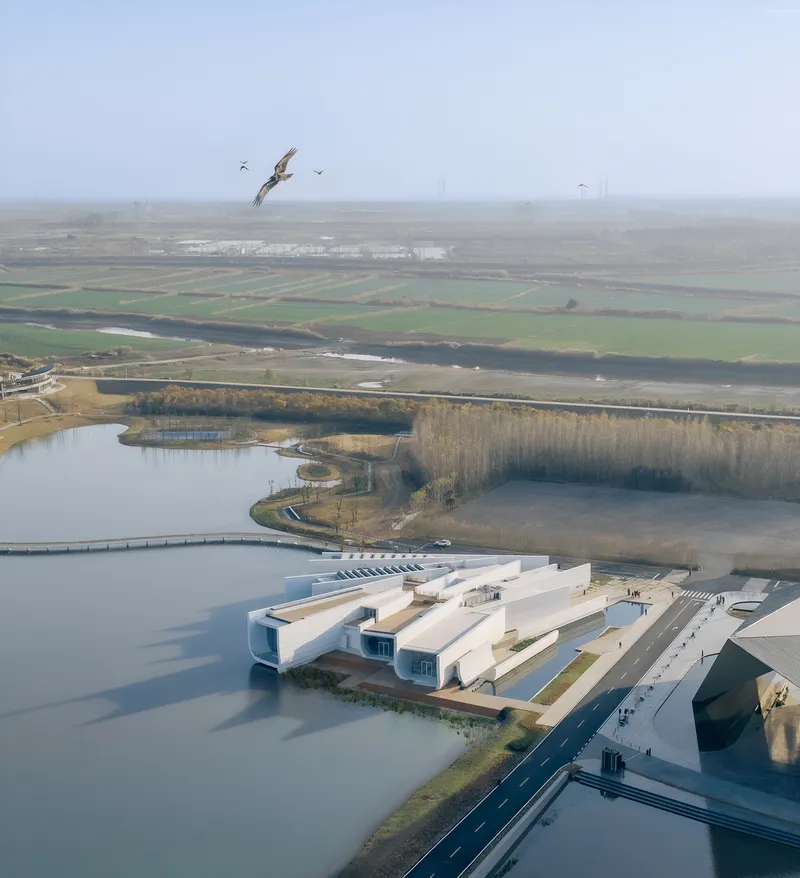
From above, the strategy is unmistakable. The building reads as a cluster of white angular wings fanning out from a loose center, their profiles echoing the meandering waterline that wind and seasonal flooding have carved over decades. TAO used BIM and digital twin technology to optimize the positioning of each wall segment relative to the shoreline, the road, and the adjacent wetland boardwalks. The result is a plan that radiates rather than encloses, allowing the landscape to infiltrate the gaps between volumes.
The aerial views under Wuhan's characteristic haze are telling. The building doesn't sit on the site so much as it emerges from it, its low horizontal silhouette barely rising above the treeline. A bird passing overhead, captured in one striking drone image, reinforces the ecological ambition: this is architecture calibrated to coexist with the migratory species that make the wetland significant.
Water as Co-Author
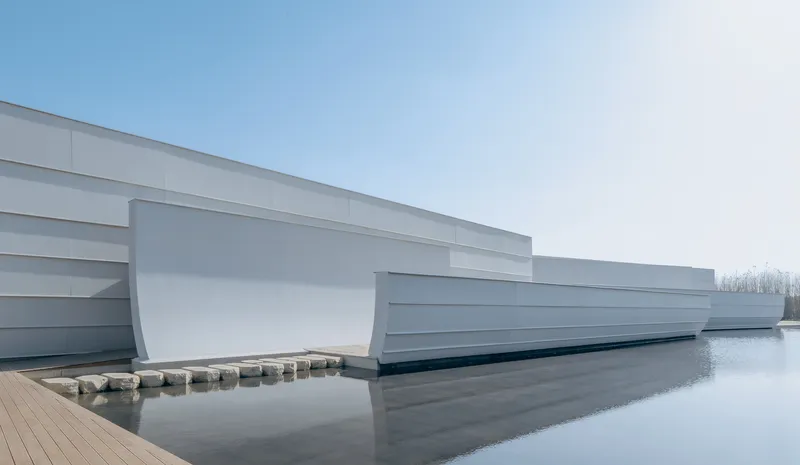
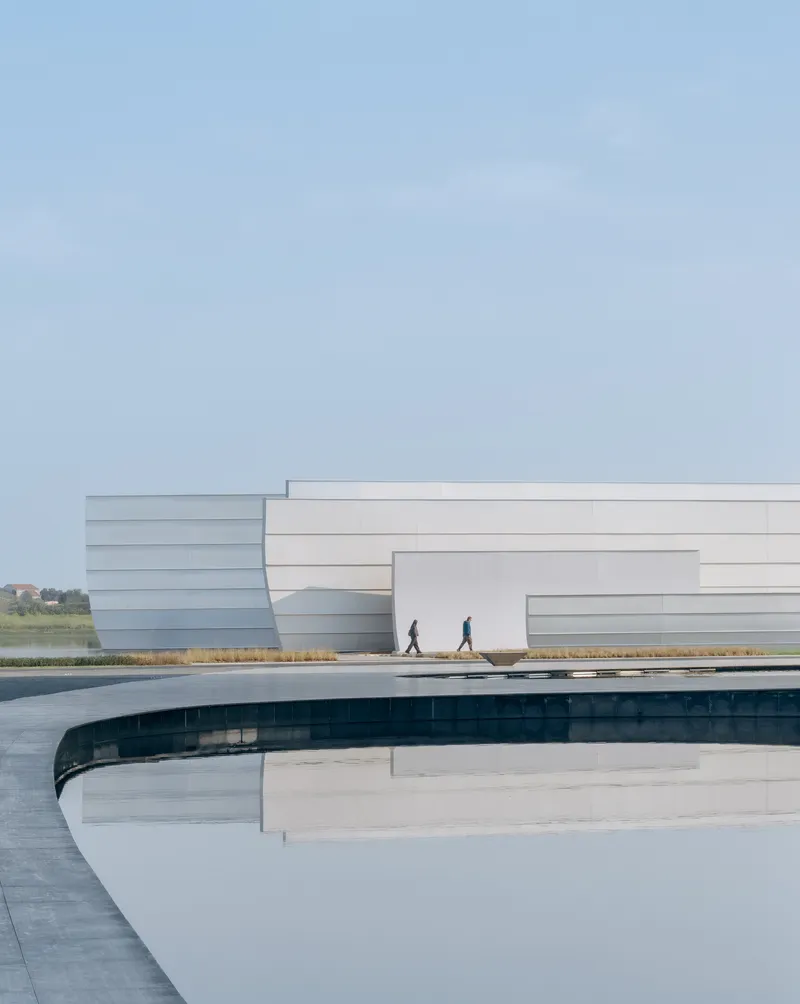
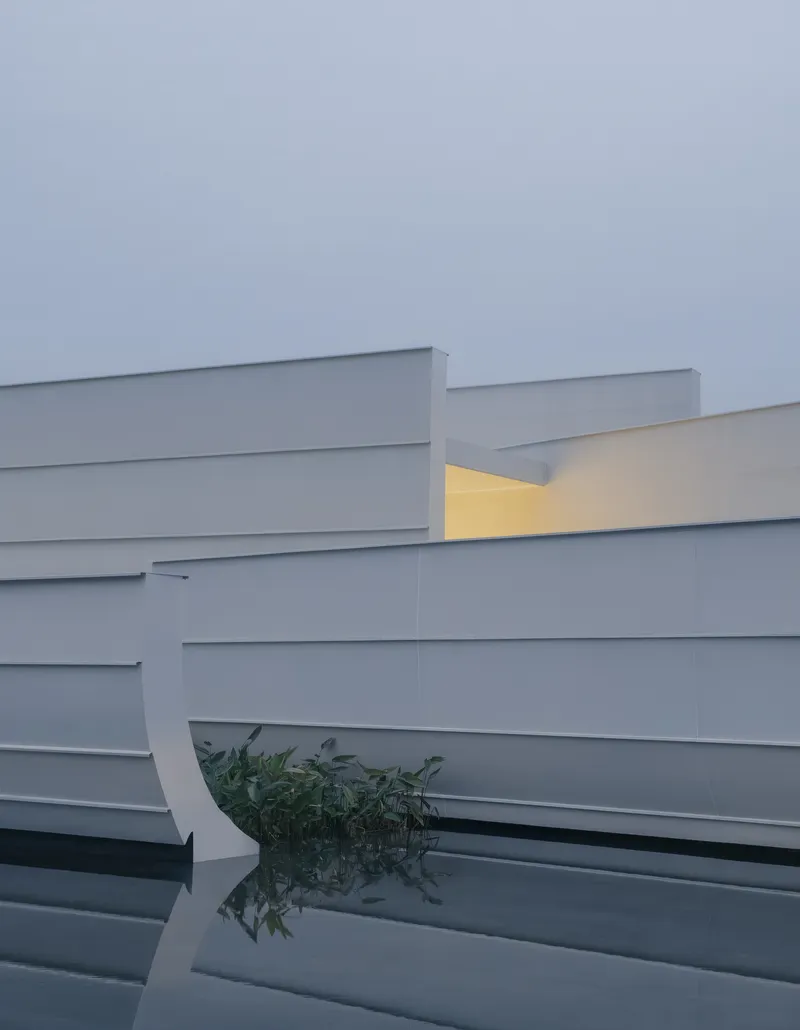
The lower sections of the walls bend in direct response to the lake. Curved surfaces rise and fall along the water edge, suggesting a form shaped by constant flow rather than by a drafting tool. Folded bases touch the water surface directly, and there is no strict boundary line between the built environment and the basin. Timber boardwalks extend outward from the building like jetties, making the transition from architecture to landscape a matter of steps, not thresholds.
Reflecting channels run alongside the layered facade, doubling the white horizontal bands in still water and producing a hovering effect that intensifies on overcast days. The GRC panels themselves participate in this dialogue: under Wuhan's high humidity and direct sunlight, the shell-aggregate surface develops a moist sheen, a micro-response to climate that gives the building a living skin rather than a static cladding.
The Exterior Skin
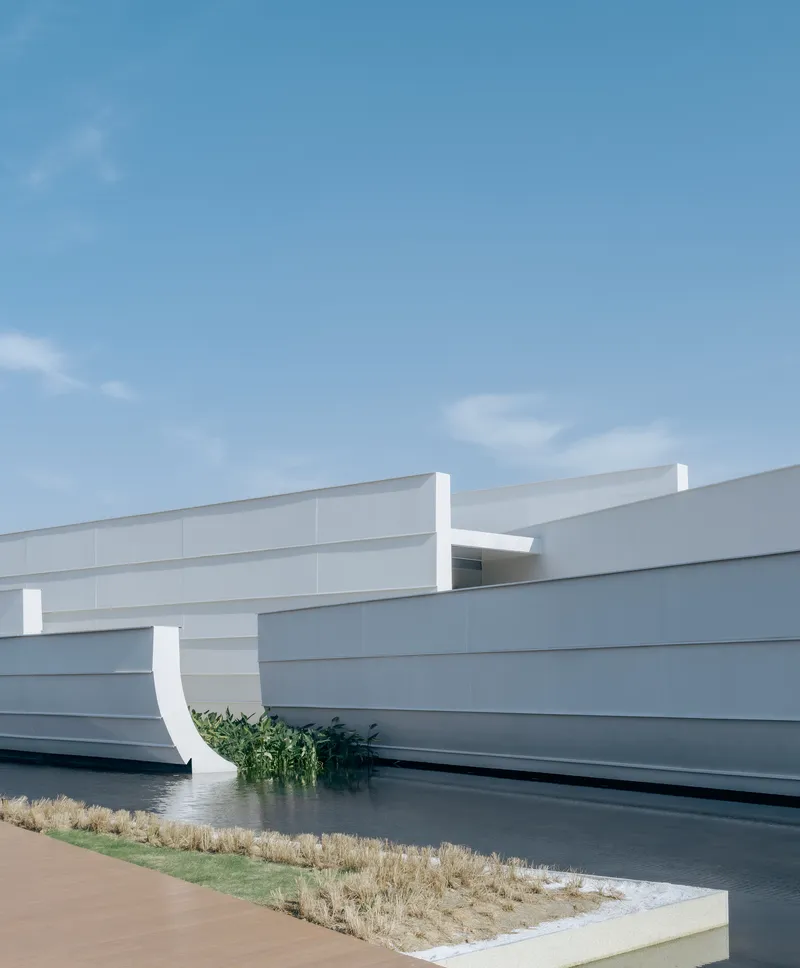
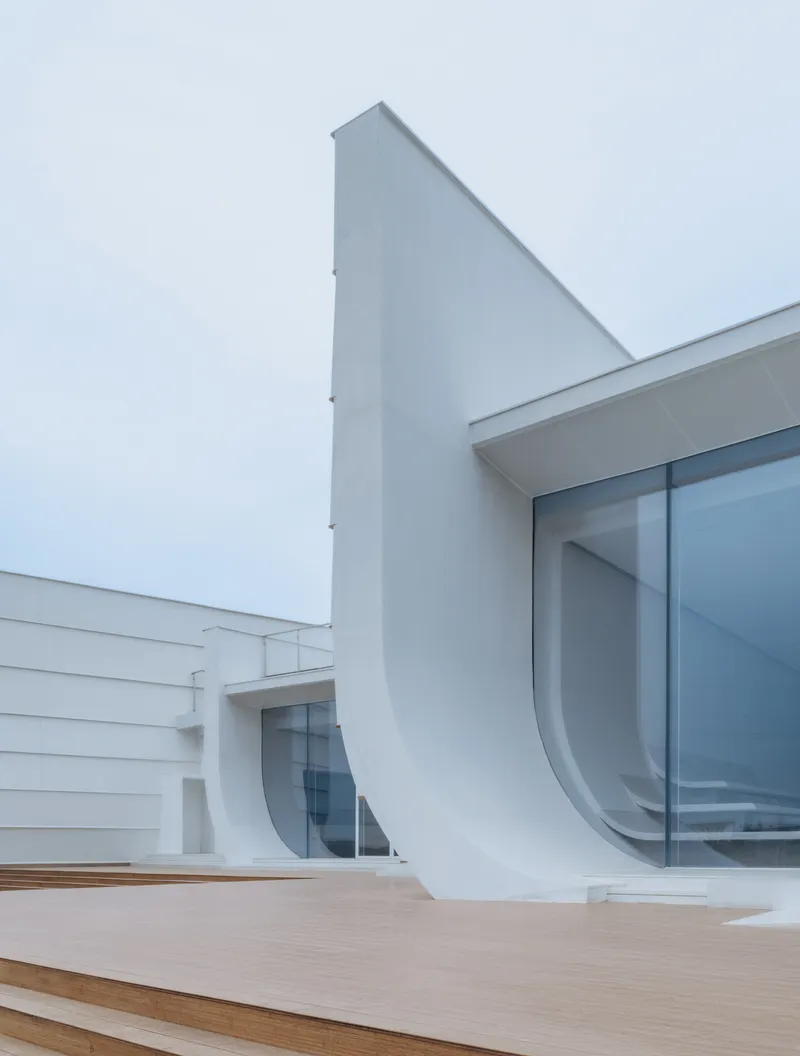
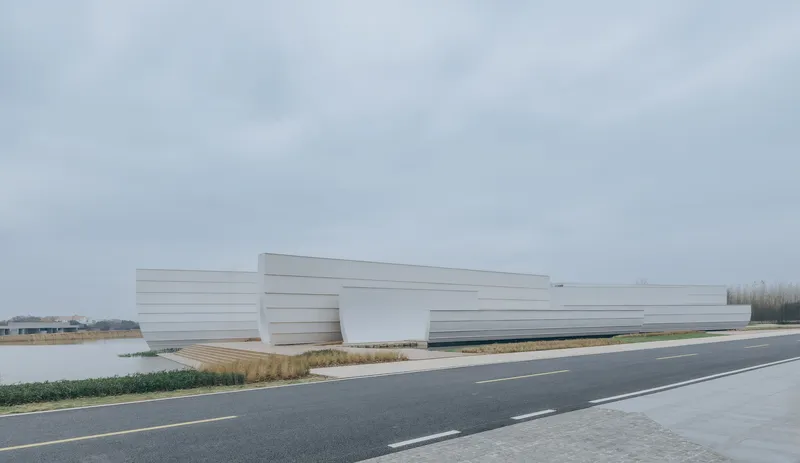
Up close, the white GRC panels reveal a material richness that the aerial views conceal. The embedded shell and conch aggregates give the surface a granular texture, a geological reference to the sedimentary processes at work in the wetland itself. Horizontal banding articulates each volume into stacked layers, reinforcing the sense that these are landforms deposited over time rather than facades erected in one campaign.
Where the panels meet floor-to-ceiling glazing, the junction is handled with precision: curved relief elements wrap around corners and taper into glass, softening what could be a hard material transition into something almost gestural. Planted grasses at the base further dissolve the building's footprint into the surrounding terrain.
Interior Flow
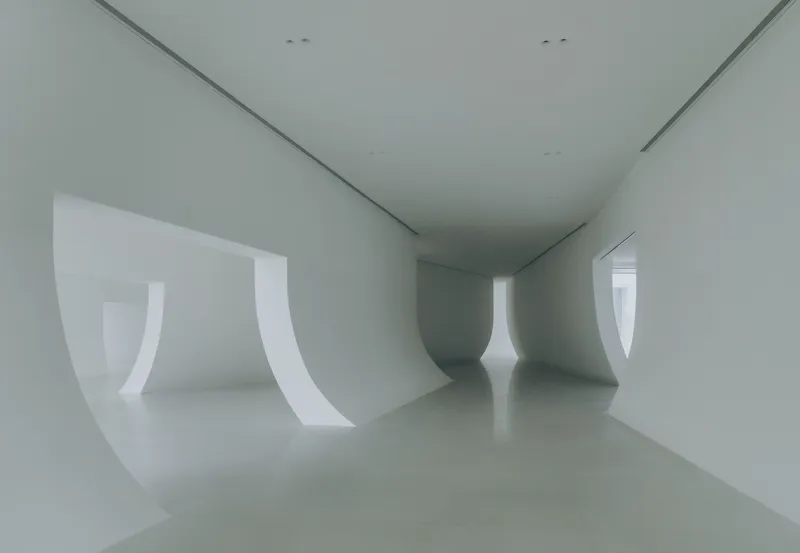
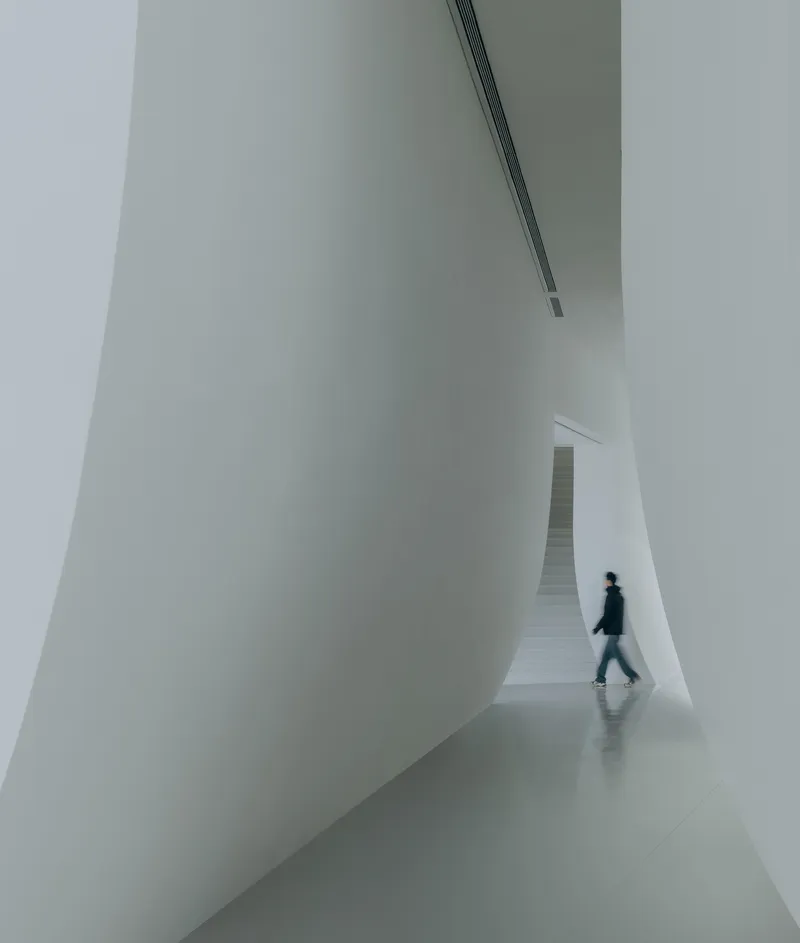
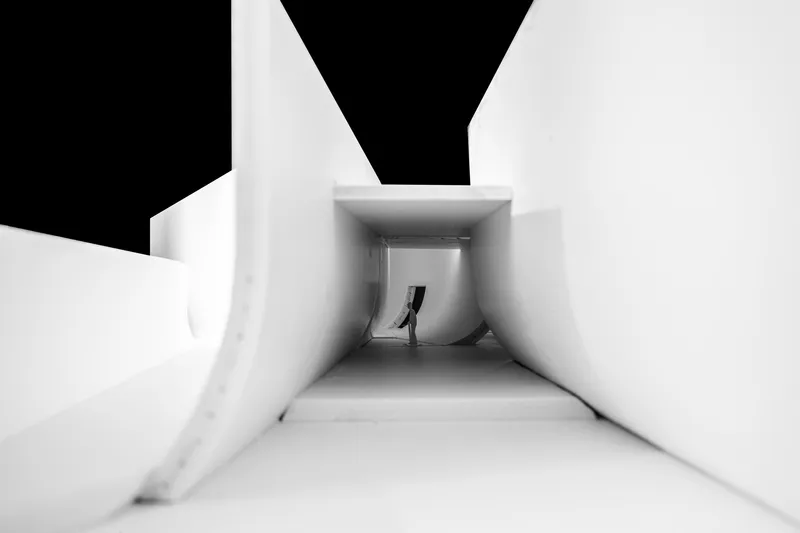
Inside, the wall remains the protagonist. Curved white surfaces define every room, corridor, and threshold, but they never feel repetitive because each wall segment has its own curvature, its own relationship to a skylight or a floor-to-ceiling window. The result is a sequence of spaces that feels navigated rather than planned. You move through the building the way you might walk along a shoreline: following the curve, discovering what lies beyond the next bend.
Overhead, linear ceiling slots and skylights positioned at varying heights introduce controlled daylight that washes down the curved walls. The light is diffuse and soft, appropriate for exhibiting art but also evocative of the hazy atmospheric conditions outside. A tapered corridor captured with a lone figure silhouetted against an overhead skylight distills the entire spatial strategy into a single image: architecture as a directed experience of light and movement.
Gallery and Threshold
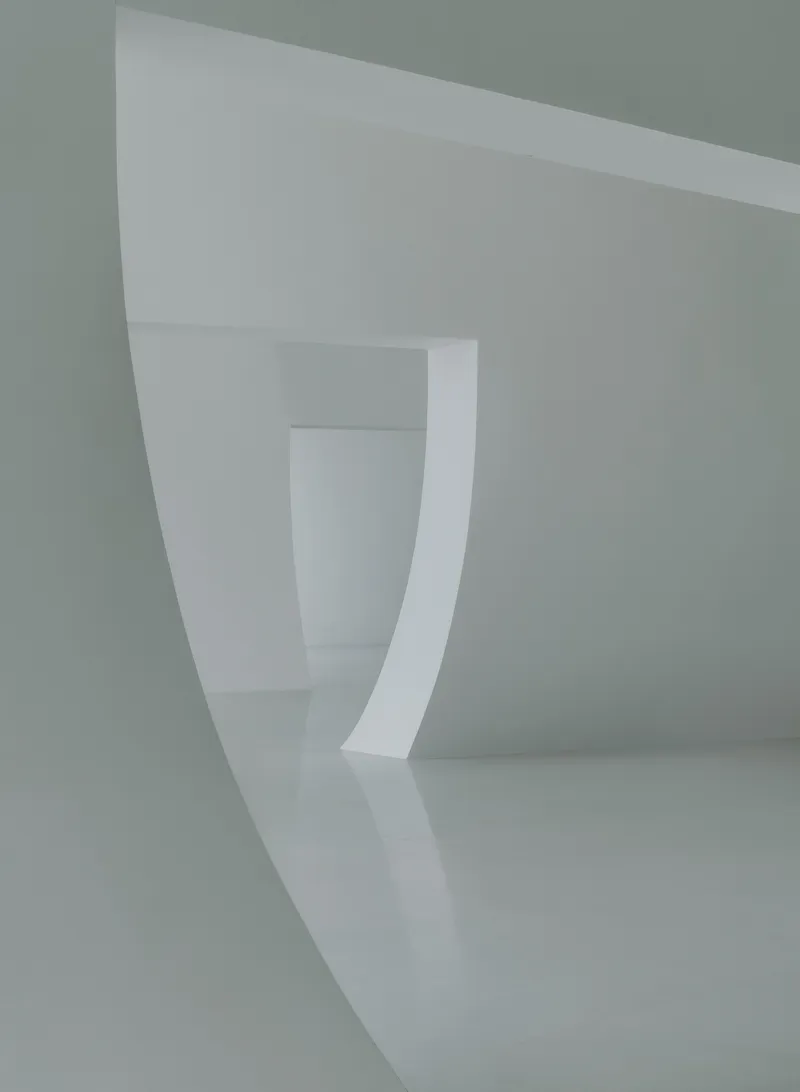
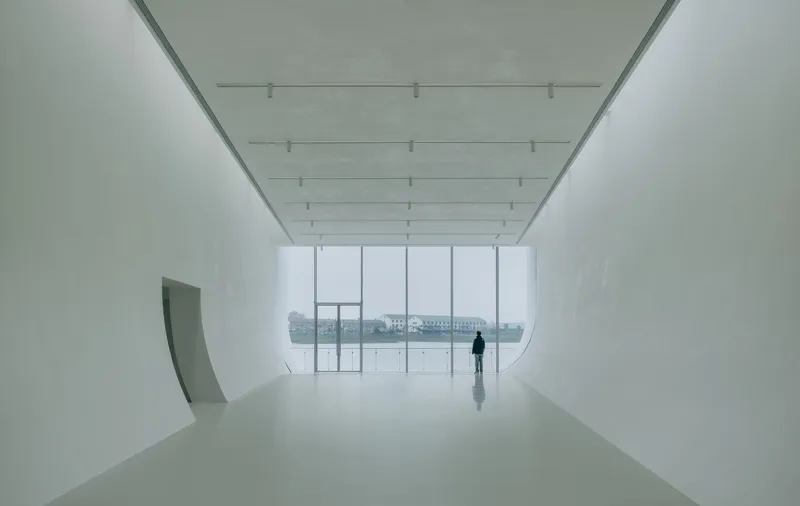
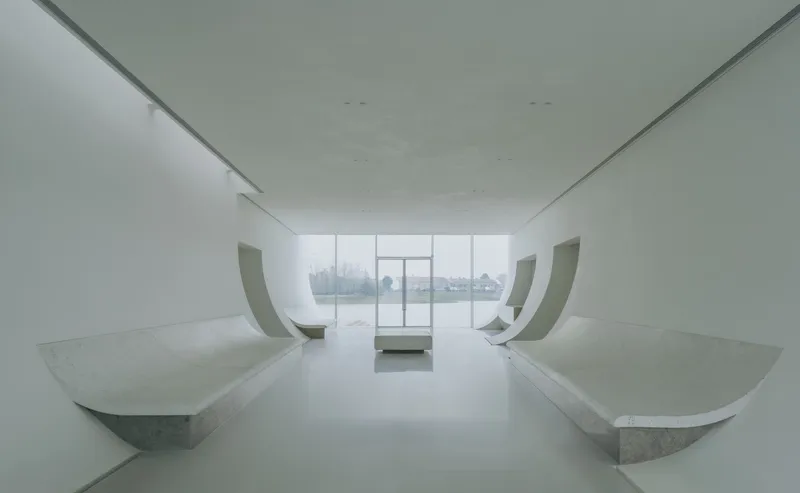
The series of curved thresholds that connect interior spaces is one of the building's most memorable gestures. Each arched opening frames the room beyond, creating a telescoping perspective that gives the relatively modest floor area a sense of depth and discovery. TAO has dissolved the conventional boundary between floor, wall, and roof in several key moments: walls punch through the ceiling plane, while roof surfaces fold down to become partitions.
Where the galleries meet the lake view, full-height glazing opens the interior to the misty waterfront. A symmetrical gallery space with paired curved benches flanking a glazed wall demonstrates that the building can be contemplative without being precious. The furniture, like the architecture, follows the curve.
Materiality and Detail
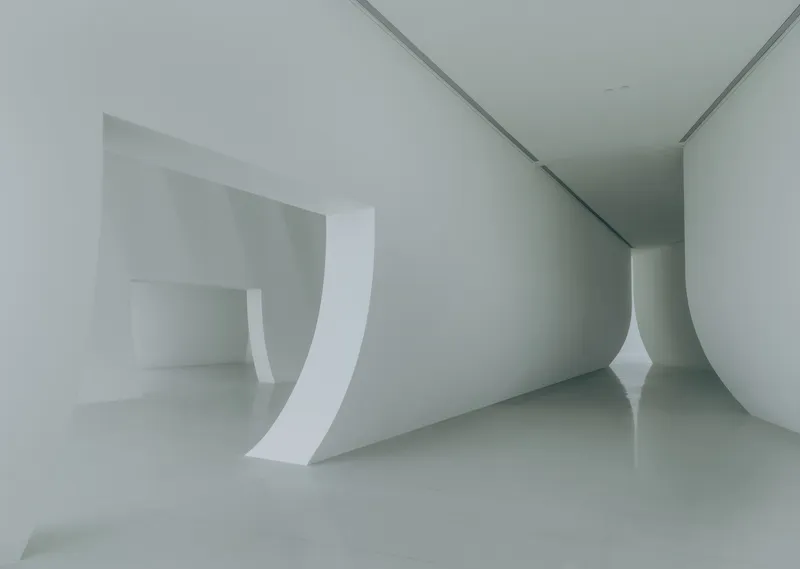
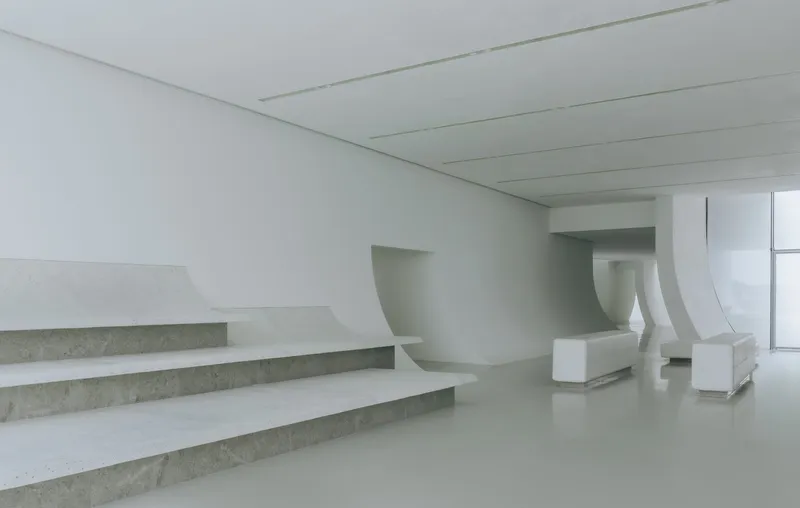
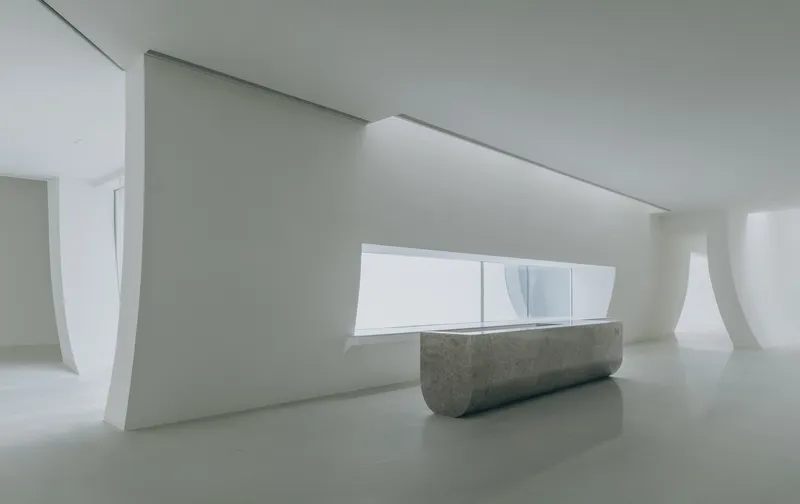
The interior palette stays disciplined: polished floors, exposed concrete stair treads, grey concrete reception surfaces, and relentless white walls. There is no attempt at warmth through applied material. Instead, warmth arrives through geometry: the continuous curvature of every surface catches and redistributes light in ways that a flat wall simply cannot. The broad staircase with its exposed concrete treads and curved white balustrades is an honest piece of construction, structural and directional rather than decorative.
A reception desk in grey concrete beneath a horizontal window, framed by those curving walls, shows the level of integration between program and form. Every functional element is embedded in the wall system. Nothing is applied after the fact.
Dusk and Illumination
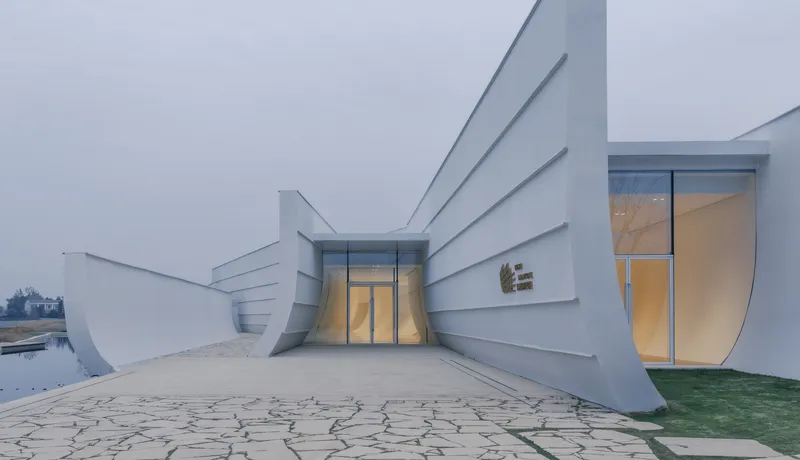
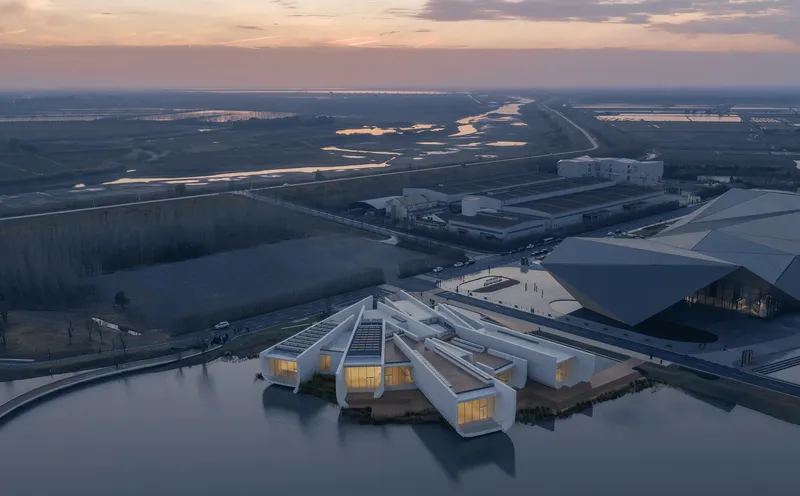
At twilight, the building transforms. Interior illumination spills through arched openings and horizontal recesses, turning the daytime landscape of white walls into a lantern array scattered along the shore. The horizontal banding that reads as shadow play during the day becomes a series of glowing lines at night, and the curved reflecting pools amplify the effect. The aerial dusk image, with warm light pooling inside the clustered pavilions while the wetland darkens around them, is the clearest statement of the building's dual identity: a gathering place for people and a beacon within a protected ecology.
Plans and Drawings
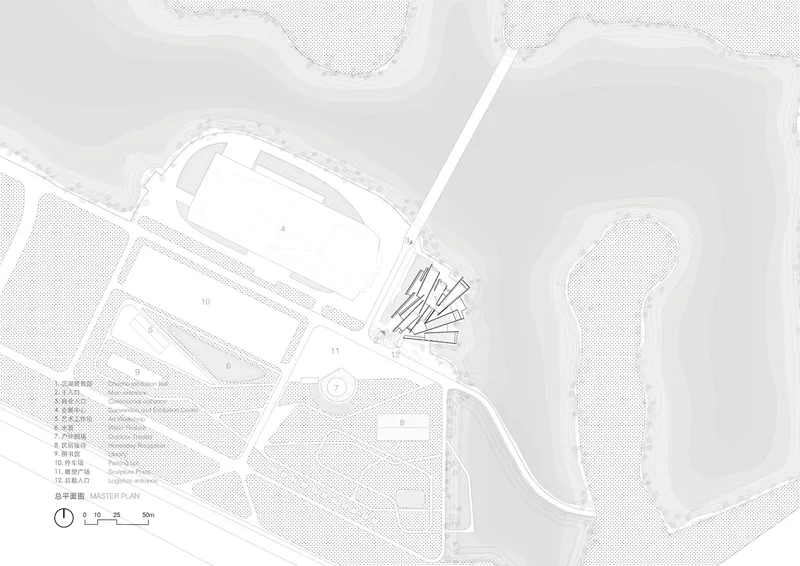
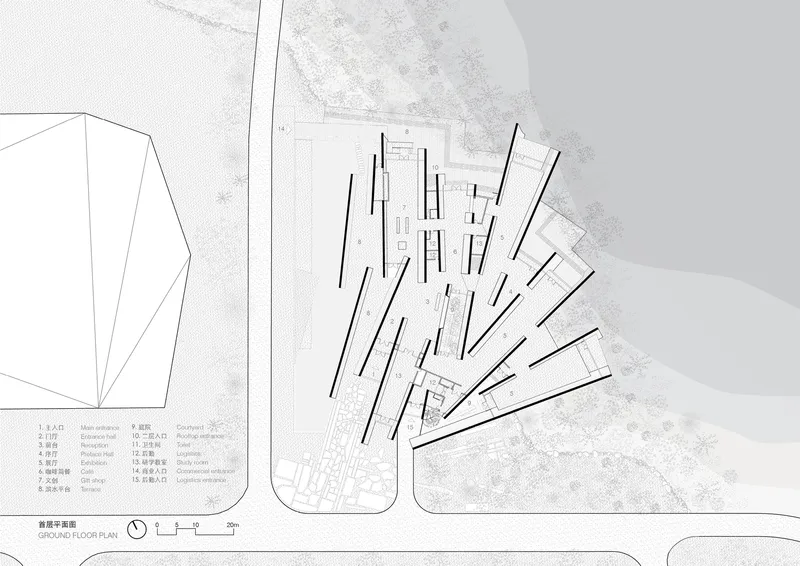
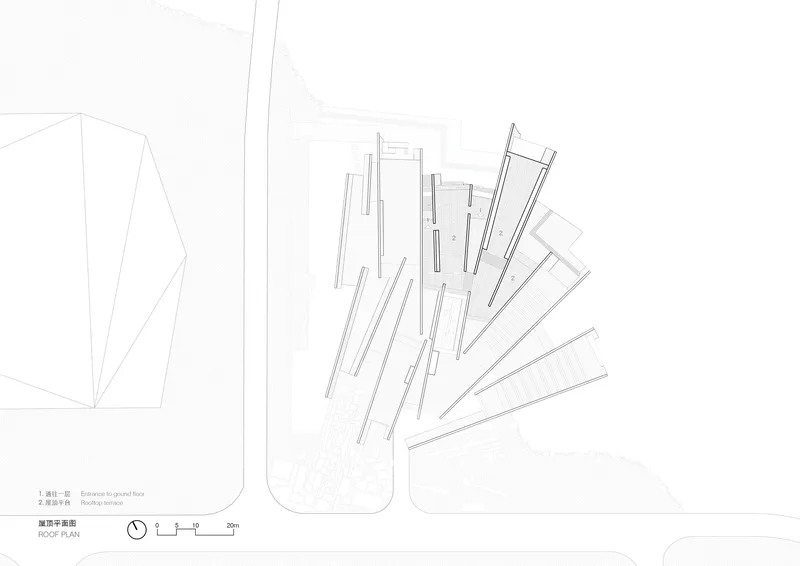
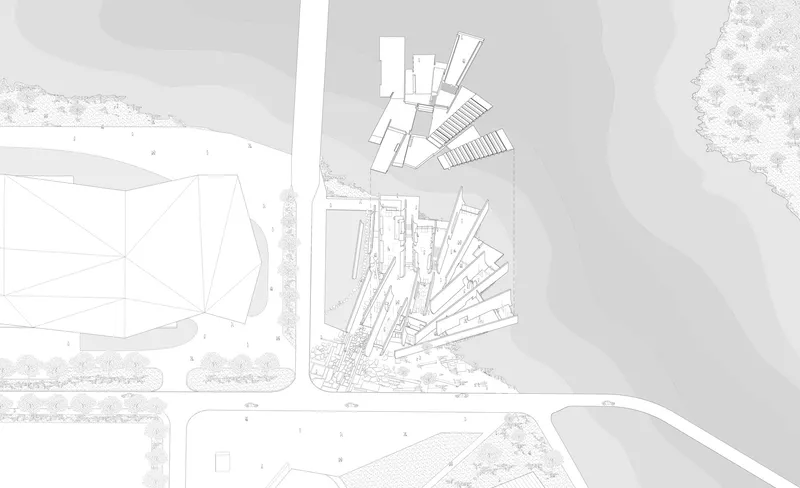
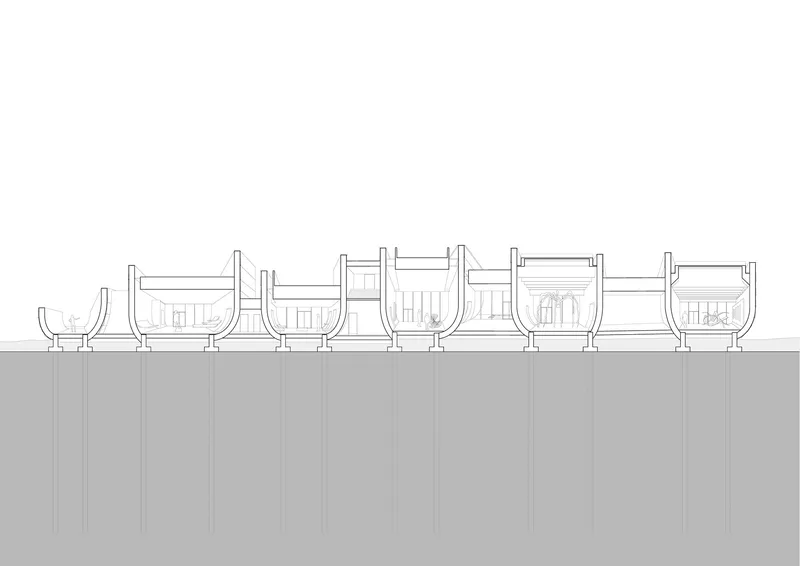
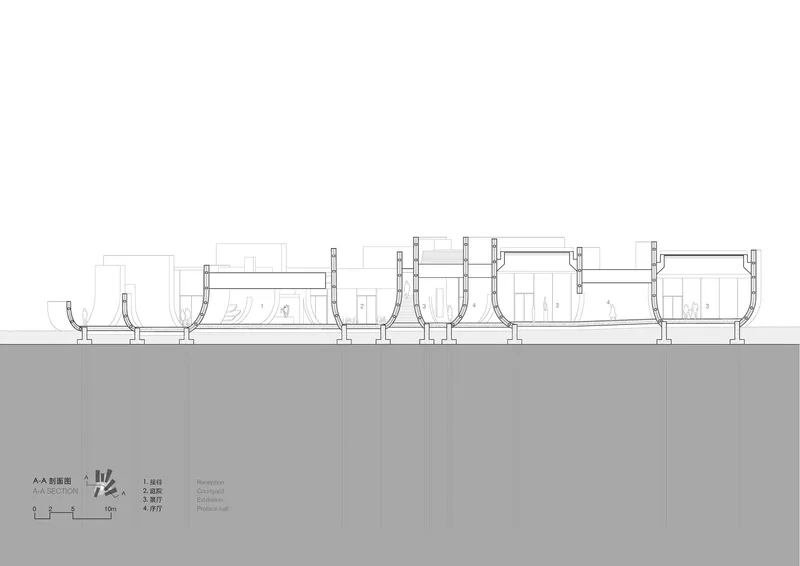
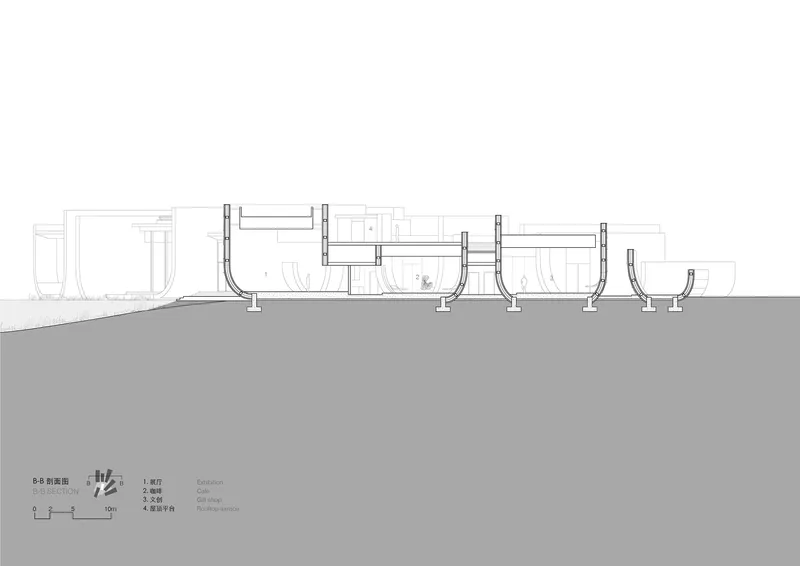
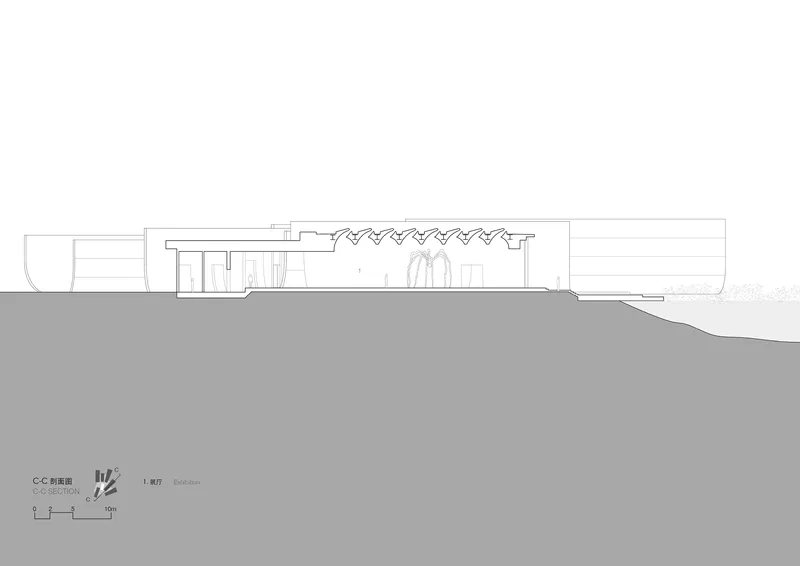
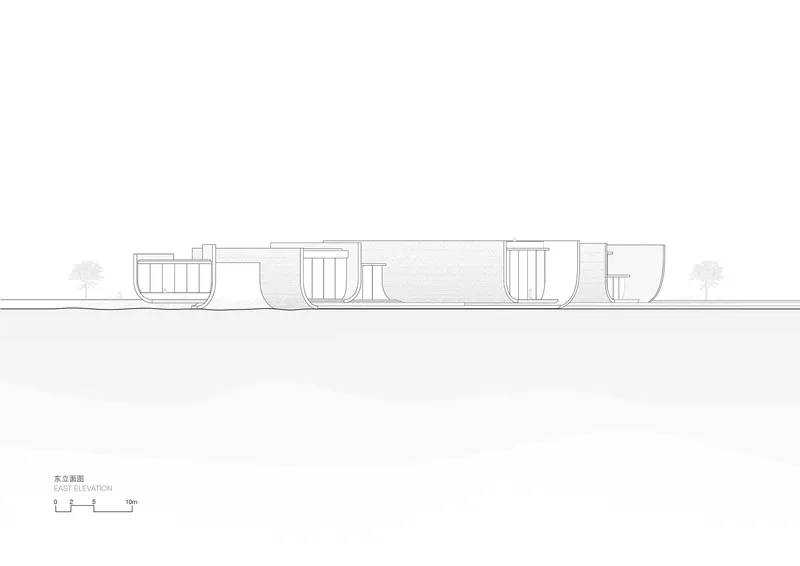
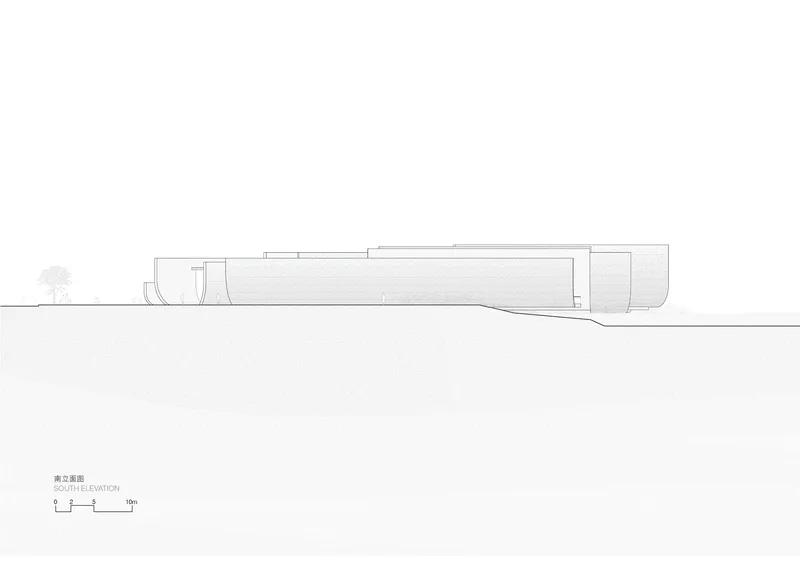
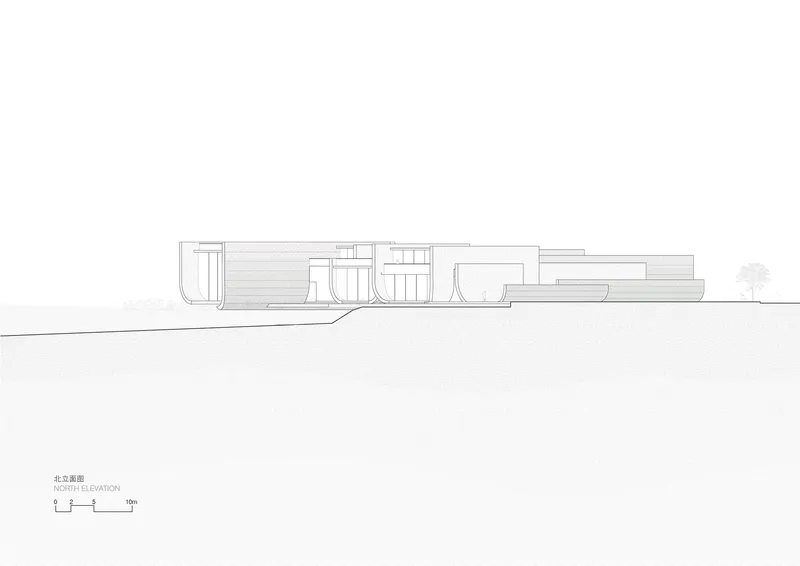
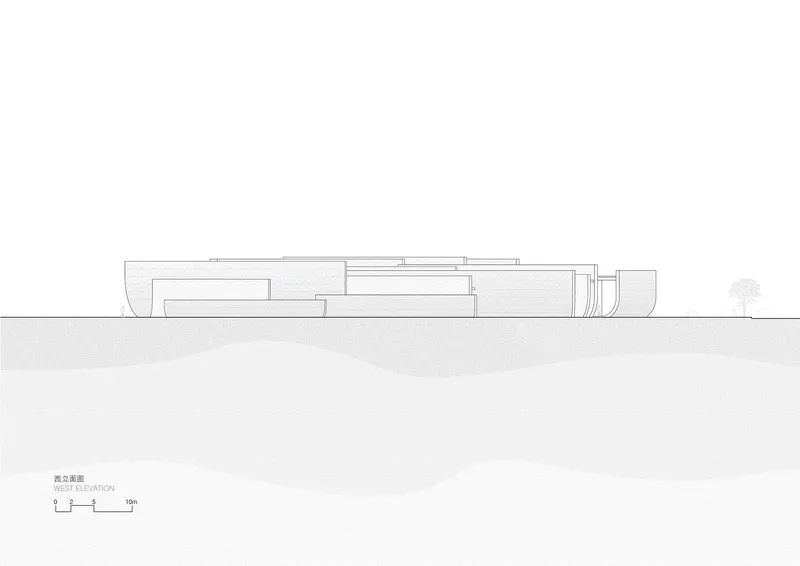
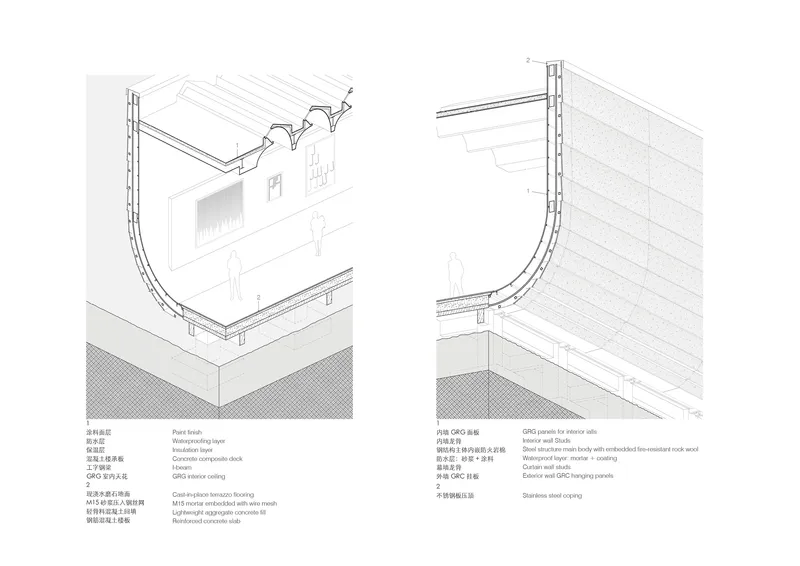
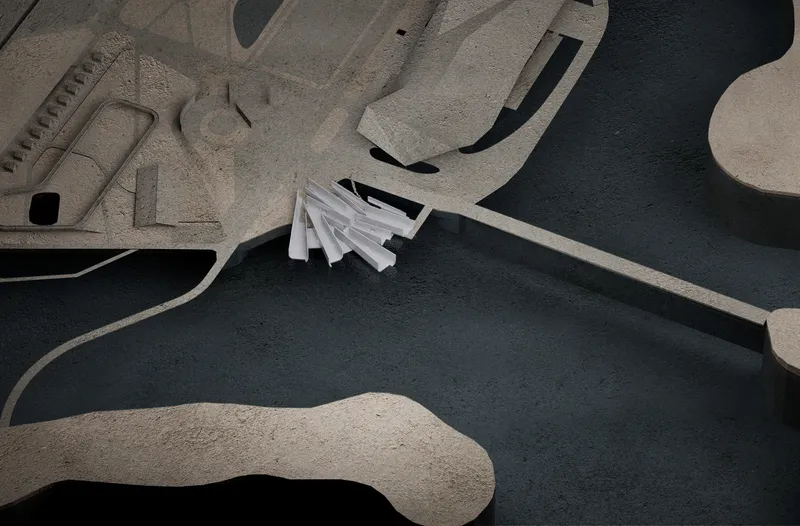
The drawings confirm what the photographs suggest: the plan is genuinely non-hierarchical. Linear exhibition spaces fan outward from central circulation nodes, and the sections reveal how bowl-shaped and arched volumes are supported by columns above foundation piles, lifting the occupied spaces above the fluctuating water table. The east elevation, with its four curved bowl-shaped volumes resting on grade, distills the formal language to its essence. Construction details of the curved roof edge assembly expose a carefully layered system of insulation and waterproofing panels beneath the GRC skin, a necessary complexity given Wuhan's punishing summers and wet winters.
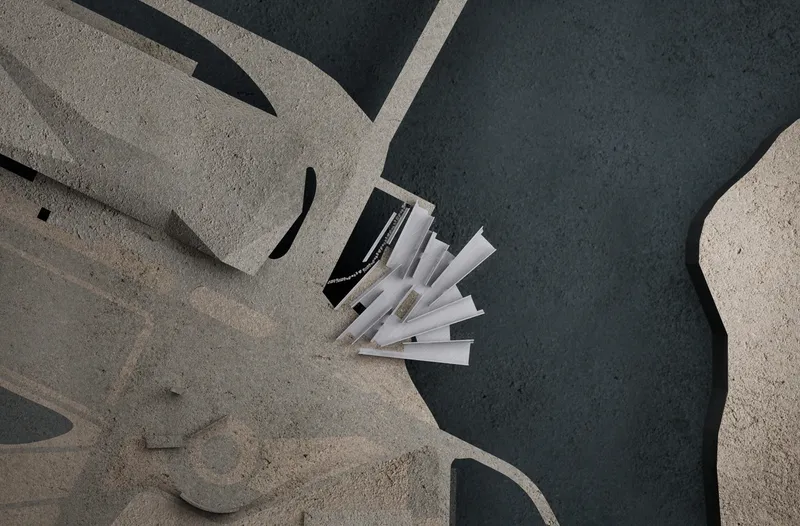
The site plans are equally revealing. Two building clusters, upper and lower, are positioned on either side of the road, connected by the landscape strategy of curvilinear water bodies and ecological boardwalks. The roof plan, with its splayed angular volumes and skeletal structural framework, reads almost like a diagram of wind direction or water flow, reinforcing the thesis that the building was shaped by the forces of the site rather than imposed upon it.
Process Models
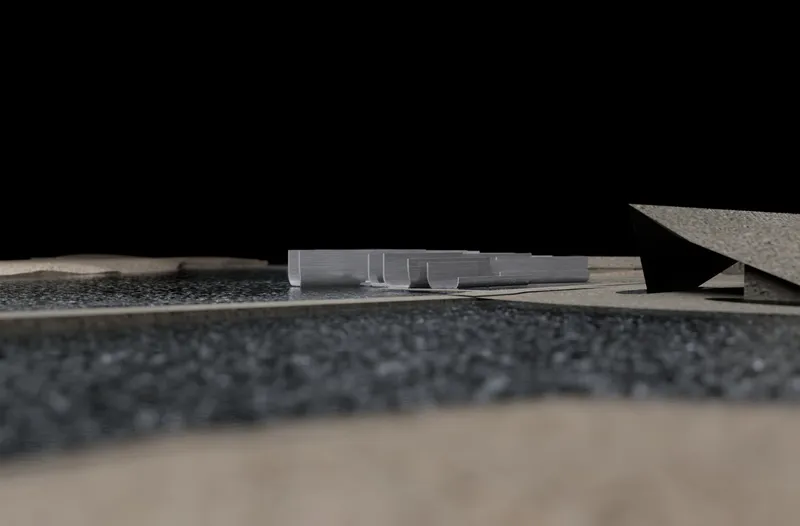
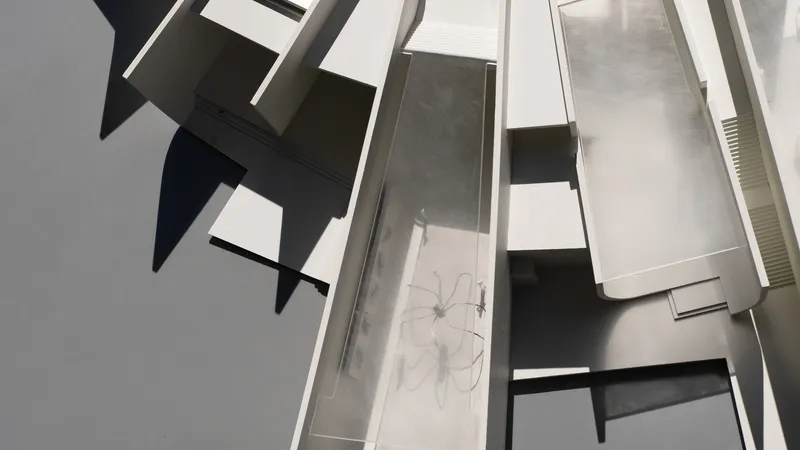
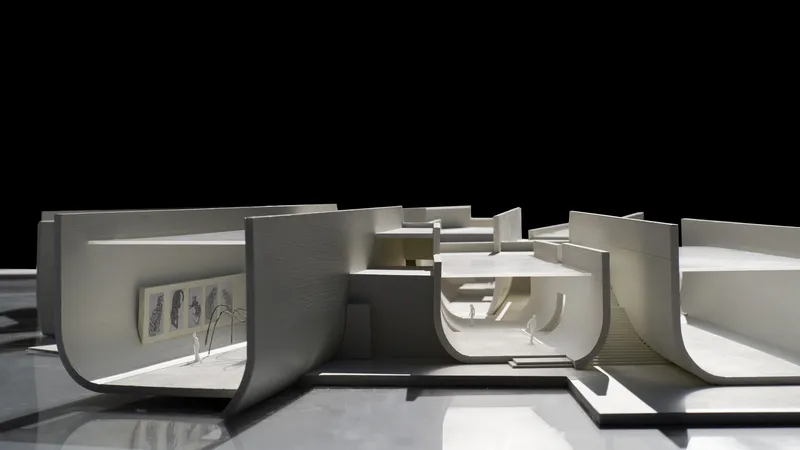
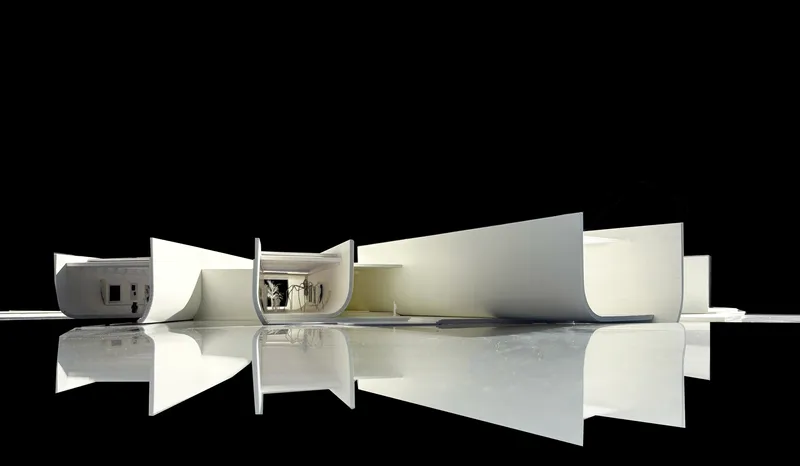
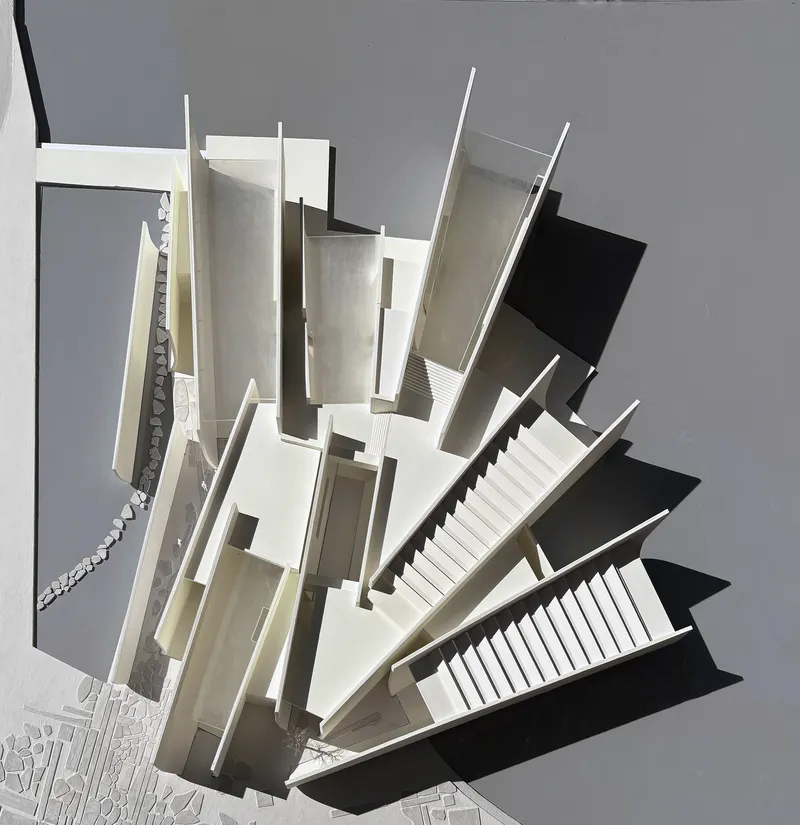
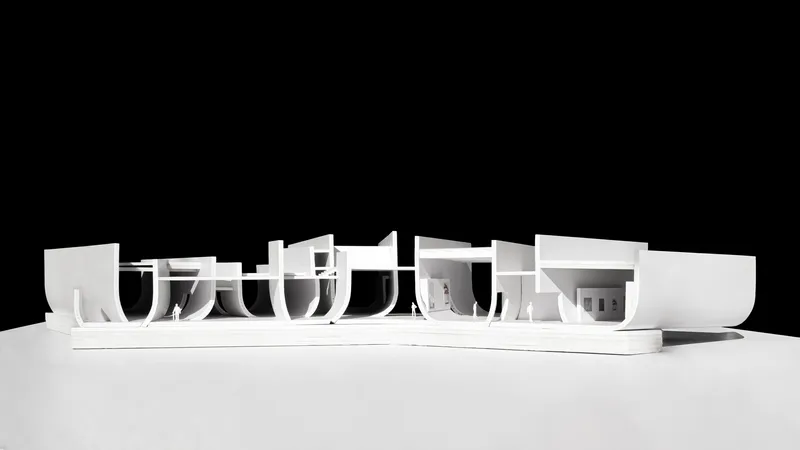
The physical study models are unusually revealing. They show TAO working through iterations that range from tightly interlocking volumes to looser configurations with sawtooth skylights and vertical tower elements. The sectional models expose the spatial ambition most clearly: undulating roof forms create vaulted interior sequences with sunken amphitheaters and terraced levels, establishing a vertical richness that the low horizontal profile conceals from the outside. These are not presentation models made to seduce a client. They are working tools, and their inclusion signals a practice that values the design process as much as the finished object.
Why This Project Matters
The Chenhu Wetland Art Center matters because it proposes a credible alternative to the sealed white box that still dominates institutional architecture, particularly in China's rapidly developing secondary cities. By generating the entire building from one element, the dispersed wall, TAO has produced a spatial system that is simultaneously legible and complex, rigorous and porous. The building does not merely reference its wetland context through metaphor or signage; it operates according to an ecological logic of permeability, allowing water, light, air, and movement to pass through its body in ways that a conventional enclosure would prevent.
For a region defined by the interplay of farmlands, water bodies, and woodlands, this is architecture that takes its environmental contract seriously. The smart monitoring systems and elevated bird-watching platforms are functional additions, but the real ecological contribution is formal: a building that refuses to draw a hard line between inside and outside, between culture and nature. In a discipline that still tends to treat context as something to frame from behind glass, TAO has built a center that wades in.
Chenhu Wetland Art Center by TAO (Trace Architecture Office). Located in Caidian District, Wuhan, China. 2,774 m². Completed 2025. Photography by Yumeng Zhu.
About the Studio
Share Your Own Work on uni.xyz
If projects like this are the kind of work you want to make, uni.xyz is a place to publish your own, find collaborators, and enter design competitions.


Popular Articles
Popular articles from the community


Co-life: Sustainable Architecture for Age-Friendly Community Living
Co-life reimagines sustainable architecture for seniors through courtyards, rammed earth, shared gardens, and spaces designed for belonging.

Conexión: Biophilic Design Reimagines High-Rise Living in Hong Kong
Conexión reimagines high-rise living in Hong Kong through biophilic design, green facades, shared spaces, daylight, water and nature within.

The Musturak Paradise: Senior Living Architecture for a Connected Future in Temara, Morocco
The Musturak Paradise reimagines senior living architecture in Temara via private homes, social spaces, culture, community, and shared care.

The Earth Pod: 3D Printed Homes for Resilient Refugee Communities
The Earth Pod reimagines refugee housing through 3D printed homes made from clay, combining resilience, self-sufficiency, and rapid shelter.

Similar Reads
You might also enjoy these articles

Bao Huynh Watercolor Atelier: A Serene Art Retreat in Hội An
Bao Huynh Watercolor Atelier in Hội An blends multifunctional art spaces, sustainable design, local materials, and family-friendly living in a serene environment.

Atelier Macri Concept Store Interior Design by CASE-REAL
Atelier Macri store features a "ko" counter, walnut wood details, cork displays, blending retail, gallery, and seamless customer experiences.

Manuel Vargas Izquierdo Stadium and High-Performance Sports Center: Architectural Excellence in Jalpa de Méndez
The Manuel Vargas Izquierdo Stadium blends sustainable design, inclusive sports facilities, and cultural-inspired architecture, revitalizing Jalpa de Méndez’s public spaces.

KAKR Buluh Awar Hall: Revitalizing Community and Ecology Through Bamboo Architecture
Community built bamboo hall revitalizes Buluh Awar village, empowering youth, restoring ecology, celebrating vernacular craftsmanship through sustainable architecture and culture.



Comments (0)
Please login or sign up to add comments
No comments yet. Be the first to comment!