
A modular opportunity
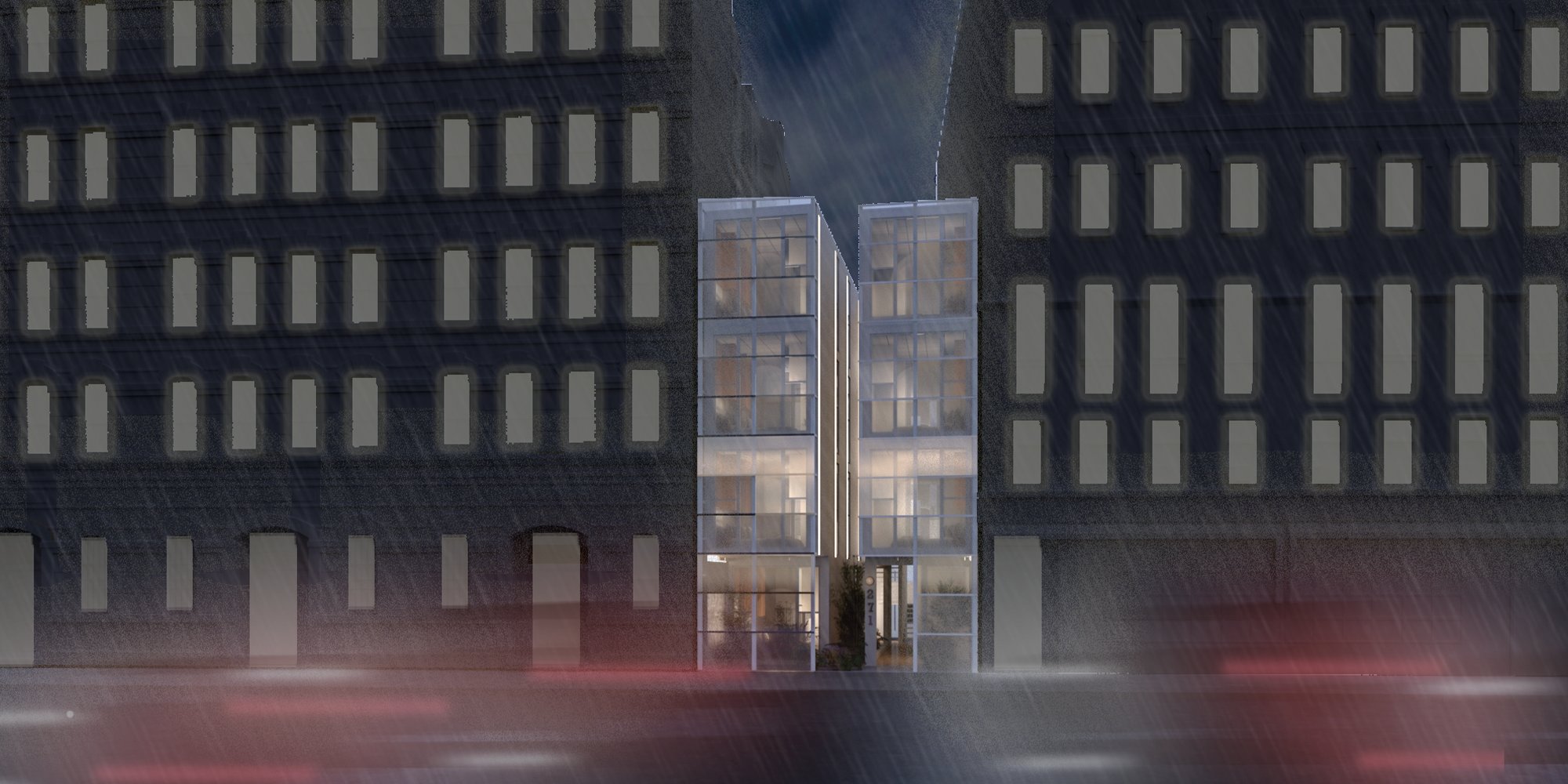
Bowery 271, inserting modularity in one of New York's most active neighborhoods.

Bowery 271 presented iteslf with a brief asking for accomodation for small modular housing in a very narrow site, which would need for a creative yet pure solution adaptable to the conditions of other sites along the city and the world.
The brief was solved by designing rectangular modules that could be easily stacked on top of each other, unified by using the same materials along its surfaces, allowing it to be turned and flipped in order to adapt to the neccesities of the client. The modules provide flexibility both on the inside and the outside, with a distribution that allows simultaneous tasks with a separated bathroom that provides natural light and ventilation throughout the space, redicing the need for external cooling.
What we wanted to achieve when designing this project was a purity of shapes and simplicity of function. As the module was able to be stacked on top of one another, the site conditions were the ones that made us shift from fully orthogonal distributions to align to the site limits. What this achieved was the creation of a central gap, which could give natural ventilation to the module's bathroom and making the external appearance of the building light up at night, highlighting it. Also, the creation of a natural barrier was a top priority for us; by seeing how parks and public spaces were not directly visible from the site (nor from its surroundings, for that matter), we created a natural buffer at the front facade that could greet users and bypassers with a punch of greenery.
The result of this exercise was a combination of three equal volumes separated by the conditions of the site and unified by a singular staircase volume, which provides access to the 12 available units while providing views to our backyard oasis and landscape. In the facade, according to the climate conditions, an opaque facade was designed, able to provide intimacy to the building users while also providing protection from the intense solar radiation that hits the building throughout most of the year, while also making the building gain depth and highlighting its color and volume. In addition to this, all modules were thought to provide cross ventilation across its floor area, reducing the effects of the intense humidity of New York's climate.
In order to maintain the same module in such an irregular site, these were located using setbacks and tilting them horizontally to match its limits. This architectural gesture was able to create an intimate buffer for the ground level apartment and framing the main entrance of the building and guiding visitors and residents to the main lobby. This area on the ground floor accomodates a welcome desk, an office and a staff bathroom for managing the units and services needed for the project.
One of the main challenges we encountered while designing Bowery 271 was the creation of open space that allowed natural light to enter the building, as it is located in between two much taller buildings that will block sunlight for most of the day. Also, accomodating all functional areas into a small area had its challenges as well, so a linear apartment that was able to be divided into three different areas, each increasing the level of intimacy and allowing users to fit their needs. A very important aspect for us was to include a washer/dryer module within the space, knowing how big of a commodity this is in the city, this would make the units much more attractive and could potentially make agnostics of modular and prefabricated construction open up about this way of living and building in a faster and more efficient way.
Designing this type of builidngs is definitely challenging, but it is a task that us as architects must put more attention to. As climate change is creating new conditions for living and creating the places we live, play and work. Making these processes more efficient and incorporating flexibility at the heart of every architectural program, able to adapt to different conditions and reshape spaces to meet the needs of any event that could present itself in future years, which appear to come with new challenges that will need us for a solution.



Popular Articles
Popular articles from the community

IKC de Geluksvogel: Sustainable School Architecture Designed for Free Movement and Digital Learning
IKC de Geluksvogel turns sustainable school architecture into a flexible Maastricht campus for digital learning, nature, and free movement.

Reincarnation Weaves a Three-Story Retreat into the Green Landscape of Rural Bangladesh
Ara Manor in Narsingdi dissolves the line between domestic architecture and its lush surroundings through screens, courtyards, and planted rooftops.
The Faith: Modular Architecture for Play, Learning, and Hope in Kutupalong Refugee Camp
A modular playground architecture project in Bangladesh where play, learning, safety, and hope rebuild childhood inside a refugee camp anew.
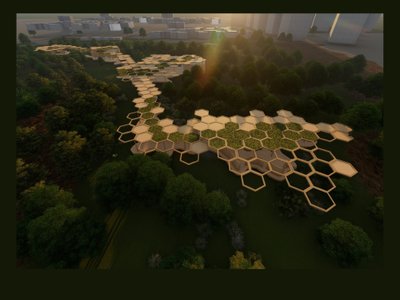
Eco Chapel: A Green Architecture Pavilion Designed in Symbiosis with the Forest
Eco Chapel uses green architecture to weave prayer, learning and reuse into a forest pavilion shaped by modular hexagonal canopies for life.

Similar Reads
You might also enjoy these articles
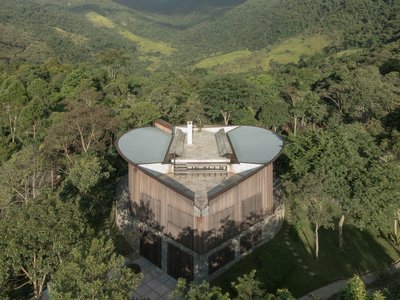
House in Bocaina by Ana Altberg + Cesar Jordão: A Circular Retreat Embracing the Atlantic Forest
Circular forest home in Brazil by Ana Altberg and Cesar Jordão, blending sustainable materials, passive design, and immersive landscape integration.
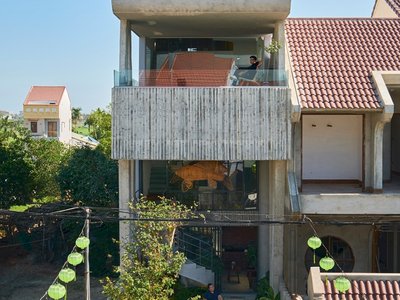
Cherry Homestay: A Harmonious Blend of Modern Design and Traditional Hoi An Architecture
Cherry Homestay blends modern architecture with traditional Hoi An elements, featuring spiral stairs, rooftop mezzanine, sustainable materials, and open, airy spaces.
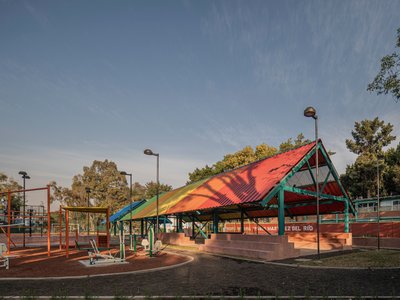
Revitalizing Culhuacán: Housing Unit Infonavit CTM Square by AMASA Estudio
AMASA Estudio revitalized CTM Culhuacán Square, transforming neglected housing unit spaces into vibrant, accessible, community-focused public areas with sustainable design elements.
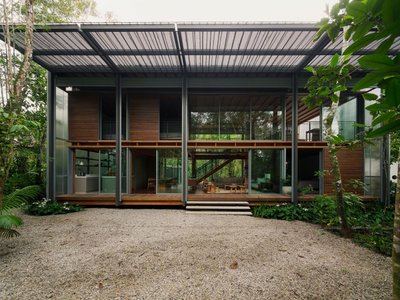
FR House by Andrade Morettin Arquitetos Associados: A Coastal Retreat Embedded in Brazil’s Native Landscape
Coastal vacation house blending into native vegetation, using translucent polycarbonate, timber structure, passive shading, and elevated design for climate-responsive living.

Explore Housing Competitions
Discover active competitions in this discipline




The International Standard for Design Portfolios


The Global Benchmark for Architecture Dissertation Awards


The Global Benchmark for Graduation Excellence


Challenge to reimagine the Iron Throne
Comments (0)
Please login or sign up to add comments
No comments yet. Be the first to comment!