
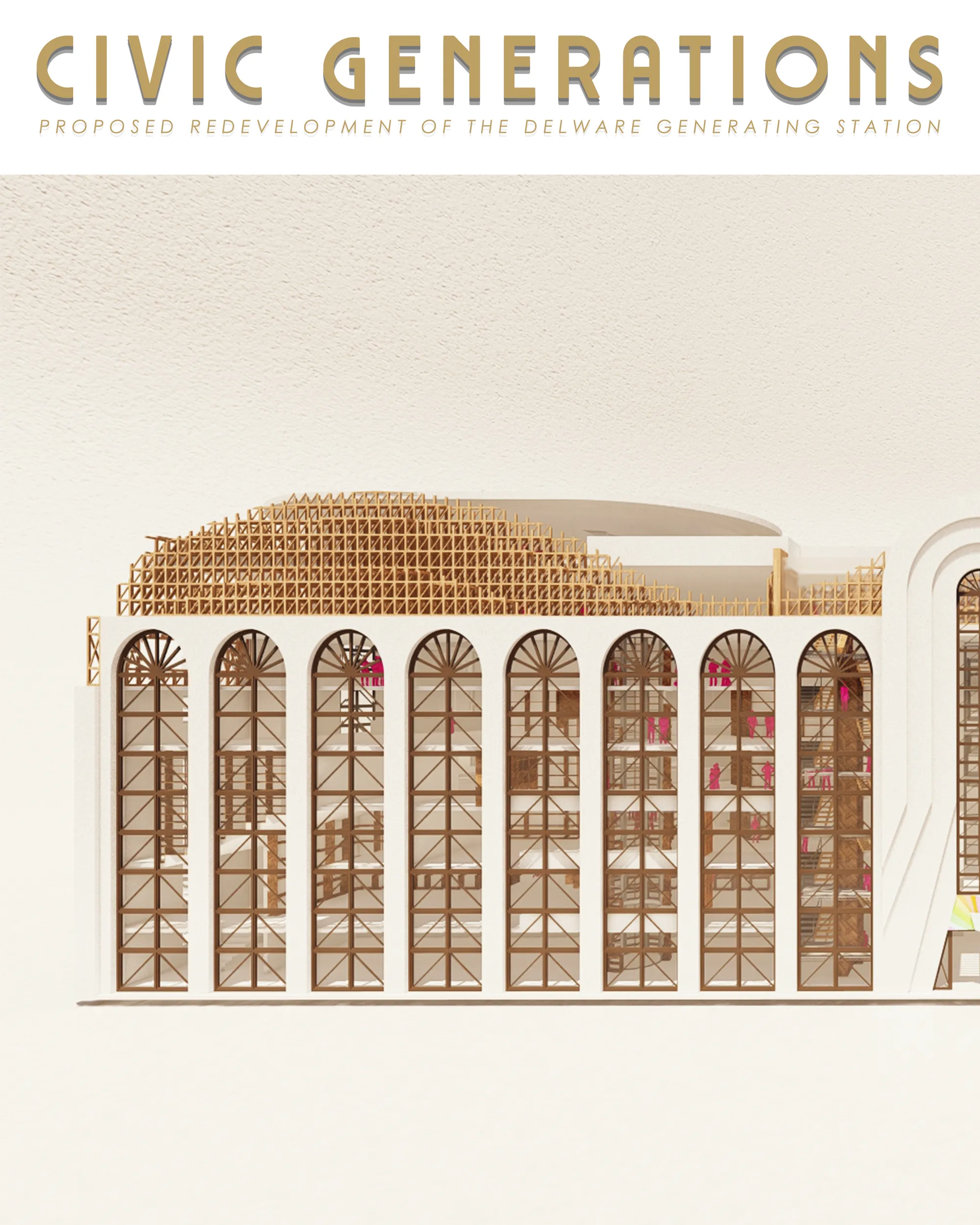
Civic Generations
A Proposed Conceptual Redevelopment of the Delware Generating Station.

Designing with adaptive reuse in mind often shows us the potential of varying structures in equally varying levels of degradation and neglect. In this case, the project called for a detailed and community-oriented design that would help renew the building as well as its surroundings. This redevelopment proposal focuses on community-oriented spaces as well as recreational spaces. It’s main goal is to spark a holistic community renaissance as well as give an empowered and ambitious take on the potential of the neglected space. This proposal builds upon the given brief and takes the intent and idea of the brief to the next level.

Conceptually, the issue with the brief is the fallout from creating such a project in the first place. Case in point, in the case of the High Line, Liz Diller, one of the architects of the project, often spoke about how developers took advantage of the space around the High Line. Like Fig. 1 suggests (The Brief), the intent of the project is to create essentially a selective redevelopment of the space that primarily consists of the mentioned spaces. Although like the problem that the High Line eventually encountered, creating a selective development of the building would only result in the developers profiting from the success of the project. As seen in The Problem figure, (again in the case of the High Line) should the project succeed, the developers stand to make the most out of the success of the project due to the economic value of the properties around the area. As an effect, community control over the fate and benefit of the project will fall. the ensuing success simply ensures that the community (who the project was built for) will not have a say on the future of the project, hence, the solution. The solution is to put the community at the center of both the project and its consequent concept. If the community is not the priority then we risk creating another project like the High Line (which was a success but also took advantage of the community as a result of its success). The solution is to double down on what the community needs other than a park / commercial area hybrid. We must ask ‘what else does the community need?’ By answering this question, we can, through conscious effort, put the community at the center of the project to allow their future growth and their needs to be met FIRST before any other party lays claim to it.
Additionally, this method and argument ensure that the project will fulfill its purpose on the terms of the community and not for any third party. This simply allows the community to explore its potential in a way that they see fit, with spaces that they imprinted upon. Spaces that allow them to make the choices that they wish to make and that will allow them to explore their own potential on their own terms.
As seen in the diagram above, the community and its growth as well as its needs were prioritized in the creation of the project. The concept simply expanded itself from the original brief and added a few other aspects to the project considerations. By putting the community at the forefront of the concept, the design essentially self-generates the other spaces that would be required to add to the success of the project. Aspects like intellectual growth, economic growth, cultural growth, etc, should help allow the community to maintain control. On top of that, the spaces added (i.e. the library, the museum, the business incubator, etc.) will all be community-based. To a certain degree, these spaces will have functions and will operate on ideas that are essentially new or virtually untested. Although some of the ideas are untested, the core program of the added spaces mixes well with the initial space parameters of the brief, further solidifying the idea that the brief and added spaces work hand-in-hand and that the added spaces are an extension of the initial brief.
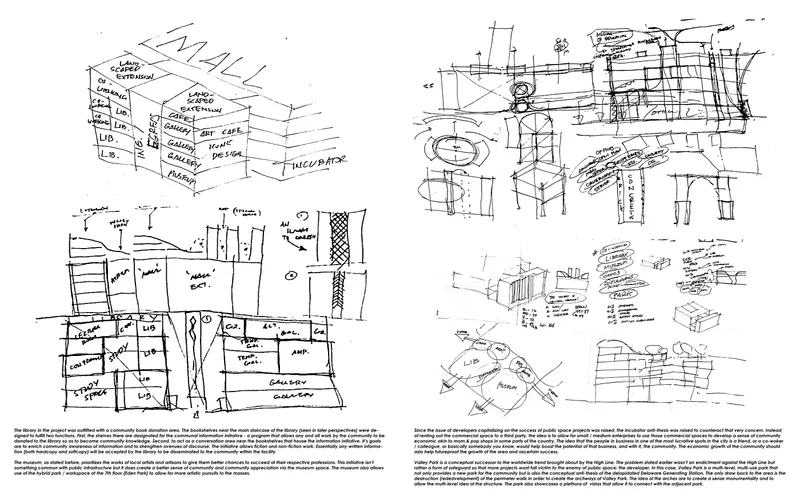
The library in the project was outfitted with a community book donation area. The bookshelves near the main staircase of the library (seen in later perspectives) were designed to fulfill two functions. First, the shelves there are designated for the communal information initiative - a program that allows any and all work by the community to be donated to the library so as to become community knowledge. Second, to act as a conversation area near the bookshelves that house the information initiative. It’s goals are to enrich community awareness of information and to strengthen avenues of discourse. The initiative allows fiction and non-fiction work. Essentially any written information (both hardcopy and softcopy) will be accepted by the library to be disseminated to the community within the facility
The museum, as stated before, prioritizes the works of local artists and artisans to give them better chances to succeed at their respective professions. This initiative isn’t something common with public infrastructure but it does create a better sense of community and community appreciation via the museum space. The museum also allows use of the hybrid park / workspace at the 7th floor (Eden Park) to allow for more artistic pursuits to the masses.
Since the issue of developers capitalizing on the success of public space projects was raised, the incubator anti-thesis was raised to counteract that very concern. Instead of renting out the commercial space to a third party, the idea is to allow for small / medium enterprises to use those commercial spaces to develop a sense of community economic akin to mom & pop shops in some parts of the country. The idea that the people in business in one of the most lucrative spots in the city is a friend, or a co-woker / colleague, or basically somebody you know, would help boost the potential of that business, and with it, the community. The economic growth of the community should aslo help futureproof the growth of the area and ascertain success.
Valley Park is a conceptual successor to the worldwide trend brought about by the High Line. The problem stated earlier wasn’t an indictment against the High Line but rather a form of safeguard so that more projects won't fall victim to the enemy of public space: the developer. In this case, Valley Park is a multi-level, multi-use park that not only provides a new park for the community but is also the conceptual anti-thesis of the dilapidated Delaware Generating Station. The only drawback to the area is the destruction (redevelopment) of the perimeter walls in order to create the archways of Valley Park. The idea of the arches is to create a sense of monumentality and to allow the multi-level idea of the structure. The park also showcases a plethora of vistas that allow it to connect with the adjacent park.
In line with the concept of community priority, the designated expansion areas are meant to house temporary buildings. The idea for those areas is that the community dictates how the space expansion should take place. The space is large enough to make significant vertical spaces (25m x 35m building space approx.) that should allow for significant community-dictated expansion. The space can be imagined as an area for artistic expression, additional public space, an expansion of the programmed facilities (i.e. the shops, the incubator, the library, the museum, etc.), and essentially whatever additional program that they deem they need for the space.

Popular Articles
Popular articles from the community


The Ocean Hive: Sustainable Architecture for a Self-Sufficient Civilization at Sea
The Ocean Hive imagines sustainable architecture at sea, where modular habitats, algae, wave power and ocean waste sustain a growing colony.

The Musturak Paradise: Senior Living Architecture for a Connected Future in Temara, Morocco
The Musturak Paradise reimagines senior living architecture in Temara via private homes, social spaces, culture, community, and shared care.

The Earth Pod: 3D Printed Homes for Resilient Refugee Communities
The Earth Pod reimagines refugee housing through 3D printed homes made from clay, combining resilience, self-sufficiency, and rapid shelter.

Co-Life: Senior Housing Design That Reconnects Older Adults With the City
Co-Life reimagines senior housing design through healing gardens, shared streets, workshops, and a sustainable community across generations.
Similar Reads
You might also enjoy these articles

Day and Night Park: A Time-Based Urban Newsstand in Beijing
A temporary urban newsstand in Beijing blending travel, light, and reading through poetic colors, compact form, and community-focused design.

Modernist Patio Renovation in El Masnou, Barcelona by Oliver Segura Arquitectura + Cebrià Arquitectura
Modernist patio renovation blending tradition and innovation with a movable pool, leveled floors, and Catalan materials in El Masnou.

Alto Residencial Coop: Cooperative Housing Development in Santiago de Compostela by Carbajo Barrios Arquitectos
A linear cooperative housing complex blending white volumes and perforated metal façades, enhancing community living, natural light, privacy, and urban integration.
Vil Genis School by BPA ARCHITECTURE – Massy, France
Vil Genis School in Massy, France, features sustainable design, south-facing classrooms, community integration, accessible spaces, and modern educational architecture.
Comments (0)
Please login or sign up to add comments
No comments yet. Be the first to comment!