
Container City
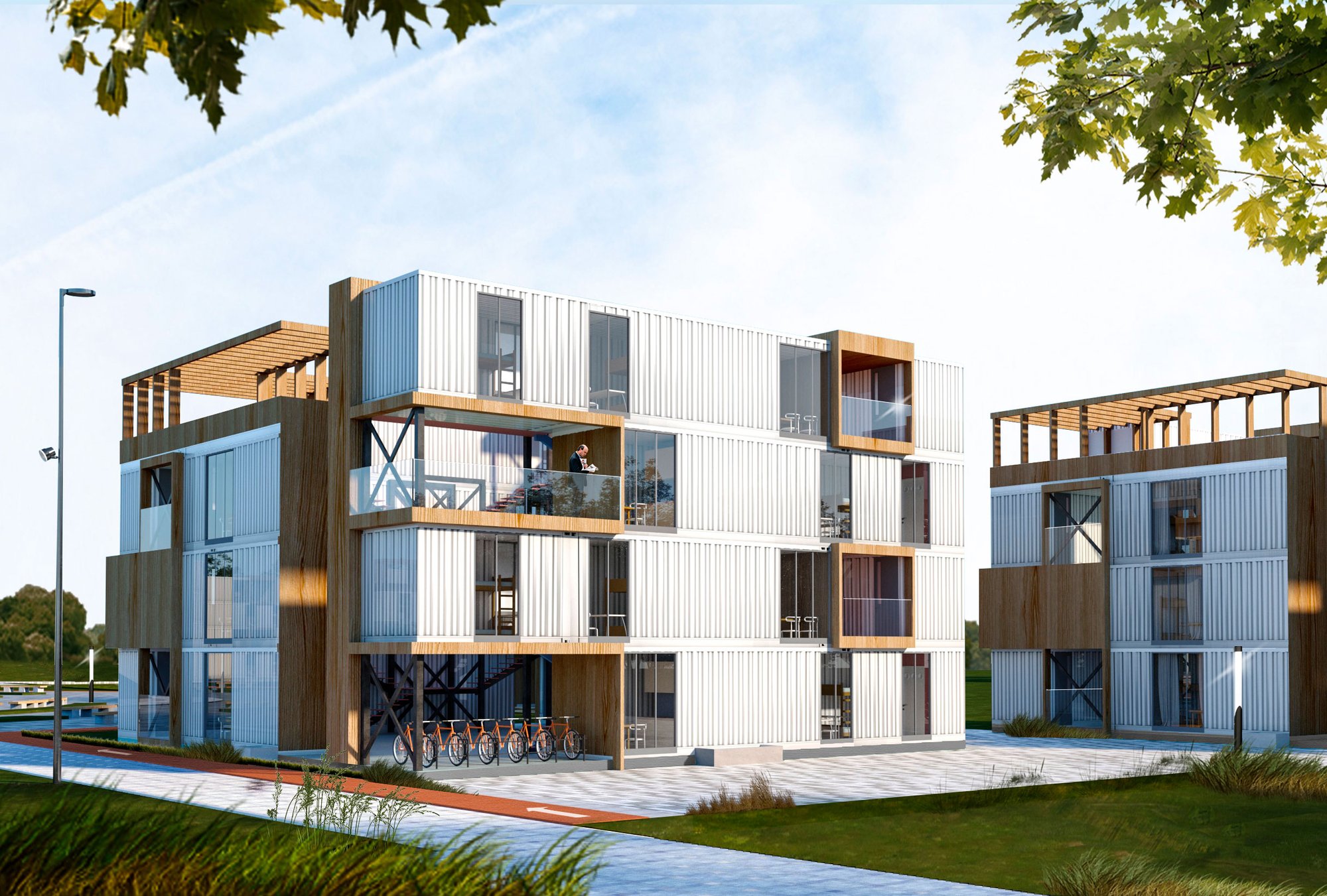
The concept of the "container city" presented in the competition reflects the author's idea of the essence of the student housing arrangement, as inexpensive and quickly constructed. To create a student campus, the competition paper applied a block development scheme. To create a student campus, a quarterly development scheme was applied in competitive work.

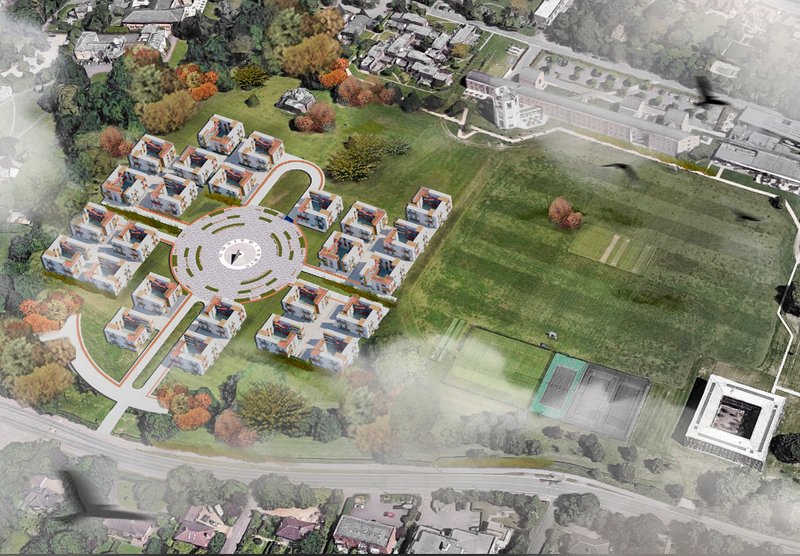
One quarter consists of 4 blocks, each block of which consists of 15 containers located in 4 levels, as required on the instructions of the competition. One block implies a one-time residence of 54 people. Four blocks form a quarter for 216 students and can be connected by pedestrian connections, by bridges at different levels based on the tasks set and environmental conditions. The required number of blocks depends only on the requirements for placing student housing at a specific given point on the map. The competition offers a campus in Cambridge in an undeveloped plant-free area and in close proximity to the main educational buildings. This campus assumes the presence of a pedestrian zone inside of the quarters with the possibility of moving on bicycles and the entrance of special machines in the event of an emergency. Car parking is offered for placement in the peripheral part of the campus.
Depending on the location, both centralized engineering training systems and autonomous ones, such as solar power, geothermal power, are possible. According to the method of placement, any block can be located both on a solid prepared base of reinforced concrete and on a spatial structure for maximum efficient use of space under the block. The presented work describes the placement of blocks on a prepared concrete base.
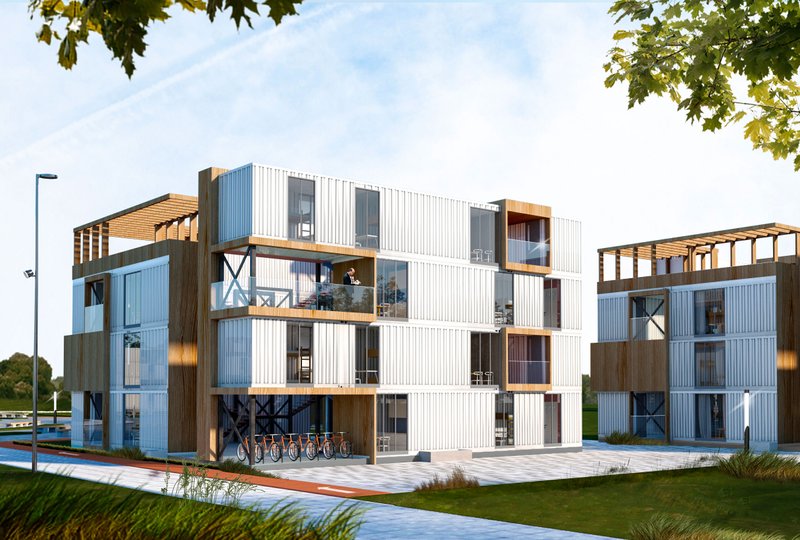
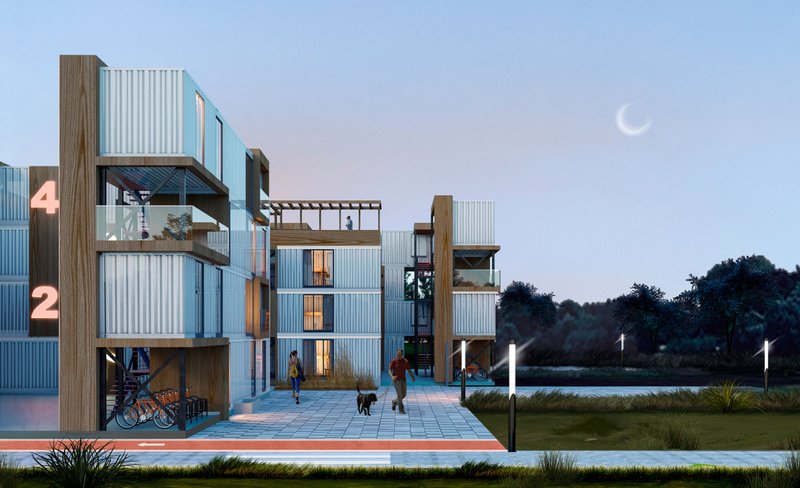
Any of the blocks is formed on the principle of a square with an inner courtyard, thereby forming a quiet zone inside of the courtyard. The combination of glass-stained glass structures and the decoration of public spaces with wood forms a unique and modern image of student housing.
Each such block has the same dimensions of sides 17.28×17.28 m. Each of the blocks represents the installation of containers on each other with a certain vertical displacement. In each block, public spaces for thematic meetings of students are formed in displacement places, and in one of the corner parts of level 4 of any of the blocks, a large open platform for general meetings and thematic events is offered. Vertical links are represented by prefabricated metal spatial ladder blocks for a certain size and are manufactured in factory conditions. Each one is represented by 2 types of containers. Type A container is a 40 ft container, Type B container is a 20 ft container. Each block consists of 12 Type A containers and 3 Type B containers.
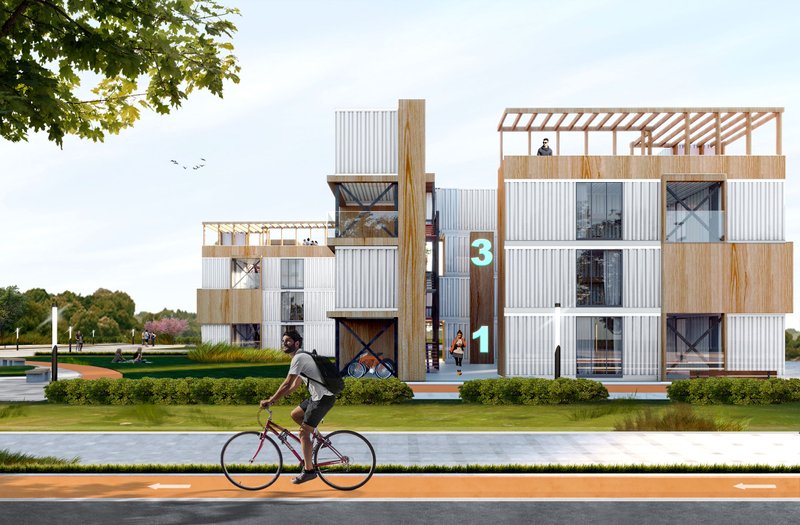
Each container represents a kind of living cell with the required minimum level of comfort, namely: an entrance group where you can change clothes by removing outerwear; main room with bedrooms and table for classes, bathroom with shower, toilet, sink for personal hygiene; kitchen area with table and a minimum set of kitchen furniture for food heating and sanitary treatment. Container type A is intended for a one-time residence of 4 people; container type B is intended for 2 people. Sleeping spaces in both types of containers are bunk modular beds with the placement of one full-size sleeping space 90×180 cm, one under the other. A desk and chair are available for studying in any type of container. For a type A container, 2 desks are offered with chairs for the replacement work of students, for a type B container, 1 writing table with a chair is offered. In either of the two types of containers, the minimum number of sanitary devices for personal hygiene is offered, such as 1 sink with a mirror, 1 toilet if necessary with bidet function, 1 shower tray 80x80 cm with a sliding door. In type A container, a kitchen area is provided for eating at a time by 4 people, as well as necessary furniture for storing, heating, and sanitary treatment of kitchen utensils. Type B containers provide a kitchen area for 2 people to eat at a time, and also necessary furniture for storing, heating, and sanitary treatment of kitchen utensils. In any of the two types of containers, the kitchen area is equipped with a sink for washing up dishes and washing food; 2-burner electric cookers for cooking, for heating food; built-in refrigerator for short-term food storage. The construction of partitions in either of the two types of containers is proposed to be made of quickly produced moisture-resistant gypsum board sheets with noise-absorbing mats inside with a thickness of 75 mm. It is proposed to finish walls, floors, ceilings in wet areas from moisture-resistant materials and piece set elements. The finishing of the main rooms and the entrance group can be made of not moisture-resistant, but at the same time safe and wear-resistant materials.
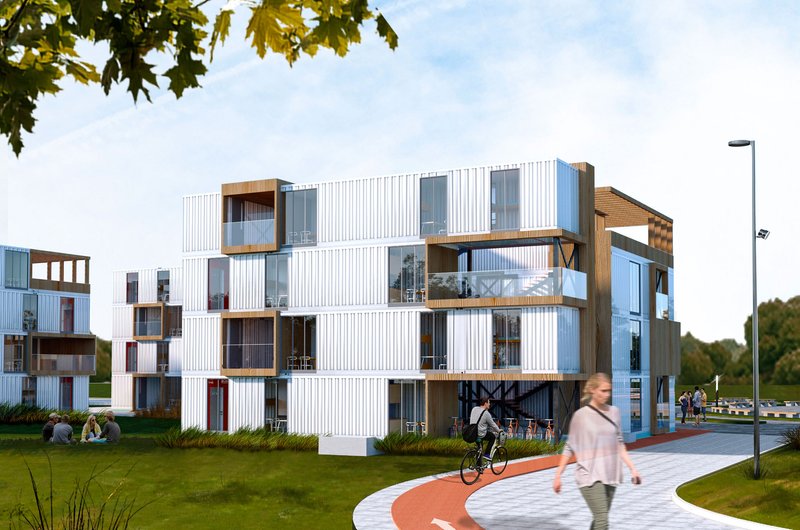
The engineering preparation of any of the two types of containers is represented by such networks as hot/cold water supply is offered, sewerage of household gravity, centralized power supply with a hidden gasket in special boxes. In either of the two types of containers, it is proposed to use natural ventilation through opening windows. All rooms with wet processes are located strictly under each other thereby eliminating the possibility of creating emergency situations in adjacent containers located below. The natural lighting of containers is stained glass structures from floor to ceiling in short sections, thereby excluding through viewing and directing natural light only to the necessary places, such as, for example, a table for classes, a table for eating. All main stained glass structures have an orientation on the outer part of the block. Only small windows are oriented into the inside. The whole concept of such containers involves factory manufacture and conversion with the necessary engineering releases so that they can be erected in the right order as a designer as soon as possible, thereby eliminating the need for more qualified builders and equipment.


Popular Articles
Popular articles from the community

Louis Malle Cinema: A Limestone Cultural Landmark Revitalizing Community Life in Prayssac
Limestone cinema extension with public forecourt, blending heritage and modern design to create flexible cultural spaces and strengthen community interaction.
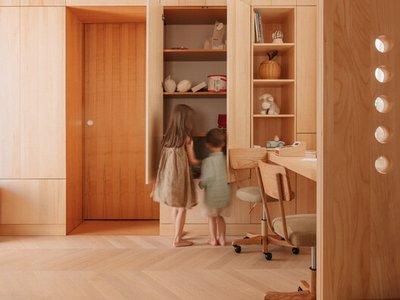
Treehouse Apartment: A Warm Timber Interior Blending Craft, Play, and Contemporary Living
Warm timber apartment with integrated treehouse, combining natural materials, craftsmanship, and playful design to create a flexible, family-oriented living environment.
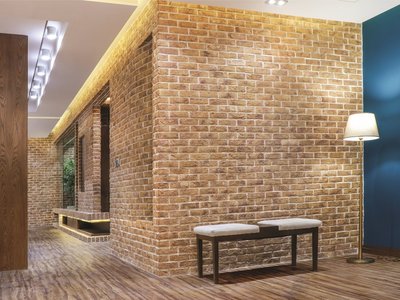
A Contemporary Take on Iranian Residential Architecture
A modern interior design in Mashhad that reinterprets brick, light, and spatial flow to create a warm, contemporary residential architecture.
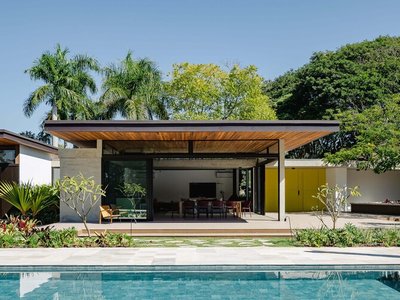
Flamboyant House by Juliana Camargo + Prumo Projetos
Modern Brazilian house integrating existing tree, pool, and volumes with glass, wood, and transitional spaces blending interior, exterior, and landscape seamlessly.


Similar Reads
You might also enjoy these articles

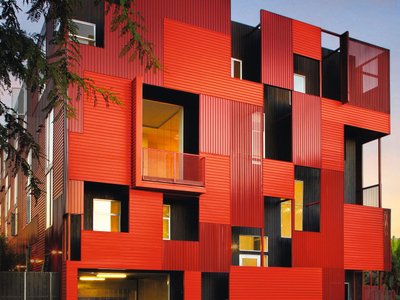
Converge Hub – A Human-Centered and Sustainable Mobility Hub at the Urban Edge
Its open and permeable design promotes sustainable movement through walkable connections, green axes, and integrated public transport
51st Annual KRob - Ken Roberts Memorial Delineation Competition
Join us in celebrating 51 years in excellence in architectural representation! With $2,400 in prize money awarded across 8 categories, this prompt-less competition is accessible to all!







Comments (0)
Please login or sign up to add comments
No comments yet. Be the first to comment!