
Vector Plinth Folds a Pentagonal Glass Pavilion into a Chittagong College Campus
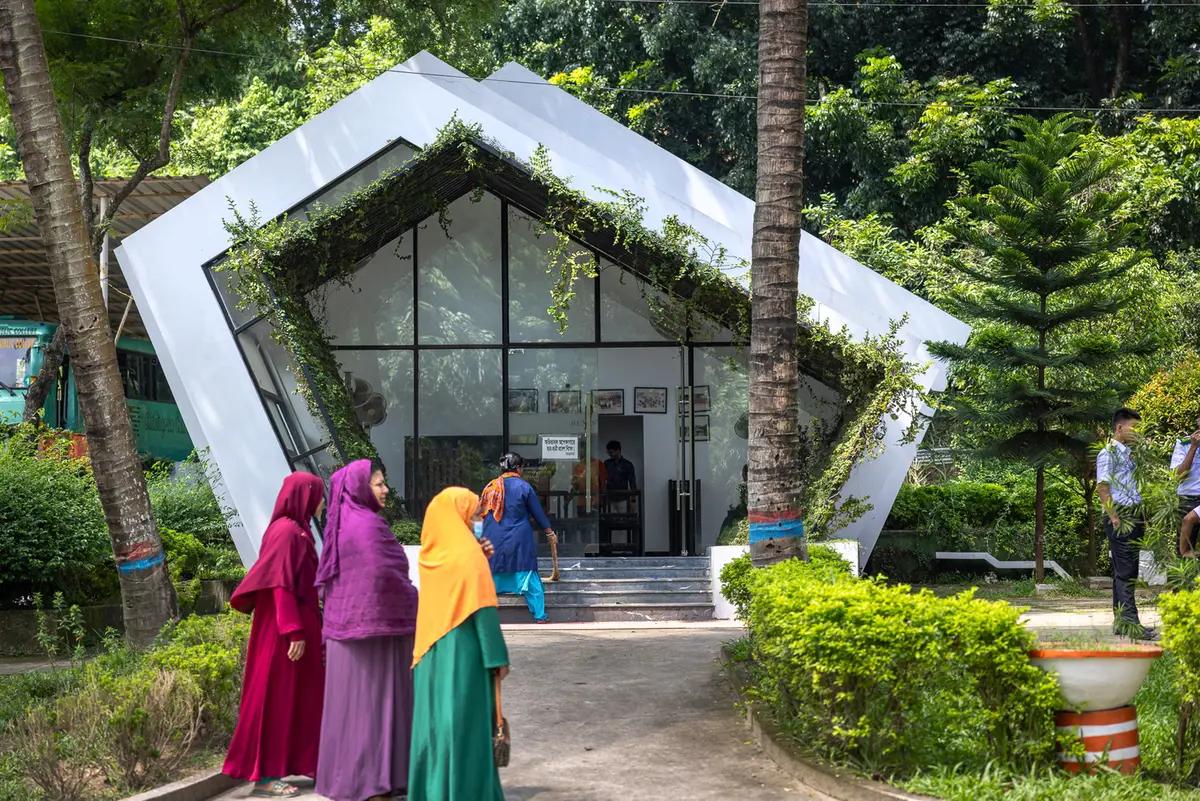
A column-free waiting shed for parents in Chattogram Cantonment Public College tilts its glass walls to deflect heat and frame greenery.


Waiting areas are the most neglected building type in institutional architecture. They tend to be afterthoughts: a bench under a tin roof, a corridor with fluorescent tubes, a patch of shade beside a parking lot. Vector Plinth rejected that premise entirely when designing the Parental Shed for Chattogram Cantonment Public College in Bangladesh, a military-administered institution established in 1978. What they delivered in 2020 is a 1,100-square-foot pavilion that treats the act of waiting as something worthy of architectural ambition.
The building's pentagonal geometry, inclined curtain glass walls, and column-free interior are the headline moves, but the real story is about proportion and restraint. On a 2,000-square-foot site surrounded by mature trees in the DOHS cantonment area, the pavilion creates height variations through a sloped ceiling that makes a modest interior feel generous. Ceramic roof tiles handle heat. Angled glazing deflects direct sun while pulling the surrounding landscape into the room. It is a small building doing a lot of careful work.
A Pentagon That Earns Its Geometry
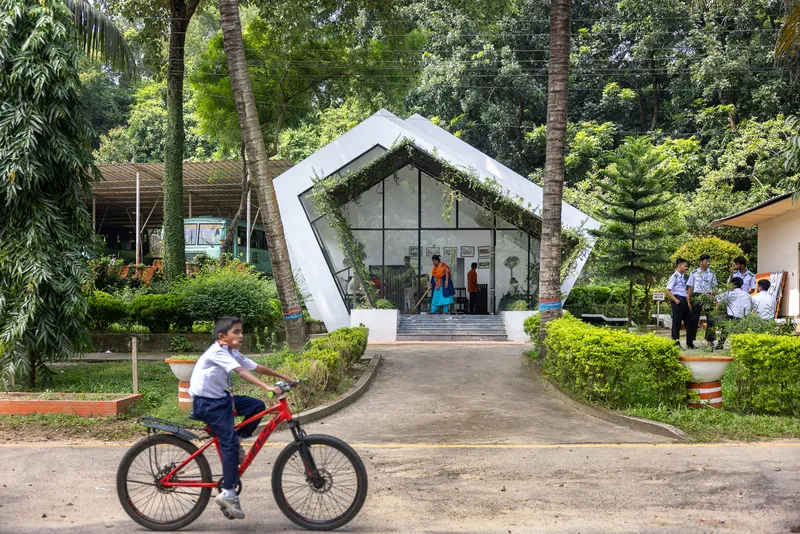
Pentagonal plans are rare for a reason: they generate awkward angles, complicate structure, and often feel like geometry for geometry's sake. Here, the five-sided footprint justifies itself. The angular form creates facade orientations that respond differently to sun paths throughout the day, allowing some walls to open up with full-height glass while others remain solid white plaster. The result is a building that reads differently from every approach, never presenting a flat, repetitive elevation.
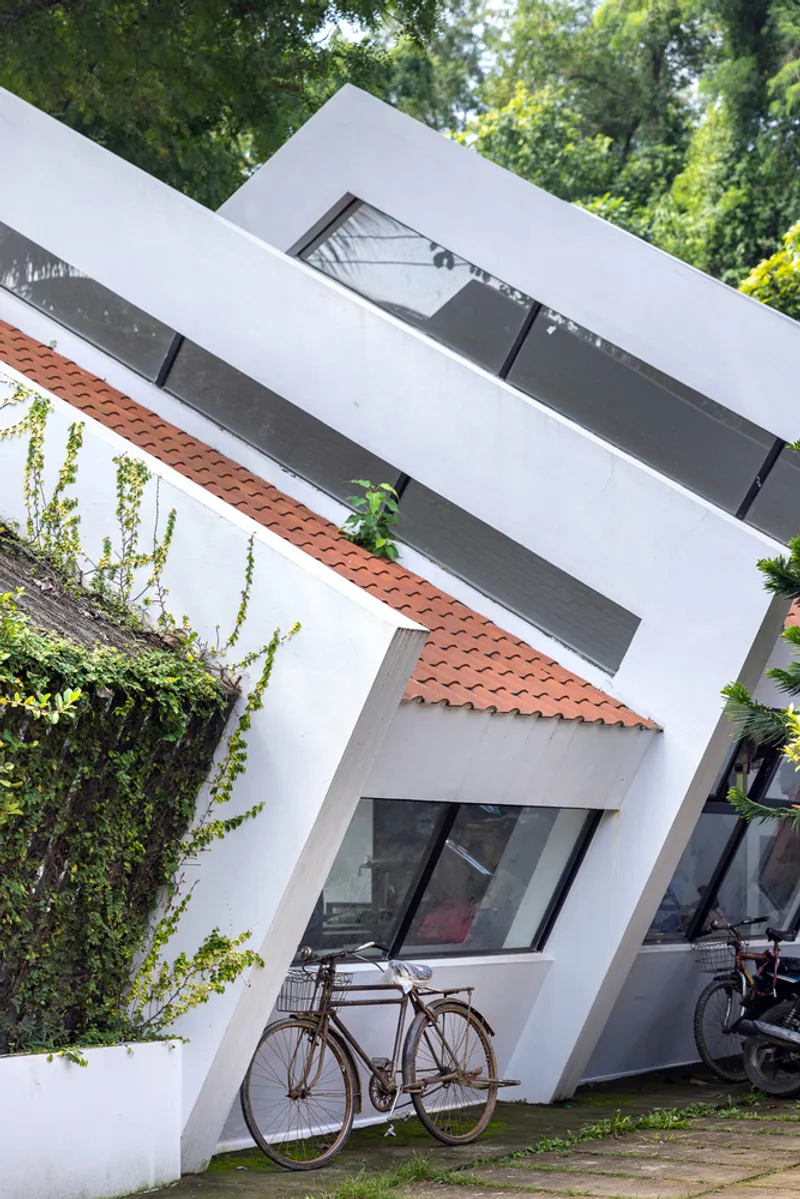
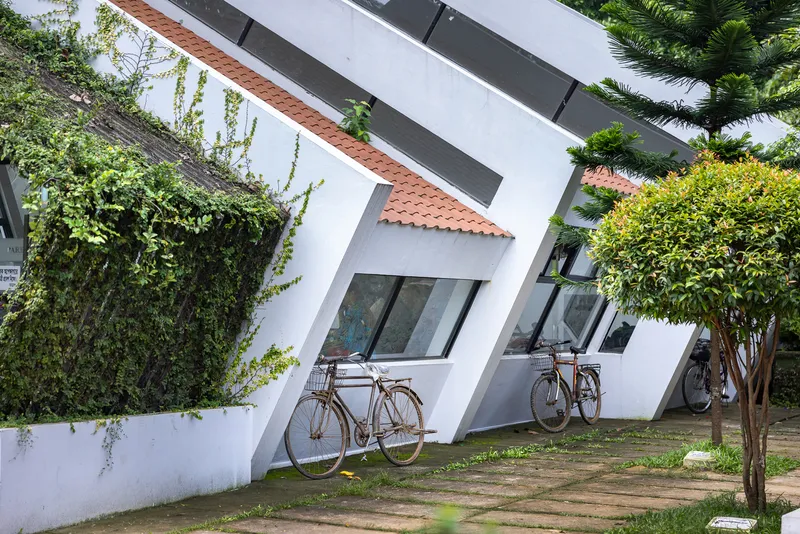
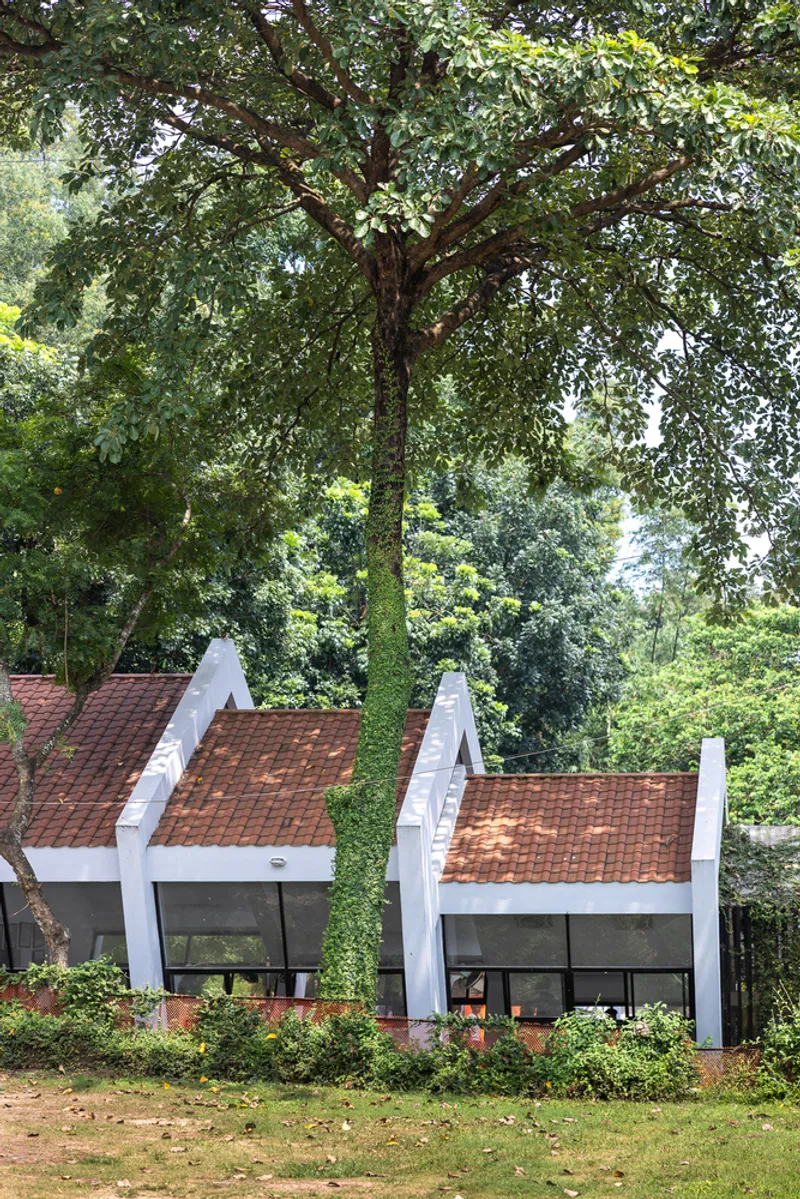
The folded roof planes reinforce this sense of directed movement. Terracotta ridge tiles appear and disappear between white stucco surfaces, giving the roofscape a layered quality visible from both the ground and the air. The form avoids the trap of being monumental at the expense of comfort; its angles guide visitors naturally toward the glazed entrance without needing signage or symmetry.
Column-Free Interior, Maximum Flexibility
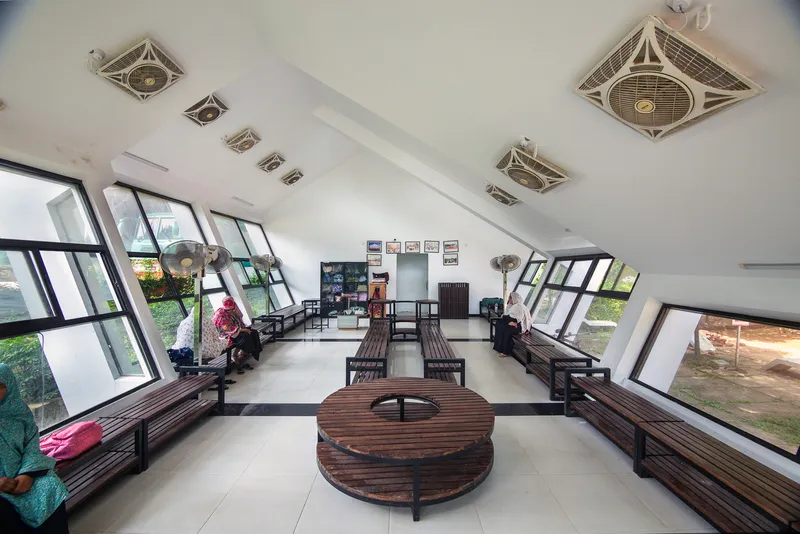
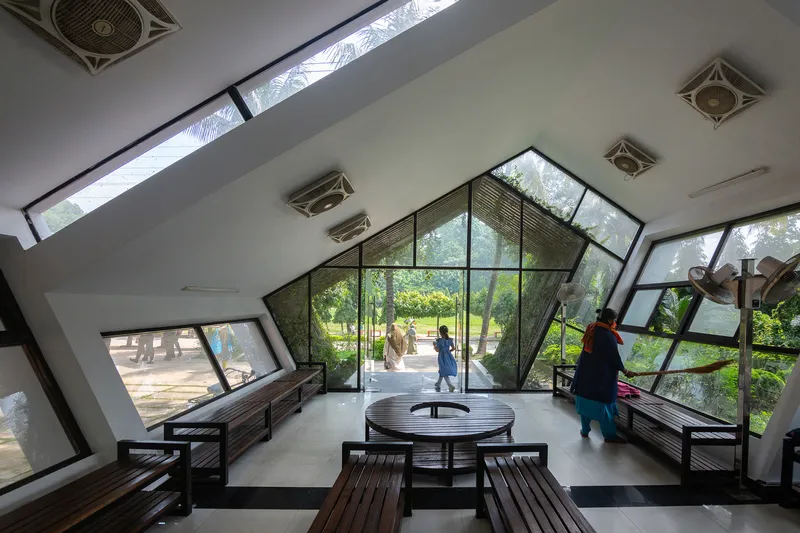
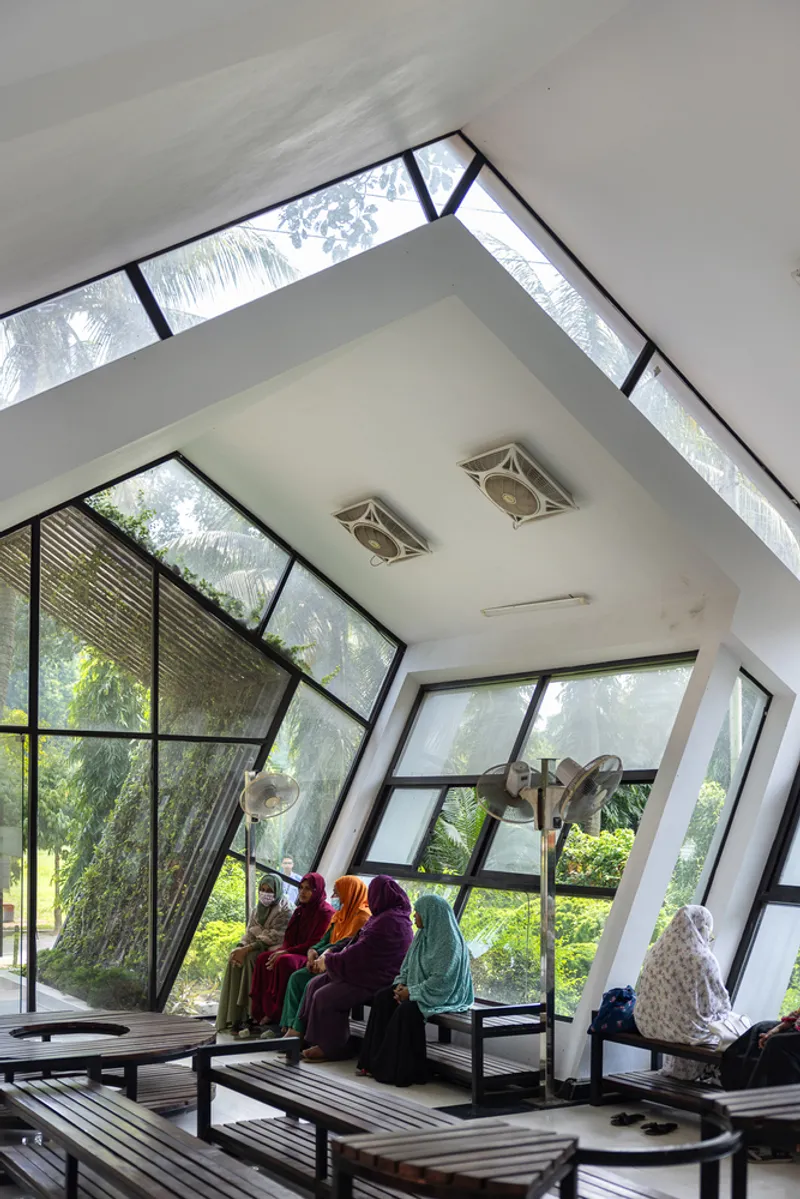
The decision to eliminate internal columns is the structural move that defines the interior experience. With roughly 850 square feet of seating area and the remainder dedicated to public amenities, the open plan allows wooden platform benches and circular tables to be arranged without obstruction. Circulation flows freely around the furniture, which matters when the space hosts parents of varying ages and mobility during busy school hours.
Ceiling fans hang beneath the sloped ceiling, a pragmatic addition that acknowledges the limits of passive cooling in Bangladesh's humid subtropical climate. The height variation created by the inclined roof does more than aesthetic work: it generates an illusion of broadness in a compact room, pushing the perceived ceiling upward at the glazed wall while pulling it lower at the rear, creating an intimate gradient from public entrance to quiet corner.
Glass Walls That Work for the Climate
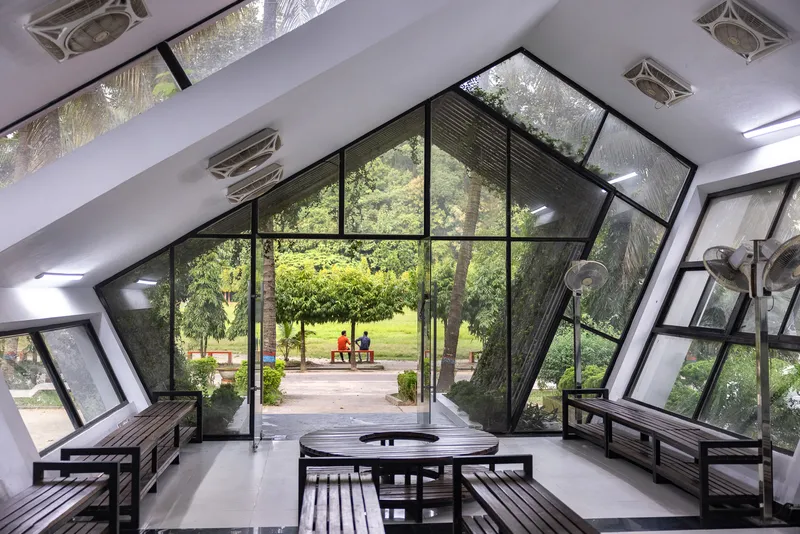
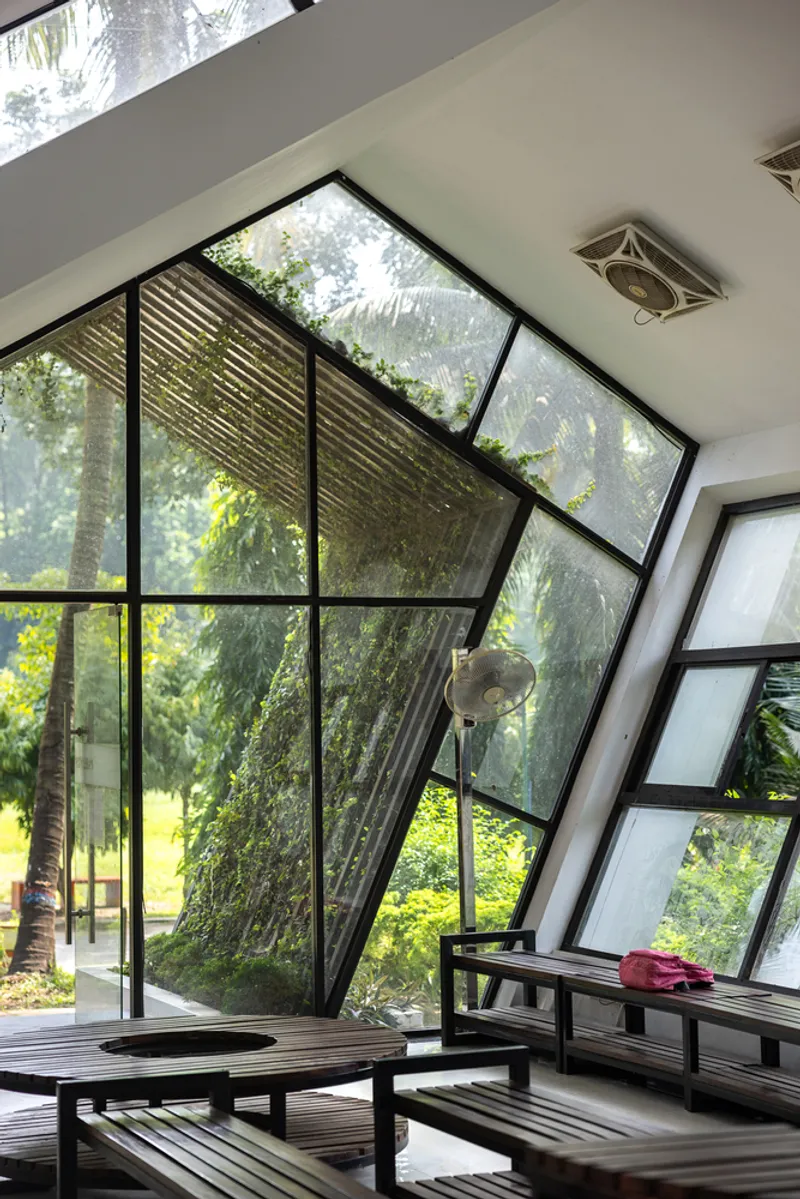
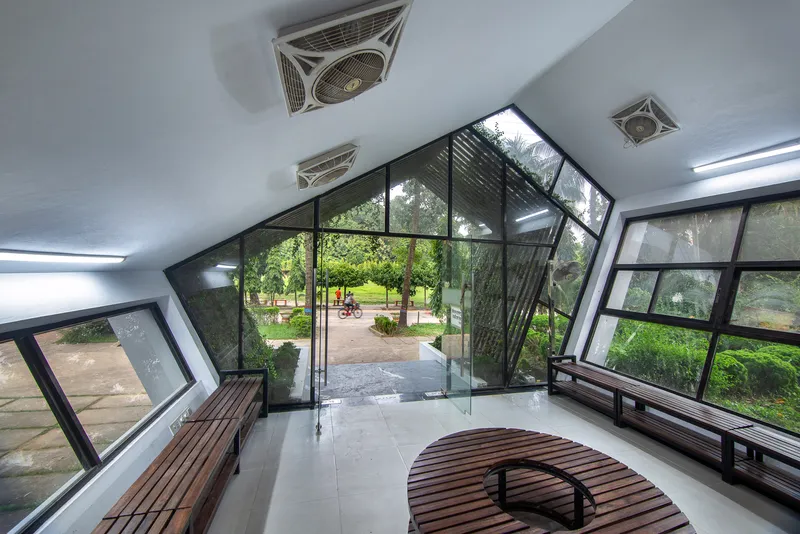
Full-height curtain glass in a tropical setting is a gamble. Without careful detailing, it becomes a greenhouse. Vector Plinth addressed this by inclining the glass panels rather than setting them vertical. The angle deflects direct solar radiation while still admitting diffused daylight, a strategy that works in tandem with the ceramic roof tiles overhead. Those tiles act as a thermal barrier, absorbing less heat than metal or concrete alternatives and keeping the interior several degrees cooler.
The payoff is visible in every interior photograph: the glass walls frame the campus's mature trees so completely that the boundary between inside and outside dissolves. A large tree trunk becomes a focal point through one angled pane. A playground appears through another. The surrounding cantonment area is known for its greenery and calm, and the pavilion captures both qualities without filtering them through small punched windows or heavy screens.
Landscape as Co-Author
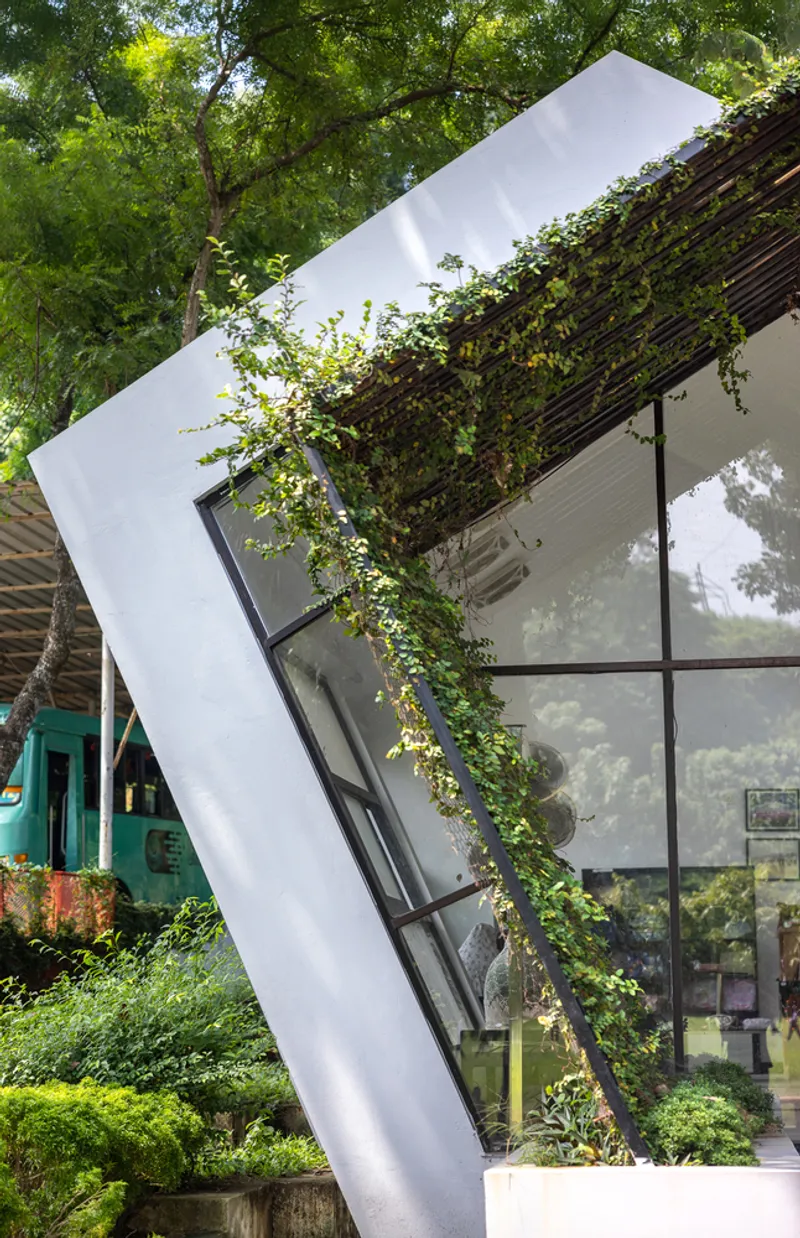
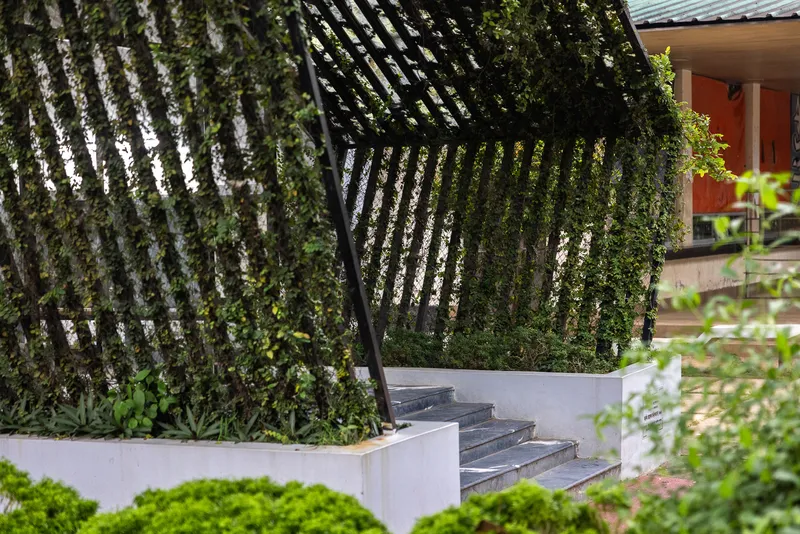
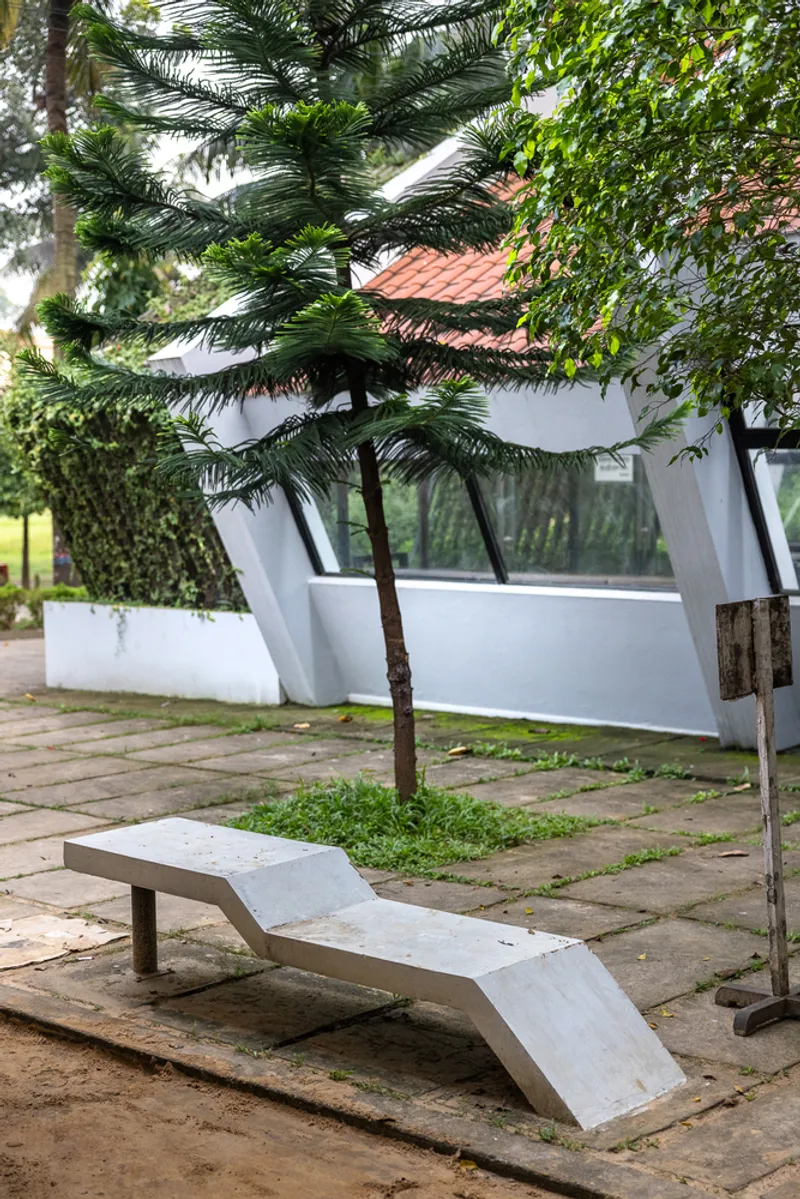
The building does not sit in the landscape so much as negotiate with it. Vertical planted trellises support climbing vines that will, over time, soften the structure's hard edges and integrate it further into its garden context. Precast concrete lounge chairs and angled benches in the courtyard extend the waiting program outdoors, turning the pavilion into one node in a larger network of resting spots under palm trees and beside planted beds.
Curved lattice screens covered with greenery define edges without enclosing them. The landscape strategy is clearly phased for maturation: photographs show young trees and fresh planting that will eventually match the density of the mature canopy already on site. It is a long-term bet that the architecture will improve with age rather than decay.
Context Within the Campus
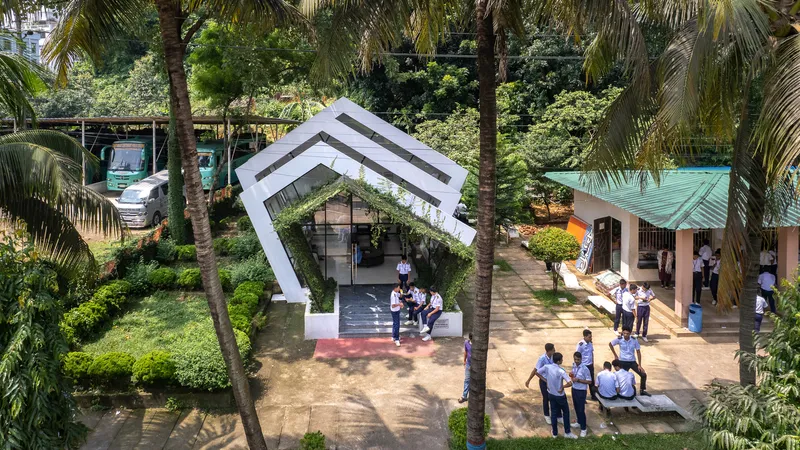
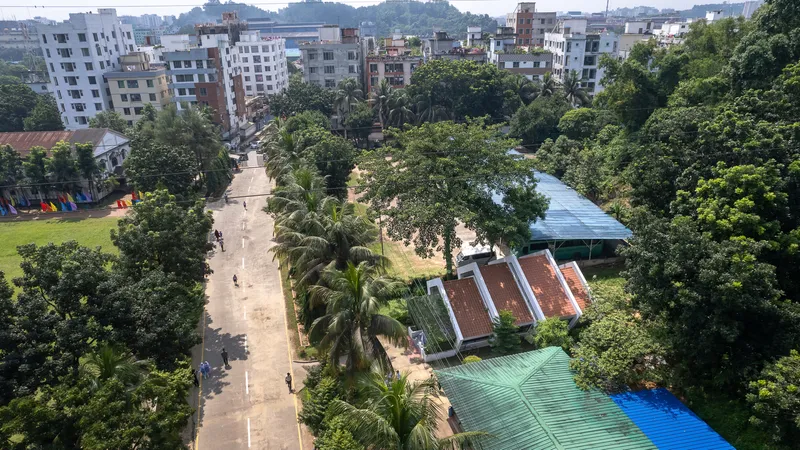
Aerial views reveal how the pavilion operates at campus scale. Its white gabled volumes sit among palm trees, legible from above as a cluster of folded roofs rather than a single building. The surrounding residential blocks and school structures are conventional, which makes the pavilion's angular silhouette both a contrast and a gift to the campus. It gives the grounds an architectural landmark that does not compete with the primary academic buildings but adds a layer of spatial quality to the in-between zones.
The bus depot visible nearby, with its corrugated metal canopy, underscores just how much the Parental Shed exceeds expectations for a support structure. Where institutional pragmatism would have produced another metal roof, Vector Plinth delivered a building that takes the social moment of waiting, the daily ritual of parents arriving and departing, and gives it architectural dignity.
Facade and Detail
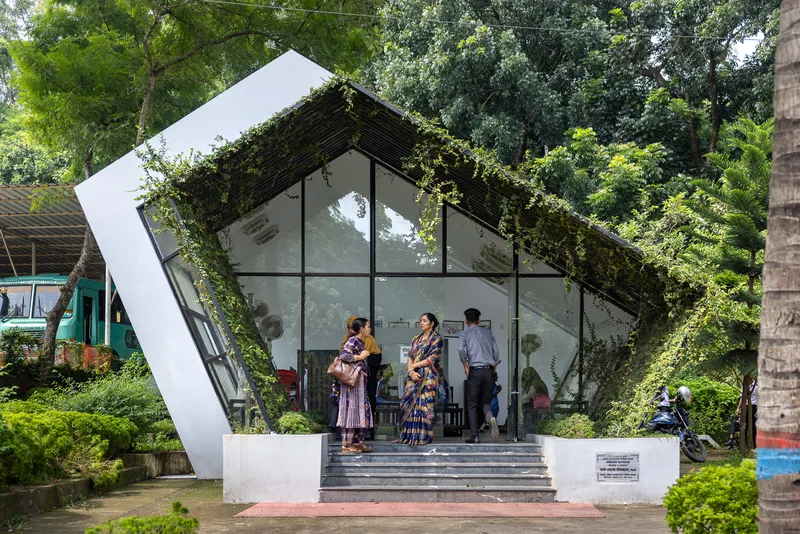
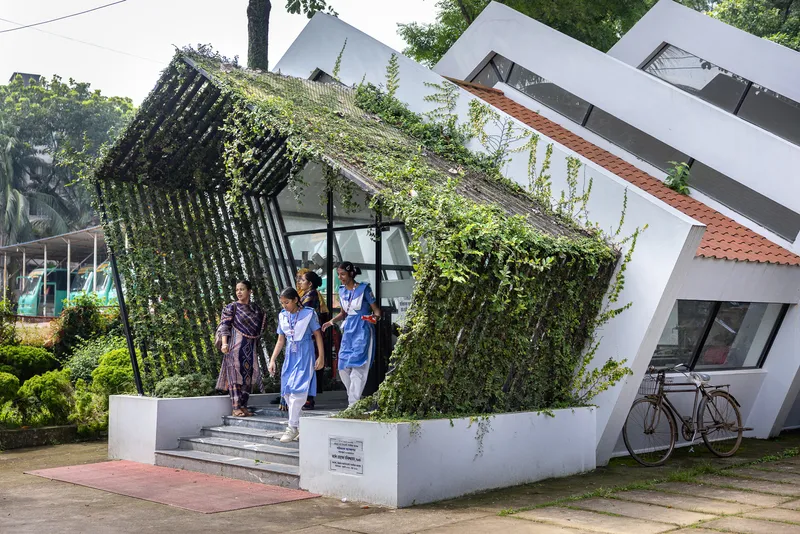
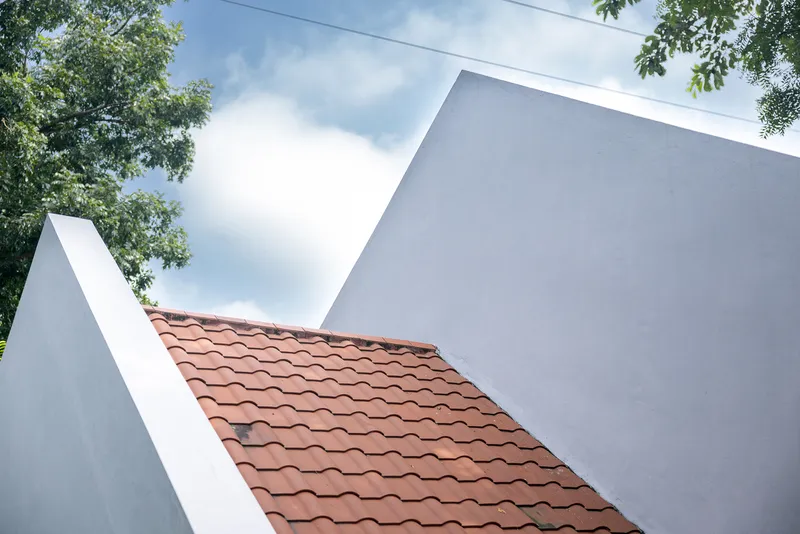
At close range, the building reveals its material logic. White rendered walls meet terracotta tiles at clean seams. The glazed gable entrance is set back slightly, creating a shadow line that reads as a threshold even before you reach the steps. Climbing vines on the steel trellis above the entry add a natural canopy that softens the arrival sequence. The raised white plinth keeps the floor above grade, protecting against monsoon water while creating a ceremonial lift that separates the pavilion from the ground plane.
Plans and Drawings
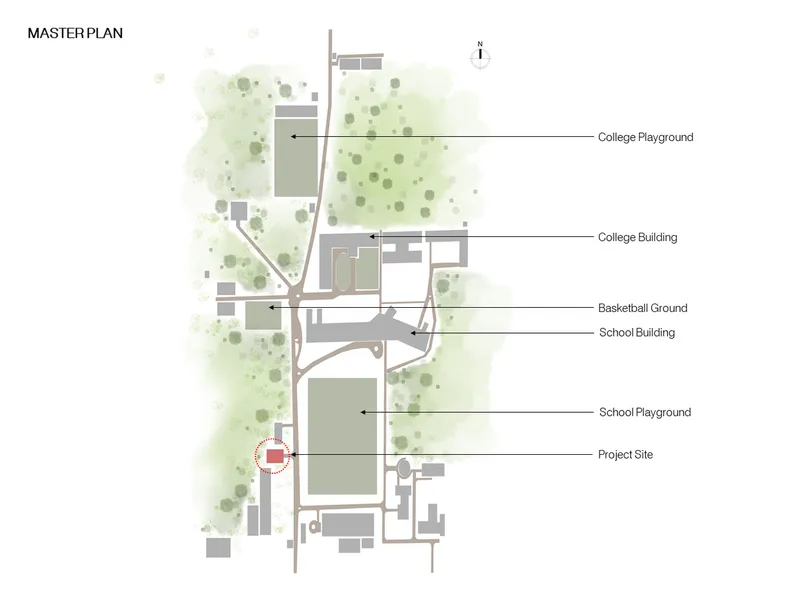
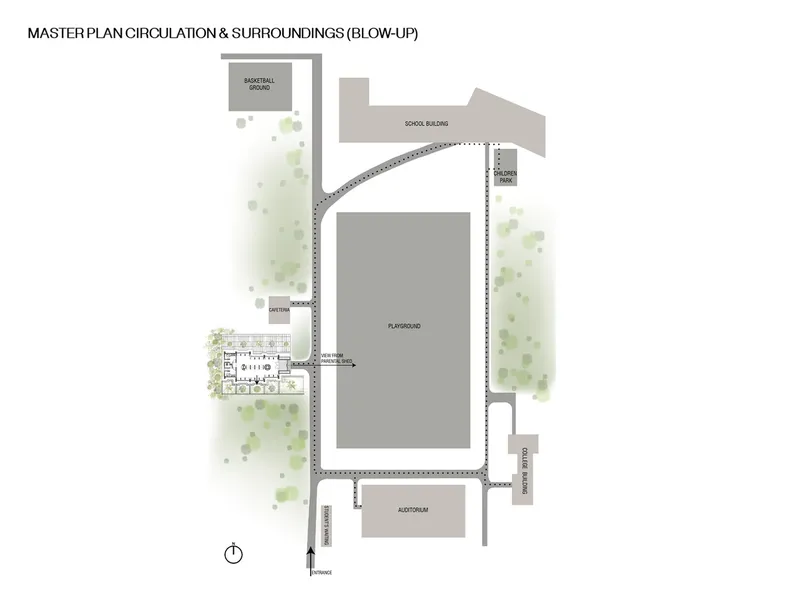
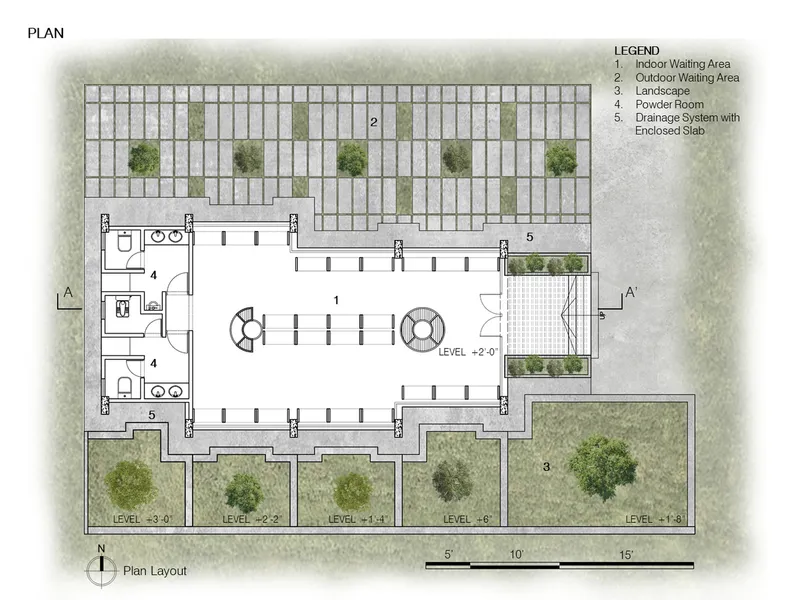
The master plan and site plan confirm the pavilion's strategic placement within the campus, connected to playgrounds and school buildings by circulation paths that make it a natural pause point in the daily flow. The floor plan shows a central waiting area flanked by powder rooms, with stepped landscape courtyards extending the footprint beyond the glass walls.
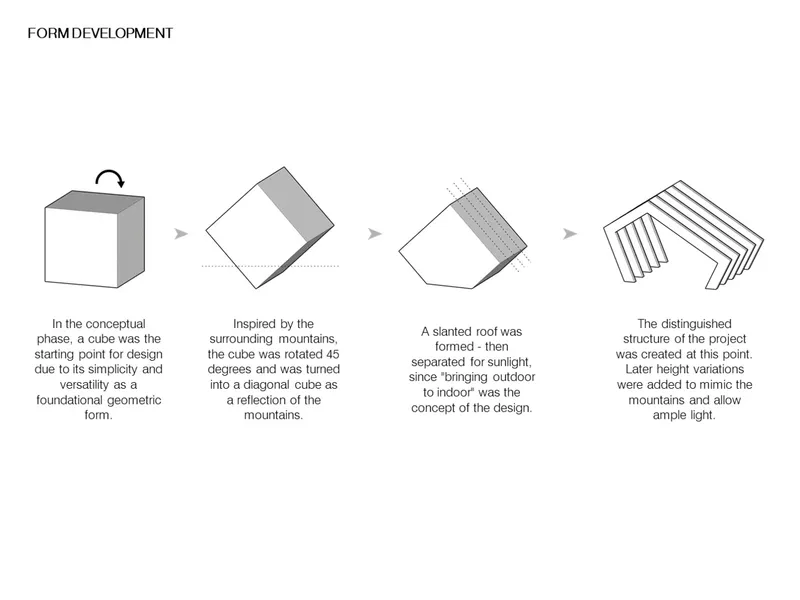
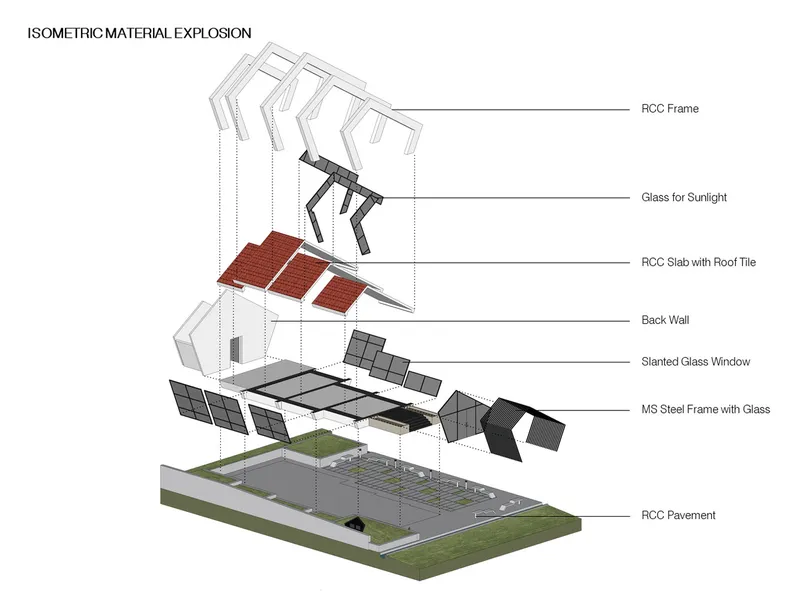
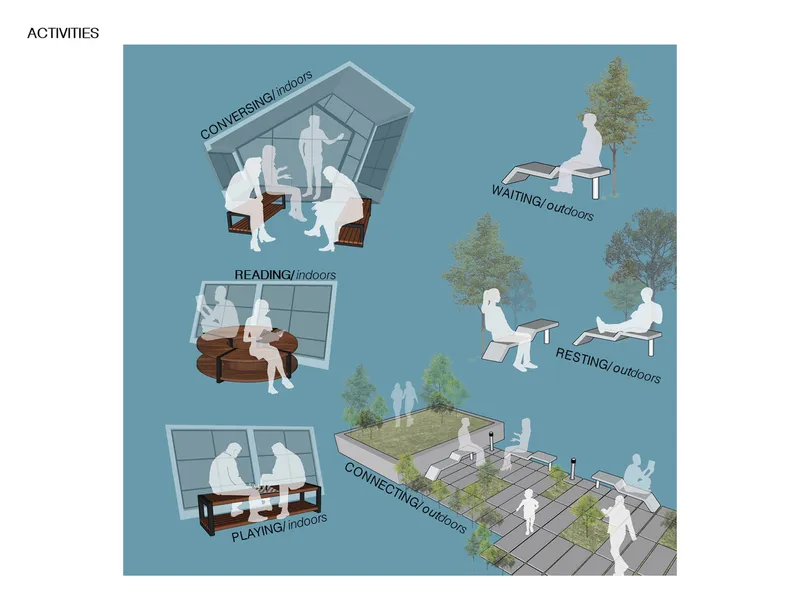
The form development diagram traces the evolution from a simple cube to the final slanted roof structure with parallel ribs, making the design logic legible. An exploded axonometric reveals the layered assembly: pavement base, steel frames, glass windows, and ceramic roof tiles stacked in a clear tectonic hierarchy. The activity zone diagram maps how figures occupy the space, from seated waiting to outdoor play, confirming that the design was driven by behavioral observation rather than formal whim.
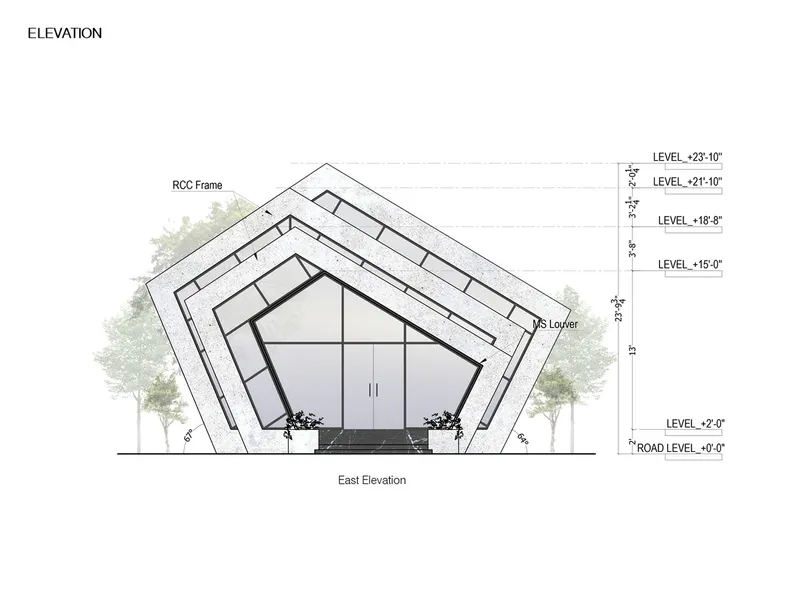
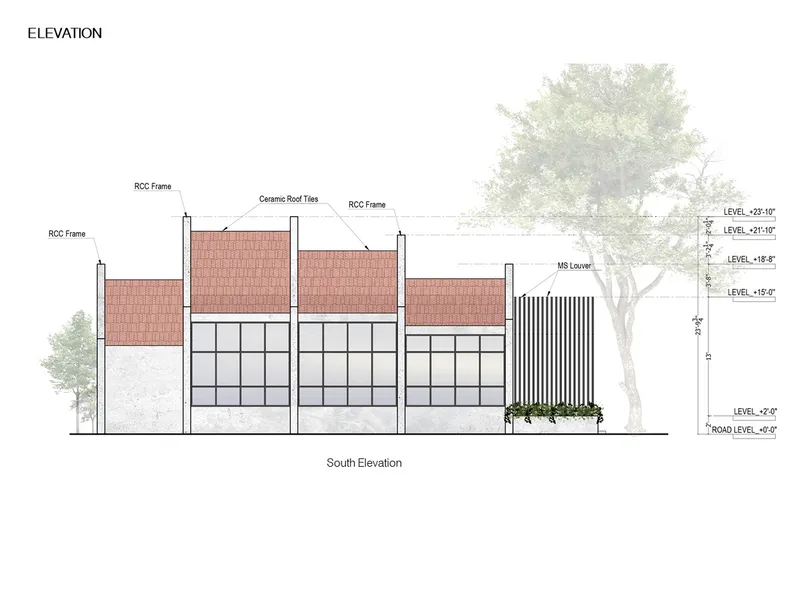
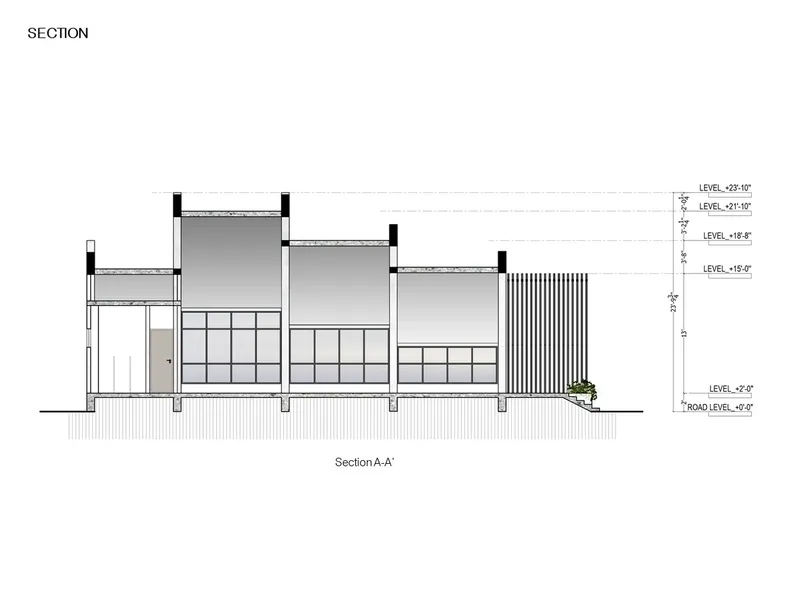
Elevations and the longitudinal section expose the building's most compelling detail: the stepping roof heights that create the interior's spatial drama. The east elevation shows the sloping layered roof frame above the glazed entrance, while the south elevation reveals the interplay between ceramic tiles, gridded glazing, and vertical louvered screens with planting. The section cuts through both waiting areas, demonstrating how height shifts across the plan to differentiate zones without partition walls.
Why This Project Matters
The Parental Shed matters because it takes a building type that typically receives zero design attention and proves it deserves serious architectural thinking. A waiting space for parents at a school in Chittagong could have been a covered bench. Instead, it became a climate-responsive glass pavilion with a pentagonal plan, a column-free interior, and a landscape strategy that matures over decades. That ambition, applied to the smallest rung of the institutional program, is instructive.
Vector Plinth's achievement is not just formal. The real contribution is strategic: proving that passive cooling, frame structures, and inclined glazing can work together at small scale in a tropical context without mechanical systems or excessive budgets. For architects working in South Asia, where institutional campuses are expanding rapidly and ancillary buildings are still treated as afterthoughts, the Parental Shed sets a precedent. Give every program the architecture it deserves, especially the programs nobody thinks deserve any.
Parental Shed by Vector Plinth. Located in Chattogram Cantonment Public College, Chittagong, Bangladesh. 1,100 sq ft built area on a 2,000 sq ft site. Completed in 2020. Photography by Asif Salman.
About the Studio
Share Your Own Work on uni.xyz
If projects like this are the kind of work you want to make, uni.xyz is a place to publish your own, find collaborators, and enter design competitions.


Popular Articles
Popular articles from the community


FCC Arquitectura Expands a Portuguese Granite House with a Board-Marked Concrete Wing
In Portugal, JV House pairs a cleaned-up whitewashed and granite dwelling with a timber-shuttered concrete extension, courtyards and a garden pool.


Singing Woman: An Opera House That Performs Before the Curtain Rises
Ovidiu Cristian Pavel's conceptual opera house translates Estonia's choral identity into a sculpted waterfront landmark facing the Baltic Sea.

Opera on the Sea: Driftwood Logic Shapes a Timber Opera House on Estonia's Coast
Trevor Orgill's opera house translates the entangled drift of floating timber into a civic building where wood, water, and music converge.

Aquadapt: An Underwater Habitat That Rewrites Its Rooms by the Hour
Curved modules ring the seabed while one shell shifts from breakfast room to cinema, farm and football pitch as residents' needs change.

Similar Reads
You might also enjoy these articles


Hodi-Mandai Geram
Project Function: Preservation and revitalization of the Intangible heritage and socio-spatial identity of the Hodi by Housing, Cultural Memory Center, Sacred Grove, landscape, local tourism economy


Olio Towers: A Mid-Rise for Performers That Fuses Housing, Rehearsal, and Stage
Located blocks from Houston's Theater District, this modular tower stacks living units around a central performance atrium.

Oasis: Modular Green Housing Carved into Dhaka's Urban Fabric
A shortlisted Plugin Housing entry reclaims unauthorized settlements in Dhaka with stepped concrete volumes, green roofs, and ventilation-driven design.

Black Hole: A Floating Megastructure for the Post-Physical Era
Emiliano Mazzarotto envisions a spherical, self-scaling arena where e-sports, digital hotels, and holographic stadiums replace traditional public space.

Explore Pavilion Competitions
Discover active competitions in this discipline

Challenge to reimagine the Iron Throne

Photograph architecture without architects

Illustrate the lost glory of Angkor Wat - Render Challenge

Design challenge to reuse E-waste
Comments (0)
Please login or sign up to add comments
No comments yet. Be the first to comment!