

Prior Performing Arts Center at the College of the Holy Cross in Worcester opens. Designed by Diller Scofidio + Renfro.
The centre is home to many different performance spaces, including a black box theatre, a recital hall, and an outdoor amphitheatre.

The doors at the College of the Holy Cross are always unlocked, 24 hours a day. According to Charles Renfro - partner at Diller Scofidio + Renfro (DS+R) and lead designer of the Prior Performing Arts Center - this policy is “a fantastic principle which speaks a lot about the ethos of the college.” The 3,000-student Catholic institution is located in Worcester, Massachusetts. The new performing and visual arts centre at Holy Cross is a physical and programmatic assertion of the importance of the arts in the Jesuit tradition of open inquiry. The centre, which is located at the top of the hilly campus, provides students and faculty with a flexible space to create and showcase their work. The Prior gives the college and its surrounding community a clear view of students and faculty at work, adding new things to the world.
The building is made up of four volumes placed around a central atrium, called the Beehive. The three main materials used in construction are Cor-ten steel, precast gypsum-fibre-reinforced concrete (GFRC), and glass. They are combined into a simple geometry that suggests horizontal and vertical organizational grids without rigidly following them. Park and garden spaces are located at the four corners, completing a nine-square plan. The weathered steel panels are arranged to mimic the angles of the hilltop site; the concrete folds and twists over the top of the building, blurring the distinction between wall and roof. This creates a two-material arched entrance at one corner. The industrial materials’ colours reflect and update the campus palette of brick and limestone, while the wood-clad interior spaces juxtapose front-of-house activities with back-of-house support functions suggested by pervasive metallic components. The Prior exemplifies the interdependence of the disciplines practised within, with the top-floor Iris and B. Gerald Cantor Arts Gallery is foregrounded through a broad window above the western main vehicular entrance.
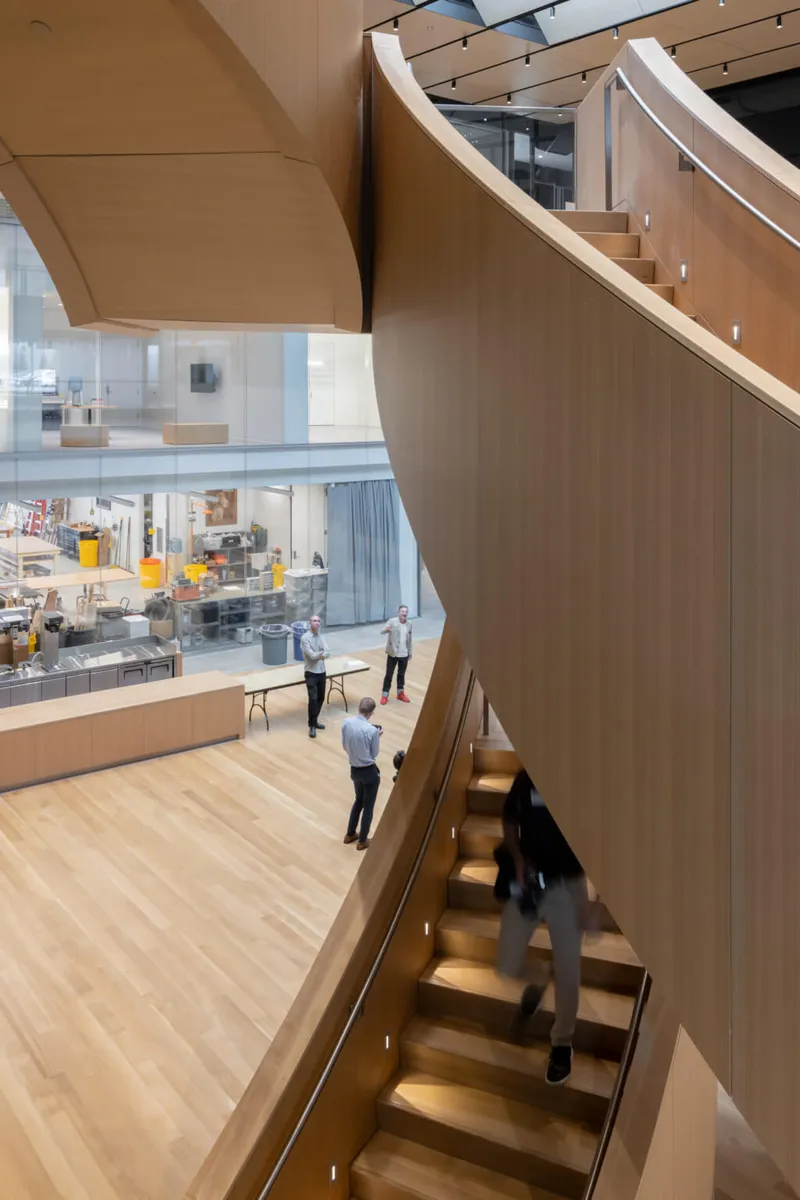 View from the third floor into the Beehive. (Iwan Baan/Courtesy DS+R)
To the north of the Beehive is the Boroughs Theatre, a black-box studio that can be configured to seat 200-250 people for theatre or dance performances. The studio is equipped with a walkable upper grid, making it versatile for a variety of productions. To the west of the Beehive is a multimedia lab and presentation space. This space is beneath the gallery, making it easily accessible for presentations and events.
To the east of the Beehive are production spaces, including a scene shop, rehearsal rooms, classrooms, and a costume shop. These spaces are visible behind glass walls, so visitors can see the inner workings of production.
To the south of the Beehive is the Luth Concert Hall, a 400-seat proscenium theatre. The concert hall includes a full-function fly tower nearly 100 feet tall, making it an impressive space for performances.
The main atrium space of the Beehive, which includes a cafe, becomes a crossroads for practitioners of the various arts, as well as for other pedestrians traversing the campus who use the building’s multiple doors as if the Beehive were an outdoor courtyard. The Beehive's concealed height from some angles and lack of an overbearing fly tower makes it a more inviting space than many opera houses.
The building's design is in the shape of a cross, which allows for maximize daylighting, sightlines, and access to all areas. Even the black-box theater and concert hall have views of the outside. The shops and loading dock at the Prior are unusually visible, and the 52-foot-wide operable front Skyfold wall allows that space to integrate with the Beehive as an event-specific option. Adaptability on multiple levels, from the large spaces to details like internal blinds for transparency and acoustic performance, even hooks on an exterior wall accommodating a large projection screen for outdoor cinema audiences, defines the Prior as a pragmatic, hackable space for today’s interdisciplinary art events.
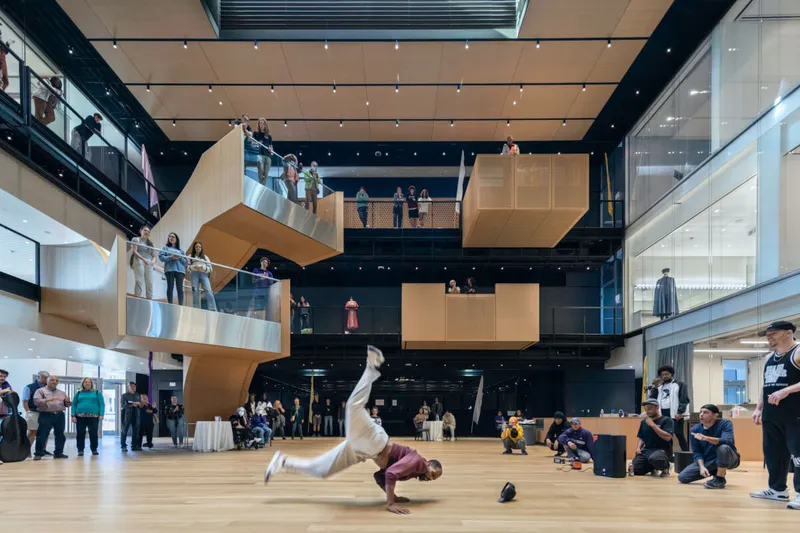 Dance performance in the Beehive with view from studio theatre. (Brett Beyer/Courtesy DS+R)
The five "muses" or "follies" in the Beehive, designed by Diller Scofidio + Renfro, are small suspended structures that offer a variety of spaces for enjoying the atrium. These include a DJ booth, a "crib" with comfortable furniture for naps or study, a small theatrical space overlooking the atrium, a "bar" providing electric charging, and a cantilevered flying staircase that can also be used for theatrical purposes. The Prior is a building that is not only meant for performances, classes, and rehearsals but also for socializing and networking. It's a welcoming site for the casual meetups of collegiate life and it's also a great place to see and be seen.
 Main public entry, marquee, and Cantor Gallery. (Brett Beyer/Courtesy DS+R)
The technical facilities in the building are top-notch and on par with a level of electronic and acoustical infrastructure that anyone would be jealous of, especially those whose school days only included access to rooms with, at most, a piano. In the Media Lab, each seat is equipped with a networked laptop, synthesizer, and audio interface. The main digital recording studio suite is the "musical brain of the whole building," according to DS+R associate principal Miles Nelligan. It connects to a large, acoustically deadened live-rehearsal space, and is wired to record performances anywhere in the building. The rehearsal space has chamfered walls that prevent sound from bouncing back, making it ideal for recording. The Luth Concert Hall's stage is large enough to accommodate up to 140 performers, making it one of the most spacious venues available for its size. This is a rare ratio of musicians and choristers to attendees, but appropriate for a school with an ambitious music department comprising not only the customary chamber orchestra, choir, jazz ensemble, a cappella groups, and marching band but also a medieval Schola Gregoriana, Balinese gamelan ensemble, and laptop ensemble. The room's churchlike reverberation time of close to two seconds is thanks to the high ceiling and bespoke GFRC panels, whose undulations were developed by DS+R with acousticians Jaffe Holden, in order to reflect, refract, and absorb precise frequencies. Lining the stage are West African makore hardwood boards (an endangered species, but sustainably harvested) which contributes to a sonic ambience that can rival European opera houses.
 Media lab with a view into the Beehive. (Brett Beyer/Courtesy DS+R)
In a time when the disciplines of STEM seem to take precedent over the arts in many academic conversations, it's refreshing to see that Holy Cross is still expressing its dedication to the creative fields through buildings like this one. Jesuits have been leading the charge in liberal arts education for over 450 years now, as noted by Holy Cross president Vincent D. Rougeau. And despite its location in the cultural shadow of big cities like Boston and Cambridge, the college is quickly becoming a center for public art presentations and teaching. According to Nelligan, college officials issued DS+R a challenge during the planning stages to keep the building illuminated at all times. The Prior is designed to be a bright and welcoming space for all.
References
Design Architect: Diller Scofidio + Renfro, (Partner-in-Charge: Charles Renfro)
Executive Architect: Perry Dean Rogers
Location: Worcester, Massachusetts
Landscape Architect: Olin
Structural Engineer: Robert Silman Associates
Sustainability: Transsolar
Theater Planning: Fisher Dachs Associates
Contractor: Dimeo Construction
Acoustics & Audio/Visual: Jaffe Holden
Civil Engineer: Nitsch Engineering
Code Consultant: Code Red Consultants
Cost Estimator: Dharam Consulting
Foodservice Consultant: Colburn & Guyette
Geotechnical: Haley Aldrich
Hardware Specifications: Campbell-McCabe
IT/Security: Shen Milson & Wilke
Lighting: Tillotson Design Associates
MEP/FP Engineer: Altieri Sebor Wieber
Specifications: Construction Specifications
Glass Manufacturer: Viracon

Popular Articles
Popular articles from the community


The Amber Palace Opera: A Geological Fiction Surfaces on Tallinn's Baltic Waterfront
Pierre Brillard reimagines a Baltic legend as a public landscape, opera house, and waterfront promenade rooted in Tallinn's coastal identity.

Aquadapt: An Underwater Habitat That Rewrites Its Rooms by the Hour
Curved modules ring the seabed while one shell shifts from breakfast room to cinema, farm and football pitch as residents' needs change.


FCC Arquitectura Expands a Portuguese Granite House with a Board-Marked Concrete Wing
In Portugal, JV House pairs a cleaned-up whitewashed and granite dwelling with a timber-shuttered concrete extension, courtyards and a garden pool.

Juan García Correa, John González and Claudia Rueda Sink a Circular Amphitheater into a Manizales Engineering Building
On the La Nubia campus in Manizales, Colombia, the S1 Building folds labs and offices into a hillside of ramped lawns that double as a campus route.

Similar Reads
You might also enjoy these articles

Rede Arquitetos Turns Circulation into Civic Space at the Educar II SESC School in Fortaleza
In Fortaleza, Brazil, Educar II SESC-CE trades a signature form for mesh screens, yellow thresholds and courtyard walkways built for equatorial heat.
116 Rokeby Building, Collingwood
Sustainable Collingwood office building featuring double-skin façade, natural ventilation, rooftop amenities, and carbon-neutral design focused on wellbeing and longevity.
Contemporary Apartment Renovation in Spain: RV House by BIAN Opens Up to the Sea
A minimalist 1930s apartment in Santander is transformed into a flexible, sea-facing home through contemporary Spanish renovation.
3 Marías House: A Contemporary Mediterranean Courtyard Retreat by Bajet Giramé + Burckhardt
Mediterranean courtyard home blending traditional architecture with modern design, terracotta flooring, flexible interiors, sustainable climate strategies, and garden integration.

Explore Performing Arts Center Competitions
Discover active competitions in this discipline


Challenge to reimagine the Iron Throne

Photograph architecture without architects

Illustrate the lost glory of Angkor Wat - Render Challenge

Bring back Drive In's
Comments (0)
Please login or sign up to add comments
No comments yet. Be the first to comment!