
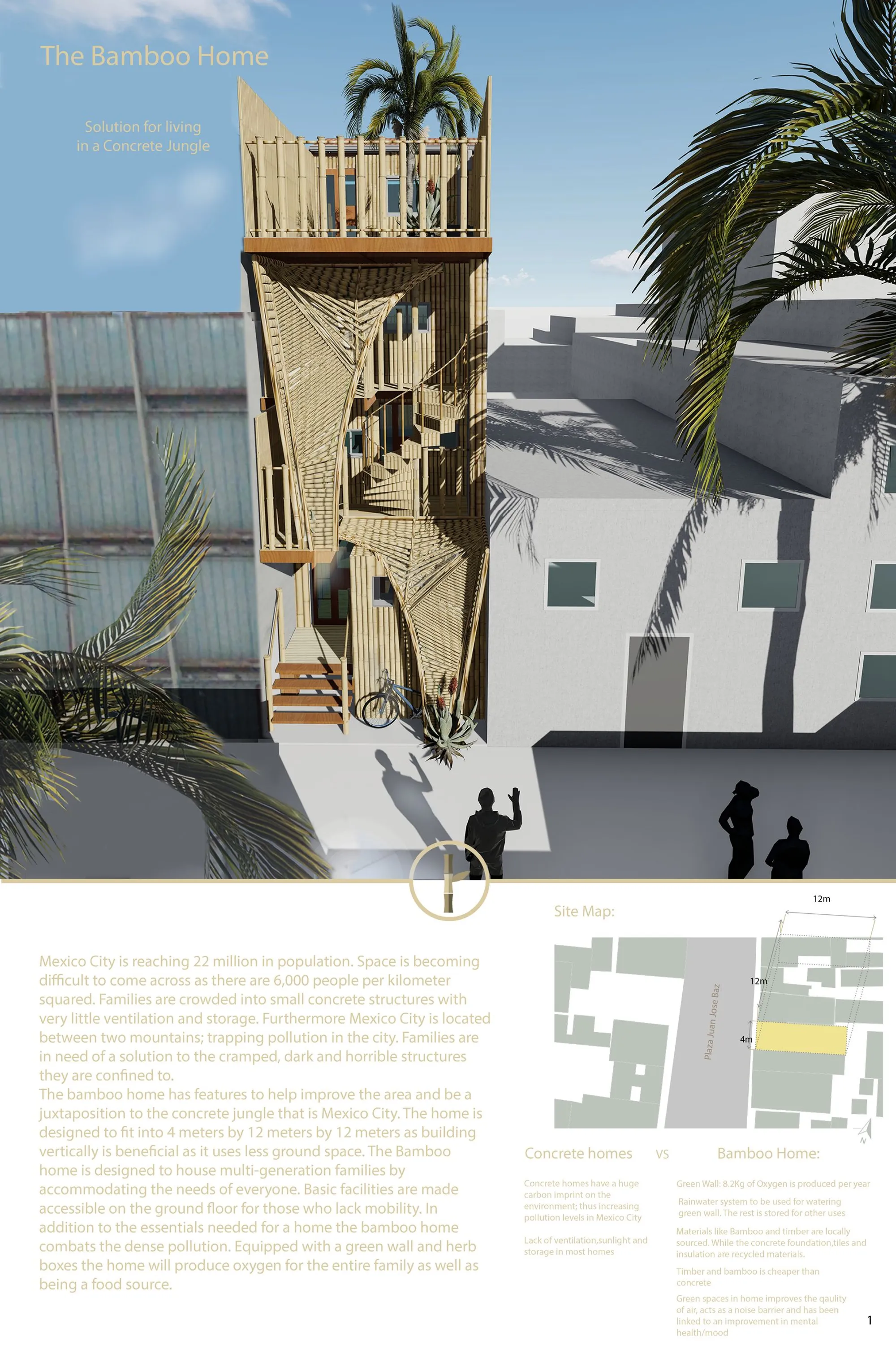
Bamboo Home: Compact Urban Housing Wrapped in a Curved Bamboo Facade
A three-story bamboo-clad residence in Mexico City uses recycled concrete, green walls, and a central atrium to counter dense urban living.


Mexico City's residential fabric is overwhelmingly concrete: dense, poorly ventilated blocks that trap heat and sever any meaningful connection to the outdoors. Bamboo Home proposes a direct counter to that condition. A three-story residence clad in a curved bamboo facade, the project channels natural airflow through its interiors, integrates vertical gardens at every level, and builds its foundation from 100% recycled concrete. It treats sustainability not as a surface gesture but as the organizing logic for every material choice, spatial decision, and structural detail.
Designed by Subhadra Auman and shortlisted in the Nano Nest 2020 competition, the project responds to a brief centered on compact, efficient housing. Sited within Mexico City's urban core, the design confronts the reality that small homes in crowded neighborhoods often sacrifice air quality and daylight for density. Auman's response is a residence where bamboo cladding, green walls, and a central atrium work together to make a tight footprint feel generous and breathable.
A Section That Breathes: Atrium, Bamboo, and Three Distinct Floors
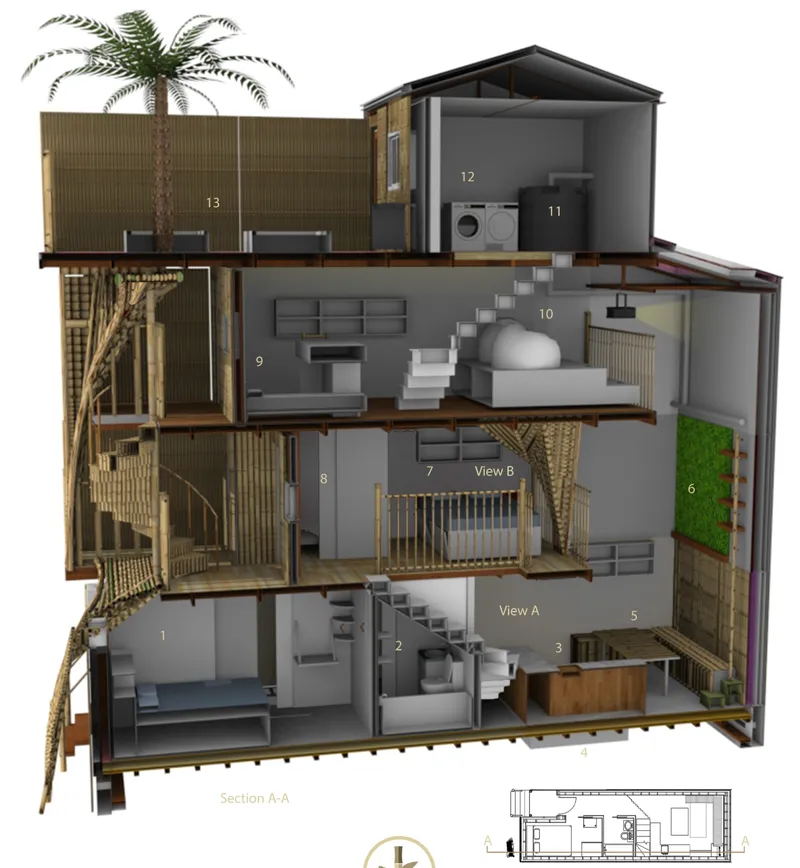
The sectional drawing reveals how the home's three stories stack distinct programs while maintaining a continuous vertical connection. The ground floor houses a bedroom for older generations, a full bathroom, a kitchen, and underfloor storage. The first floor contains a second bedroom with bunk beds, a bathroom with shower, and a green wall that faces the interior. The top floor serves as a flexible cinema and extra sleeping area, with a utilities room and rooftop plant boxes. A large central atrium pulls daylight down through all three levels, and the curved bamboo cladding on the exterior filters light and wind into the home without sacrificing privacy.
What makes the section compelling is its refusal to treat each floor as an isolated slab. Open balconies and the atrium void stitch the levels together visually and thermally, allowing warm air to rise and exit while cooler air enters at the base through the bamboo screen. The structural logic is legible too: reclaimed timber provides the primary frame, while bamboo serves as both cladding and environmental mediator.
Bamboo Slats and Green Walls as Interior Surfaces
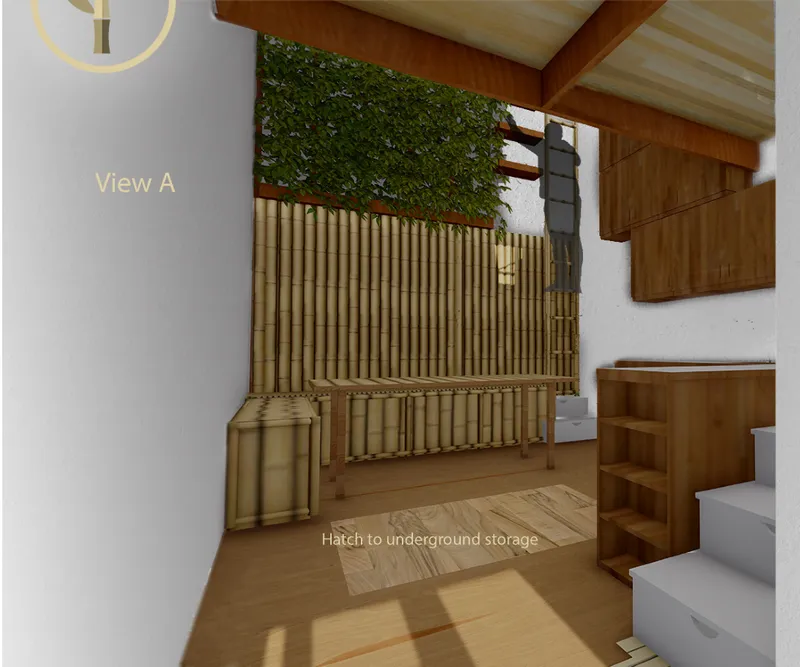
Inside, the bamboo is not merely decorative. Vertical slats line interior walls, creating a rhythmic texture that modulates light and air. Above these slats, a green wall introduces living plant matter directly into the domestic environment, improving air quality and softening the acoustic character of the space. The timber flooring anchors the palette in warm, natural tones. The overall effect is a room that feels layered with natural materials rather than assembled from industrial components.
The integration of plant boxes and vertical gardens at multiple points throughout the home is a deliberate strategy against the confinement that characterizes much of Mexico City's compact housing. Rather than relying solely on windows for a connection to the outside, Auman brings the outside in, embedding greenery into the architecture itself.
An Exploded Assembly of Recycled, Reclaimed, and Renewable Parts
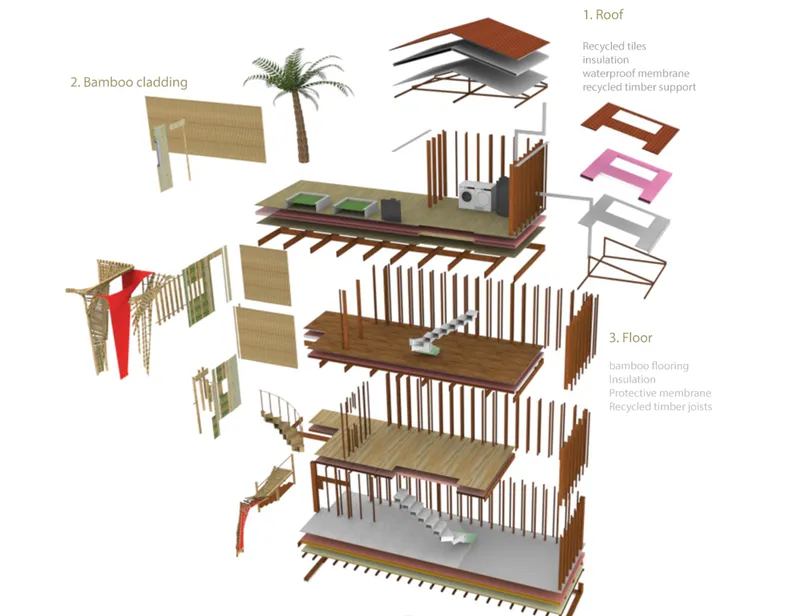
The exploded axonometric drawing breaks the home into its constituent layers: roof assembly, bamboo cladding panels, floor slabs, and structural components. Each layer corresponds to a specific material strategy. The foundation uses 100% recycled concrete, reducing the embodied carbon of the heaviest building element. Reclaimed timber forms the structural skeleton, keeping the frame lightweight relative to a conventional concrete or steel system. The bamboo cladding wraps the exterior as a continuous curved surface, directing airflow while shading the interior from direct solar gain.
Reading the axonometric from bottom to top, the circular logic of the material palette becomes clear. Every component is either recycled, reclaimed, or renewable. Construction waste is minimized not through heroic engineering but through straightforward material selection. The drawing also clarifies how the curved facade attaches to the rectilinear structure beneath it, with the bamboo acting as a screen that floats slightly off the building envelope, creating a ventilated cavity.
Living Under Woven Bamboo: A Bedroom That Feels Like a Canopy
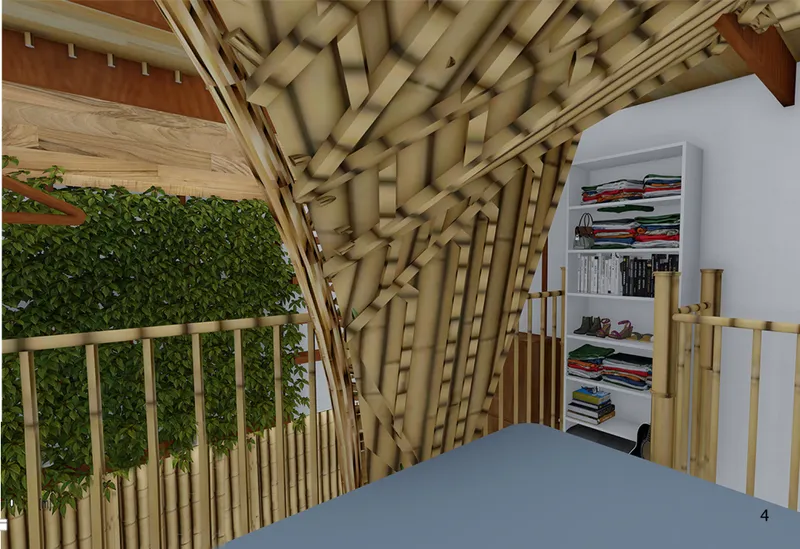
The interior bedroom view captures one of the home's most tactile moments. A woven bamboo ceiling structure arches overhead, giving the room the character of a sheltered outdoor space rather than a sealed box. Beyond a bamboo railing, another green wall is visible, reinforcing the sense that every sightline in the home terminates in either natural material or living vegetation. The bedroom itself is compact but not cramped, a result of the adaptable layout strategy that uses movable furniture and multifunctional zones to ensure each square meter serves more than one purpose.
The woven ceiling does more than establish atmosphere. Its structure allows air to circulate between the bamboo members, contributing to the passive ventilation strategy that runs throughout the building. Strategic window placement on upper floors maximizes natural light during the day, reducing dependence on artificial lighting and reinforcing the home's energy efficiency goals.
Why This Project Matters
Bamboo Home is a clear argument that compact urban housing does not have to be synonymous with poor air quality, darkness, and disconnection from nature. By building with bamboo, recycled concrete, and reclaimed timber, Auman demonstrates that a sustainable material palette can also produce spaces that are warm, textured, and inviting. The project's three-story organization proves that even on a tight urban footprint, distinct zones for rest, work, and leisure can coexist without sacrificing openness or ventilation.
In a city facing both environmental pressures and an acute housing shortage, the project offers a replicable model. Its strategies are not exotic or prohibitively expensive: curved bamboo screens, green walls, underfloor storage, and a central atrium are all achievable with accessible construction techniques. What distinguishes the design is the coherence with which these elements are combined. Every decision, from material sourcing to spatial planning, serves the same goal: a healthier way to live densely. That coherence is what makes Bamboo Home worth studying, and worth building.
View the Full Project
About the Designers
Designer: Subhadra Auman
Enter a Design Competition on uni.xyz
uni.xyz runs architecture and design competitions year-round that reward proposals with spatial conviction and real site intelligence.
Project credits: Bamboo Home by Subhadra Auman Nano Nest 2020 (uni.xyz).




Popular Articles
Popular articles from the community


The Ocean Hive: Sustainable Architecture for a Self-Sufficient Civilization at Sea
The Ocean Hive imagines sustainable architecture at sea, where modular habitats, algae, wave power and ocean waste sustain a growing colony.

The Musturak Paradise: Senior Living Architecture for a Connected Future in Temara, Morocco
The Musturak Paradise reimagines senior living architecture in Temara via private homes, social spaces, culture, community, and shared care.

Conexión: Biophilic Design Reimagines High-Rise Living in Hong Kong
Conexión reimagines high-rise living in Hong Kong through biophilic design, green facades, shared spaces, daylight, water and nature within.

Co-life: Sustainable Architecture for Age-Friendly Community Living
Co-life reimagines sustainable architecture for seniors through courtyards, rammed earth, shared gardens, and spaces designed for belonging.


Similar Reads
You might also enjoy these articles

Bao Huynh Watercolor Atelier: A Serene Art Retreat in Hội An
Bao Huynh Watercolor Atelier in Hội An blends multifunctional art spaces, sustainable design, local materials, and family-friendly living in a serene environment.

Atelier Macri Concept Store Interior Design by CASE-REAL
Atelier Macri store features a "ko" counter, walnut wood details, cork displays, blending retail, gallery, and seamless customer experiences.

Manuel Vargas Izquierdo Stadium and High-Performance Sports Center: Architectural Excellence in Jalpa de Méndez
The Manuel Vargas Izquierdo Stadium blends sustainable design, inclusive sports facilities, and cultural-inspired architecture, revitalizing Jalpa de Méndez’s public spaces.

KAKR Buluh Awar Hall: Revitalizing Community and Ecology Through Bamboo Architecture
Community built bamboo hall revitalizes Buluh Awar village, empowering youth, restoring ecology, celebrating vernacular craftsmanship through sustainable architecture and culture.


Explore Bamboo Construction Competitions
Discover active competitions in this discipline



Challenge to reimagine the Iron Throne


Photograph architecture without architects


Illustrate the lost glory of Angkor Wat - Render Challenge


Design challenge to reuse E-waste
Comments (0)
Please login or sign up to add comments
No comments yet. Be the first to comment!