
3andwich Design Turns a Concrete Bridge in Rural China into a Timber Corridor Inspired by the Tea Horse Road
A glulam covered bridge in Kang County, Gansu Province, revives corridor bridge traditions while sequestering 144 tons of carbon over a mountain river.


In Kang County, a small town of about 200,000 people tucked into the mountains of Gansu Province, two rivers meet and flow south through a compact urban center. At that confluence sits a nondescript concrete bridge built in 2003, 117 meters long and 12 meters wide, doing its job of moving cars over water. 3andwich Design / He Wei Studio was asked to do something more with it: to convert that civic utility into a piece of inhabited infrastructure that could extend the town's commercial street, slow down traffic, and give Kang County a public room over the river.
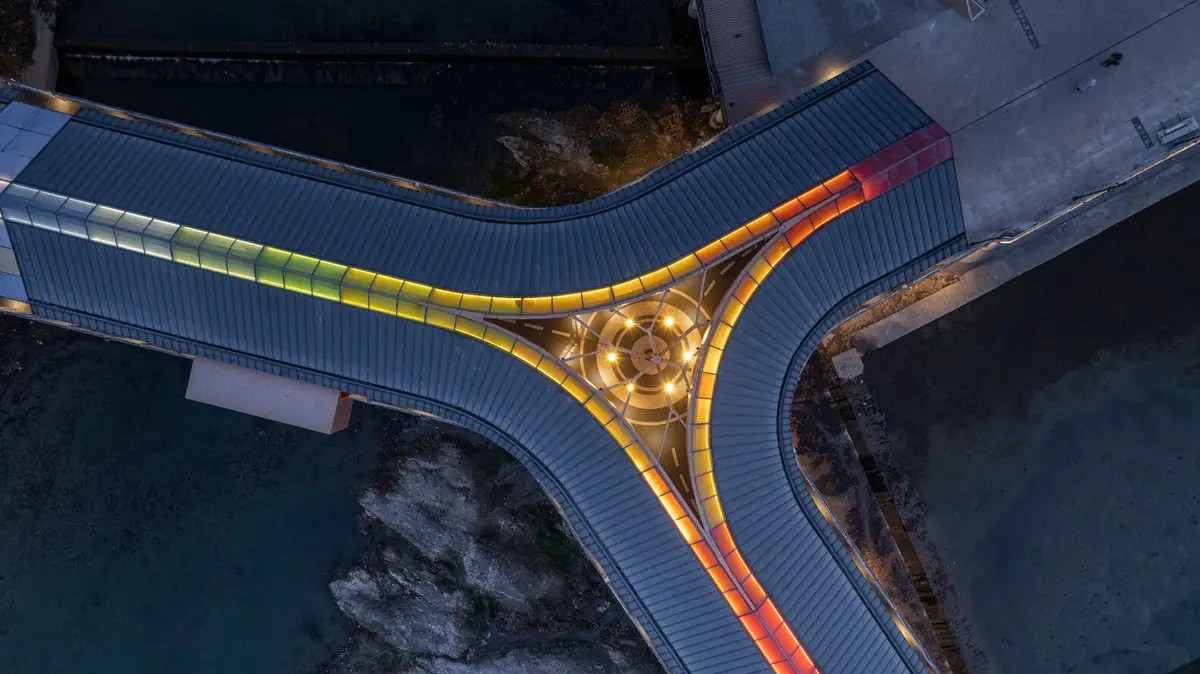
The answer is a glulam timber corridor bridge with a three-armed plan, 800 square meters of covered space that sits on the old bridge deck without demolishing it. The form draws directly from the Dragon and Phoenix Bridge, a Qing Dynasty covered bridge that survives nearby as a provincial-level cultural relic and a reminder of Kang County's history as a node on the Tea Horse Ancient Road. What makes the project genuinely interesting is not the historical reference itself but the structural logic used to realize it: 160 cubic meters of Douglas fir, prefabricated as glulam portal frames in a factory and bolted together on site, clad in red cedar plywood, and topped with a colored glass skylight that shifts from red to blue along the ridge. The result is a bridge that sequesters about 144 tons of carbon while functioning as a market hall, a viewing platform, and a sheltered path.
A Y-Shaped Plan Over Two Rivers

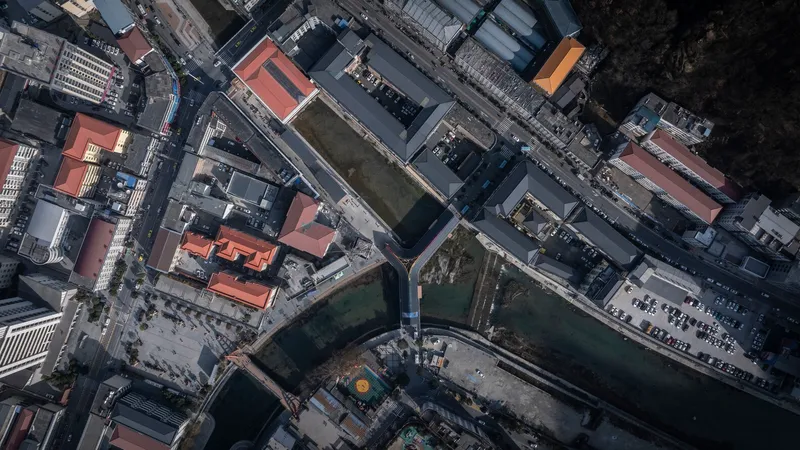

Seen from the air, the bridge reads as a Y: three wings that converge at a large central space over the water where the Yanzi River and Sanguan River meet. The northern arm reaches toward the commercial street, the western arm faces a kindergarten, and the eastern arm connects to a residential neighborhood. That tripartite plan does real urban work. It knits together three separate zones of the town that previously shared only the flat, car-dominated bridge deck.
The central convergence point is the key move. It expands into a generous gathering space, passable through the middle and lined with seats and enclosed box-shaped rooms on both sides. The architects describe it as a venue for temporary markets, outdoor performances, and other public events. For a town this size, that kind of flexible covered space, free to use and open to the river air, is a significant civic gift.
Timber Frames and Tree-Shaped Steel


The structural system is a hybrid. Portal frames made of Douglas fir glulam form the primary skeleton, each frame assembled from six glued-wood components with slanting supports on the columns at both sides. Where the plan opens up at the center, the portal frame gives way to a single-sided standing structure supported by a tree-shaped steel column that branches outward to carry an inward-curving triangular steel beam. It is the kind of detail that sounds overwrought in description but reads clearly in person: the steel trees hold the roof open so the timber frames can step back and let daylight in.
The white branching columns are visually striking against the warm tones of the Douglas fir, and they serve a practical purpose. By consolidating the structural load into single points at the center, the architects free up the floor plate for flexible use. Circular floor patterns mark the column locations, giving the interior a rhythm that alternates between compression under the timber bays and release at each steel tree.
A Skylight That Marks Time in Color
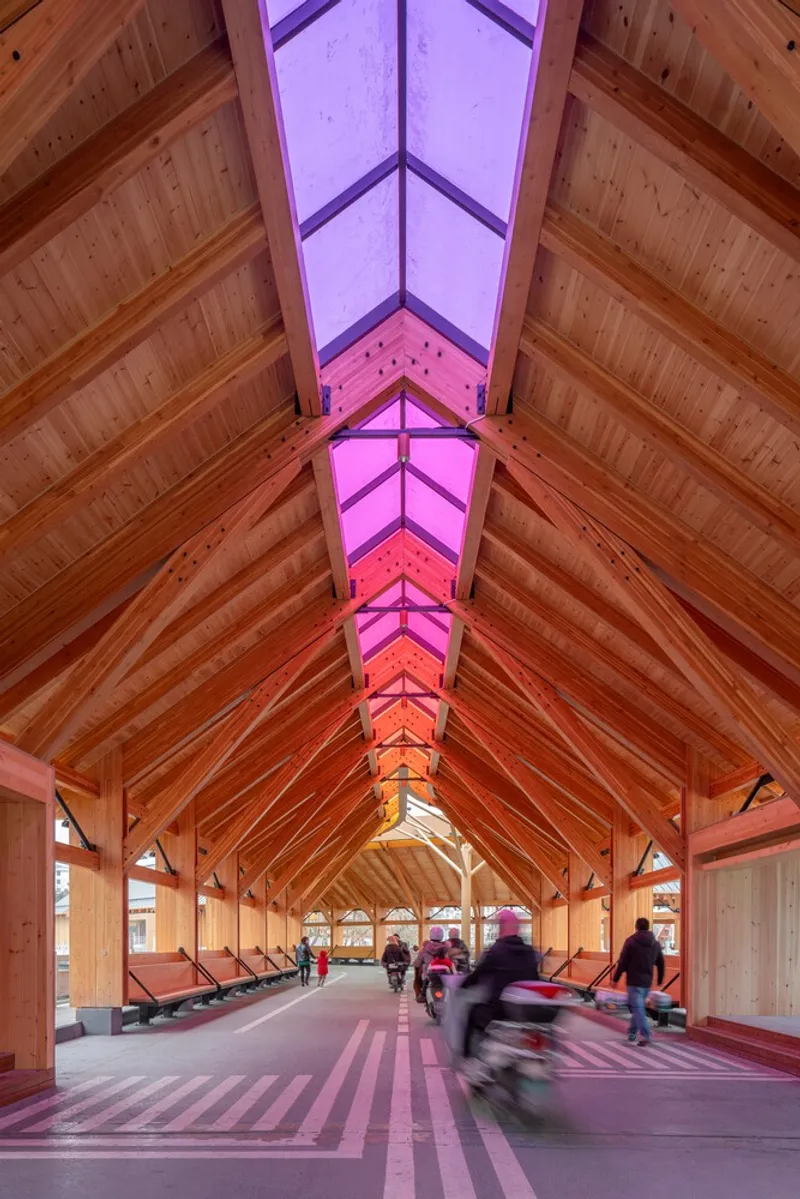


The most immediately photogenic detail is the ridge skylight: a continuous strip of colored glass set between the timber rafters along the double-sloping roof. The glass graduates from red at one end to blue at the other, and the architects describe this gradient as "representing time." Whether or not that conceptual frame lands for every visitor, the effect is undeniable. Pink and violet light spills down the interior surfaces, transforming the warm wood into something theatrical.
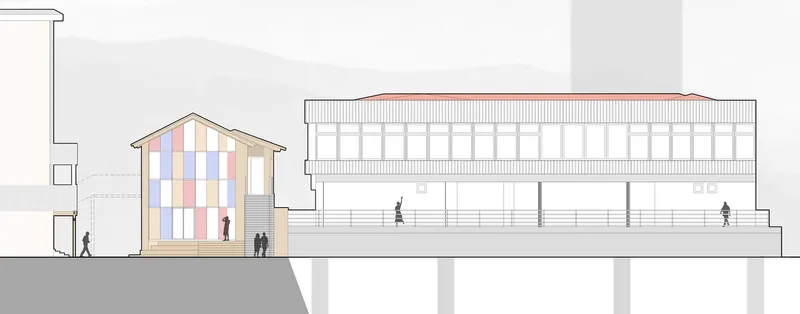
The skylight is also a functional device. It brings daylight deep into a structure that is nine meters wide and 7.2 meters tall at the ridge, dimensions that could easily produce a dark tunnel. The eaves sit at 3.2 meters, a height calibrated to allow fire trucks to pass beneath the bridge's arched openings. Light enters from the top and washes sideways across the curved trusses, reinforcing the sense of a covered outdoor room rather than an enclosed building.
Cladding as a Working Layer


The 50mm-thick red cedar plywood cladding on the columns is more than a finish material. The architects use it to create a layered construction that conceals drainage infrastructure and lighting equipment in hidden cavities behind the panels. That approach keeps the interior surfaces clean while protecting the primary glulam structure from weather exposure. It also adds visual depth: the cedar reads as a secondary grain against the Douglas fir, enriching the palette without introducing a third material.
At the bridge's edges, the original white marble breast boards from the 2003 structure have been retained and integrated into the new design. It is a straightforward gesture of material continuity, connecting the new covered bridge to its concrete predecessor. The marble's cool gray stands in contrast with the warm timber above, marking the line where old infrastructure ends and new inhabitation begins.
Evening on the River

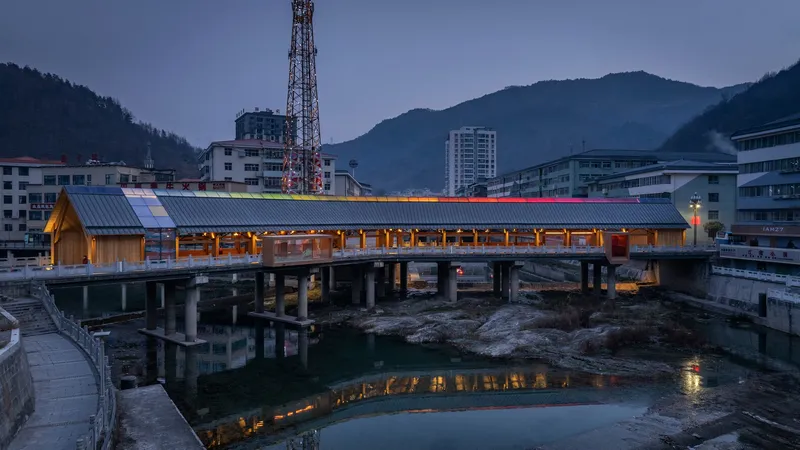

At dusk the bridge transforms. Edge lighting along the deck and the colored skylight visible through the roof openings turn the structure into a lantern suspended over the rocky riverbed. The mountain backdrop, ever-present during the day, recedes into silhouette while the bridge asserts itself as the luminous center of Kang County's public life. The gabled pavilion entries at either end glow from within, their exposed rafters casting shadows that read like an invitation.
The nighttime character is not incidental. For a bridge designed to extend the commercial street and host evening markets, lighting is a programmatic necessity. The concealed fixtures within the cedar column cladding earn their keep here, producing an even wash that avoids the harsh spotlighting that plagues so many civic projects in small Chinese cities.
Inhabiting the Edges


The sides of the bridge house enclosed, box-shaped viewing rooms with glass walls and benches, spaces where visitors can sit and watch the river or the mountains without being in the flow of pedestrian traffic. These pink-lit chambers, visible from the main passage, function like display cases in reverse: people inside look out at the landscape while people outside look in at the silhouettes. It is a neat spatial trick that creates intimacy within a public corridor.
The passage through the center remains open, generous, and uninterrupted. That separation of movement and rest, the middle for walking and the edges for pausing, gives the bridge its social life. Families stroll through the timber bays while others linger at the sides. The corridor bridge tradition that 3andwich Design references here was always about exactly this: making a bridge do more than connect two banks.
Plans and Drawings
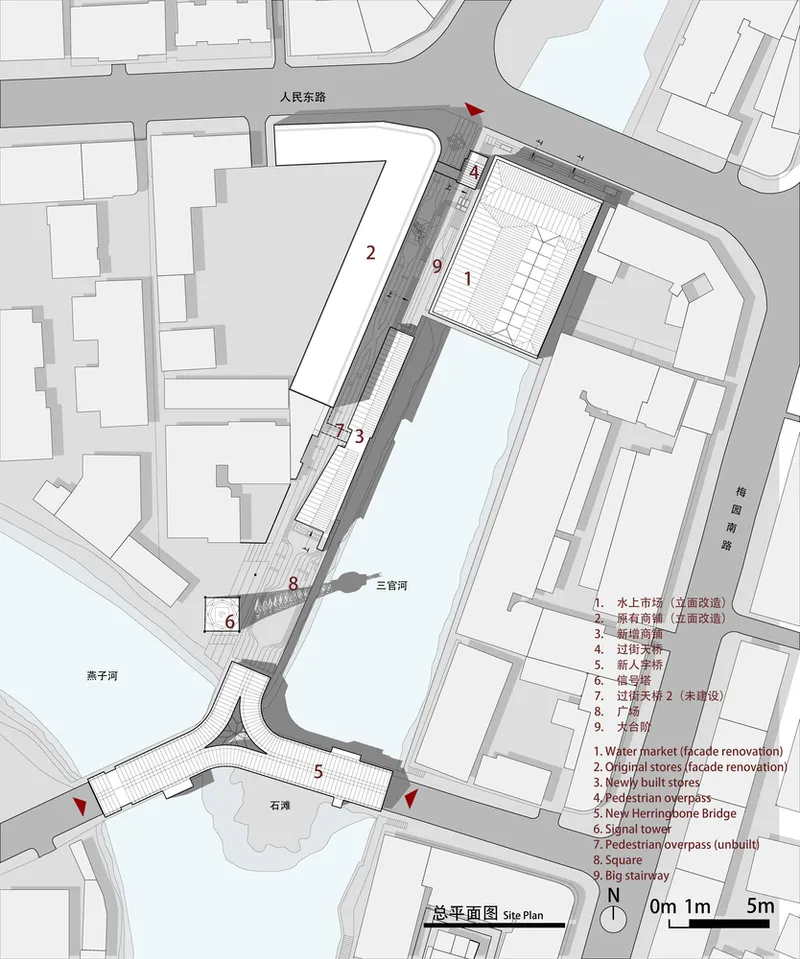
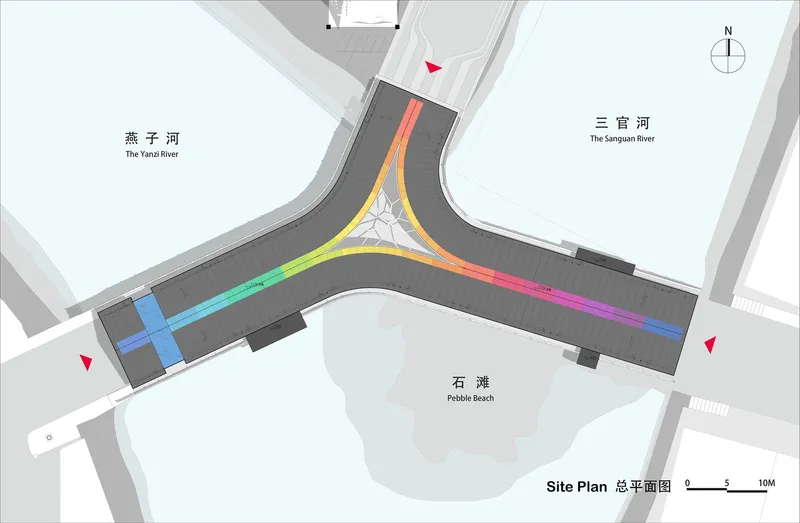





The site plans reveal the Y-shaped geometry clearly, with the colored-glass skylight rendered as a rainbow gradient along the ridge of each arm. The exploded axonometric is particularly informative, showing the layered assembly: bridge deck at the base, timber portal frames in the middle, and the metal roof floating above. The assembly detail drawing of the steel box columns and bolted timber connections illustrates how the prefabricated elements lock together on site, a construction method that kept the work period short and disruption to the existing bridge minimal.
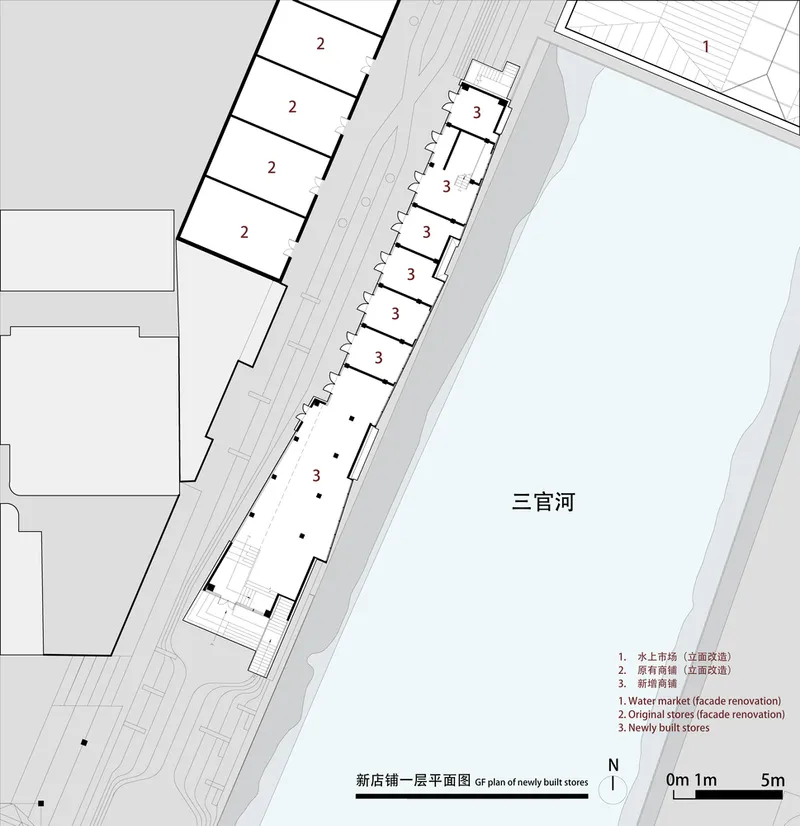
The sections show the proportional relationship between the 3.2-meter eave height and the 7.2-meter ridge, a steep pitch that gives the interior its cathedral-like quality while managing rainwater runoff in a region prone to heavy seasonal rains. The floor plans of the adjacent linear commercial building along the waterfront suggest a broader urban strategy at work: the bridge is one piece of a larger effort to reorganize Kang County's center around pedestrians and the river.
Why This Project Matters
Covered bridges are not rare in China, and glulam timber is not a new material. What 3andwich Design achieves here is the synthesis of both within the framework of a real urban problem: a small mountain town needs public space, a concrete bridge needs a reason to exist beyond car traffic, and a local building tradition needs to be made relevant without being reduced to scenography. The New Herringbone Bridge addresses all three. Its 160 cubic meters of wood store carbon instead of emitting it. Its Y-plan connects three neighborhoods instead of two banks. Its colored skylight makes infrastructure feel celebratory.
The project is also a reminder that prefabrication and craft are not opposites. The glulam frames were factory-made, but the bridge they form is spatially rich, materially layered, and deeply rooted in its site. For architects working in China's smaller cities, where budgets are tight and the pressure to produce generic results is constant, this is a model worth studying. Infrastructure can be inhabited. Bridges can be rooms. And timber, when used with structural intelligence, can turn an ordinary municipal project into something a town actually wants to gather inside.
New Herringbone Bridge, designed by 3andwich Design / He Wei Studio. Located in Kang County, Gansu Province, China. Area: 800 sqm.
About the Studio
Share Your Own Work on uni.xyz
If projects like this are the kind of work you want to make, uni.xyz is a place to publish your own, find collaborators, and enter design competitions.


Popular Articles
Popular articles from the community


Cloaked Colonization: A Mobile Underwater Habitat That Moves Like a Fish
Micah Abaya's shortlisted EHC Pacific entry reimagines ocean settlement as a dispersed network of self-sustaining architectural organisms.

Opera on the Sea: Driftwood Logic Shapes a Timber Opera House on Estonia's Coast
Trevor Orgill's opera house translates the entangled drift of floating timber into a civic building where wood, water, and music converge.

The Amber Palace Opera: A Geological Fiction Surfaces on Tallinn's Baltic Waterfront
Pierre Brillard reimagines a Baltic legend as a public landscape, opera house, and waterfront promenade rooted in Tallinn's coastal identity.

Singing Woman: An Opera House That Performs Before the Curtain Rises
Ovidiu Cristian Pavel's conceptual opera house translates Estonia's choral identity into a sculpted waterfront landmark facing the Baltic Sea.

Similar Reads
You might also enjoy these articles


Hodi-Mandai Geram
Project Function: Preservation and revitalization of the Intangible heritage and socio-spatial identity of the Hodi by Housing, Cultural Memory Center, Sacred Grove, landscape, local tourism economy


Olio Towers: A Mid-Rise for Performers That Fuses Housing, Rehearsal, and Stage
Located blocks from Houston's Theater District, this modular tower stacks living units around a central performance atrium.

Oasis: Modular Green Housing Carved into Dhaka's Urban Fabric
A shortlisted Plugin Housing entry reclaims unauthorized settlements in Dhaka with stepped concrete volumes, green roofs, and ventilation-driven design.

Black Hole: A Floating Megastructure for the Post-Physical Era
Emiliano Mazzarotto envisions a spherical, self-scaling arena where e-sports, digital hotels, and holographic stadiums replace traditional public space.

Explore Foot Bridge Competitions
Discover active competitions in this discipline

Challenge to reimagine the Iron Throne

Photograph architecture without architects

Illustrate the lost glory of Angkor Wat - Render Challenge

Design challenge to reuse E-waste
Comments (0)
Please login or sign up to add comments
No comments yet. Be the first to comment!