
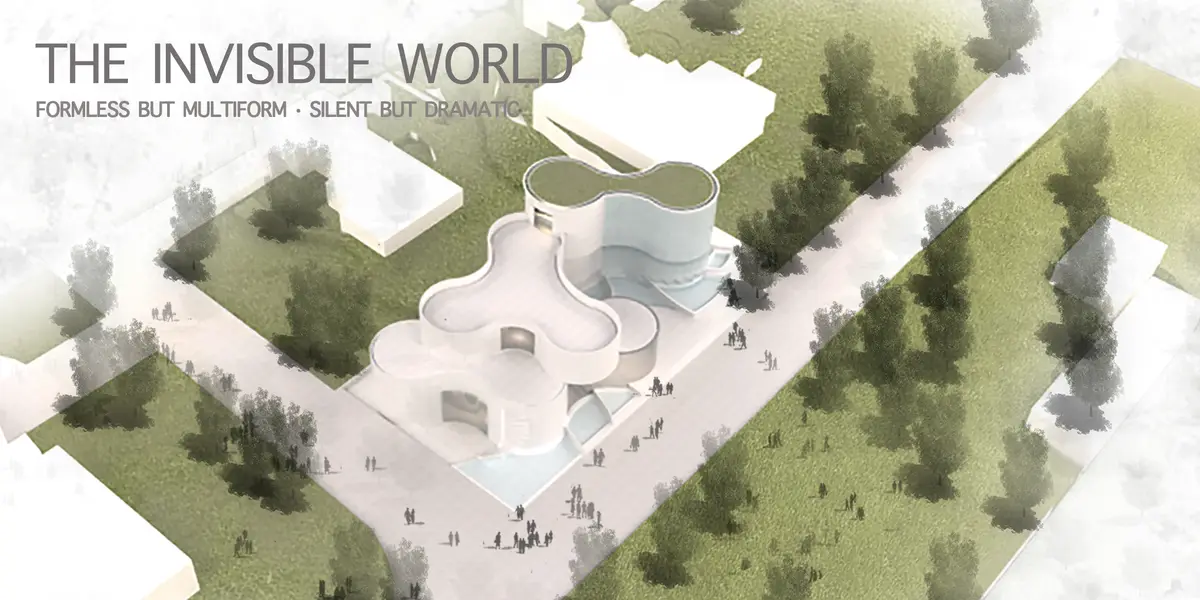
THE INVISIBLE WORLD
FORMLESS & MULTIFORM·SILENT & DRAMATIC

1 CONCEPT
Although the main purpose of the design was to transform the abandoned grain bins into an agricultural dormitory, we wanted to respond appropriately to the deeper appeal of the local community on this basis. Driven by this belief, we find the clue to water.
Water has always been one of the most important needs in Kansas, for agriculture, for living, and for the arid environment. Quietly, in an invisible way, water is affecting the growth of Kansas. However, as mentioned in the title "THE INVISIBLE WORLD", in addition to satisfying the original survival needs of the people of Kansas, water actually has the ability to enlighten space. Water is FORMLESS BUT MULTIFORM, SILENT BUT DRAMATIC.
If the container is round, the water is round.
If the container is tilted silently, the water will whisper.
If water's desire to express exceeds the container, then it will shock your soul.
Therefore, we proposed the concept of "BIN + WATER", hoping to integrate and utilize water resources to create beautiful water landscape on the basis of barn satisfying accommodation, and then achieve the purpose of enlightenment. So that is can influence the community and the wider community of agricultural learners.
2 Design Background
The project site is located in Osage, Kansas, USA, with a typical temperate continental climate. The annual precipitation analysis chart shows that the local annual precipitation is relatively small, only 500 mm, and it is concentrated in summer. This has led to extreme water shortages in some areas. And the limited drainage area of Kansas' major rivers has exacerbated this situation.
In addition, there are often droughts and sandstorms in the area. As a major food production state, crop planting and harvesting are in fact often threatened.
Through analysis by overlaying precipitation maps, crowd distribution maps, sandstorm frequency maps, hydrological maps, etc., we found that the recycling of water resources and water-based agricultural education are very necessary.
3 Design Method
The project mainly explores and solves the following problems:
a. Effectively improve the utilization rate of grain bins.
b. Alleviating local water shortages.
c. Create a multi-functional space integrating accommodation, exhibition and study.
3.1Unit organization.
As the main objective of the project is to extend the life of the traditional steel grain bins while giving it new functions and forms, and build it to accommodate 40 people. Therefore, the intensive organization of bins became our top priority. A total of 12 traditional bin skins are used in the design. Part of the bin is cut and integrated as a connection between other units. Doing so allows for more flexibility in the use of Spaces -- Dumbbell Spaces, Cloverleaf Spaces, etc. In the arrangement of barn communities, we stacked the bins in different forms to get a rich vertical effect. This also provides the stage for water injection.
3.2 Water injection
Rich vertical effects, smooth lines, flowing volumes, they combine to evoke the feeling of water. But we really brought water into the building. We inserted a small waterfall and the corresponding fall into the building, combined with the sound of the water, to maximize the attention.
When people look at the main part of the building from the outside, it is like some bins covered by water flow. There are also stairs for students to visit and exchange under the waterfall. It not only provides enough activity space, but also creates a space for the flowing water to show art, which is re-presented to people in the modern architectural form. It is the collision of water and living space, the fusion of human and nature, and we want to give space and environment new vitality. And here comes the touching part of the exhibition -- people should pay attention to our precious water!
Specifically, in addition to providing the multifunctional hall and indoor exhibition hall, we also organized one or more series of routes to connect the indoor and outdoor space, so as to provide students and visitors with a deep understanding of water resources. During the walk, as the landscape changes, the water can be associated with more precious things.
3. 3 Sustainable water
However, it is not enough to create a magnificent waterscape, but also to pay attention to the sustainable use of water. Rooftop pools can store concentrated summer rainfall in the first place.
The second step is related to equipment. The vertical height difference in the site provides suitable space for water-related equipment. Under the waterscape steps, is mainly used to store domestic wastewater, atmospheric precipitation and other water storage space. In addition, equipment rooms with functions of disinfection, cleaning and filtration are also added under the water storage space to provide the use of the living space of the whole building, realize the system of water circulation and reduce the waste of resources.

Popular Articles
Popular articles from the community


Co-life: Sustainable Architecture for Age-Friendly Community Living
Co-life reimagines sustainable architecture for seniors through courtyards, rammed earth, shared gardens, and spaces designed for belonging.

The Ocean Hive: Sustainable Architecture for a Self-Sufficient Civilization at Sea
The Ocean Hive imagines sustainable architecture at sea, where modular habitats, algae, wave power and ocean waste sustain a growing colony.

Co-Life: Senior Housing Design That Reconnects Older Adults With the City
Co-Life reimagines senior housing design through healing gardens, shared streets, workshops, and a sustainable community across generations.

Little Red Riding Hood: Architectural Design as a Journey Through Fear, Light, and Storytelling
Little Red Riding Hood reimagines the fairy tale through architectural design shaped by fear, light, scale, memory, uncertainty, and choice.

Similar Reads
You might also enjoy these articles

Day and Night Park: A Time-Based Urban Newsstand in Beijing
A temporary urban newsstand in Beijing blending travel, light, and reading through poetic colors, compact form, and community-focused design.

Modernist Patio Renovation in El Masnou, Barcelona by Oliver Segura Arquitectura + Cebrià Arquitectura
Modernist patio renovation blending tradition and innovation with a movable pool, leveled floors, and Catalan materials in El Masnou.

Alto Residencial Coop: Cooperative Housing Development in Santiago de Compostela by Carbajo Barrios Arquitectos
A linear cooperative housing complex blending white volumes and perforated metal façades, enhancing community living, natural light, privacy, and urban integration.
Vil Genis School by BPA ARCHITECTURE – Massy, France
Vil Genis School in Massy, France, features sustainable design, south-facing classrooms, community integration, accessible spaces, and modern educational architecture.

Comments (0)
Please login or sign up to add comments
No comments yet. Be the first to comment!