

Enhancing human interactions through creating architecture and spatial qualities that speak.
Transient public spaces


Background
Public places in a city are the elements that fill the community ties, encouraging human interactions that create a network of spaces strengthening different levels of influence. With the coming of advanced communication technology, human interaction has seen a new way of communicating. With this transient structures and spaces have earned a significant role when it comes to utilization of services and having experiences.
With the development of new infrastructure, how can these temporary structures and spaces rejuvenate and create more value?
Power of ‘Temporary’
Temporary spaces exist for a short period but are capable of increasing the productivity of an existing public arena. There are many possibilities that can be explored and achieved that are not possible in public spaces. These entities and structures contribute to having scopes for diverse usage at the ease of the users. They can also be adapted according to the environmental space quality. Their agile nature makes them more versatile in terms of construction and changing their locations accordingly. This makes them easy to transform and upgrade the interface they provide.
Based on the utilization response, these momentary structures can be modified and updated from time to time. Sometimes these experimental sites provide interaction which is useful to attract people.
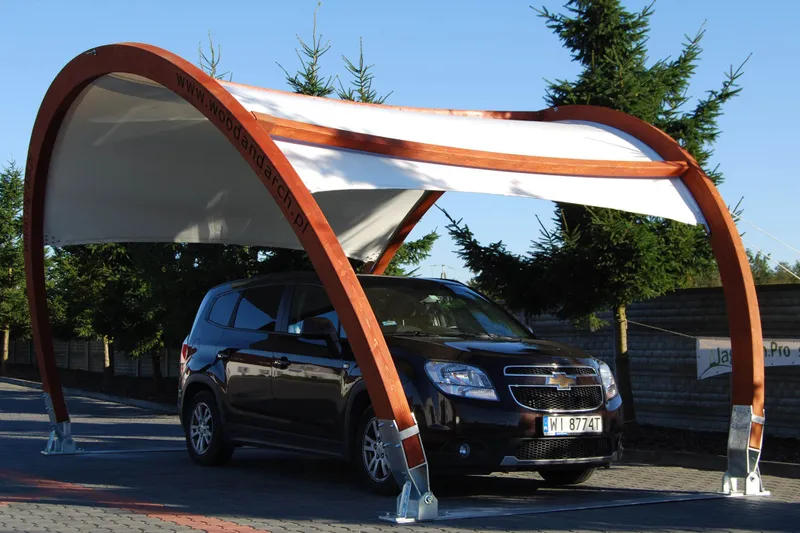
One entity: many usages
As discussed previously, due to the agility of transient spaces, they evolve from time to time making them more effective by opening doors for various utilization options. Being an important factor in providing social experiences, temporary public spaces are capable of hosting festivals, exhibitions, and events. Not only limited to this, but they also add an aesthetic value to an existing public arena.
Transient furniture and installations even provide a functional aspect and serve the citizens with various important services. Being a part of the community, the spatial quality while also serving a definite purpose, sometimes transient structures and temporary places have helped in making a secluded place interactive.
Exploring the components of transient public spaces
Transient public areas usually have a temporary structure, functional furniture, and some qualities that provide aesthetics and add to the nature of that space. These structures mainly can be explored in layers that are their framework, sheathing and sometimes both of these actings together towards new forms. To understand these aspects clearly the following examples can be considered:
Case Study: Illuminate Paris, France
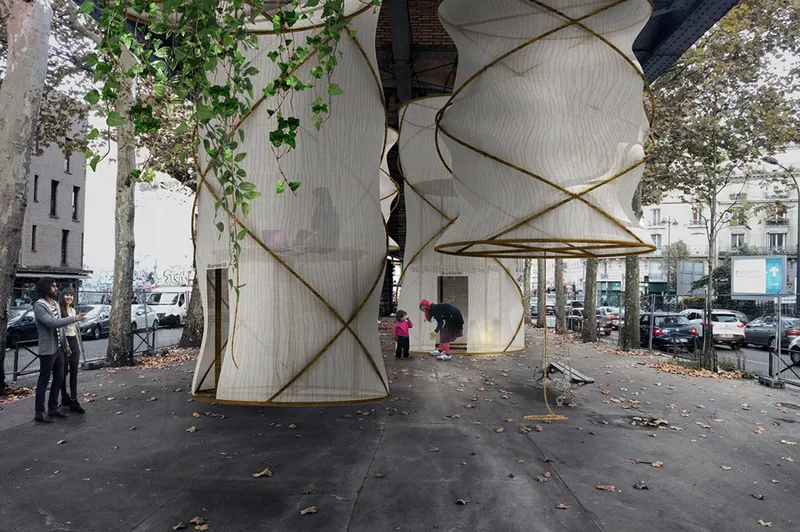
In an attempt to find suitable and safe housing for migrants coming to the city, this collaborative project is a public park beneath an elevated railway bridge. Accommodating basic functions like playground, performance space and a public park, these are cylindrical canopy structures. The 4 meter-wide and 7 meter-tall installations are composed of recycled transparent polypropylene canvas as its sheathing and coil spring bamboo tubes as the framework. This public installation has aimed to provide cultural exchanges and collective activities by reclaiming underutilized public spaces.
Case Study: Reframe, France
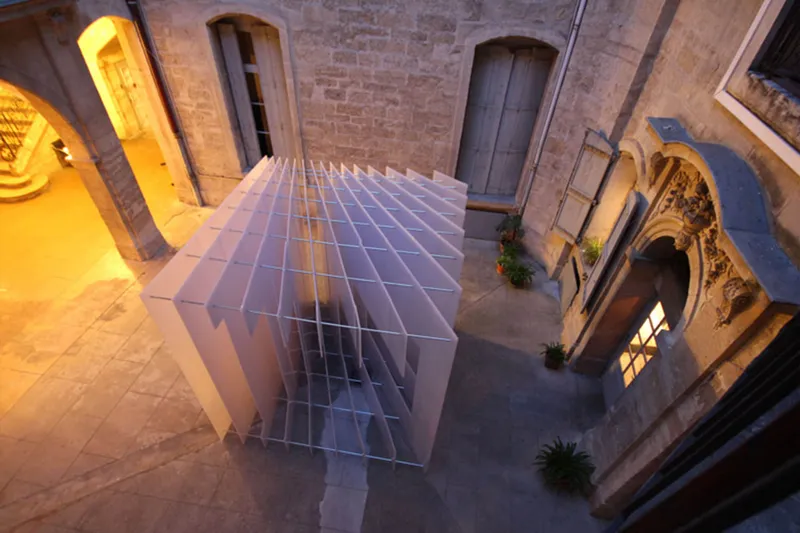
Dutch architecture office Paul Scales attempted to explore different views of a courtyard which was the respective site of this temporary installation. The simple cube design of the structure is made from polycarbonate sheets which gradually reveals multiple framed viewpoints. This installation serves as a good example of sheathing and framework together being used as a single entity making the structure stand.
A glance at the diverse applications of transient structures
Short-lived structures and installations that are also an indispensable part of a temporary public space, can excel in providing a variety of usage options. A public place that was once serving a specific purpose, can be moulded into another direction of utilization by placing a temporary structure there. These installations are site-specific and are designed to transform the perception of a place.
Mobile Public Spaces: a different approach for creating innovative public spaces
Case study - Inflato Dumpsters
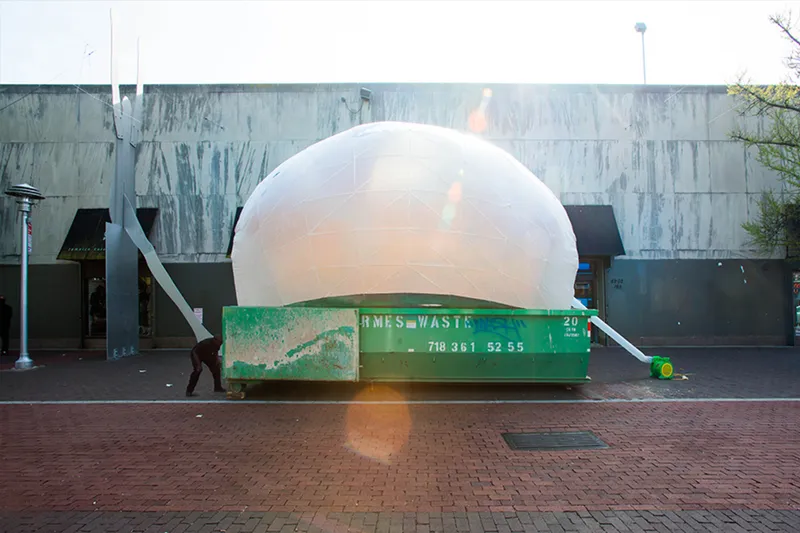
Case study - These dumpsters consist of blow-up structures fitted in them which are mobile learning laboratories used for hosting exhibitions, workshops and classes. The mastermind behind the idea, John Locke sees this street-level unit as a dynamic and informational addition to the cityscape.
The dumpsters consist of an inflatable two-layered membrane made from polyethene and mylar film, which allows views from both in and out towards the street.
Case Study - Plaza Movil

Plaza Movil (a movable square), is a transportable public space for the citizens to meet and play. Designed as a part of a competition by Designo Patagonia, it occupies streets in days when transit slows down. These squares are ideal for people who do not live nearer to a good public space or do not have any means to get to them. These portable street parks use discarded materials like car tyres, and supermarket carts to provide play and game equipment to children that come on streets in low traffic. All the elements of the park are easy to transport.
These case studies have aimed to bring recreational facilities to people that don't live close to public areas.
Seeking solutions through transient structures and spaces
The temporary nature of public infrastructures makes it versatile for them to be used as various service providing areas, all compiled together in one place. As seen in the above-discussed case study of Illuminate Paris, the designed installation served as a living place for the refugees and also used an underutilized public area changing its spatial characteristics. In the future, such design concepts can help in solving issues of limited availability of places to study, work and carry remaining daily tasks.
Places that increase productivity drives efficiency and deliver rich experiences at the ease of the public can be one paradigm for transient public units and spaces.
To know more visit https://uni.xyz/competitions/elevate
Resources :


Popular Articles
Popular articles from the community


The Amber Palace Opera: A Geological Fiction Surfaces on Tallinn's Baltic Waterfront
Pierre Brillard reimagines a Baltic legend as a public landscape, opera house, and waterfront promenade rooted in Tallinn's coastal identity.

Extended Shell: Retrofitting Kolkata's Balconies as Living Urban Thresholds
A modular retrofit system recovers the social and environmental intelligence of Kolkata's historic verandas for contemporary Park Street residents.

Opera on the Sea: Driftwood Logic Shapes a Timber Opera House on Estonia's Coast
Trevor Orgill's opera house translates the entangled drift of floating timber into a civic building where wood, water, and music converge.
Temporary Home for Dogs: A Reversed Zoo Rethinks Animal Shelter Architecture
In Bucharest, a sinuous corridor and freed landscape flip the logic of containment, designing a shelter that works to make itself unnecessary.

Similar Reads
You might also enjoy these articles

Pixel Gardens: One Repeated Module Stacked Into a Terraced Social Housing Tower for Famagusta
Salem Bader's shortlisted housing tower builds a vertical neighbourhood from one repeated module, offsetting units to carve terraces, light and air.

Bao Huynh Watercolor Atelier: A Serene Art Retreat in Hội An
Bao Huynh Watercolor Atelier in Hội An blends multifunctional art spaces, sustainable design, local materials, and family-friendly living in a serene environment.

Atelier Macri Concept Store Interior Design by CASE-REAL
Atelier Macri store features a "ko" counter, walnut wood details, cork displays, blending retail, gallery, and seamless customer experiences.

Manuel Vargas Izquierdo Stadium and High-Performance Sports Center: Architectural Excellence in Jalpa de Méndez
The Manuel Vargas Izquierdo Stadium blends sustainable design, inclusive sports facilities, and cultural-inspired architecture, revitalizing Jalpa de Méndez’s public spaces.


Comments (0)
Please login or sign up to add comments
No comments yet. Be the first to comment!