

Pixel Gardens: One Repeated Module Stacked Into a Terraced Social Housing Tower for Famagusta
Salem Bader's shortlisted housing tower builds a vertical neighbourhood from one repeated module, offsetting units to carve terraces, light and air.


Modular housing usually fails in the same way: the box arrives from the factory, gets bolted to the next box, and the building that results could sit in any city on earth. Pixel Gardens starts from that criticism. It accepts the discipline of a single unit module and then works on the gaps. By shifting, rotating and pulling units out of alignment, the tower creates terraces, shared rooms and breathing spaces in the voids between them. The pixel is the room, and the garden grows in the spaces the pixels leave empty.
Designed by Salem Bader and shortlisted in the Plugin Housing Challenge 2020, the project proposes social housing for Famagusta in Northern Cyprus. Famagusta is a historic port city with a large population of students, tourists and long-term residents, and it is relatively affordable to live in. Bader places the tower in a strategic urban zone near Famagusta Lake, at a point that connects the universities, the historic districts and the city's social hubs through key transport links. The plan treats the lake as a potential eco-friendly recreational site, and the land-use strategy favours green space and mixed-use development over isolated residential blocks.
A Section Where the Offsets Do the Work
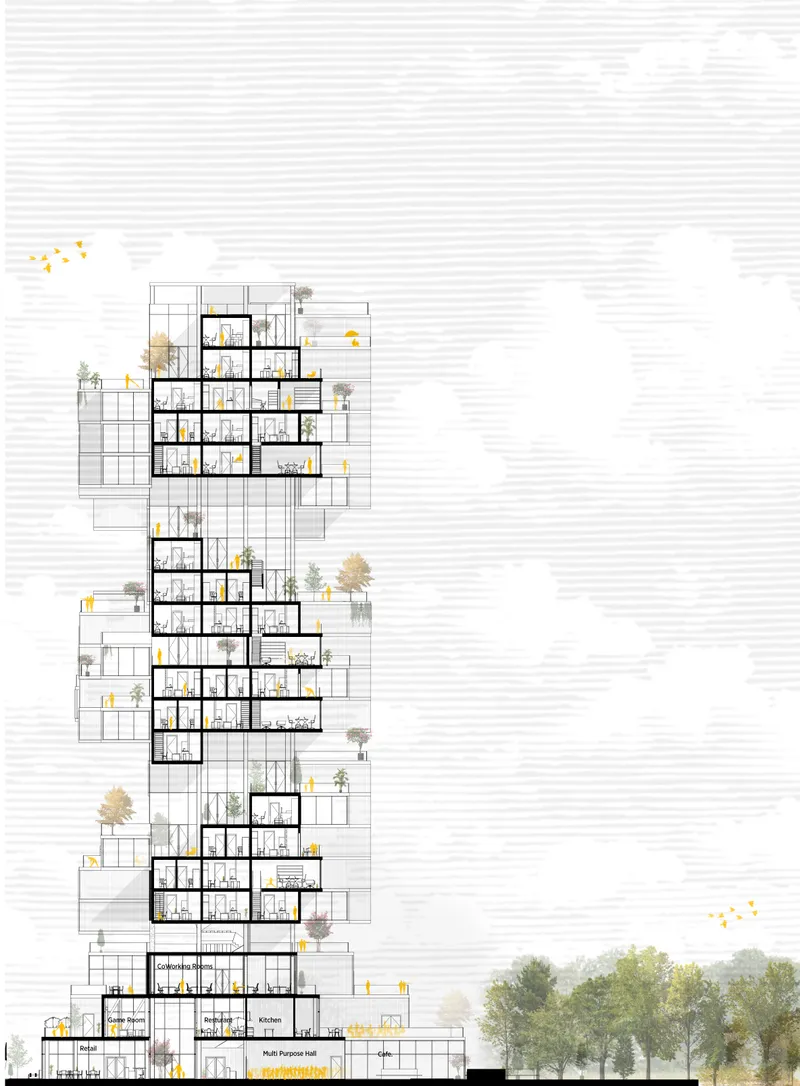
The section shows the project's logic most clearly. Room modules stack upward, but they do not stack flush. Each offset leaves a step-back terrace planted with trees, so the elevation reads as a sequence of outdoor rooms rather than a sealed wall of units. Bader organises vertical movement as a three-level system per floor. That arrangement lets residents see across and between levels, which supports neighbourly contact in a building type that usually keeps people apart. The same offsets serve as breathing areas that allow cross-ventilation. In the Cypriot climate, passive cooling through module placement is a practical way to reduce energy use.
At the base, the drawing shows retail, a cafe and a hall opening onto the adjacent park. The brief describes this ground floor as a home for markets, cafes and cultural hubs. That choice matters for social housing. A tower that gives its ground plane back to the street becomes part of the city's public life, and residents are not cut off from it.
Timber Boxes Over a Glass Base, and a Street Under Cover
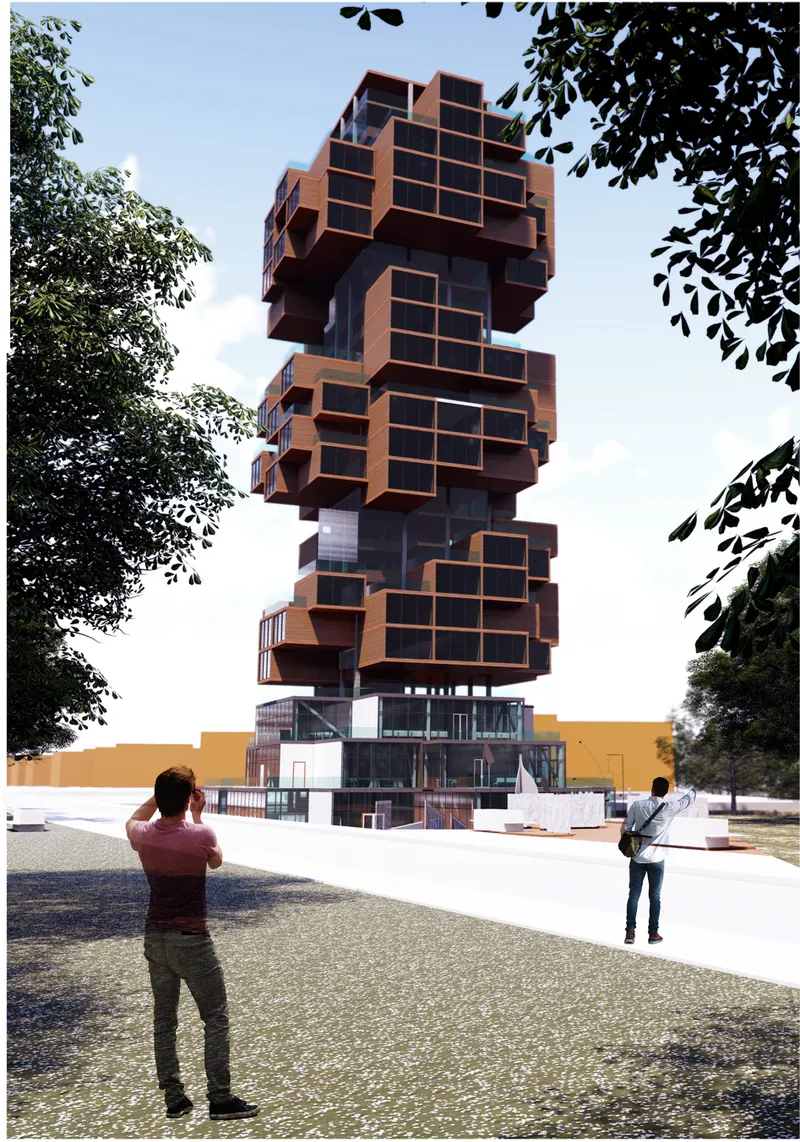
The exterior render presents the tower as a cluster of timber-clad boxes resting on a glazed base. It is a clear tectonic split. The heavy, legible modules sit above, and a transparent public plinth sits below, inviting people in. Bader specifies a steel-frame structure for its durability and light weight, and that frame makes the cantilevers and offsets plausible. Each module can be expressed as an object without the structure fighting the composition.
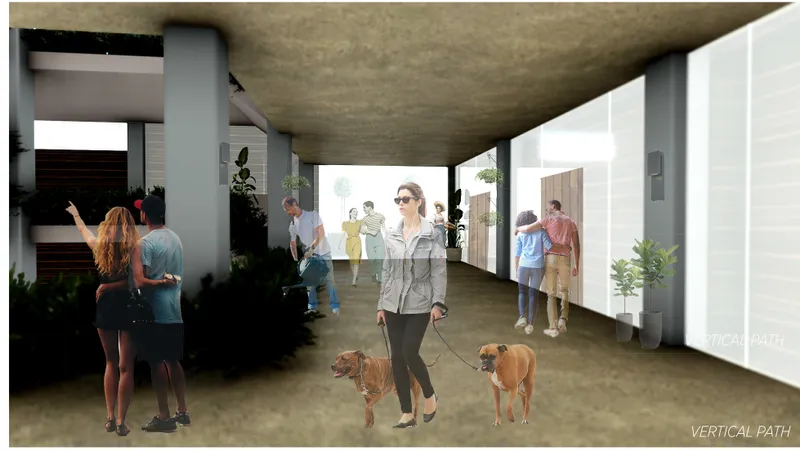
The covered walkway shows the project at pedestrian scale. Concrete columns and frosted panels define a sheltered route lined with planting, and people use it the way they would use a good street: walking dogs, lingering in pairs. This corresponds to the urban connectivity strategy, which links public plazas, bike paths and pedestrian-friendly routes. The tower's edge is designed as a place people pass through, not a boundary.
The Room as a Frame for the Plaza
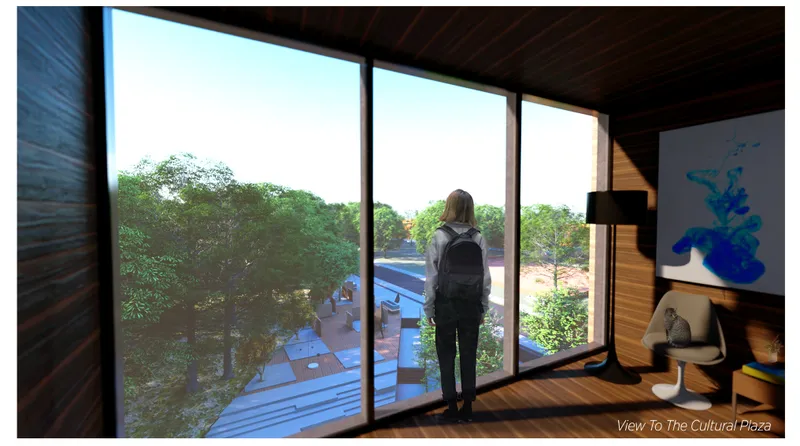
Inside, the module is timber-lined and ends in floor-to-ceiling glass that looks onto trees and the plaza below. The image shows why the units are placed with care for light and views. A compact prefabricated room feels very different when one entire face opens to greenery. Bader's attention to orientation makes a small unit generous, which is the central difficulty of any affordable modular scheme. The figure with a backpack points to the intended residents. In a university city like Famagusta, a student or young professional is a likely occupant of the single-living units.
Five Unit Types, Endless Tower Combinations

The unit diagrams set out the kit of parts. Types A and B are single-living modules for individuals or couples. Types C, E and F are double and rotated configurations for larger households, and their spatial arrangements come from turning and combining the base module. Bader describes a delivery chain that makes the system readable to residents. Future occupants choose and order a module type, the factory produces it precisely, a truck transports it, and it is assembled on site to reduce cost and labour. The process resembles configuring a product, and it gives residents real say over the kind of space they will occupy.
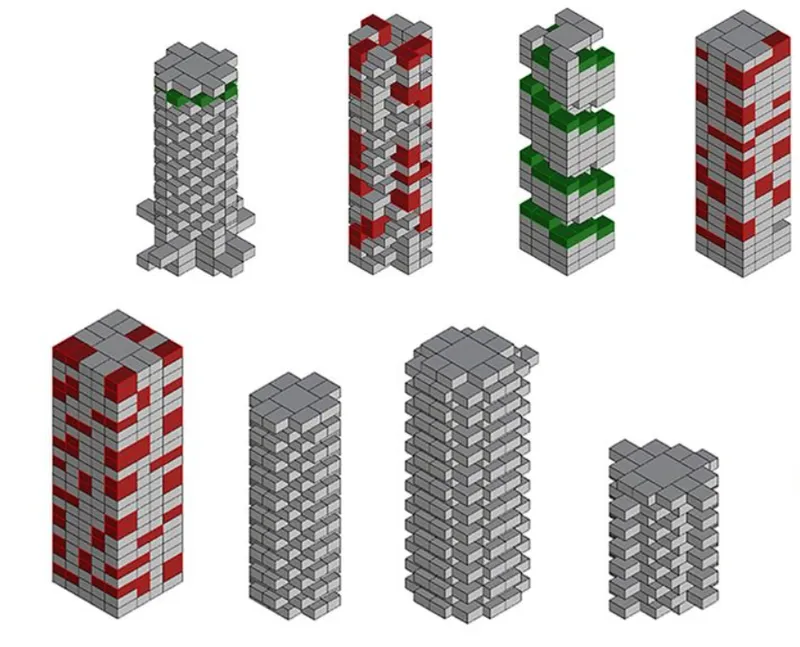
The massing study tests eight towers built from the same blocks around central cores. Red and green highlight the different units and terraces. This is where the pixel metaphor is most convincing. With one module and a small set of rules, the towers come out different in silhouette and terrace pattern while staying recognisably related. Common modules for gathering, laundry and co-working can be placed into the stack wherever a community needs them, so shared programme fits into the same grid as private rooms.
Why This Project Matters
Pixel Gardens takes a firm position on modularity: repetition is not the problem, and indifference to context is. Bader keeps the efficiency of a single factory-built unit and puts the design effort into placement. The offsets produce terraces, airflow and visual connection, and the ground floor connects the tower to a city with distinct cultural and student life. The prefabrication argument and the social argument are developed together, which is uncommon in competition housing.
The proposal also deserves attention because the strategy can be repeated. Small units, shared common modules, passive cooling through arrangement and a public plinth could apply to many warm-climate cities that need affordable housing quickly. For a shortlisted student entry, it offers a clear method: choose one module, and then design the spaces between the modules as carefully as the modules themselves.
View the Full Project
About the Designers
Designer: Salem Bader
Enter a Design Competition on uni.xyz
uni.xyz runs architecture and design competitions year-round that reward proposals with spatial conviction and real site intelligence.
Project credits: Pixel Gardens by Salem Bader Plugin Housing Challenge 2020 (uni.xyz).


Popular Articles
Popular articles from the community


Temporary Home for Dogs: A Reversed Zoo Rethinks Animal Shelter Architecture
In Bucharest, a sinuous corridor and freed landscape flip the logic of containment, designing a shelter that works to make itself unnecessary.

Cloaked Colonization: A Mobile Underwater Habitat That Moves Like a Fish
Micah Abaya's shortlisted EHC Pacific entry reimagines ocean settlement as a dispersed network of self-sustaining architectural organisms.

Opera on the Sea: Driftwood Logic Shapes a Timber Opera House on Estonia's Coast
Trevor Orgill's opera house translates the entangled drift of floating timber into a civic building where wood, water, and music converge.
Faces of the Soviet Avant-Garde: Turning Moscow's Street Names into an Open-Air Museum
A network of sculptural installations across a Moscow residential district transforms forgotten architect names into spatial encounters with cultural memor

Similar Reads
You might also enjoy these articles

FAMM Arquitectura Organizes Ten Villas Around Courtyards and Jungle in Nosara, Costa Rica
El Molino pairs two elongated volumes with deep overhangs and timber louvers to build a compact coastal community five minutes from the beach.
Oscar Niemeyer's Ibirapuera Park Pavilions Define São Paulo's Cultural Identity in Concrete and Curve
A constellation of modernist volumes set within São Paulo's most important urban park, conceived for the city's 400th anniversary in 1954.
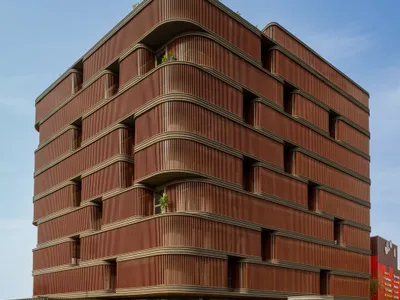
Sanjay Puri Architects Wraps a Jaipur Office Tower in Capsule-Shaped Green Buffers
A nine-level climate-responsive workplace near Jaipur Airport uses stacked planter terraces and aluminium screens to fight 40°C heat.
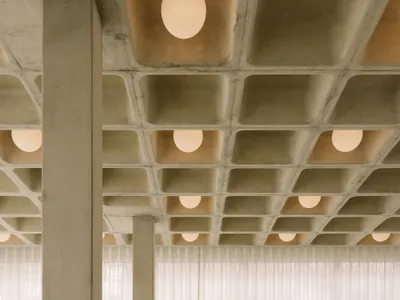
RHO Converts a Berlin Spree-Side Industrial Courtyard into Enkime's 1,000 m² Agency Headquarters
A social media agency's new home in Charlottenburg trades glossy branding for concrete waffle ceilings, glazed tile, and sheer curtains.

Comments (0)
Please login or sign up to add comments
No comments yet. Be the first to comment!