
CSADI Carves a Jade Blade into the Qinling Mountains for China's First Ecology Museum
A 43,788 square meter terraced museum in Shangluo draws its form from a Xia Dynasty artifact and steps down toward the valley below.


China has no shortage of cultural institutions set against dramatic topography, but the Qinling Museum in Shangluo occupies genuinely singular ground. The Qinling Mountains constitute the continental divide between China's north and south, a geographic hinge that shapes climate, ecology, and millennia of cultural exchange. To build the country's first comprehensive museum dedicated to this mountain range, CSADI, led by Cheng Yiduo and Yang Jiangfeng, had to answer a question that goes beyond program: how do you make architecture worthy of an entire biome?
Their answer is strikingly literal and strikingly effective. The museum's form derives from a jade ceremonial blade dating to the Xia Dynasty (roughly 2070 to 1600 B.C.), a national first-class artifact that itself embodies the region's deep cultural memory. Stretched across nearly 44,000 square meters, the building cascades down its sloped site in broad terraces, translating the blade's angular profile into a procession of stepped roofs, monumental plazas, and carefully framed views of the surrounding valley. The result is a building that reads as both object and landscape, a civic threshold between the town of Shangluo and the mountains that define it.
Terrain as Architecture
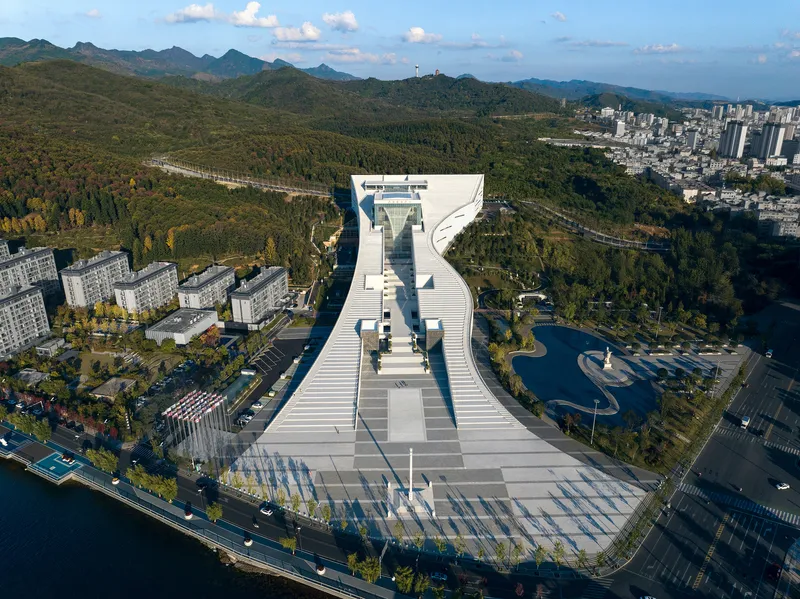
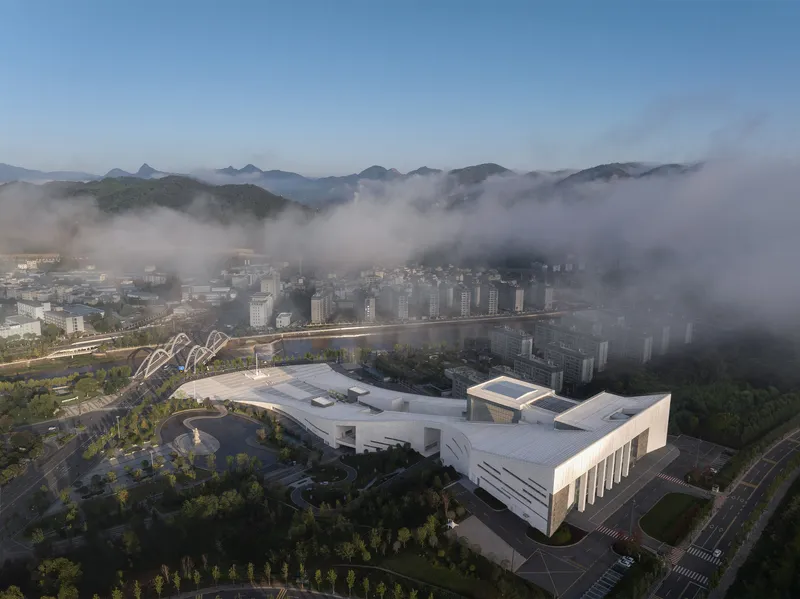
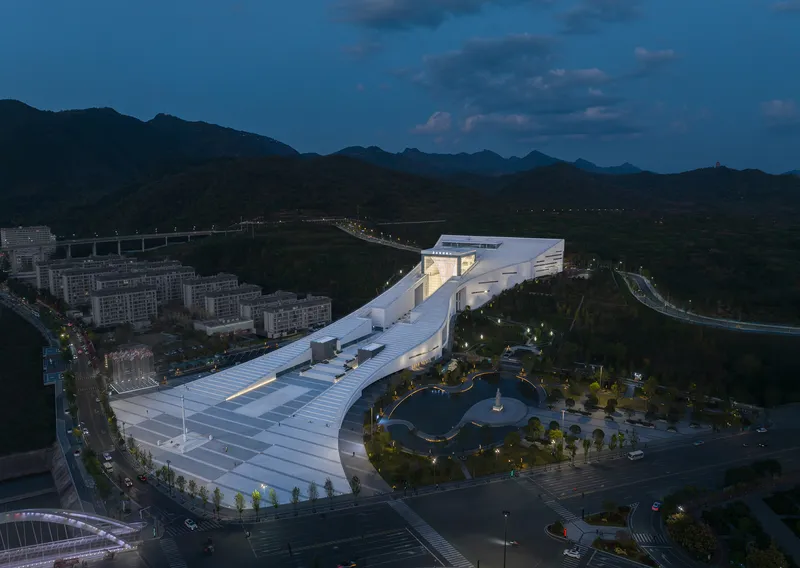
Seen from the air, the Qinling Museum does not sit on its site so much as it descends through it. The building's profile follows the natural slope, stepping down in broad plateaus that echo the terraced agriculture common across Shaanxi Province. Forested hills and residential blocks frame the complex on three sides, while a landscaped park and water features soften the transition to the urban fabric below. On foggy mornings, the terraces appear to float above the valley, dissolving the line between built form and mountain contour.
What distinguishes the massing from other stepped megastructures is its restraint. The building never tries to compete with the peaks behind it. Instead, the horizontal emphasis and pale materiality allow the architecture to register as a constructed ridge, a geological echo rather than a monument dropped onto the landscape.
The Monumental Stairway
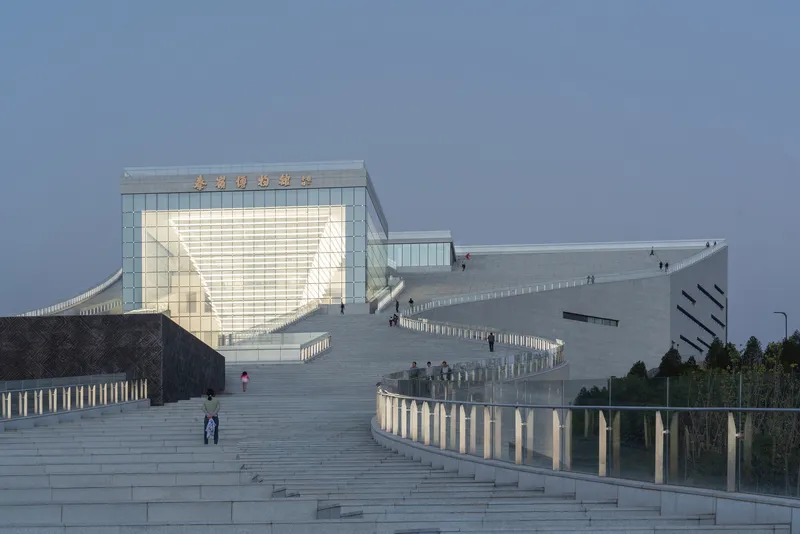
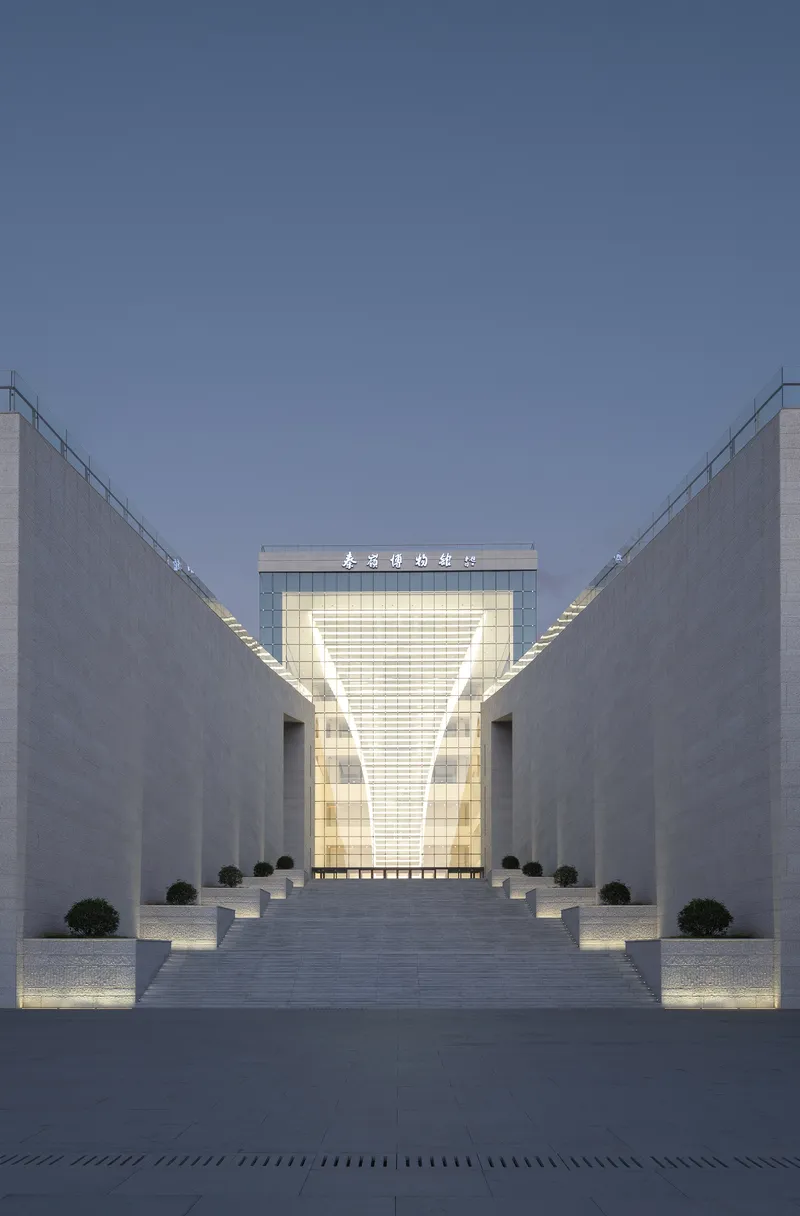
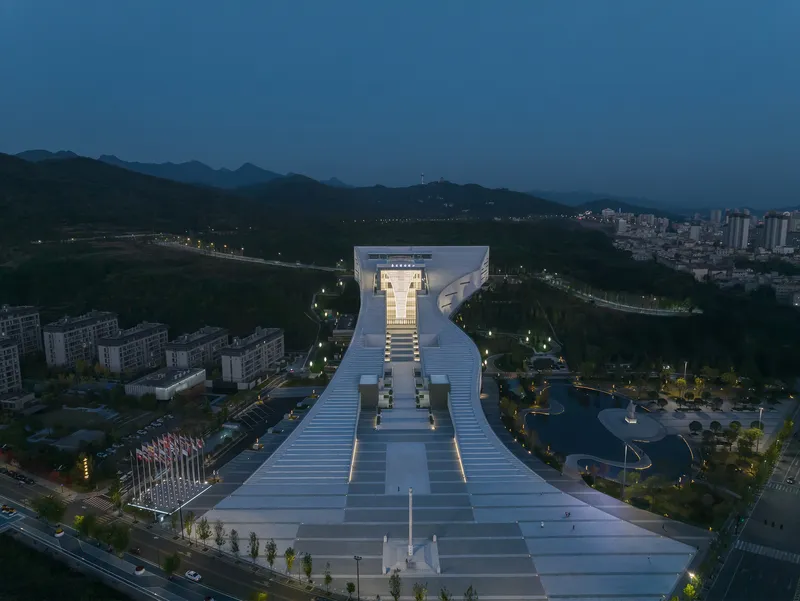
The primary approach to the museum is orchestrated through a wide stone staircase that rises toward an illuminated glass volume, functioning as both entrance and civic stage. Angled walls of textured stone flank the ascent, compressing the visitor's field of vision before releasing it at the top into panoramic views. At dusk, the glass pavilion glows against the fading sky, pulling visitors upward with a sense of ceremony that the architects clearly intended.
This is processional architecture done well. The stairs are wide enough to accommodate crowds during events and performances, reinforcing the museum's secondary role as a public gathering space. The proportions recall ancient Chinese axial planning, updated here with a material palette of stone, metal, and glass that keeps the gesture contemporary.
Stone and Light
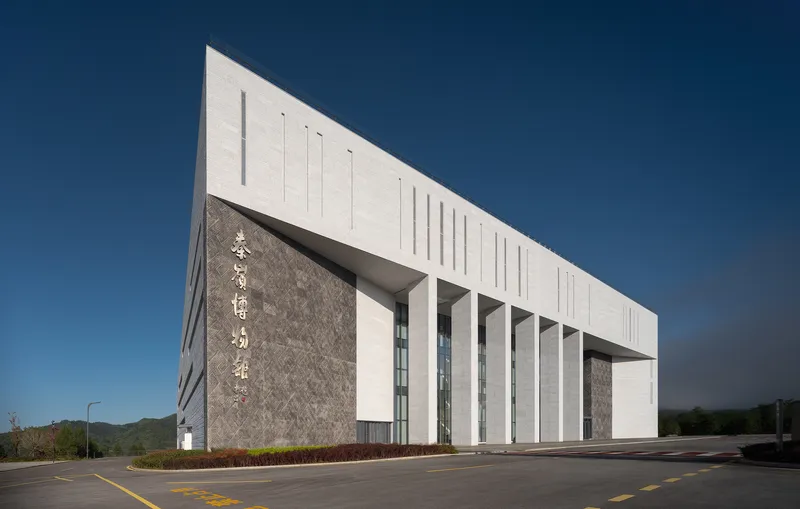
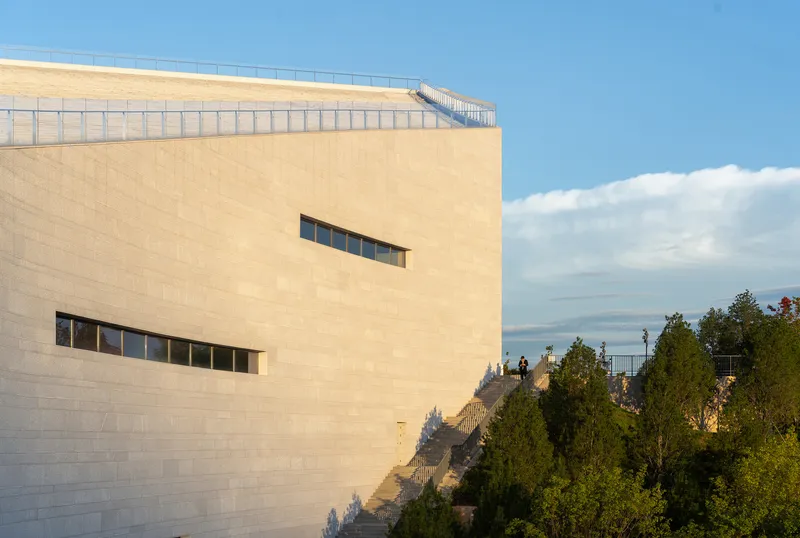
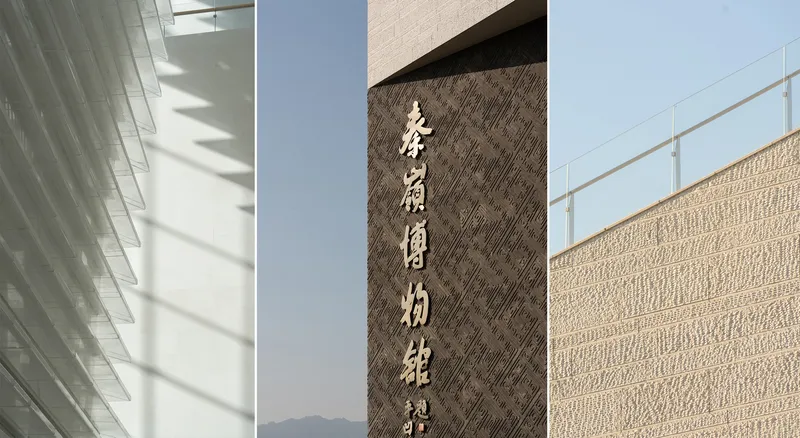
Up close, the museum reveals a considered hierarchy of surfaces. Pale stone and concrete dominate the lower levels, grounding the building with mass and texture. Horizontal ribbon windows cut into the upper facades introduce controlled daylight while maintaining the fortress-like solidity of the base. A recessed colonnade at street level creates a sheltered threshold that mediates between the museum's monumental scale and the human body.
Carved stone signage panels with Chinese characters reinforce the cultural specificity of the project. These details matter. They signal that the building is not a generic white box parachuted into a mountain town but a structure that takes its context seriously, from the geology of the region to its calligraphic traditions.
Water, Reflection, and Edge
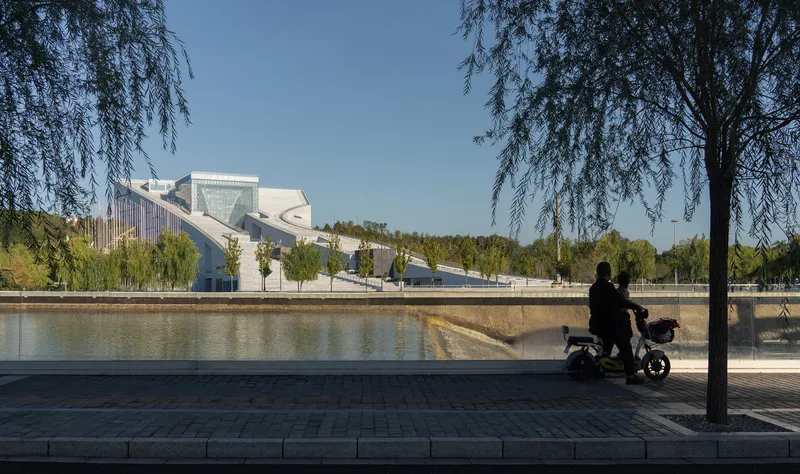
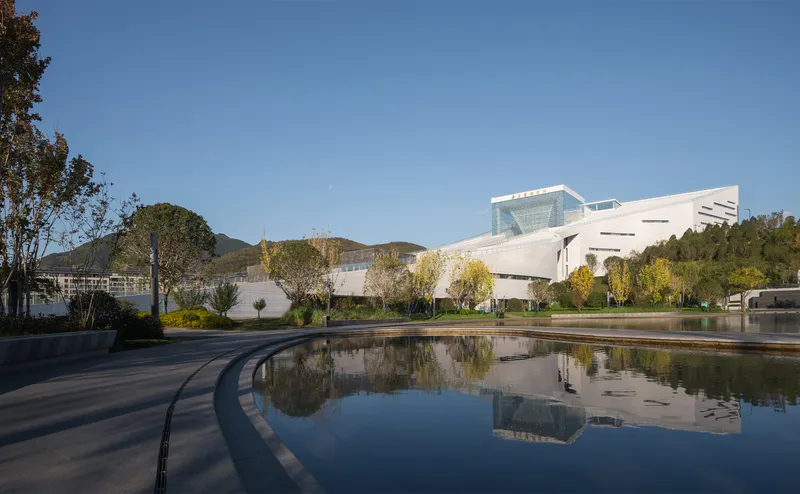
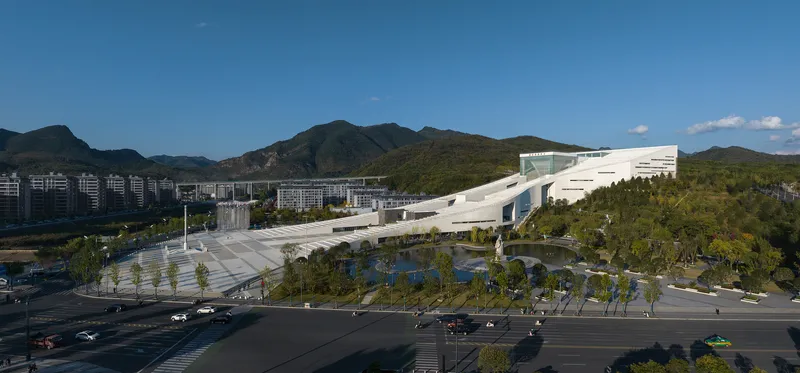
Water plays a critical role in the museum's site strategy. A canal and a series of reflecting pools wrap the building's lower edge, doubling its white cantilevered volumes in still surfaces and softening the boundary between architecture and ground plane. Viewed across the canal with willow trees framing the shot, the museum takes on an almost painterly quality, recalling the misty landscape scrolls that the Qinling region has inspired for centuries.
The curved reflecting pool near the entrance is particularly effective. It mirrors the cantilever overhead and the hillside beyond, collapsing foreground, middle ground, and background into a single image. It is a small move with outsized perceptual impact, one that suggests the architects understood that the museum's relationship to the Qinling landscape needed to be felt, not just seen.
Rooftop Topography
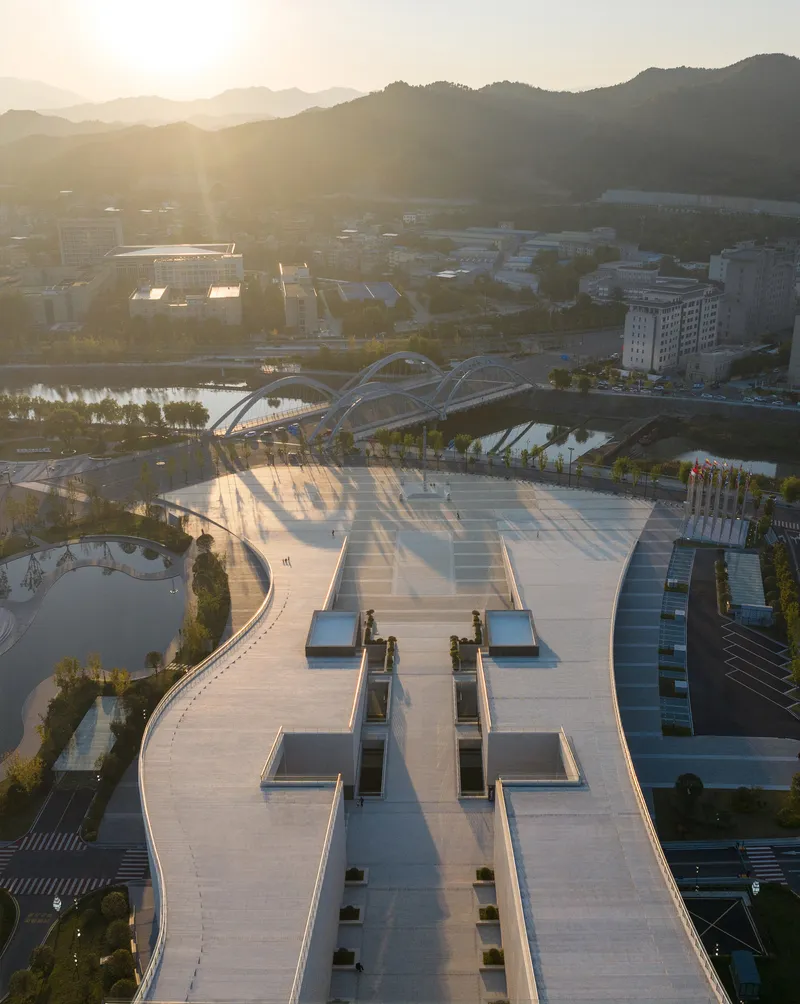
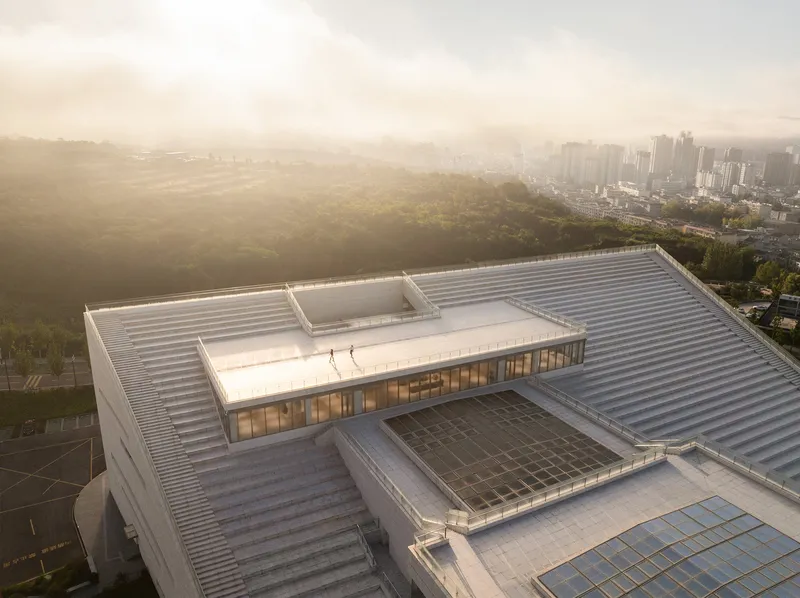
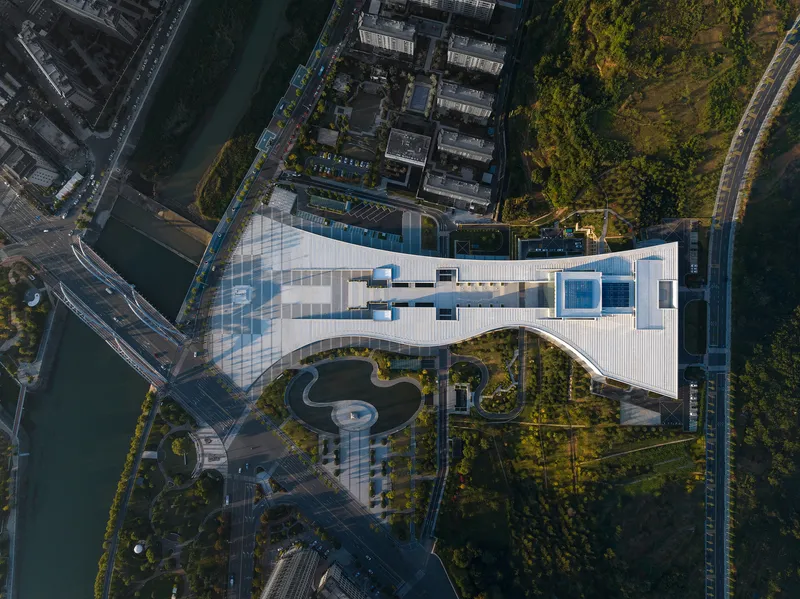
The stepped roof is more than a formal gesture. It is a functional landscape in its own right. Skylights punctuate the terraces, washing the exhibition halls below with natural light. At sunset, the metal roof surfaces catch the warm tones of the valley, and the skylights glow from within, turning the building into a luminous topography. The aerial views reveal curved skylight strips that break up the otherwise orthogonal geometry, introducing a biomorphic rhythm that references the mountain ridgelines visible on every horizon.
After nightfall, the building's surfaces reportedly serve as a canvas for light shows, extending the museum's role as a cultural destination well past closing hours. Whether this feature ages well or slides into spectacle will depend on curation, but the architectural bones are strong enough to support it.
Interior Scale
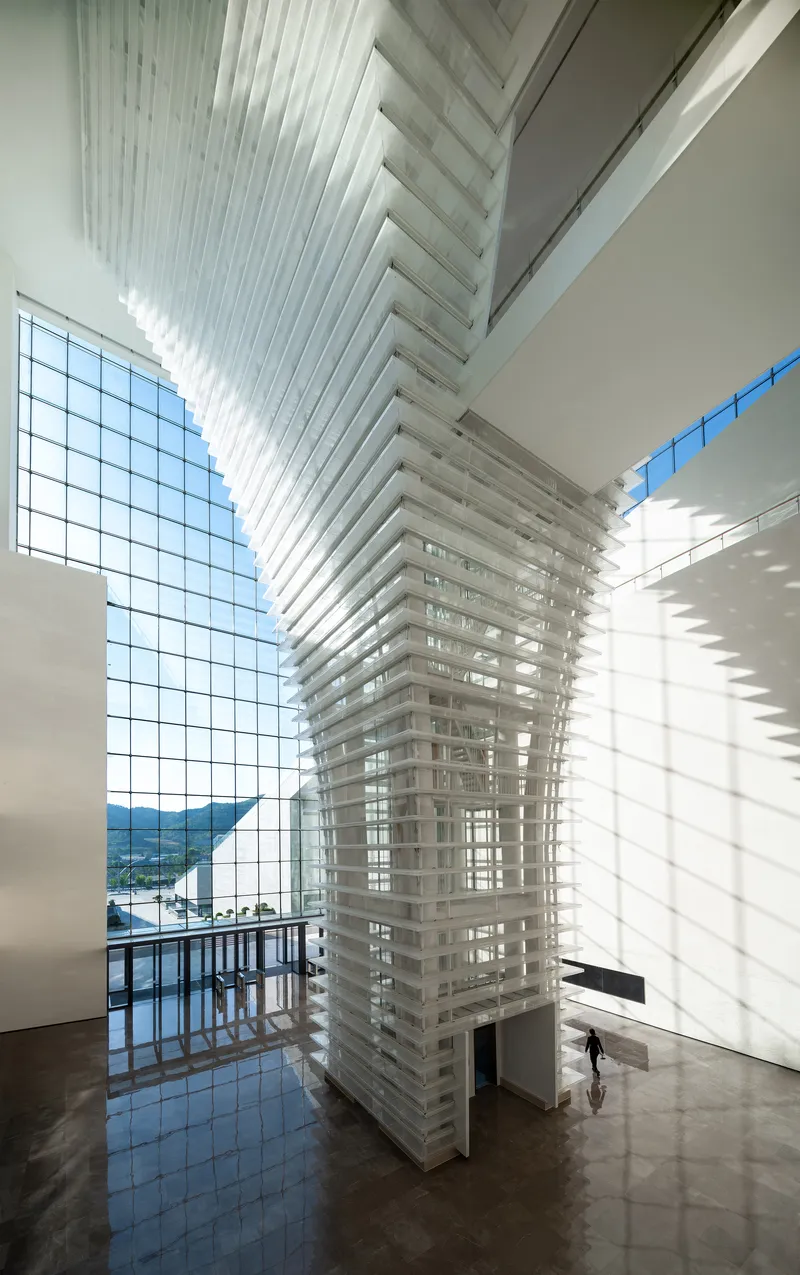
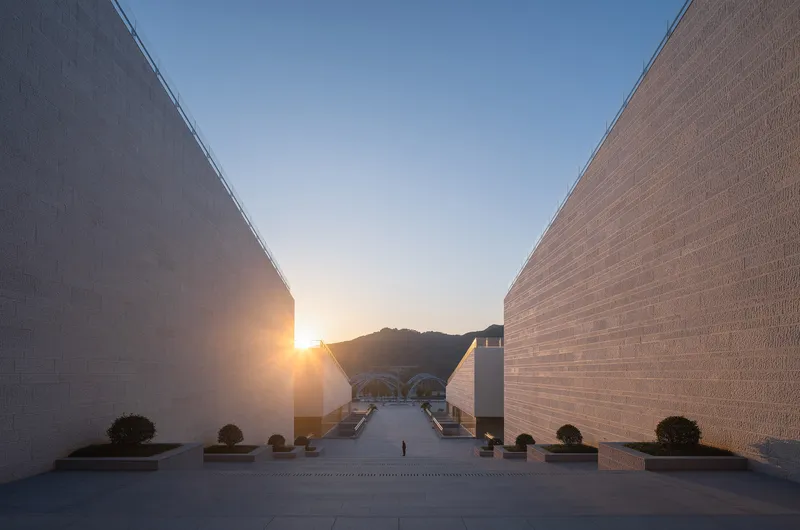
The interior images available reveal a building that handles scale with confidence. A multi-story atrium features layered horizontal fins and a curtain wall that frames a single visitor far below, underscoring the vastness of the space without overwhelming it. The fins filter light and create a sense of depth, a welcome counterpoint to the building's heavy stone exterior. Elsewhere, a paved courtyard is framed by two angled brick-clad walls that converge toward a distant hillside, pulling the landscape directly into the museum experience.
These moments suggest that the architects were thinking carefully about the visitor's bodily experience, not just the building's silhouette. The shift from stone to brick to glass as you move inside creates a material narrative that keeps the journey from feeling monotonous across nearly 44,000 square meters.
Fog and Presence
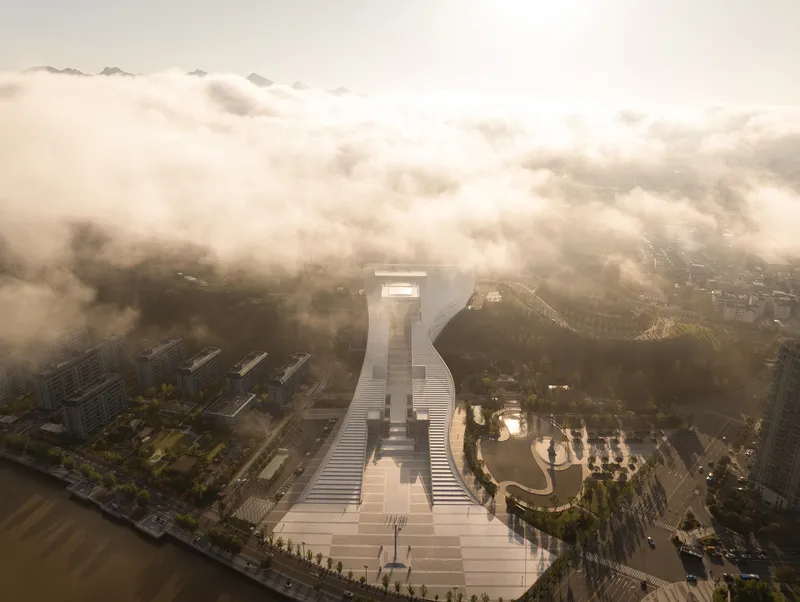
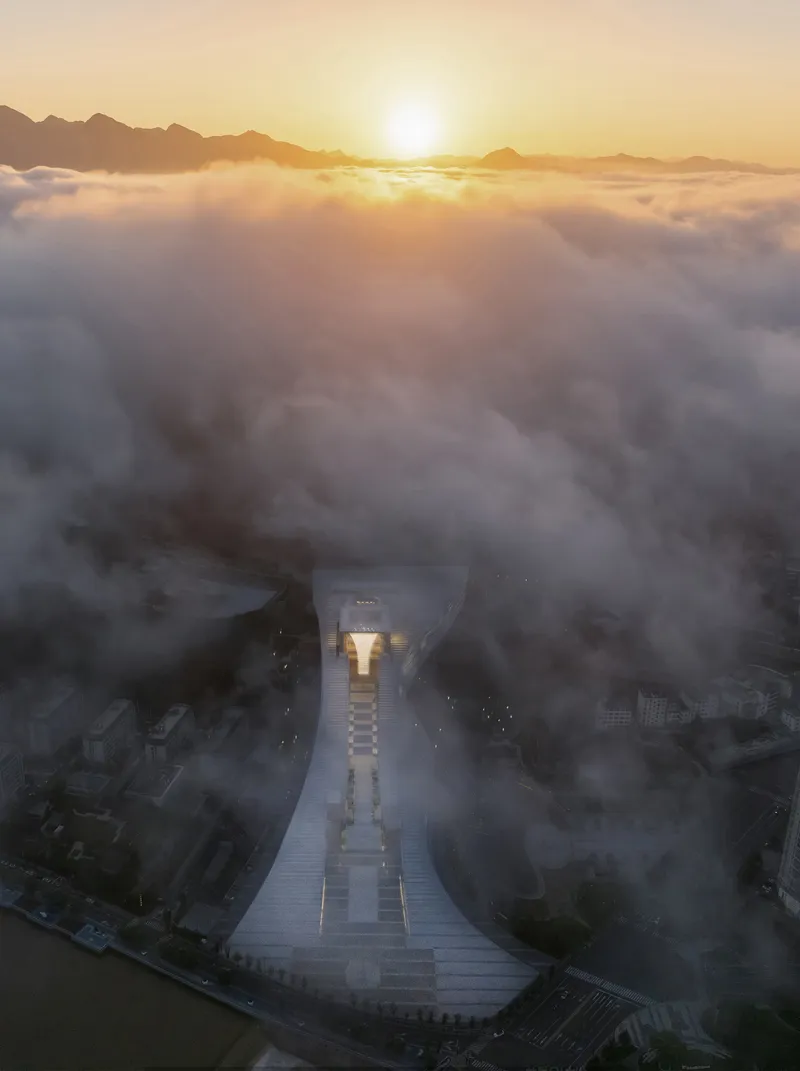
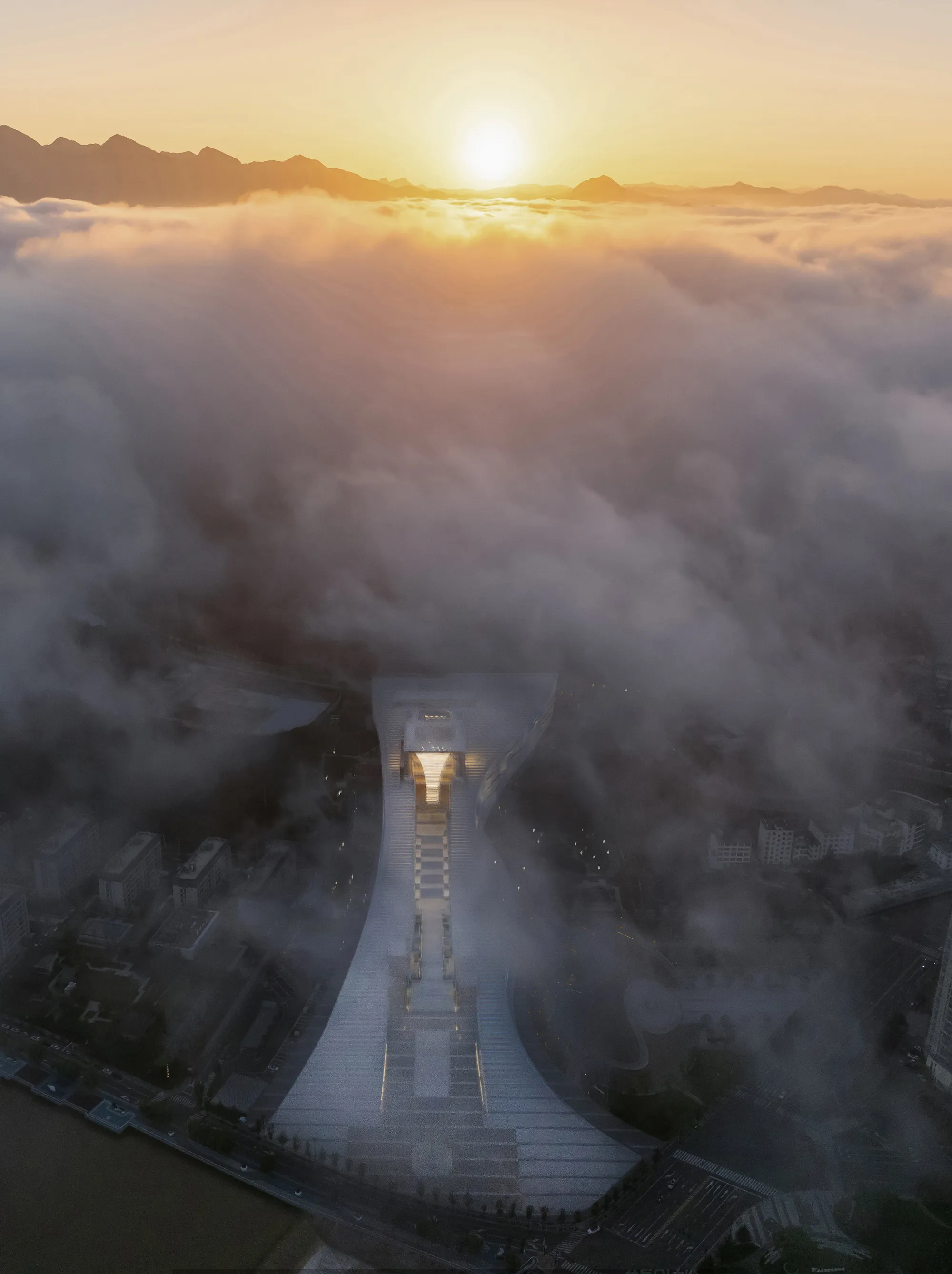
Some of the most compelling images of the Qinling Museum capture it in fog, and that is no accident. The Qinling range is famous for its atmospheric conditions, with clouds and mist pooling in valleys for much of the year. In these conditions, the museum's axial stairway and terraced mass emerge from the white void like a geological formation, stripped of context and reduced to pure form. The building was clearly designed with this phenomenon in mind. Its pale palette, horizontal proportions, and clean edges maximize legibility in low visibility, ensuring the museum reads as a landmark even when the mountains behind it disappear.
Plans and Drawings
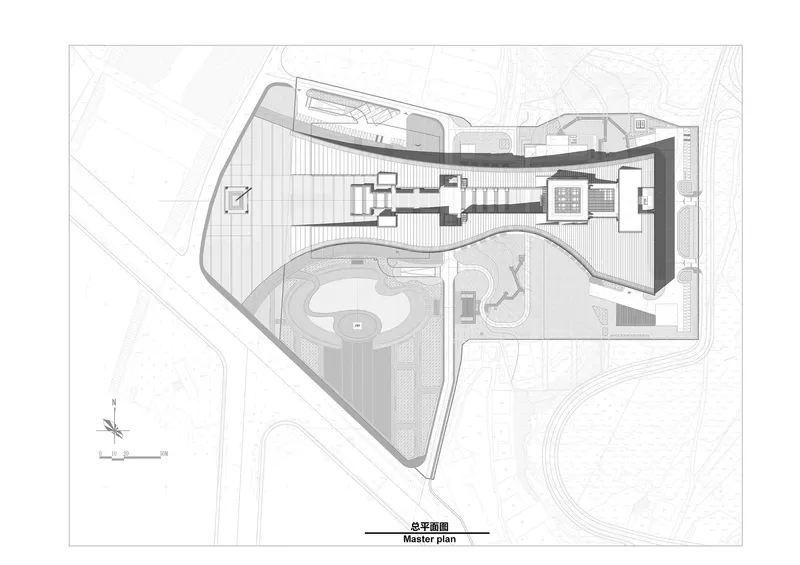
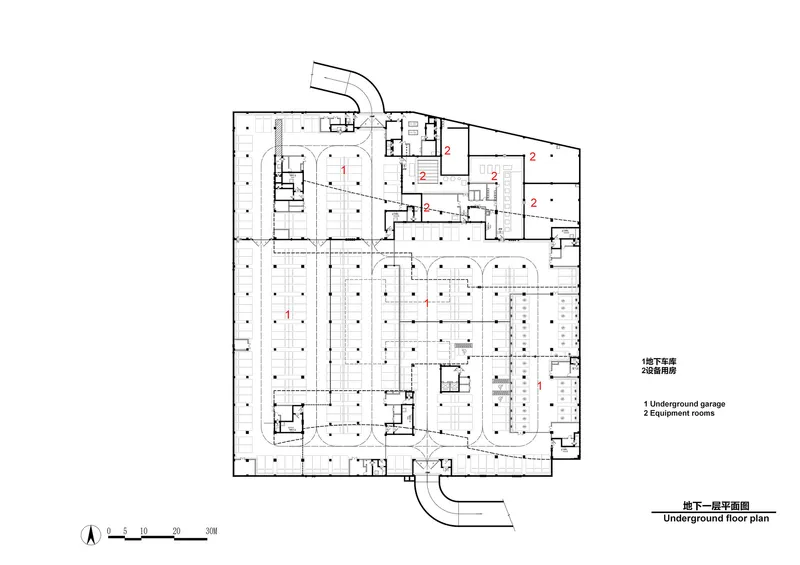
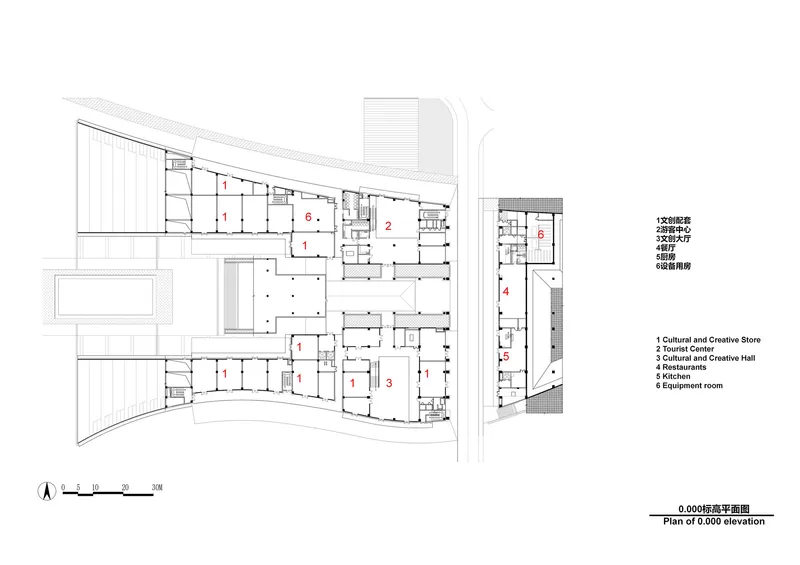
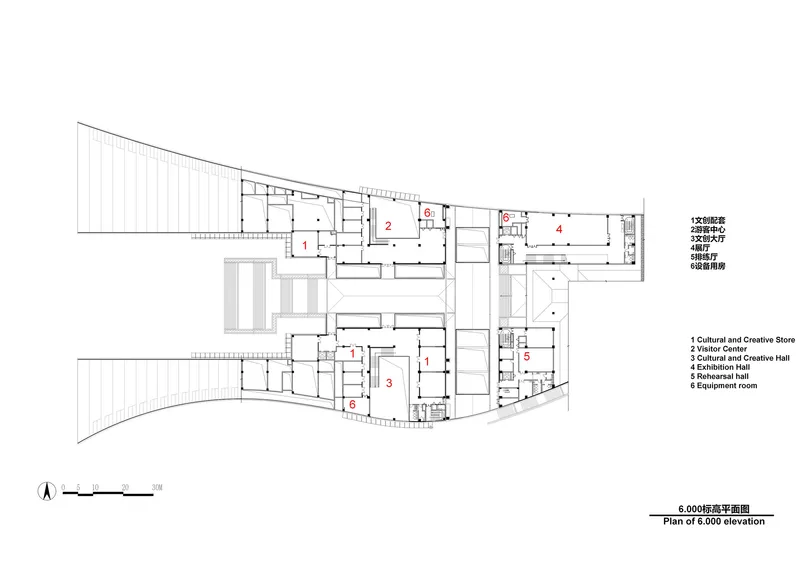
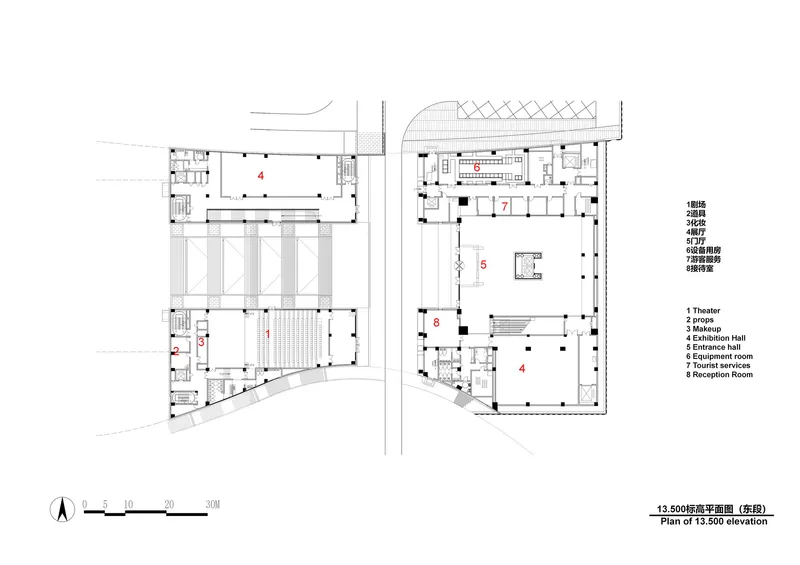
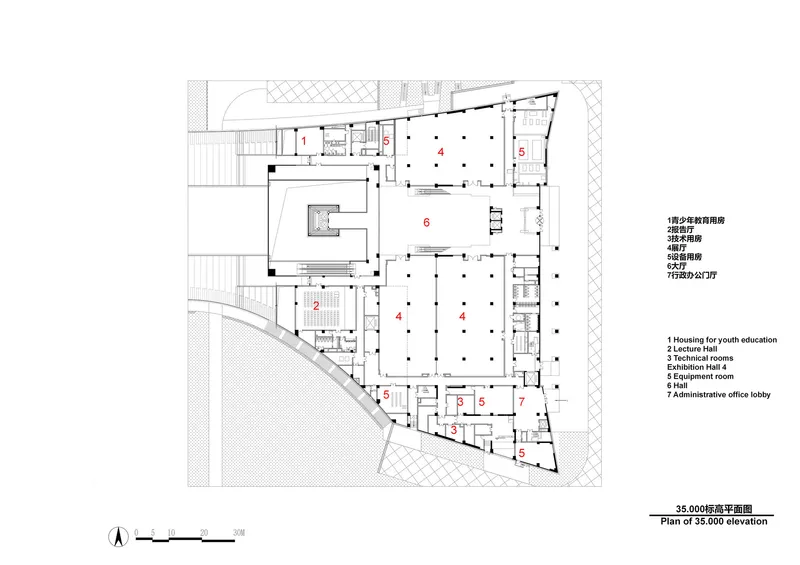
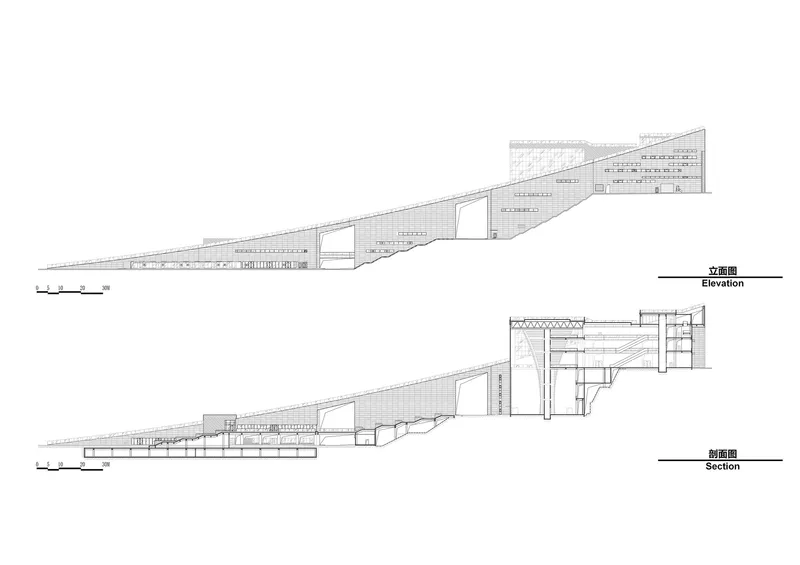
The plans reveal a complex organizational logic. At ground level, a cultural store and hall spaces are organized along a curved exterior wall, while upper floors distribute exhibition halls and a restaurant along the stepped terraces. Two interconnected volumes create a central courtyard, and a multi-winged layout at another level surrounds additional courtyards with exhibition halls and support spaces. The section drawing confirms the cascading strategy: the building steps down the slope across at least four major levels, with an underground parking garage and equipment rooms forming a substantial base. The site plan shows how the angular footprint negotiates the surrounding water features and landscape, orienting the primary axis toward the mountains.
Why This Project Matters
The Qinling Museum is significant not because it is large or because it occupies a dramatic site, though both are true. It matters because it represents a maturing approach to cultural architecture in China, one that derives form from artifact and context rather than from computational novelty or imported typology. The jade blade concept could easily have produced a superficial metaphor, a shape for shape's sake. Instead, it generated a building whose angular terraces, stepped profiles, and processional sequences genuinely respond to the mountain landscape they are meant to celebrate.
As the first comprehensive museum dedicated to the Qinling range's ecology and culture, the building also carries an institutional burden: it needs to work as a public gathering space, a performance venue, and a leisure destination in addition to its exhibition program. The generous plazas, the civic stairway, and the night-lighting strategy all suggest CSADI understood that a museum for an entire mountain range cannot function as a sealed container. It has to be porous, open to the landscape and the community in equal measure. On the evidence of its first year, the Qinling Museum delivers on that ambition.
Qinling Museum by CSADI (lead architects: Cheng Yiduo, Yang Jiangfeng). Shangluo, China. 43,788 m². Completed 2025. Photography by Yilong Zhao.
Share Your Own Work on uni.xyz
If projects like this are the kind of work you want to make, uni.xyz is a place to publish your own, find collaborators, and enter design competitions.




Popular Articles
Popular articles from the community


The Musturak Paradise: Senior Living Architecture for a Connected Future in Temara, Morocco
The Musturak Paradise reimagines senior living architecture in Temara via private homes, social spaces, culture, community, and shared care.

Riyadh For All: Intergenerational Urban Design for Active Aging in Rabat
Riyadh For All reimagines urban design in Rabat with intergenerational co-living, adaptive courtyards, and Moroccan cultural exchange today.

Co-Life: Senior Housing Design That Reconnects Older Adults With the City
Co-Life reimagines senior housing design through healing gardens, shared streets, workshops, and a sustainable community across generations.

Play: Fragments of Their World
Familiar architecture becomes modular playground design, creating safe spaces where displaced children can learn, connect, imagine and play.


Similar Reads
You might also enjoy these articles

Bao Huynh Watercolor Atelier: A Serene Art Retreat in Hội An
Bao Huynh Watercolor Atelier in Hội An blends multifunctional art spaces, sustainable design, local materials, and family-friendly living in a serene environment.

Atelier Macri Concept Store Interior Design by CASE-REAL
Atelier Macri store features a "ko" counter, walnut wood details, cork displays, blending retail, gallery, and seamless customer experiences.

Manuel Vargas Izquierdo Stadium and High-Performance Sports Center: Architectural Excellence in Jalpa de Méndez
The Manuel Vargas Izquierdo Stadium blends sustainable design, inclusive sports facilities, and cultural-inspired architecture, revitalizing Jalpa de Méndez’s public spaces.

KAKR Buluh Awar Hall: Revitalizing Community and Ecology Through Bamboo Architecture
Community built bamboo hall revitalizes Buluh Awar village, empowering youth, restoring ecology, celebrating vernacular craftsmanship through sustainable architecture and culture.



Comments (0)
Please login or sign up to add comments
No comments yet. Be the first to comment!