
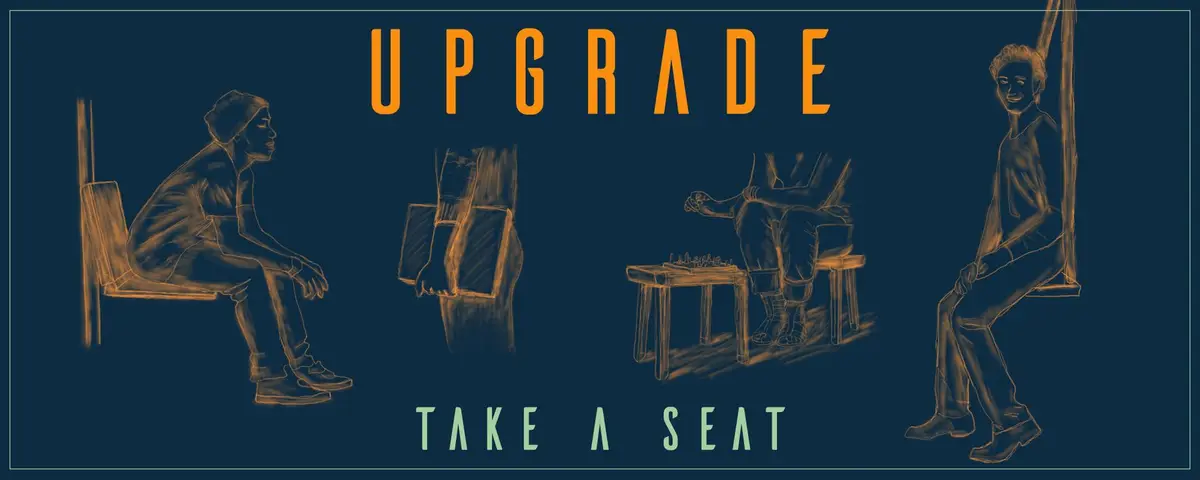
Upgrade: A Laptop-Sized Folding Seat That Hooks Onto Transit Poles
Anna Ebert and Michel Plusje rethink commuter comfort with a portable seat that clips, swings, and stands in four configurations.


Every city runs on its transit network, and every transit network runs on the tolerance of standing passengers. Overcrowded buses and trams treat fatigue as a default condition, something commuters absorb rather than solve. Upgrade refuses that bargain. It is a foldable personal seat, no larger than a laptop when collapsed, that hooks onto vertical poles, suspends from overhead handrails, or stands freely as a stool. Four configurations from a single folding object: clip-on chair, swing seat, short stool, and tall stool that doubles as a portable surface.
Designed by Anna Ebert and Michel Plusje, Upgrade received an Honorable Mention in the @ease competition, which challenged designers to rethink portable comfort for everyday life. The project's strength lies in its refusal to be a single-purpose product. Rather than designing one seat well, Ebert and Plusje designed a system of seating behaviors packed into a flat, carryable form.
Collapsed to Laptop Scale, Expanded to Four Functions
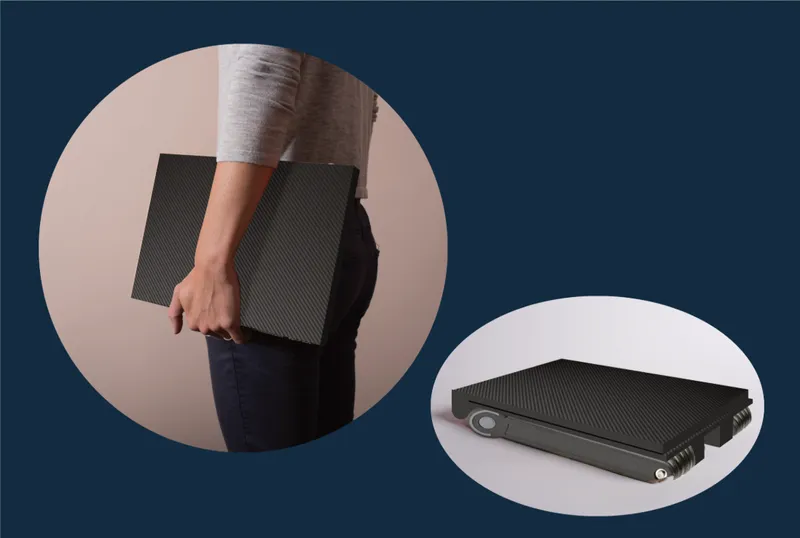
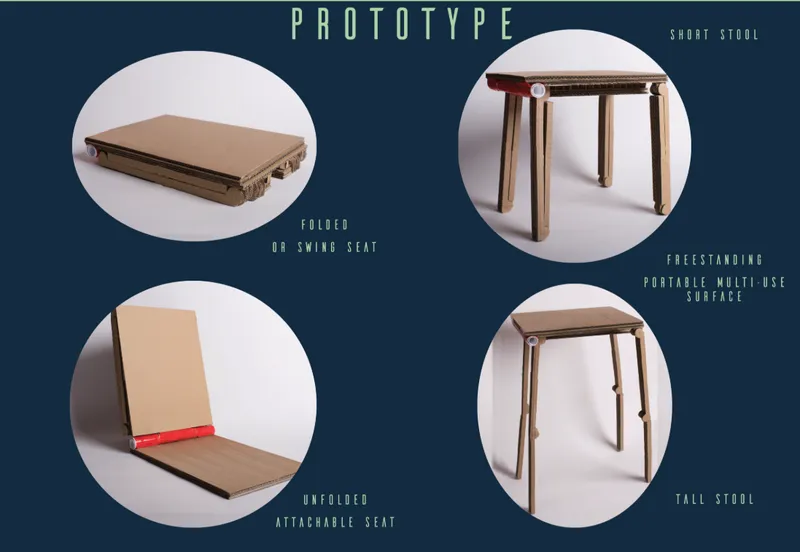
The core proposition is dimensional compression. When folded, Upgrade fits in a bag or sits flat under an arm. When unfolded, its lightweight frame and fabric surface produce a seat that can bear a person's weight across several distinct postures. The prototype diagram reveals a wooden frame with a taut fabric surface, hinging along scored folds that allow the flat slab to become a chair back, a seat pan, or a freestanding stool depending on which panels lock into position. The carbon fiber renderings suggest a production-ready material path that would keep the object rigid under load while remaining light enough to carry without thought.
What matters here is not just the engineering but the interaction model. Each configuration requires only seconds to deploy: attach, unfold, sit. There is no assembly, no toolkit, no instruction manual. The folding logic is legible from the object itself, which is a harder design problem than it appears.
Hooking Into the Infrastructure That Already Exists
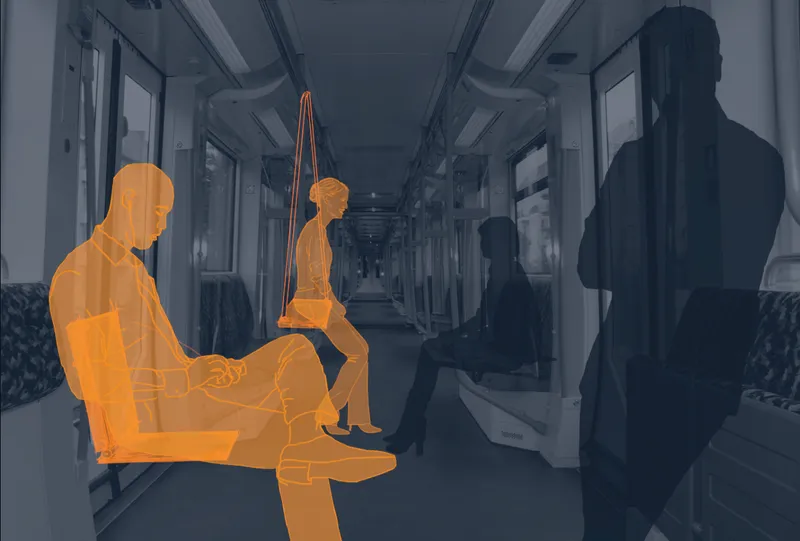
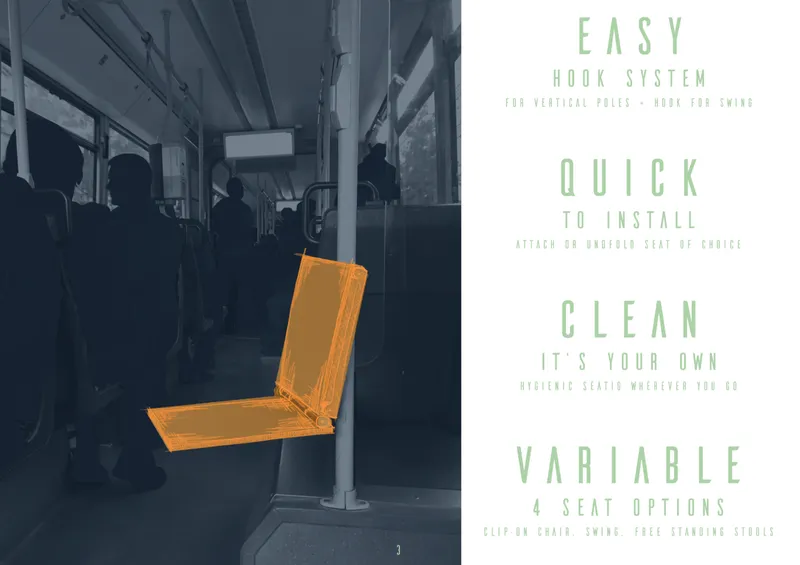
The most provocative move in Upgrade is its parasitic relationship to transit infrastructure. Rather than asking cities to install new seating, the design hooks onto elements that already crowd every bus and tram interior: vertical grab poles and overhead handrails. The clip-on configuration latches to a pole and unfolds a seat surface behind the user's back, turning dead space into occupied comfort. The swing configuration suspends from an overhead rail, creating a hanging seat that moves with the vehicle. Both approaches treat existing transit hardware as structural hosts for a personal comfort layer.
The transit corridor rendering shows this in action, with figures occupying suspended and folded seats within the tight geometry of a vehicle interior. The pole-mounted prototype image is more grounded, demonstrating how the hook system grips a standard vertical pole. The hygiene argument is straightforward: you sit on your own surface, not a shared one. But the spatial argument is more interesting. Upgrade lets passengers claim seating where transit authorities never planned to provide it.
From Cardboard Proof to Configuration Logic
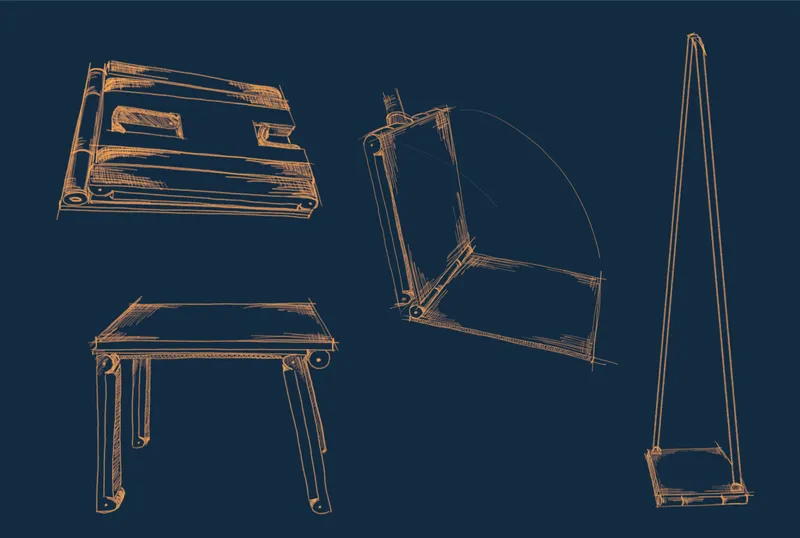
The technical line drawing strips away material appeal and exposes the folding logic. Collapsed, stool, swing, and table configurations are each shown as flat orthographic projections, revealing how the same set of hinged panels produces radically different geometries. The stool stands on two folded legs. The swing hangs from a single hook point. The table extends horizontally as a portable surface. Each state is a different reading of the same folded sheet, which is the kind of design economy that separates a gadget from a system.
Ebert and Plusje refined this logic through multiple cardboard prototypes before arriving at the current form. That iterative process, moving from foldable slabs to attachable swings to freestanding stools, is visible in the clarity of the final configurations. Nothing feels forced. Each mode appears to be a natural consequence of the folding geometry rather than an afterthought bolted onto a primary function.
Beyond Transit: Parks, Queues, and Open Urban Space
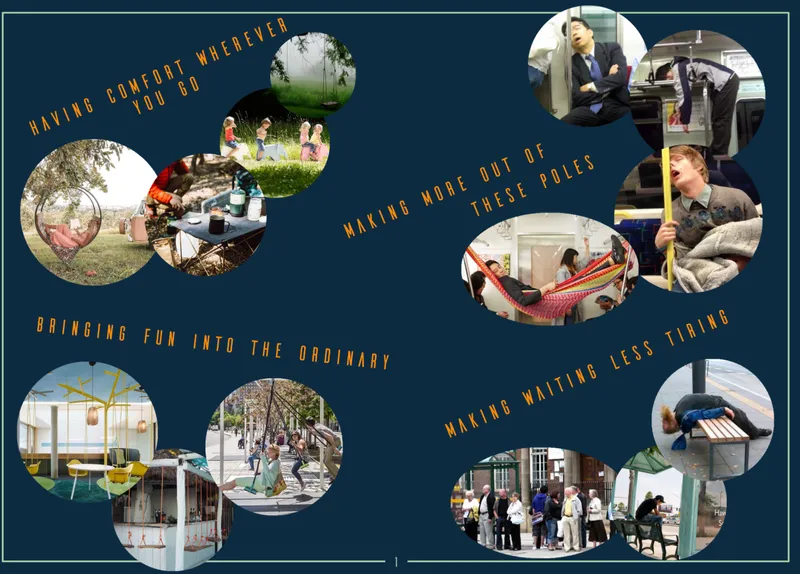
The collage of circular vignettes pushes Upgrade out of the bus and into broader urban life. People sit in parks, wait in indoor lobbies, perch at outdoor events. The freestanding stool configurations handle these contexts without any infrastructure to hook onto, which is critical. A transit-only product would be clever. A product that works equally well at a picnic, in a queue, or at an impromptu outdoor gathering starts to function as a genuine lifestyle tool. The short stool becomes a picnic seat. The tall stool becomes a standing-height surface. Portability is the constant; context is the variable.
There is also an accessibility dimension worth noting. For anyone who finds prolonged standing difficult, whether due to age, disability, or simple exhaustion, Upgrade offers agency over one's own comfort in spaces where seating is scarce or absent. That shift from infrastructure-dependent comfort to self-carried comfort is a meaningful reframing of how public space serves its users.
Why This Project Matters
Upgrade does not ask cities to build more seats. It asks individuals to carry one. That inversion is the project's real contribution. By treating transit poles and handrails as structural opportunities rather than mere grab points, Ebert and Plusje expose an untapped layer of spatial potential inside every bus, tram, and train. The four-configuration system ensures the object is never redundant: it always has a mode suited to the situation at hand.
The project also demonstrates that portable comfort does not require exotic technology or complex mechanisms. A well-designed folding geometry, a hook, a fabric surface, and a lightweight frame produce a product that is immediately understandable and immediately useful. In a competition field focused on carrying your own comfort, Upgrade delivers a literal, compact, and surprisingly versatile answer. It is the kind of design that makes you wonder why it does not already exist.
View the Full Project
About the Designers
Designers: Anna Ebert, Michel Plusje
Enter a Design Competition on uni.xyz
uni.xyz runs architecture and design competitions year-round that reward proposals with spatial conviction and real site intelligence.
Project credits: Upgrade by Anna Ebert, Michel Plusje @ease (uni.xyz).


Popular Articles
Popular articles from the community


Co-life: Sustainable Architecture for Age-Friendly Community Living
Co-life reimagines sustainable architecture for seniors through courtyards, rammed earth, shared gardens, and spaces designed for belonging.

Co-Life: Senior Housing Design That Reconnects Older Adults With the City
Co-Life reimagines senior housing design through healing gardens, shared streets, workshops, and a sustainable community across generations.

The Ocean Hive: Sustainable Architecture for a Self-Sufficient Civilization at Sea
The Ocean Hive imagines sustainable architecture at sea, where modular habitats, algae, wave power and ocean waste sustain a growing colony.

Little Red Riding Hood: Architectural Design as a Journey Through Fear, Light, and Storytelling
Little Red Riding Hood reimagines the fairy tale through architectural design shaped by fear, light, scale, memory, uncertainty, and choice.

Similar Reads
You might also enjoy these articles

ALGAL REALM: A Bio-Integrated Lunar Habitat Design for Life Beyond Earth
ALGAL REALM reimagines lunar habitat design with algae-powered life support, 3D-printed regolith, and vertical living for a lunar future.

Cinema Futurismo: Futuristic Architecture Reimagining the Future of Cinema
Cinema Futurismo merges futuristic architecture, holographic projection, intimate seating, and landscape into a new social cinema.
Little Red Riding Hood: Architectural Design as a Journey Through Fear, Light, and Storytelling
Little Red Riding Hood reimagines the fairy tale through architectural design shaped by fear, light, scale, memory, uncertainty, and choice.
Playducation: Modular Architecture That Turns Play Into a Space for Learning
Playducation transforms modular architecture into a flexible world of play, learning, and healing for children in refugee settlements.

Explore Flexible Seating Competitions
Discover active competitions in this discipline

Challenge to merge furniture with learning

Competition to design a workstation for architects
Comments (0)
Please login or sign up to add comments
No comments yet. Be the first to comment!