
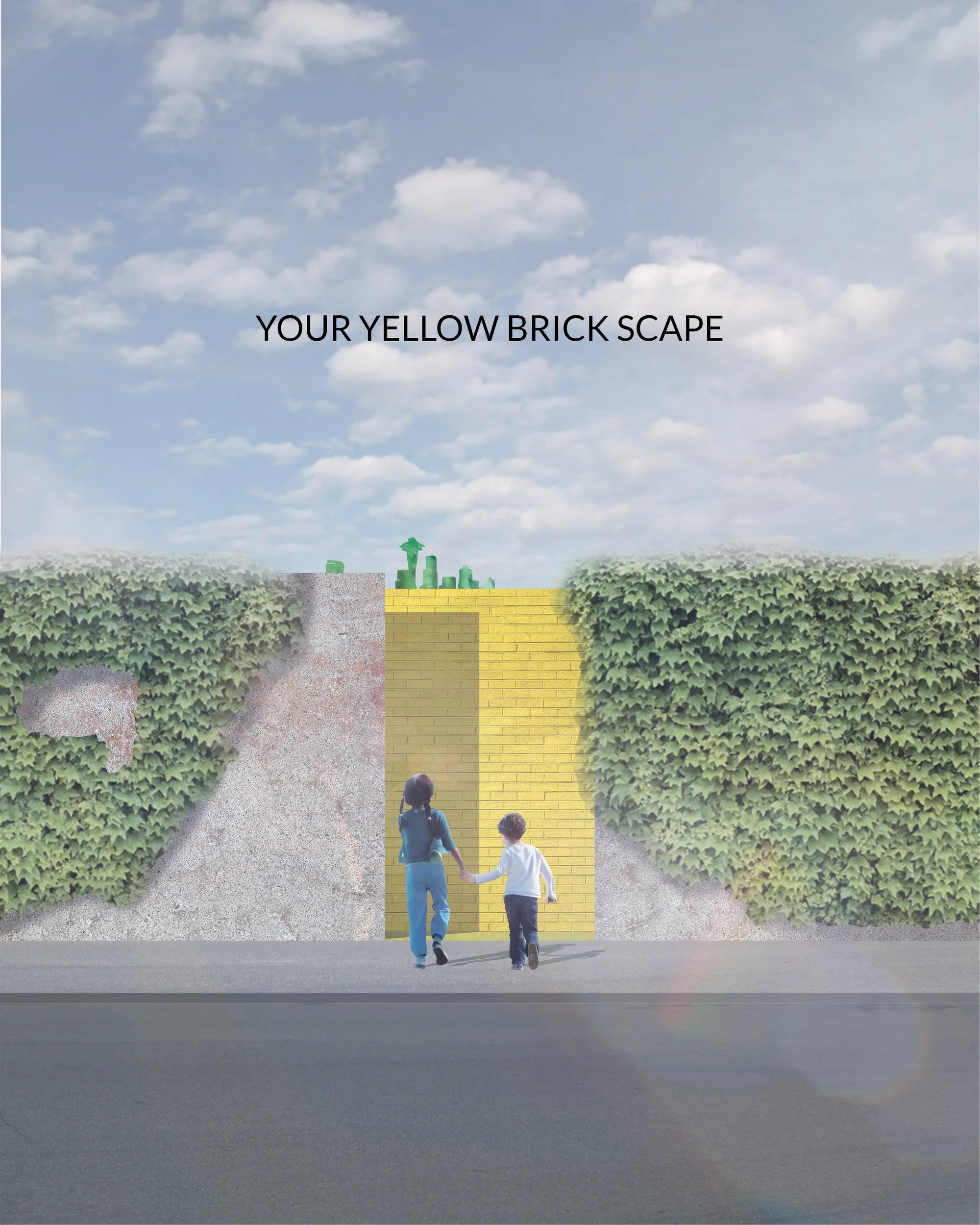
Your Yellow Brick Scape
We can't all go on Dorothy's path. But we can all go our own fantastic way.

Concept
Dorothy and her companions cross different landscape typologies on the way to the Emerald City: cultivated landscapes, forests, ditches, river valleys and the poppy field.
What is important here, is that Dorothy's path leads through different landscapes, different spatial and playful qualities, not what these landscapes look like exactly.
The contribution YOUR YELLOW BRICK SCAPE suggests that there is no one and only way through the different landscapes. Your yellow brick scape is one big landscape that is continuously transformed. Everyone who discovers this landscape, becomes an interpreter. Each and everyone will find their own way to move through this landscape. And in doing so, the myriad imagined paths of players condense into one large map, that brings the spirit of Dorothy's journey to the Gas Works Park in Seattle.
Approaching
This magic brick landscape is surrounded by walls. The existing walls are completed by a new wall on the east side. The atmospheric change is abrupt. That is why the entrances are narrow. Recessed slices of wall, made of yellow brick, block the view into the interior and yet are already harbingers of an unexpected landscape that lies beyond. And then you are inside!
Inside
Escalating yellow brick! A grotesque exaggeration of the existing soft-hilly landscape of Gasworks park. The brick landscape gets into motion and tries to expand the ideas on how we use brick as material in landscape architecture. A permanent transformation quoting different landscape scenarios without trying to recreate them exactly: narrow ditches, flat hills, peculiar columns.
The existing groups of birch trees are further developed with small groups of trees to create shaded areas. They are situated in the lowest places where the rainwater can benefit them.
Interpretation
This folded, furrowed, undulating and twisted landscape is a playspace for playing without rules. Players can play alone, in a small group, or move through the landscape with 20 people. Ultimately they make their own rules.
But a landscape as an open work of art is more than an invitation to play. It is an invitation to each and everyone to understand the landscape in their own way, to read it and ultimately to make it a small part of their own story. This can be through playing, in a wide variety of forms. But it can also be lying down, reading, sleeping, working or simply meeting to discuss, laugh or be silent together.
And over time, the countless Dorothys, will leave traces - the yellow clinker will be streaked with the traces of use. The patina will become part of the brickscape.
And thus, this landscape, figuratively and also spatially, ties in with an extremely successful landscape architecture typology: The park!
DESIGN PROCESS
Reading
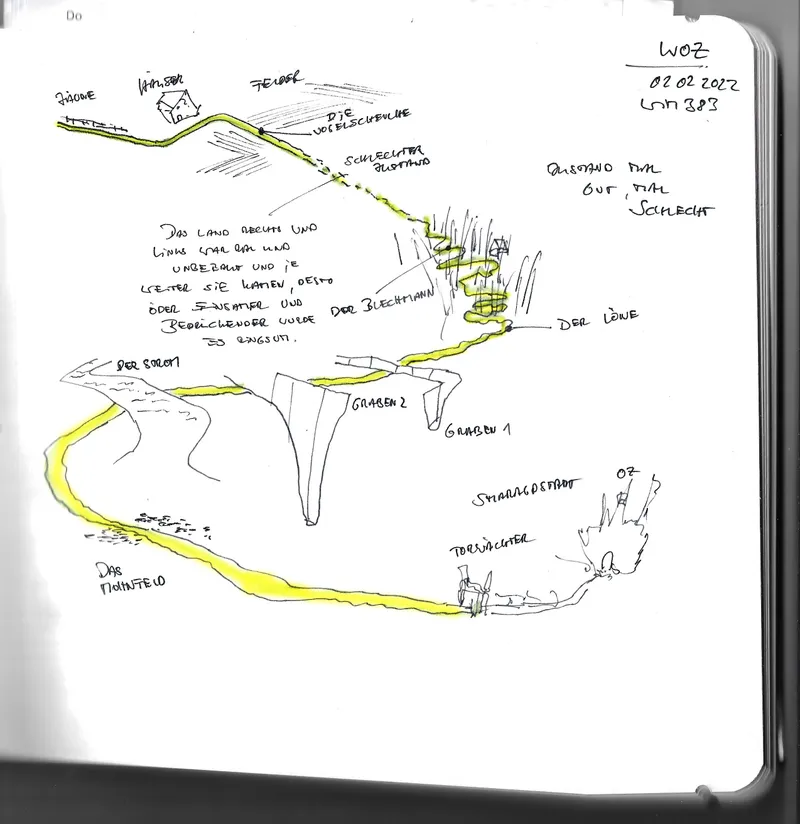
We've heard the title many times, but we weren't very familiar with the story. So we read the book, through the eyes of landscape architects. What's exciting about the journey Dorothy and her companions take together is the sequence of these landscapes and how these landscapes blend into each other..
Stance and central idea
It was clear to us very quickly, that we didn't want to work too close to the text. We didn't want a path that leads from A to B and along the way you experience some great things. We got the hang of it by talking among ourselves.
A path is linear. Dorothy's path is linear. When we build a landscape that we develop over the whole area, but everyone on it, finds their own way, the lines merge into one area. Like a treasure map, where at first there's a dotted line. And then more and more and different lines are added until the map is filled in. That was the image we worked with in the process.
Concept
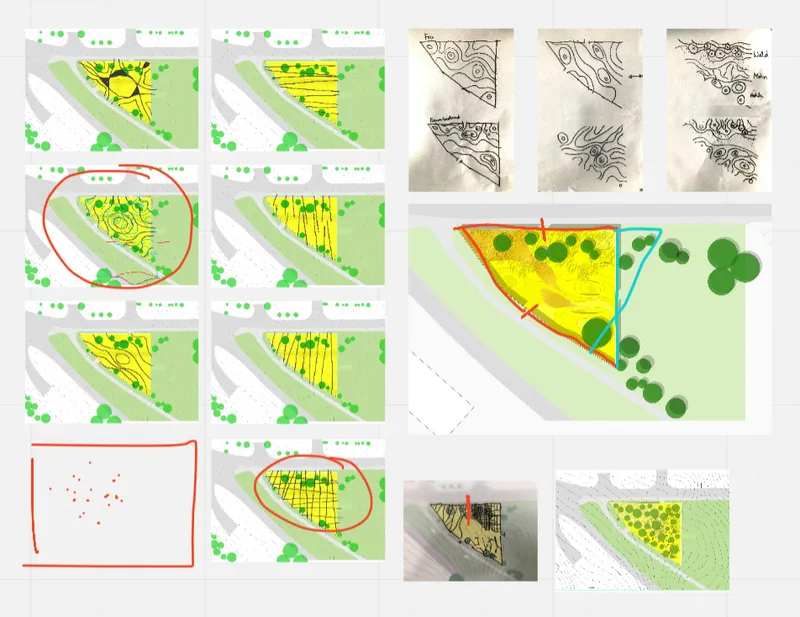
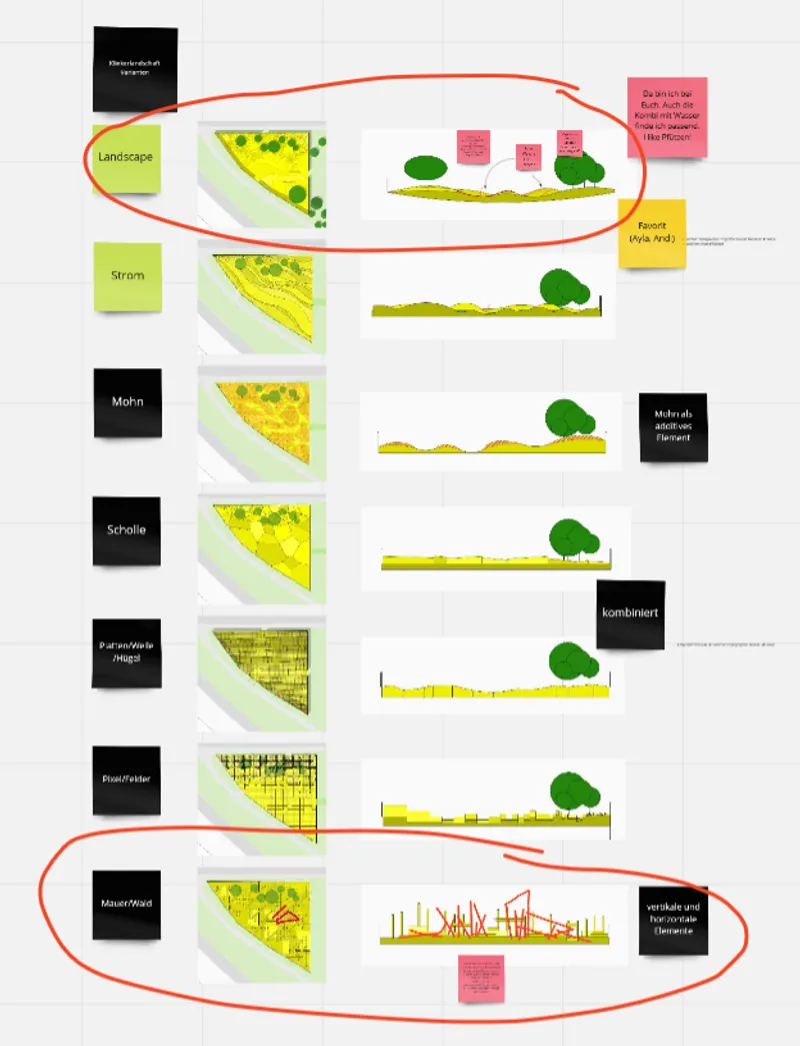
But what does this landscape look like? At the beginning there were several landscape scenarios, which were distributed side by side in the room, similar to the book, in which the landscapes are clearly separated from each other. Finally, we came to the conclusion to develop the scenic scenarios from one large, coherent landscape. The scale of the space does not tolerate any subdivision in our approach. The players should step into this fantasy land and not decide between landscape A or B, but be invited to discover the entire landscape.
Design
How do you get there? We wanted the arrival at the Land of Oz to be as intense and abrupt as possible. In the end, we decided on the indented wall slides, which block the view, but at the same time already tell something of the inside. With the brick landscape itself, we tried to exploit the softness and subtlety that brick allows in terms of landscape architecture. In the horizontal and in the vertical. Through this creative play, the massive stone landscape is constantly restructured.
Finally
As always, a beautiful, long way. Whether to the next garden, to the new courtyard or park, to a new interpretation of urban greenery or just the winding design path, to the land of Oz.




Popular Articles
Popular articles from the community


Co-life: Sustainable Architecture for Age-Friendly Community Living
Co-life reimagines sustainable architecture for seniors through courtyards, rammed earth, shared gardens, and spaces designed for belonging.

The Earth Pod: 3D Printed Homes for Resilient Refugee Communities
The Earth Pod reimagines refugee housing through 3D printed homes made from clay, combining resilience, self-sufficiency, and rapid shelter.

Hill & Cross Opera: Sculptural Opera House Architecture Shaped by Tallinn’s Landscape and Identity
Hill & Cross Opera reimagines opera house architecture in Tallinn through its sculptural hill, civic plaza, glass wave and a luminous cross.

The Ocean Hive: Sustainable Architecture for a Self-Sufficient Civilization at Sea
The Ocean Hive imagines sustainable architecture at sea, where modular habitats, algae, wave power and ocean waste sustain a growing colony.


Similar Reads
You might also enjoy these articles
The Rhythm of Seasons
A Farmers' Market Connecting Nature and the City

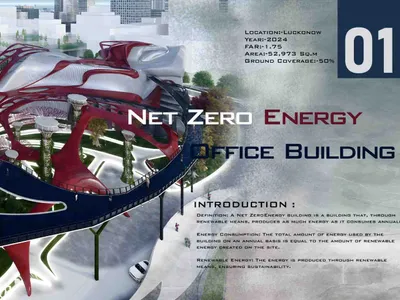
More Than a Building-Designing a Living System
More Than a Building-Designing a Living System
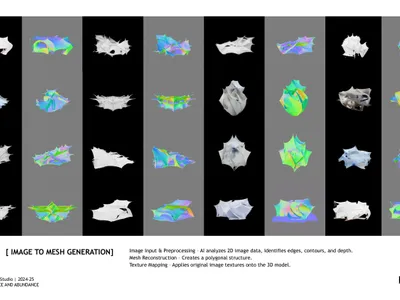
Base Beyond
DESERT COMPOUND ARID: TOURISM OF ABSENCE AND ABUNDANCE


Comments (0)
Please login or sign up to add comments
No comments yet. Be the first to comment!