
2050+ Refurbishes Rome's La Rinascente, Balancing Franco Albini's Legacy with a New Rooftop Life
A ten-storey department store beside the Aurelian walls gets a facade rethink and a glass-roofed sixth-floor restaurant open to the Roman skyline.


Touching a building by Franco Albini and Franca Helg is not a neutral act. The original La Rinascente on Piazzale Fiume, opened in 1961, was a disciplined piece of modern retail architecture: a simple square volume with storage below, offices above, and commercial floors in between, organized around a courtyard that grouped services to the sides and left the center free for selling. When 2050+ took on its refurbishment six decades later, the practice had to decide how much of that rationalist logic to preserve, how much to reinterpret, and where to push something genuinely new into the frame.
The answer is a project that treats modernity as a material and functional condition rather than a stylistic one. The facade panels, cast from a cement and granite mixture, reinterpret the Roman tradition of heavy stone frontages while their folded geometry nods to the engaged columns of Renaissance and Baroque palazzi. Inside, circulation has been rethought with a panoramic elevator modeled on a car lift that Albini once proposed for a never-realized rooftop parking lot. And at the top, a new glass roof transforms the sixth floor into a restaurant and food hall that finally gives the building a public relationship with the city skyline. It is a refurbishment that argues you can be loyal to an original architect's convictions without being imprisoned by their details.
A Facade That Reads Like Roman Masonry
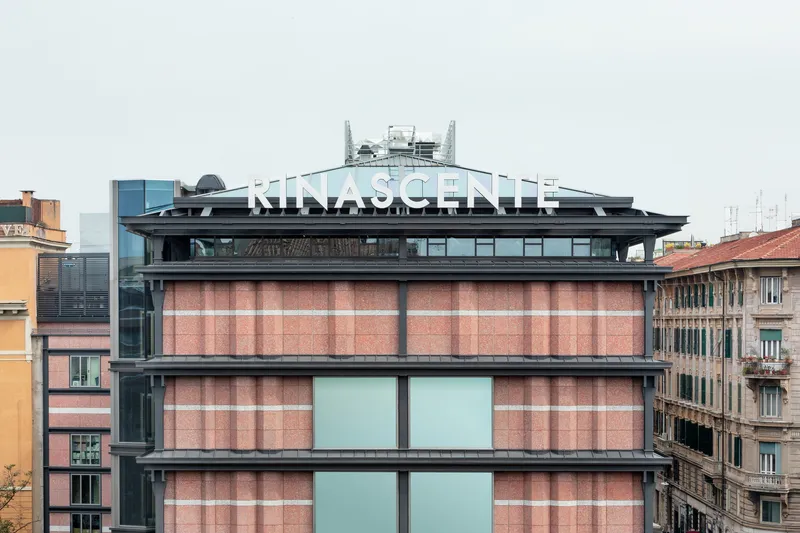
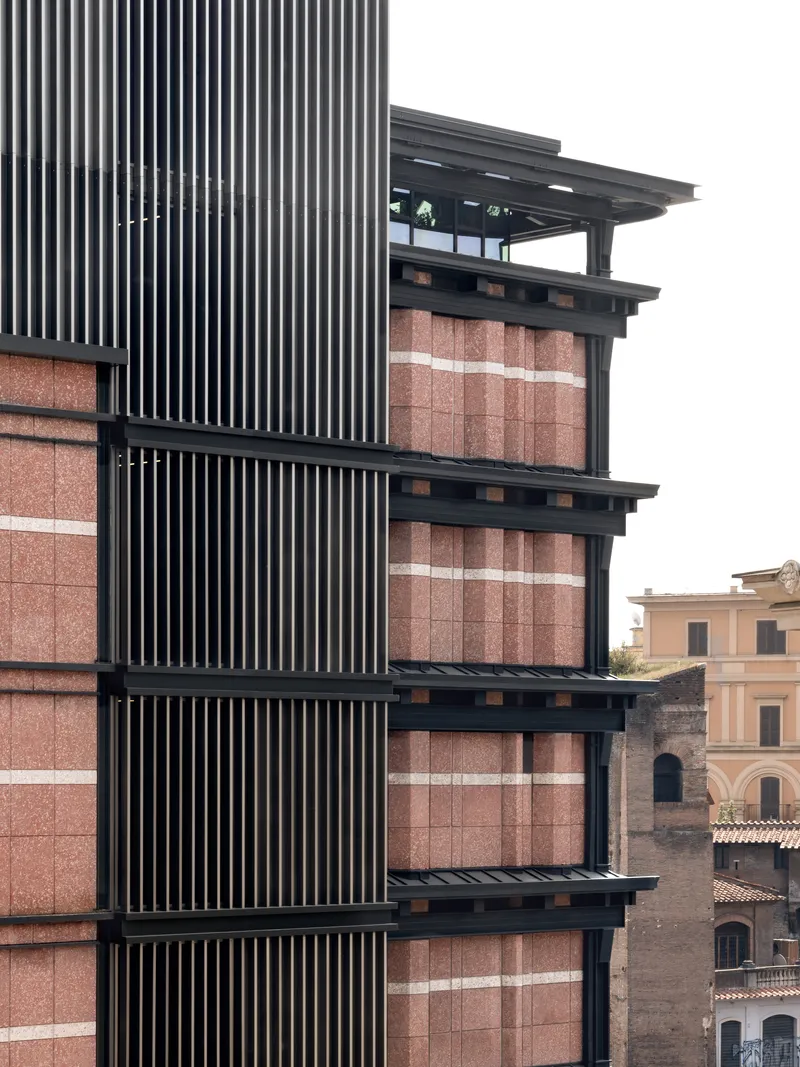
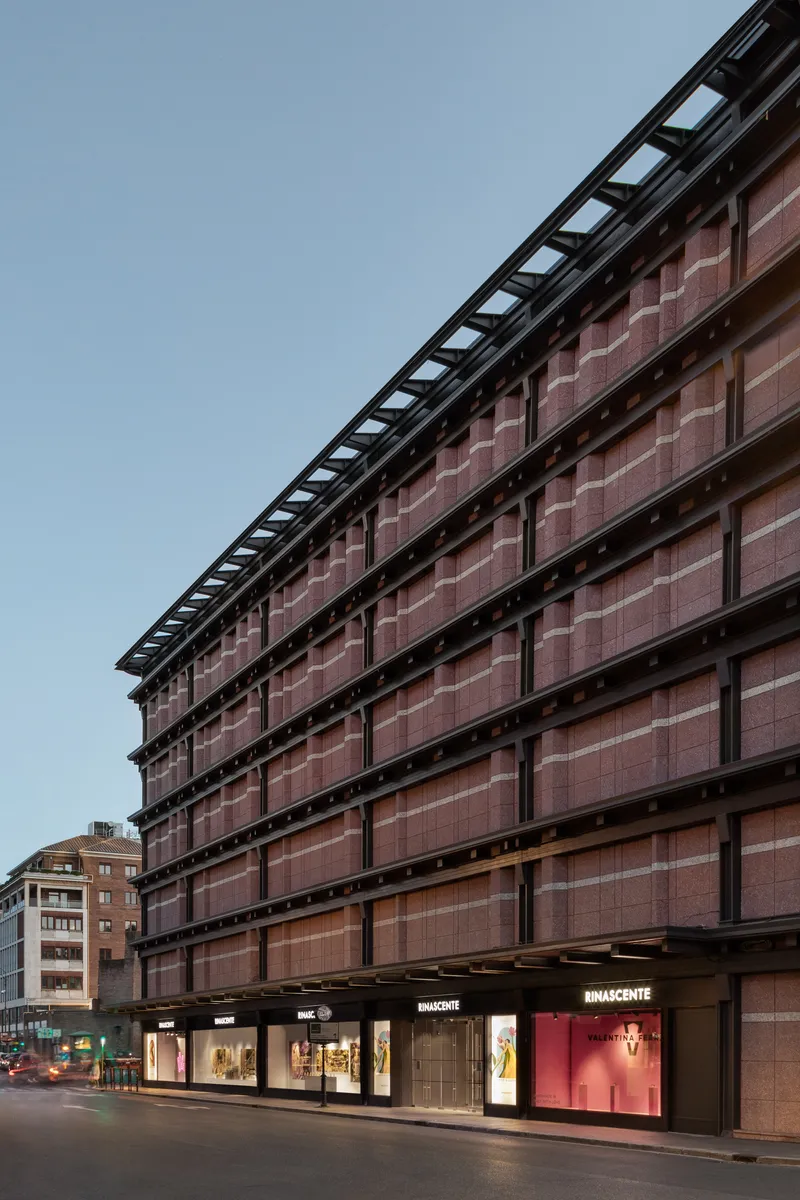
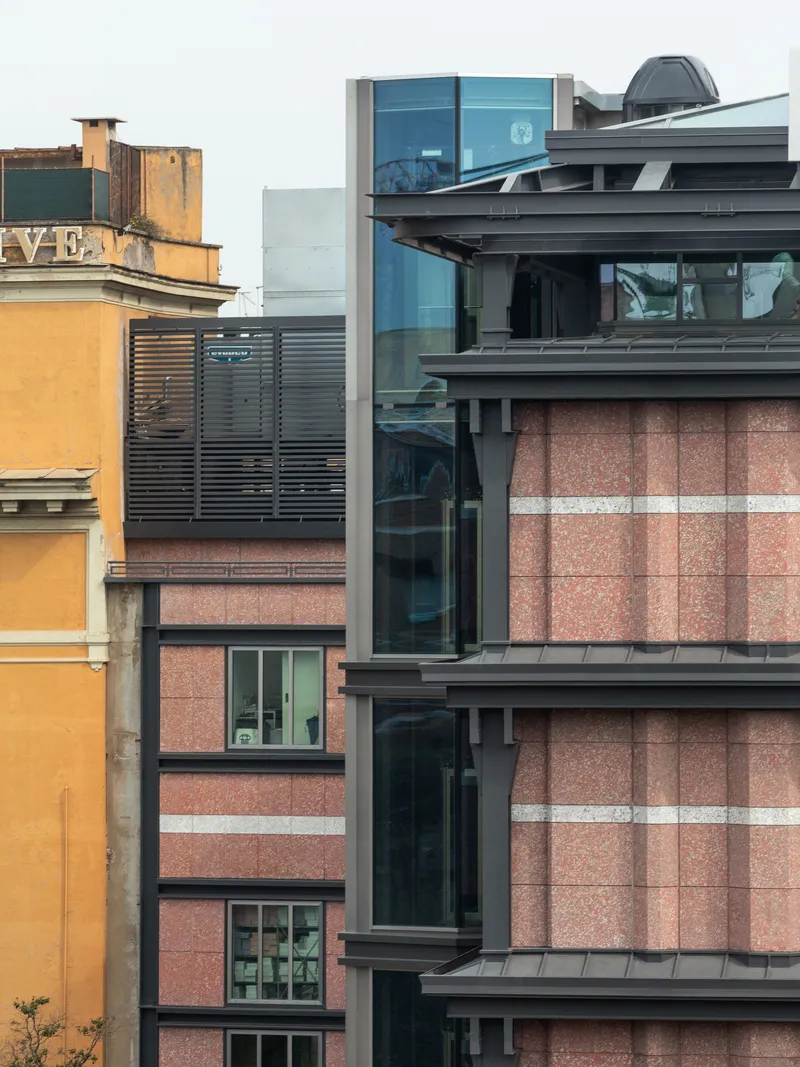
The most visible move is the new skin. Pre-fabricated panels of cement and granite mixture replace the expectation of curtain-wall neutrality with something deliberately textural. Vertical corrugations diminish in depth as the facade descends, a subtle gradient that produces strong chiaroscuro at the upper floors and a flatter, calmer reading at street level. Red masonry infill panels tie the building back to the immediate context of ochre and brick along Via Salaria. The result is a surface that photographs differently at every hour, shifting between warm and cool as Roman light rakes across its ridges.
Look closely at the steel frame and you can read the building's structure expressed on the outside: the folded infill panels sit between the columns like engaged pilasters, borrowing the plastic articulation of sixteenth-century facades without quoting them literally. It is an intelligent move, giving the department store a civic weight that the surrounding late nineteenth-century apartment blocks can accept as a neighbor.
Corner Conditions and Contextual Stitching
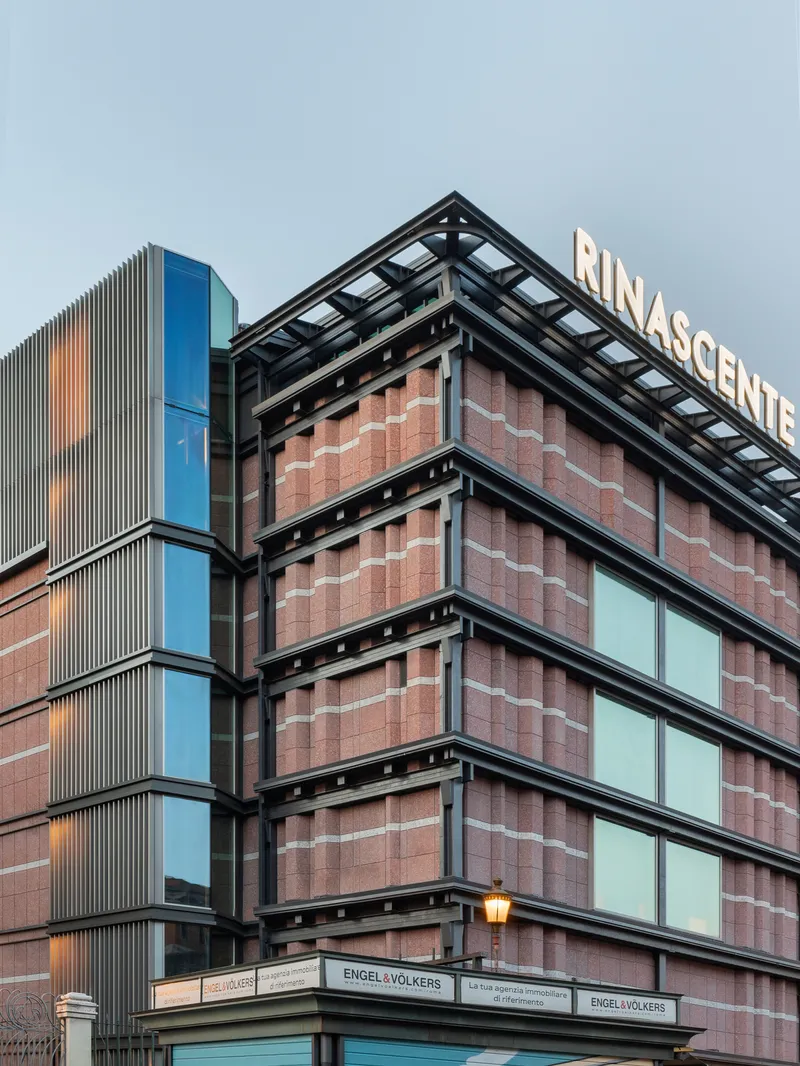
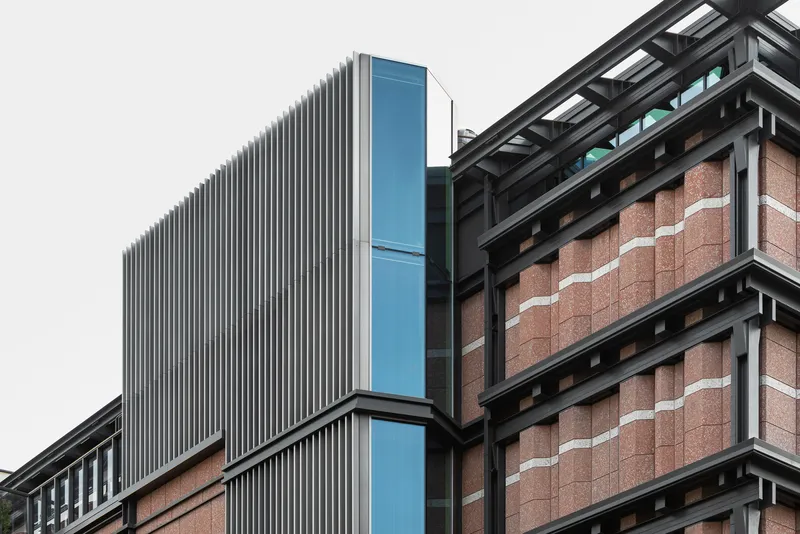
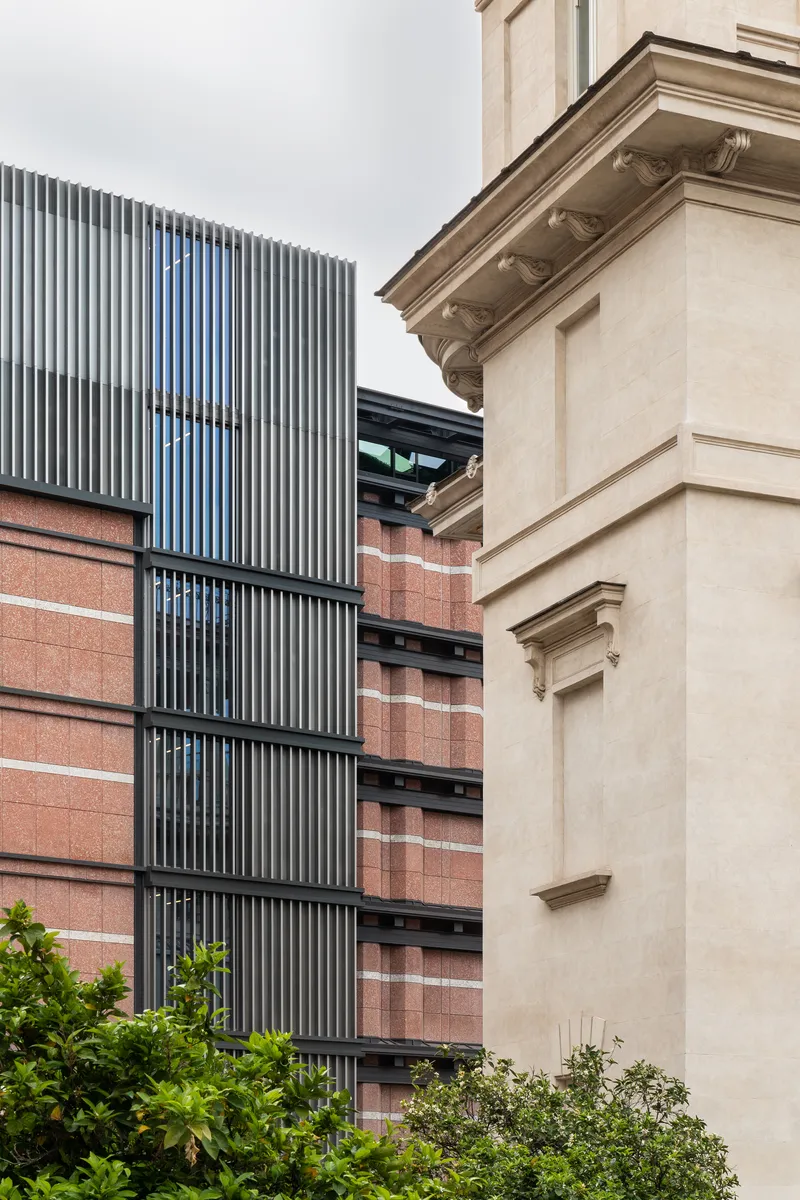
The corners tell the real story of how 2050+ negotiated between old and new. Where the terracotta-toned panels meet the exposed steel frame, a deliberate joint reveals the construction logic: structure first, cladding second. On the opposite edge, vertical metal fins rise beside red brick bands and a rendered heritage corner, making the transition from modern retail volume to Aurelian-era wall feel considered rather than accidental.
The blue glass balconies that project from one face introduce a contrasting register, lighter and more transparent, that signals the internal circulation zones. These are not decorative additions; they mark the panoramic elevator bay and the stairwell, giving the street a legible diagram of how people move through the building.
Street Presence at Dusk
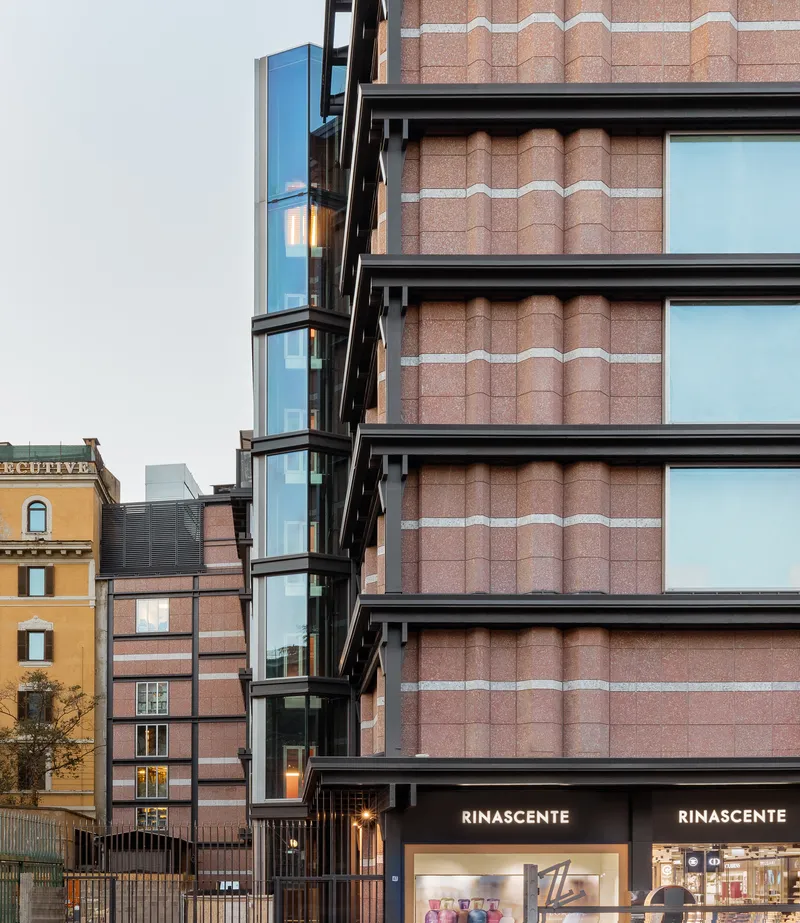
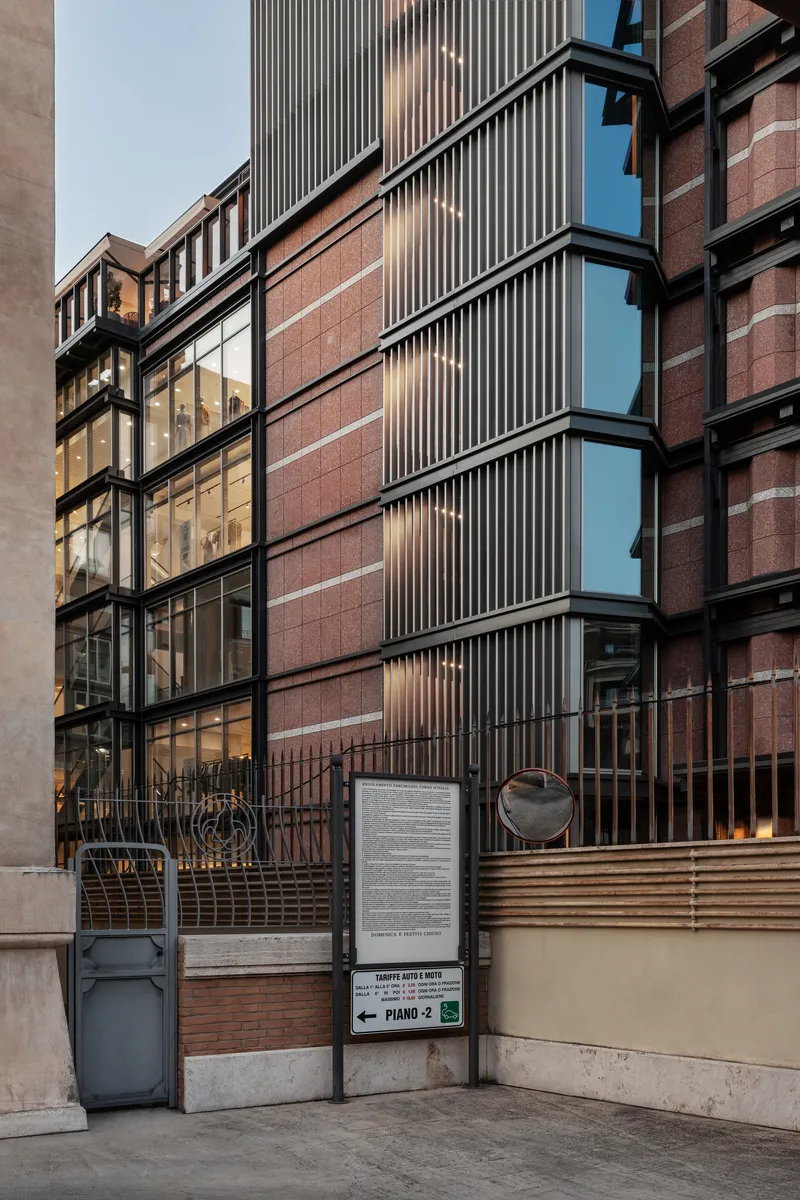
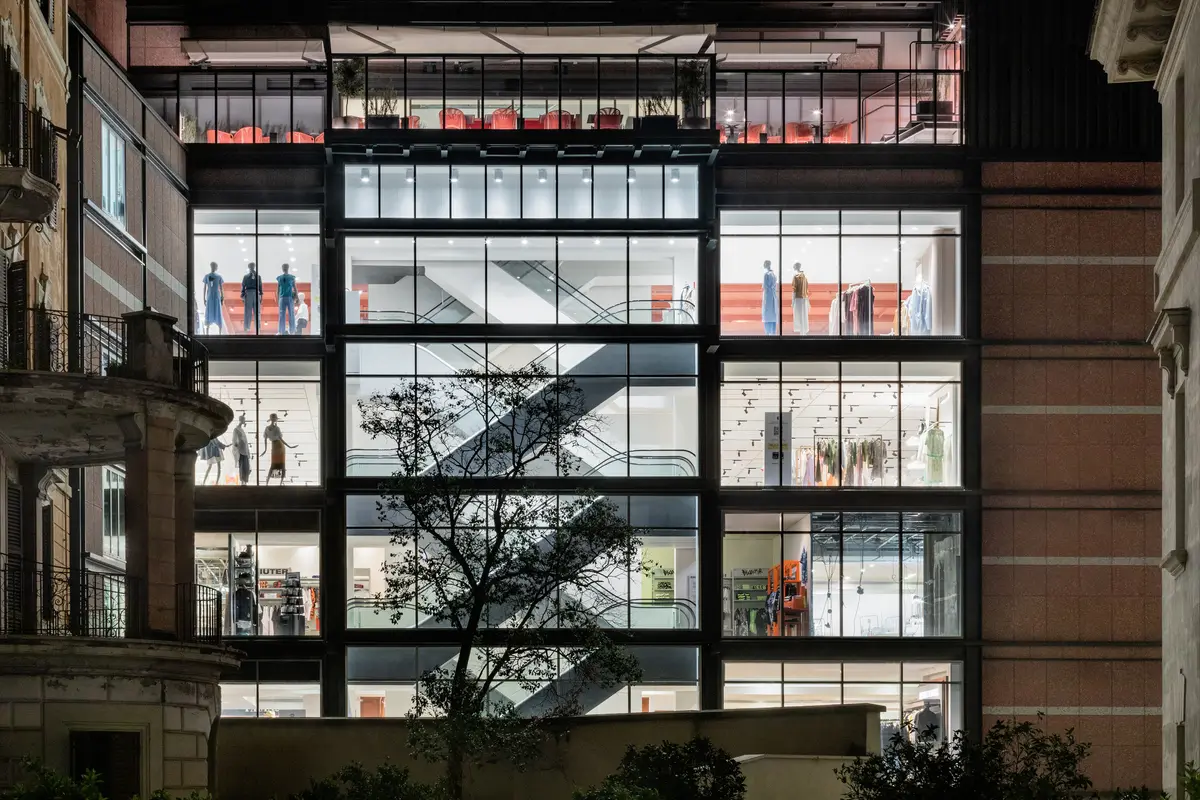
Retail architecture lives or dies at twilight, when interior illumination turns a building into a lantern. Here the full-height glazed bays reveal escalators and shoppers across multiple floors, converting the courtyard side into an animated section drawing visible from the street. The ground-level entrance, framed with horizontal timber slats and a metal gate, keeps the threshold grounded and domestic in scale, resisting the temptation to blow out the base with a dramatic void.
Seen alongside its neighbor, a weathered ochre residential building, La Rinascente reads as both assertive and contextual. The stacked blue glass boxes at the corner add a vertical accent that the residential facade lacks, pulling the eye upward to the new rooftop volume.
Interior: Folded Ceilings and Calibrated Light
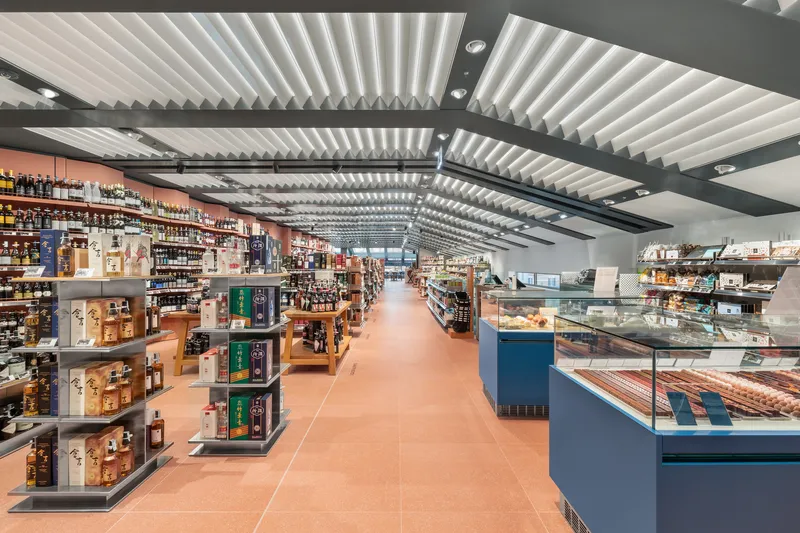
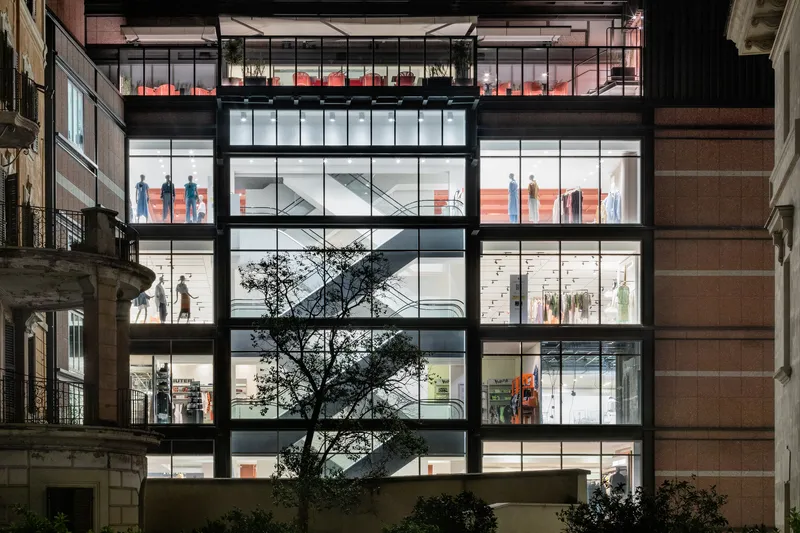
Inside, the commercial floors are artificially and constantly illuminated, a standard retail condition, but the ceiling treatment lifts them out of the generic. Folded white acoustic panels introduce a triangular motif into the rhythm of the structural beams, breaking up what would otherwise be flat expanses of suspended tile. The geometry echoes the corrugated facade panels, creating a material conversation between inside and outside that most department stores never bother to attempt.
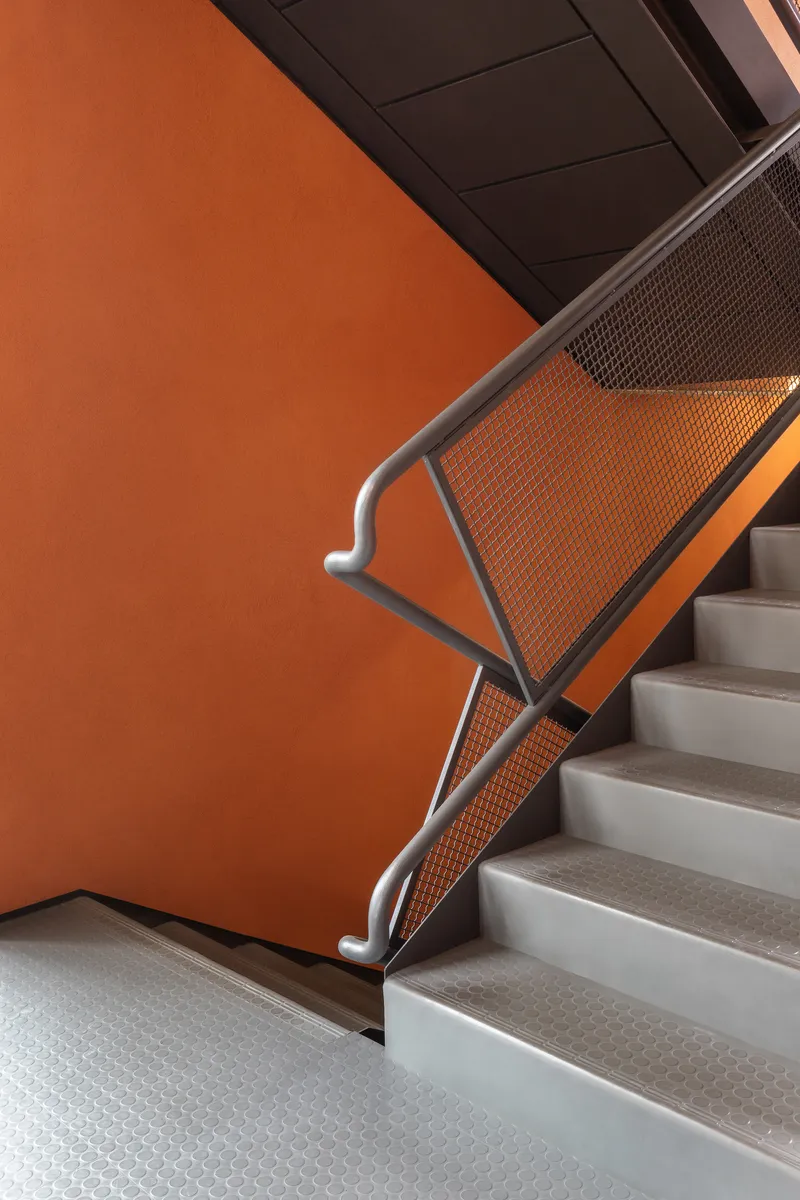
The internal staircase gets its own chromatic register: orange walls, terrazzo treads, perforated metal balustrades. It is a compressed, tactile space that rewards the shopper who chooses legs over escalators. The color choice is bold without being arbitrary, picking up the warm tones of the exterior cladding and concentrating them in a vertical tube of saturated light.
Vertical Circulation as Architecture
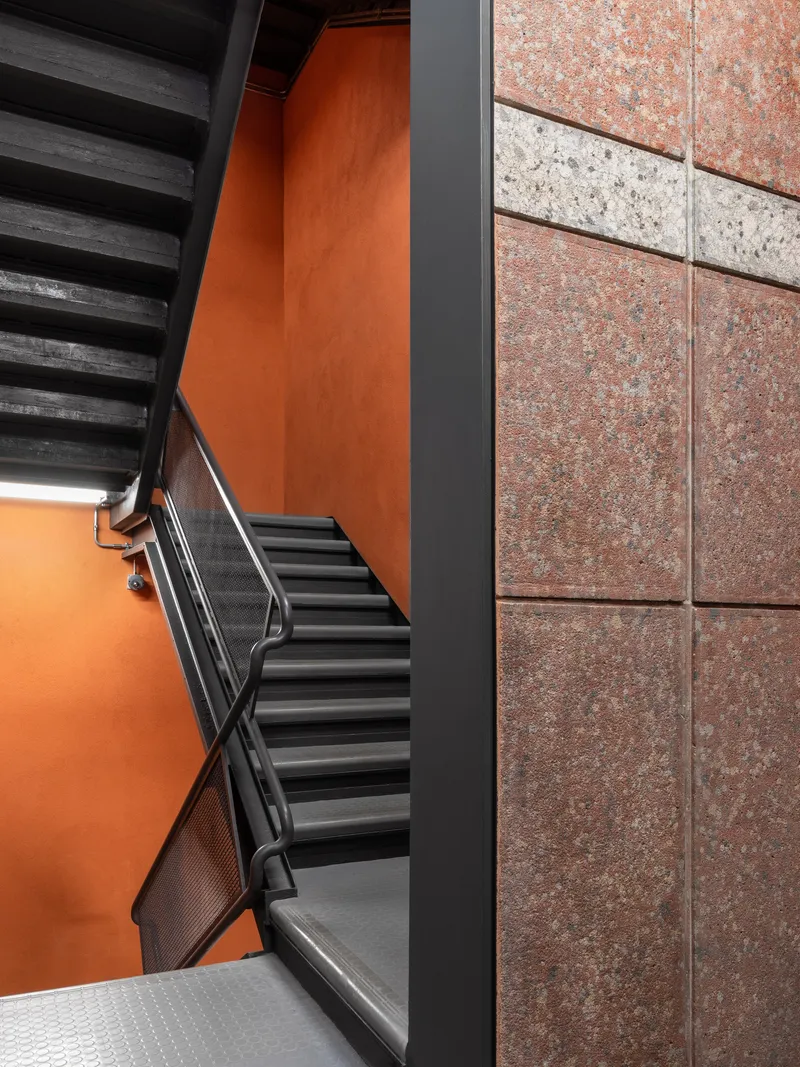
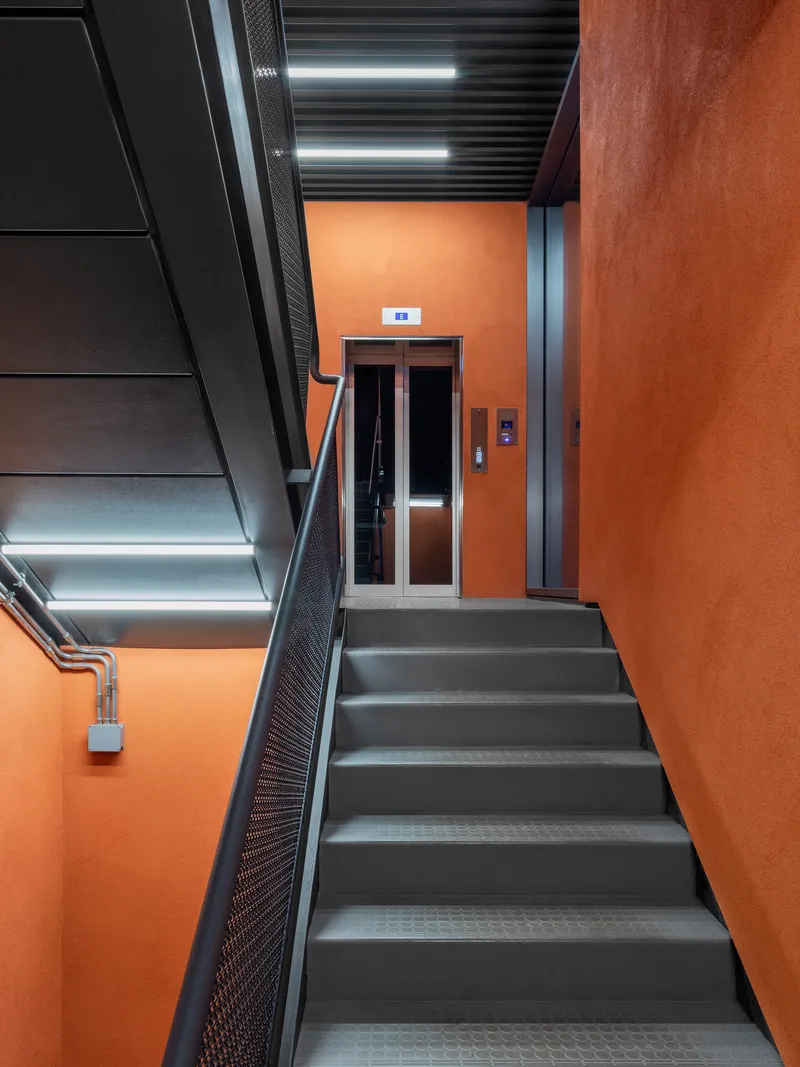
The new panoramic elevator bay deserves its own mention. Modeled on the design for a car lift that Albini and Helg once planned for a rooftop parking lot that was never built, the elevator flanks the existing egress stairs and provides direct access from the courtyard to the sixth-floor restaurant. It is a knowing nod to the original architects' ambitions, realized in a different form for a different program.
In the stairwell, orange walls meet the terracotta tile facade at a glazed seam, letting daylight filter down between the landing and the exterior skin. Elevator doors framed by black metal detailing sit within this warm enclosure like pieces of industrial furniture. The detailing is precise without being precious, which is exactly the register a high-traffic commercial staircase demands.
The Glass Roof and the Sixth-Floor Restaurant
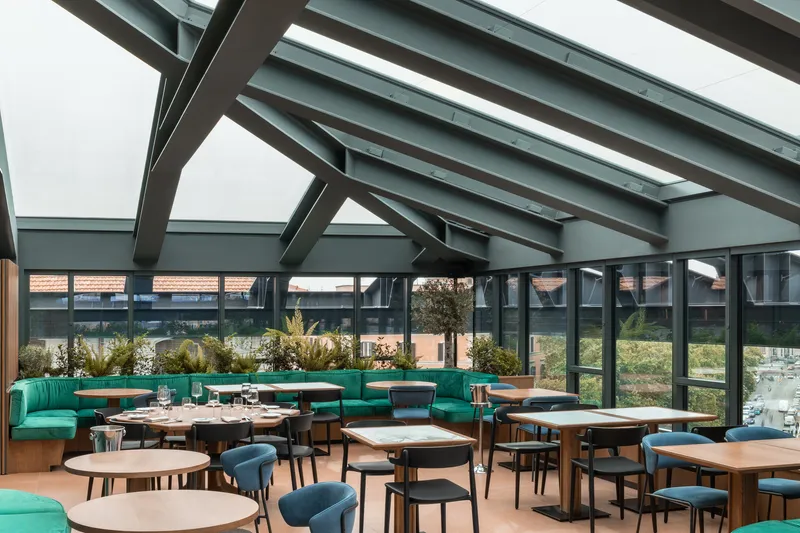
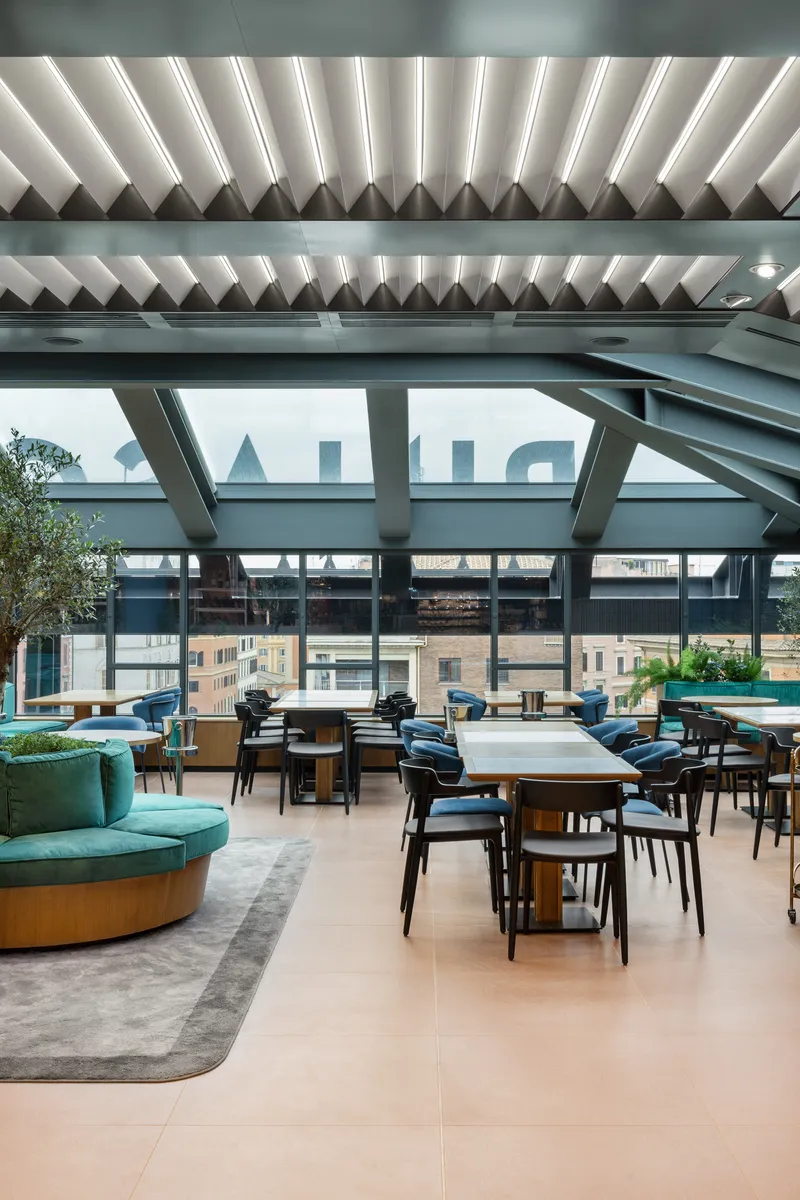
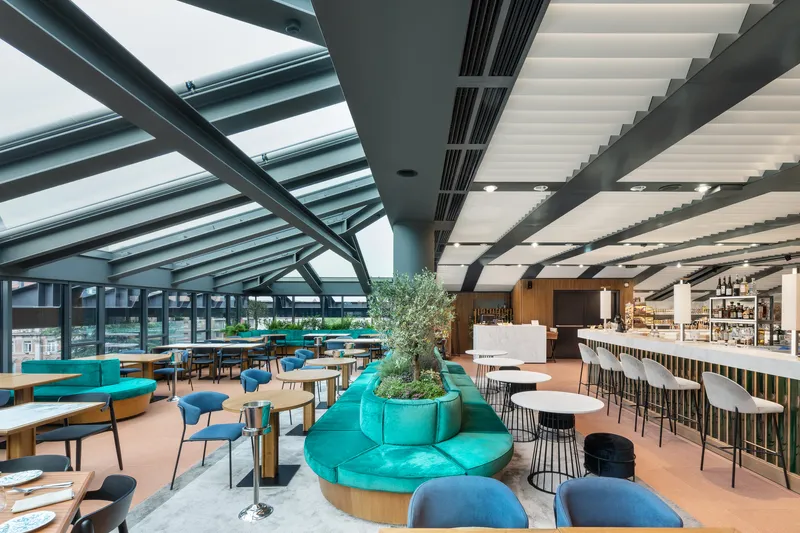
The sixth floor is the project's real payoff. A new glass roof supported by exposed steel trusses floods the space with natural light and opens panoramic views toward the neighboring rooftops and the Roman skyline beyond. Turquoise banquette seating and planted circular islands give the restaurant and food hall a relaxed, almost Mediterranean quality, a long way from the artificial brightness of the sales floors below.
Folded ceiling baffles continue at this level, providing acoustic control beneath the glass and filtering the light into soft, diffused bands. The terrace has been reopened with an outlet onto the courtyard, transforming a previously closed upper floor into a genuine public destination. For a building that sits beside the Aurelian walls, earning a rooftop relationship with the city feels both historically appropriate and commercially savvy.
Plans and Drawings
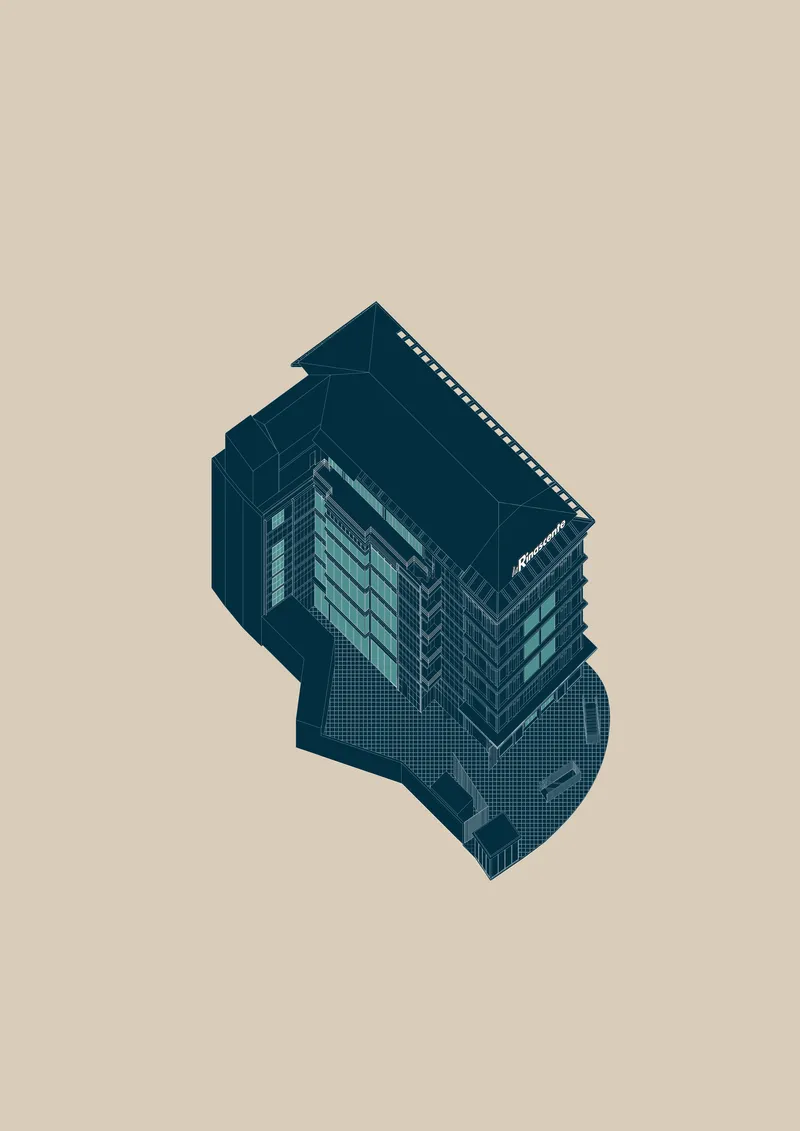
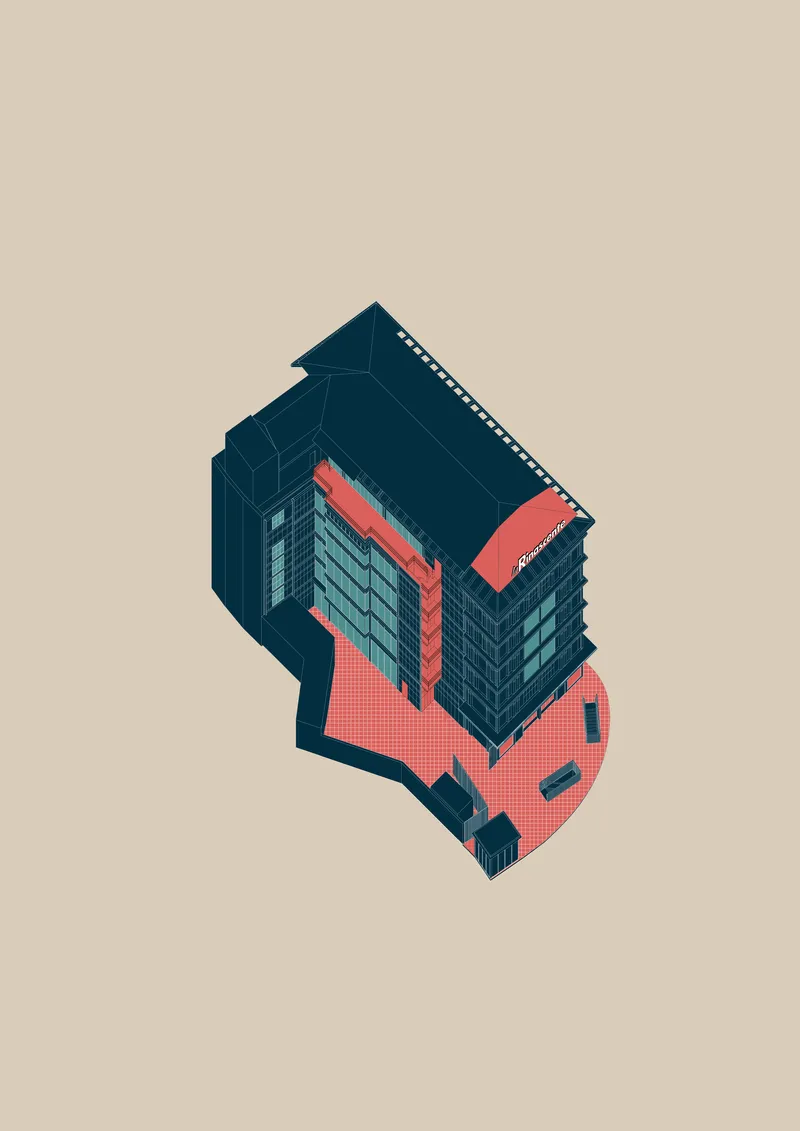
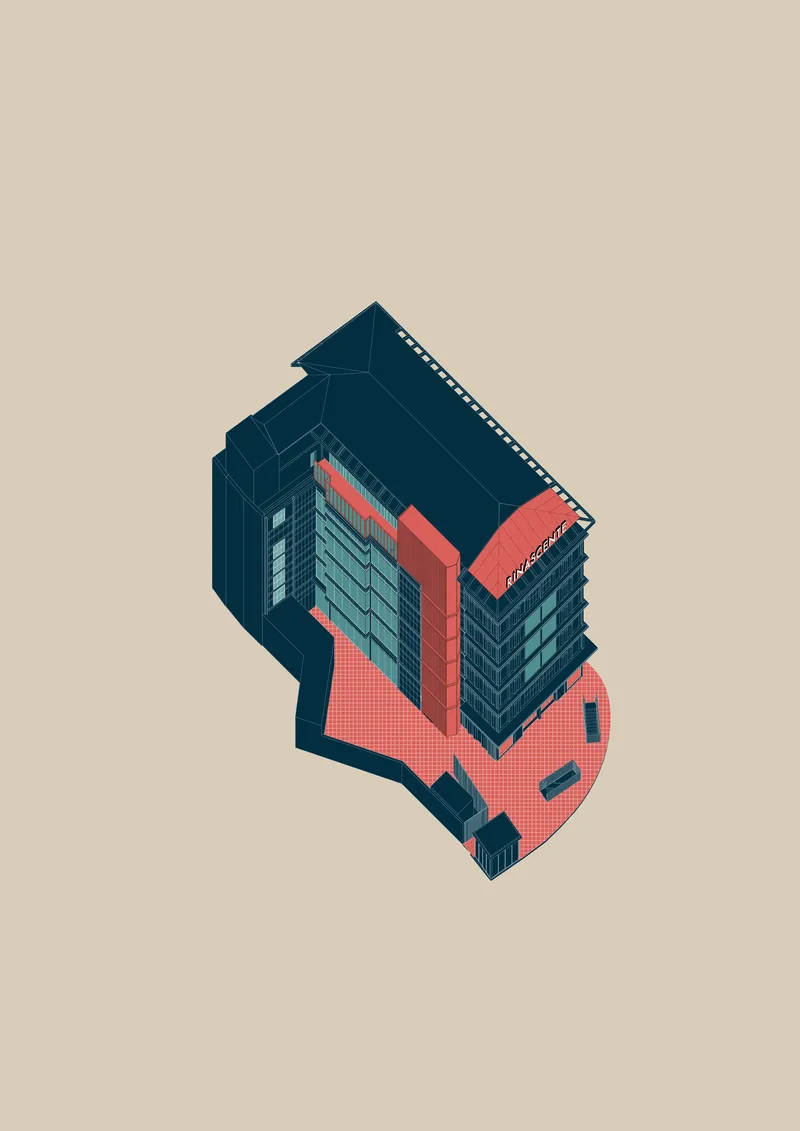


The isometric drawings make the internal logic legible in a way the photographs cannot. The ten-storey volume reads as a compact urban block, its pitched glass roof sitting atop the main mass like a lightweight crown. Coral-colored circulation bridges and a courtyard pool appear in several views, illustrating the project's ambition to weave outdoor amenity into what is fundamentally a commercial box. Paired outbuildings and scattered figures give scale, confirming that 2050+ conceived this not just as a retail interior but as a piece of the neighborhood.
Why This Project Matters
Refurbishing a mid-century modern landmark in a historic city is a balancing act that most firms resolve with either timid conservation or aggressive erasure. 2050+ has found a third position: tactical intervention grounded in material intelligence. The facade panels engage with Roman masonry traditions without pastiche. The panoramic elevator resurrects a lost idea from the original architects. The glass-roofed restaurant gives the building a new public purpose it never had. Each move is specific, defensible, and additive.
What makes the project worth studying is its argument that modernity is a condition of honesty about materials and function, not a question of stylistic affiliation. In a city where every renovation risks triggering a conservation debate, 2050+ has delivered a department store that respects Albini and Helg's structural logic while refusing to treat it as a museum piece. The building works harder now than it did in 1961, and it looks better doing it.
La Rinascente Department Store Refurbishment by 2050+. Located in Roma, Italy. Completed in 2022. Photography by Alessandro Saletta and Agnese Bedini, DSL Studio.
About the Studio
Share Your Own Work on uni.xyz
If projects like this are the kind of work you want to make, uni.xyz is a place to publish your own, find collaborators, and enter design competitions.


Popular Articles
Popular articles from the community


Manzana Morphosis: Stretching Barcelona's Grid into a Living Landscape for 2050
A radical reworking of the Eixample manzana turns density into a tool for generous public space, vertical ecology, and environmental performance.


graciastudio Turns a Viewless Tijuana Lot Inward Around a Courtyard of Concrete, Timber and Trees
In Tijuana, Jorge Gracia's GA2 House stacks a timber-clad private floor over exposed concrete and replaces a missing view with a planted interior patio.

The Amber Palace Opera: A Geological Fiction Surfaces on Tallinn's Baltic Waterfront
Pierre Brillard reimagines a Baltic legend as a public landscape, opera house, and waterfront promenade rooted in Tallinn's coastal identity.

FCC Arquitectura Expands a Portuguese Granite House with a Board-Marked Concrete Wing
In Portugal, JV House pairs a cleaned-up whitewashed and granite dwelling with a timber-shuttered concrete extension, courtyards and a garden pool.

Similar Reads
You might also enjoy these articles

LAVA Architecten Gives Vocational Education a Sawtooth-Roofed Face on a Mechelen School Campus
In Mechelen, Belgium, a 2,053 m² STEM school on a 6×6 m grid turns workshops and classrooms into rooms that can be rearranged as teaching changes.

KEMA Studio Turns a Derelict Marvila Attic into a 60 m² Lighthouse Apartment Above Lisbon
In Lisbon's Marvila district, a rebuilt roof, four skylights and two plywood volumes turn an unlivable attic into a bright home facing the Tagus.

Pixel Gardens: One Repeated Module Stacked Into a Terraced Social Housing Tower for Famagusta
Salem Bader's shortlisted housing tower builds a vertical neighbourhood from one repeated module, offsetting units to carve terraces, light and air.

Bao Huynh Watercolor Atelier: A Serene Art Retreat in Hội An
Bao Huynh Watercolor Atelier in Hội An blends multifunctional art spaces, sustainable design, local materials, and family-friendly living in a serene environment.

Explore Renovation Competitions
Discover active competitions in this discipline

Challenge to design luxury tourism on rails

VR headsets Storefront design competition

Designing a staircase for a client
Comments (0)
Please login or sign up to add comments
No comments yet. Be the first to comment!