

21coffees: A Walkable Green Roof Turns a Viennese Café Into Part of the Park
Shortlisted at Brewed 2020, a partly buried café beside Belvedere 21 lifts the park over its roof and hides a living room jungle and flexible venue below.


Most new buildings in a park take something away from it. 21coffees argues the opposite: a café can hand the ground back to the public by folding it over its own roof. The result is a grass-covered wave that people walk, climb and sit on, while below it a coffeehouse doubles as a cultural venue. The proposal is less a pavilion dropped into greenery than a piece of landscape that happens to serve espresso.
Designed by Julia Wagner and Tadej Podakar, the project was a shortlisted entry in Brewed 2020. The site sits next to the Museum Belvedere 21 in Vienna, on the seam between a dense urban district and a public park. The brief the designers set themselves pairs a café with a flexible cultural space, and frames the whole thing as a contemporary reading of Vienna's coffeehouse tradition rather than a nostalgic copy of it.
A Grass Wave That Glows at Its Glazed End
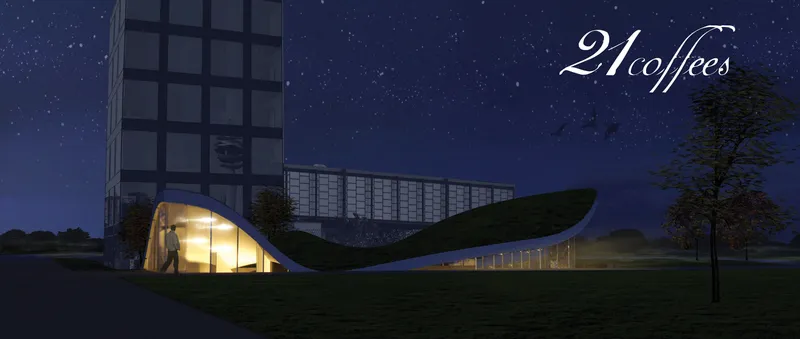
The night rendering sets out the project's whole strategy in a single frame. The roof rises from the ground as a continuous green surface, then terminates in a fully glazed end wall that turns into a lantern after dark. From the park side the building almost disappears into the topography; only the lit opening announces that there is an interior at all. This is a deliberate trade: the designers give up façade presence to keep visual impact low, and let light do the work of signage.
The move matters because of where the site is. Positioned between hard city fabric and open parkland, another freestanding object would have sharpened that edge. Instead the wave softens it, reading as the park's own terrain lifting up to meet the street.
The Living Room Jungle Under a Perforated Sky
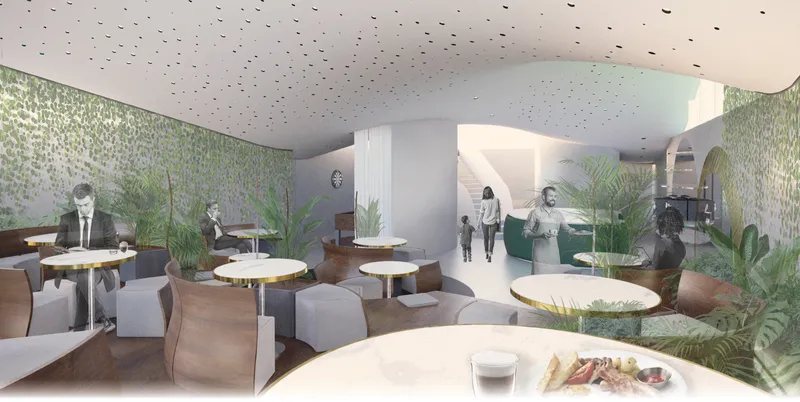

Inside, the designers describe the space as a "living room jungle," and the renderings back up the phrase. Round marble tables and curved timber seating sit against ivy-covered walls, while a perforated white ceiling filters daylight in the first view and becomes a starlit field in the evening scene. The planting is not decoration hung on the edges; it breaks the seating into smaller zones so the room feels intimate without being closed off. Large areas of glazing pull daylight deep into the plan and keep the park in view from inside.
The evening image adds palms, a green-lit bar and a dog at the diners' feet. It is a telling detail. This is pitched as a neighbourhood room as much as a destination for museum visitors, the kind of place where families walk through and regulars settle in, which is exactly the social role the Viennese coffeehouse has always played.
A Roof Meant to Be Climbed, Not Just Admired
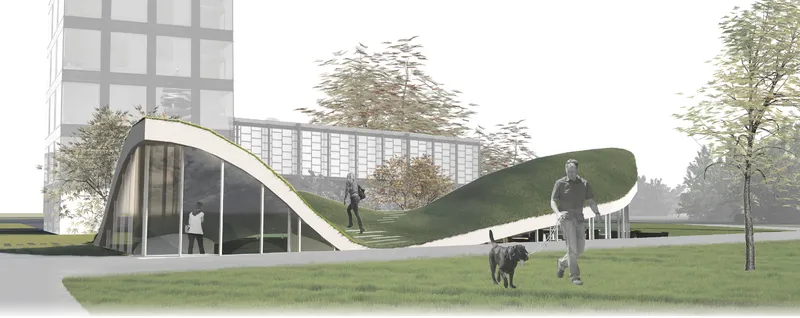
The daytime view confirms that the green roof is public ground. A walker passes with a dog while another figure climbs the slope, and the undulations create a sculptural topography that offers raised vantage points over the park and toward the museum. Rather than occupying green space, the building effectively adds to it, stacking café and lawn on the same footprint.
The same form choreographs arrival. Approaching from the city, visitors meet a gentle rise in the ground that steers them toward an entrance placed where pedestrian paths cross. From there the experience shifts in stages, from the hard surfaces and rigid geometry of the street to organic forms, planting, natural light and warm materials. The transition starts well before anyone reaches the door.
One Section, Two Kinds of Evening
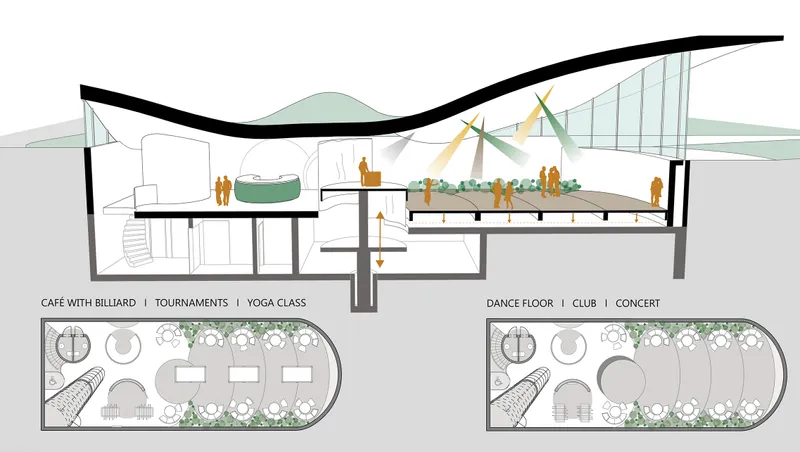
The section drawing is where the cultural ambition becomes concrete. Beneath the wave roof, the floor plan is shown in two configurations: one arranged for café and billiard use, the other cleared for a dance floor and concert layout. The volume under the curve is generous enough to absorb both, and the comparison makes the case that flexibility here comes from planning the furniture and circulation, not from adding rooms.
The billiard tables are a sharp reference. Billiards has long been part of the Viennese coffeehouse, and keeping it in the programme ties the contemporary shell back to a specific local habit. The same space then flips into a venue at night, letting a single building hold the daytime café crowd and an evening audience without either feeling like an afterthought.
A Curved Green Counter Anchors the Room
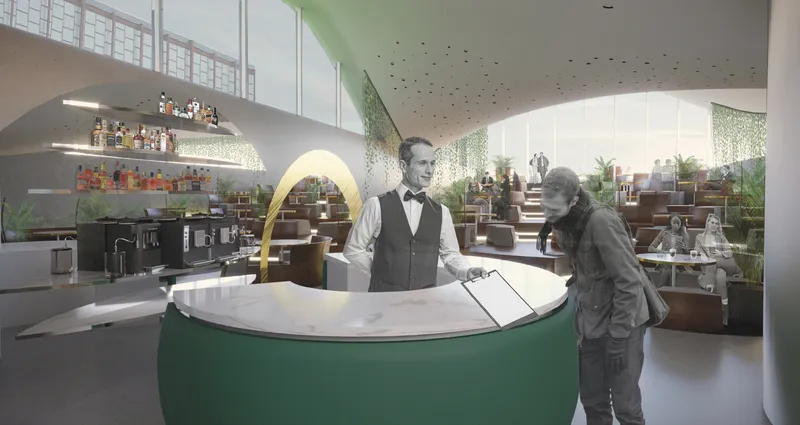
The service counter echoes the roof in plan, curving rather than running straight, and its green finish carries the planting palette into the working heart of the café. A bartender in a vest, espresso machines and backlit bottle shelves give the scene the formality of a traditional coffeehouse, while tiered seating rises behind the customer. Those tiers are worth noting: they suggest the interior is shaped to work as an informal auditorium when the room switches to performance mode, so the bar can face an audience as easily as a queue.
Partly Buried, So the Earth Does the Insulating
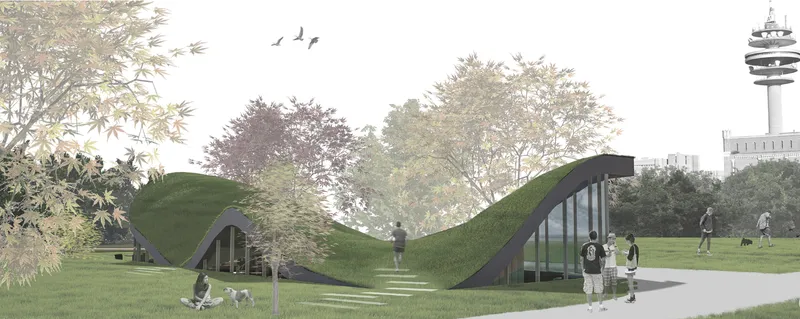
The final rendering pulls back to show the roof among people, dogs and the city's skyline, with glazed openings punched into the grass. What reads as a formal gesture is also an environmental one. By partially embedding the building in the terrain, the designers reduce its exposure to temperature extremes, cutting the energy needed for heating and cooling. The extensive green roof adds to that performance and turns the structure into an ecological layer rather than an object sitting on the site.
None of this is presented as a bolt-on sustainability package. The thermal benefits follow directly from the decision to make the building part of the ground, which is the most convincing kind of green design: the strategy that would make sense even if no one were counting kilowatt hours.
Why This Project Matters
21coffees shows how a modest programme can carry a large urban idea. A café beside a museum could easily have been a glass box competing with its neighbour. Wagner and Podakar instead gave the park more walkable ground, held the building's profile low, and placed the entrance where people already move. The architecture earns its place by what it gives back to the public realm, not by how loudly it announces itself.
It is also a thoughtful answer to the question of tradition. Rather than reproducing bentwood chairs and mirrored walls, the project keeps the coffeehouse's social habits, lingering, billiards, music, and rehouses them in a planted, daylit interior under a landscape roof. For a competition about the future of coffee spaces, that is the right instinct: carry forward what people do in these rooms, and let the form be new.
View the Full Project
About the Designers
Designers: Julia Wagner, Tadej Podakar
Enter a Design Competition on uni.xyz
uni.xyz runs architecture and design competitions year-round that reward proposals with spatial conviction and real site intelligence.
Project credits: 21coffees by Julia Wagner, Tadej Podakar Brewed 2020 (uni.xyz).


Popular Articles
Popular articles from the community


Manzana Morphosis: Stretching Barcelona's Grid into a Living Landscape for 2050
A radical reworking of the Eixample manzana turns density into a tool for generous public space, vertical ecology, and environmental performance.

Aquadapt: An Underwater Habitat That Rewrites Its Rooms by the Hour
Curved modules ring the seabed while one shell shifts from breakfast room to cinema, farm and football pitch as residents' needs change.


David Ortega Stacks a Two-Story Mexico City Penthouse Around a Steel Stair and a Pergola-Shaded Roof Terrace
In Colonia Roma, a 300 m² penthouse uses oak joinery, a planted steel stair and a slatted roof pergola to make a new-build apartment feel like a house.

graciastudio Turns a Viewless Tijuana Lot Inward Around a Courtyard of Concrete, Timber and Trees
In Tijuana, Jorge Gracia's GA2 House stacks a timber-clad private floor over exposed concrete and replaces a missing view with a planted interior patio.

Similar Reads
You might also enjoy these articles
Healing Façade: A Modular Chapel System That Restores Ethiopia's Sacred Forests
Winner of the Eco-Chapel competition, this circular timber façade collects water from air to rebuild soil and reforest degraded Ethiopian landscapes.
Kaffeebühnen: Where Coffee Shop Architecture Becomes a Civic Stage in Vienna
A linear sequence of timber boxes, transparent shells, and open yards turns the Viennese café tradition into a public performance space.
Eco Chapel: A Modular Forest Pavilion That Grows Like the Landscape It Protects
Hexagonal timber modules weave through existing trees, turning a chapel into a living system for prayer, education, and reforestation.


Urban Forest: A Vertical Ecosystem for 5,000 Workers in Singapore's Changi Business Park
Radially stacked pods and layered green decks turn a 7-acre plot into 47 acres of ecological workspace projected for 2040.


Comments (0)
Please login or sign up to add comments
No comments yet. Be the first to comment!