
23 SUL Builds an Artist Couple a Three-Story Studio Around a Tropical Courtyard in São Paulo
A 210-square-meter workspace and social hub in São Paulo folds plywood, concrete, and glass block around a lush planted core.


An artist couple's studio should do more than store canvases and brushes. It should set the conditions for creative work: controlled light, spatial variety, room to think and room to host. That is the brief 23 SUL took on with ASA Sandra and Albano Studio, a 210-square-meter building in São Paulo that stacks workspaces, a kitchen, a reading room, and generous terraces around a central courtyard dense with banana palms and traveler's palms. Completed in 2023, the project treats the courtyard not as leftover space but as the engine of the whole plan.
What makes this project worth studying is the way it compresses an extraordinary number of uses into a narrow urban footprint without ever feeling cramped. The building splits into two volumes flanking the courtyard, connected by metal walkways and an open stair. Every room borrows light, ventilation, and a view of green from that void at the center. Lead architects Gabriel Manzi, Ivo Magaldi, Luiz Florence, Moreno Zaidan Garcia, and Tiago Oakley manage this with a restrained palette of exposed concrete, plywood, glass block, and perforated metal, letting the tropical planting supply the color and the courtyard supply the drama.
Street Presence: Dark, Quiet, Protective

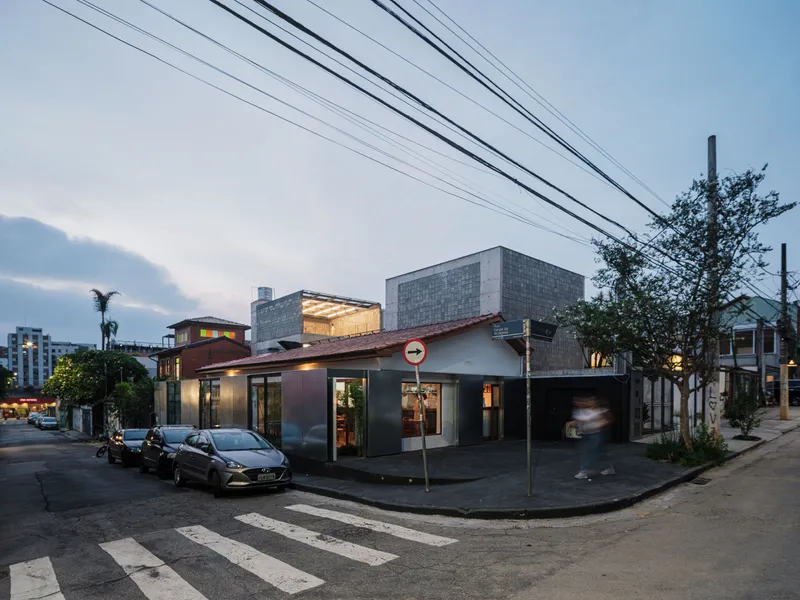

From the street, the building gives away very little. A dark ceramic tile volume sits above a backlit glass block entry wall, the composition punctuated by a spiky yucca tree and flanked by overhead power lines typical of São Paulo's residential neighborhoods. At twilight the translucent glass entry gate glows like a lantern, signaling something happening inside without exposing it. The restraint is deliberate: this is a workspace, not a gallery storefront, and the street facade acts as a filter between the city's noise and the creative life within.
The Courtyard as Engine
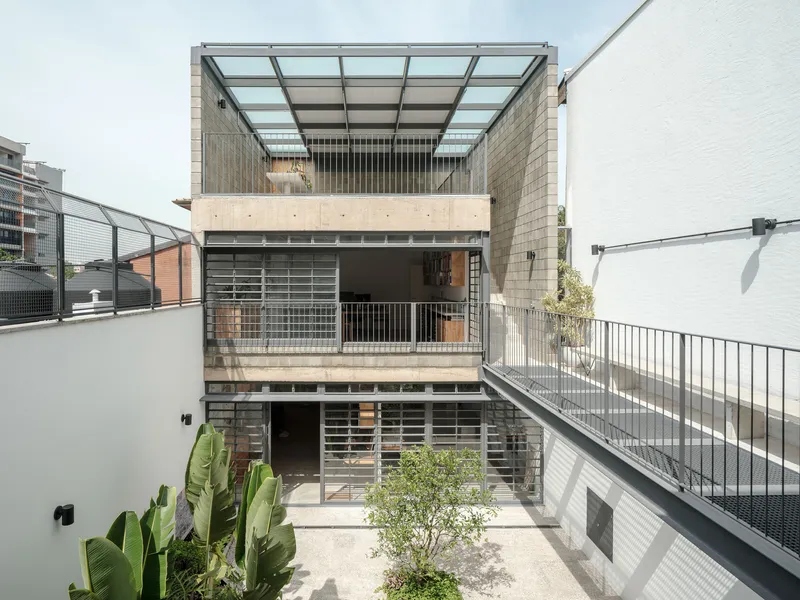

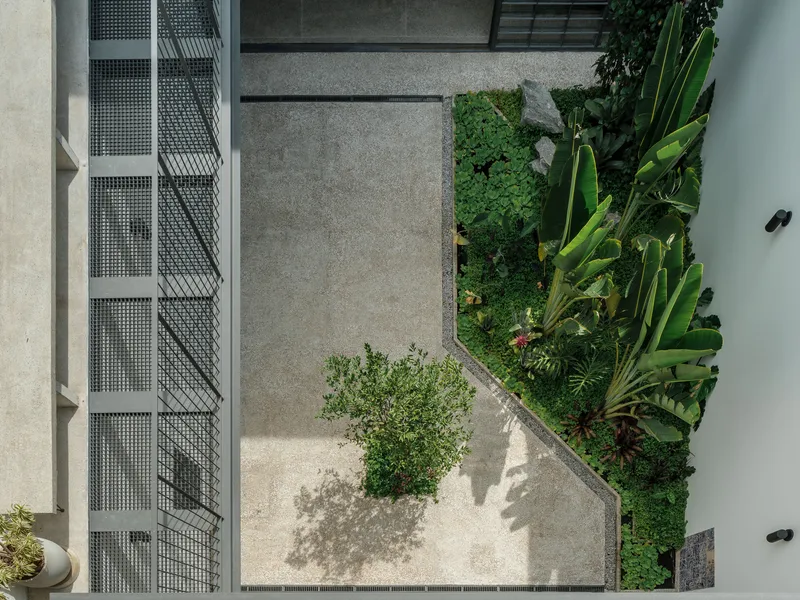
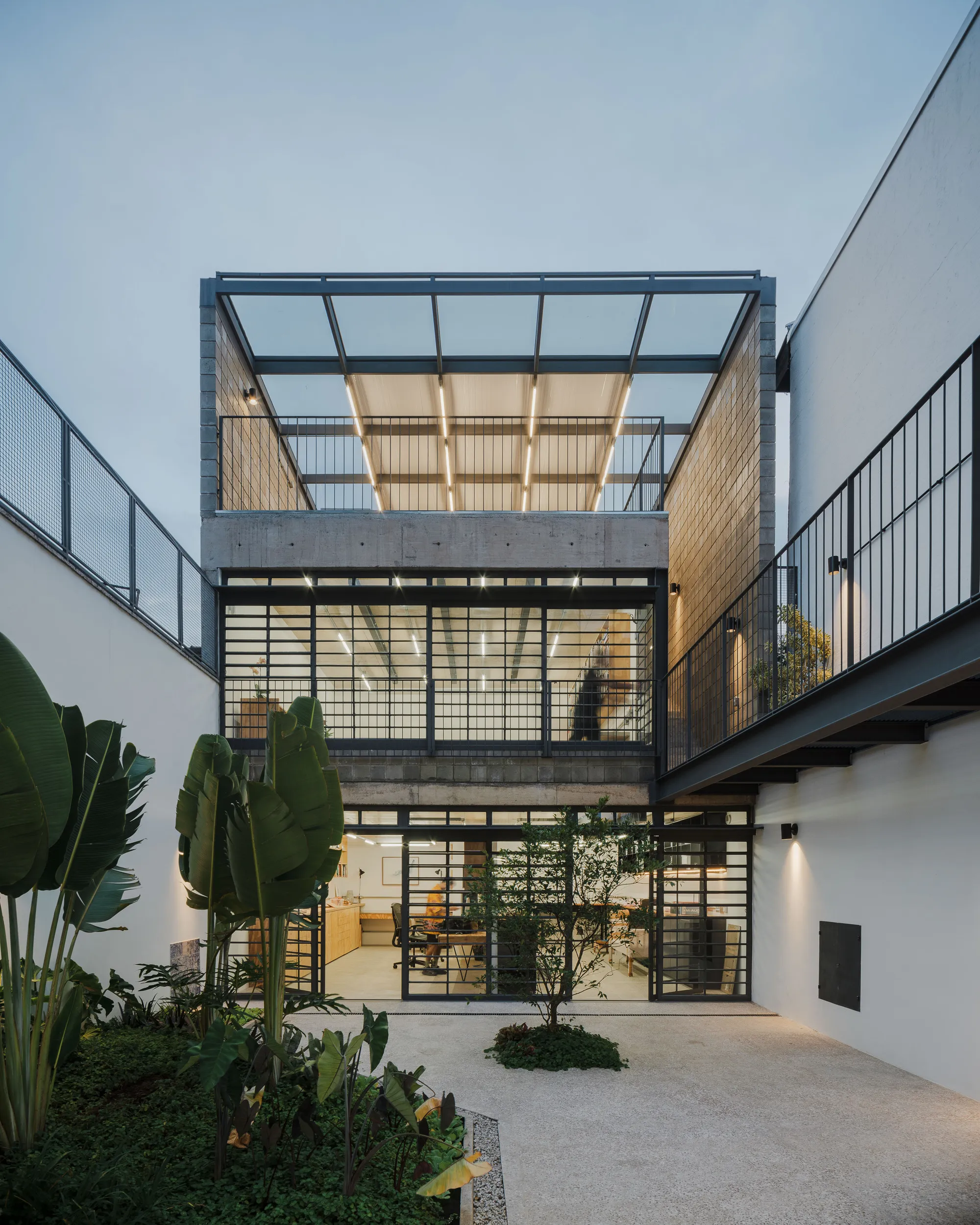
Step past the facade and the building opens dramatically. The internal courtyard rises three stories, its concrete frame exposed and honest, with metal walkways and perforated stairs threading between levels. Banana palms and traveler's palms grow from a planted bed at ground level, their canopy reaching toward a glazed skylight overhead. The courtyard is not ornamental; it is the building's primary circulation spine, its main light source, and its ventilation strategy rolled into one.
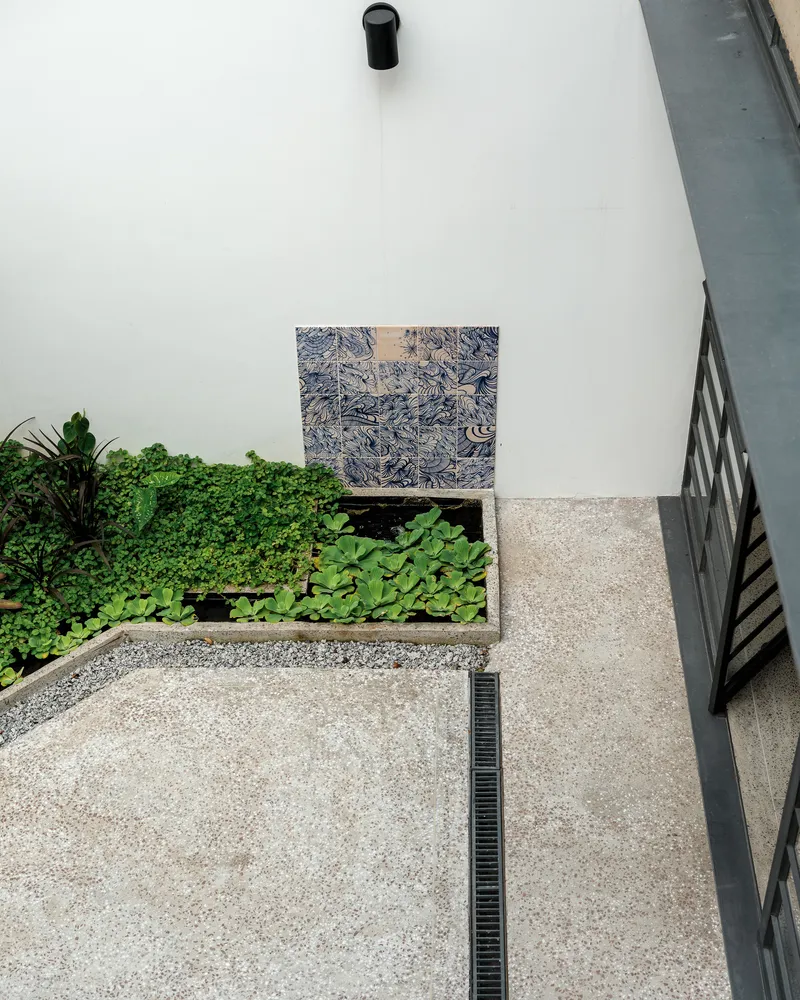
The landscape design by Klara Kaiser and Koiti Mori treats the planting as architecture. The tropical foliage softens the concrete surfaces, filters direct sun before it hits interior glass walls, and gives every room in the building a living backdrop. Even from the overhead view, the careful geometry of exposed aggregate paving, planted beds, and a patterned tile wall panel makes clear that nothing here is accidental.
Courtyard Facades and Materiality


Inside the courtyard, the building reveals its material logic. The two flanking volumes wear beige ceramic tile on their courtyard faces, a warm contrast to the dark street facade. Concrete terrace balconies project outward, their edges left raw. Gridded steel screens, perforated metal stairs, and patches of timber cladding create layers of transparency and opacity that shift as you move through the space and as the light changes through the day.
At dusk the courtyard becomes cinematic. The gridded screens glow from interior light, the glazed skylight catches the last blue of the sky, and the banana palms throw silhouettes against the concrete frame. Photographed by Pedro Kok, these moments capture the building at its most revealing: a machine for controlled atmosphere.
Glass Block and Filtered Daylight
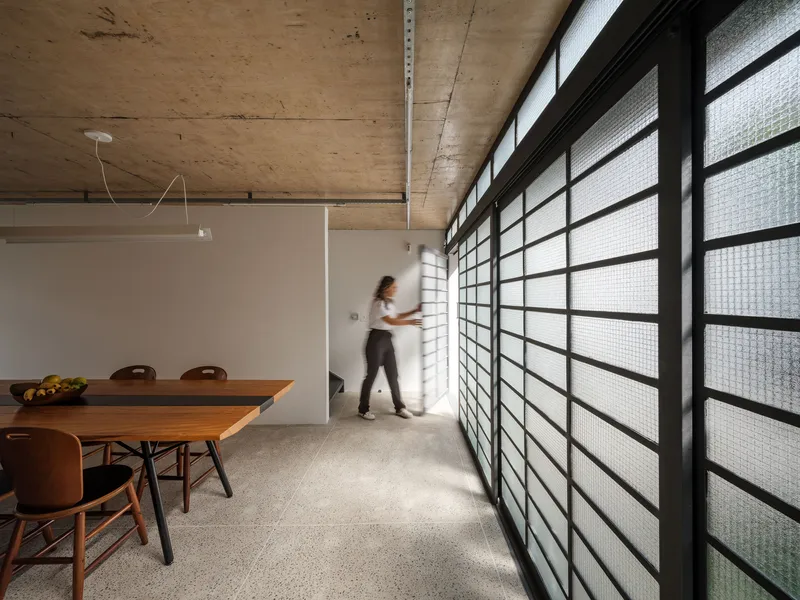
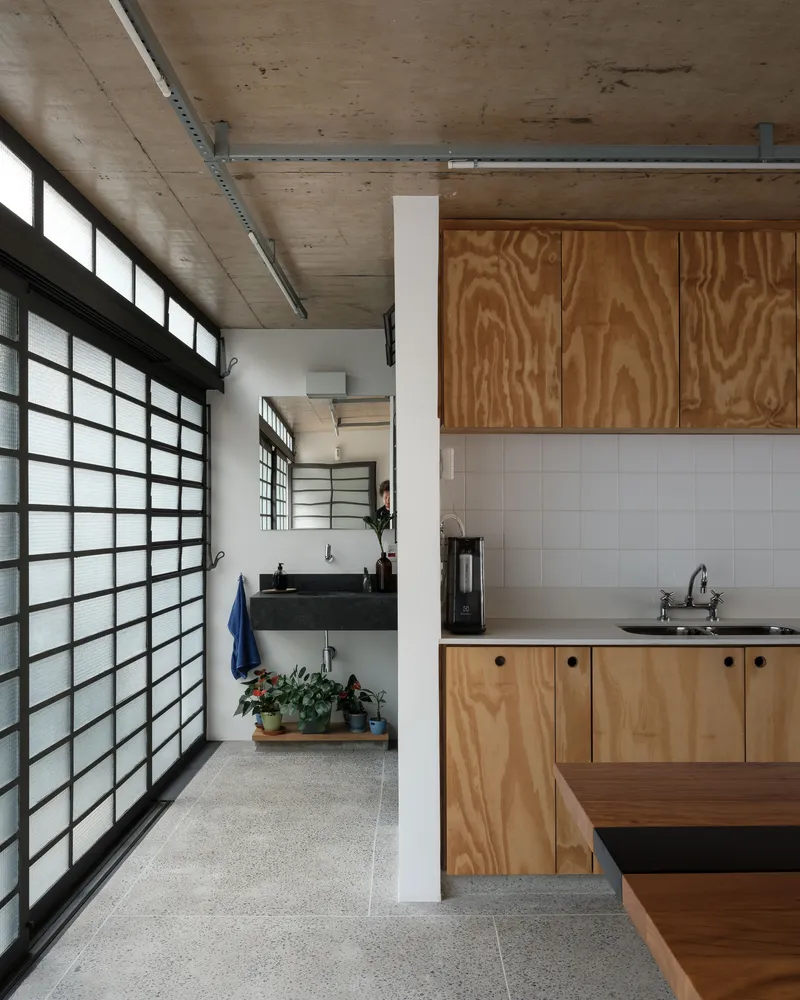

Glass block appears throughout the building, and it is doing real work. The full-height glass block wall at the entry admits a diffuse, even light into the ground floor without opening the interior to direct views from the street. In the kitchen, a gridded glass block wall filters daylight from the street side, illuminating the plywood cabinetry with a soft glow that would be impossible with clear glazing at this proximity to neighbors.
From the exterior, the three-story translucent glass and steel facade reads as a screen, its grid establishing a rhythm that ties together the metal stair, the planted courtyard, and the skylight overhead. The glass block is not a nostalgic gesture. It is a pragmatic solution for privacy, light quality, and thermal performance on a tight urban site.
Workspace Interiors: Plywood, Concrete, Precision

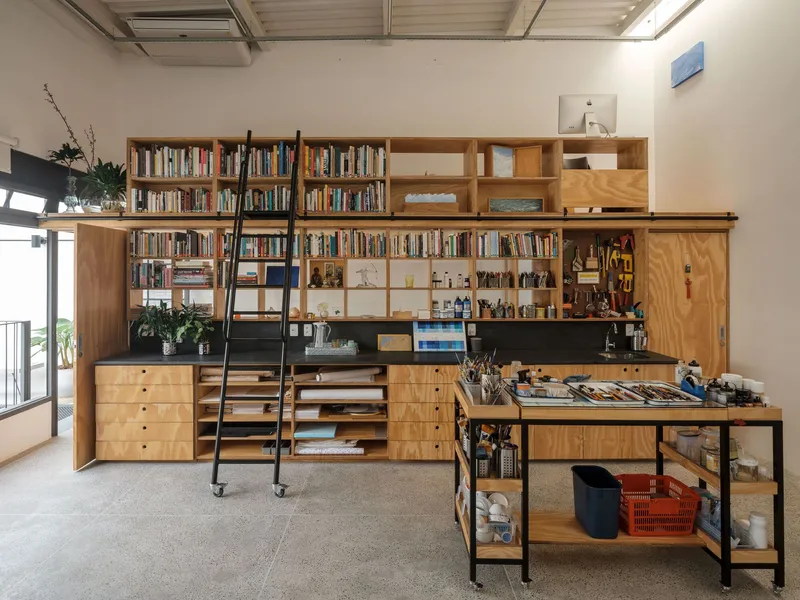
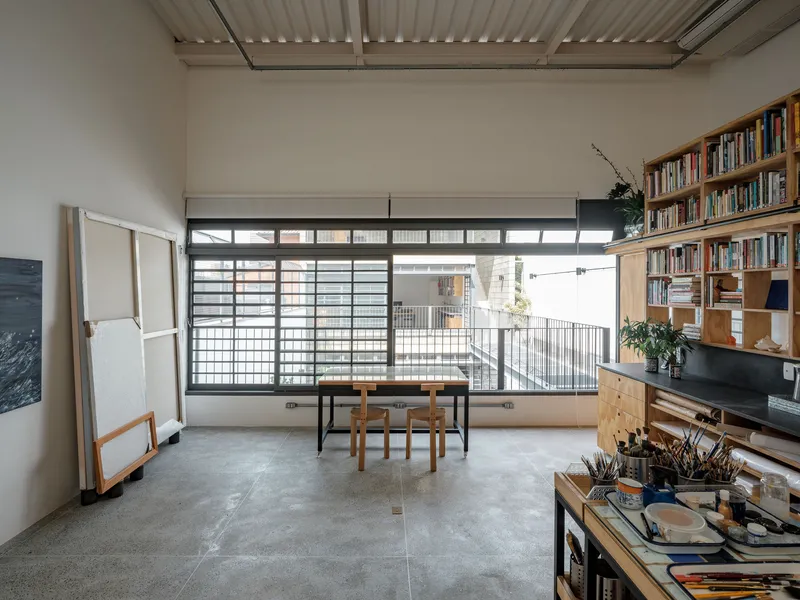
The studio spaces are defined by plywood. Floor-to-ceiling plywood shelving walls with rolling library ladders organize books, supplies, and tools. The corrugated metal ceiling in the upper studio catches light from a gridded skylight above, bouncing it down into the workspace. A black steel work table sits in the foreground, ready for use. These rooms are not styled for photographs; they are built for work, and the evidence of that intention is everywhere.
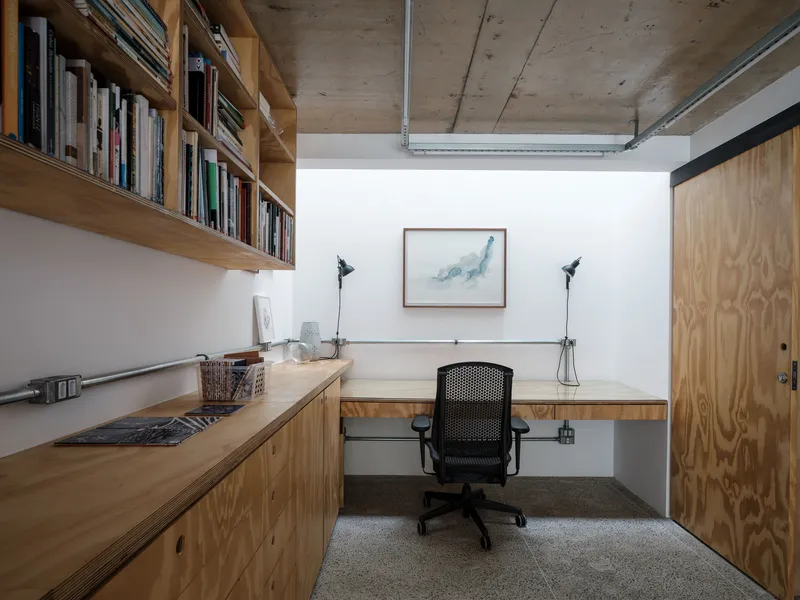
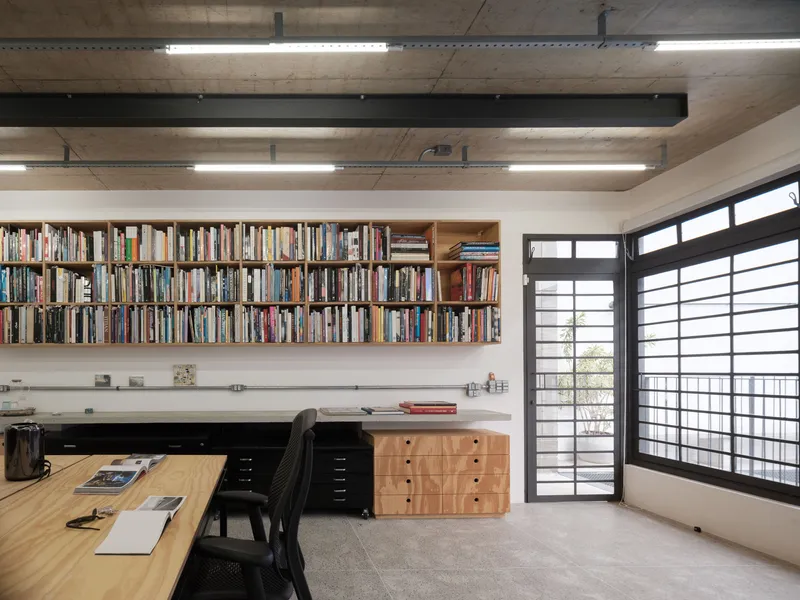

Smaller work areas use built-in plywood desks and floating timber shelves beneath exposed concrete beams, keeping the palette tight and the surfaces functional. The reading room deploys a gridded steel window wall that looks into the courtyard, a plywood ceiling with linear lighting, and low bookshelves, creating a space that is at once intimate and visually connected to the building's green core. Every millwork detail was executed by ND Marcenaria, and the joints show a level of care that matches the ambition of the architecture.
Kitchen and Gathering Space

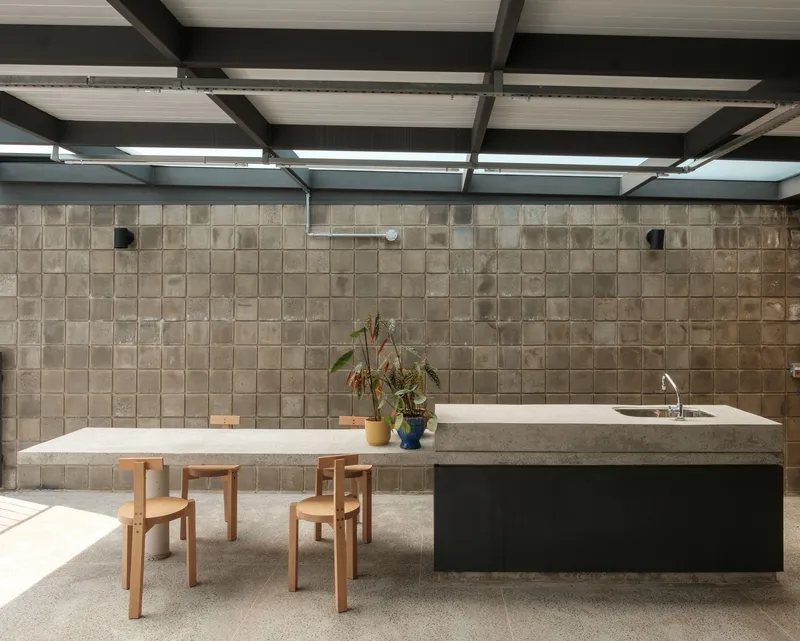

The brief called for the studio to double as a social gathering space, and the kitchen and dining area deliver on that promise. A concrete island anchors the dining zone, surrounded by timber chairs and framed by a beige tile wall and exposed steel ceiling beams. The kitchen itself pairs plywood cabinet doors with a white tile backsplash and terrazzo flooring, keeping the material palette consistent with the rest of the building while introducing a domestic warmth.
The concrete countertop with its stainless steel sink, set against glazed tile and plywood, is a detail that summarizes the entire project: honest materials, precise craftsmanship, nothing concealed. The metalwork by Militão Serralheria and the stone by Marmoraria Lagonegro hold their own against the architects' concrete frame.
Bridges, Stairs, and Vertical Life


Circulation in this building is a performance. Metal mesh walkways span the courtyard at the upper levels, their perforated surfaces allowing light and rain to pass through. The exterior metal staircase ascends past translucent glazed walls and a glazed roof canopy, creating a sequence that alternates between enclosure and exposure. A person ascending the stair at twilight, captured in one of Kok's images, becomes a figure in a stage set.


The courtyard's planted bed is visible from every level, through gridded windows, from walkways, and from the terraces above. Ribbed metal cladding on one courtyard wall casts diagonal shadows that shift through the day, adding a temporal dimension to the experience of moving through the building. The architecture ensures that you are never more than a glance away from green.
Plans and Drawings
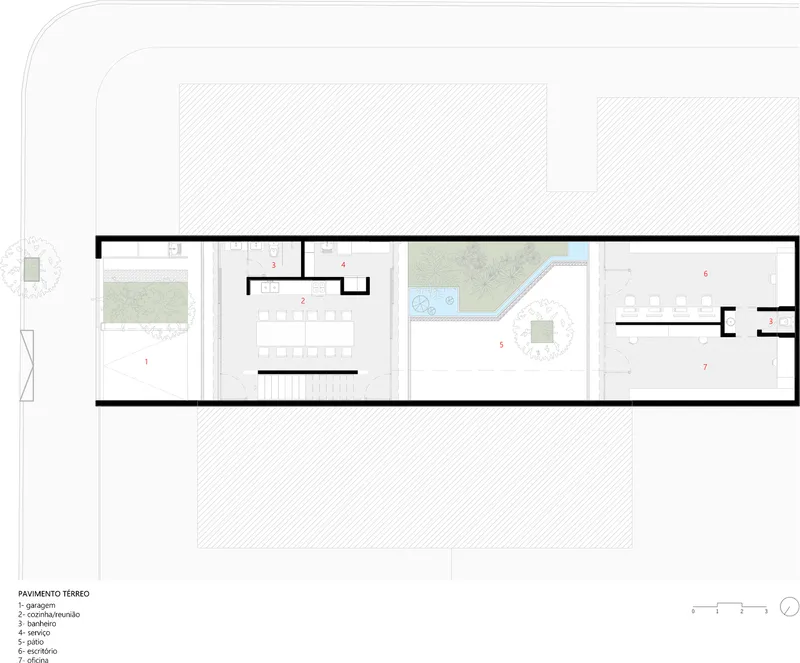

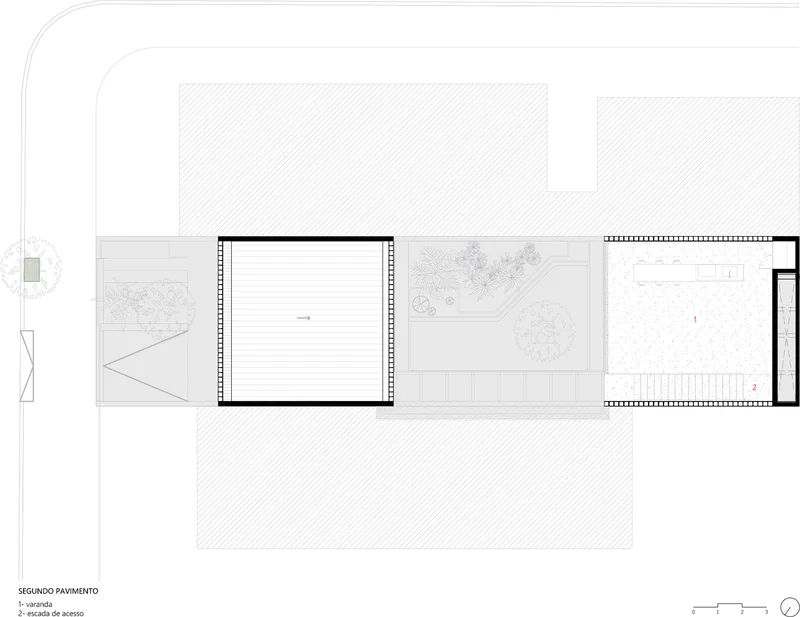


The floor plans make the strategy legible. At the ground level, a garage, kitchen, pool, and courtyard with circular tree plantings establish the public layer. The first and second floors arrange interior rooms on either side of the central courtyard, each with direct visual and physical access to the planted core. The roof plan confirms the two-courtyard arrangement, with slatted infill and planted areas providing shade and ventilation from above.
The longitudinal sections are the most revealing drawings. They show how the split-level volumes step down toward the courtyard, how the pool sits at the base, and how the trees grow up through the building's section. The axonometric section drawing makes it clear that every level engages the courtyard differently: ground level through the planting, middle level through the walkway, upper level through the skylight. It is a compact building with a tall section, and the drawings prove that density and generosity are not mutually exclusive.
Why This Project Matters
São Paulo is full of buildings that turn their backs on their sites, sealing off interior space from a city that can feel relentless. ASA Sandra and Albano Studio does something different. It creates its own environment, a courtyard microclimate of filtered light and tropical green, and then organizes every room to benefit from it. The result is a workspace that feels both protected and alive, private from the street but open to the sky. For 210 square meters, the building contains an improbable richness of spatial experience.
23 SUL's achievement here is in discipline. The material palette is narrow: concrete, plywood, glass block, perforated metal, ceramic tile. The structural logic is straightforward: a concrete frame with steel connectors. But the arrangement of these elements around a single planted void produces a building that changes character at every level, at every hour, and in every season. It is a reminder that constraint, when paired with spatial intelligence, produces architecture that is both economical and generous.
ASA Sandra and Albano Studio by 23 SUL (Gabriel Manzi, Ivo Magaldi, Luiz Florence, Moreno Zaidan Garcia, Tiago Oakley). São Paulo, Brazil. 210 m², completed 2023. Landscape architecture by Klara Kaiser and Koiti Mori. Photography by Pedro Kok.
About the Studio
Share Your Own Work on uni.xyz
If projects like this are the kind of work you want to make, uni.xyz is a place to publish your own, find collaborators, and enter design competitions.



Popular Articles
Popular articles from the community


Hill & Cross Opera: Sculptural Opera House Architecture Shaped by Tallinn’s Landscape and Identity
Hill & Cross Opera reimagines opera house architecture in Tallinn through its sculptural hill, civic plaza, glass wave and a luminous cross.

The Earth Pod: 3D Printed Homes for Resilient Refugee Communities
The Earth Pod reimagines refugee housing through 3D printed homes made from clay, combining resilience, self-sufficiency, and rapid shelter.

The Musturak Paradise: Senior Living Architecture for a Connected Future in Temara, Morocco
The Musturak Paradise reimagines senior living architecture in Temara via private homes, social spaces, culture, community, and shared care.

Play: Fragments of Their World
Familiar architecture becomes modular playground design, creating safe spaces where displaced children can learn, connect, imagine and play.

Similar Reads
You might also enjoy these articles

Bao Huynh Watercolor Atelier: A Serene Art Retreat in Hội An
Bao Huynh Watercolor Atelier in Hội An blends multifunctional art spaces, sustainable design, local materials, and family-friendly living in a serene environment.

Atelier Macri Concept Store Interior Design by CASE-REAL
Atelier Macri store features a "ko" counter, walnut wood details, cork displays, blending retail, gallery, and seamless customer experiences.

Manuel Vargas Izquierdo Stadium and High-Performance Sports Center: Architectural Excellence in Jalpa de Méndez
The Manuel Vargas Izquierdo Stadium blends sustainable design, inclusive sports facilities, and cultural-inspired architecture, revitalizing Jalpa de Méndez’s public spaces.
KAKR Buluh Awar Hall: Revitalizing Community and Ecology Through Bamboo Architecture
Community built bamboo hall revitalizes Buluh Awar village, empowering youth, restoring ecology, celebrating vernacular craftsmanship through sustainable architecture and culture.





Comments (0)
Please login or sign up to add comments
No comments yet. Be the first to comment!