
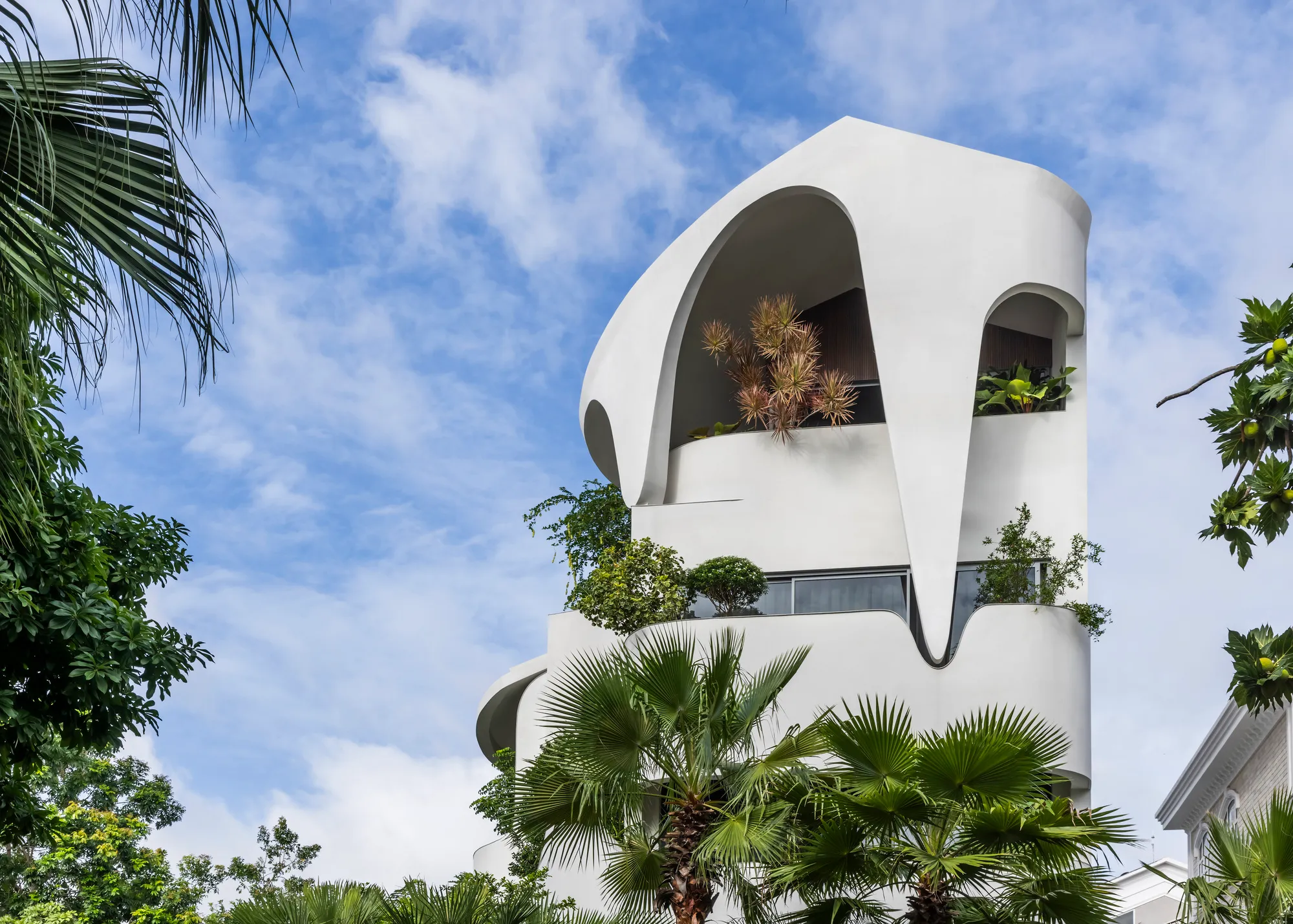
23o5Studio Wraps a Six-Bedroom Ho Chi Minh City Home in Curving White Terraces and Tropical Greenery
A 2000s-era Saigon residence is stripped back and reimagined as a vertical garden of arched balconies and freeform pools.


Most renovation projects in Ho Chi Minh City face the same negotiation: a narrow lot, a structure that has already been rebuilt more than once, and a family whose needs have outgrown whatever the last owner left behind. Bống's House, designed by 23o5Studio and led by architect Ngô Việt Khánh Duy, takes a residence from the early 2000s and essentially reinvents it from the skin inward. The result is a 350 m² home that reads less like a renovation and more like a manifesto for what a dense urban house can feel like when every floor is treated as a garden level.
What makes the project genuinely worth studying is the way it collapses the boundary between structure and landscape across five stories. The clients, a family with an appreciation for traditional painting and artisanal lacquerware, needed six bedrooms, an expansive kitchen, and communal spaces generous enough for daily family life. Rather than stacking rooms behind a flat facade, 23o5Studio sculpted each floor plate into a series of curving terraces, arched openings, and planted ledges that make the house feel open to the sky even in a tight urban block.
A Facade That Grows
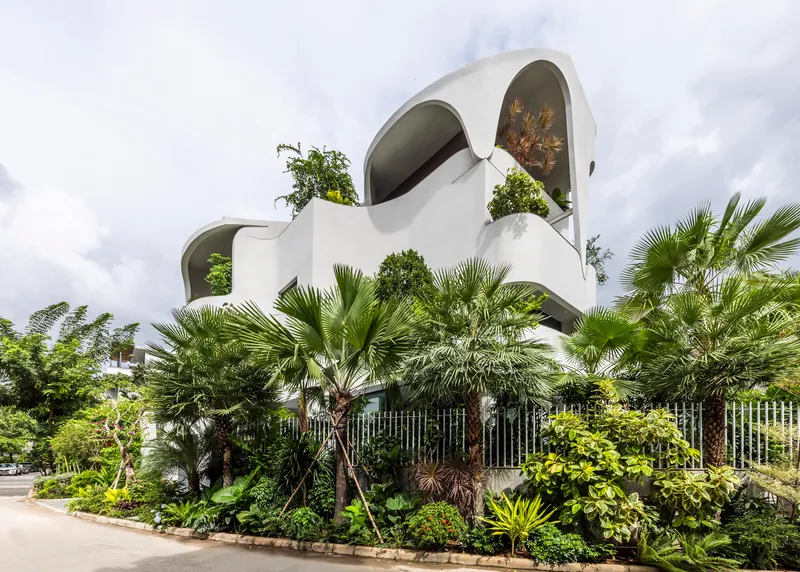
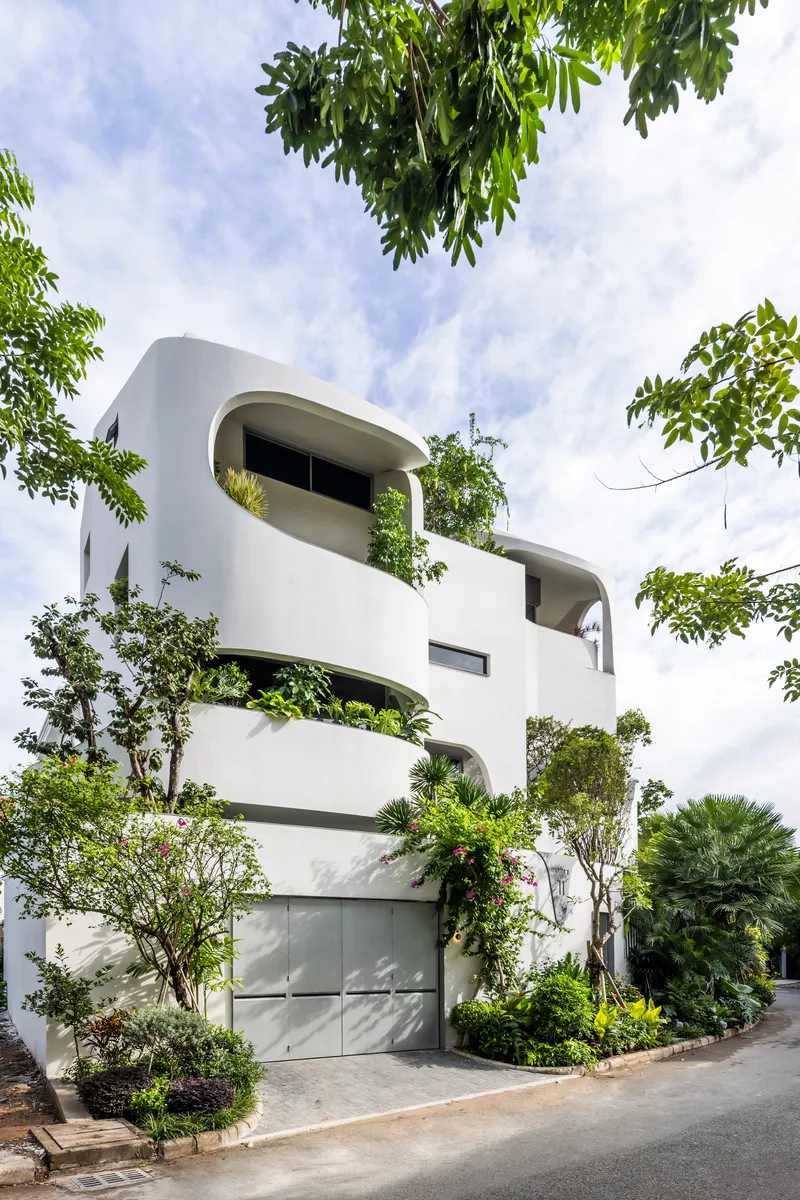
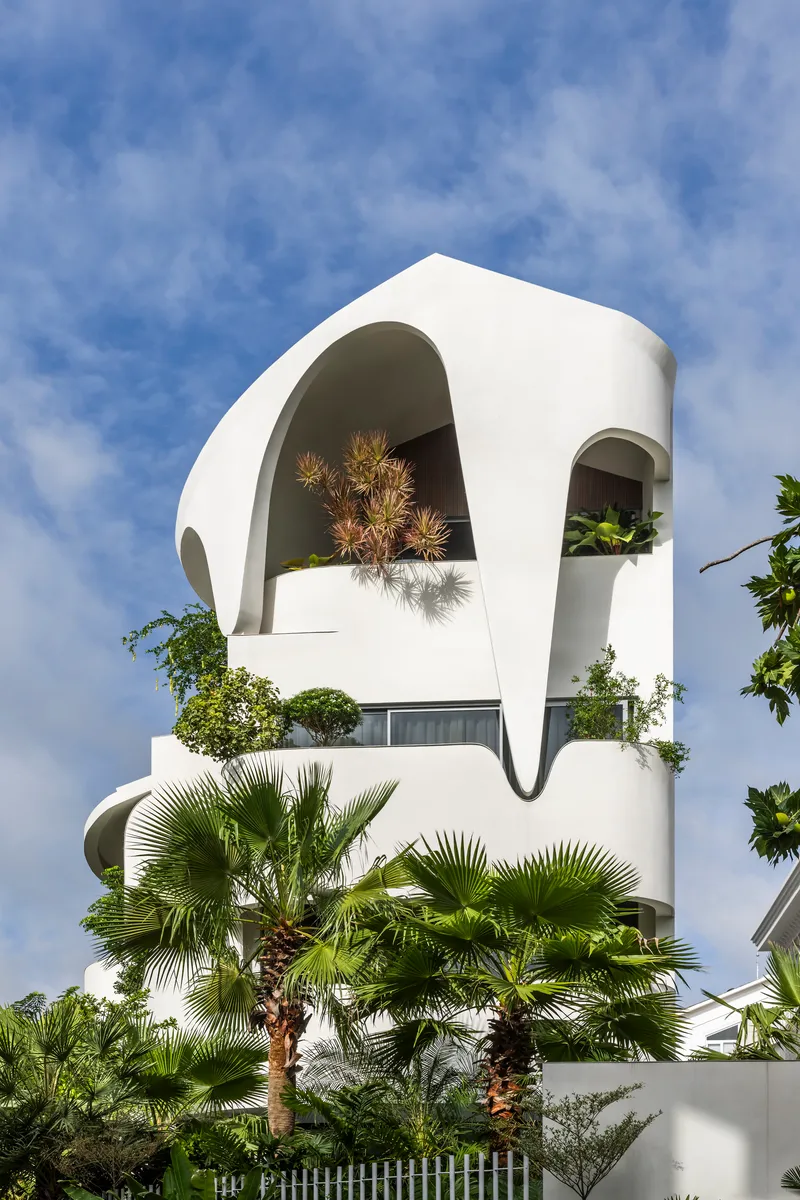
From the street, the house announces itself with stacked white volumes punctuated by large arched openings. The arches are not decorative gestures; they frame planted terraces at every level, allowing potted pines, climbing vines, and trailing greenery to register as part of the architectural composition rather than an afterthought. The effect is a facade that appears to be in the process of being consumed by its own garden, which in Ho Chi Minh City's humid climate is not a metaphor. Things grow fast here, and the design leans into that fact.
The white concrete surfaces are kept deliberately plain, allowing the curves and the plantings to do the expressive work. There is no ornament competing with the foliage. Palm fronds, banana leaves, and monstera spill over edges and through openings, giving the building a softness that its crisp geometry would otherwise lack.
Vertical Terraces and the Spiral Upward
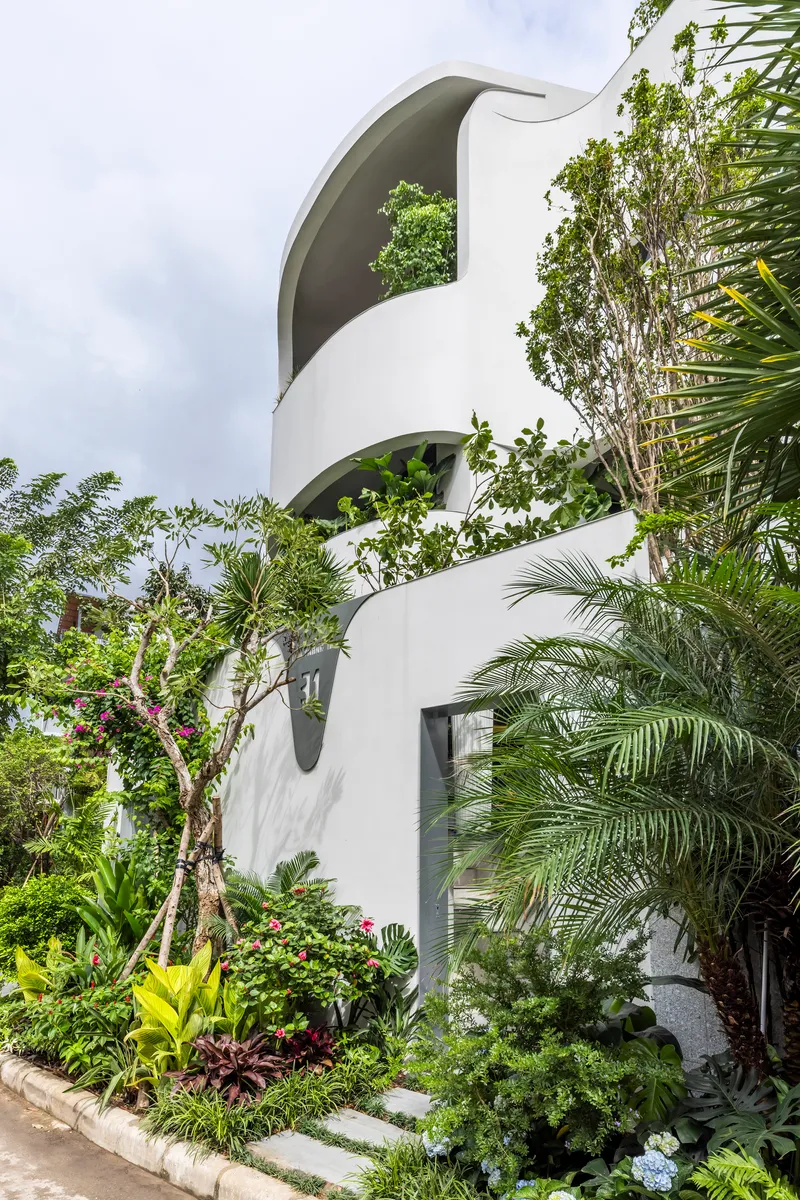
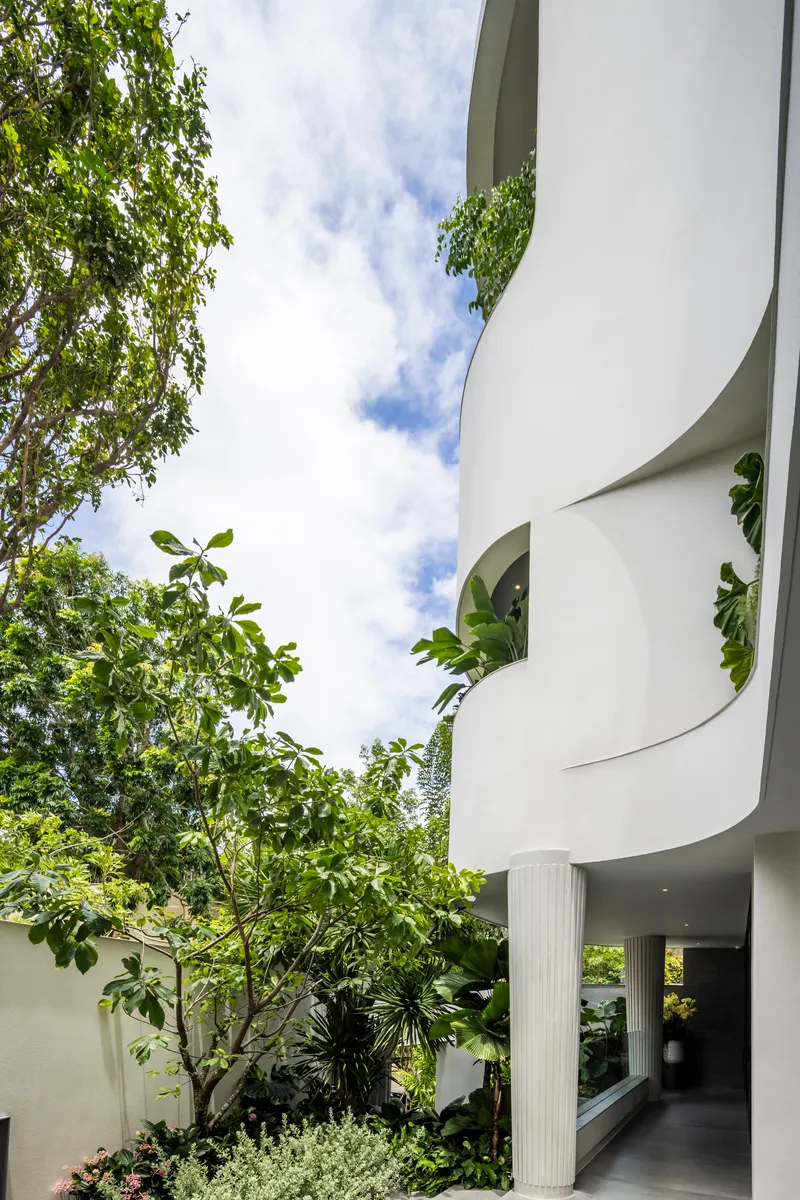
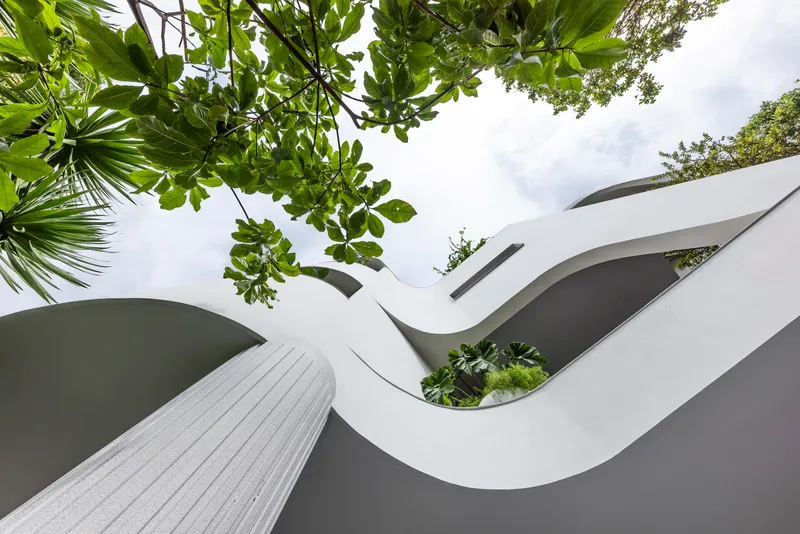
Seen from below, the house reveals its most inventive move: each balcony wraps and shifts slightly from the one beneath it, producing a spiraling effect as the eye travels up. The planted edges blur the floor lines, and the undulating roof forms visible from ground level create a canopy more reminiscent of a treehouse than a five-story urban dwelling. It is an intelligent response to the problem of privacy on a dense block. Rather than screening with walls, the design uses its own geometry and greenery to create visual layering.
The curving soffits overhead, visible in the worm's-eye views, reinforce the organic language. Concrete planters are integrated directly into the balcony slabs, so vegetation is structural rather than portable. Over time, this house will only become more itself.
Ground Level: Pool, Pavilion, and the Collapse of Indoor and Outdoor
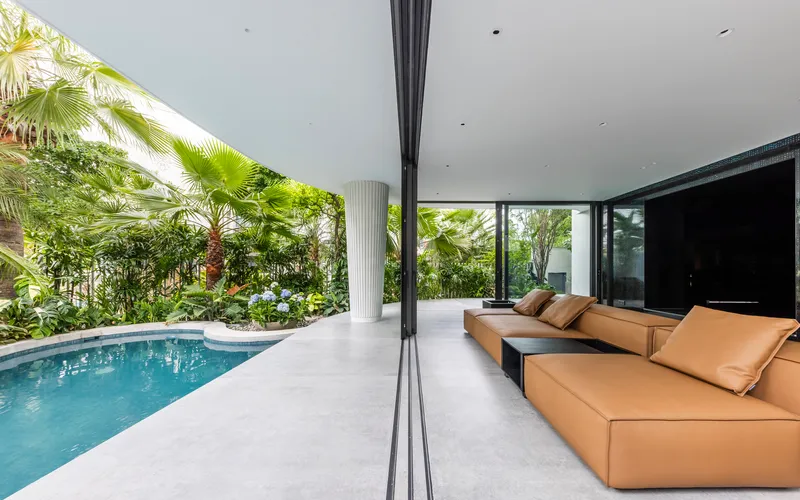
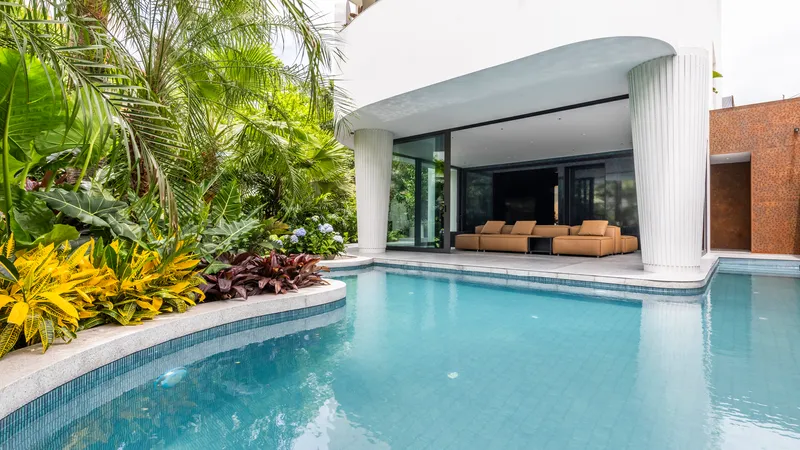
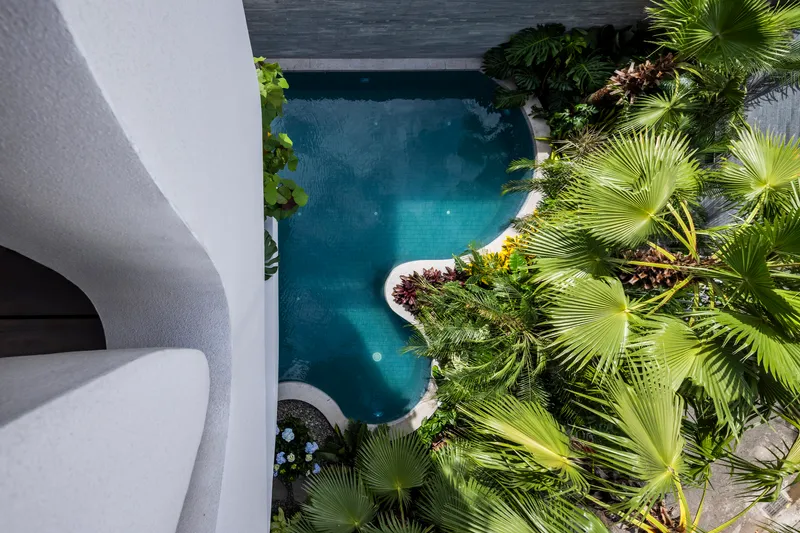
The ground floor is organized around a freeform swimming pool that wraps around a covered terrace supported by fluted columns. The pool itself contains a planted island bed, a detail that turns what could be a simple amenity into a piece of landscape architecture. From the aerial view, the pool reads as an organic shape nestled among palms and curved balconies, as if the house grew around a body of water rather than the other way around.
The living pavilion, with its tan sectional sofa and open sides, dissolves the threshold between interior comfort and garden. Glass sliding doors and perforated metal screens allow the family to modulate the degree of openness depending on weather and mood, but the default setting is wide open.
Screens, Thresholds, and Filtered Light
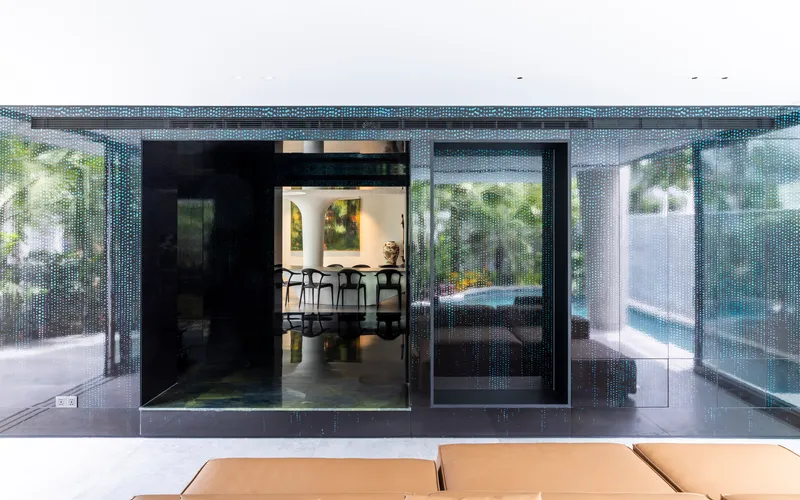
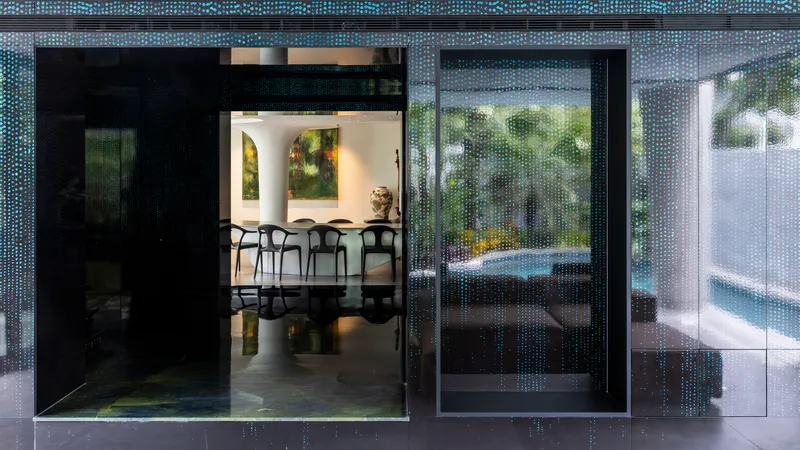
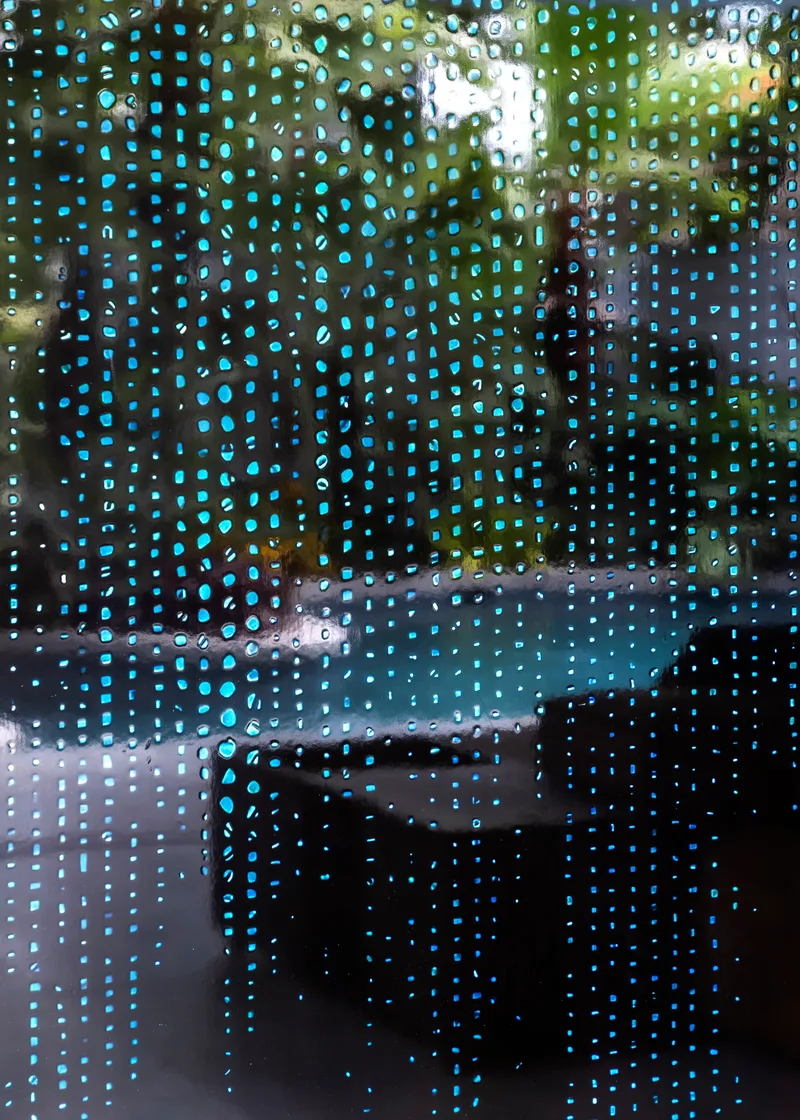
Perforated metal screens play a quiet but essential role throughout the house. They appear at the boundary between terraces and interior rooms, casting patterned shadows across floors and walls while filtering views of the garden into soft, impressionistic layers. The close-up of the screen material reveals a density of pattern that recalls traditional Vietnamese lattice work without copying it directly.
These screens also serve a practical climate function. In Ho Chi Minh City, direct sun can be brutal, and the perforations allow air movement while cutting solar gain. Combined with the deep overhangs of the curved terraces, the house has a layered environmental strategy built into its aesthetics.
Kitchen, Dining, and the Organic Ceiling
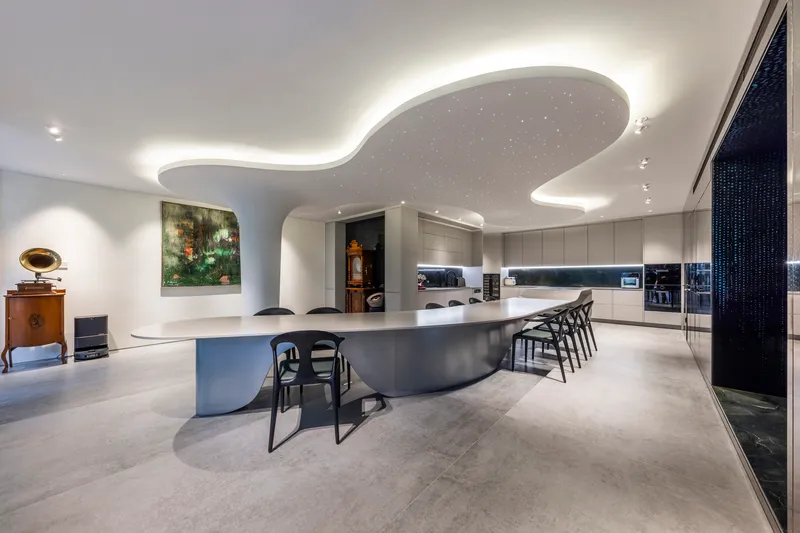
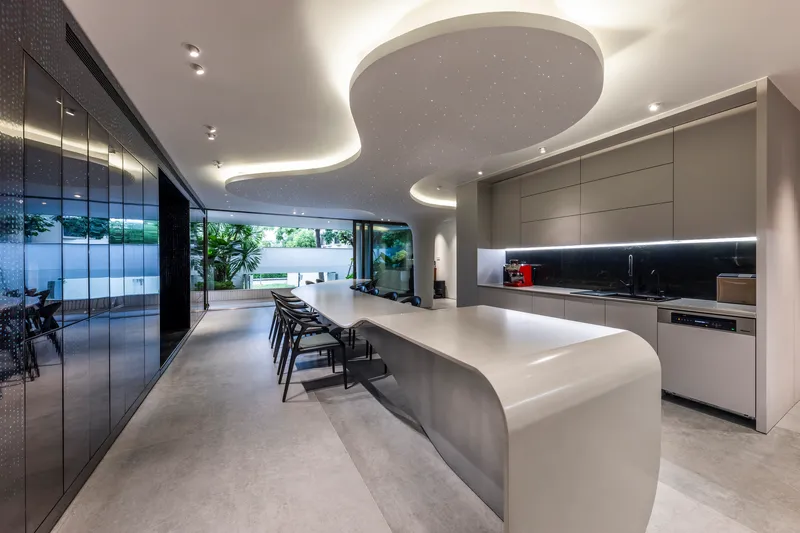
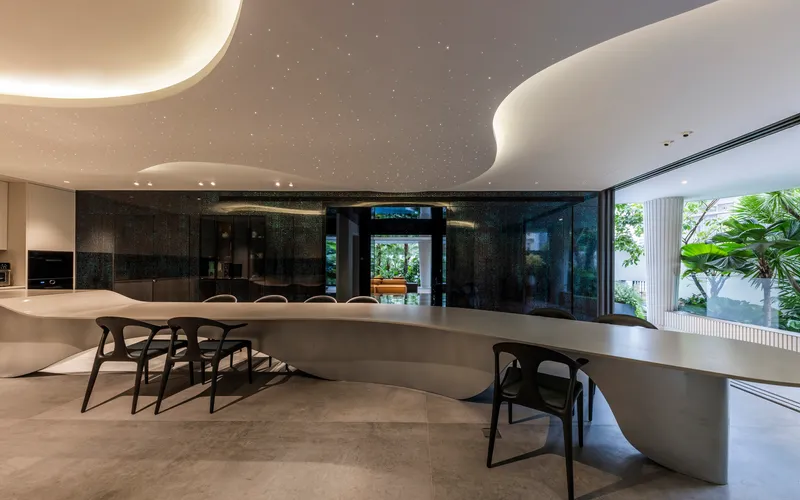
The kitchen and dining area is the social center of the house, and 23o5Studio treats it accordingly. A curved island anchors the space, while an organic ceiling element above, finished with concealed uplighting, creates a floating cloud-like form that defines the dining zone without enclosing it. The cutout in the ceiling opens to a courtyard above, pulling natural light deep into the plan.
There is a seriousness to the material palette here. Dark cabinetry, backlit ceiling planes, and a curved white counter give the room a composed, deliberate atmosphere that contrasts with the lush informality of the terraces. For a family that values artisanal lacquerware and traditional painting, this space reads as a kind of gallery for everyday life.
Bedrooms and Bathrooms as Garden Rooms
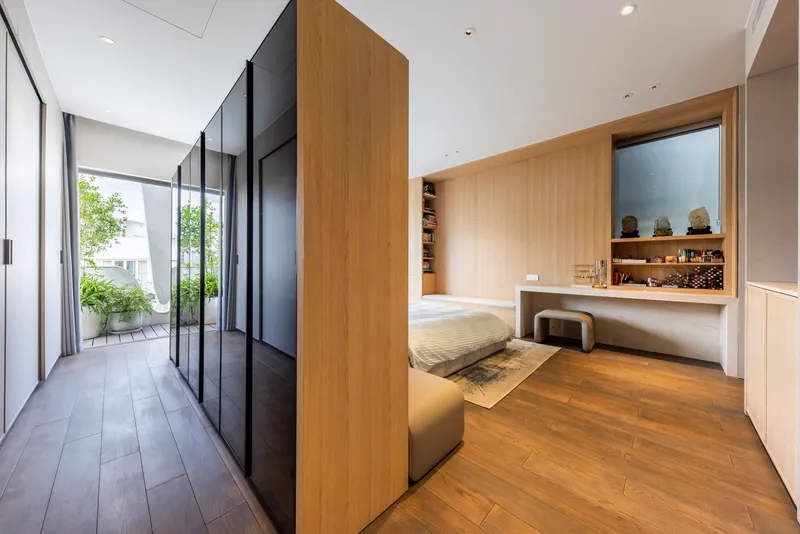
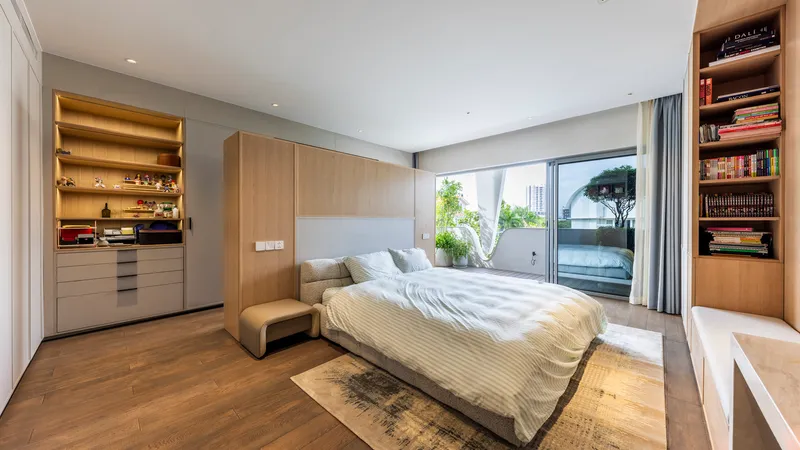
The six bedrooms are distributed across the upper floors, each opening to a planted terrace or balcony. Timber-clad partitions, light wood millwork, and built-in shelving give the rooms warmth and order, while sliding glass doors ensure that greenery is never more than a step away. The design avoids the trap of making every room identical; each has its own relationship to the exterior, shaped by the shifting geometry of the terraces.
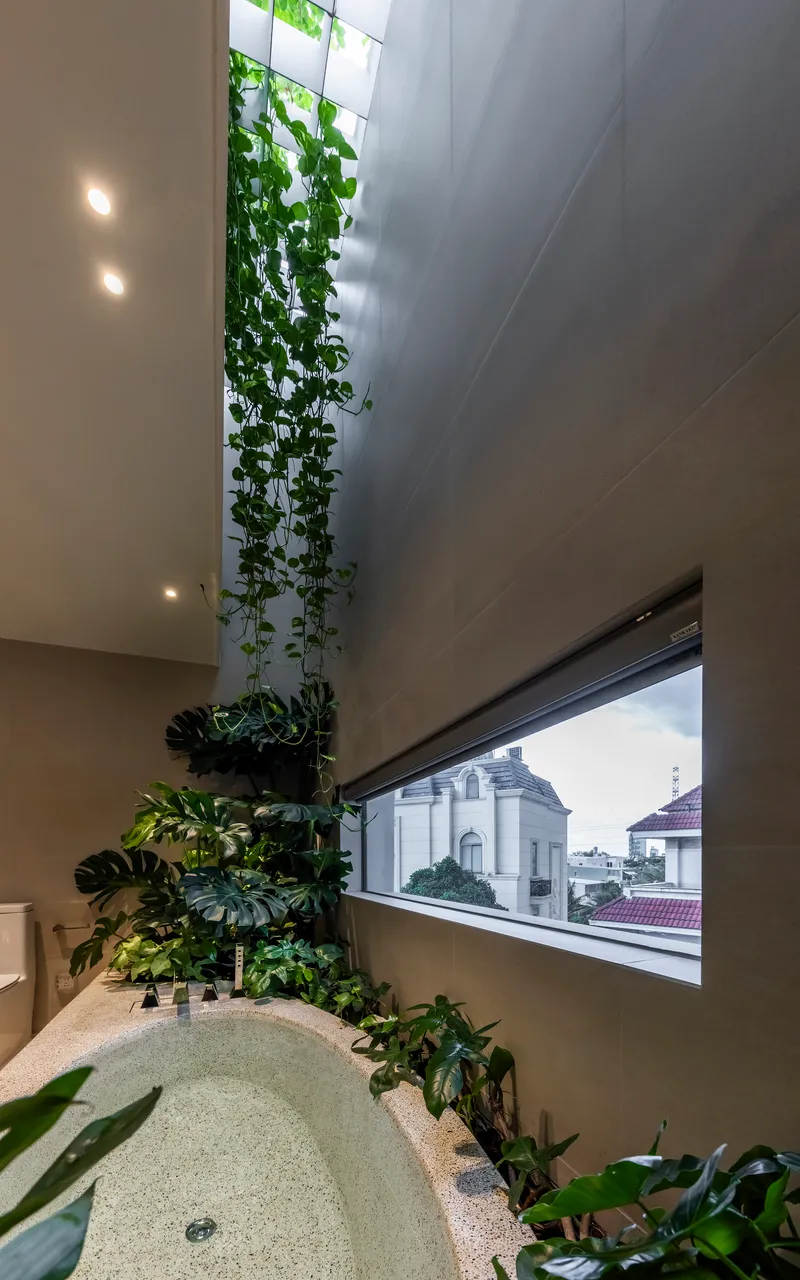
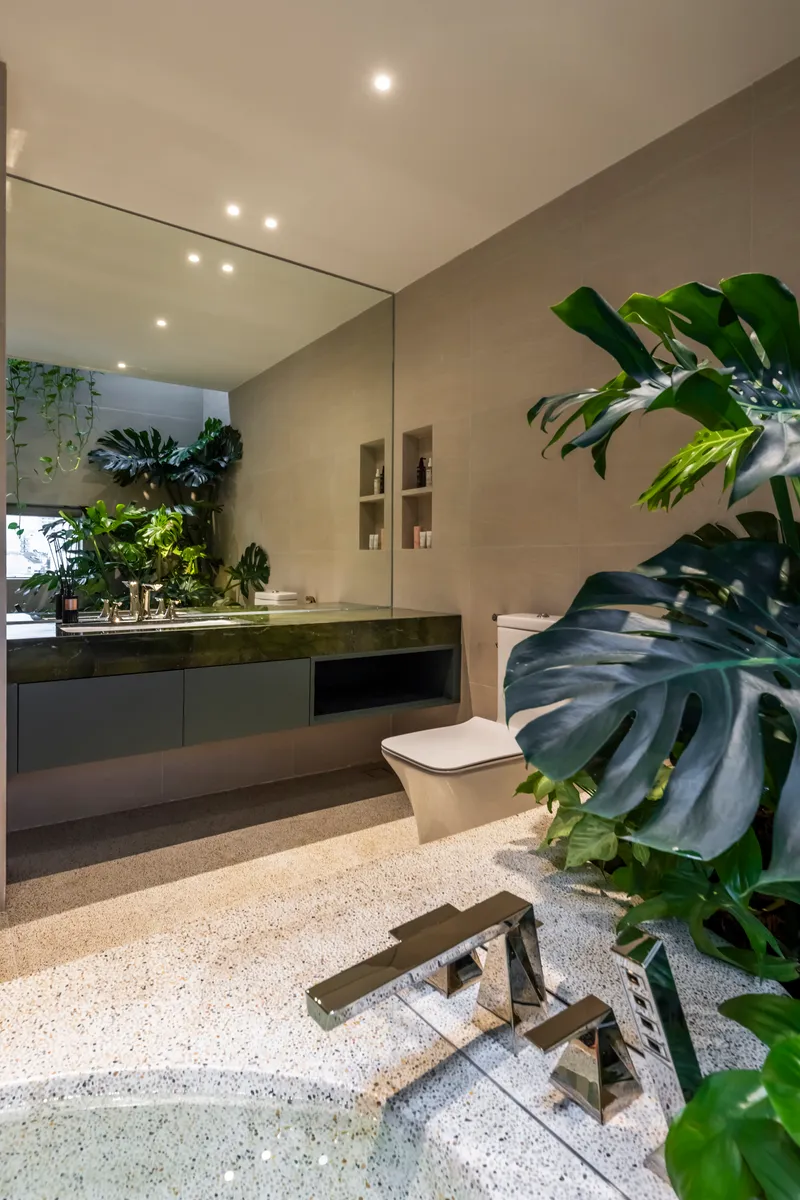
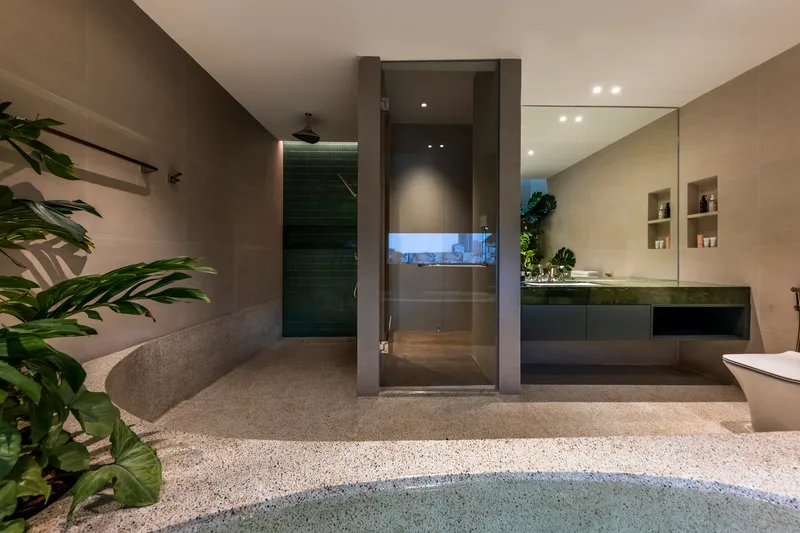
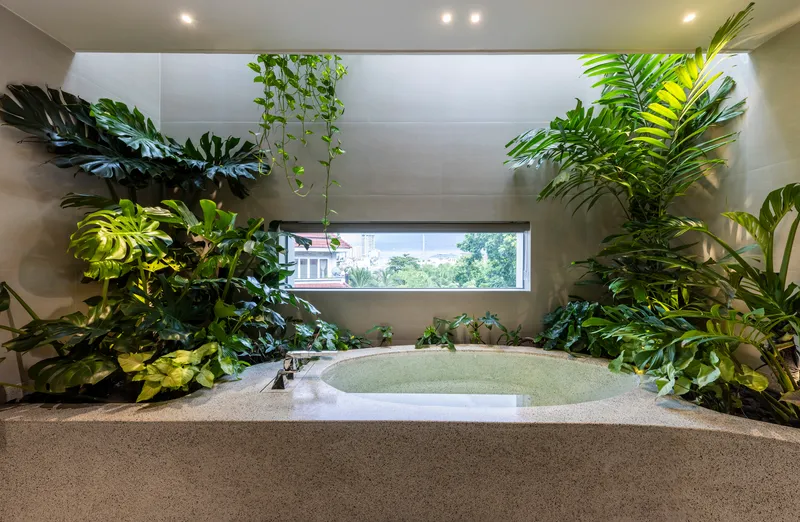
The bathrooms are where the house's commitment to interiors-as-landscape becomes most vivid. One features a bathtub surrounded by monstera and hanging vines cascading from a skylight, turning a daily ritual into something bordering on theatrical. Terrazzo flooring, timber stepping stones, and floating mirrors contribute to rooms that feel more like curated conservatories than utility spaces. It is excessive, yes, but it is excessive in service of a clear idea.
Rooftop and Upper Terraces
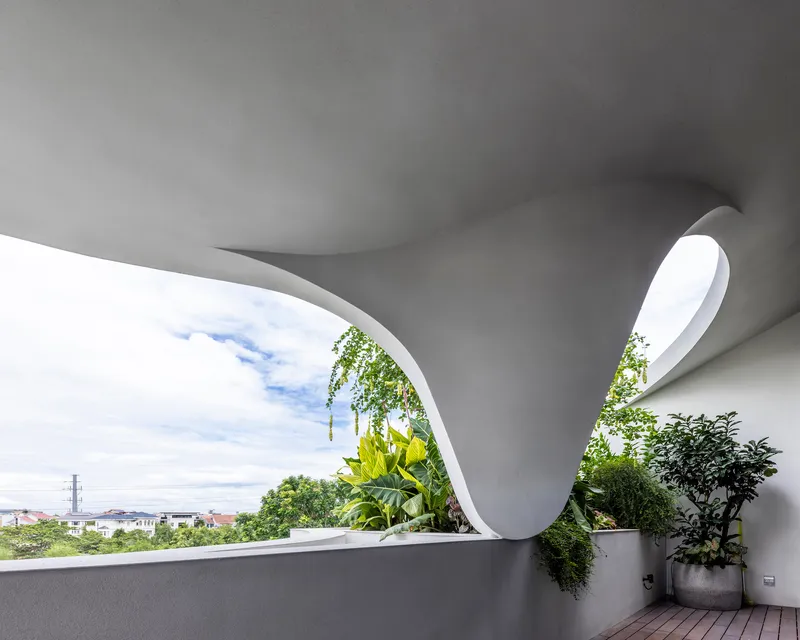
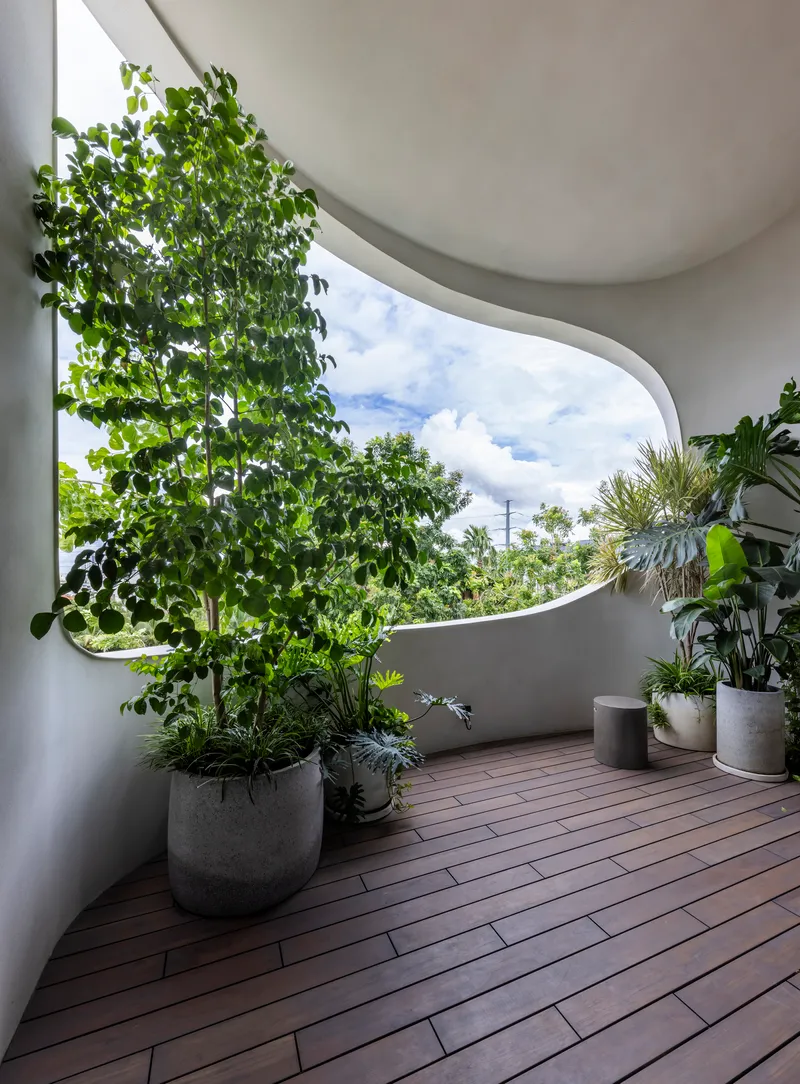
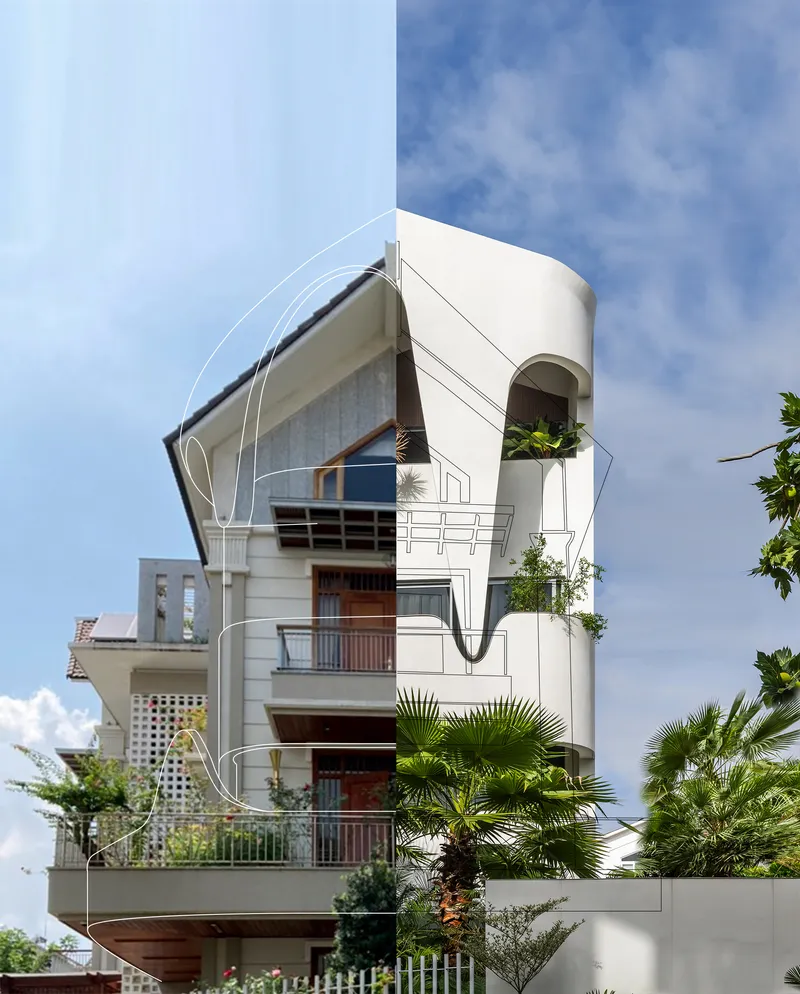
At the upper levels, the terraces open outward to the surrounding neighborhood skyline. Curved balconies with timber decking and concrete planters provide outdoor rooms that feel private despite their elevation. The rooftop, capped by a glass pavilion, offers a final layer of program: a place for entertaining or simply watching the city from within a cocoon of greenery.
The cylindrical volumes visible on the facade resolve at this level into functional elements: stair enclosures, planter housings, and light wells. Nothing is purely formal. Every curve has a job, even if that job is simply holding soil for a banana plant.
Plans and Drawings
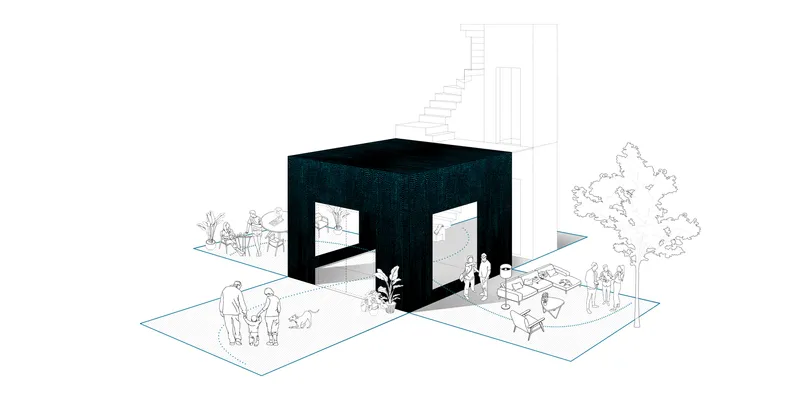
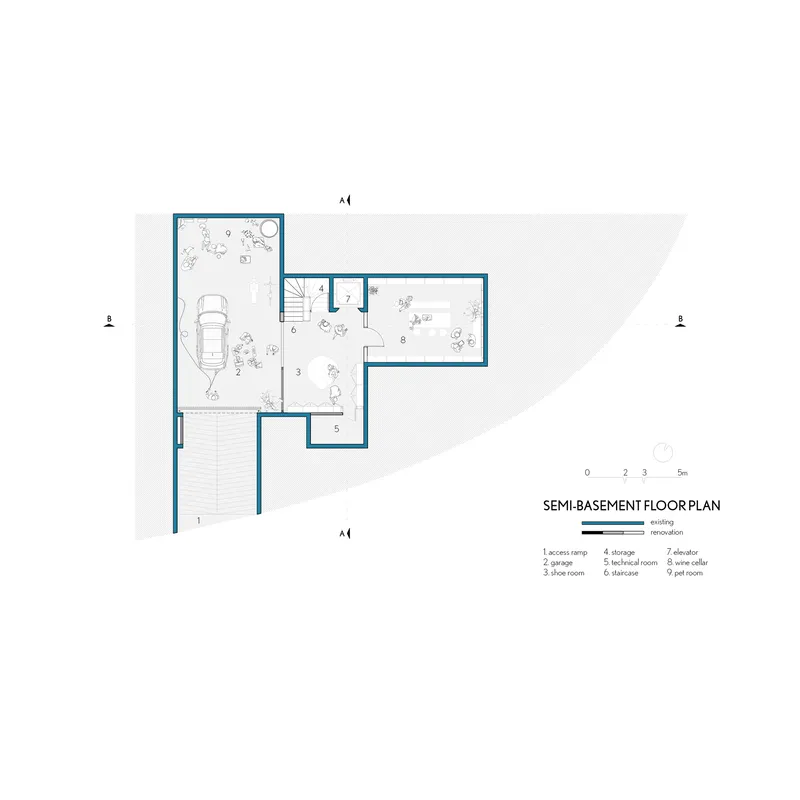
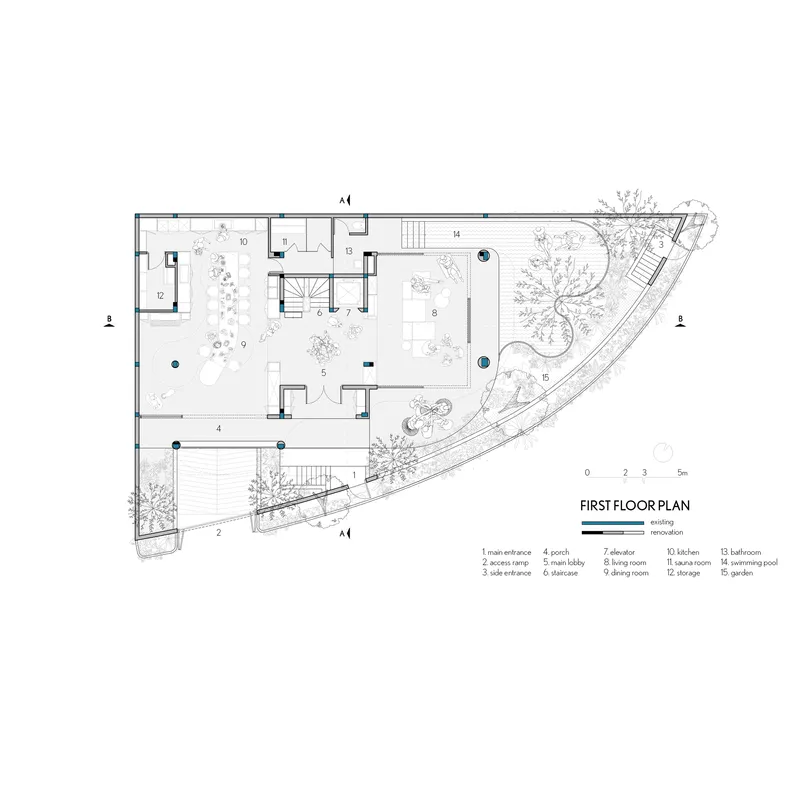
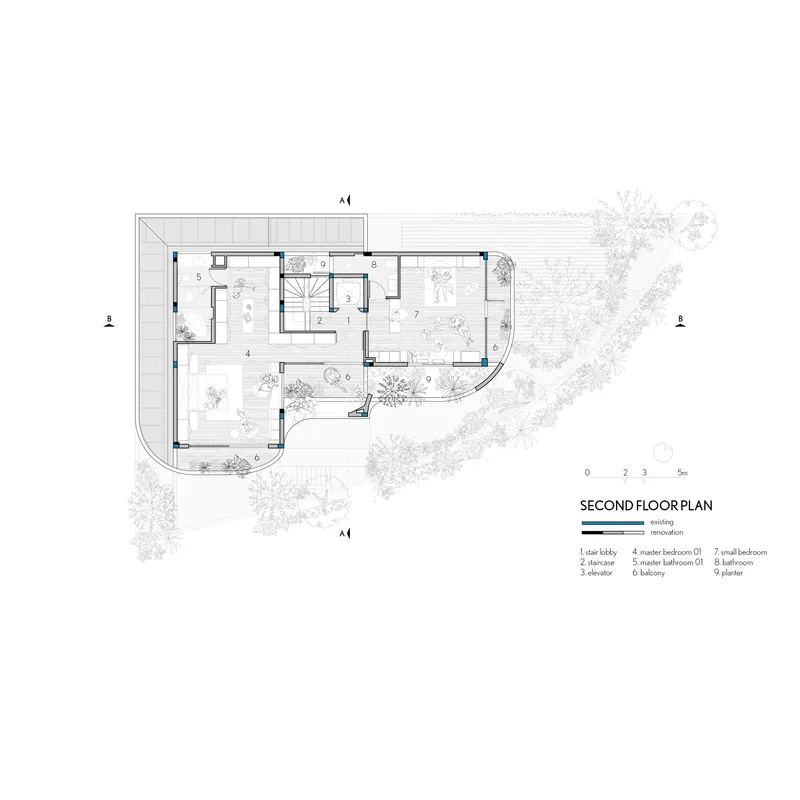
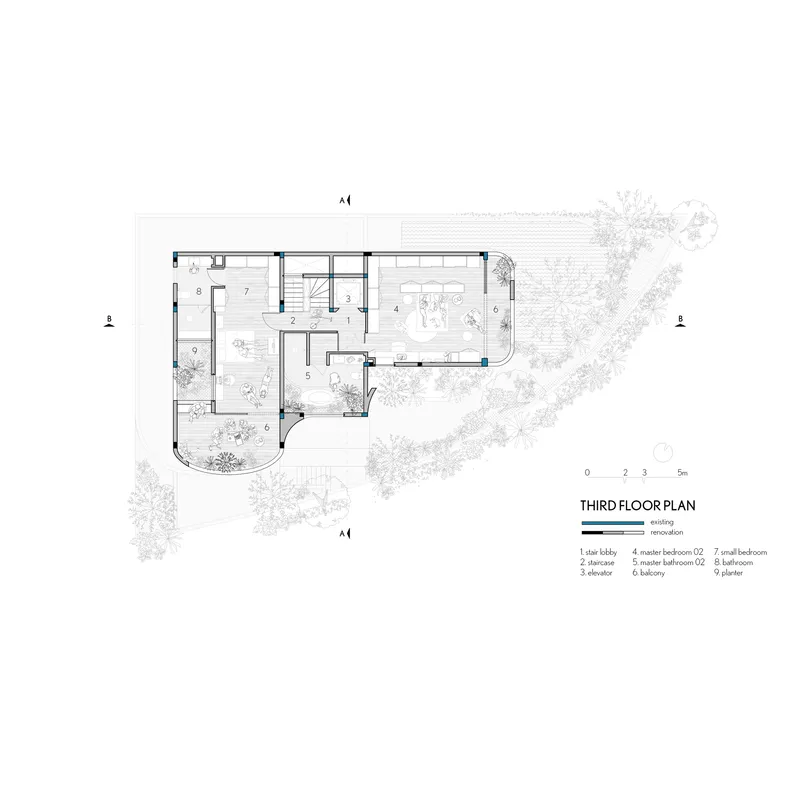
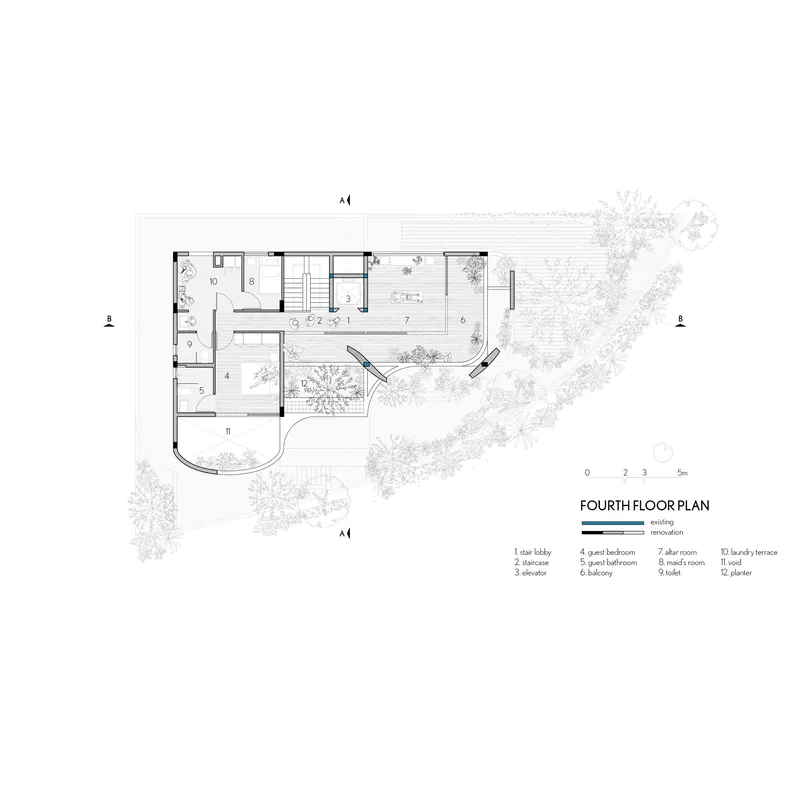
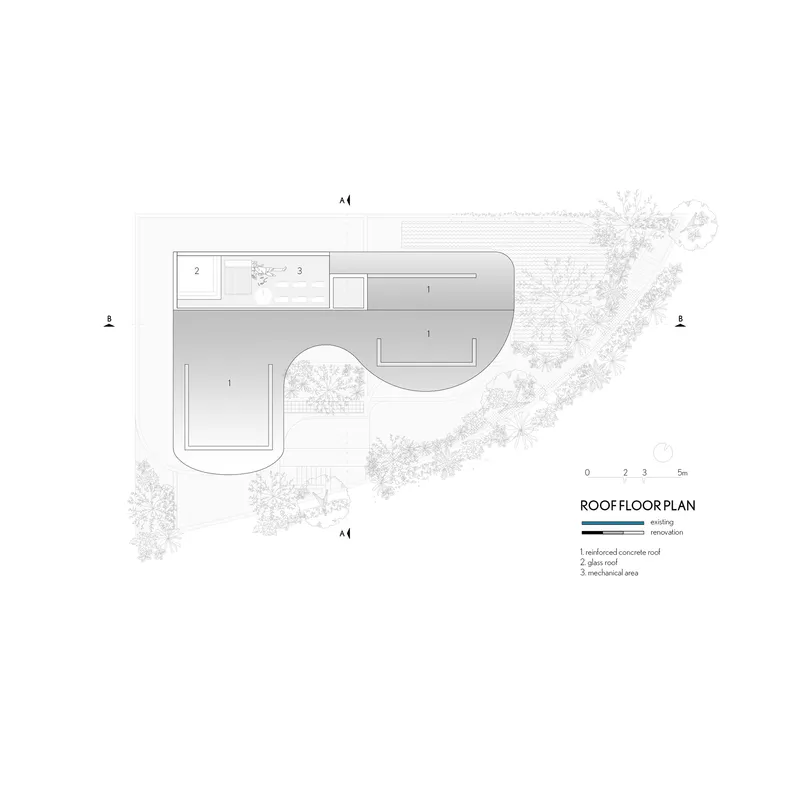
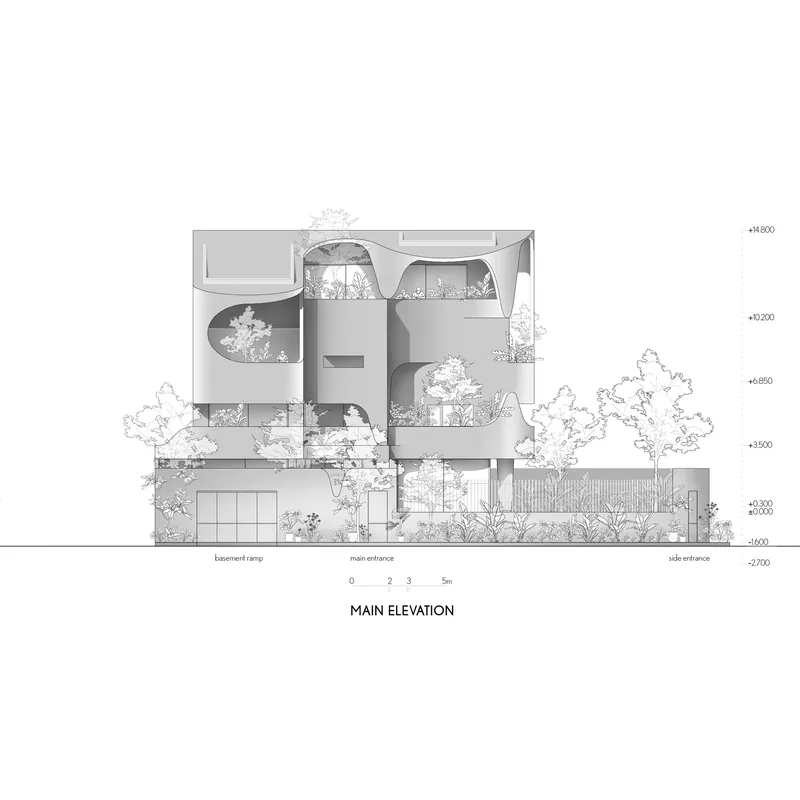
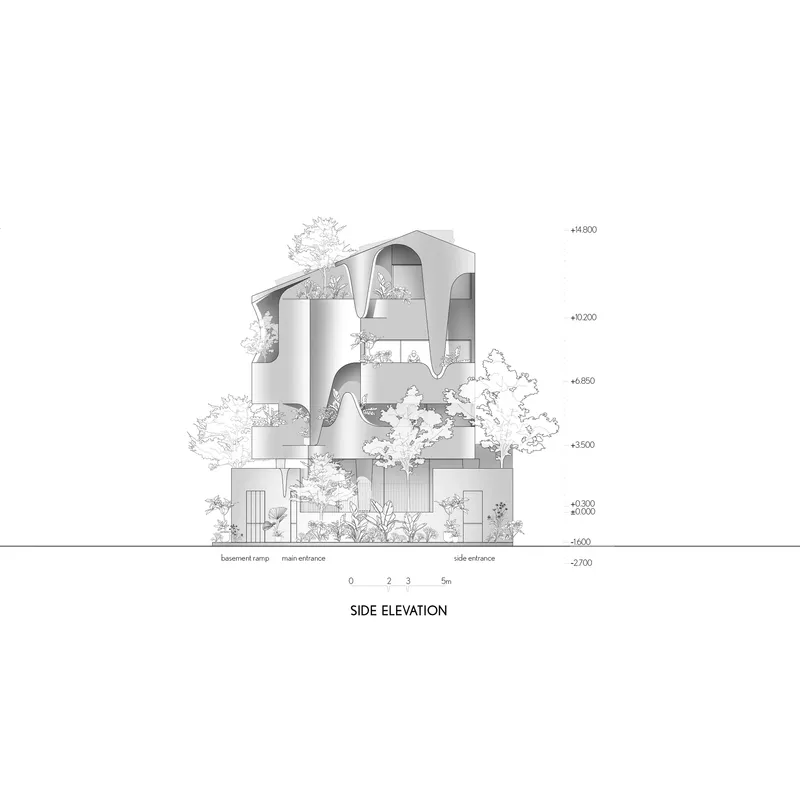
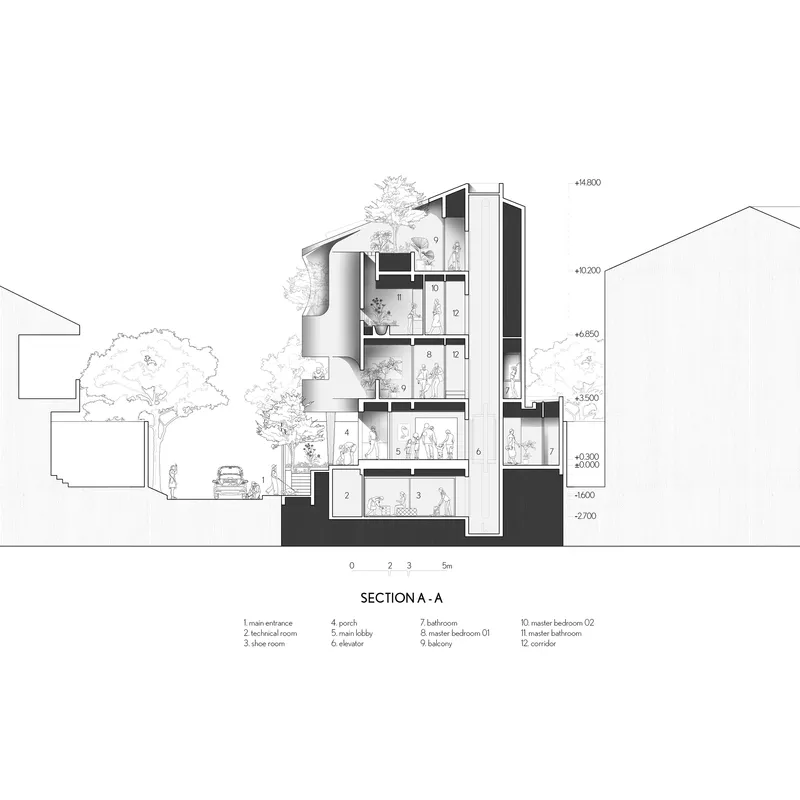
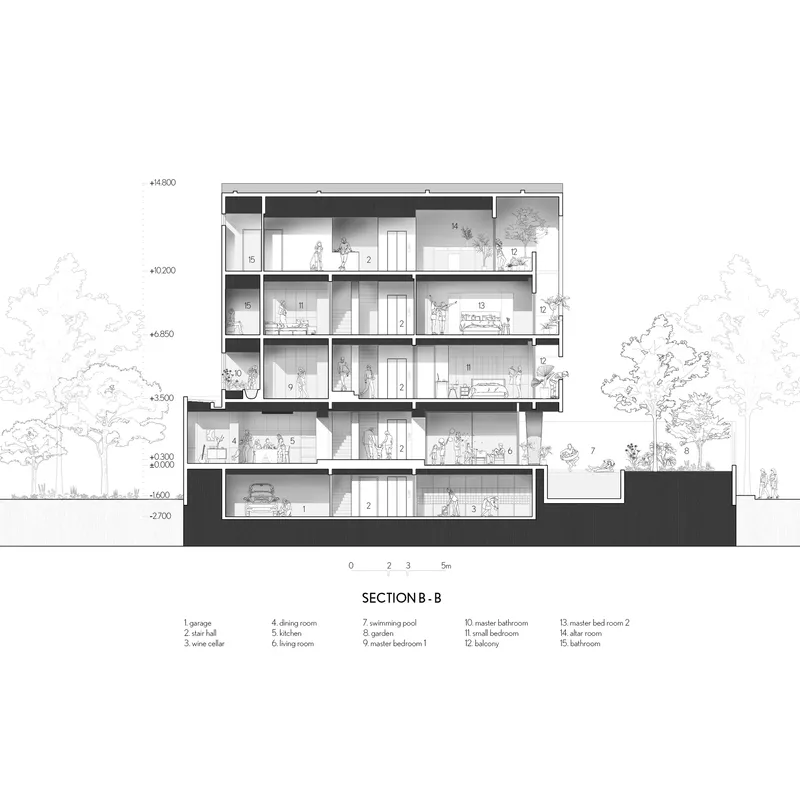
The drawings reveal what the photographs only hint at: the house is organized around a triangular garden at the first floor that contains the pool and primary landscape, with the upper floors progressively shifting their footprints to create the terraced effect. The sections show a full five stories plus a semi-basement for parking and technical spaces, with voids and skylights threading natural light through the stack. The axonometric drawing is particularly instructive, showing how a dark cubic volume is carved open by terraces and planted edges on every side, turning what could be a sealed box into a breathing organism.
Floor plans confirm the density of program: six bedrooms are distributed across the second through fourth floors, each floor also accommodating generous balconies and planted terraces along the angled perimeter. The roof plan shows the glass pavilion and curved terrace as a final crown, completing the vertical sequence from basement garage to sky garden.
Why This Project Matters
Bống's House matters because it demonstrates that renovation in a dense tropical city does not have to mean compromise. With 350 m² and six bedrooms to accommodate, the easiest path would have been to maximize floor area and treat the facade as a wrapper. Instead, 23o5Studio surrendered significant buildable volume to terraces, voids, planters, and a freeform pool, betting that the quality of space would more than compensate for the loss of square meters. That bet pays off. The house feels larger than it is, cooler than it should be, and more alive than any sealed box could manage.
More broadly, the project offers a convincing model for how existing housing stock in Southeast Asian cities can be transformed rather than demolished. The original 2000s structure, already modified by previous owners, becomes the armature for something genuinely new. The curving terraces, the arched openings, the integration of planting at a structural level: these are not cosmetic upgrades. They represent a rethinking of what a vertical house in Ho Chi Minh City can be. For a city building upward faster than it can build outward, that rethinking is overdue.
Bống's House by 23o5Studio, lead architect Ngô Việt Khánh Duy. Ho Chi Minh City, Vietnam. 350 m², completed 2024. Photography by Hirouyki Oki.
About the Studio
Share Your Own Work on uni.xyz
If projects like this are the kind of work you want to make, uni.xyz is a place to publish your own, find collaborators, and enter design competitions.




Popular Articles
Popular articles from the community


Play: Fragments of Their World
Familiar architecture becomes modular playground design, creating safe spaces where displaced children can learn, connect, imagine and play.

The Musturak Paradise: Senior Living Architecture for a Connected Future in Temara, Morocco
The Musturak Paradise reimagines senior living architecture in Temara via private homes, social spaces, culture, community, and shared care.

The Ocean Hive: Sustainable Architecture for a Self-Sufficient Civilization at Sea
The Ocean Hive imagines sustainable architecture at sea, where modular habitats, algae, wave power and ocean waste sustain a growing colony.

Lunar Spiral: Space Architecture Shaped by the Mathematics of the Universe
Lunar Spiral reimagines space architecture through Fibonacci geometry, lunar regolith, levitating habitats, and self-sustaining Moon living.


Similar Reads
You might also enjoy these articles

Bao Huynh Watercolor Atelier: A Serene Art Retreat in Hội An
Bao Huynh Watercolor Atelier in Hội An blends multifunctional art spaces, sustainable design, local materials, and family-friendly living in a serene environment.

Atelier Macri Concept Store Interior Design by CASE-REAL
Atelier Macri store features a "ko" counter, walnut wood details, cork displays, blending retail, gallery, and seamless customer experiences.

Manuel Vargas Izquierdo Stadium and High-Performance Sports Center: Architectural Excellence in Jalpa de Méndez
The Manuel Vargas Izquierdo Stadium blends sustainable design, inclusive sports facilities, and cultural-inspired architecture, revitalizing Jalpa de Méndez’s public spaces.

KAKR Buluh Awar Hall: Revitalizing Community and Ecology Through Bamboo Architecture
Community built bamboo hall revitalizes Buluh Awar village, empowering youth, restoring ecology, celebrating vernacular craftsmanship through sustainable architecture and culture.

Explore Residential Building Competitions
Discover active competitions in this discipline


Challenge to design mud housing for contemporary communities


Challenge to design luxury tourism on rails


VR headsets Storefront design competition


Designing a staircase for a client
Comments (0)
Please login or sign up to add comments
No comments yet. Be the first to comment!