

3-in-1 Functionality: A Compact Home Stacking Three Generations Near the Black Sea
A narrow Romanian residence weaves grandparents, parents, and children into a single vertical volume governed by skylights and shared ritual.


How do you fit six people from three generations into a single tight urban plot and still give each of them room to breathe? Stefania Bulanga answers with a house that reads as a minimalist box from the street but operates, inside, as a richly choreographed vertical landscape. Every floor belongs to a different generation, every corridor pulls double duty, and a pair of skylights stitch the whole thing together with a continuous column of daylight.
Sited on a narrow plot near the Black Sea and hemmed in by dense urban fabric, 3-in-1 Functionality houses grandparents, two parents, and two young daughters across four floors. The ground level anchors the family around a shared kitchen, dining area, and greenery-tended living space. The middle levels accommodate the grandparents and parents respectively, and the top floor, flooded with light, is given entirely to the children: a combined playground and home cinema. It is a compact residential project that refuses to treat compactness as a constraint.
A Narrow Facade That Conceals Vertical Complexity


From the street, the house presents a slender face: yellow accent panels and geometric glazing give it a restrained graphic identity, almost modest in scale. A translucent FRP front facade ensures that passersby see form rather than interior life, granting the family privacy while letting softened light filter inward. Step inside, however, and the spatial logic reveals itself. Looking up through the angular glazed roof structure, you register the full four-storey void that organizes the house. Concrete walls, metal railings, and the geometry of the stairwell make it clear that this is not a standard stacked apartment; it is a single organism with a legible circulatory system.
Ground Floor: Where Collective Ritual Begins

The shared living space at ground level is where the family converges. Timber shelving lines the concrete walls, and a planted bed in the foreground introduces greenery as a spatial buffer rather than decoration. The kitchen and dining area sit at the heart of daily ritual: cooking, eating, gathering. Bulanga places this communal programme at the base of the house deliberately, ensuring that every generation passes through the shared zone on their way up or down. Transitional spaces are activated throughout the plan; corridors become reading nooks or plant-filled buffers, eliminating dead square footage.
The staircase itself does more than move people between floors. It doubles as seating and storage, turning a typically utilitarian element into usable domestic surface. In a house this compact, every centimetre of section needs to justify its existence, and Bulanga treats that discipline as a design driver rather than a limitation.
Vertical Stacking as Generational Logic


The section drawing makes the project's organizing principle explicit. Four floors are stacked within the single volume, connected by a continuous stairwell that terminates beneath a rooftop skylight structure. Two skylights and a diagonally oriented ridge capture sun from the northwest and southeast, flooding the interiors with daylight despite the surrounding urban density. This is not just a daylighting strategy; it is a symbolic gesture. The shared light source visually connects every level of the house, an architectural metaphor for lineage and familial continuity.
The axonometric drawing reinforces this reading. Yellow accent walls mark moments of intensity within the concrete frame, and the angled glazed roof hovers above the stairwell as a luminous crown. The top floor, reserved for the two daughters, becomes the brightest space in the house. Its open plan accommodates play, rest, and film nights, making it both the symbolic and literal apex of the domestic section. Ventilation is maximized through layered fenestration and stacked openings, ensuring that airflow follows the same vertical logic as the light.
Privacy Without Isolation
The real achievement here is tonal. Each generation gets its own floor: the grandparents their quiet, the parents their functionality, the children their freedom. Yet the house never fractures into disconnected units. Common spaces at transition zones encourage interaction without mandating it. The stairwell acts as a social condenser, and the skylights bind the interior into a single luminous whole. Bulanga replaces the Western convention of room compartmentalization with a flowing, layered spatial approach that treats the extended family not as a problem to be solved but as a programme to be celebrated.
Why This Project Matters
Multi-generational housing is not a niche concern. As urban plots shrink and housing costs climb, the question of how to consolidate diverse domestic needs into a single compact form becomes central to contemporary residential practice. Bulanga's project offers a persuasive answer: stack the generations vertically, activate every transitional space, and use daylight as a unifying medium. The result is a house that is not merely compact but complete.
3-in-1 Functionality demonstrates that empathy is a design tool, not a sentiment. By understanding the specific rhythms of a Romanian family of six, from the grandparents' need for calm to the children's need for play, Bulanga produces architecture that responds to emotional as well as spatial realities. It is a reminder that the best small houses are not clever exercises in miniaturization; they are generous acts of spatial imagination.
View the Full Project
About the Designers
Designer: Stefania Bulanga
Enter a Design Competition on uni.xyz
uni.xyz runs architecture and design competitions year-round that reward proposals with spatial conviction and real site intelligence.
Project credits: 3 in 1 by Stefania Bulanga.


Popular Articles
Popular articles from the community

Faces of the Soviet Avant-Garde: Turning Moscow's Street Names into an Open-Air Museum
A network of sculptural installations across a Moscow residential district transforms forgotten architect names into spatial encounters with cultural memor
Manzana Morphosis: Stretching Barcelona's Grid into a Living Landscape for 2050
A radical reworking of the Eixample manzana turns density into a tool for generous public space, vertical ecology, and environmental performance.
Opera on the Sea: Driftwood Logic Shapes a Timber Opera House on Estonia's Coast
Trevor Orgill's opera house translates the entangled drift of floating timber into a civic building where wood, water, and music converge.
Temporary Home for Dogs: A Reversed Zoo Rethinks Animal Shelter Architecture
In Bucharest, a sinuous corridor and freed landscape flip the logic of containment, designing a shelter that works to make itself unnecessary.

Similar Reads
You might also enjoy these articles

Shakur's House: Exposed Brick as an Interior Organiser in a 168 m² Mashhad Residence
Brick moves indoors in this Mashhad residence, where masonry walls, glass partitions and teal planes sequence a compact home without closing it off.
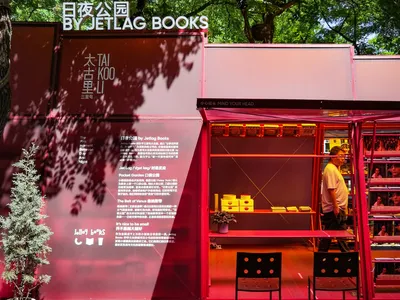
Day and Night Park: A Time-Based Urban Newsstand in Beijing
A temporary urban newsstand in Beijing blending travel, light, and reading through poetic colors, compact form, and community-focused design.

Modernist Patio Renovation in El Masnou, Barcelona by Oliver Segura Arquitectura + Cebrià Arquitectura
Modernist patio renovation blending tradition and innovation with a movable pool, leveled floors, and Catalan materials in El Masnou.
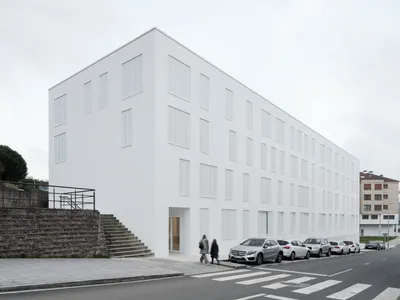
Alto Residencial Coop: Cooperative Housing Development in Santiago de Compostela by Carbajo Barrios Arquitectos
A linear cooperative housing complex blending white volumes and perforated metal façades, enhancing community living, natural light, privacy, and urban integration.


Comments (0)
Please login or sign up to add comments
No comments yet. Be the first to comment!