
3fconcept Cantilevers a Concrete Block Over a Garden Oasis in Hue, Vietnam
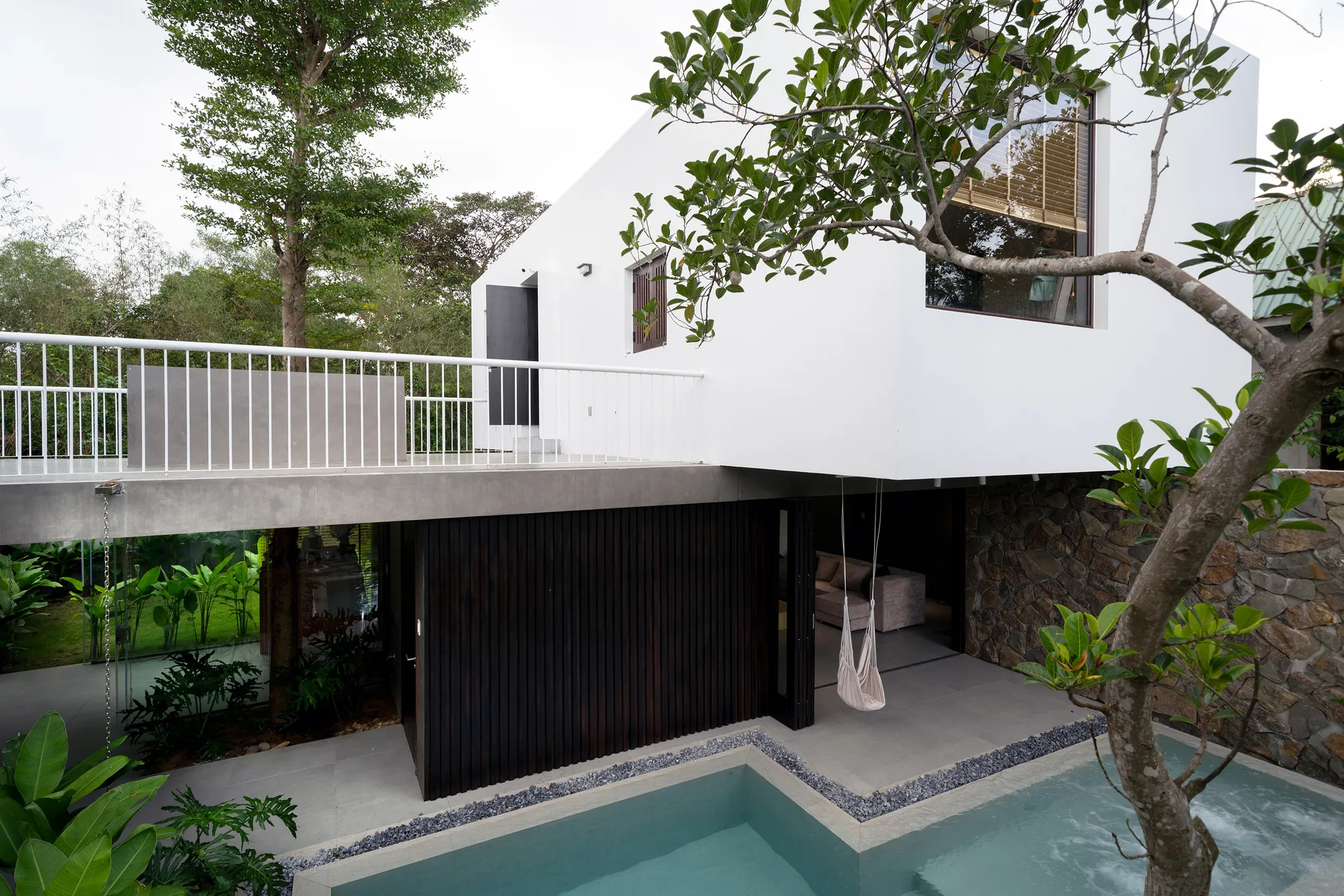
Cua's House uses a perpendicular two-volume plan and a 2.5-meter cantilever to keep tropical heat at bay on a narrow site near Hue's ancient center.

Hue's residential fabric is dominated by the tube house, a long, narrow typology born from tight urban plots and relentless subdivision. Ten minutes from the ancient imperial capital's center, 3fconcept and lead architect Phan Nhat Hung took the opposite approach. Instead of stretching a single volume deep into the lot, they stacked two volumes at right angles to each other: an open, landscape-driven ground floor running the width of the site and a solid, bedroom-bearing upper block running perpendicular along its length. The result is a house that reads as two buildings in dialogue rather than one extruded form.
What makes Cua's House genuinely interesting is the disciplined way it weaponizes geometry against Hue's brutal climate. Summers here are scorching and humid; winters bring relentless rain. The upper volume cantilevers 2.5 meters beyond the ground floor's edge, forming an eave wide enough to shade the entire terrace and pool zone below. A mature tree planted at ground level punches through the balcony above, cooling air before it reaches the bedrooms. The house is not fighting its climate; it is using its own mass as a parasol.
Two Volumes, Two Directions
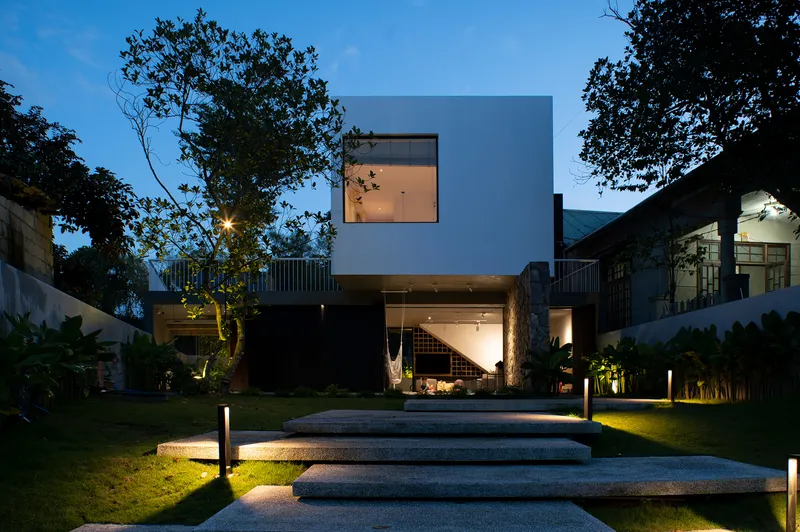

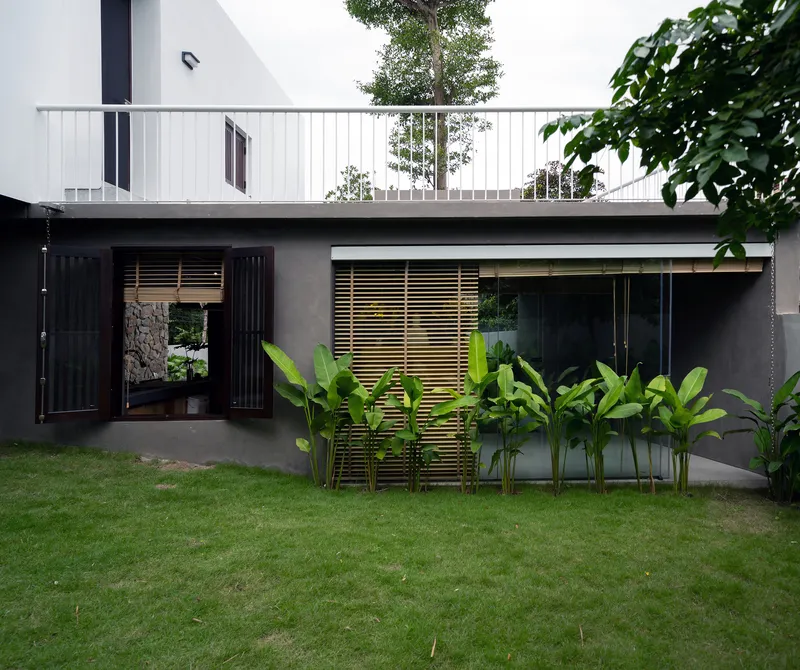
Seen from the rear at dusk, the perpendicular relationship between the two volumes is unmistakable. The white upper block hovers over a glazed, illuminated ground floor, and the cantilever casts a deep shadow line that divides the composition cleanly. The aerial view confirms the strategy: the 80-square-meter ground floor is essentially a landscape platform, with pool, parking, and garden carved from a roughly 450-square-meter site. Neighboring houses crowd in on all sides, which makes the deliberate openness of the ground plane feel almost extravagant.
The dark concrete and timber-louvered screen along the garden facade give the base a visual weight that anchors the floating white mass above. Banana plants and dense planting soften the transition, but the architectural move is blunt: solid over void, heavy over open, private over public.
Living Among the Trees
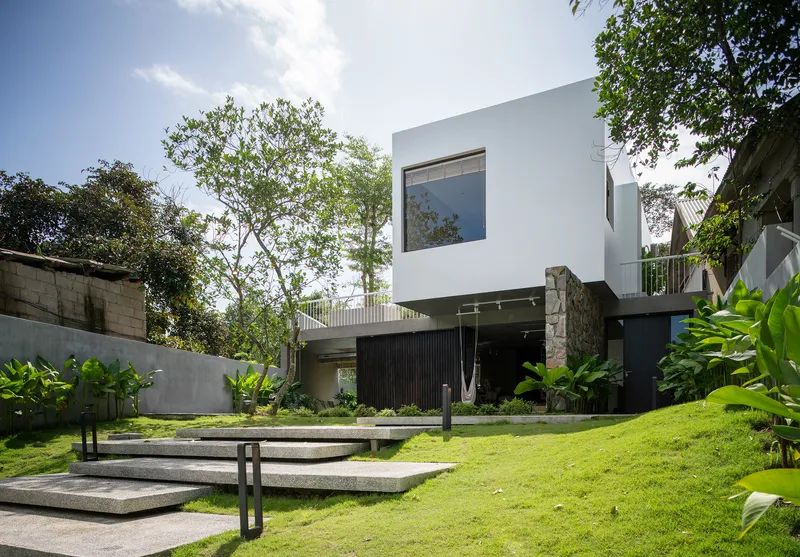
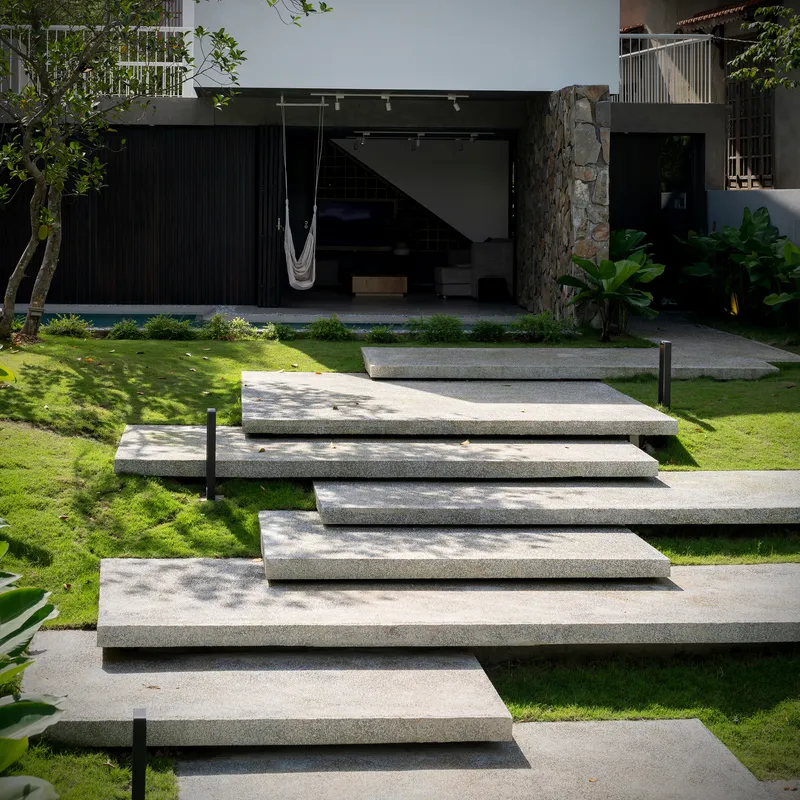
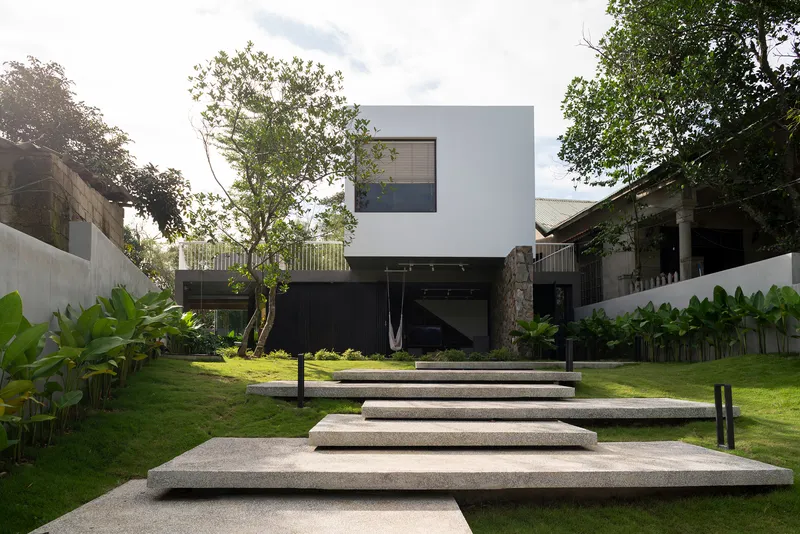
The approach to the house is choreographed through cascading terrazzo steps that cut through the lawn. These wide, shallow platforms slow you down, pulling attention toward the dappled light filtering through the canopy. The preserved tree at the center of the composition is not incidental decoration; it is an active climate device, its shade reducing surface temperatures beneath the cantilever significantly during summer months.
There is a deliberate refusal to separate architecture from landscape here. The stone column visible under the covered terrace, the irregular lawn paths, and the fruit and vegetable garden at the rear all reinforce the idea that the ground floor belongs to the outdoors. Walls exist only where absolutely necessary.
The Pool as Organizing Element
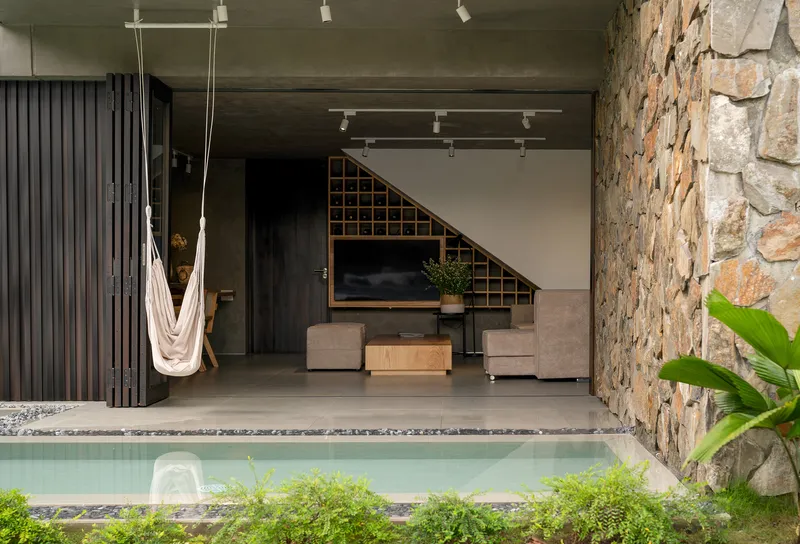
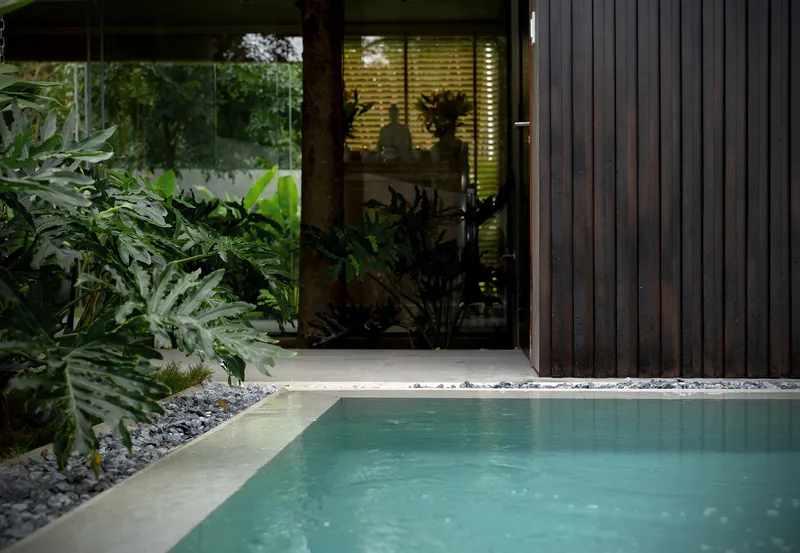
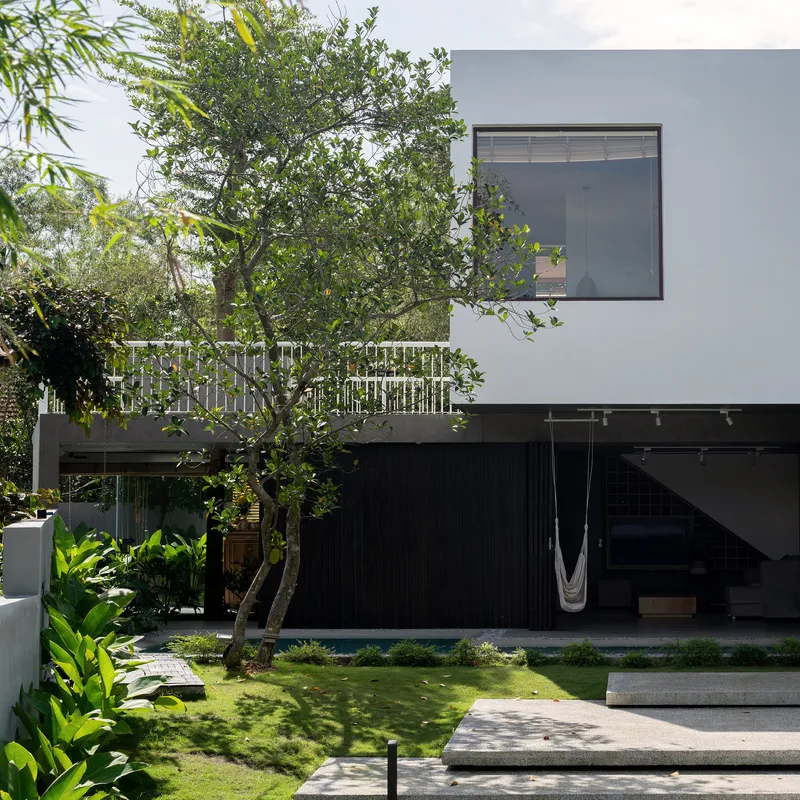
The swimming pool sits in the courtyard between the two directional axes of the plan, functioning less as a luxury amenity and more as a spatial hinge. The irregular stone-clad wall beside the water and the suspended hammock overhead turn this zone into an outdoor living room that works equally well for a midday nap or an evening gathering. At dusk, the illuminated timber slatted window behind the pool gives the space a lantern-like glow, transforming what is essentially a hard-surfaced courtyard into something atmospheric.
The pool edge detail at image ten is worth studying: timber cladding meets water meets planted bed meets tree trunk, all within a meter of each other. It is a tight palette managed with enough restraint that none of the materials compete. The dark timber acts as a unifying backdrop for everything organic.
Interior Warmth Under Concrete
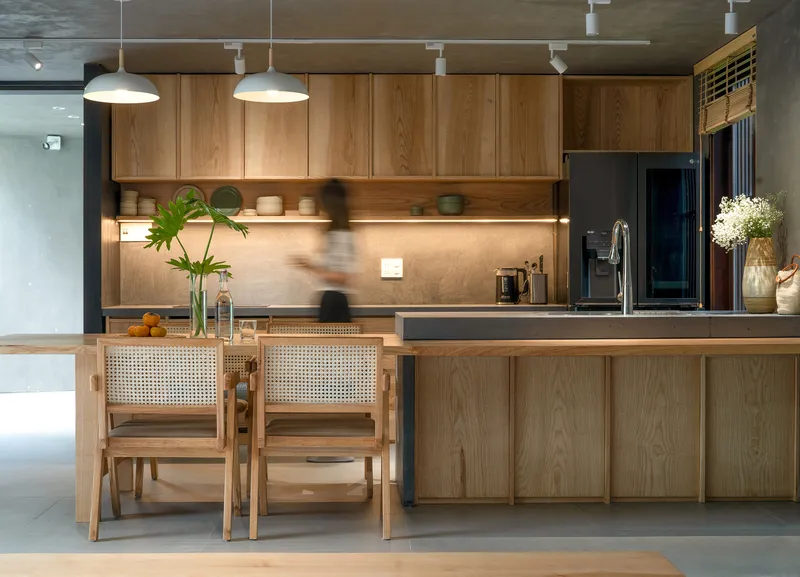
Inside, the exposed concrete ceiling of the kitchen is left raw, with track lighting running along simple channels. Timber cabinetry and cane-backed chairs warm up what could otherwise feel industrial. The contrast between rough overhead surfaces and the fine-grained joinery below gives the kitchen a workshop quality that suits a house designed around outdoor life.
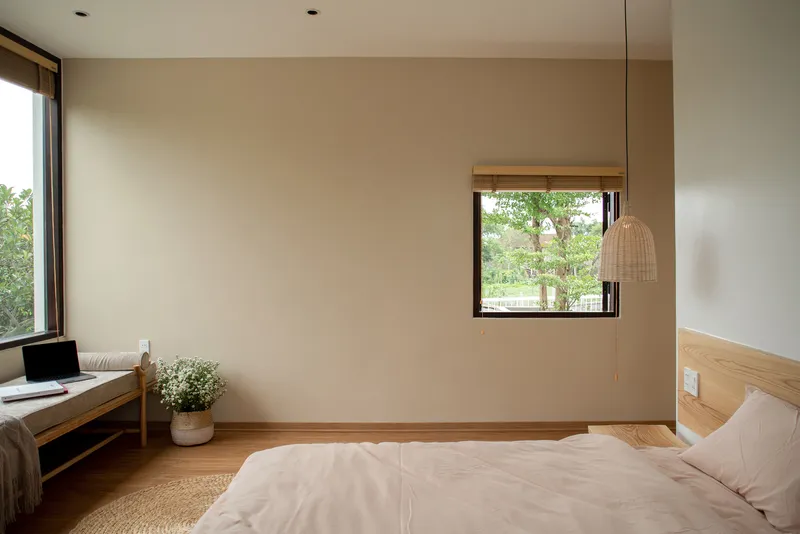
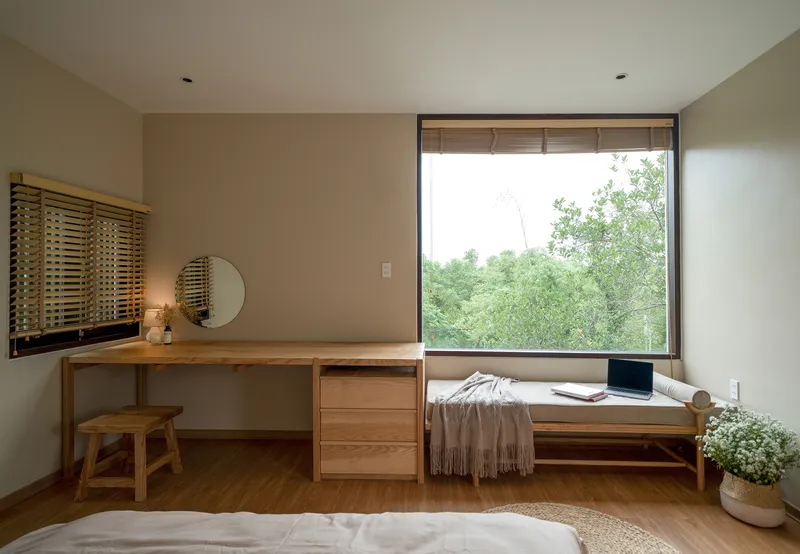
The bedrooms upstairs are quieter, more enclosed. Pale walls, woven pendant lights, and timber bed frames keep the material vocabulary consistent without replicating the openness of the ground floor. Windows are purpose-designed to frame garden foliage rather than the neighboring rooftops, a small but important act of curation that protects privacy while keeping nature in view. The built-in desk with its window seat overlooking green is the kind of considered detail that elevates a compact bedroom into a genuinely pleasant room.
Timber Screens and Rooftop Retreat
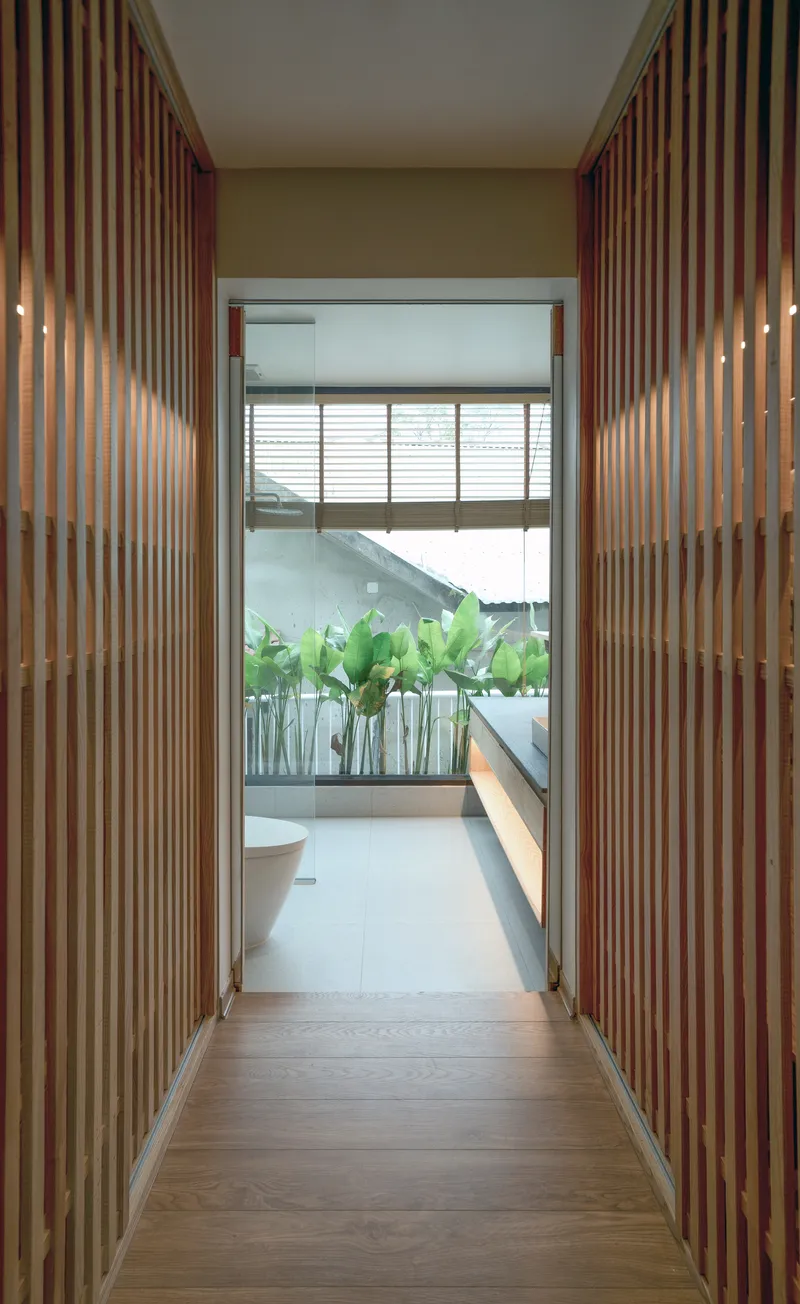
The vertical timber slat walls along the corridor filter light and ventilation into the upper floor's circulation zone. They also give the hallway a rhythm that prevents it from feeling like dead space between bedrooms. Beyond the slats, a planted balcony introduces another layer of green into the upper volume, reinforcing the idea that no part of this house is far from vegetation.
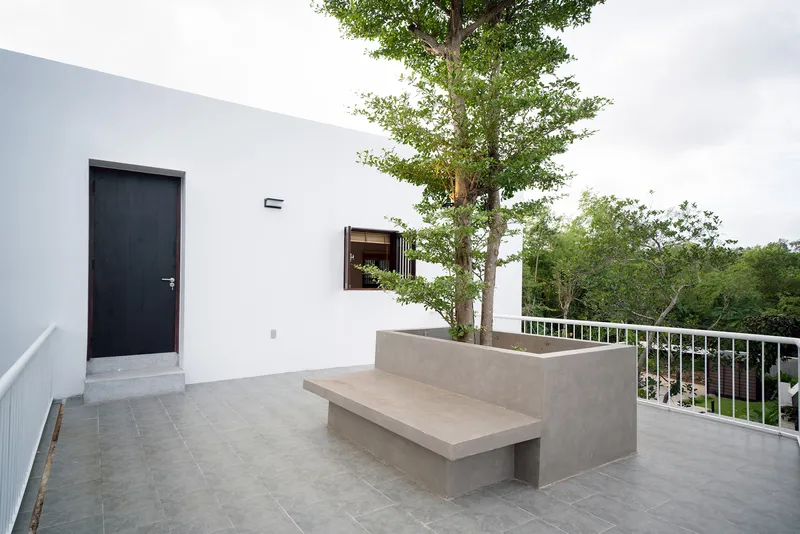
The rooftop terrace, with its concrete bench planter and single tree, is the house's most restrained gesture. It does not try to be a garden; it simply offers elevation and air. Under Hue's overcast winter skies, it reads as a contemplative endpoint to a vertical sequence that begins at the pool and ends in open sky.
Plans and Drawings
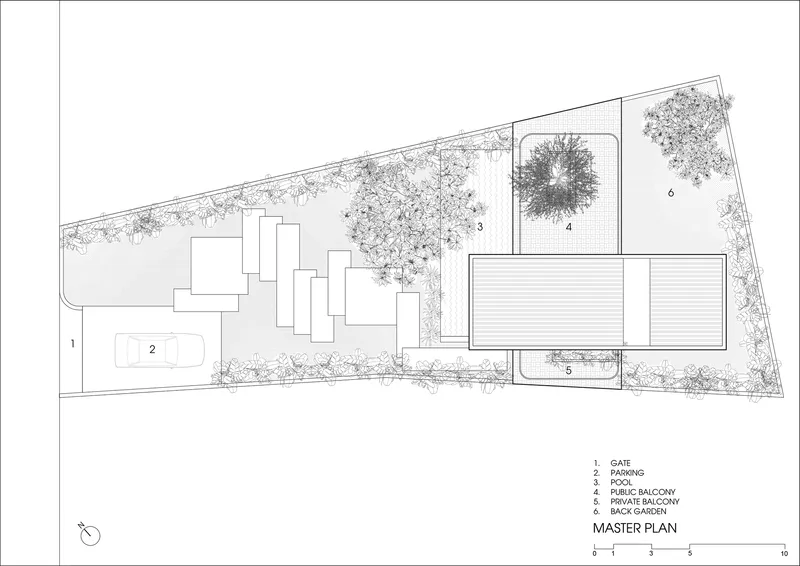
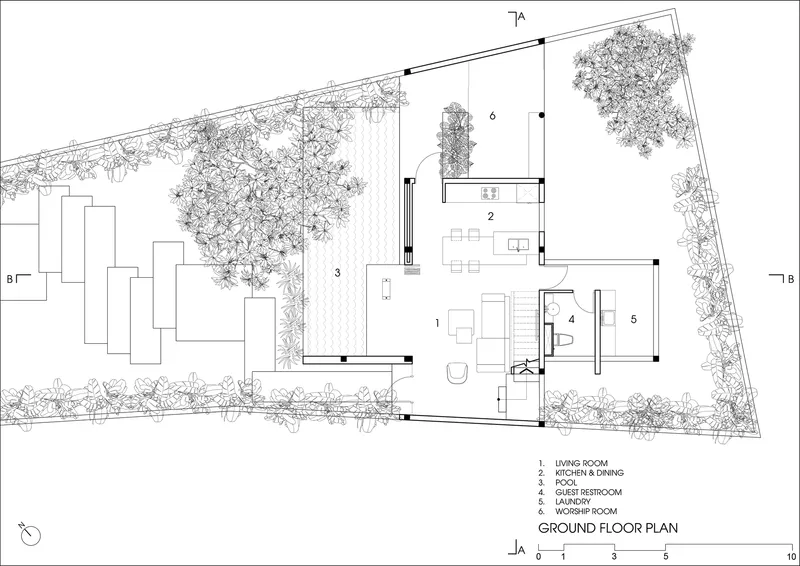
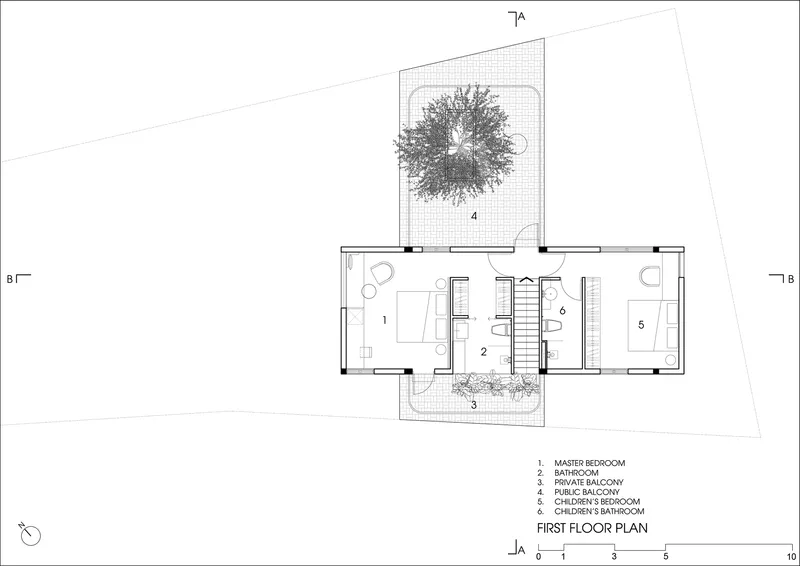
The master plan drawing reveals just how much of the site is given over to landscape. Pool, parking, and planting occupy the majority of the footprint, with the built volume pushed to one side. The ground floor plan shows living spaces wrapping the central pool courtyard, while the first floor plan above rotates 90 degrees, placing three bedrooms along the lot's long axis with a central stairwell and the penetrating courtyard tree.
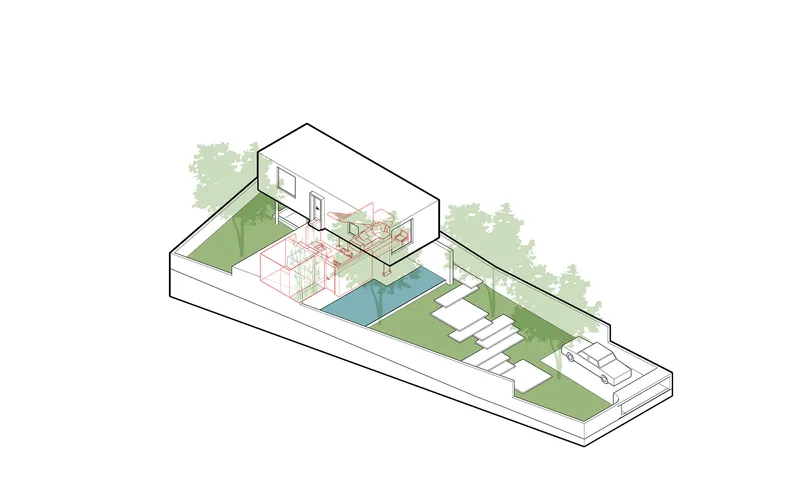
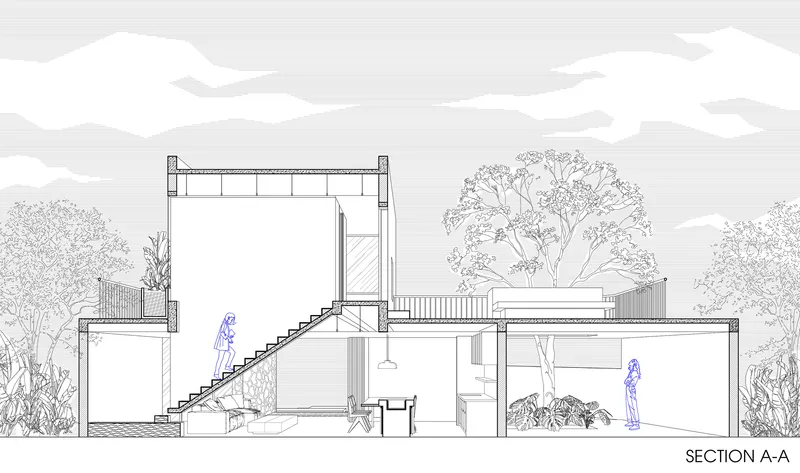
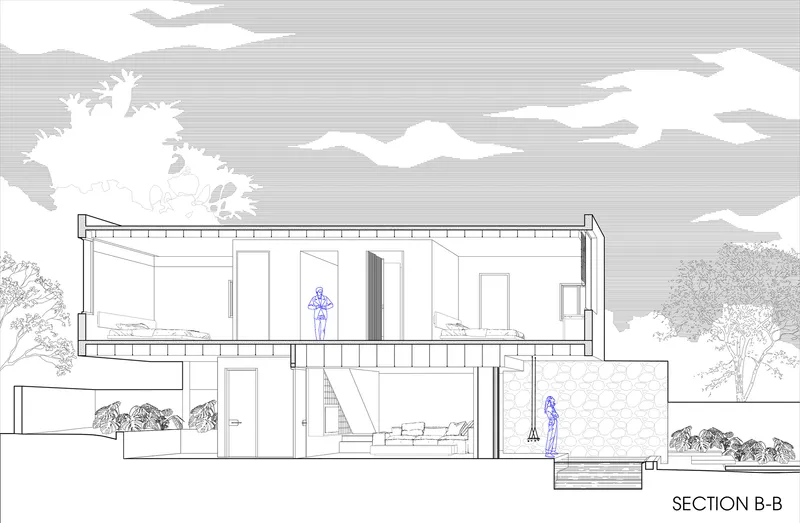
The axonometric is the most revealing drawing. It makes the stepped courtyard sequence legible in a way the photographs cannot, showing how pool, planted zones, and terrazzo platforms cascade through the site. The two section cuts confirm the cantilever's role: the 2.5-meter projection creates a double-height covered zone at ground level that is neither fully inside nor fully outside. It is a threshold condition designed for a climate that demands shade and airflow in equal measure.
Why This Project Matters
Cua's House is a quiet rebuttal to the tube house norm that defines residential architecture in central Vietnam. By rotating the upper floor perpendicular to the ground, 3fconcept breaks the linear logic that most narrow-lot houses are trapped in, creating sight lines that reach both the front garden and the rear orchard. The cantilever is not a formal flourish; it is a passive cooling strategy that eliminates the need for deep mechanical intervention. In a region where summer temperatures and humidity can be punishing, the decision to let structure do the work of climate control is both pragmatic and economically smart.
More broadly, this is a house that takes the idea of coexistence with nature seriously without being precious about it. The tree that grows through the balcony, the vegetable garden at the rear, the pool that replaces a living room wall: these are not symbolic gestures. They are functional elements that shape how the house breathes, shades, and feeds its occupants. At 180 square meters of built area on a 450-square-meter site, the ratio of landscape to building is the real design move, and it is one that more houses in Southeast Asia's dense suburban peripheries could learn from.
Cua's House by 3fconcept, lead architect Phan Nhat Hung. Hue, Vietnam. 180 m², completed 2022. Photography by Nguyen Dang Hieu.
About the Studio
Share Your Own Work on uni.xyz
If projects like this are the kind of work you want to make, uni.xyz is a place to publish your own, find collaborators, and enter design competitions.




Popular Articles
Popular articles from the community

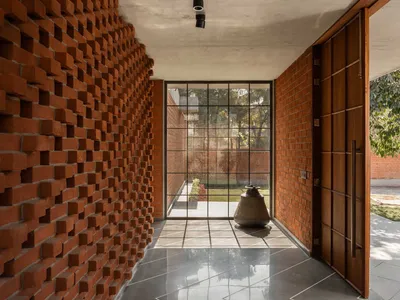
Vaissnavi Shukl Wraps a Single-Storey Ahmedabad Home Around a Courtyard That Breathes
Malhaar Residence uses perforated brick, translucent canopies, and an L-shaped plan to turn a quiet suburban plot into an inward world.
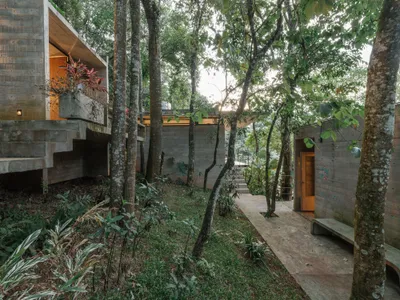
Terra e Tuma Scatters Four Concrete Pavilions Through the Atlantic Forest in Mairiporã
A fragmented compound of music studio, art studio, chapel, and living quarters preserves every tree on a steep forested hillside near São Paulo.
UNA Barbara e Valentim Plants Four CLT Bungalows in a Fragile Ceará Landscape
Prefabricated eucalyptus timber cabins touch down lightly on the sandy, biodiverse coast of Barroquinha, Brazil.

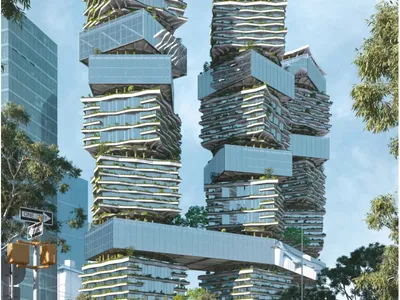
Hierarchy Towers: Sustainable Architecture for Vertical Co-Living in Singapore
Hierarchy Towers reimagines sustainable architecture through co-living, shared workplaces, green terraces, and new public life in Singapore.

Similar Reads
You might also enjoy these articles
Loma House by Besonias Almeida Arquitectos: Modern Coastal Living in Costa Esmeralda
Loma House by Besonias Almeida Arquitectos is a modern coastal home in Costa Esmeralda, blending exposed concrete, wood, and natural dunes.
“Pitcombe’s Old School House Renovation by Bindloss Dawes: Blending Heritage and Contemporary Design”
Bindloss Dawes transformed Pitcombe’s 19th-century Somerset schoolhouse with a sustainable timber extension, blending historic charm, contemporary design, and panoramic countryside views.
F3 Residence by Belluzzo Martinhão Arquitetos: Contemporary Luxury in São Paulo’s Countryside
F3 Residence in São Paulo blends contemporary design, natural materials, multigenerational living, hillside integration, expansive glass, infinity pool, and seamless indoor-outdoor flow.
Private Villa in Ubud by BAMM ARCHITECTS: Contemporary Design Amidst Bali’s Jungle
Private Villa in Ubud blends contemporary design with tropical landscape, featuring open-air pavilion, stone and wood materials, suspended master bedroom, and jungle pool views.


Explore Residential Building Competitions
Discover active competitions in this discipline




The Global Benchmark for Architecture Dissertation Awards


The Global Benchmark for Graduation Excellence


Challenge to design a barrier free sports center


Challenge to design an outdoor ice-rink and park
Comments (0)
Please login or sign up to add comments
No comments yet. Be the first to comment!