
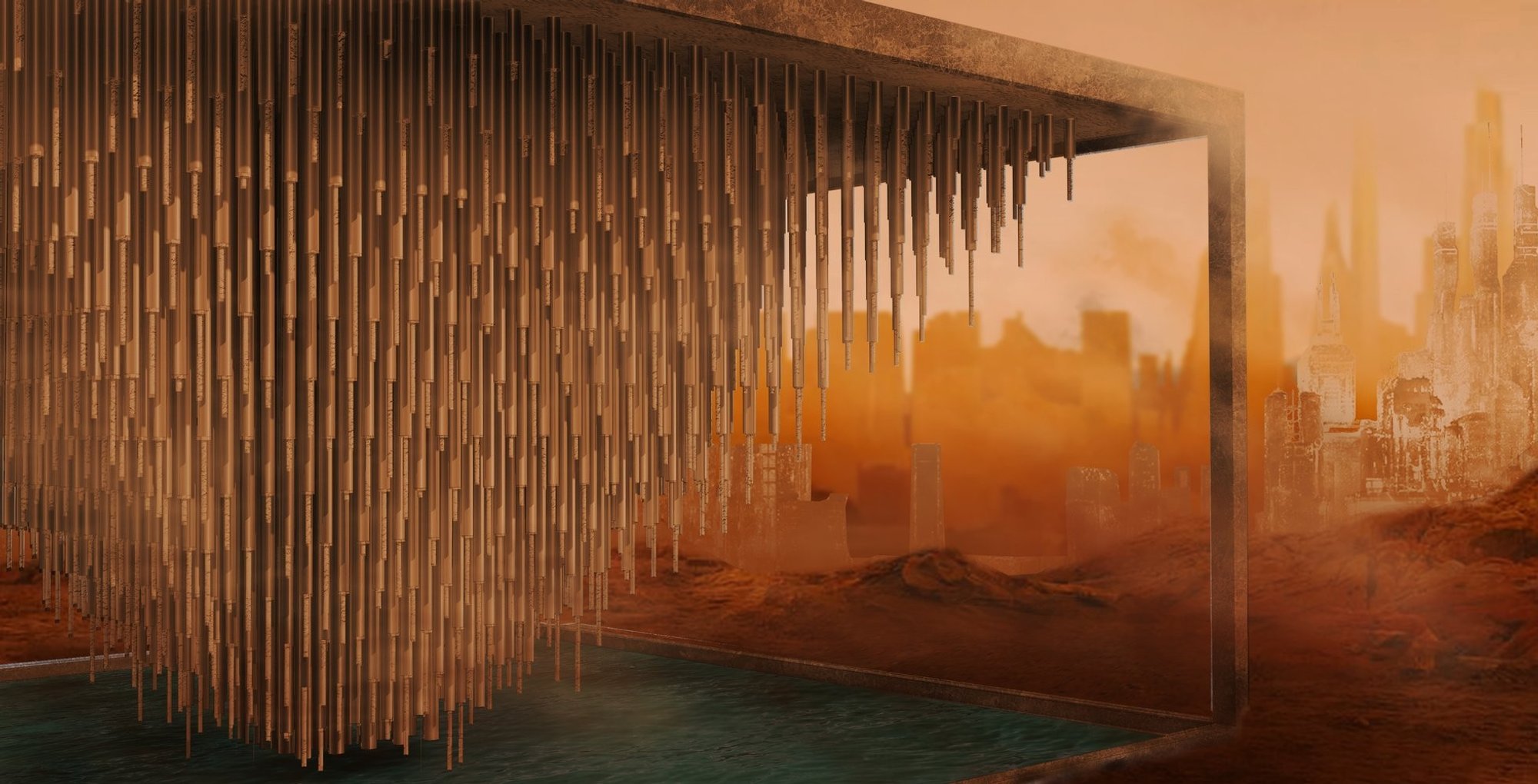
A Global Warming Memorial That Materializes Carbon Emissions
A climate-responsive architecture that transforms CO2 into evolving form, making global warming visible through time, chemistry, and space.

In the evolving discourse of sustainable design, climate-responsive architecture has emerged as a critical framework for addressing environmental crises through spatial and material intelligence. The project Global Warming, designed by Ziyu Zhao and Xiaolong Xue, winner of the Hourglass competition, redefines memorial architecture by transforming invisible atmospheric processes into a tangible, evolving spatial experience.
Rather than functioning as a static monument, this proposal operates as a dynamic environmental instrument. It visualizes the progression of global warming through chemical reactions, spatial transformation, and temporal accumulation, positioning architecture as both a witness and an active participant in climate discourse.
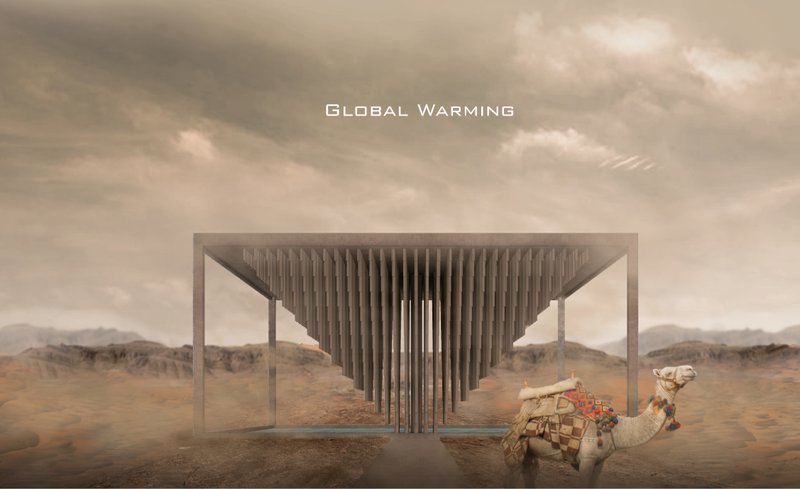
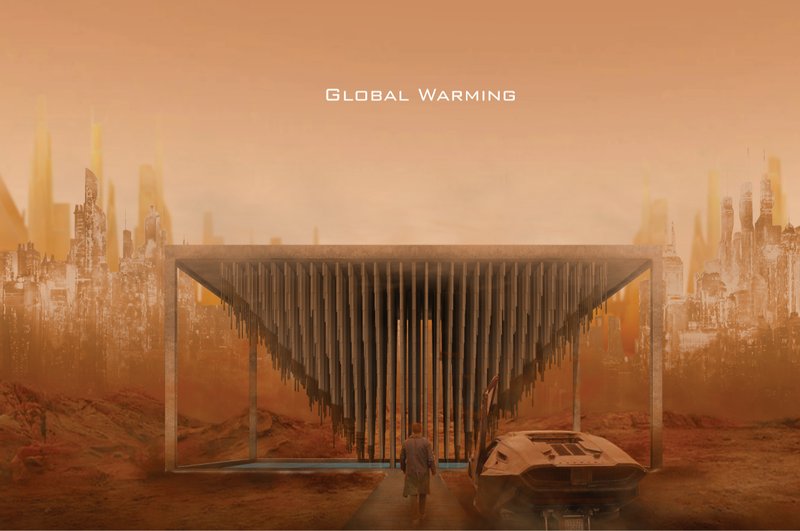
Concept: Making the Invisible Visible
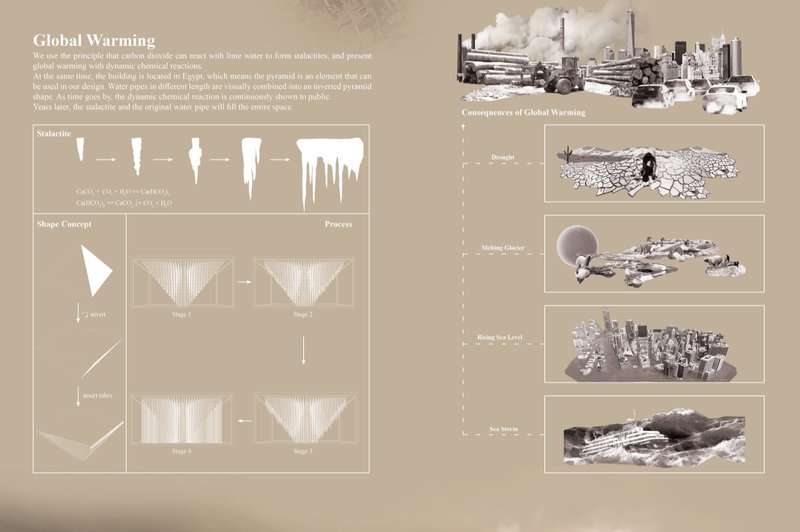
At the core of this project lies a scientific principle: carbon dioxide reacts with lime water (calcium hydroxide) to form calcium carbonate, which accumulates as stalactites. This reaction becomes the conceptual and material driver of the design.
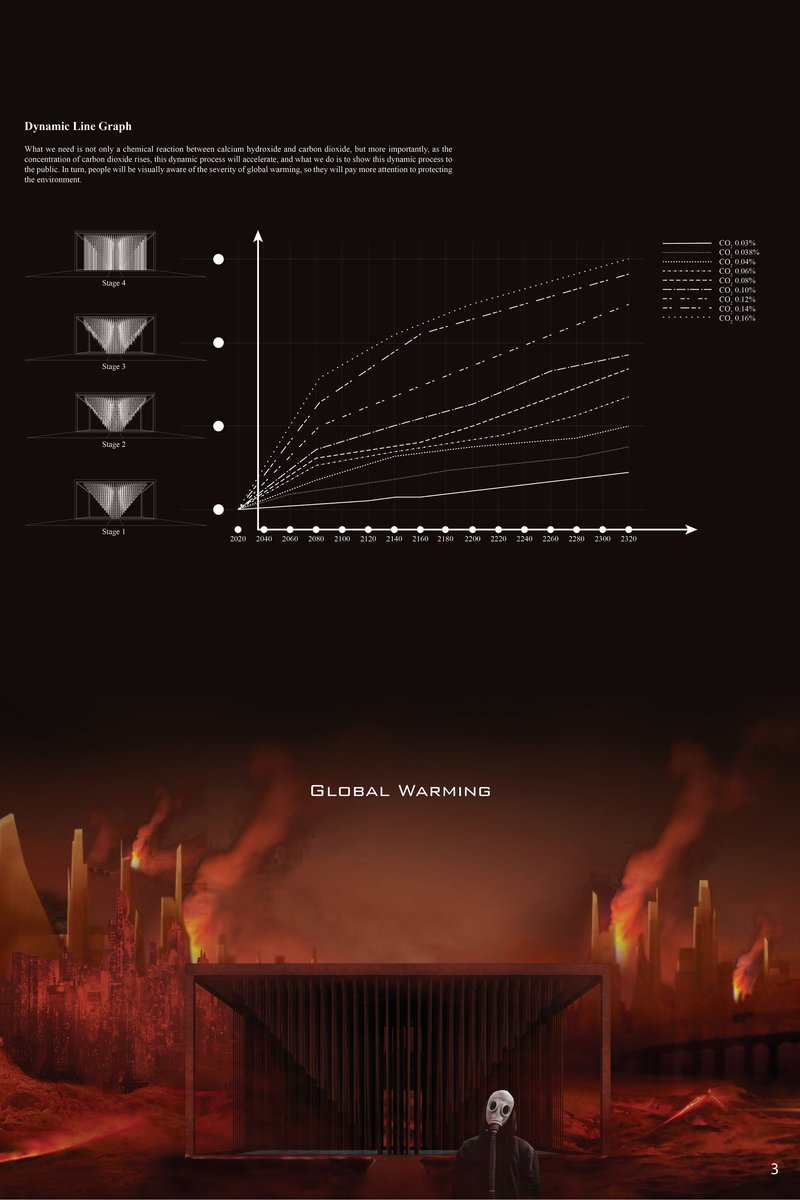
Global warming is often perceived as abstract due to its invisibility. Rising CO2 levels cannot be directly observed, yet their consequences are catastrophic. This project translates that invisibility into a physical process. As atmospheric carbon dioxide increases, the rate of chemical reaction accelerates, leading to faster formation of stalactites within the structure.
The architecture becomes a live indicator of environmental change. Over time, the space physically transforms, recording climate data through material growth. This creates a direct relationship between environmental degradation and spatial experience.
Architectural Form: The Inverted Pyramid
The project adopts an inverted pyramid geometry, a deliberate inversion of traditional monumentality. While pyramids historically symbolize permanence and legacy, this inverted form suggests instability, inversion of ecological balance, and a shift in human-nature relationships.
Water pipes embedded within the structure distribute calcium hydroxide solution. As the solution reacts with carbon dioxide in the air, stalactites begin forming downward, gradually occupying the internal volume.
This geometric strategy is not merely symbolic. It enables a controlled accumulation process where gravity, fluid dynamics, and chemical reactions converge. Over years, the interior void transforms into a dense mineral landscape, effectively turning the building into a growing archive of atmospheric conditions.
System Logic: Architecture as a Chemical Machine
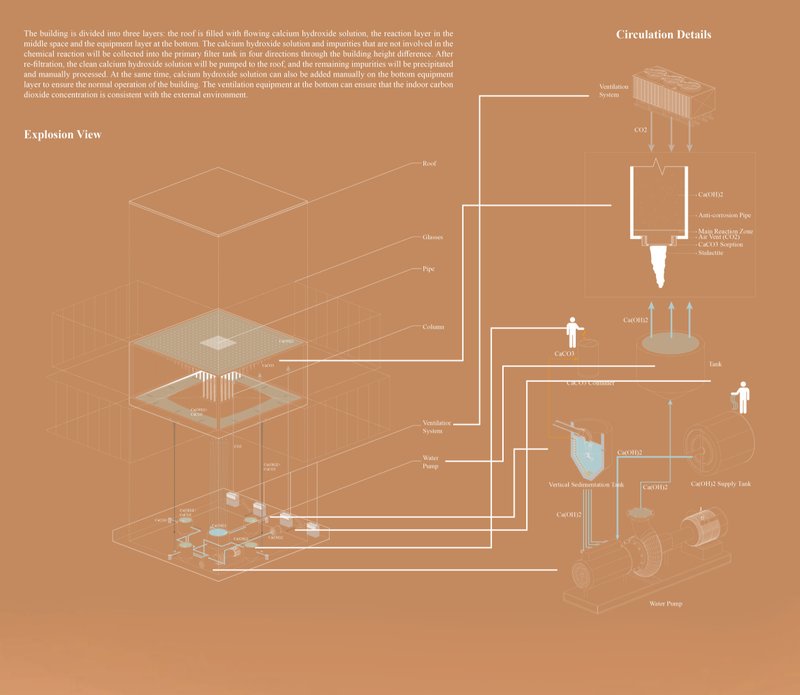
The building operates across three primary layers:
- Roof Layer: Contains flowing calcium hydroxide solution, initiating the reaction cycle.
- Reaction Layer (Middle): The primary zone where CO2 interacts with the solution, forming stalactites.
- Equipment Layer (Bottom): Houses mechanical systems, pumps, and sedimentation tanks for circulation and maintenance.
The system functions through continuous circulation. The solution flows downward, reacts with carbon dioxide, and is collected for reprocessing. Ventilation systems ensure that indoor CO2 levels remain consistent with the external environment, maintaining the integrity of the reaction.
This integration of environmental data, chemical processes, and mechanical systems positions the building as a hybrid between architecture and environmental infrastructure.
Spatial Experience: Time as a Design Material
Unlike conventional buildings, this memorial is not defined at the moment of completion. Instead, it evolves over decades.
Visitors entering the space encounter different spatial conditions depending on the stage of stalactite formation:
- Stage 1: Minimal formations, emphasizing openness and structural clarity.
- Stage 2: Initial growth begins to define spatial thresholds.
- Stage 3: Increased density creates immersive, cave-like conditions.
- Stage 4: The interior becomes heavily occupied by mineral formations, compressing space and altering circulation.
This progression transforms time into a primary design parameter. The architecture is not static but continuously rewritten by environmental conditions.
Environmental Narrative: From Awareness to Urgency
The project extends beyond formal experimentation. It constructs a narrative around the consequences of global warming.
Visual references within the proposal highlight drought, melting glaciers, rising sea levels, and extreme weather events. These are not merely contextual images but part of a broader communicative strategy.
By correlating these phenomena with the internal transformation of the building, the project establishes a feedback loop between global climate conditions and localized spatial experience.
Visitors do not simply observe climate change. They inhabit its consequences.
Sustainability Discourse: Beyond Symbolism
While the project is conceptually strong, it also raises critical questions about scalability and implementation.
Juror Kazumasa Takada noted:
"Great idea with very unique cutting point. I found this project's concept the most interesting among all the entries of this competition. However, the shape of the memorial is not outstanding yet. I wished the Designer has expanded the idea into spatial proposal so that the memorial did not end up as mere statue but architecture."
This critique highlights the tension between conceptual clarity and spatial articulation. It suggests the potential for further development into more immersive, inhabitable environments.
Juror Jonas Prismontas added:
"Really brilliant concept, and a good way to make use of the CO2. Can this be less high tech and be replicated many times around the world in the most polluted areas to act as air filters?"
This observation shifts the discussion toward scalability and replication. It questions whether such systems can move beyond singular monuments and become distributed environmental interventions.
Toward Replicable Climate Architecture
The project opens up a broader architectural question: can buildings function as active environmental agents rather than passive structures?
If adapted and simplified, this system could evolve into a network of climate-responsive installations across urban environments. These could serve as both air filtration systems and public awareness infrastructures.
The idea of transforming monuments into "clean air shelters" introduces a new typology where architecture directly contributes to environmental remediation.
Global Warming repositions architecture as a medium of evidence rather than representation. It does not merely symbolize climate change but records it, materializes it, and spatializes it.
By integrating chemistry, environmental data, and temporal transformation, the project challenges conventional definitions of architecture. It suggests that future buildings may not only respond to climate but actively document and influence it.
In this context, climate-responsive architecture becomes more than a design strategy. It becomes a necessity.
Project Credits
Project: Global Warming
Designers: Ziyu Zhao, Xiaolong Xue
Recognition: Winner, Hourglass Competition



Popular Articles
Popular articles from the community

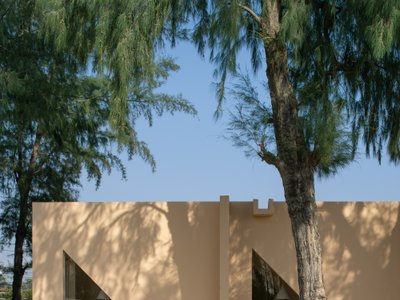
Pinto Builds a Faceless Pavilion Beneath Casuarina Trees on Thailand's Rayong Coast
SON Restaurant refuses a front door or a back wall, treating all four facades equally in a 260-square-meter brick and stucco grid.
ONA Threads Four Board-Formed Concrete Cabins Along a 260-Meter-Deep Site in Mendoza
At the edge of Argentina's wine country, a set of curved concrete lodges negotiate a razor-thin parcel between city and mountain.

The Flow: Coffee Shop Interior Design Where Time, People, and Process Intertwine
The Flow reimagines Viennese coffee culture through arched forms, warm interiors, music, reading, work, and social gathering.
Noue Studio Organizes a Swiss Restaurant Around a Single Concrete Wall
In Granges-Paccot, Switzerland, a 216-square-meter renovation turns raw materials and a central spine into a legible dining experience.

Similar Reads
You might also enjoy these articles


Urban Forest: A Vertical Ecosystem for 5,000 Workers in Singapore's Changi Business Park
Radially stacked pods and layered green decks turn a 7-acre plot into 47 acres of ecological workspace projected for 2040.
interACT: A Wearable Transit Object That Turns Commuting Into Social Infrastructure
A backpack-mounted foldable device transforms walking, waiting, and riding into moments of shared comfort across Jakarta's transit network.
Lean On Barrier System: Where Traffic Safety Meets Chai Culture in Ahmedabad
A modular steel barrier doubles as informal seating and lean-on furniture at one of Ahmedabad's busiest intersections, keeping vendors in place.
The Black Bagh: A Living Monument Built from Water, Light, and Memory
On the banks of the Yamuna, two designers replace the myth of a marble mausoleum with a regenerative landscape of reflection and ritual.

Explore Architecture Competitions
Discover active competitions in this discipline




The International Standard for Design Portfolios


The Global Benchmark for Architecture Dissertation Awards


The Global Benchmark for Graduation Excellence


Challenge to reimagine the Iron Throne
Comments (0)
Please login or sign up to add comments
No comments yet. Be the first to comment!