

Schwartz and Architecture Builds a 390-Square-Foot Dovecote Studio in Sonoma Wine Country
A chapel-like off-grid addition in Sonoma invites Mourning Doves to nest in its laser-cut feather roof while rejecting farmhouse clichés.


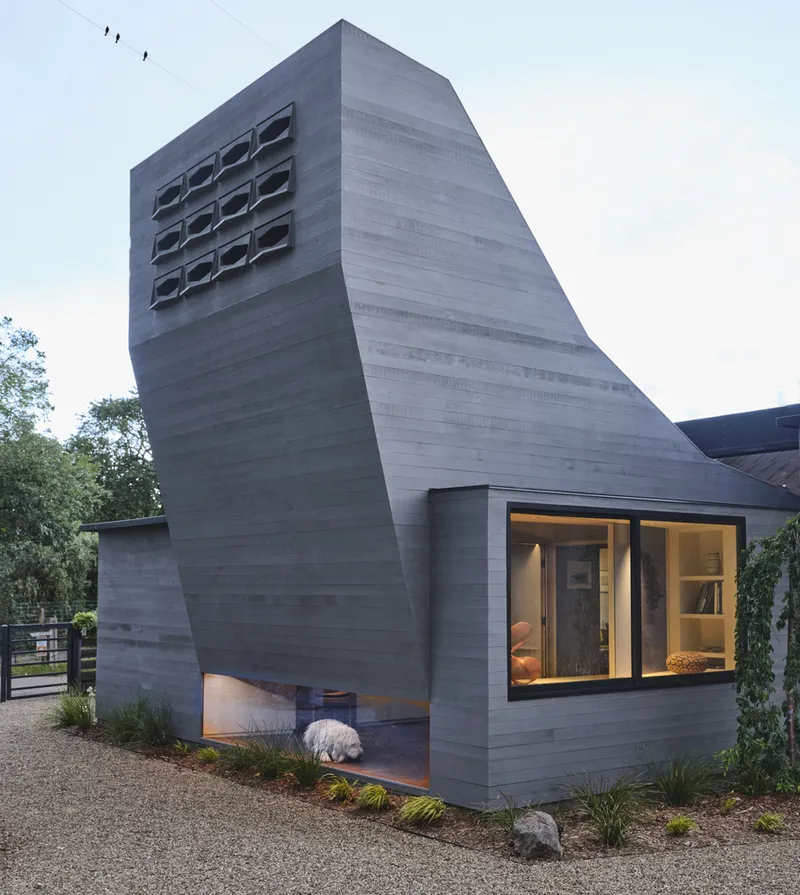
Wine country architecture has a problem. The "modern farmhouse" has become a default setting, a stylistic tic that reduces rural buildings to cosmetic gestures with little connection to the land they sit on. Schwartz and Architecture's Mourning Dovecote in Sonoma is a sharp, specific rebuttal. At just 390 square feet, this studio addition to an existing two-bedroom home is small enough to be overlooked and strange enough to demand attention: an angled timber tower rising from tall grasses, its roof clad in laser-cut metal shingles shaped like bird feathers, its facade punctured by twelve nesting boxes for the Mourning Doves that already inhabit the site.
What makes the project genuinely interesting is not its sustainability checklist, though the numbers are real (a solar array that offsets 100% of annual fossil fuel use, off-grid capability, zero-waste fabrication logic). It is the ambition to treat a small room as a piece of inter-species infrastructure. The studio was designed not only for the owner/architect to work in but for doves to live on, with computational modeling used to determine height, orientation, proportion, and ventilation that would encourage nesting. The result is a chapel-like interior that soars to 18 feet, where light enters from hidden sources and the boundary between human habitat and bird habitat dissolves.
A Tower in the Tall Grass
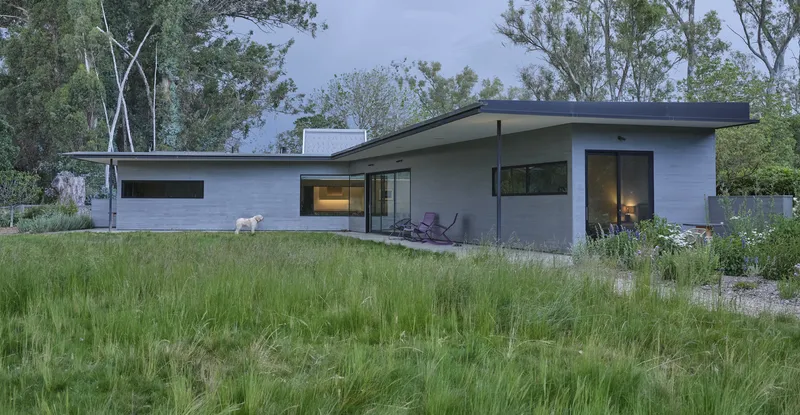
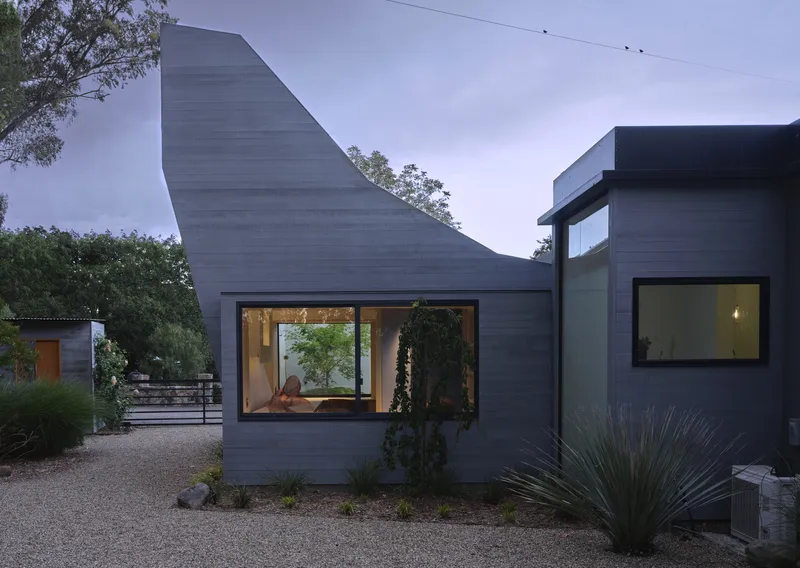
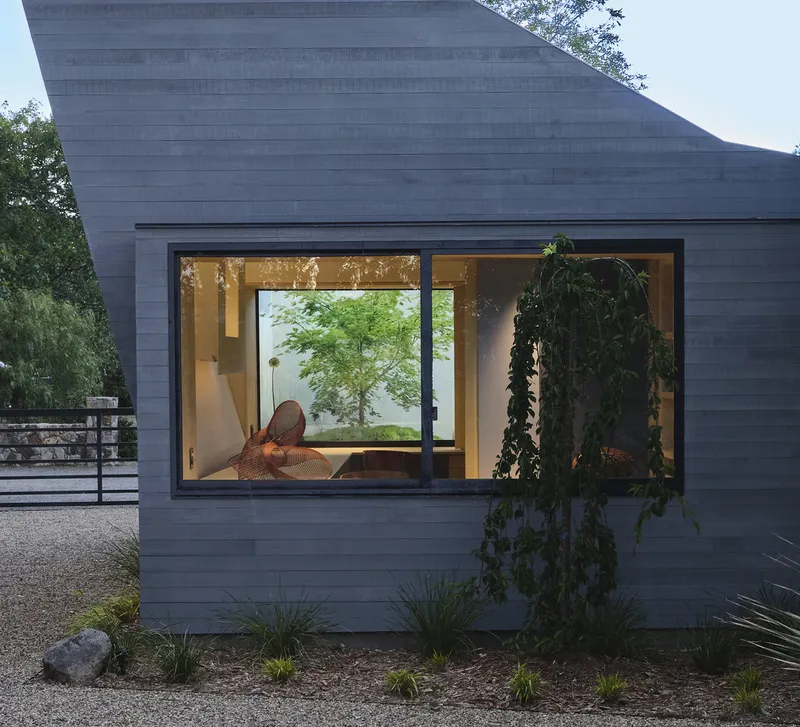
From a distance, the Dovecote reads as a lean, angular volume set low among grasses, its horizontal timber siding and muted grey tones keeping it grounded against the Sonoma landscape. The building sits at the central junction of the original L-shaped "Hydeaway House," a 2,000-square-foot home that was featured in the New York Times in 2013 for its cost-effective design strategies. The addition is accessible from the living area, but its canted walls and rising roofline give it a distinct identity, a building within a building's orbit.
At twilight the corner windows glow, framing views of interior seating and a Japanese maple tree in the small hidden courtyard. The entry sequence passes under a deliberately compressed 7-foot beam below the living room window before the space opens vertically to its full 18-foot height. That compression-to-release move is one of the oldest tricks in the book, but it works here because the contrast is so extreme and because what you release into is genuinely unexpected: a room that feels sacred without any of the usual signifiers.
Feathers, Not Shingles
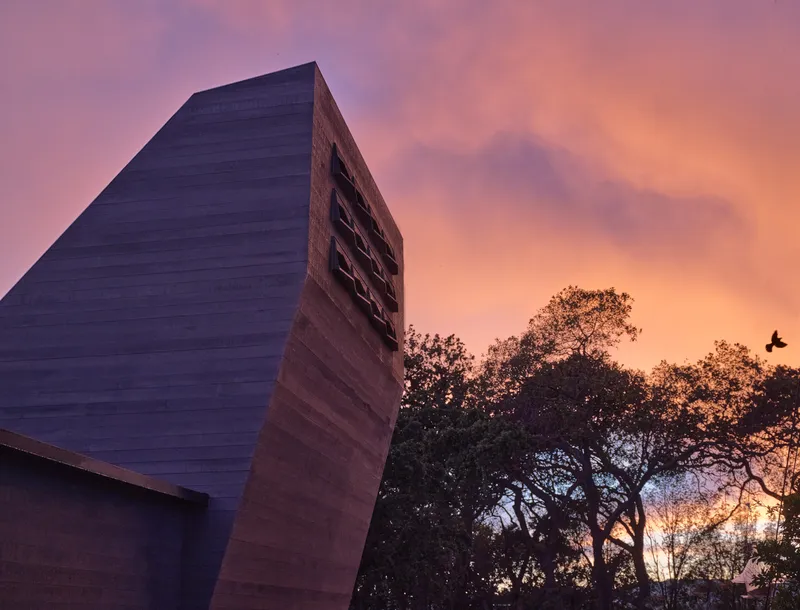
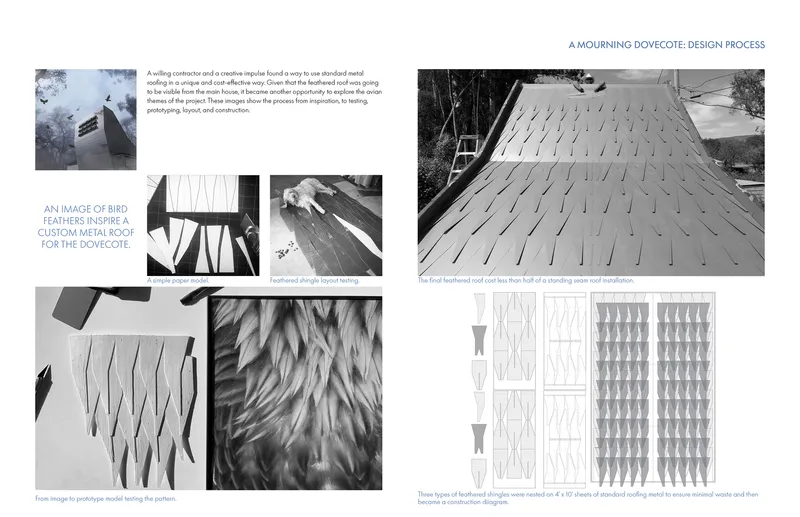
The roof is the project's most conspicuous invention. Working with Brian Cutright of Cutright Construction, Schwartz developed custom laser-cut metal shingles shaped like bird feathers that nest together on sheet metal with minimal waste at the cutter. The result cost half as much as a traditional standing seam metal roof, which is the kind of detail that matters when you are trying to prove that craft and budget discipline are not mutually exclusive.
Against a pink and orange sunset, the tower's gridded openings, the nesting boxes for doves, become legible as part of a larger pattern: the feather shingles, the hexagonal window penetrations, the angled facade planes all working together to create a surface that is neither purely decorative nor purely functional. The design process board traces the evolution from bird feather to metal tile, and it reveals how much iterative prototyping went into something that, on the finished building, looks effortless.
A Chapel Without a Congregation
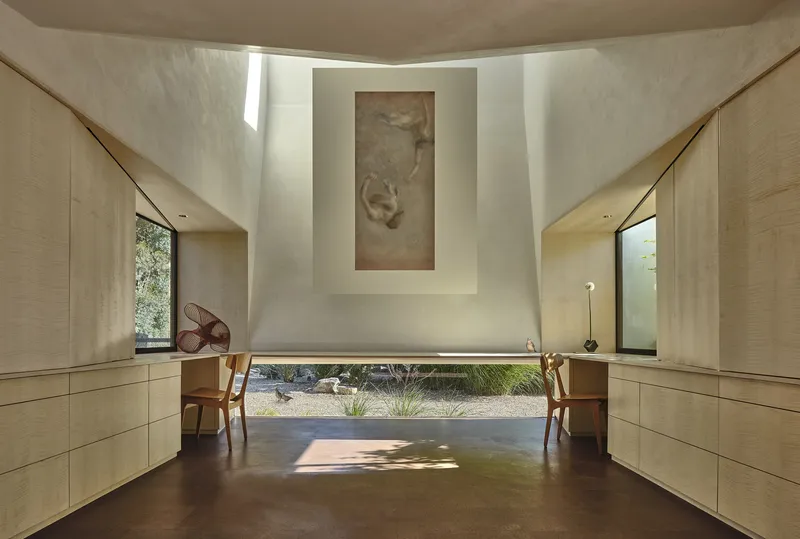
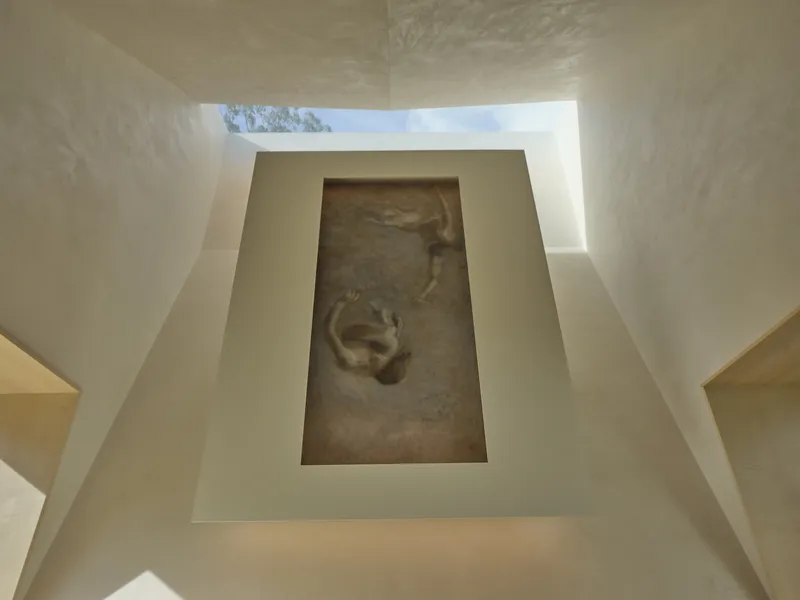
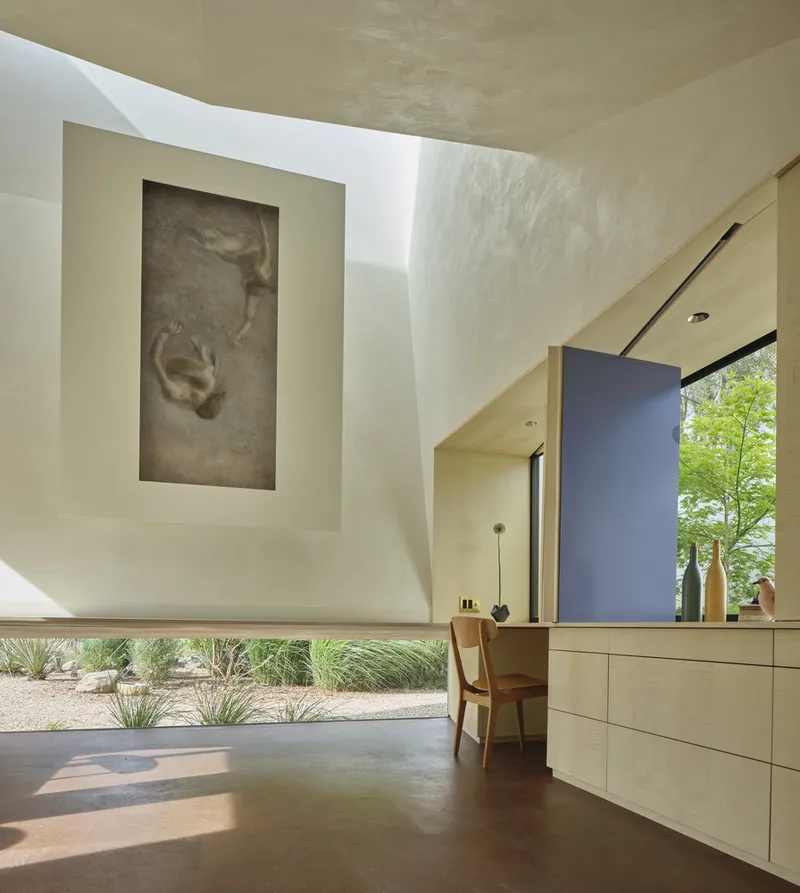
Inside, the Dovecote operates as a single bespoke space. The off-white plaster ceiling rises in slightly triangular planes that conceal a south-facing skylight, so the room fills with light from a source you cannot immediately identify. This is the chapel analogy the architect has described, and it holds: the quality of illumination shifts throughout the day, tracked by computational modeling during the design phase, lending the space a meditative stillness that is rare in rooms this small.
English Sycamore cabinetry with a translucent whitewash finish lines one wall, with an aluminum art panel recessed into a niche. An upward view through the rectangular skylight reveals framing by angled plaster walls, a moment of pure geometry. The desk area uses sliding timber panels in colors drawn from mourning dove plumage; these pivot to reveal magnetic pin-up boards, a nod to the room's function as a working studio. Every detail, from the cast-bronze door handles wrapped in leather strapping to the 3D-printed hardware informed by Alvar Aalto's work, unites movement, craft, and nature into a coherent material language.
Filtered Light and Starling Curtains
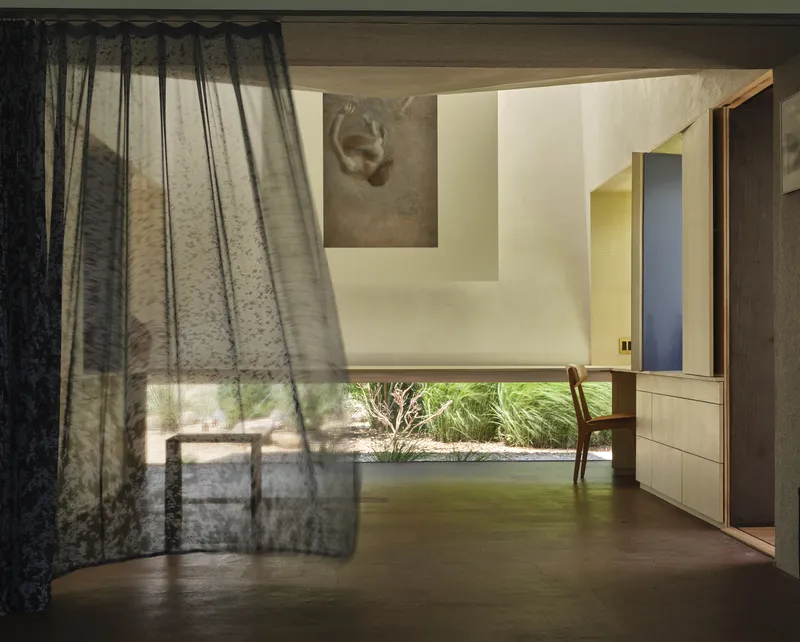
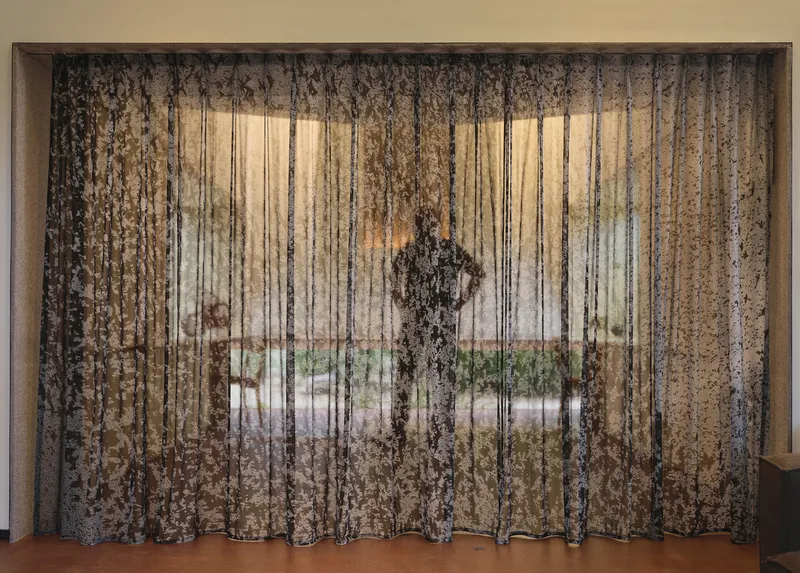
A sheer silk curtain hangs the full height of the interior, its pattern derived from a rearrangement of a photograph from Richard Barnes' Murmur series, which captures the swirling flight formations of starlings. It is a beautiful conceptual link: a building designed for doves, veiled by an image of another bird's collective movement. The curtain filters daylight onto the dark natural cork floor, creating shifting patterns that reinforce the room's connection to time and weather.
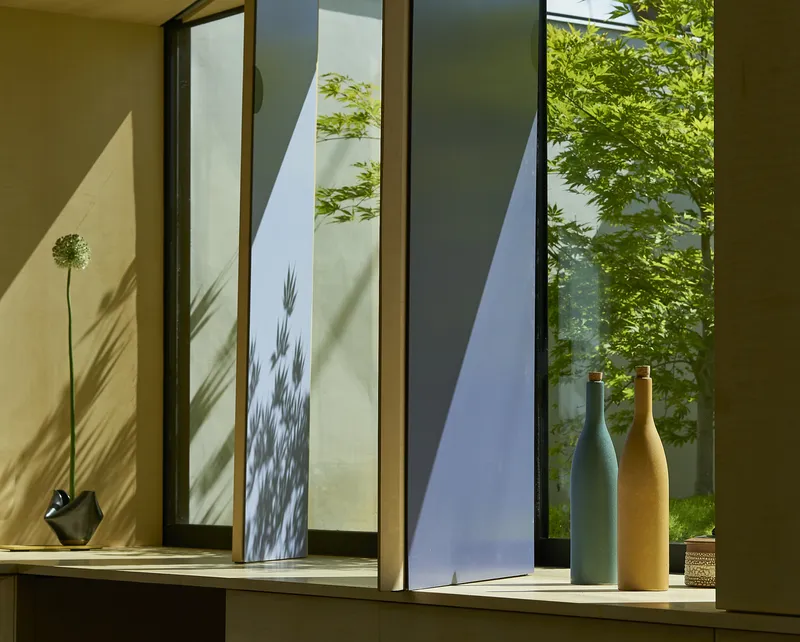
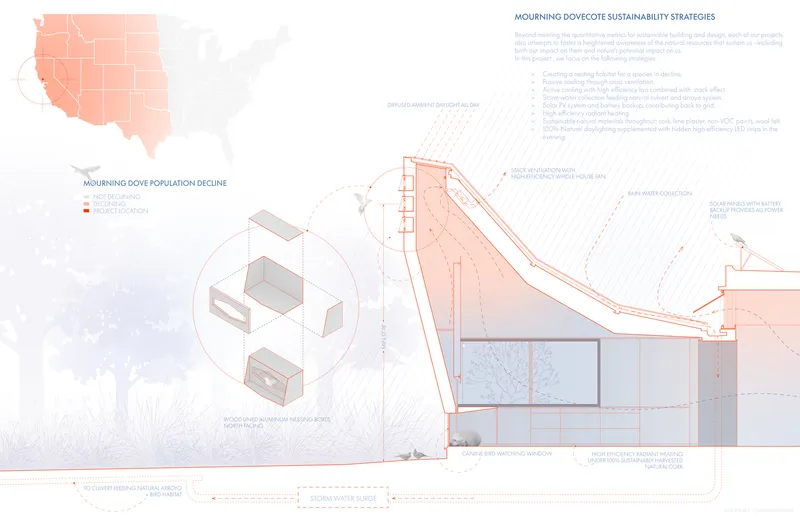
At the base of the canted back wall, a floor window stretches 12 feet wide by 30 inches high, a deliberately low aperture that frames the courtyard garden at dog and dove level. Ceramic vases on the interior sill cast long shadows beside framed views of a courtyard tree. The window placement is strategic: it provides a perch for observing the doves from inside while maintaining the sense that the upper volume belongs to the light, not to the view.
Courtyard and Entry Bridge
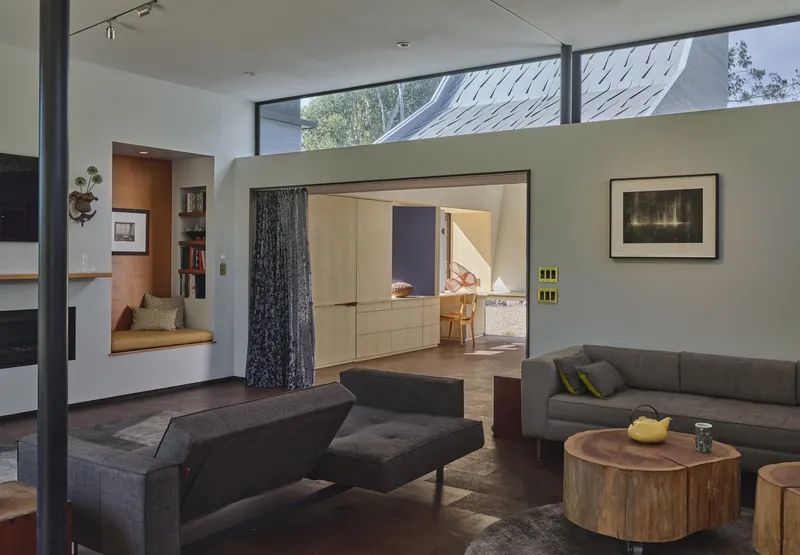
The small hidden courtyard alongside the extension, with its mossy mounds, site boulders, and Japanese maple, is modest but deliberate. It acts as a transitional zone between the original house and the studio, blurring the threshold between domestic space and working space. The walkway connecting the two is made from surplus cedar offcuts from the construction, laminated into a bridge. Zero-waste logic applied to landscape infrastructure.
From the living room of the original house, clerestory windows and a built-in window seat frame an opening to the adjacent wood-clad space. The relationship between old and new is handled with restraint: the studio does not try to match the existing house or overpower it, but sits alongside it as a clearly different creature, connected by materials and courtyard rather than by formal mimicry.
Plans and Drawings
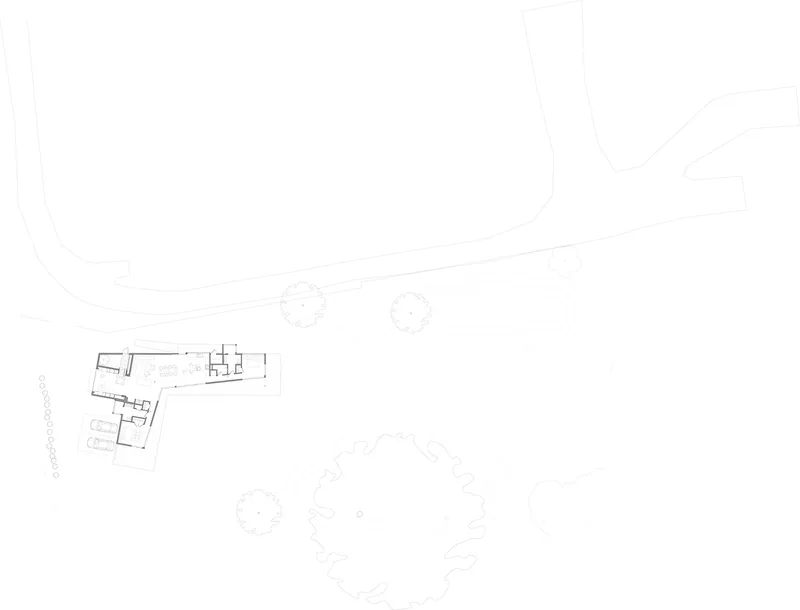
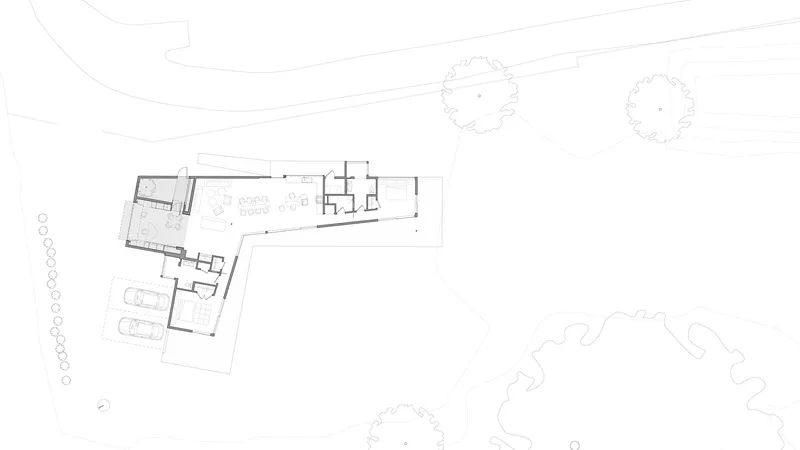
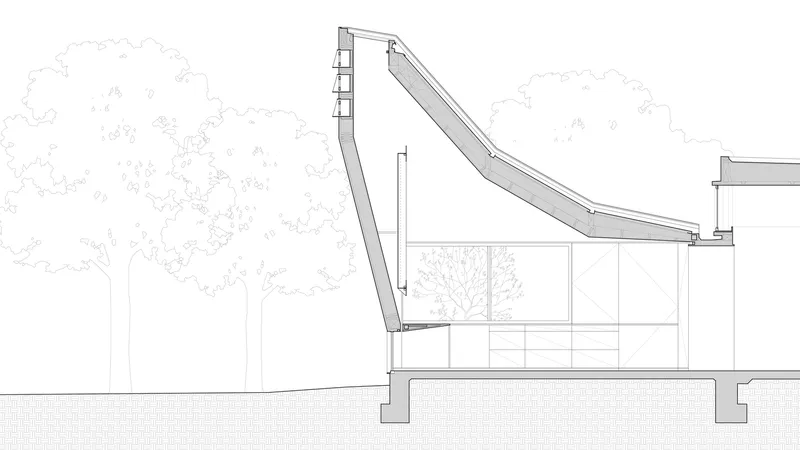
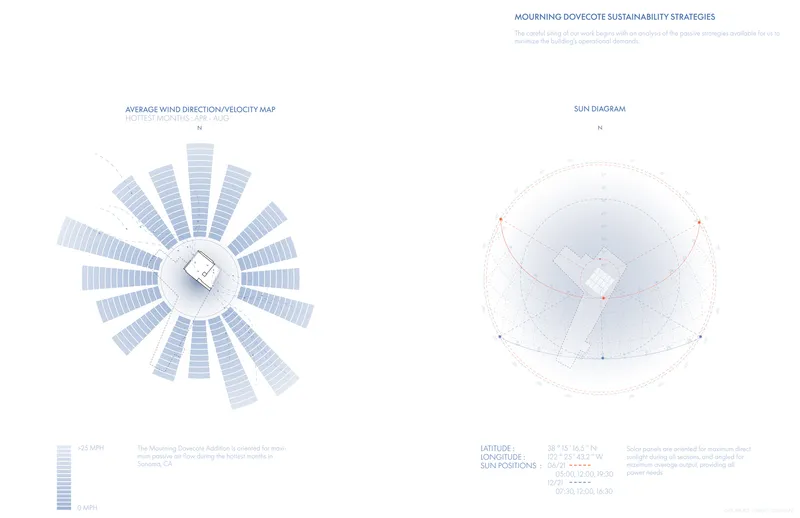
The site plan reveals the angled footprint of the addition at the junction of the L-shaped original house, surrounded by circular tree canopies and landscape contours that make the project's preservation of existing vegetation explicit. The floor plan shows how much program Schwartz packed into 390 square feet: desk, pin-up walls, seating, art display, and courtyard access, all organized around a single axis of movement from the compressed entry to the soaring interior.
The section drawings are the most instructive. They illustrate the sloping roof structure, the hidden skylight, the interior glazing strategy, and the relationship to mature trees on the site. Sun path and wind direction diagrams document the environmental analysis that drove passive strategies: orientation, overhang depth, opening placement, and ventilation paths were all calibrated through computational modeling before a single board was cut. For a 390-square-foot room, the analytical rigor is striking.
Why This Project Matters
The Mourning Dovecote is a useful corrective to two tendencies in contemporary practice. The first is the conflation of "sustainable" with "solar panels and a green roof." Schwartz and Architecture's approach is genuinely systemic: the solar array, the off-grid capability, and the radiant heating are present, but they are embedded within a design logic that begins with computational daylight modeling and extends to zero-waste fabrication, cedar offcut reuse, and a roof system that costs half as much as the conventional alternative. Sustainability here is not an add-on; it is the methodology.
The second tendency is the treatment of ecological ambition as separate from architectural ambition. The twelve nesting boxes are not birdhouses bolted to a facade. They are integrated into the angled wall plane, their dimensions and placement determined by the same environmental analysis that shaped the human interior. The building is designed to be occupied by two species, and neither is an afterthought. At a moment when architecture's relationship to non-human life is largely rhetorical, the Dovecote puts a specific, buildable, measurable proposal on the table. That it does so in 390 square feet, at a cost-conscious budget, in a region saturated with aesthetic cliché, only makes the argument sharper.
A Mourning Dovecote by Schwartz and Architecture, Sonoma, California. 390 sq ft. Completed 2020. Photography by Douglas Sterling Photography.
About the Studio
Share Your Own Work on uni.xyz
If projects like this are the kind of work you want to make, uni.xyz is a place to publish your own, find collaborators, and enter design competitions.


Popular Articles
Popular articles from the community


Opera on the Sea: Driftwood Logic Shapes a Timber Opera House on Estonia's Coast
Trevor Orgill's opera house translates the entangled drift of floating timber into a civic building where wood, water, and music converge.


ETEH Reworks the Shared Spaces of São Domingos School in Brazil Around Timber, Color and Hanging Plants
At São Domingos School in Brazil, 436 m² of hall, refectory and library are recast with timber joinery, a yellow and blue code and trailing greenery.

Aquadapt: An Underwater Habitat That Rewrites Its Rooms by the Hour
Curved modules ring the seabed while one shell shifts from breakfast room to cinema, farm and football pitch as residents' needs change.

FCC Arquitectura Expands a Portuguese Granite House with a Board-Marked Concrete Wing
In Portugal, JV House pairs a cleaned-up whitewashed and granite dwelling with a timber-shuttered concrete extension, courtyards and a garden pool.

Similar Reads
You might also enjoy these articles

Bamboo Housing Challenge 2026: Design Affordable, Sustainable Homes Using Bamboo
An international design competition by Bamboo U and IBUKU inviting architects and designers to reimagine affordable housing using bamboo — with the winning design built full-scale in Bali.

Computational Design & Education: Beegraphy Design Awards Introduces 7th Category (Featuring Jiyun's Innovative Approach)
Dive into Beegraphy’s 7th Design Awards category, where computational design meets education to create immersive, interactive learning tools, inspired by Jiyun’s work.

From Parametric Lighting to Urban Furniture: Join the 2nd Workshop in Beegraphy’s Computational Design Series
Dive into Cutting-Edge Design Techniques and Practical Applications with Industry Experts

Last Call: Unleash Your Architectural Genius in SHAK's Kindergarten Design Competition
Urgent call for architects to join SHAK's kindergarten design competition before the looming deadline

Explore Architecture Competitions
Discover active competitions in this discipline

Challenge to reimagine the Iron Throne

Photograph architecture without architects

Illustrate the lost glory of Angkor Wat - Render Challenge

Design challenge to reuse E-waste
Comments (0)
Please login or sign up to add comments
No comments yet. Be the first to comment!