
Abin Design Studio Carves a Kolkata Office from Stone, Timber, and Silence
A 605-square-meter developer headquarters in Kolkata channels minimalism through raw travertine, woven timber screens, and deliberate restraint.


Most office interiors for real estate developers fall into one of two traps: either they mimic the aspirational language of their own marketing brochures, all glass and chrome, or they retreat into a safe corporate neutrality that says nothing at all. Abin Design Studio's headquarters for a Kolkata-based developer sidesteps both. Called The Spatial Continuum, the 605-square-meter project instead builds its identity from material honesty and spatial discipline, deploying travertine, copper, and woven timber to construct an environment that reads as neither austere nor indulgent.
What makes the project genuinely interesting is its refusal to treat minimalism as subtraction. Every surface here carries weight: stone is left rough-hewn, timber screens are hand-patterned, copper panels are allowed to age. The restraint is not in the absence of detail but in the decision to let each material speak without competition. The result is an office that feels more like an inhabited ruin, in the best possible sense, than a conventional workplace.
Arrival as Ritual
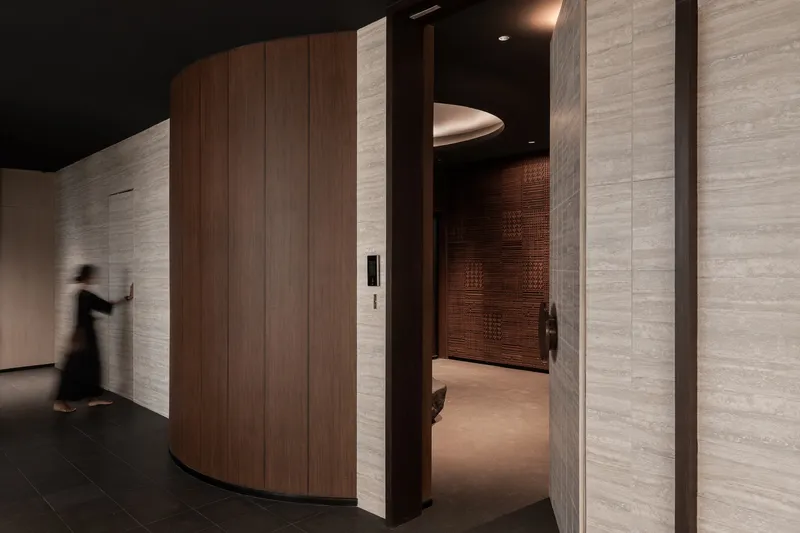
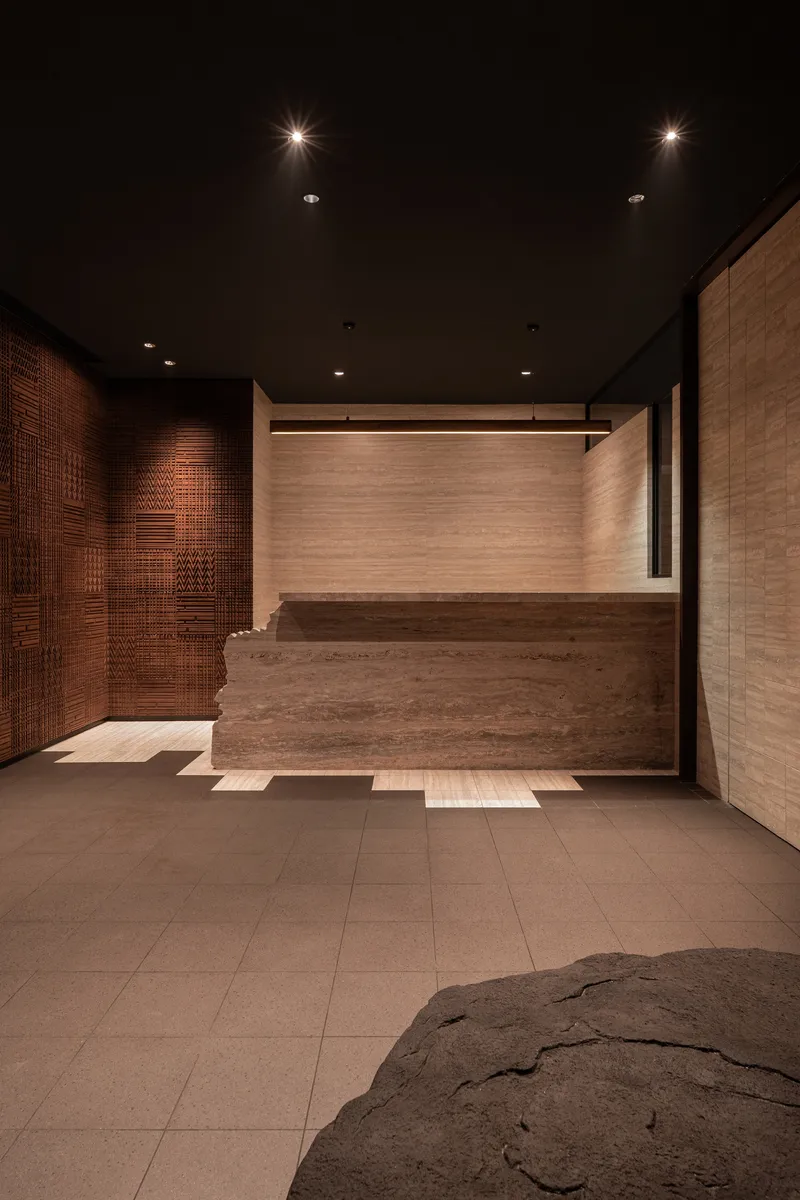
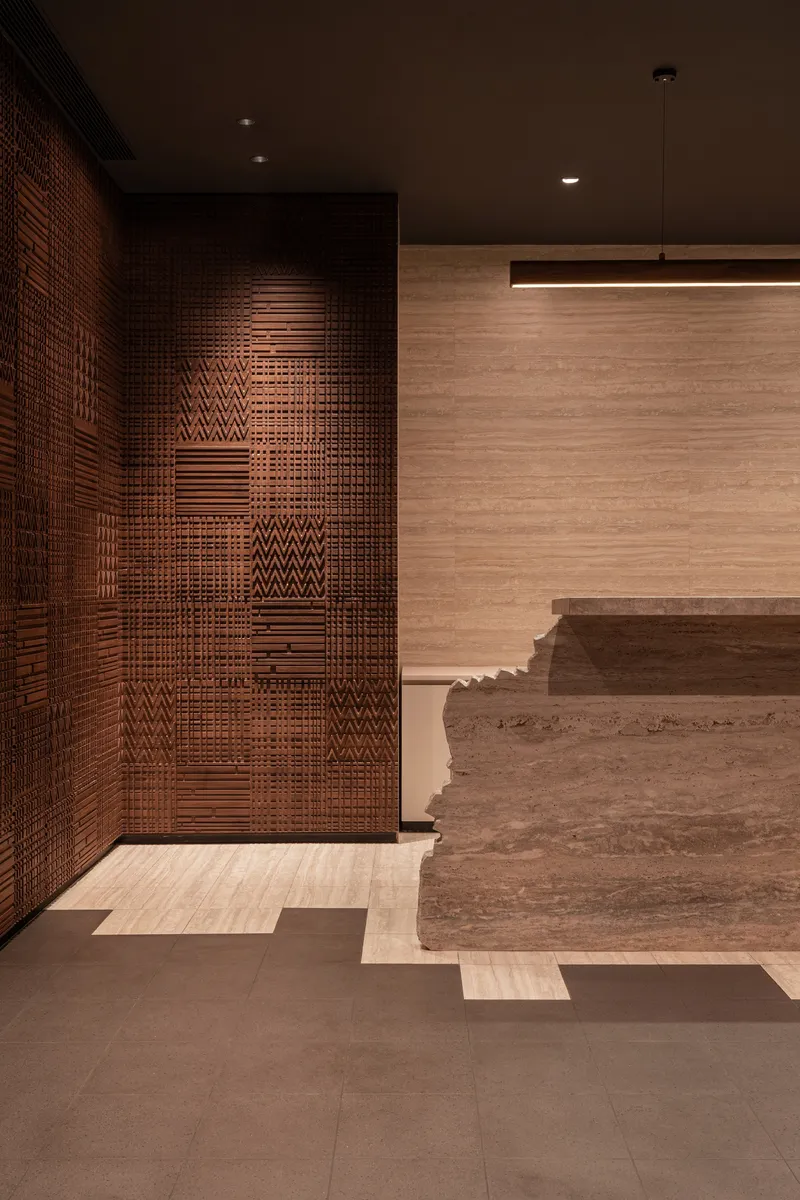
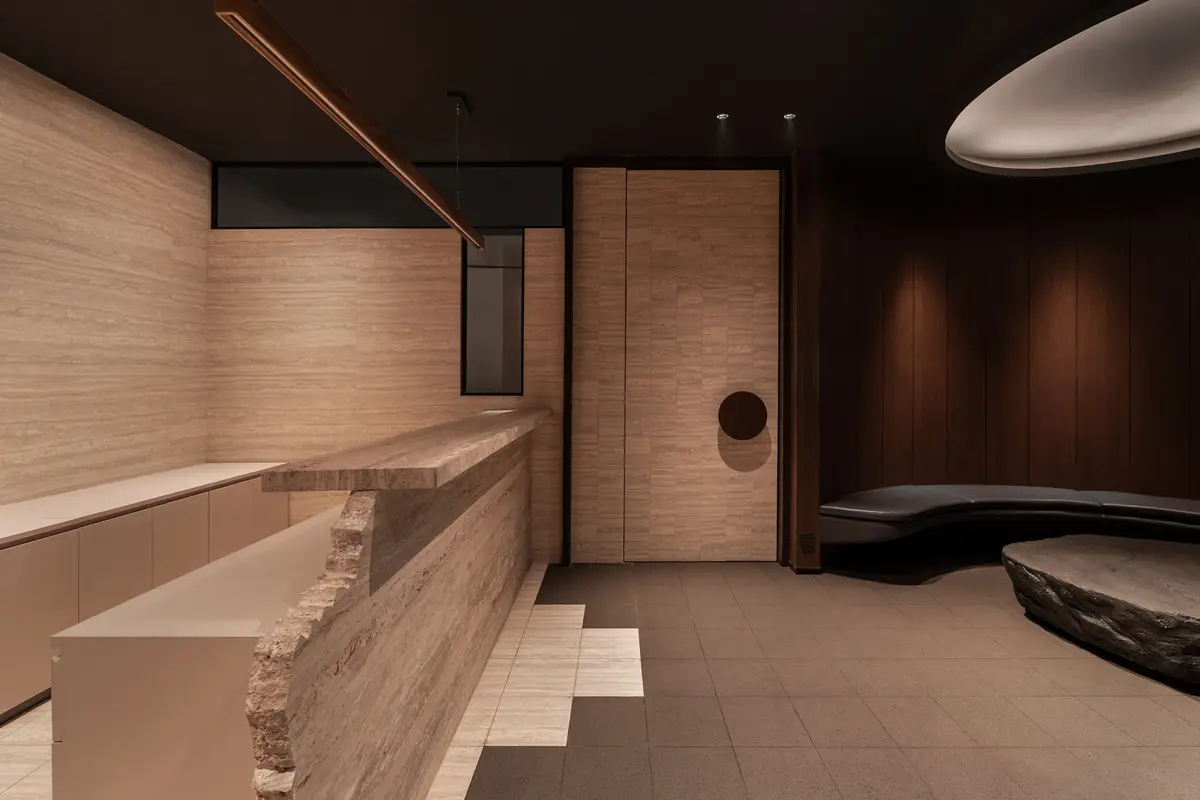
The entry sequence sets the tone immediately. A curved, wood-clad volume houses the elevator, flanked by textured stone walls that suggest geological time rather than corporate polish. Figures move through the space as silhouettes, reinforcing the sense that the architecture is larger than any single occupant. Around the corner, the reception desk emerges from a single block of travertine, its rough-hewn edges left deliberately unfinished against a backdrop of oxidized copper tile.
The copper panels behind the desk are worth lingering on. Their patina is not decorative appliqué but a material condition that will deepen over years of use. Paired with the horizontal pendant fixture floating overhead, the reception becomes a threshold between the city outside and the calibrated quiet within. It is an unapologetically slow introduction to a fast-paced industry.
Woven Screens and the Geometry of Privacy
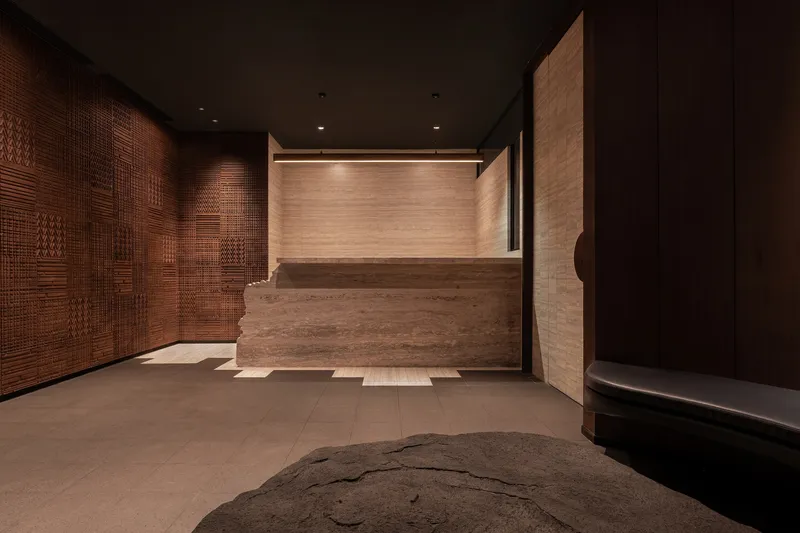
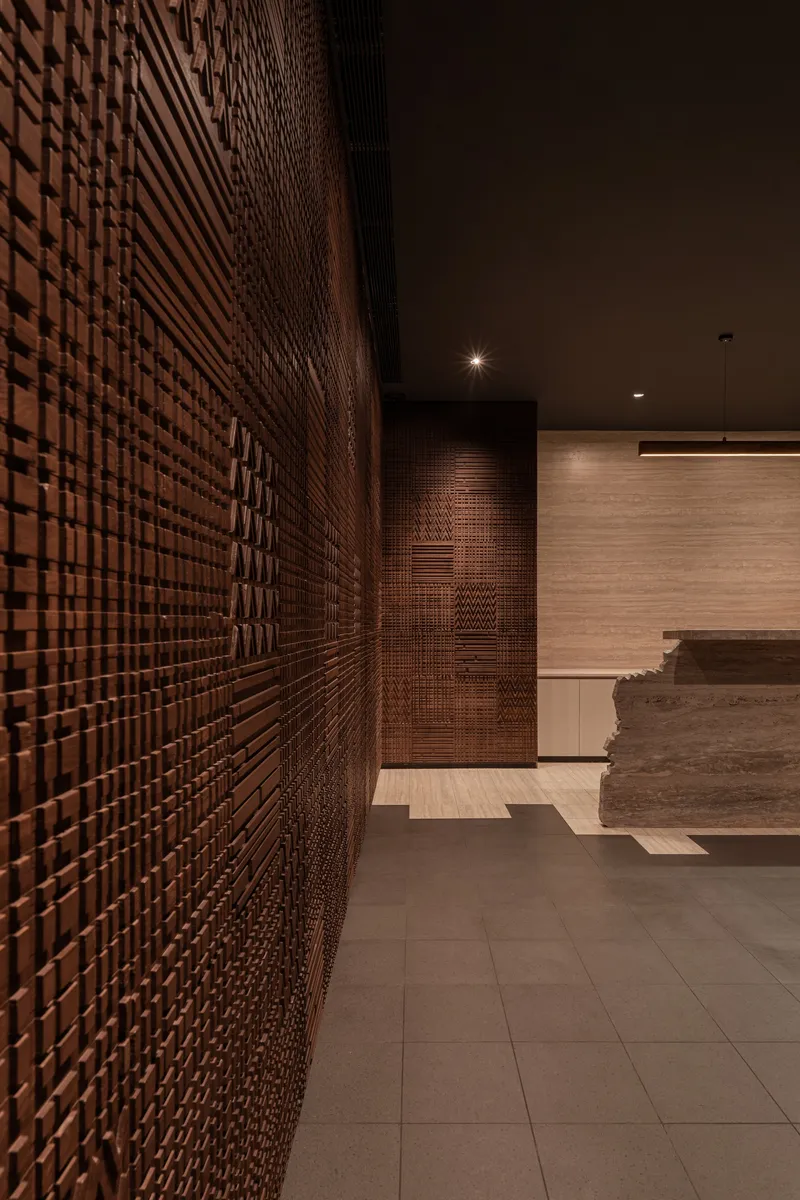
One of the project's strongest recurring elements is the basketweave timber screen, which appears at multiple scales and orientations throughout the plan. At the reception it serves as a backdrop for the travertine desk, its geometric density offsetting the stone's mineral stillness. Down the corridor it reappears as a wall surface punctuated by recessed doorways, establishing rhythm without repetition.
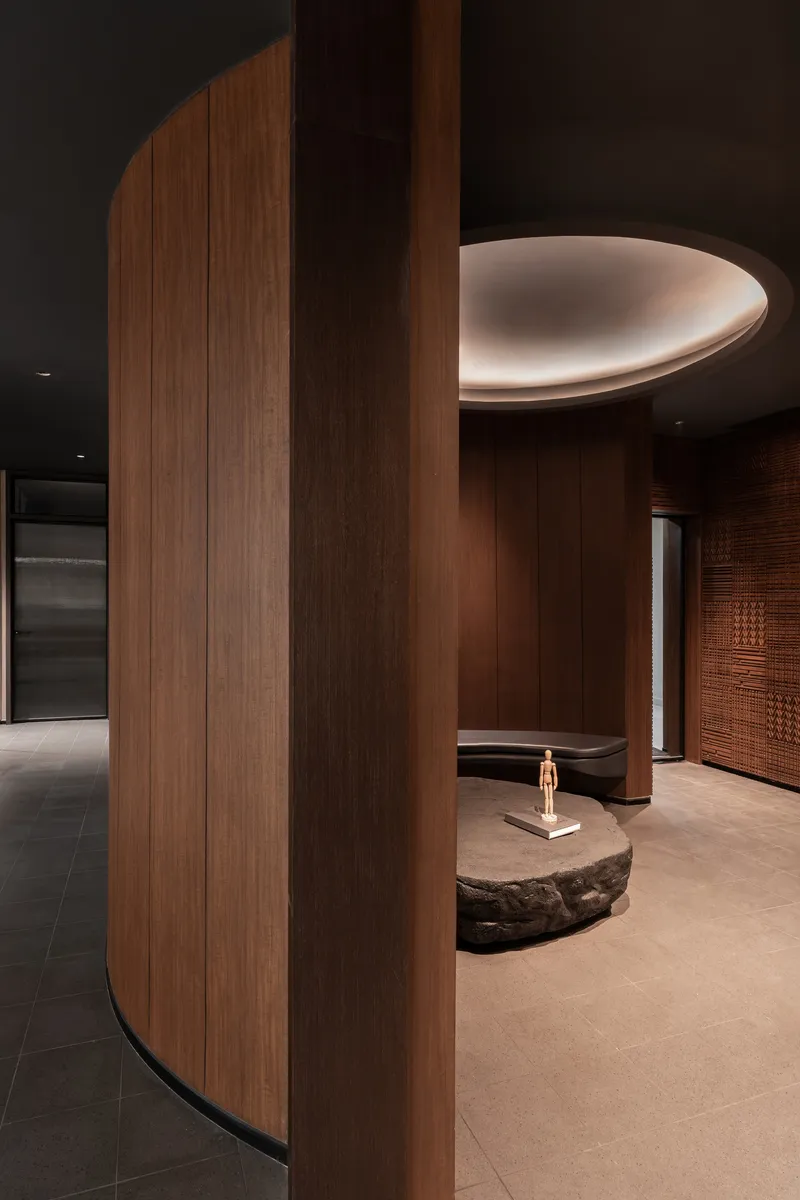
The screen does real spatial work. It is not a feature wall in the Instagram sense but a device that modulates privacy, filters sightlines, and introduces a craft register that the rest of the palette supports. The curved wood-clad columns in the lobby share the same language, their radiused surfaces softening what could otherwise become an overly rectilinear plan. Abin Design Studio clearly understands that warmth in minimalism comes from touch, not from color.
Corridors That Breathe
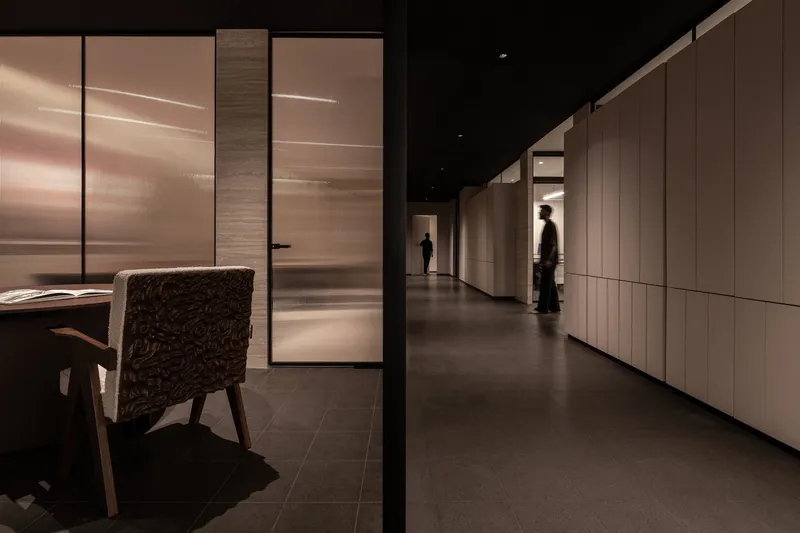
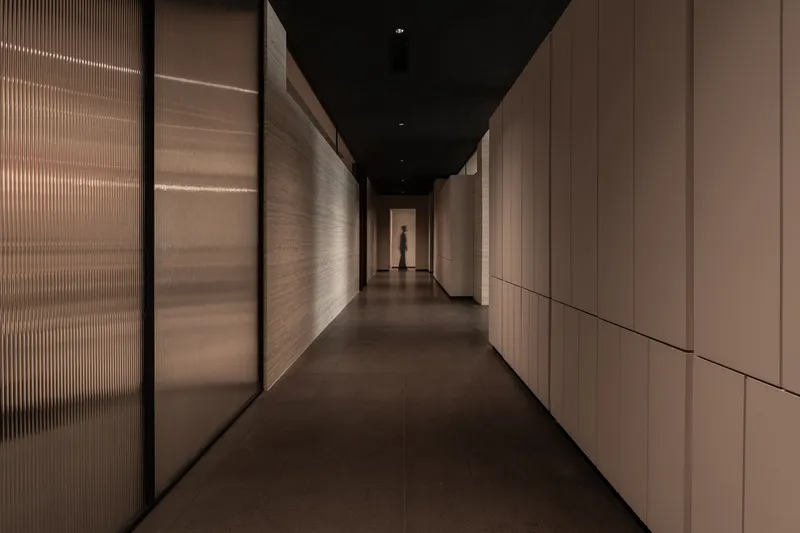
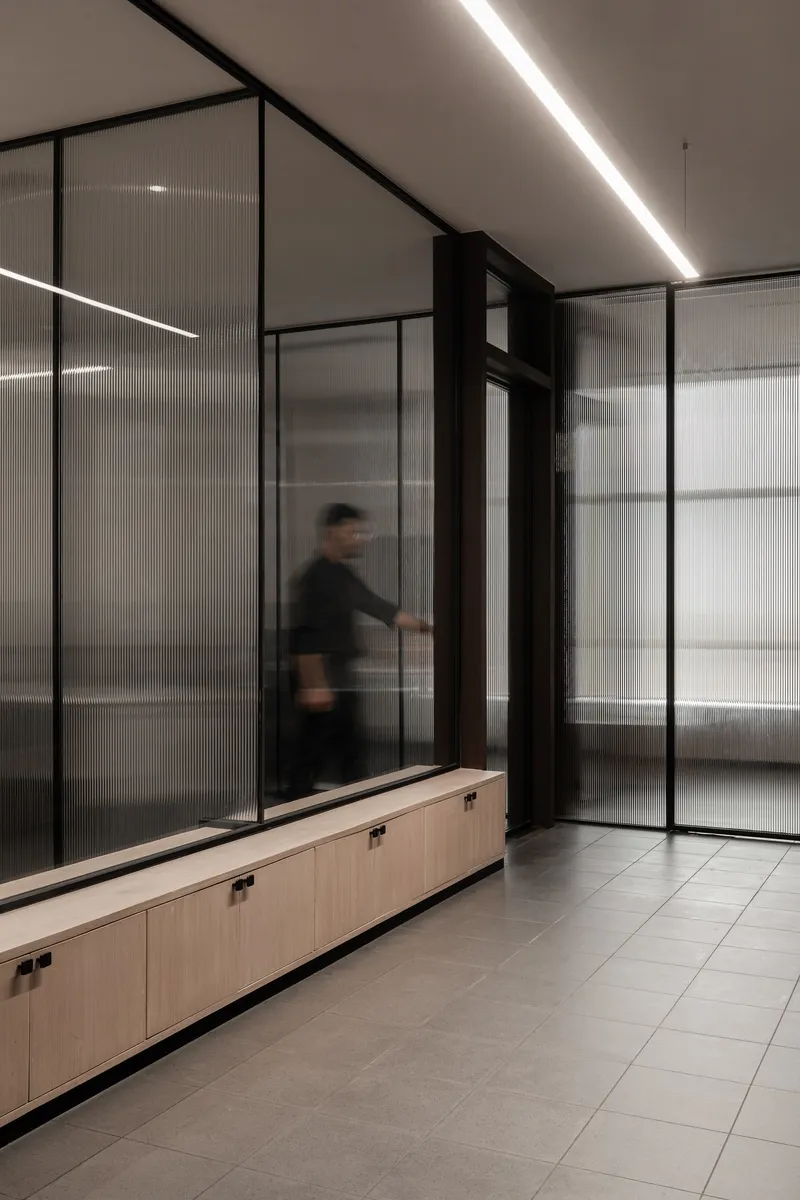
Circulation in The Spatial Continuum is not an afterthought but a primary architectural experience. Long corridors are lined with ribbed translucent glass partitions and light wood paneling, producing a layered luminosity that shifts as you move through them. Figures appear as blurred silhouettes behind the glass, present but never intrusive. The effect is closest to a Japanese shoji screen, translating a centuries-old spatial idea into a contemporary Kolkata context.
The dramatic artificial lighting in these passages deserves particular attention. Rather than flooding the corridors with even illumination, Abin Design Studio uses recessed ceiling strips and spotlights to create zones of brightness and shadow. The result is corridors that feel cinematic, even meditative, qualities you almost never associate with office hallways.
The Dark Room and Its Disc
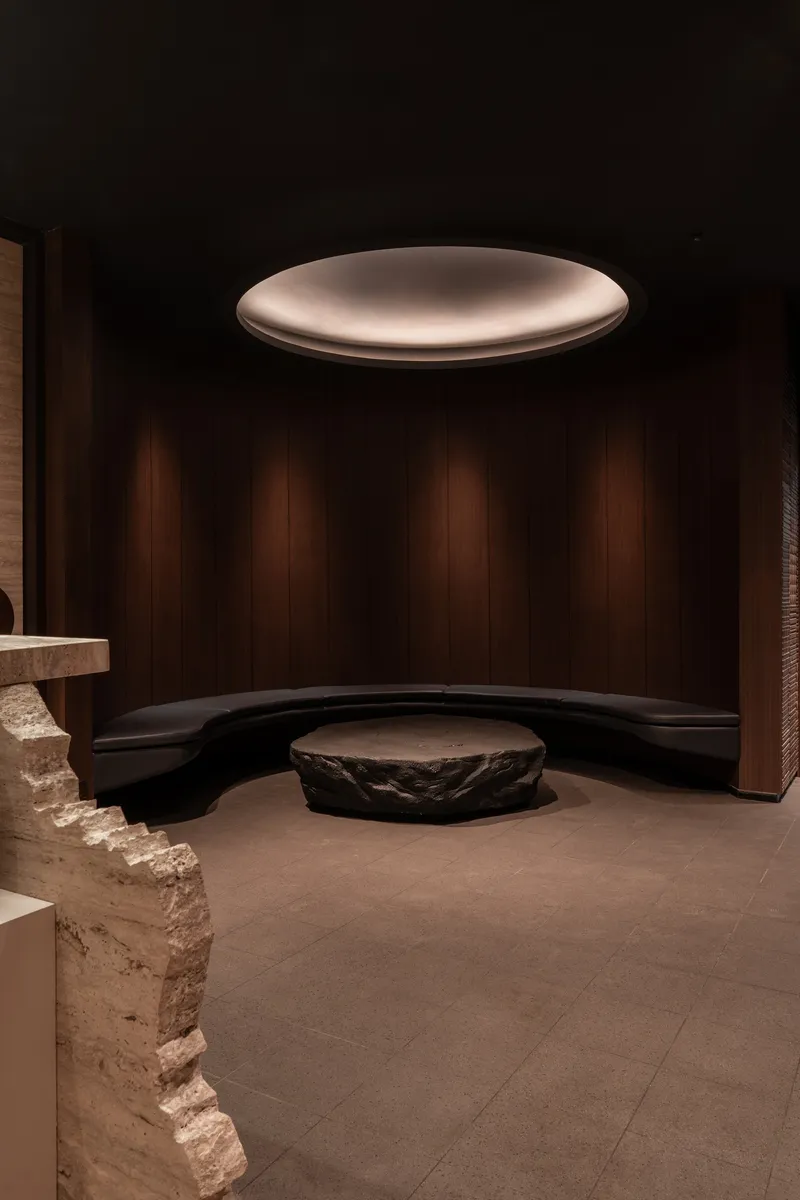
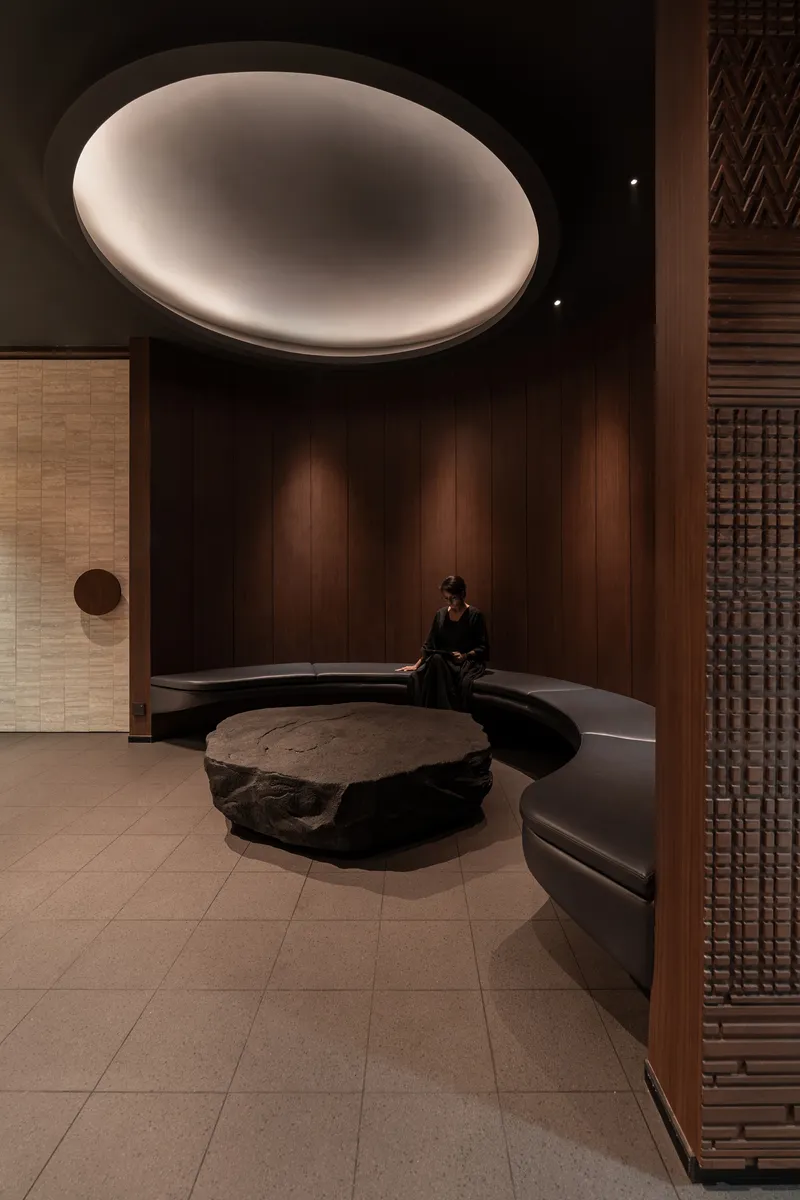
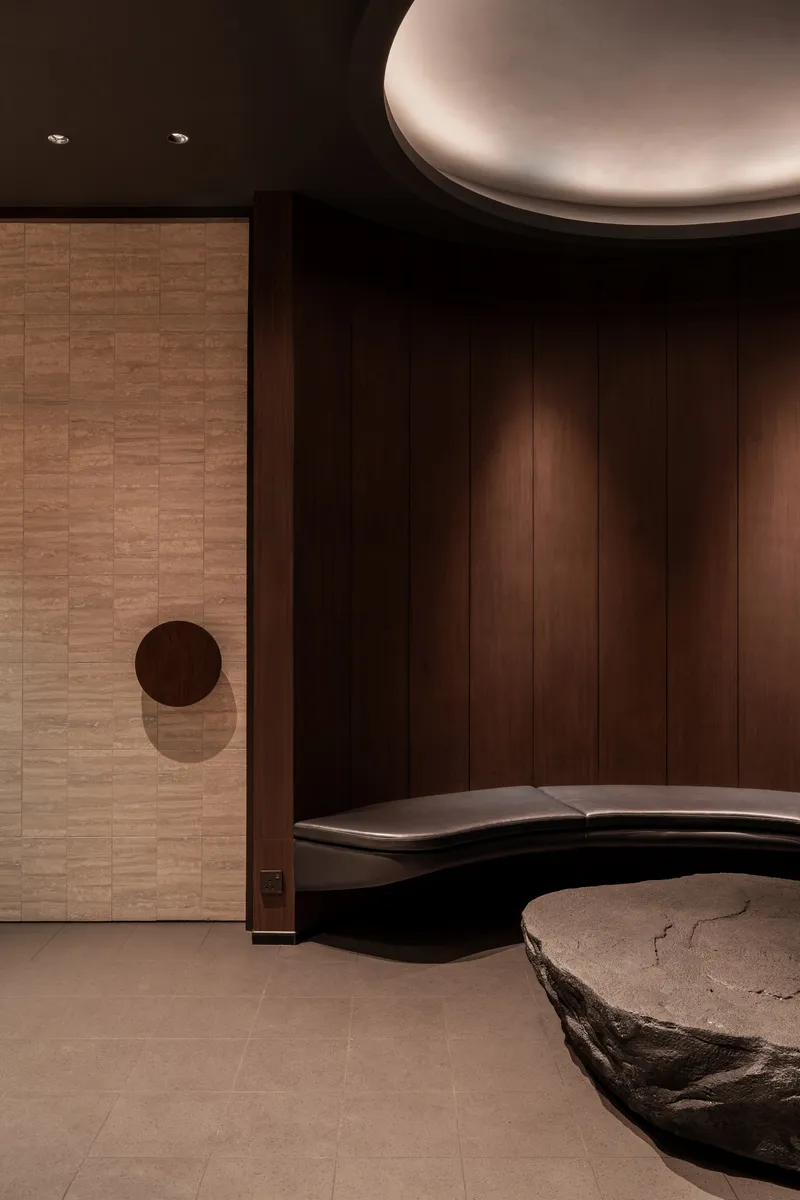
Perhaps the most atmospheric space in the project is the dark meeting room anchored by a curved black bench, a raw stone table, and a single glowing disc on the ceiling. The disc functions like an artificial moon, casting soft, diffused light downward onto the seating below while the rest of the room recedes into shadow. It is a theatrical gesture in a project otherwise defined by restraint, and it works precisely because nothing else in the room competes for your attention.
The sliding timber door with its circular handle, visible in the threshold shot, reinforces the tactile commitment running through the entire design. Every point of contact between hand and surface has been considered. In an era where most office doors are anonymous flush panels, this is a quiet provocation.
Meeting Rooms and Working Landscapes
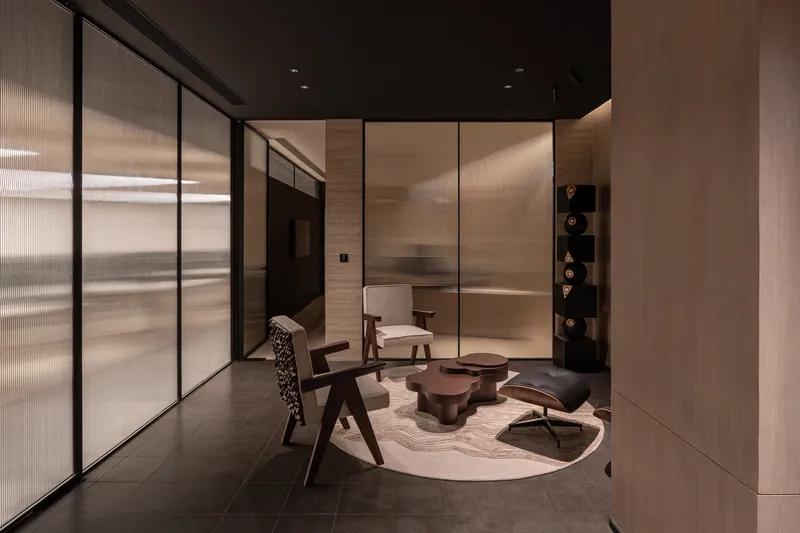
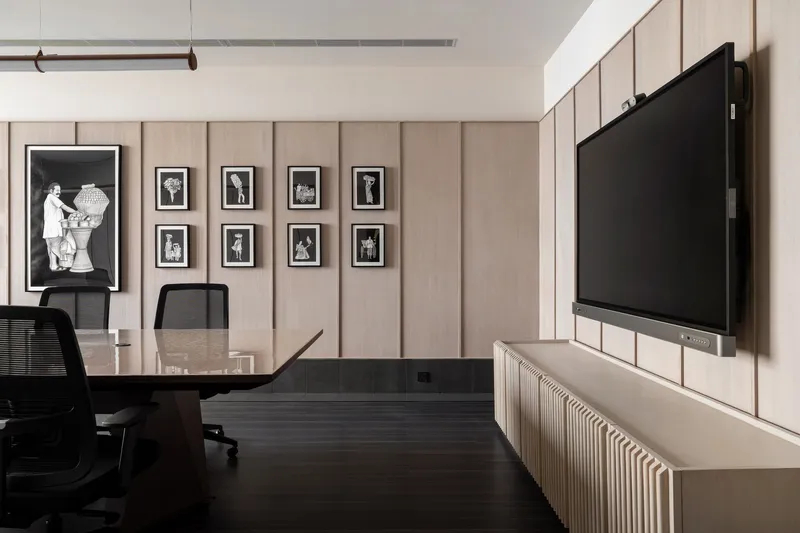
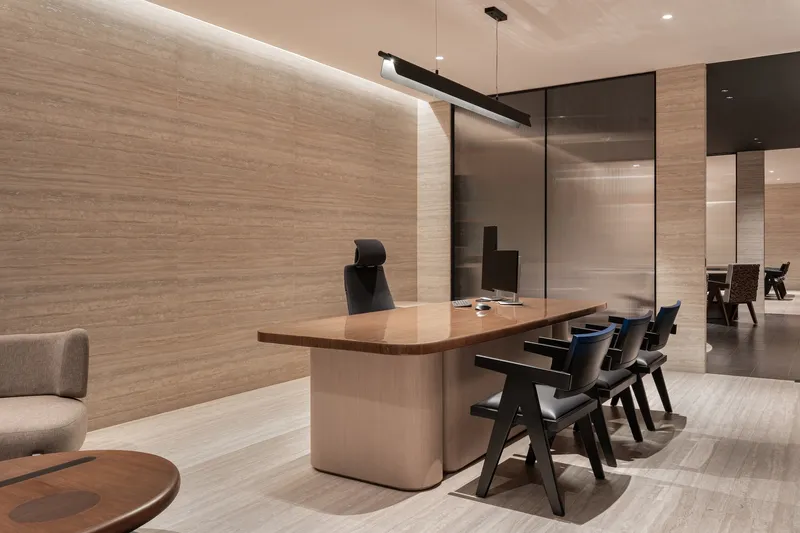
The meeting spaces throughout the project vary in formality but share a consistent material grammar. The glass-partitioned room with fluted panels and a circular rug reads as a soft, semi-transparent enclosure rather than a sealed box. In contrast, the conference room lined with vertical wood paneling and framed photographs doubles as a gallery wall, grounding business conversations in the developer's own body of work.
A smaller meeting area uses a timber table set against a textured wood wall with concealed linear lighting, creating a space that would feel at home in a well-designed restaurant. The consistent quality across these rooms suggests that Abin Design Studio treated every enclosed space as a design problem worthy of its own resolution, not just a box with a table inside.
Open Floor and Executive Edge
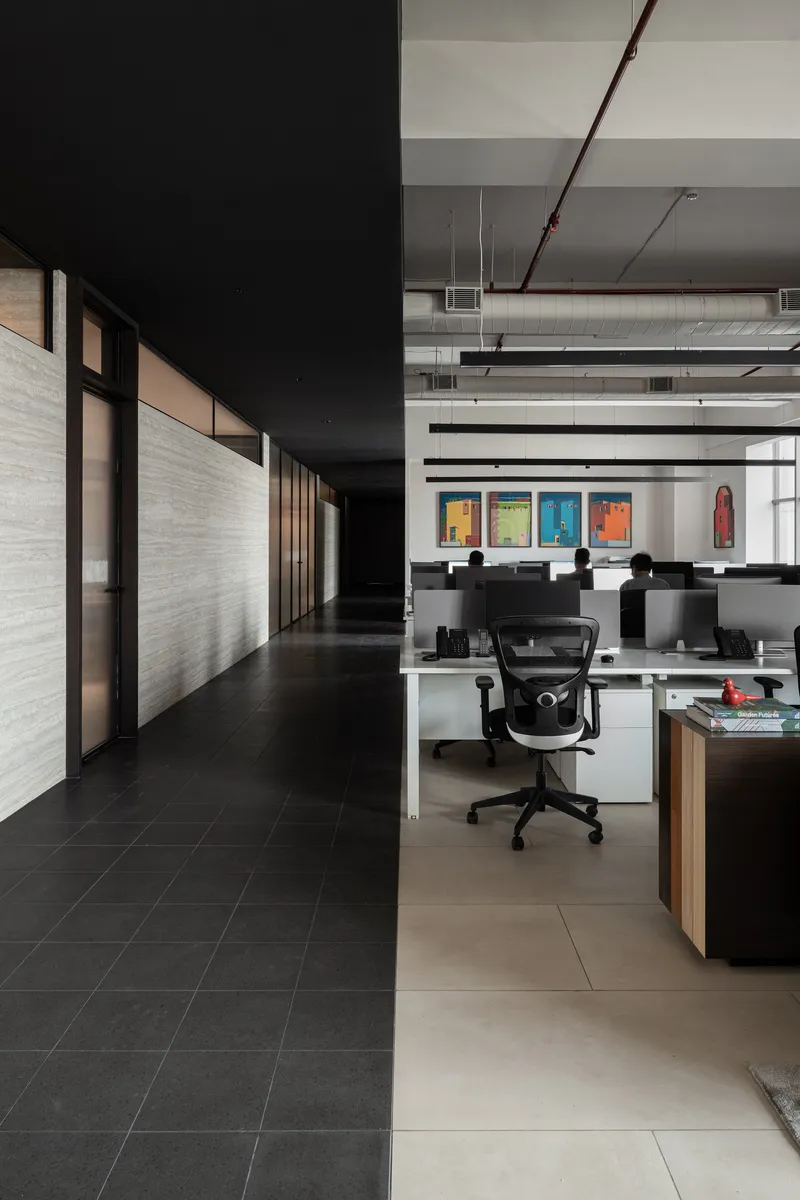
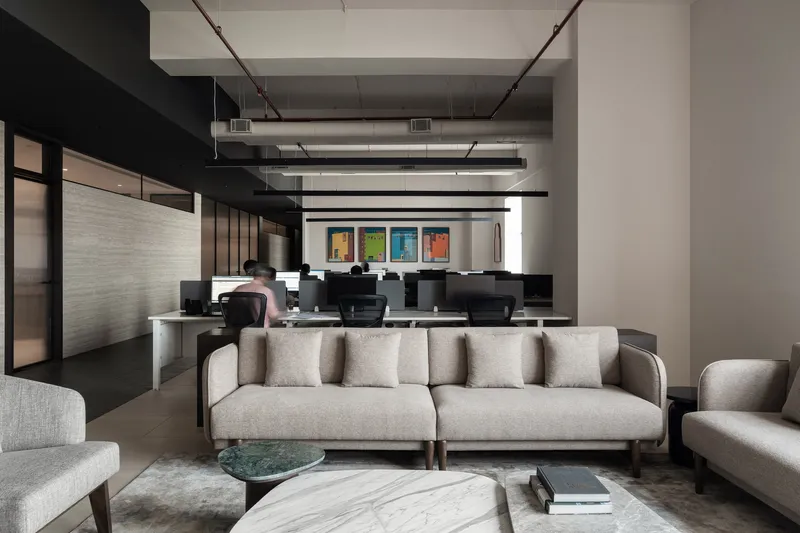
The open office floor takes a decidedly different tonal approach. Exposed ceiling ducts and services are left visible, and colorful framed art punctuates the workstation zone. It is a deliberate contrast: the common working area is looser, more energetic, and less curated than the arrival and meeting sequences. The lounge overlooking the workstations, with its sofas and marble coffee table, acts as a buffer between the two registers.
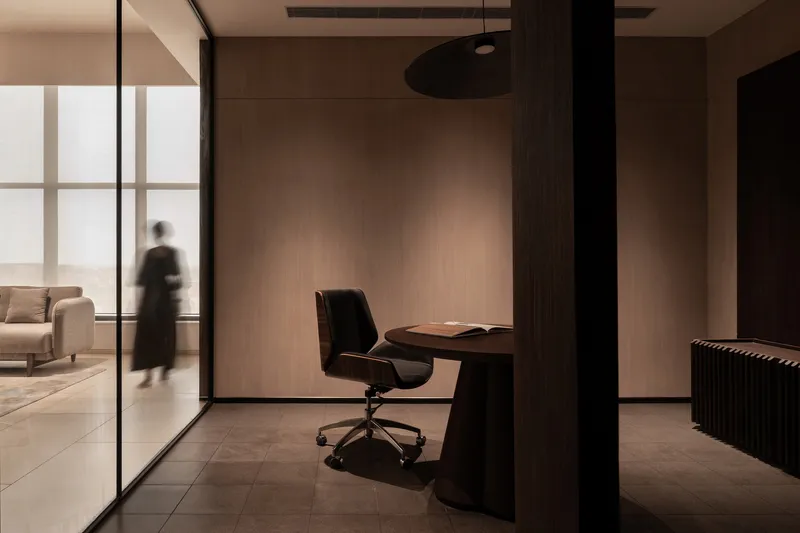
The private office alcove, with its circular desk and framed glass partition, marks the executive end of the spectrum. A passing figure caught mid-stride outside the glass suggests the constant motion of an active workplace while the interior remains composed. It is a neat spatial metaphor for leadership: visible but insulated, part of the flow but slightly apart from it.
The Translucent Partition as Leitmotif
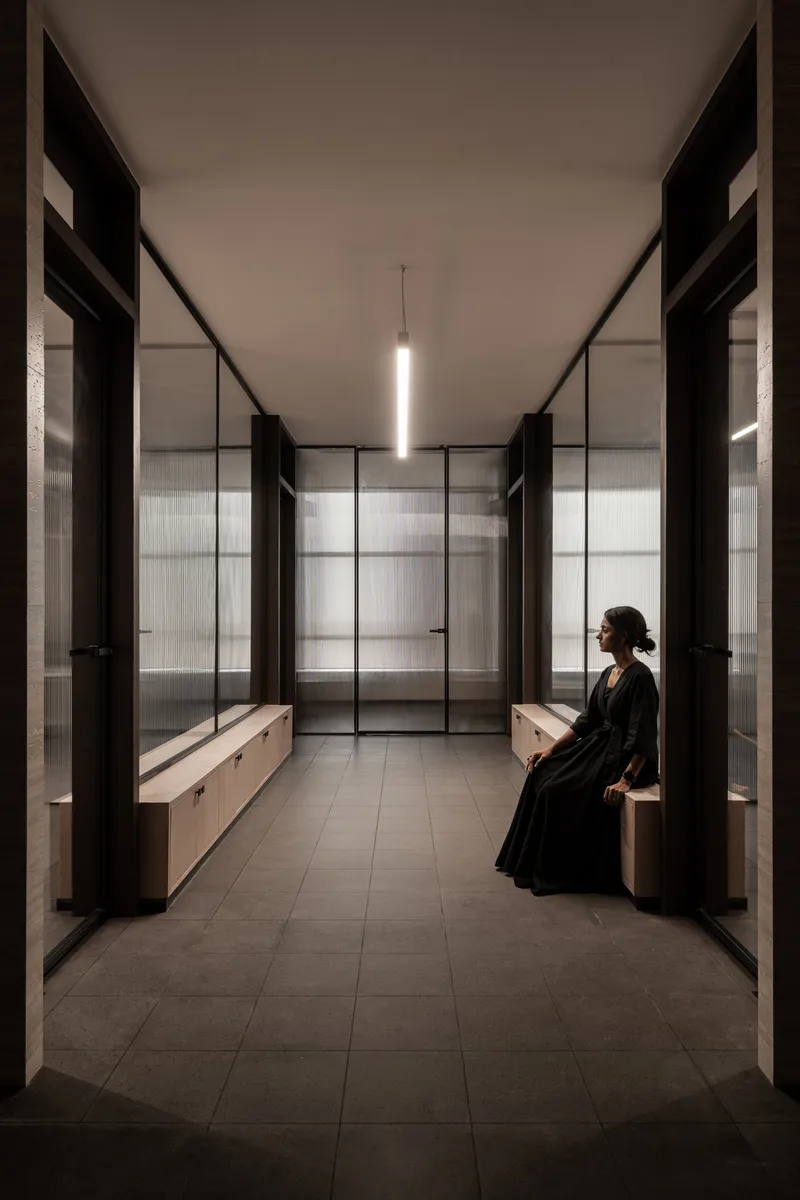
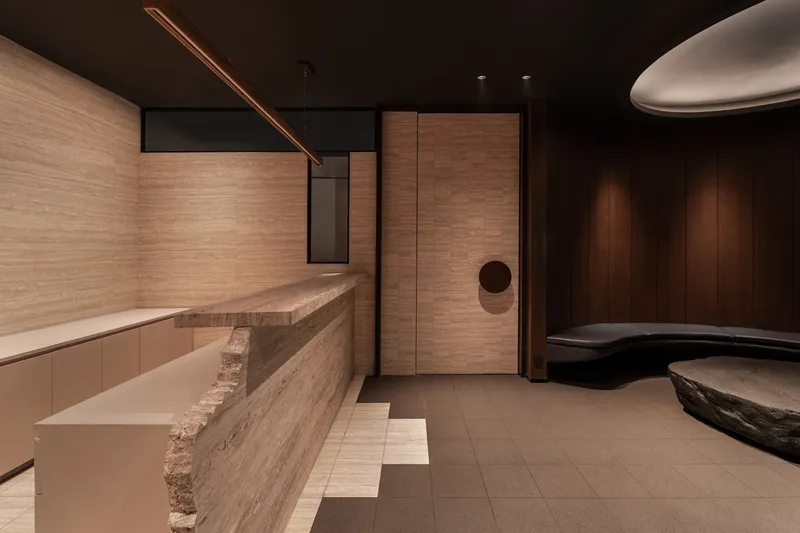
Running through the project like a recurring musical phrase is the translucent glass partition. Whether in the fitting room, where a seated figure appears framed between frosted panels, or alongside the travertine reception desk, these partitions establish the project's fundamental spatial idea: that boundaries in a workspace should be felt rather than enforced. Light passes through, bodies register as shadows, sound is muffled but not silenced. It is a remarkably humane approach to the open-plan-versus-private-office debate, resolving it not with policy but with material.
Plans and Drawings
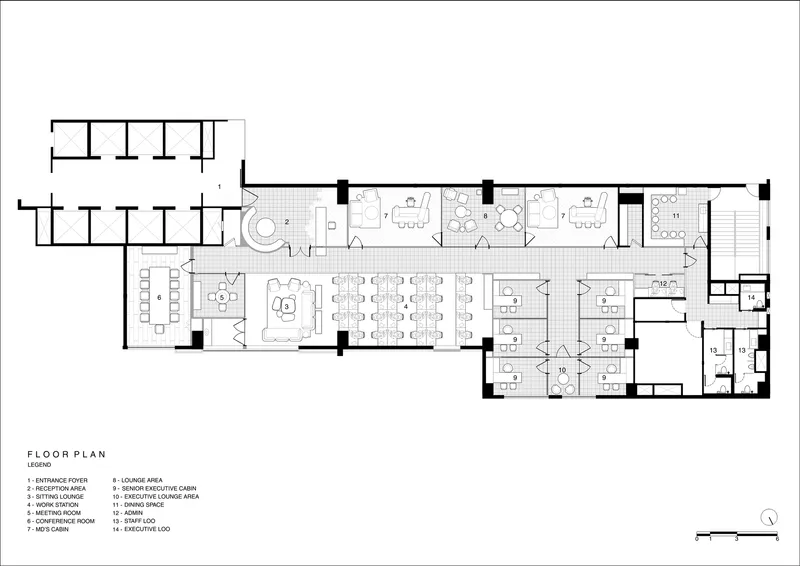
The floor plan reveals a clear organizational logic: the reception, meeting rooms, and executive spaces occupy the perimeter and front of the plan, while the open workstation floor extends toward the back. Circulation corridors thread between these zones, confirming the experiential sequence from the dense, materially rich arrival to the lighter, more open working areas.
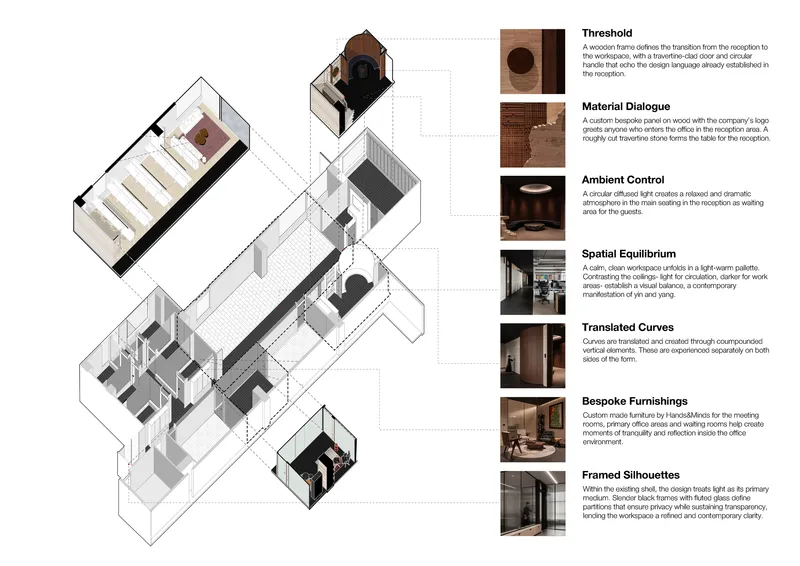
The exploded axonometric is particularly useful, mapping not just spatial organization but the material palette layer by layer. Annotated detail photographs are embedded directly into the drawing, connecting the abstraction of the axonometric to the tactile reality of copper, travertine, and woven timber. It is a presentation technique that more studios should adopt: it closes the gap between what a drawing promises and what a space delivers.
Why This Project Matters
The Spatial Continuum matters because it demonstrates that office interiors in the Indian context can operate at a level of material and spatial sophistication that rivals the best international work without importing a foreign aesthetic. The travertine, the copper, the woven timber: these are not borrowed signifiers of luxury but carefully chosen materials whose textures and aging patterns are specific to the climate and culture of Kolkata. Abin Design Studio has built a workplace that will look better in five years than it does today, a rare and valuable quality.
More broadly, the project offers a persuasive counter-argument to the tech-startup aesthetic that still dominates office design globally. Where that model relies on novelty, ping-pong tables, and bright graphics, The Spatial Continuum relies on gravity, silence, and the slow accumulation of patina. For a developer client whose own work reshapes the physical city, this office is a quiet manifesto: build less, mean more.
The Spatial Continuum by Abin Design Studio. Kolkata, India. 605 m². Completed 2025. Photography by Manan Surti Photography.
About the Studio
Share Your Own Work on uni.xyz
If projects like this are the kind of work you want to make, uni.xyz is a place to publish your own, find collaborators, and enter design competitions.


Popular Articles
Popular articles from the community


Architekt Andreas Gruber Scatters 23 Dark Timber Chalets Across a South Tyrolean Forest Edge
In Molini di Tures, Amonti Chalets breaks a resort into a hamlet of gabled timber houses, with parking, storage and services pushed into the slope.

Jaramillo Van Sluys Arquitectura and Urbanismo Turn a Demolished Registry Lot in Quito into an Orchard Plaza
In Quito's Centro Histórico, a 2,800 m² plaza exposes the San Agustín convent wall and redraws its lost Augustinian orchard in volcanic stone.

GROUP A Strips a 1969 Rotterdam Harbor Headquarters to Its Frame and Wraps It in Timber Louvers
In Rotterdam's M4H harbor district, Ferro Offices reuses a 1969 frame, adds one timber storey and reaches BREEAM-NL Outstanding.

longwave studio Reorganizes a 112 m² Tainan Apartment Around the Daily Routines of a Family and Two Cats
In Tainan, Taiwan, birch plywood, rust-red furniture and a freestanding plaster wall link arrival, storage, work and family life in one apartment.

Similar Reads
You might also enjoy these articles


LAVA Architecten Gives Vocational Education a Sawtooth-Roofed Face on a Mechelen School Campus
In Mechelen, Belgium, a 2,053 m² STEM school on a 6×6 m grid turns workshops and classrooms into rooms that can be rearranged as teaching changes.

KEMA Studio Turns a Derelict Marvila Attic into a 60 m² Lighthouse Apartment Above Lisbon
In Lisbon's Marvila district, a rebuilt roof, four skylights and two plywood volumes turn an unlivable attic into a bright home facing the Tagus.

Pixel Gardens: One Repeated Module Stacked Into a Terraced Social Housing Tower for Famagusta
Salem Bader's shortlisted housing tower builds a vertical neighbourhood from one repeated module, offsetting units to carve terraces, light and air.

Bao Huynh Watercolor Atelier: A Serene Art Retreat in Hội An
Bao Huynh Watercolor Atelier in Hội An blends multifunctional art spaces, sustainable design, local materials, and family-friendly living in a serene environment.

Explore Spatial Relationships Competitions
Discover active competitions in this discipline

Challenge to reimagine the Iron Throne

Photograph architecture without architects

Illustrate the lost glory of Angkor Wat - Render Challenge

Design challenge to reuse E-waste
Comments (0)
Please login or sign up to add comments
No comments yet. Be the first to comment!