
Acta Studio Lines a Miami Bakery in Handmade Latticed Wood That Doubles as Architecture
Caracas Bakery's second location in Miami's MiMo district pairs Scandinavian restraint with artisan craft at every surface.


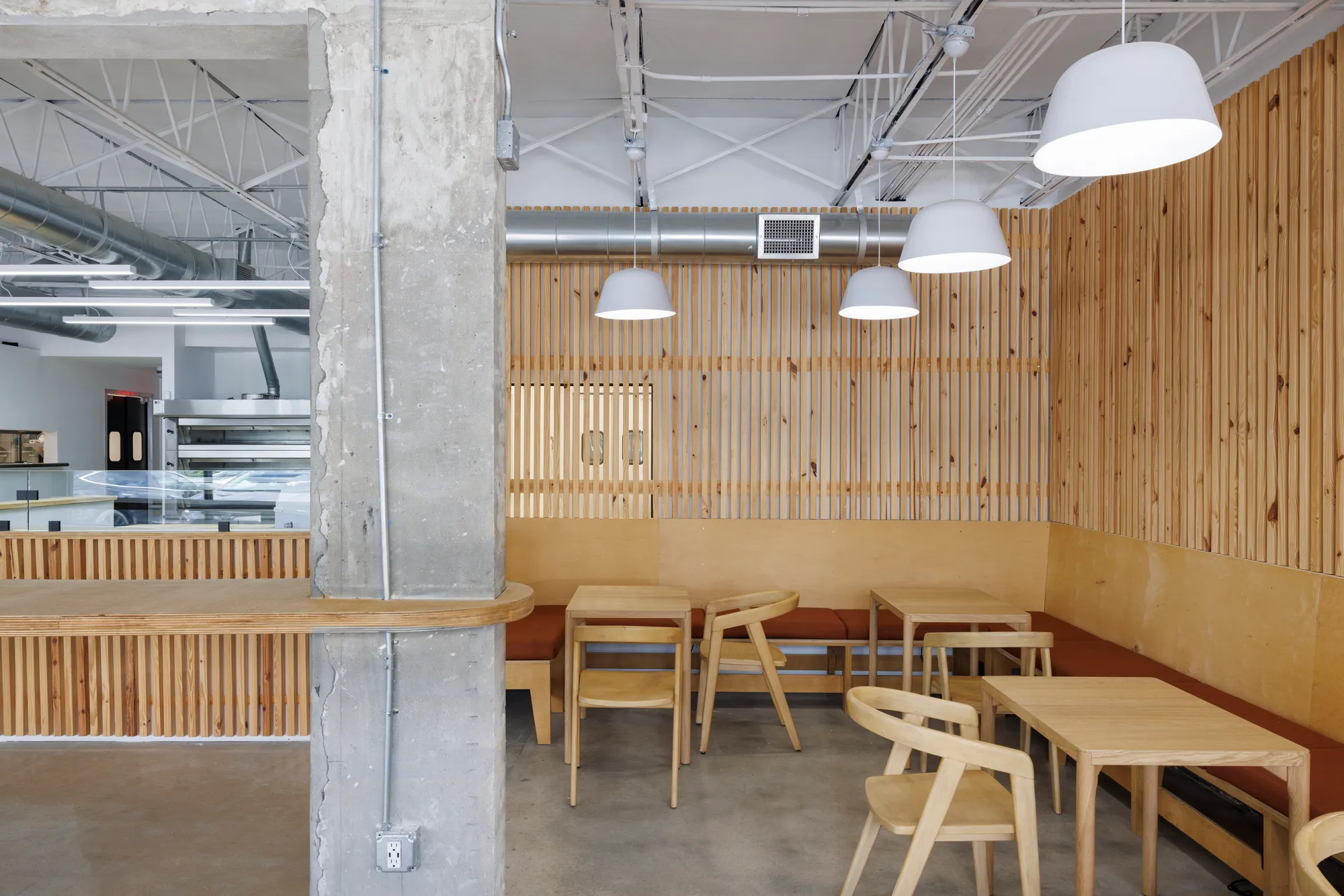
Caracas Bakery is a French-Venezuelan institution in Miami, and when it came time to open a second location, the brief could have gone sideways fast: tropical pastels, rattan pendants, the whole Miami cliché. Instead, Acta Studio, led by Cristina Medina-González, took a 3,000-square-foot ground-floor unit in the MiMo district and dressed it almost entirely in latticed timber panels, handmade by a single local carpenter. The result is a bakery interior that feels quiet and warm in a city that rarely aims for either.
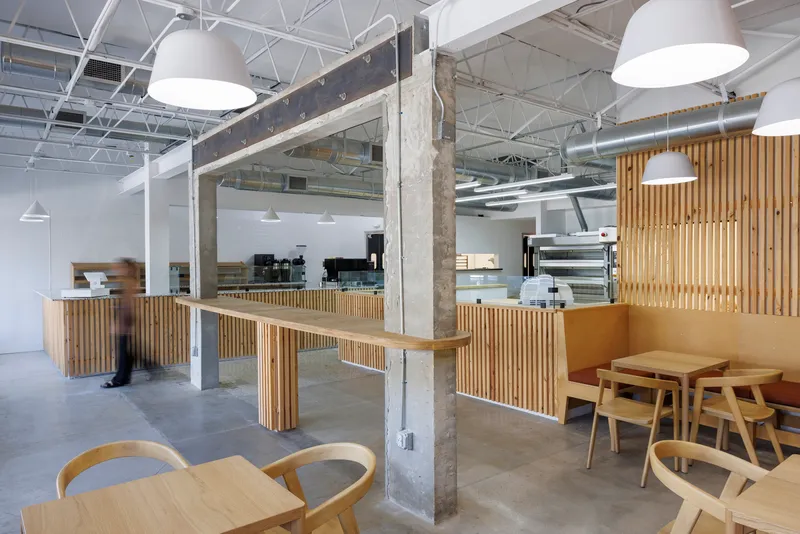
What makes the project genuinely interesting is the way a single material system does nearly all the architectural work. The vertical timber slats wrap from the service counter to the walls behind the seating, unifying three distinct zones without partition walls. Against the raw concrete columns and exposed ceiling trusses that came with the shell, the wood reads as a precise, almost textile insertion. There is no fighting the industrial bones of the building. There is only lining them.
A Counter That Becomes a Wall
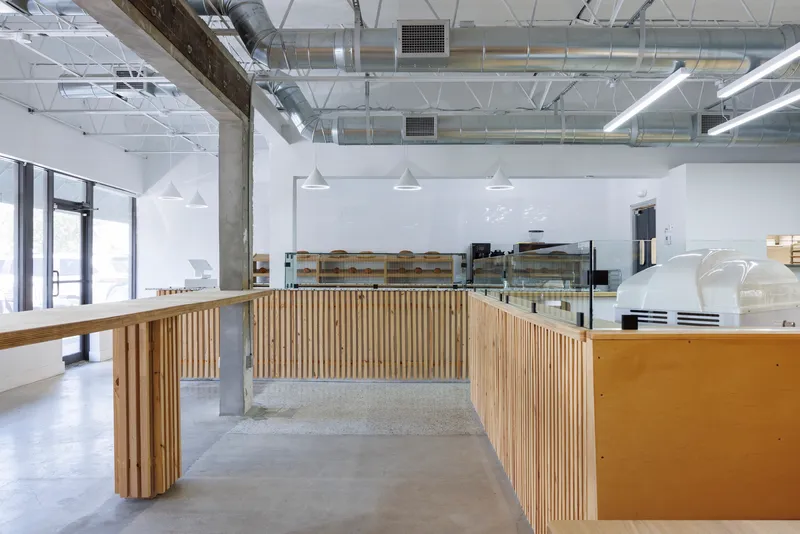
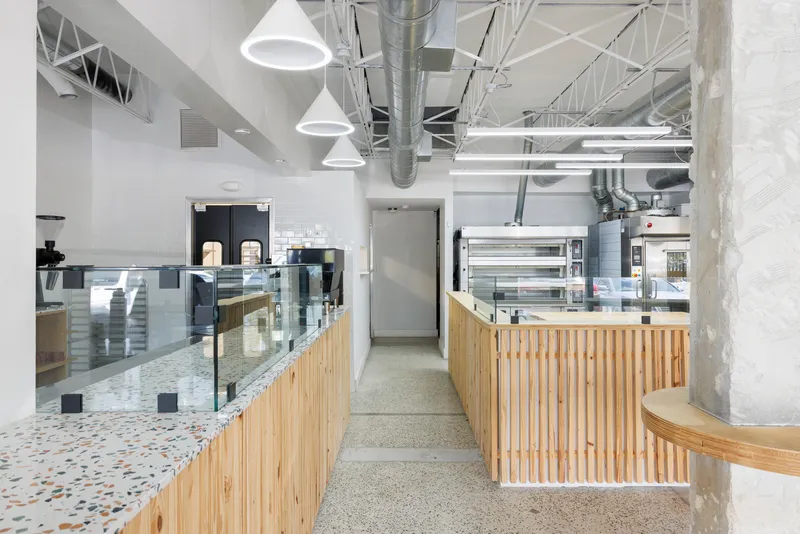
The elongated service counter is the centerpiece, and it announces the design logic immediately. Vertical timber slats clad its front face, rising to roughly chest height and framing a concrete terrazzo countertop. Glass display cabinets sit atop, letting the pastries do the color work while the architecture stays neutral. The slats are spaced consistently enough to read as pattern but open enough to avoid feeling like a fence.
Walking along the counter toward the back of the space, the same slatted language continues into the corridor between the service zone and the seating area. Terrazzo flooring underfoot and white pendant lights overhead keep the palette disciplined. There is a clear debt to Scandinavian minimalism here, but the warmth of the wood and the honesty of the concrete keep it from feeling Nordic-clinical. It is closer to a workshop than a showroom.
Concrete Columns as Furniture Anchors
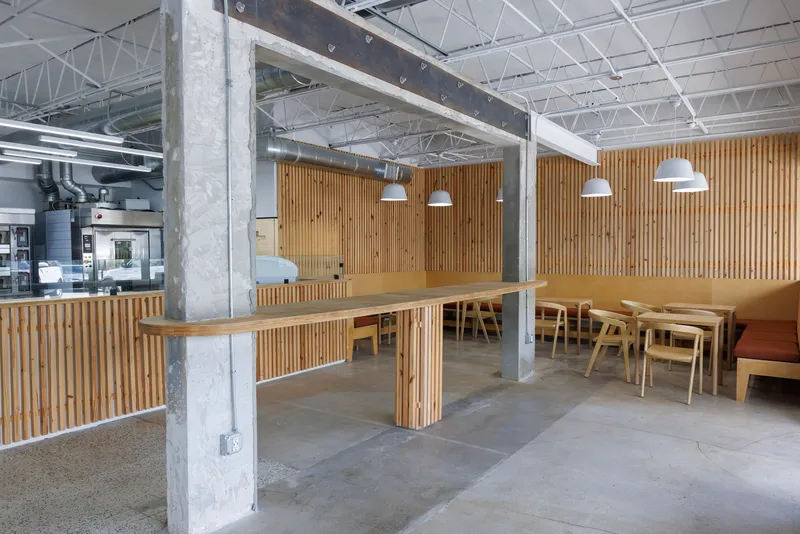
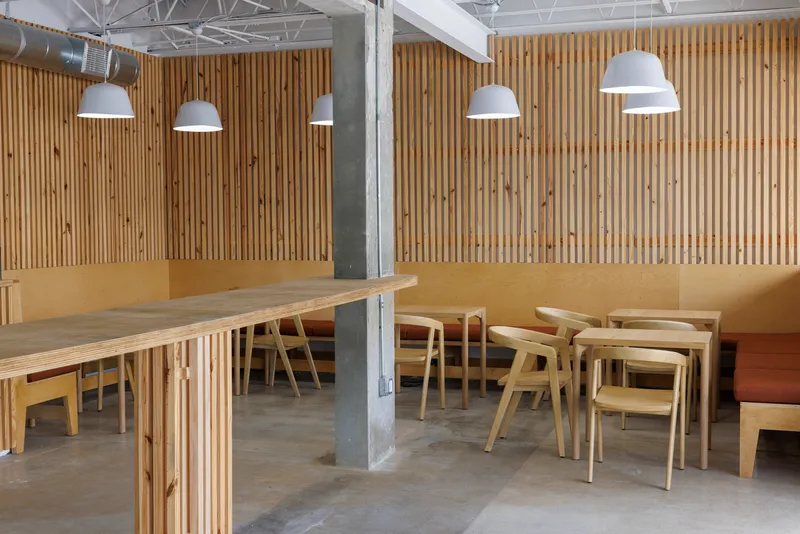
The existing concrete support beams and columns could have been concealed behind drywall and forgotten. Acta Studio instead uses them as organizational devices. A long communal timber table wraps around one column, making the structural element feel intentional rather than leftover. In the adjacent zone, individual tables and chairs cluster around another column, which anchors the seating arrangement without a single added wall.
Between two concrete beams, a wooden counter is positioned for short-stay patrons, the people who want a cortadito and a croissant and then they are gone. It is smart programming: the column spacing dictates the counter's length, so the architecture and the furniture are essentially the same decision.
Banquette Seating and the Slatted Wall
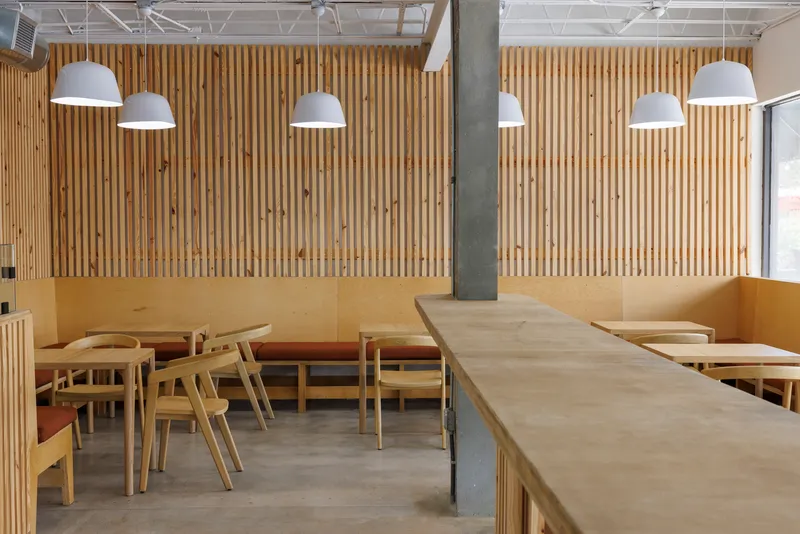
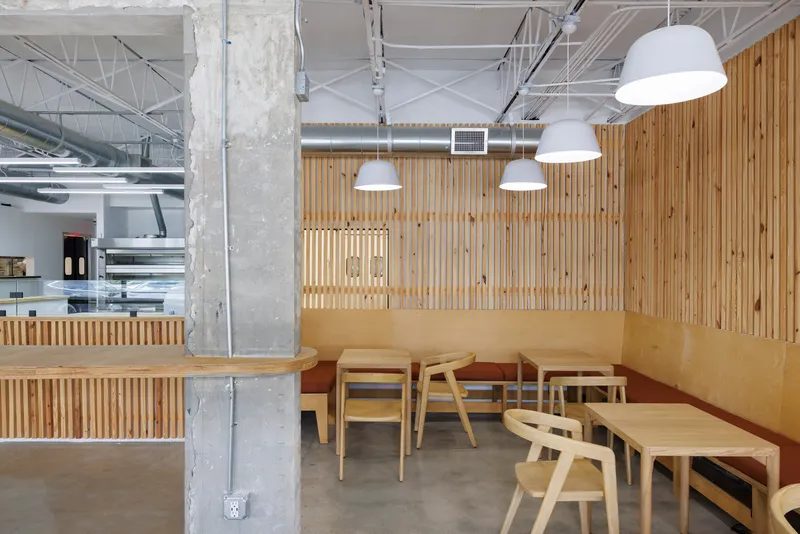
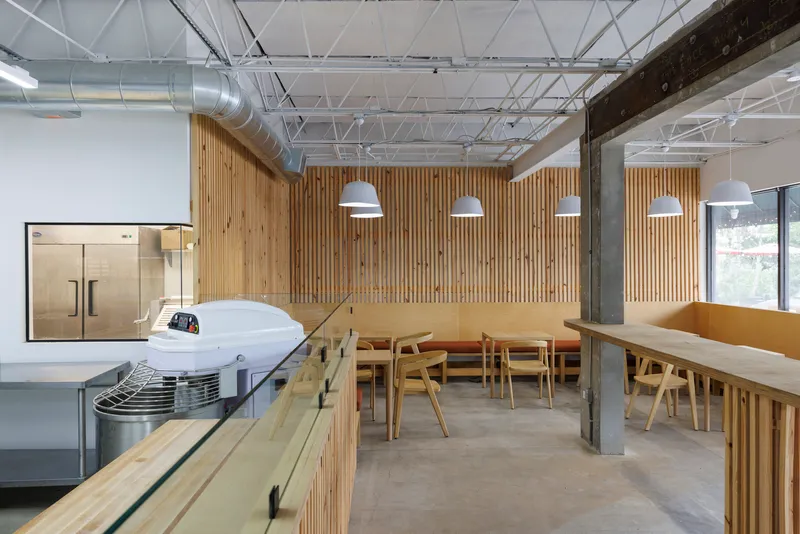
Along the perimeter wall, an elongated wooden bench provides banquette seating, paired with simple timber tables and chairs. Behind the bench, the vertical slat system climbs the wall, creating visual continuity with the counter on the opposite side of the room. In one section, a backlit opening punches through the slats, introducing a soft glow that signals the transition between dining zones without any signage or change in floor material.
The plywood banquettes are honest about their construction. No upholstery, no concealed fasteners trying to look like fine joinery. The material palette stays within a tight range of blonde and natural wood tones, earth-colored concrete, and white fixtures. It is a strategy that could feel monotonous but instead reads as confident, because Medina-González lets the carpentry itself be the ornament.
The Exposed Ceiling as a Fifth Elevation

Leave the ceiling raw and you have to own it. Here, exposed trusses, HVAC ducting, and conduit are all left visible, painted or not, and the effect is an honest industrial ceiling plane that contrasts sharply with the crafted surfaces below. The white pendant lights hang at a consistent height, creating a secondary datum that visually compresses the space and draws attention back to the timber and terrazzo.
It is a calculated move. Spending the budget on bespoke carpentry at human scale while leaving the ceiling untouched means the money lands where people actually look and touch. Too many restaurant fitouts distribute their ambitions evenly across every surface and end up dilute. Acta Studio concentrates theirs.
Plans and Drawings
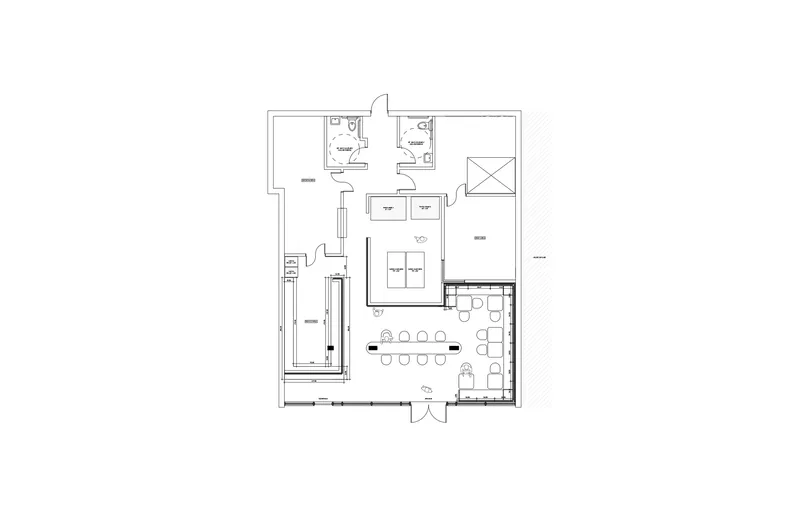
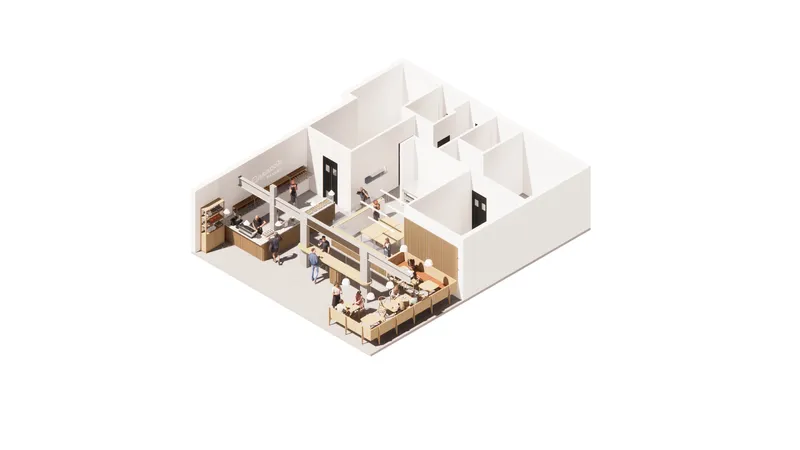
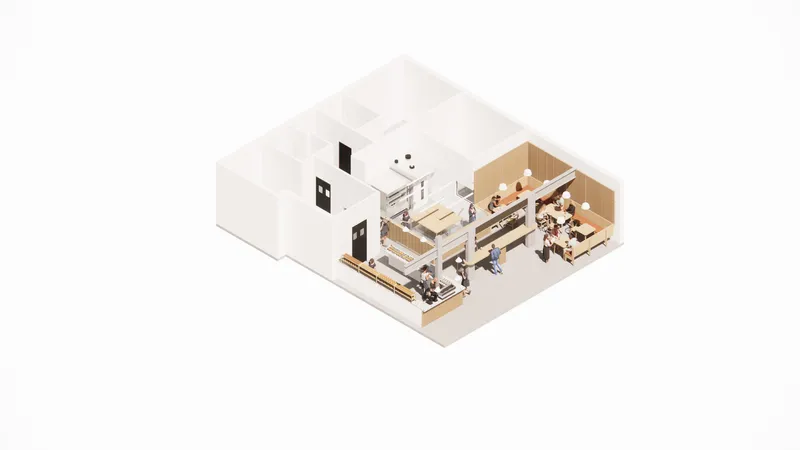
The floor plan reveals a straightforward linear organization: restrooms and storage at one end, the open kitchen and workspace at the other, with the service counter acting as a spine that separates the preparation side from the public side. The axonometric and isometric drawings are more revealing, showing how the timber-clad service zone functions as a freestanding piece of furniture inserted into the concrete shell. Figures populate the drawings at various work stations and seating positions, confirming that the spatial strategy is fundamentally about choreographing movement along a single axis.
What the drawings make clear is how little partition wall exists. The kitchen is open, the seating flows from one cluster to the next, and the only real enclosures are the restrooms and storage. The latticed wood does most of the spatial definition, functioning as a screen rather than a barrier. It separates without isolating.
Why This Project Matters
Caracas Bakery is a small project by area and by budget, but it demonstrates something that larger commissions often miss: material discipline creates stronger rooms than material variety. By committing to a single handmade timber system and letting the existing concrete structure do the rest, Acta Studio produced a space that feels both specific to its site and transferable as a strategy. The MiMo district is full of commercial ground-floor shells waiting for tenants. This project shows how to occupy one without erasing its character.
It also matters because of who made it. The majority of the woodwork was built by a local carpenter, not fabricated off-site by a millwork firm and shipped in. That decision keeps craft visible, keeps money local, and gives the surfaces an irregularity that digital fabrication cannot replicate. In a city where restaurant interiors often compete for Instagram novelty, this one bets on texture and restraint. It is a bet that holds up.
Caracas Bakery by Acta Studio, led by Cristina Medina-González. Located in Miami, United States, in the MiMo district. 3,000 sq ft (279 sqm). Completed in 2022. Photography by James Jackman.
About the Studio
Share Your Own Work on uni.xyz
If projects like this are the kind of work you want to make, uni.xyz is a place to publish your own, find collaborators, and enter design competitions.




Popular Articles
Popular articles from the community


The Musturak Paradise: Senior Living Architecture for a Connected Future in Temara, Morocco
The Musturak Paradise reimagines senior living architecture in Temara via private homes, social spaces, culture, community, and shared care.

Co-Life: Senior Housing Design That Reconnects Older Adults With the City
Co-Life reimagines senior housing design through healing gardens, shared streets, workshops, and a sustainable community across generations.

Riyadh For All: Intergenerational Urban Design for Active Aging in Rabat
Riyadh For All reimagines urban design in Rabat with intergenerational co-living, adaptive courtyards, and Moroccan cultural exchange today.

Conexión: Biophilic Design Reimagines High-Rise Living in Hong Kong
Conexión reimagines high-rise living in Hong Kong through biophilic design, green facades, shared spaces, daylight, water and nature within.


Similar Reads
You might also enjoy these articles

Bao Huynh Watercolor Atelier: A Serene Art Retreat in Hội An
Bao Huynh Watercolor Atelier in Hội An blends multifunctional art spaces, sustainable design, local materials, and family-friendly living in a serene environment.

Atelier Macri Concept Store Interior Design by CASE-REAL
Atelier Macri store features a "ko" counter, walnut wood details, cork displays, blending retail, gallery, and seamless customer experiences.

Manuel Vargas Izquierdo Stadium and High-Performance Sports Center: Architectural Excellence in Jalpa de Méndez
The Manuel Vargas Izquierdo Stadium blends sustainable design, inclusive sports facilities, and cultural-inspired architecture, revitalizing Jalpa de Méndez’s public spaces.

KAKR Buluh Awar Hall: Revitalizing Community and Ecology Through Bamboo Architecture
Community built bamboo hall revitalizes Buluh Awar village, empowering youth, restoring ecology, celebrating vernacular craftsmanship through sustainable architecture and culture.


Explore Commercial Buildings Competitions
Discover active competitions in this discipline


Challenge to design luxury tourism on rails


VR headsets Storefront design competition


Designing a staircase for a client
Comments (0)
Please login or sign up to add comments
No comments yet. Be the first to comment!