

Adakpame Guesthouse: Studio NEiDA's Compressed Earth Architecture Responds to Climate and Culture in Lomé
Studio NEiDA's compressed earth block guesthouse features courtyard design, passive cooling, and flexible spaces serving Togo's diaspora community in Lomé.


Bridging Diaspora and Home
In the Adakpame district of Lomé, Togo's coastal capital, Studio NEiDA has completed a modest yet significant project that speaks to larger themes of migration, cultural identity, and sustainable building practices in West Africa. The Adakpame Guesthouse, constructed from compressed earth blocks and organized around a lush central courtyard, represents more than a simple residential building—it embodies the complex relationship between the Togolese diaspora and their homeland, while demonstrating how traditional building techniques can be adapted to contemporary needs.
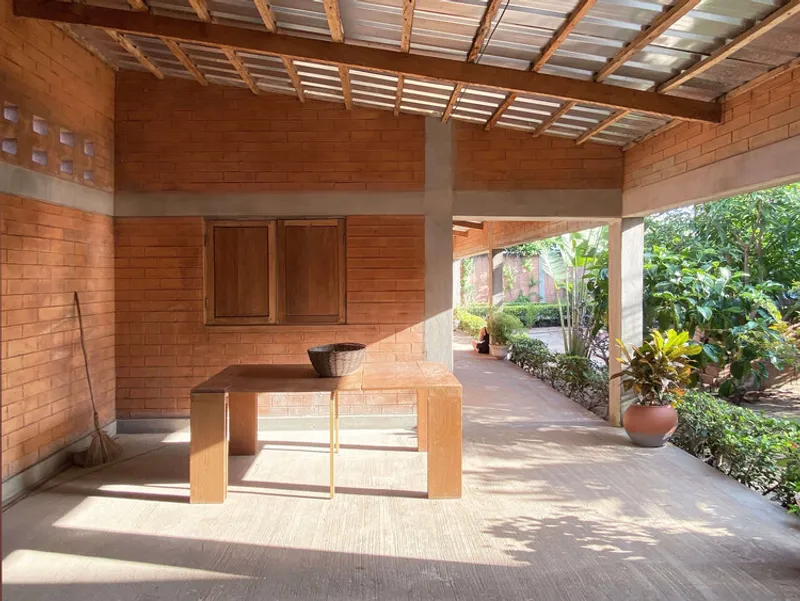
Initially conceived as a home for two brothers on land inherited from their mother, the project evolved during the design process into a dual-purpose property serving both as a second home and short-term rental accommodation. This transformation reflects a common pattern among diaspora communities worldwide, who increasingly invest in properties that allow them to maintain connections to their countries of origin while generating income when they're away.
The Courtyard as Organizing Principle
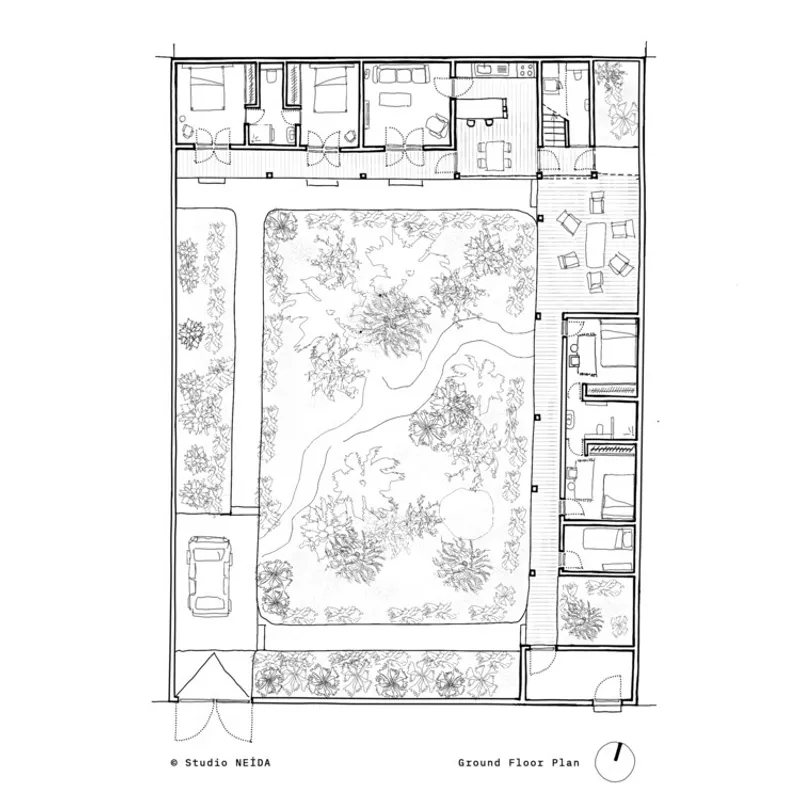
The fundamental organizing concept of the Adakpame Guesthouse is the courtyard—an architectural typology with ancient roots in hot climates worldwide. Studio NEiDA has arranged the 200-square-meter building in an L-shaped configuration that frames a generous central courtyard featuring lush garden plantings. This spatial strategy serves multiple purposes simultaneously: environmental, functional, social, and cultural.
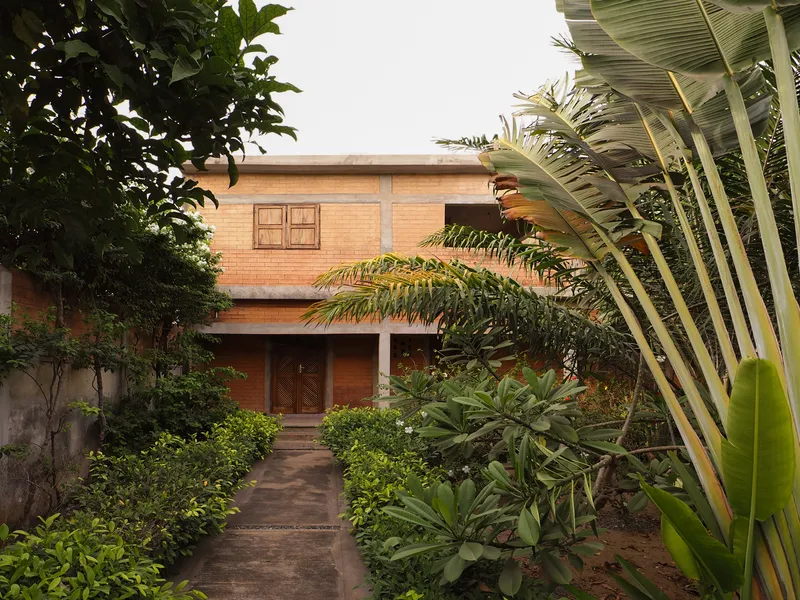
Environmentally, the courtyard creates a microclimate distinct from the surrounding urban context. The concentration of vegetation in this protected outdoor room provides evaporative cooling, with plants releasing moisture that lowers ambient temperatures. The courtyard's partially enclosed nature allows cooler evening air to settle and linger into the morning, while the surrounding building mass provides shade during the hottest parts of the day.
Functionally, the courtyard serves as the primary circulation space, with all rooms oriented toward this central garden. This arrangement eliminates the need for interior corridors, reducing the building's footprint and construction costs while ensuring that all spaces benefit from views of greenery and natural ventilation. The courtyard also provides flexible outdoor living space for dining, socializing, or simply relaxing in the shade—activities that would be uncomfortable in fully exposed exterior areas.
Socially, the inward-facing organization creates privacy from neighbors while fostering interaction among residents or guests. Unlike houses with rooms opening to separate exterior facades, the courtyard model encourages awareness of others' presence and facilitates casual encounters. This aligns with traditional West African housing patterns where domestic life occurs semi-publicly within compound walls rather than in isolated nuclear family units.
Culturally, the courtyard typology connects to longstanding regional building traditions. While the specific architectural expression is contemporary, the fundamental spatial organization references courtyard houses found throughout West Africa, the Sahel, and across the Islamic world. This continuity with tradition provides cultural resonance without resorting to superficial stylistic imitation.
The Gallery Walkway: Mediating Inside and Outside
One of the most successful elements of Studio NEiDA's design is the covered gallery walkway that wraps around the courtyard, providing sheltered circulation between rooms. This intermediate zone between fully interior and fully exterior space plays a crucial role in the building's environmental performance and spatial experience.
The gallery provides essential protection from Lomé's intense sun and heavy rainfall. West Africa's tropical climate features both a pronounced dry season with scorching temperatures and a rainy season with torrential downpours. The gallery allows residents to move between rooms during rain showers without getting wet, while its deep overhang creates valuable shade throughout the day, keeping room entries cool and preventing direct sun from penetrating into interior spaces.
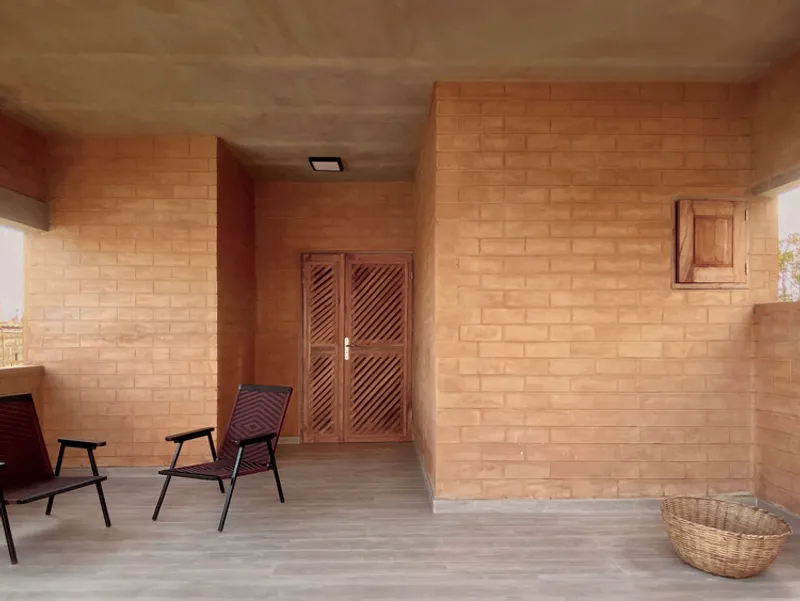
Beyond its practical functions, the gallery establishes a gradient of environmental conditions between the open courtyard and enclosed rooms. This transitional space offers a comfortable middle ground—outdoors enough to enjoy breezes and garden views, yet protected enough to be usable even in less-than-perfect weather. As the architects note, "Life happens outdoors and along these covered areas," acknowledging that in tropical climates, much of daily activity naturally migrates to these intermediate zones rather than occurring inside air-conditioned boxes.
The gallery also creates psychological comfort by providing a buffer zone. Rooms don't open directly onto the exposed courtyard but rather onto this protected threshold, giving residents a sense of shelter while maintaining visual and physical connection to the garden. This layering of space—from interior room to covered gallery to courtyard garden—creates spatial richness within a relatively modest building footprint.
The Diaspora Housing Phenomenon
The Adakpame Guesthouse typifies a broader architectural phenomenon across Africa and other regions with significant diaspora populations. Family members working abroad often build homes in their countries of origin, creating properties that serve multiple purposes: maintaining family connections, providing accommodation during visits, generating rental income, and ultimately serving as retirement residences.
This dual-purpose approach shapes design priorities in specific ways. Homes must be simultaneously welcoming for family use and suitable for short-term rentals to strangers. They need to be maintainable by local relatives or caretakers during long absences. And they must balance personal family investment with commercial viability. Studio NEiDA's design navigates these competing demands with spatial flexibility and durable, low-maintenance construction.
The choice to transform the project from a strictly private residence to a guesthouse reflects pragmatic economic thinking. In many African cities, the short-term rental market has grown substantially, driven by both regional business travel and international tourism. A well-designed guesthouse can generate income that helps cover maintenance costs and property taxes while the owners are abroad, making the investment more sustainable over time.
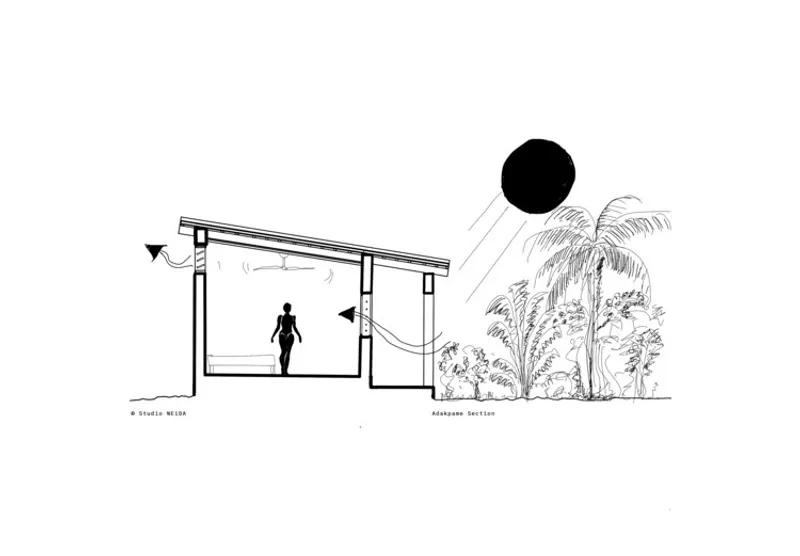
The Courtyard as Organizing Principle
The fundamental organizing concept of the Adakpame Guesthouse is the courtyard—an architectural typology with ancient roots in hot climates worldwide. Studio NEiDA has arranged the 200-square-meter building in an L-shaped configuration that frames a generous central courtyard featuring lush garden plantings. This spatial strategy serves multiple purposes simultaneously: environmental, functional, social, and cultural.
Environmentally, the courtyard creates a microclimate distinct from the surrounding urban context. The concentration of vegetation in this protected outdoor room provides evaporative cooling, with plants releasing moisture that lowers ambient temperatures. The courtyard's partially enclosed nature allows cooler evening air to settle and linger into the morning, while the surrounding building mass provides shade during the hottest parts of the day.
Functionally, the courtyard serves as the primary circulation space, with all rooms oriented toward this central garden. This arrangement eliminates the need for interior corridors, reducing the building's footprint and construction costs while ensuring that all spaces benefit from views of greenery and natural ventilation. The courtyard also provides flexible outdoor living space for dining, socializing, or simply relaxing in the shade—activities that would be uncomfortable in fully exposed exterior areas.

Socially, the inward-facing organization creates privacy from neighbors while fostering interaction among residents or guests. Unlike houses with rooms opening to separate exterior facades, the courtyard model encourages awareness of others' presence and facilitates casual encounters. This aligns with traditional West African housing patterns where domestic life occurs semi-publicly within compound walls rather than in isolated nuclear family units.
Culturally, the courtyard typology connects to longstanding regional building traditions. While the specific architectural expression is contemporary, the fundamental spatial organization references courtyard houses found throughout West Africa, the Sahel, and across the Islamic world. This continuity with tradition provides cultural resonance without resorting to superficial stylistic imitation.
L-Shaped Spatial Organization
The building's L-shaped plan creates maximum courtyard space while efficiently organizing the program. The ground floor contains two sets of two rooms, each pair sharing a bathroom, positioned along the two legs of the L. An al-fresco common area and kitchen occupy the connecting corner where the two wings meet, serving as the social heart of the ground-floor arrangement.
This zoning strategy allows the ground floor to function flexibly. When used as a guesthouse, the two pairs of rooms can accommodate separate groups or families, each with their own bathroom, while sharing the common kitchen and outdoor areas. When used by the extended family, the organization naturally accommodates multiple generations or sibling groups while maintaining some privacy.
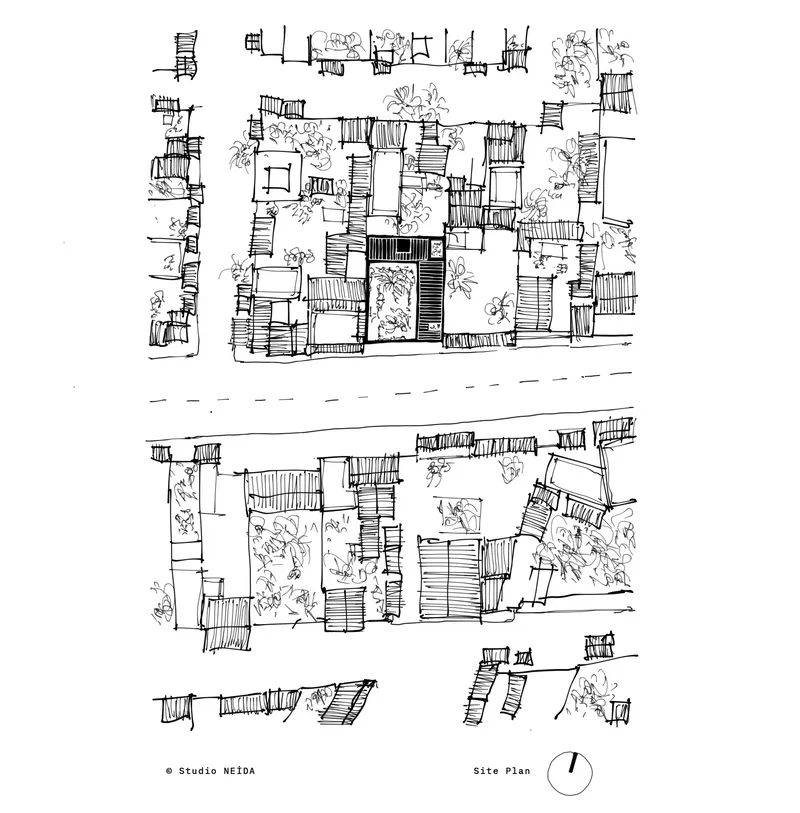
A staircase leads to the second level, which contains a separate living quarter with a more private character. This upper level features a generous en-suite bedroom, private terrace, and dedicated kitchen, creating essentially an independent apartment. This arrangement works well for the property owners when visiting—they can occupy the upper level while renting out the ground-floor rooms, or vice versa. It also allows for long-term rental of one level while keeping the other for personal use.
The vertical separation of the private upper apartment from the ground-floor rooms adds flexibility while maintaining appropriate privacy boundaries. Guests on different levels need not encounter each other constantly, reducing potential friction in a shared property while still allowing interaction in the central courtyard when desired.
The Gallery Walkway: Mediating Inside and Outside
One of the most successful elements of Studio NEiDA's design is the covered gallery walkway that wraps around the courtyard, providing sheltered circulation between rooms. This intermediate zone between fully interior and fully exterior space plays a crucial role in the building's environmental performance and spatial experience.
The gallery provides essential protection from Lomé's intense sun and heavy rainfall. West Africa's tropical climate features both a pronounced dry season with scorching temperatures and a rainy season with torrential downpours. The gallery allows residents to move between rooms during rain showers without getting wet, while its deep overhang creates valuable shade throughout the day, keeping room entries cool and preventing direct sun from penetrating into interior spaces.
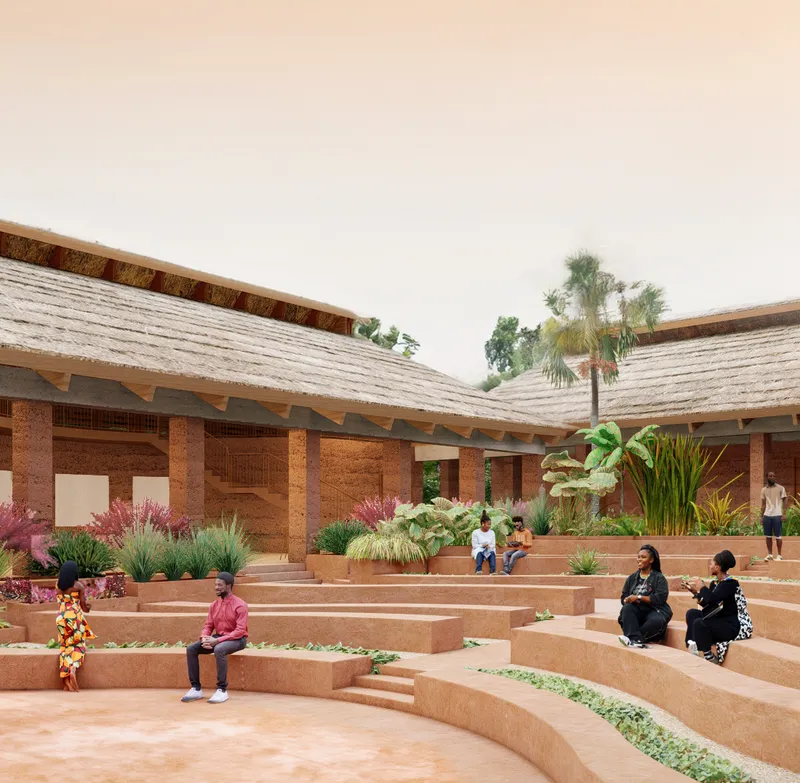
Beyond its practical functions, the gallery establishes a gradient of environmental conditions between the open courtyard and enclosed rooms. This transitional space offers a comfortable middle ground—outdoors enough to enjoy breezes and garden views, yet protected enough to be usable even in less-than-perfect weather. As the architects note, "Life happens outdoors and along these covered areas," acknowledging that in tropical climates, much of daily activity naturally migrates to these intermediate zones rather than occurring inside air-conditioned boxes.
The gallery also creates psychological comfort by providing a buffer zone. Rooms don't open directly onto the exposed courtyard but rather onto this protected threshold, giving residents a sense of shelter while maintaining visual and physical connection to the garden. This layering of space—from interior room to covered gallery to courtyard garden—creates spatial richness within a relatively modest building footprint.
Scale and Proportion
At 200 square meters, the Adakpame Guesthouse is a modest project that punches above its weight in terms of spatial quality and architectural sophistication. This scale is appropriate for its dual function—large enough to accommodate multiple guest rooms or extended family, small enough to be maintained by property owners who may visit only occasionally.
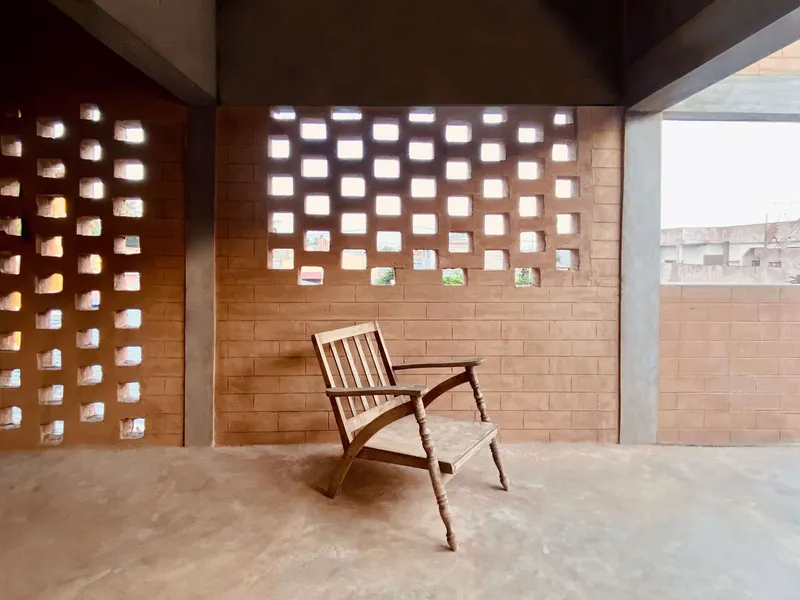
The single-story ground floor with two-story element creates varied ceiling heights and spatial experiences within the compact footprint. The proportions of the courtyard—large enough to feel spacious, small enough to feel enclosed—strike an effective balance. The covered galleries are wide enough to be truly usable rather than mere circulation paths. These dimensional decisions contribute significantly to the project's success despite its limited size.
Cultural and Economic Context
Understanding the Adakpame Guesthouse requires appreciating Togo's position in global flows of migration and remittance. Like many West African nations, Togo has a significant diaspora population working in Europe, North America, and other African countries. Remittances from these diaspora communities represent a substantial portion of national income, and housing investment is a primary use of these funds.
The guesthouse model allows diaspora members to invest in property that generates returns while maintaining family connections—a financially rational strategy that also serves emotional and cultural needs. Studio NEiDA's design accommodates this complex set of requirements, creating flexible space that works for both family occupation and commercial rental.
Architecture as Cultural Bridge
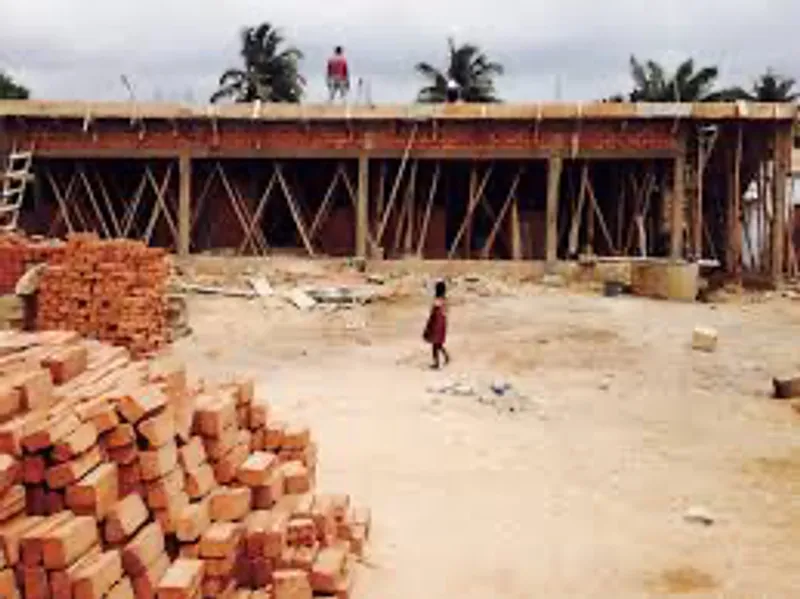
Projects like the Adakpame Guesthouse serve as literal and figurative bridges between diaspora communities and their homelands. They provide physical spaces where diaspora members can reconnect with family and culture during visits, while their design and construction processes engage local labor and craft traditions. The architecture mediates between different scales of economy—international remittances funding construction by local workers using local materials.
This bridging function extends to design vocabulary as well. The building must feel both contemporary enough to satisfy clients who've lived abroad and seen international architecture, yet rooted enough in local building culture to feel appropriate in Lomé. Studio NEiDA navigates this balance through a design that's modern in its spatial clarity and functional efficiency while employing familiar typologies and construction methods.
All the Photographs are works of Jeanne Autran-Edorh, Studio NEiDA




Popular Articles
Popular articles from the community


The Musturak Paradise: Senior Living Architecture for a Connected Future in Temara, Morocco
The Musturak Paradise reimagines senior living architecture in Temara via private homes, social spaces, culture, community, and shared care.
AL-JANNAH: Sustainable Architecture and Permaculture for Afghan Widows
AL-JANNAH uses sustainable architecture and permaculture to create resilient oasis of housing, learning, work and renewal for Afghan widows.

Co-Life: Senior Housing Design That Reconnects Older Adults With the City
Co-Life reimagines senior housing design through healing gardens, shared streets, workshops, and a sustainable community across generations.

Hill & Cross Opera: Sculptural Opera House Architecture Shaped by Tallinn’s Landscape and Identity
Hill & Cross Opera reimagines opera house architecture in Tallinn through its sculptural hill, civic plaza, glass wave and a luminous cross.


Similar Reads
You might also enjoy these articles


Hodi-Mandai Geram
Project Function: Preservation and revitalization of the Intangible heritage and socio-spatial identity of the Hodi by Housing, Cultural Memory Center, Sacred Grove, landscape, local tourism economy


Olio Towers: A Mid-Rise for Performers That Fuses Housing, Rehearsal, and Stage
Located blocks from Houston's Theater District, this modular tower stacks living units around a central performance atrium.

Oasis: Modular Green Housing Carved into Dhaka's Urban Fabric
A shortlisted Plugin Housing entry reclaims unauthorized settlements in Dhaka with stepped concrete volumes, green roofs, and ventilation-driven design.

Black Hole: A Floating Megastructure for the Post-Physical Era
Emiliano Mazzarotto envisions a spherical, self-scaling arena where e-sports, digital hotels, and holographic stadiums replace traditional public space.


Explore Hospitality Building Competitions
Discover active competitions in this discipline



Challenge to reimagine the Iron Throne


Photograph architecture without architects


Illustrate the lost glory of Angkor Wat - Render Challenge


Design challenge to reuse E-waste
Comments (0)
Please login or sign up to add comments
No comments yet. Be the first to comment!