

Šépka architekti Resurrects Josef Gočár's Automatic Mills as a Cultural Hub in Pardubice
A century-old grain mill on the Chrudimka River becomes a gallery, workshop, and public square where every material tells the truth.


For over a hundred years, the Winternitz Automatic Mills ground grain on the banks of the Chrudimka River in Pardubice. Designed by Josef Gočár in 1909, expanded after a 1919 fire, and operated continuously until 2013, the complex is one of the earliest built works by a figure who would become central to Czech geometric modernism. A year after shutting down, the mills earned national cultural monument status. Šépka architekti took that designation not as a constraint but as a creative premise: how do you give a second life to an industrial relic without lying about what it is or what you added to it?
The answer, completed in 2023, is a scheme built on radical material honesty. Two new buildings, the GAMPA municipal gallery and the Sféra polytechnic workshop, slot into the existing fabric alongside new public squares, a rooftop amphitheatre, and a landscape of brick water channels and sycamore trees. Wherever brick is visible, that wall is masonry. Wherever concrete is visible, it carries load. Wherever corten steel appears, it is cladding and nothing more. No plaster, no veneers, no pretense. More than 30 concrete test cubes were mixed and color-matched to the historic red and grey brick, and some of those cubes remain embedded in an entrance wall as a visible record of the process. The project completes a triangle of civic landmarks linking the Renaissance castle, Perštýn Square, and the mills, giving Pardubice a new public precinct that is entirely pedestrian and unapologetically tactile.
Lifting the Workshop Above the Gallery
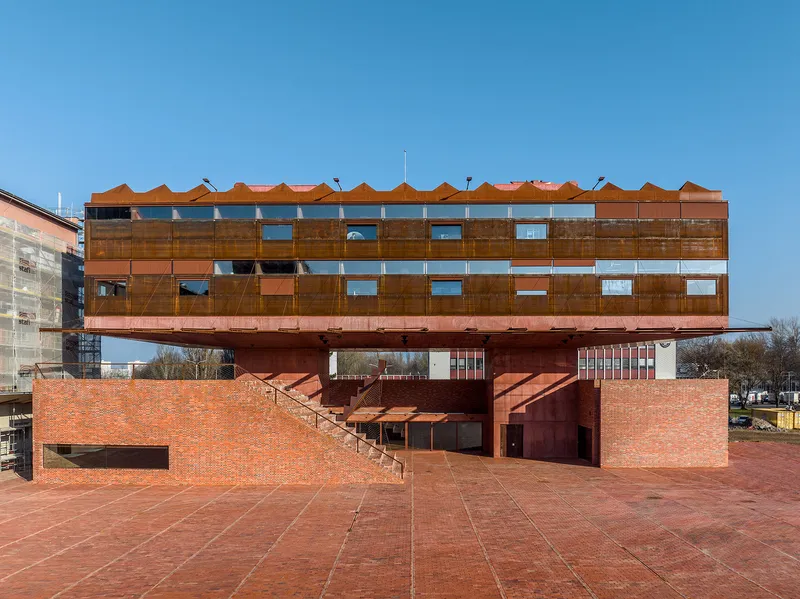
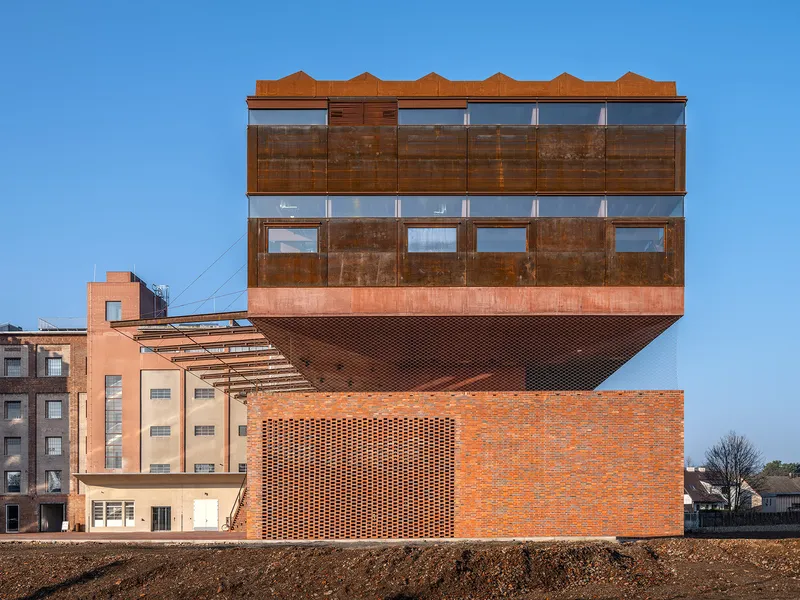
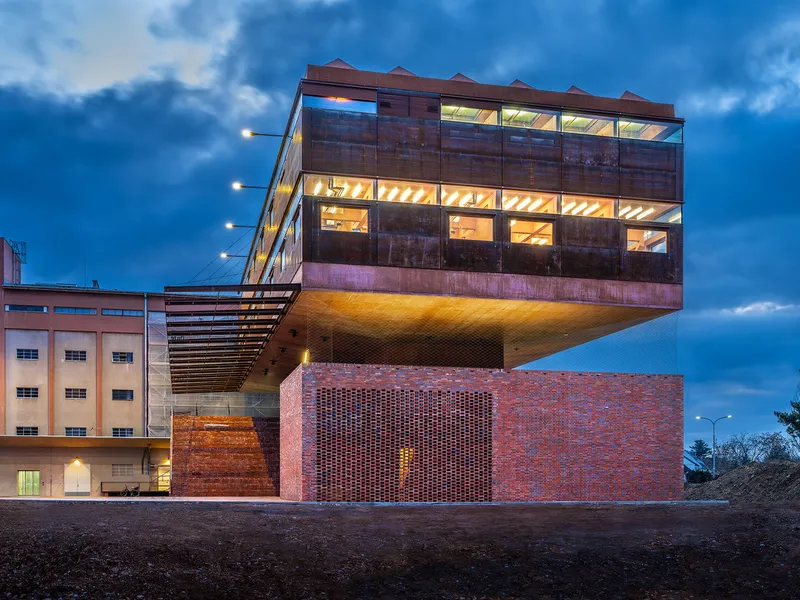
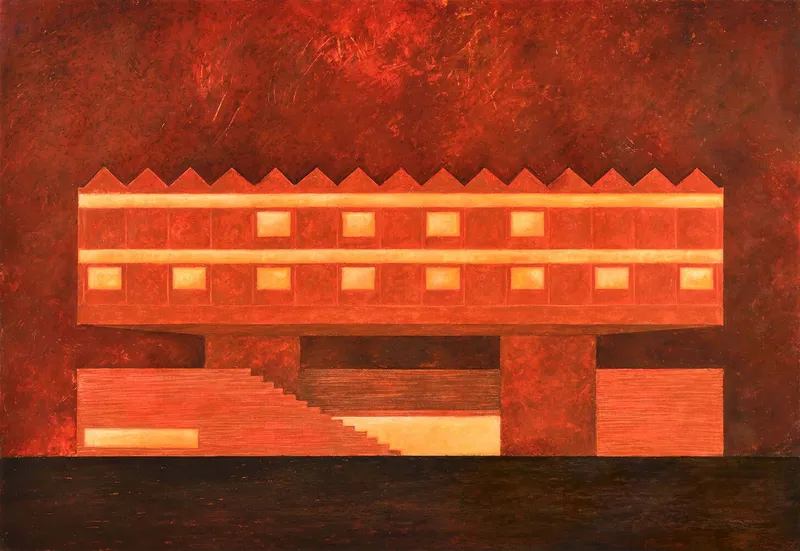
The most striking formal move is the cantilevered Sféra volume, a weathering-steel box elevated above the brick podium of GAMPA on a 3-by-3-meter concrete grid. The decision to lift the educational program off the ground floor accomplishes two things at once. It separates the quiet concentration of student laboratories from the public energy of the gallery below, and it leaves a gap between old and new that preserves sight lines through the complex. The pair of staircases that connect the two levels double as structural bracing, turning vertical circulation into load-bearing elements.
The sawtooth roofline of Sféra, with its pyramid-shaped skylights, delivers glare-free natural light to classrooms devoted to robotics, natural sciences, and the arts. Each floor holds two workshops flanking a central corridor, with staff rooms and services logically placed near the entrance hall. It is a plan that reads as almost didactically clear, which is fitting for a building whose purpose is education.
The Projection Room and Immersive Learning
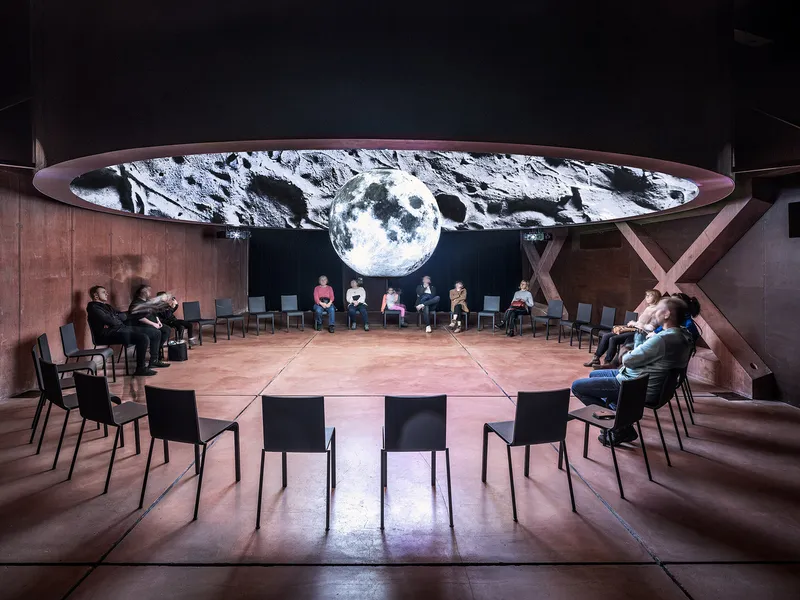
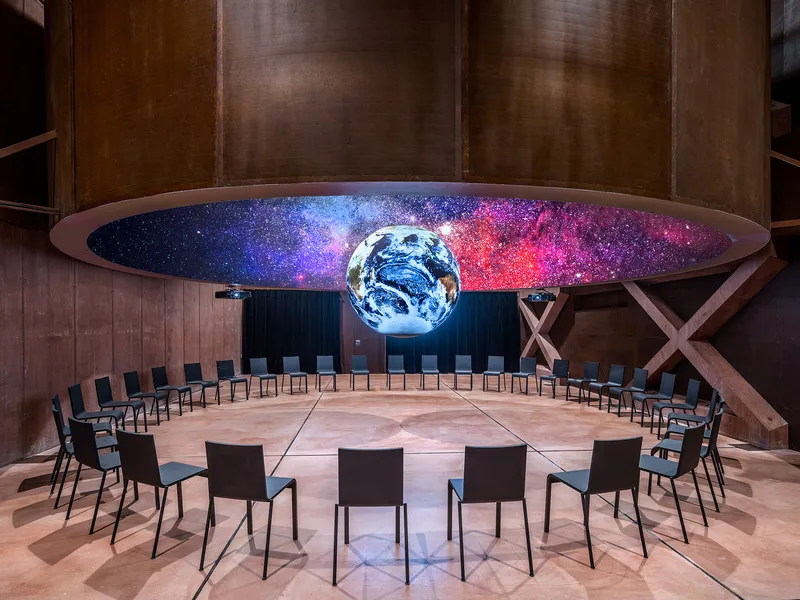
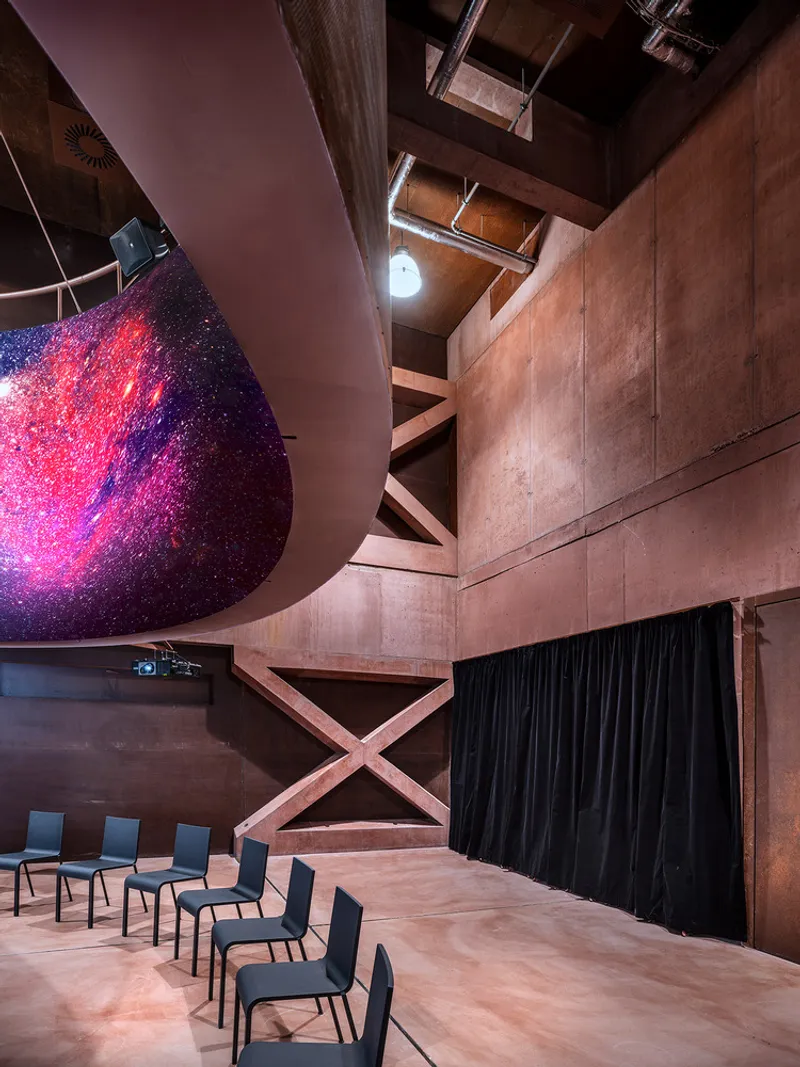
Buried inside Sféra is a two-story circular projection room designed to introduce visitors to natural phenomena through a curved overhead screen. With its corten-clad floor and walls, the space reads less like a classroom and more like a planetarium crossed with a launch capsule. The room projects cosmic imagery and earth simulations onto its domed surface while visitors sit in concentric rings below. It is the single most theatrical gesture in a project that otherwise exercises restraint, and it earns its drama by being genuinely useful rather than decorative.
GAMPA and the Flexible Interior
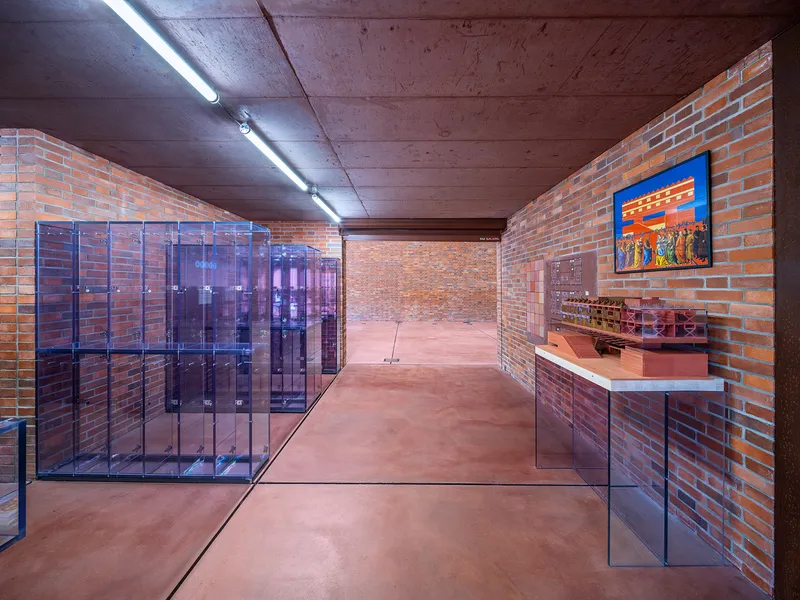
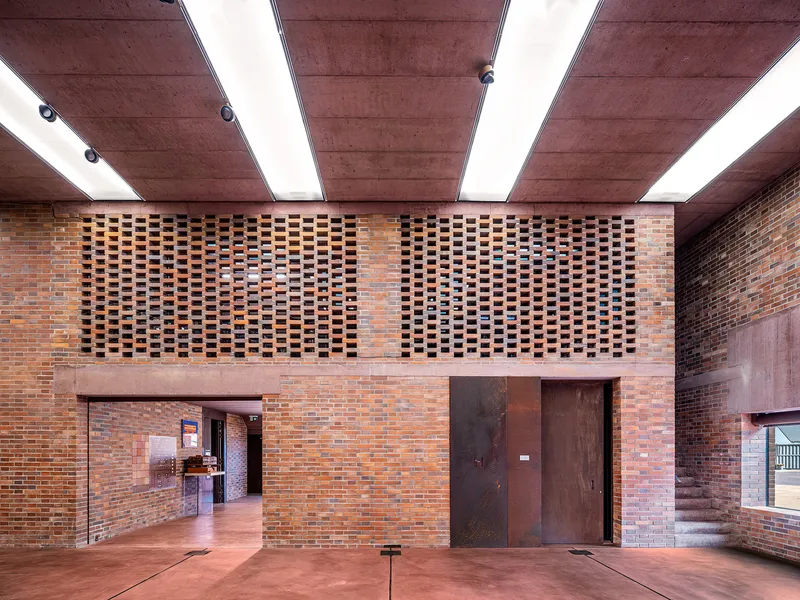
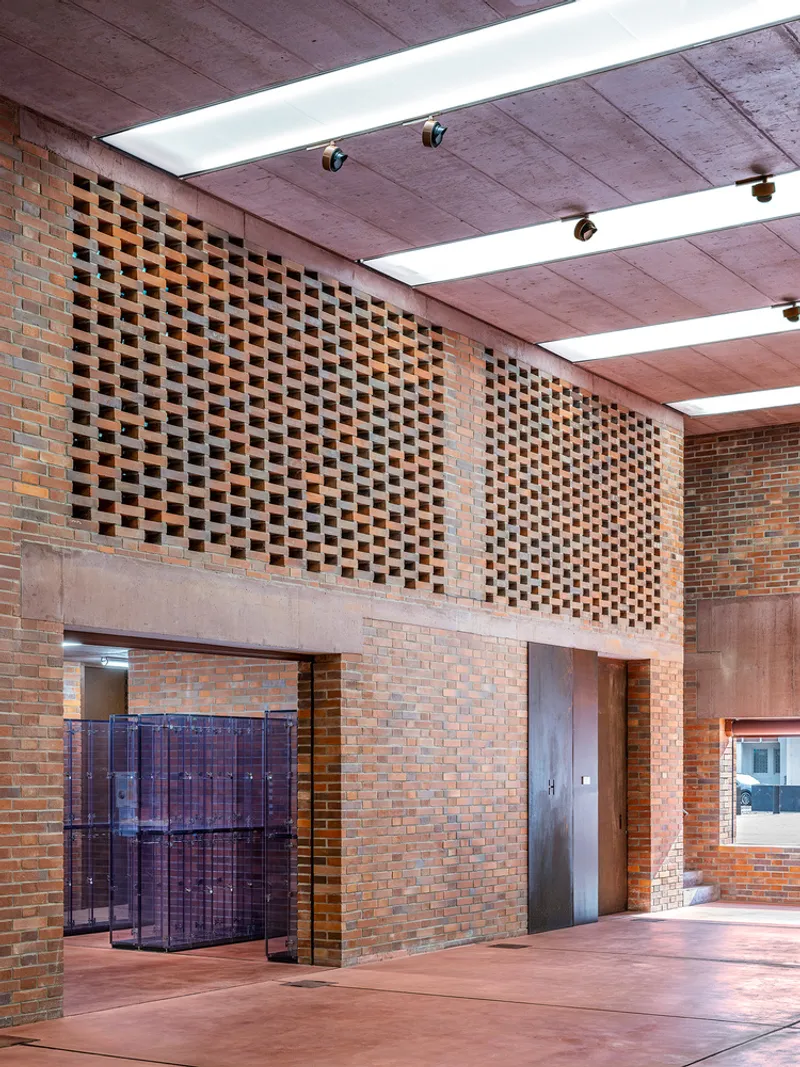
The Gallery of the City of Pardubice occupies the ground floor beneath Sféra, its exhibition rooms working primarily with upper lighting and skylights to create controlled conditions for art. Folding walls and sliding doors allow the gallery to be reconfigured for different show formats, a practical necessity for a municipal institution that must accommodate everything from solo installations to traveling group exhibitions. Beyond the main galleries, the program stacks offices and an artist's apartment on the floor above.
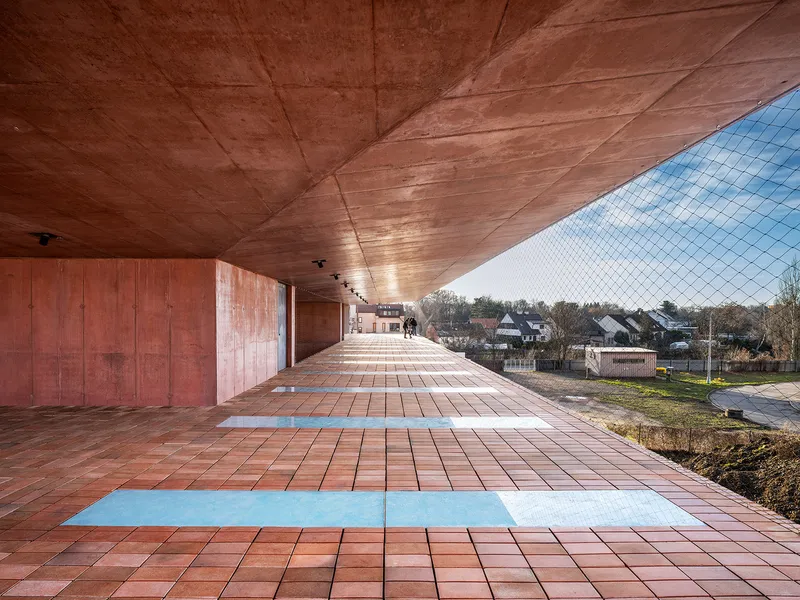
What keeps GAMPA from reading as generic white-cube infrastructure is the insistence on exposed materiality. Perforated brick screen walls filter light above weathered steel doors, and coffered board-formed concrete ceilings reveal the geometry of the structural grid overhead. The gallery corridor, with its red brick walls and terracotta flooring, feels like an extension of the outdoor plaza rather than a separate world.
Materiality as Moral Argument
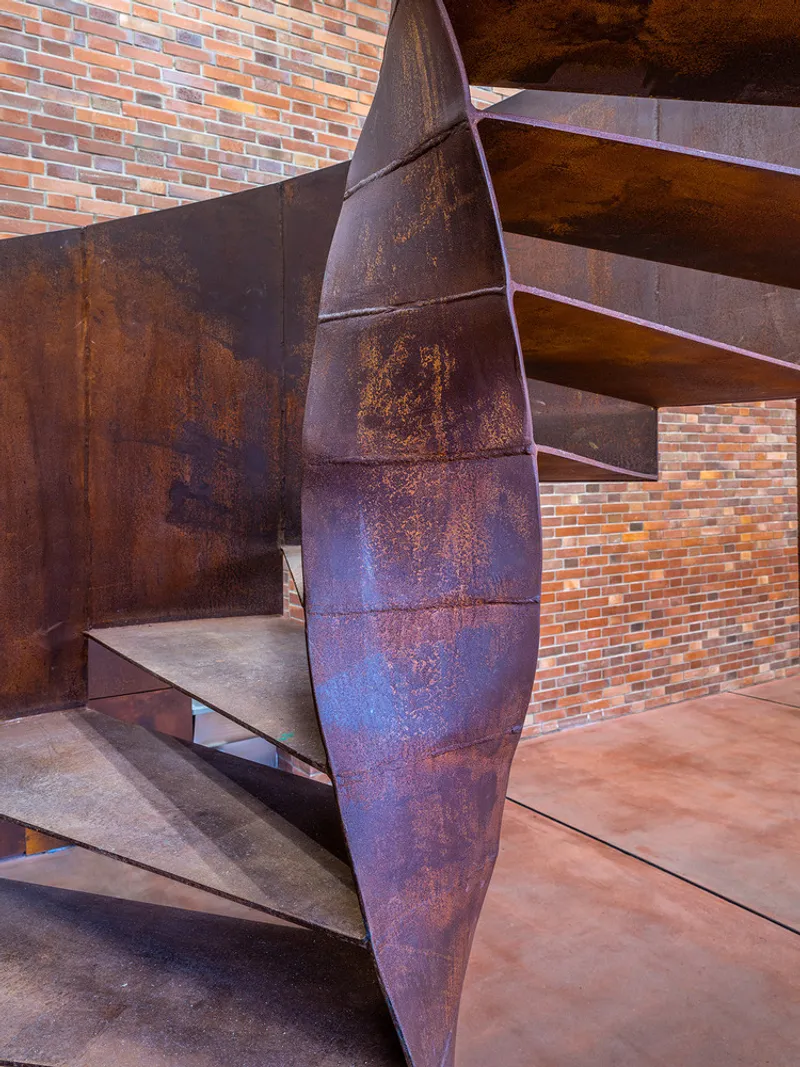
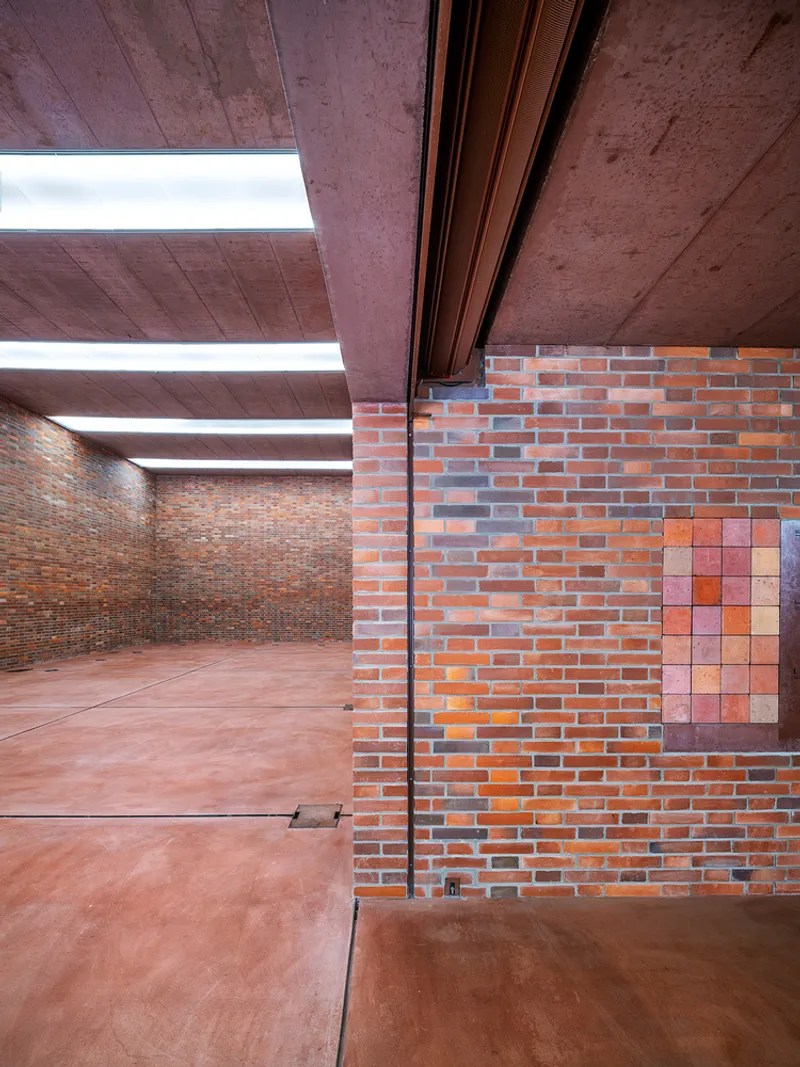
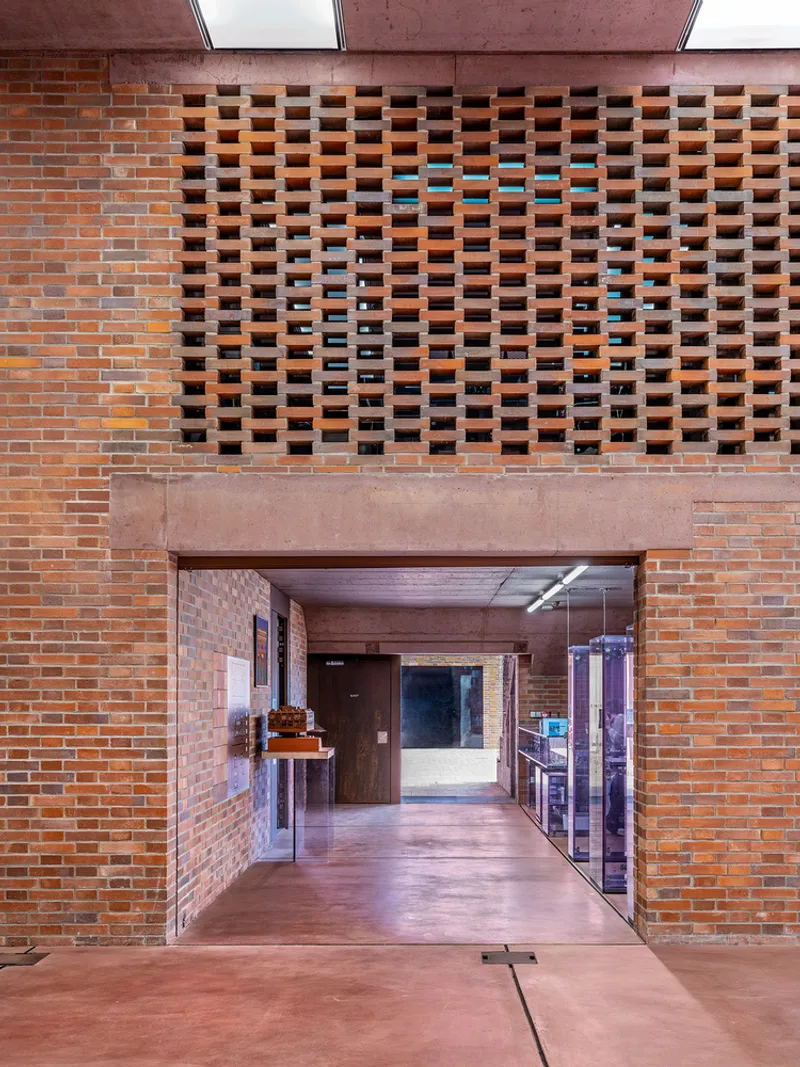
Šépka architekti frames the material palette as a question of truthfulness, and the results are convincing precisely because the architects did the hard work to back up the philosophy. Over 30 concrete samples were poured and tested to find a mix that harmonizes with Gočár's original red and grey non-plastered bricks. A handful of those test cubes are set into the entrance wall, turning the R&D process into a kind of found sculpture. The folded corten staircases that hang against multi-toned brick walls are unapologetically industrial, their patina evolving in real time alongside masonry that has weathered for a century.
The logic extends to smaller details: brick paving with red mortar on the ground plane, large openings cut into ceiling supports to integrate mechanical services without dropped ceilings or secondary enclosures. Nothing hides. The effect is not rawness for its own sake but a legible hierarchy in which every surface declares its role.
Two Squares and a Rooftop Amphitheatre
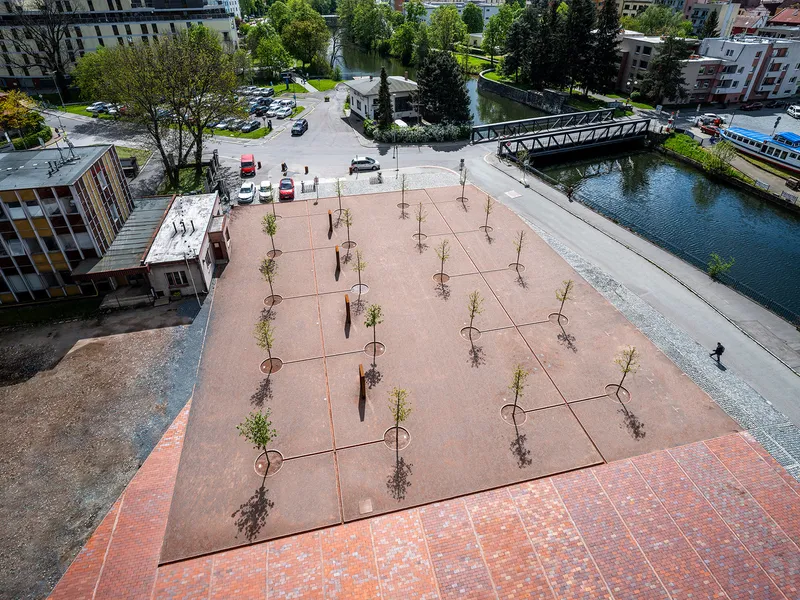
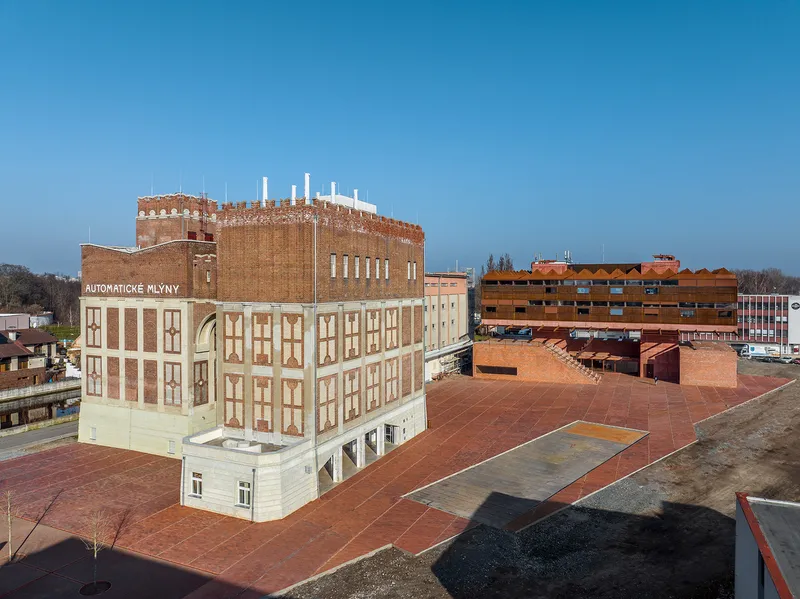
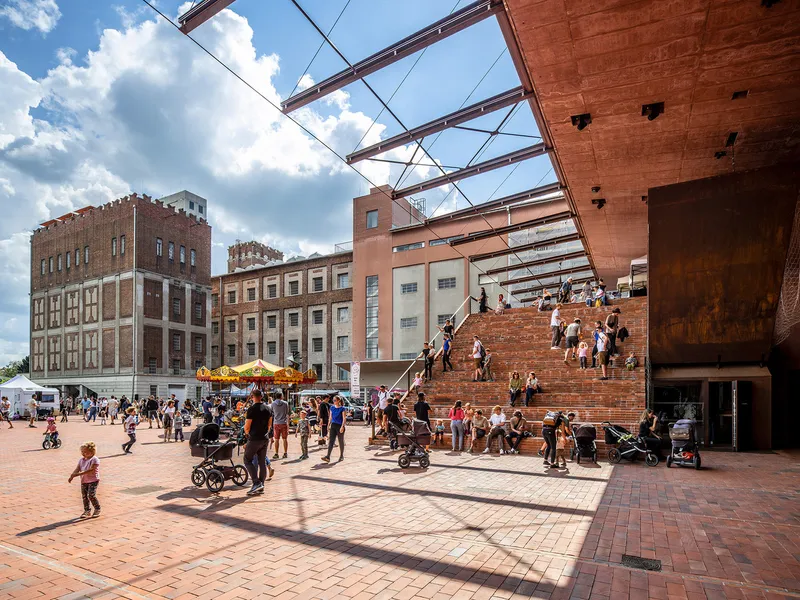
The site strategy hinges on two new public spaces that differ in character but share a commitment to the pedestrian. The Entry Square welcomes visitors with a sycamore bosquet irrigated through brick-lined water channels that lead to each tree, a landscape detail that doubles as drainage infrastructure. It is a calm threshold, designed for markets and everyday pause. On the other side, the Mill Courtyard occupies the interior of the complex, a lively void for open-air concerts, theatre, and exhibitions framed by the original industrial facades.
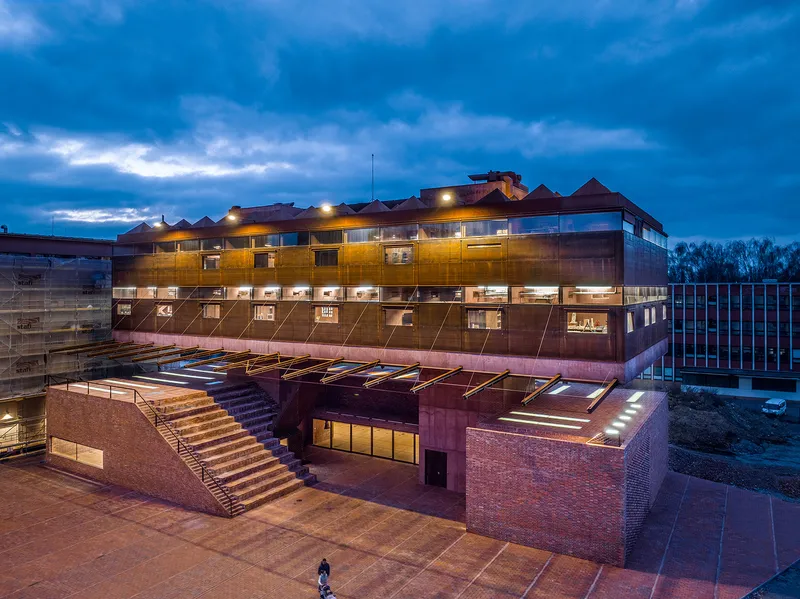
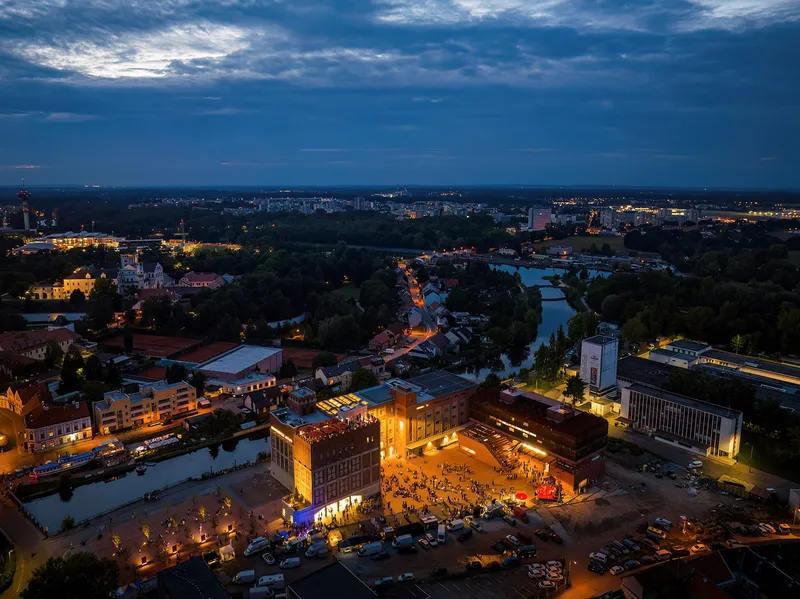
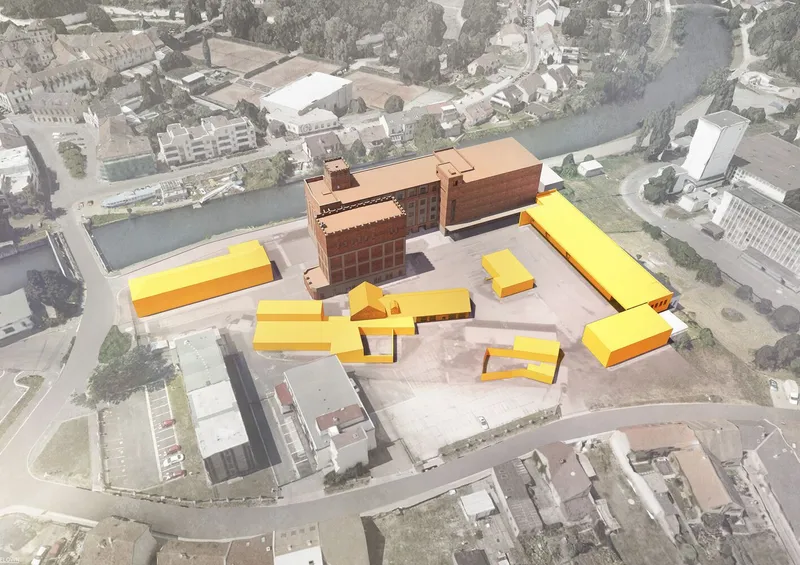
The GAMPA rooftop extends the public realm upward. An accessible amphitheatre seating 250 people transforms the gallery's fifth elevation into a summer event venue with views over Pardubice. Some secondary buildings were demolished to reveal the monumental entrance portal of the original mill, a decision that trades square footage for legibility and lets the Gočár architecture breathe.
Workshop Spaces and Domestic Details
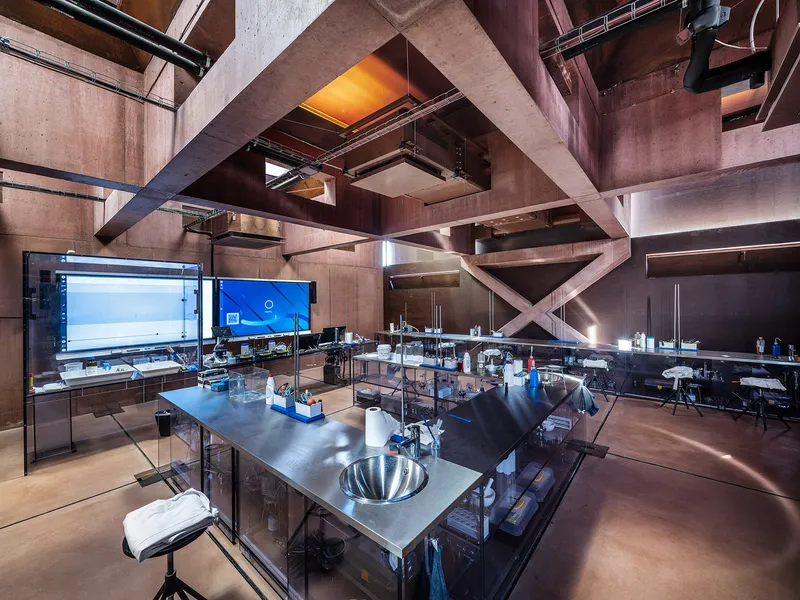
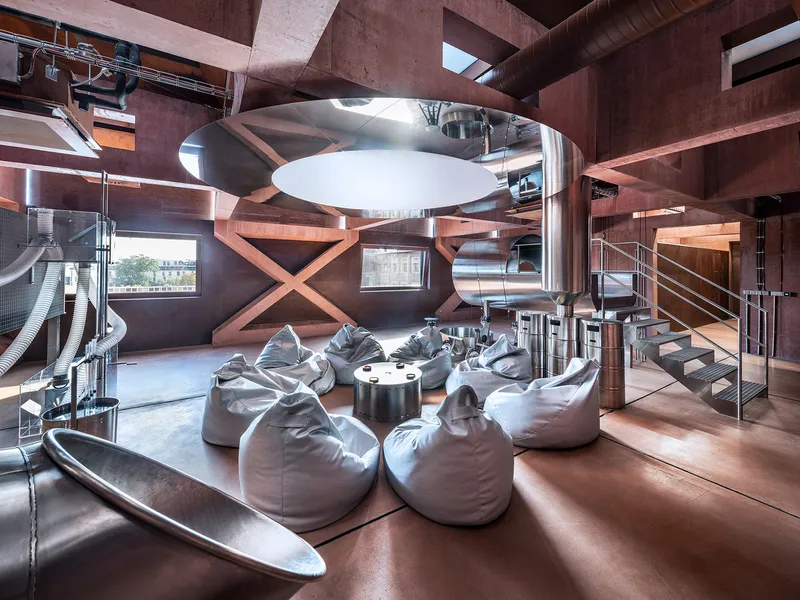
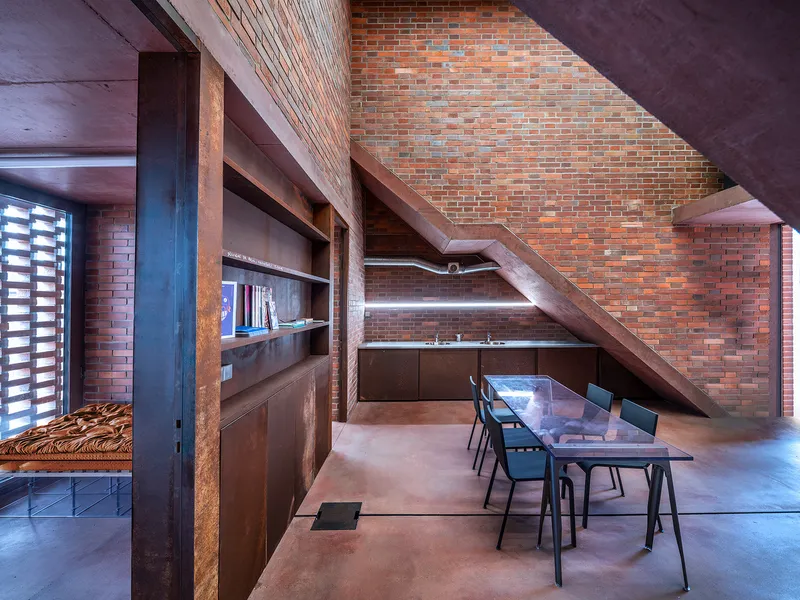
The Sféra workshops are outfitted with stainless steel workstations set beneath crisscrossing concrete beams, spaces that feel more like well-funded fabrication labs than standard school classrooms. Generous windows light the workshops naturally, and the pyramid skylights above the laboratories eliminate the harsh directional glare that plagues conventional rooftop glazing. Elsewhere, an artist's apartment tucks into the complex with a brick wall filtered by horizontal slatted screens, while a dining nook sits beneath a diagonal concrete staircase, an improvised domesticity carved out of structural leftovers.
Site and Landscape Details
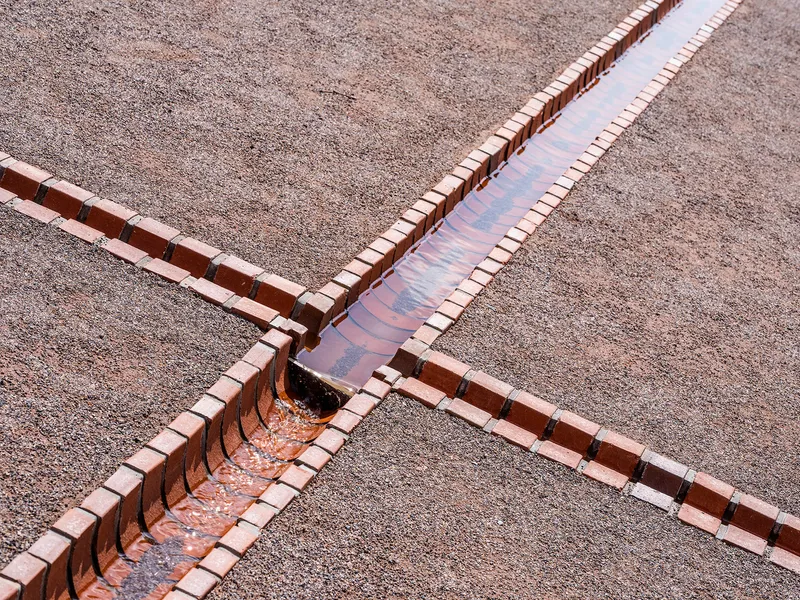
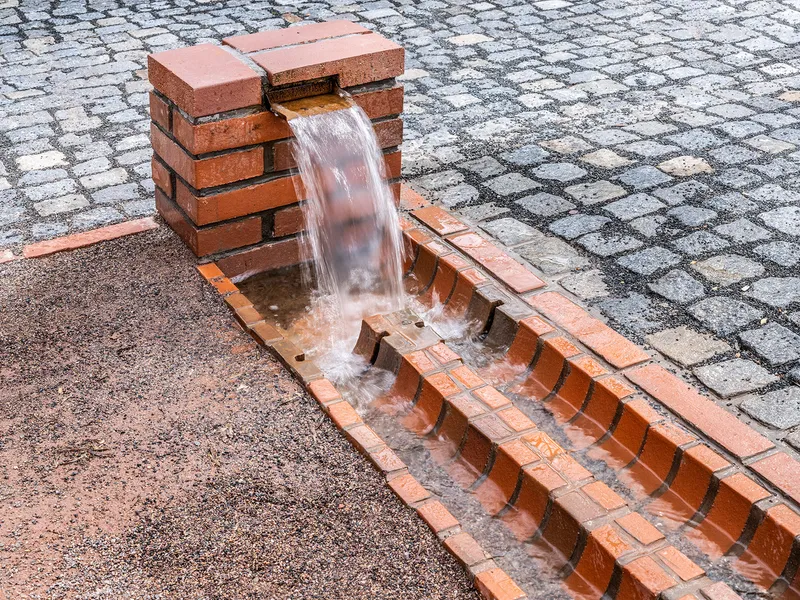
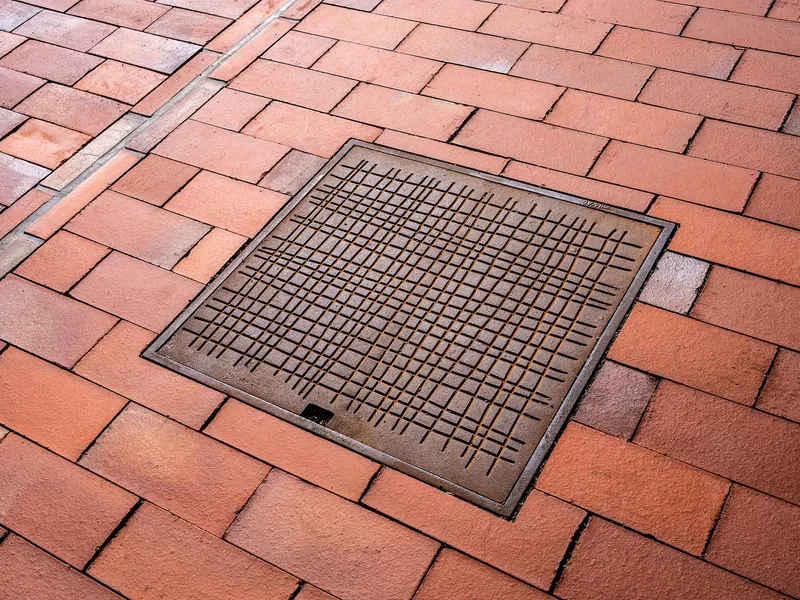
The landscape holds its own against the buildings. Brick water channels cross in X-patterns over gravel, a stepped red brick fountain feeds shallow flows across cobblestone, and metal drainage grates nest into herringbone-patterned paving. These are small moves, but they accumulate into a ground plane that feels intentional at every scale. The material continuity between building and landscape, all red brick, red mortar, and terracotta, dissolves the boundary between architecture and terrain.
Construction and Structure
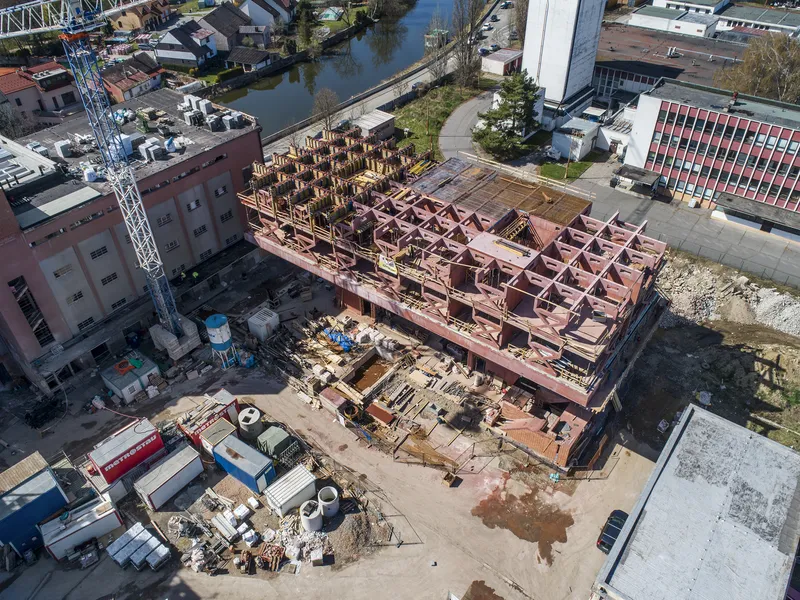
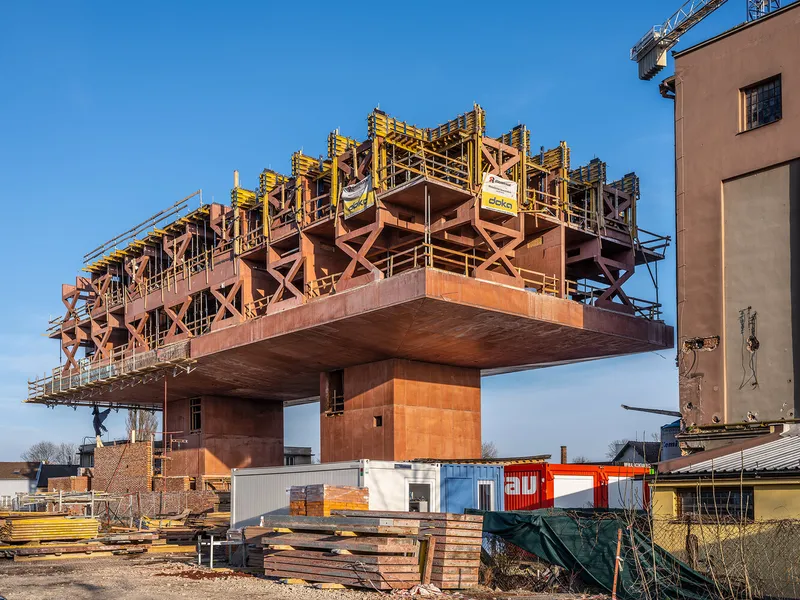
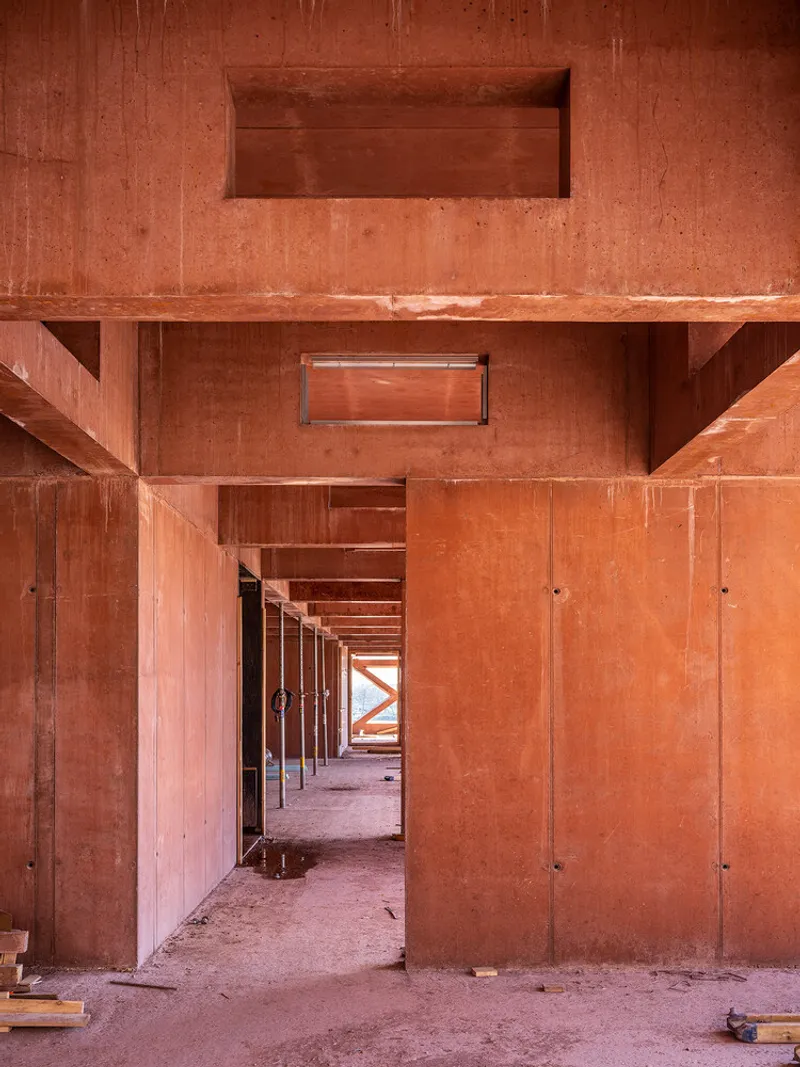
Construction photographs reveal the ambition of the structural system. The Sféra building's corten frame sits on a forest of temporary scaffolding, its cross-bracing and formwork exposed before the cladding arrives. The 3-by-3-meter grid produces wide spans that allow open workshop floors, while the red concrete columns and beams bear the imprint of their formwork as permanent texture. Watching these images alongside the finished building clarifies how much of the final aesthetic was determined at the engineering stage rather than applied afterward.
Plans and Drawings
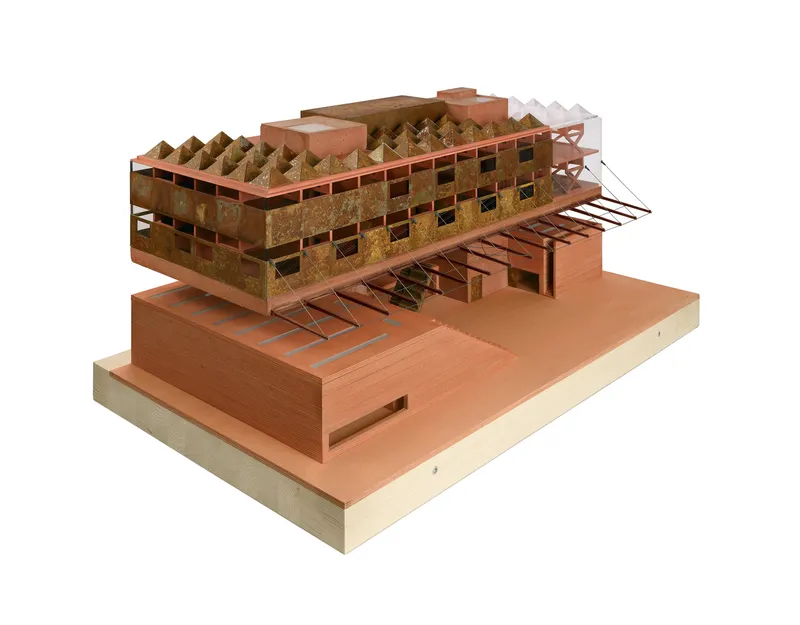
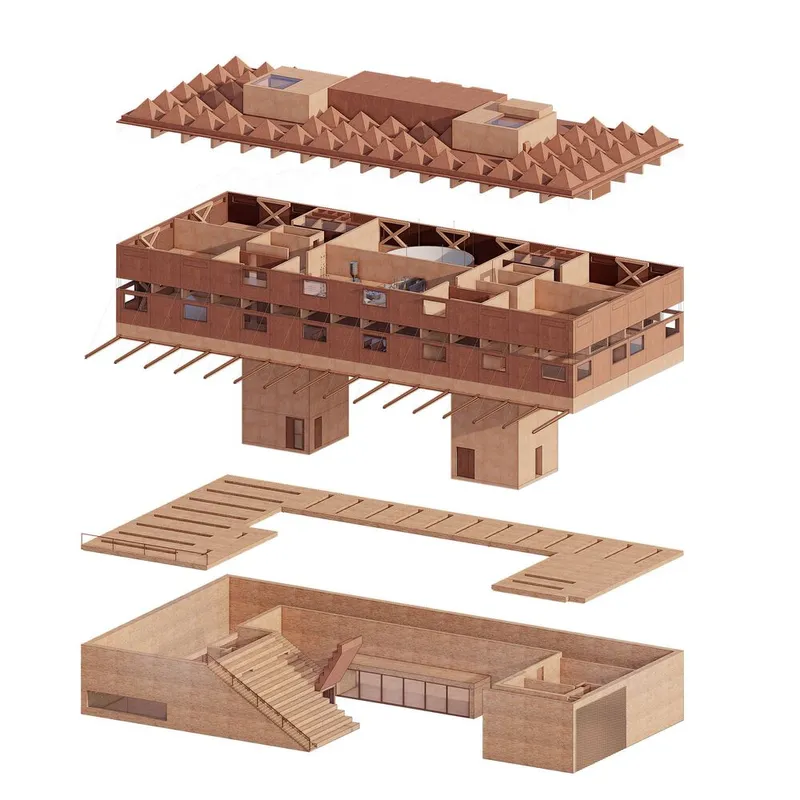
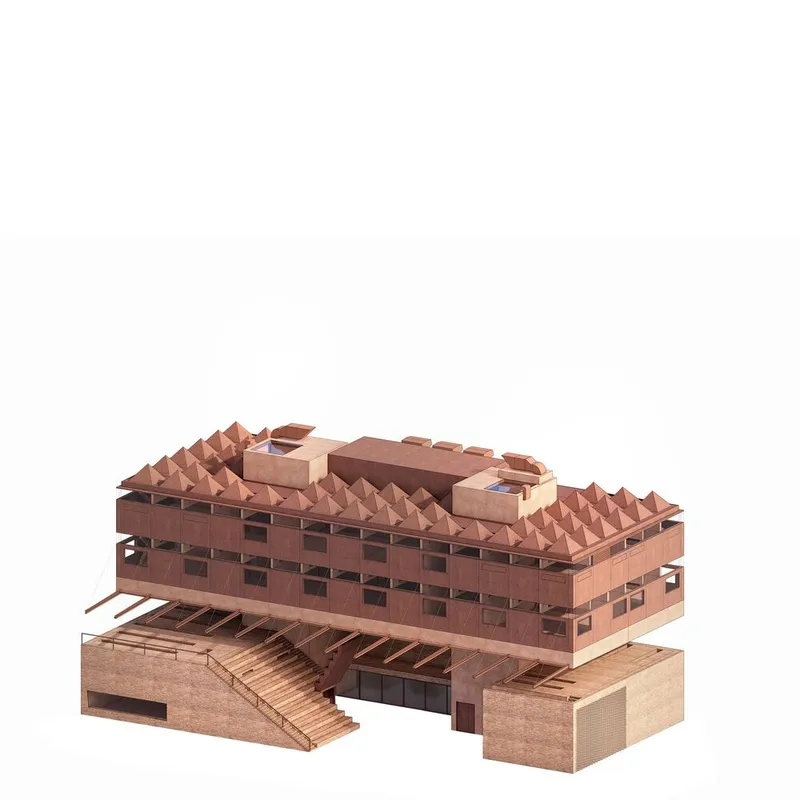
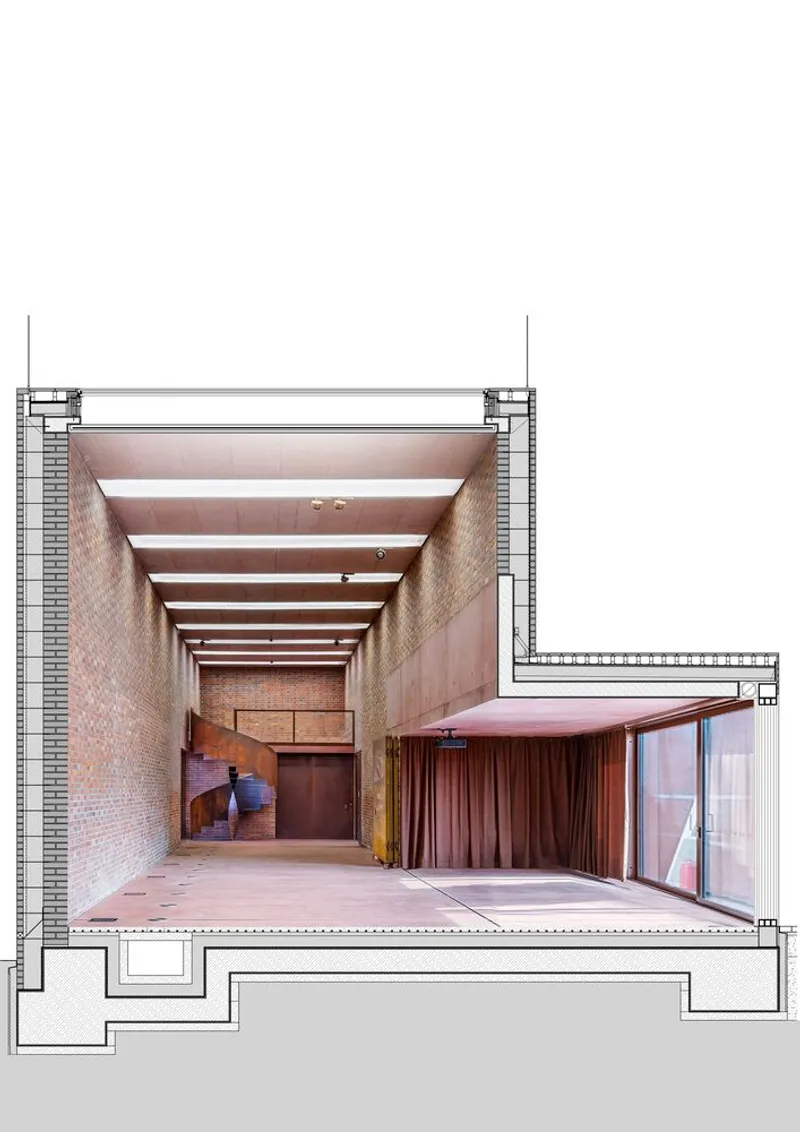
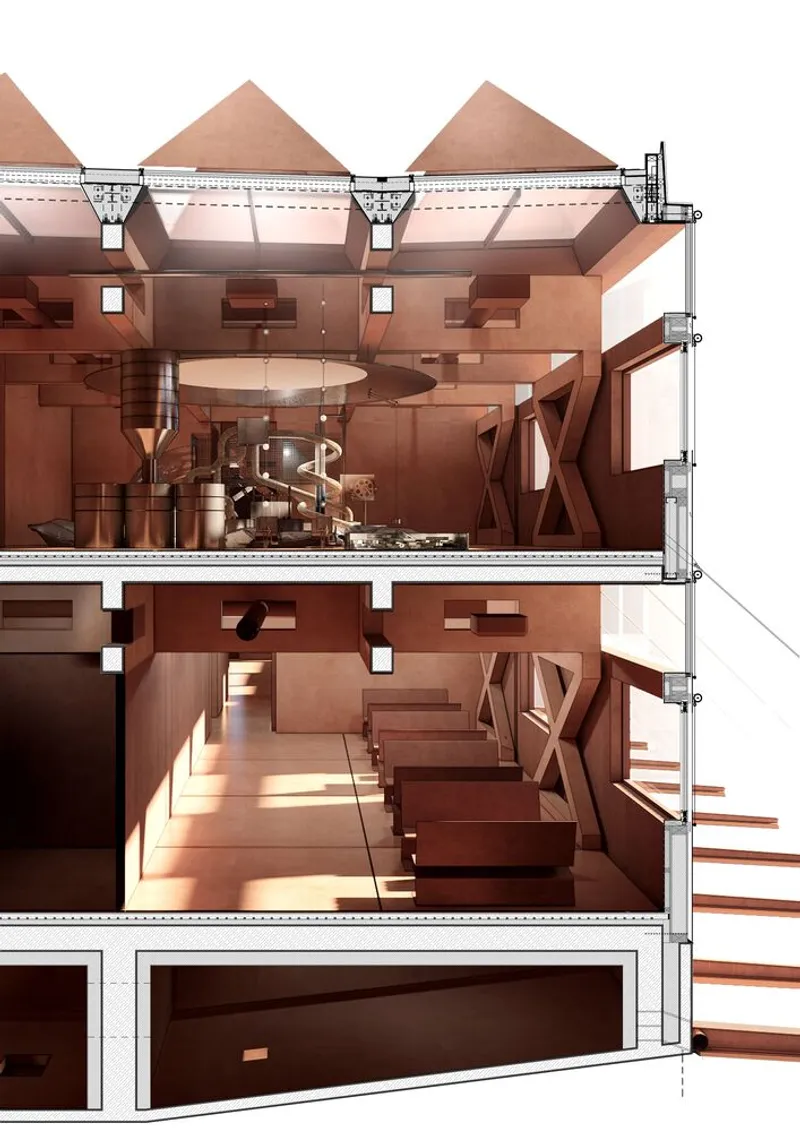
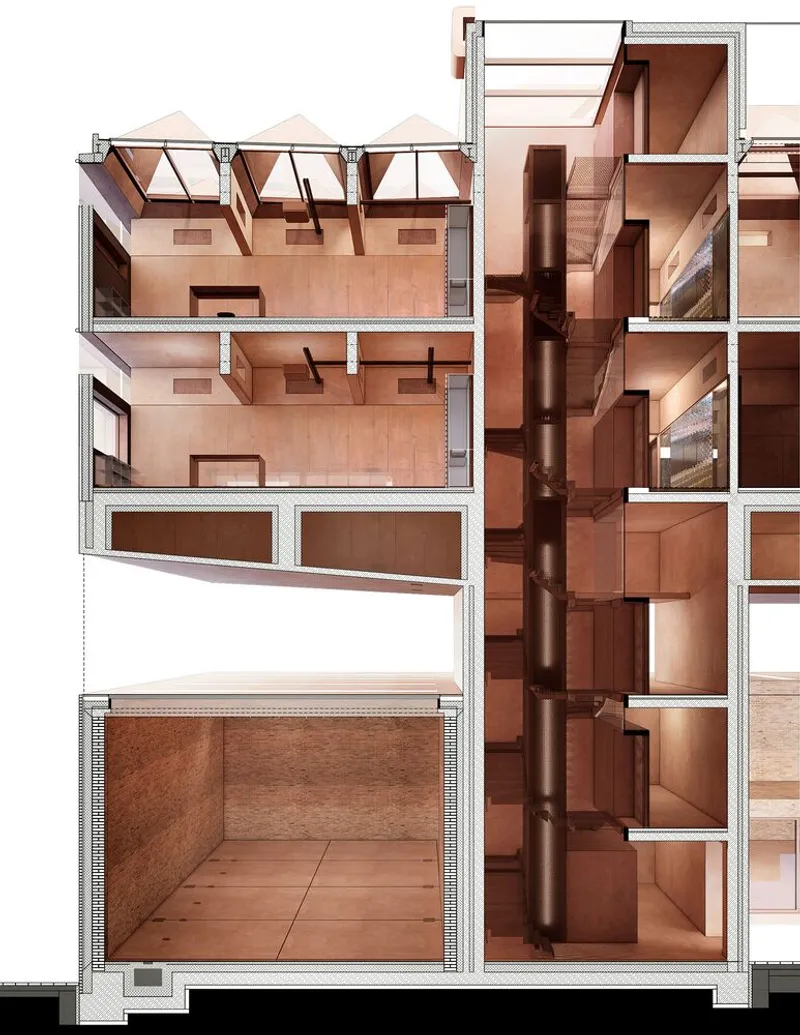
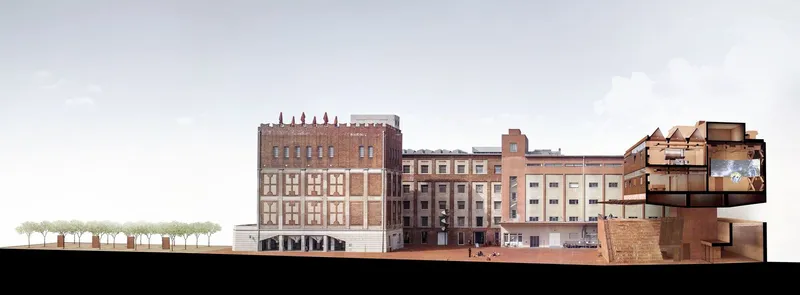
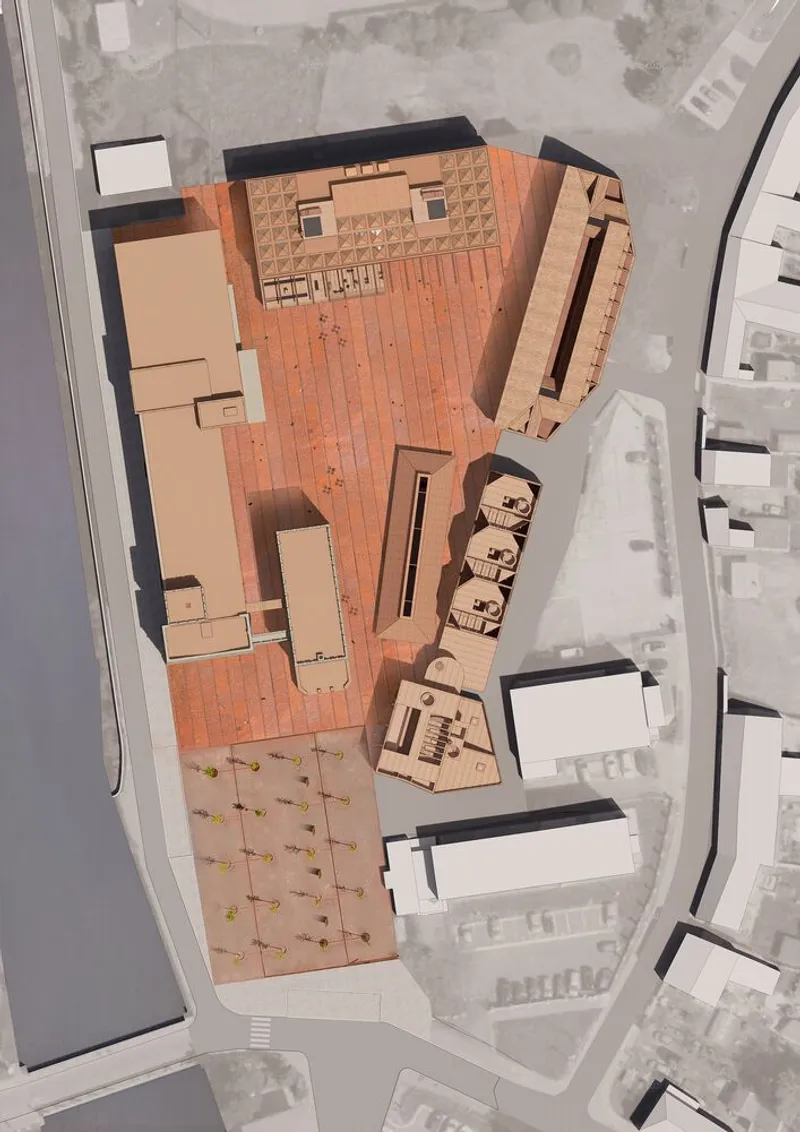
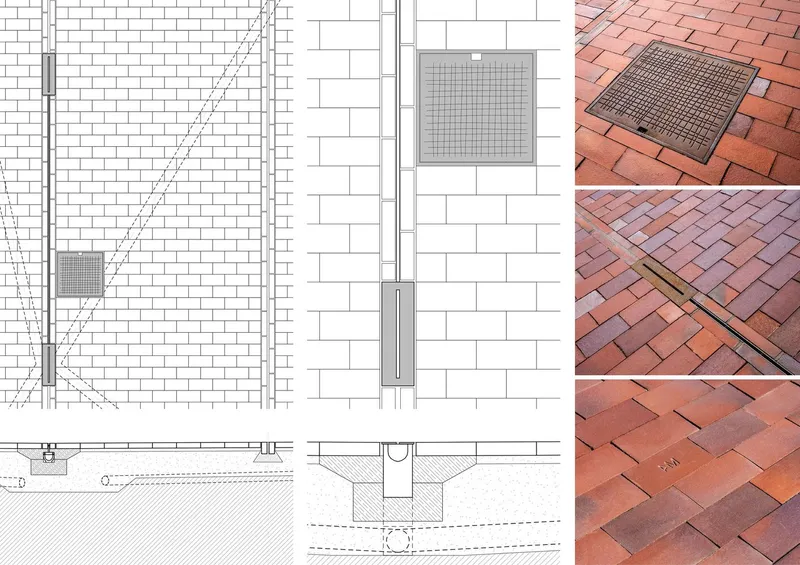
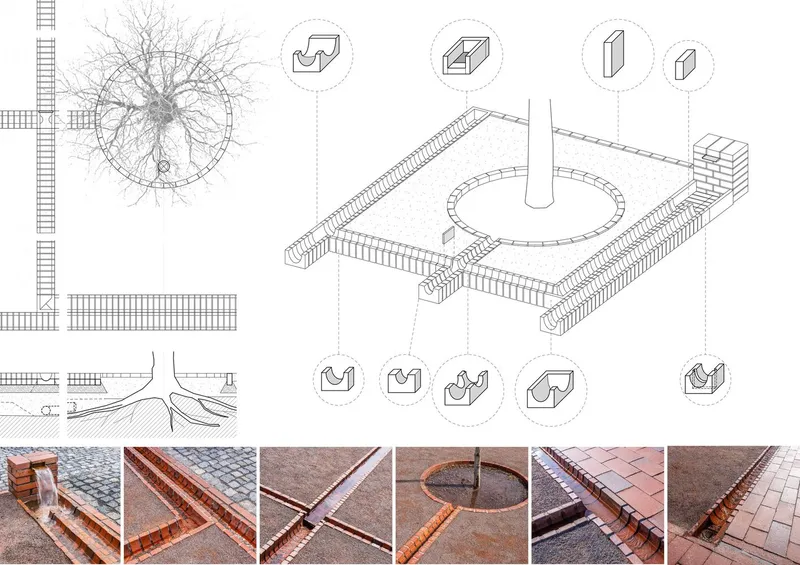
The exploded axonometric drawings unpack the layered assembly of Sféra's pyramidal roof structure, zigzag trusses, and timber floor plates in a way that makes the structural logic instantly readable. Sections through both buildings show how the GAMPA gallery's curtain partitions and glazed courtyard facade relate to the Sféra classrooms stacked above, connected by a central spiral staircase. The site plan confirms the pedestrian-only strategy, with canopy structures and newly planted trees defining the courtyard edges. Detail drawings of the brick paving system, complete with circular elements and linear drainage joints, demonstrate the same obsessive material consistency that governs the buildings themselves.
Why This Project Matters
Adaptive reuse is now so common that the phrase risks losing meaning. Too many conversions settle for preserving a shell and filling it with generic program. Šépka architekti goes further by making the relationship between old and new structurally and materially legible at every point of contact. The decision to test 30 concrete mixes and embed the rejects in the wall is not a stunt; it is a position on how architecture should declare its intentions. When you walk through the complex, you never wonder which surfaces are original and which are new, because the architects have given you the grammar to read the difference.
The Automatic Mills transformation also succeeds as urbanism. By completing the triangle between castle, square, and mills, the project stitches a formerly industrial zone back into Pardubice's civic life. The rooftop amphitheatre, the two contrasting squares, and the fully pedestrian ground plane suggest that the real program here is the city itself. The gallery and workshops are important, but they are almost secondary to the public space they generate. That is the rarest and most valuable thing an adaptive reuse project can achieve: not just saving a building, but giving a city a reason to gather.
Adaptive Reuse of the Automatic Mills, Pardubice, Czech Republic. Architects: Šépka architekti. Year: 2023. Photography: Aleš Jungmann.
About the Studio
Share Your Own Work on uni.xyz
If projects like this are the kind of work you want to make, uni.xyz is a place to publish your own, find collaborators, and enter design competitions.



Popular Articles
Popular articles from the community


Co-life: Sustainable Architecture for Age-Friendly Community Living
Co-life reimagines sustainable architecture for seniors through courtyards, rammed earth, shared gardens, and spaces designed for belonging.

Co-Life: Senior Housing Design That Reconnects Older Adults With the City
Co-Life reimagines senior housing design through healing gardens, shared streets, workshops, and a sustainable community across generations.

Conexión: Biophilic Design Reimagines High-Rise Living in Hong Kong
Conexión reimagines high-rise living in Hong Kong through biophilic design, green facades, shared spaces, daylight, water and nature within.

The Ocean Hive: Sustainable Architecture for a Self-Sufficient Civilization at Sea
The Ocean Hive imagines sustainable architecture at sea, where modular habitats, algae, wave power and ocean waste sustain a growing colony.


Similar Reads
You might also enjoy these articles

Bamboo Housing Challenge 2026: Design Affordable, Sustainable Homes Using Bamboo
An international design competition by Bamboo U and IBUKU inviting architects and designers to reimagine affordable housing using bamboo — with the winning design built full-scale in Bali.

Computational Design & Education: Beegraphy Design Awards Introduces 7th Category (Featuring Jiyun's Innovative Approach)
Dive into Beegraphy’s 7th Design Awards category, where computational design meets education to create immersive, interactive learning tools, inspired by Jiyun’s work.

From Parametric Lighting to Urban Furniture: Join the 2nd Workshop in Beegraphy’s Computational Design Series
Dive into Cutting-Edge Design Techniques and Practical Applications with Industry Experts

Last Call: Unleash Your Architectural Genius in SHAK's Kindergarten Design Competition
Urgent call for architects to join SHAK's kindergarten design competition before the looming deadline


Explore Adaptive Reuse Competitions
Discover active competitions in this discipline



Challenge to reimagine the Iron Throne


Photograph architecture without architects


Illustrate the lost glory of Angkor Wat - Render Challenge


Design challenge to reuse E-waste
Comments (0)
Please login or sign up to add comments
No comments yet. Be the first to comment!