
Jacobsen Arquitetura Weaves a Lakeside House into Granite, Timber, and Water
On a forested peninsula in Brazil, AEA House dissolves the boundary between architecture and its rocky, lush terrain.


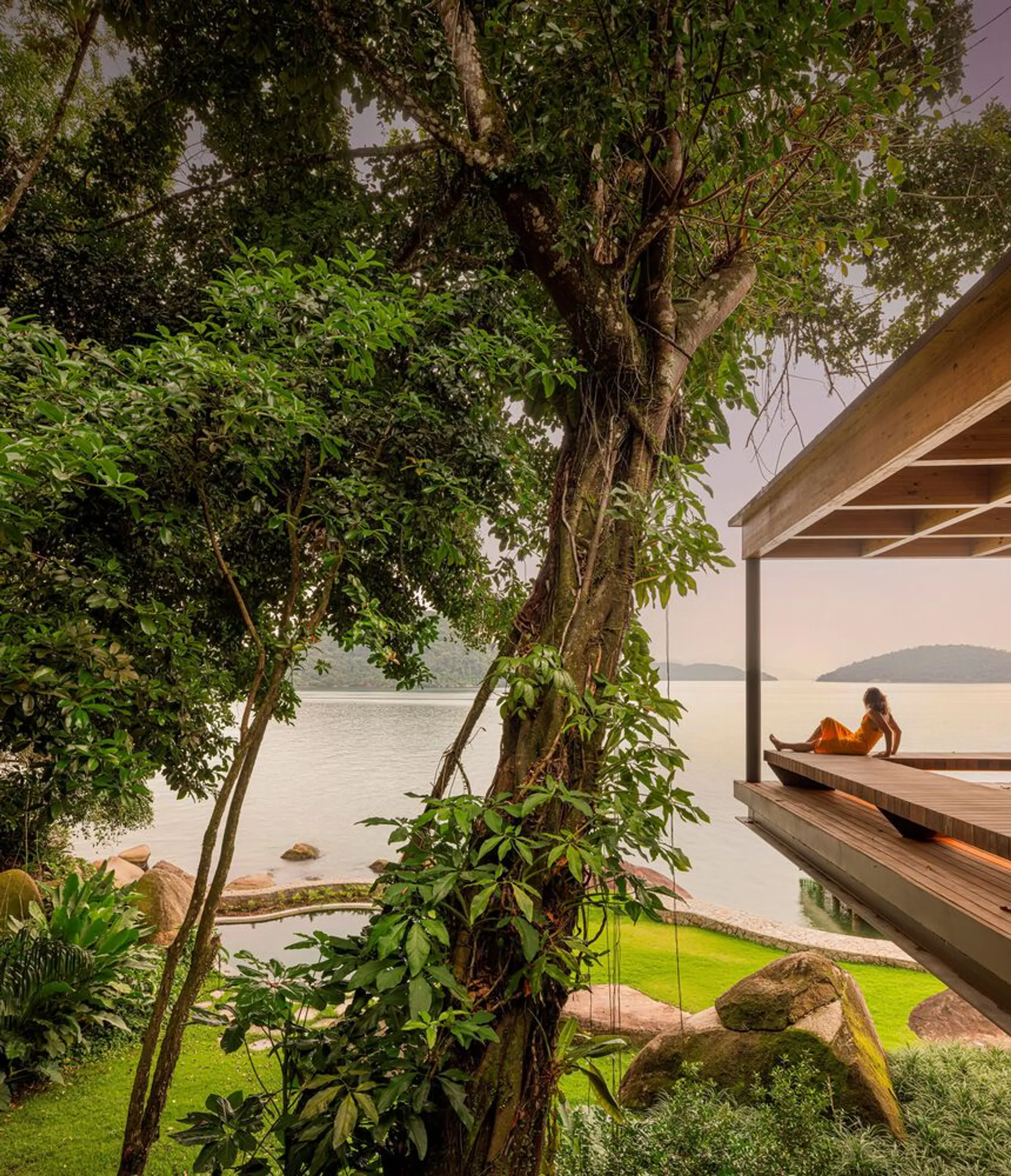
There is a particular kind of ambition that shows itself not in height or span but in restraint. Jacobsen Arquitetura's AEA House, set on a forested peninsula above a calm bay, demonstrates this precisely. The residence stretches horizontally across its sloped site, barely rising above the tree canopy, its timber volumes and planted roofs deferring to the topography rather than competing with it. Granite boulders, some of them massive and moss-covered, are not obstacles to be removed but protagonists around which the house wraps, leans, and occasionally yields.
What makes the project genuinely interesting is the degree to which it treats landscape as co-author. This is not a house placed on a site. It is a house that could not exist on any other site: its plan curves to follow a pool shaped by the terrain, its sections step to accommodate rock outcroppings, and its material palette of timber cladding, perforated brick, and glass reads as a calibrated negotiation between enclosure and exposure. Every room opens to something specific, whether lake, mountain, boulder, or canopy.
Nestled, Not Imposed
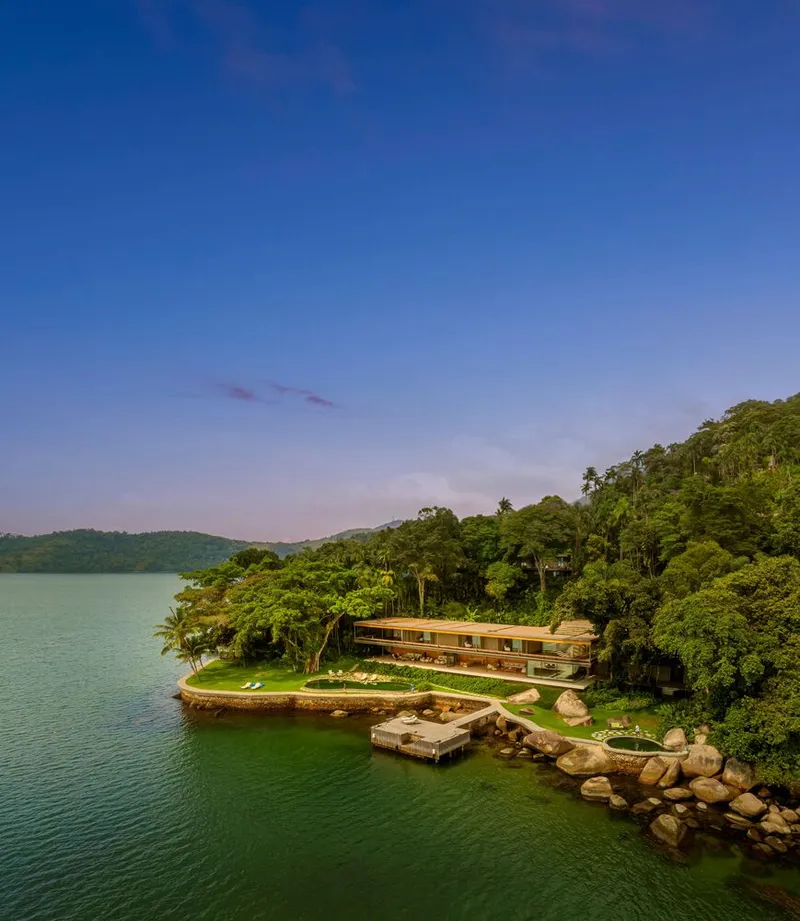
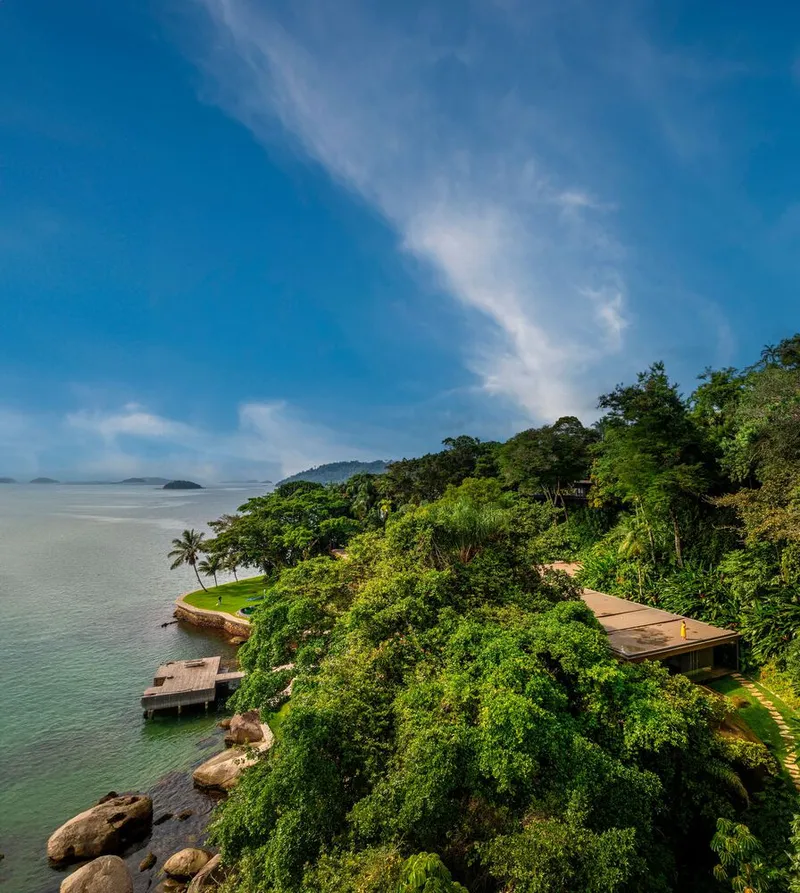
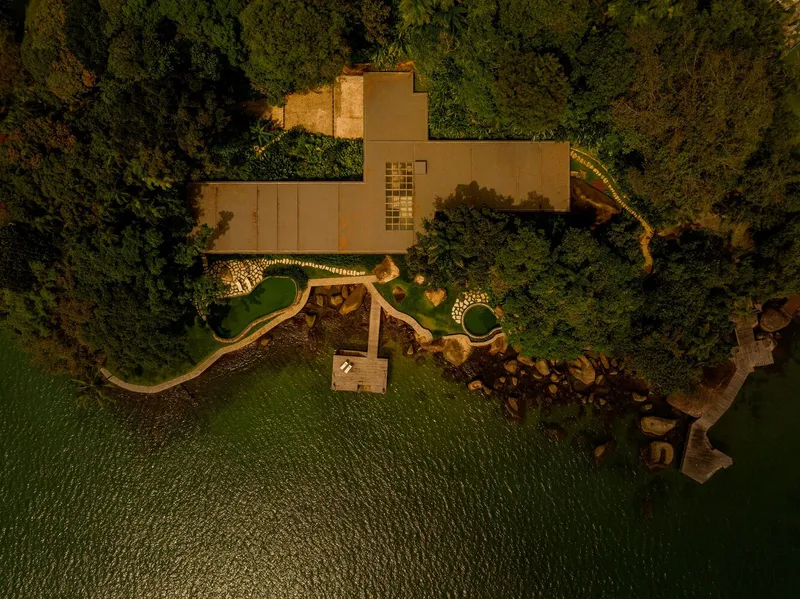
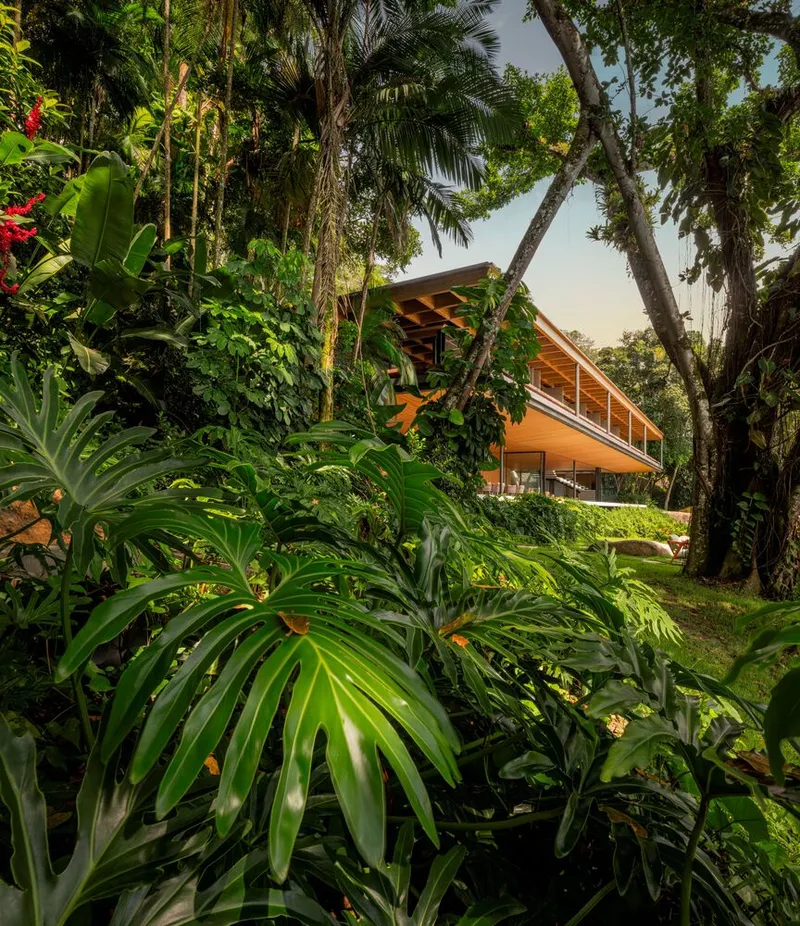
From the air, AEA House reads less as a building and more as a clearing in the forest with a flat lid. The low-slung roof volumes, seen at dusk, barely register against the dense hillside vegetation. Illuminated pathways thread through garden zones, revealing that the house is not a single mass but a loose aggregation of pavilions connected by circulation spines and open courts. The strategy distributes the program across the terrain rather than stacking it, keeping the roofline well below the surrounding tree canopy.
The peninsula location amplifies the effect. Water surrounds the site on three sides, and the architects exploit this by orienting every major volume toward views of the bay. There is no singular front facade. The house addresses the landscape omnidirectionally, an approach that demands careful section work and rewards the inhabitant with a different framing at every turn.
Stone as Structure, Stone as Guest
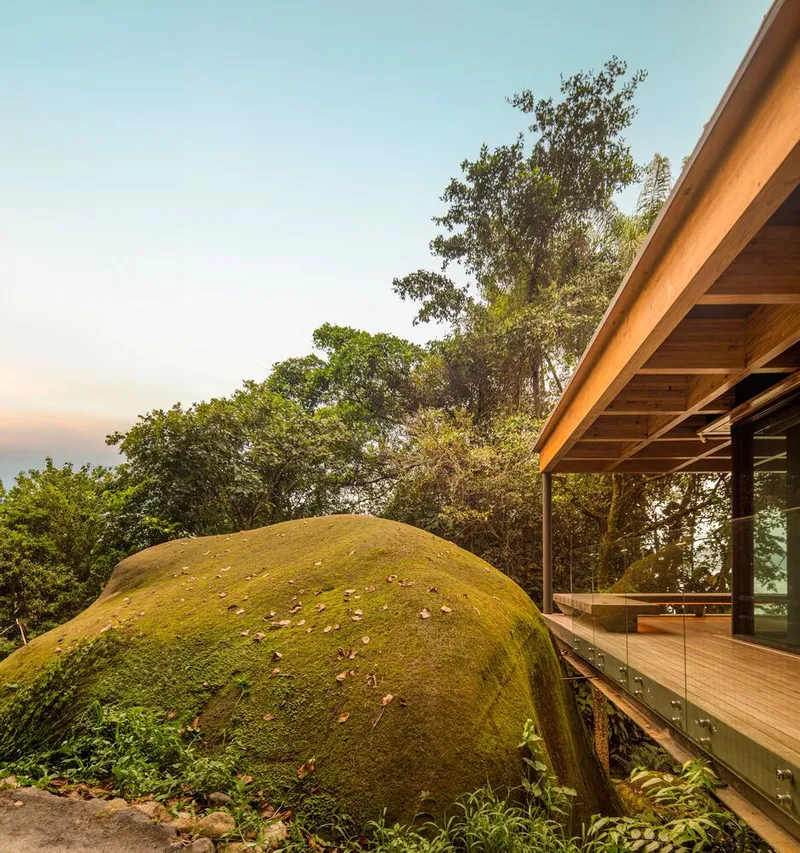
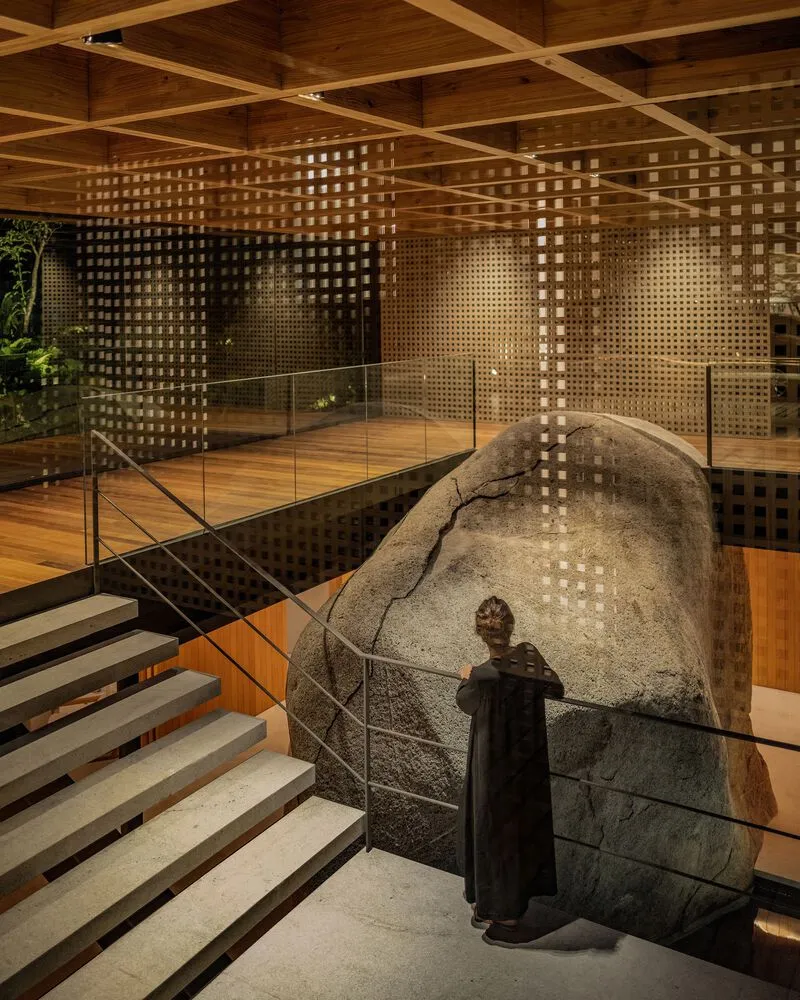
The most striking detail in the project is the way existing granite outcroppings are incorporated into the architecture. In one instance, a moss-covered boulder stands directly beside the glazed pavilion wall, its irregular surface nearly touching the clean timber frame. Inside, a similar boulder penetrates the building envelope and sits next to a staircase, framed by perforated brick screens and a glass balustrade as though it were a piece of sculpture installed for contemplation.
Jacobsen Arquitetura has a long history of this kind of geological incorporation, but AEA House takes it further than most. The boulders are not decorative accents. They are structural facts that shaped the plan. The decision to build around them rather than blast them away is both ecological and aesthetic: it anchors the house in deep time, reminding occupants that the rock was here millions of years before the timber screens arrived and will outlast them.
The Interior Courtyard as Vertical Event
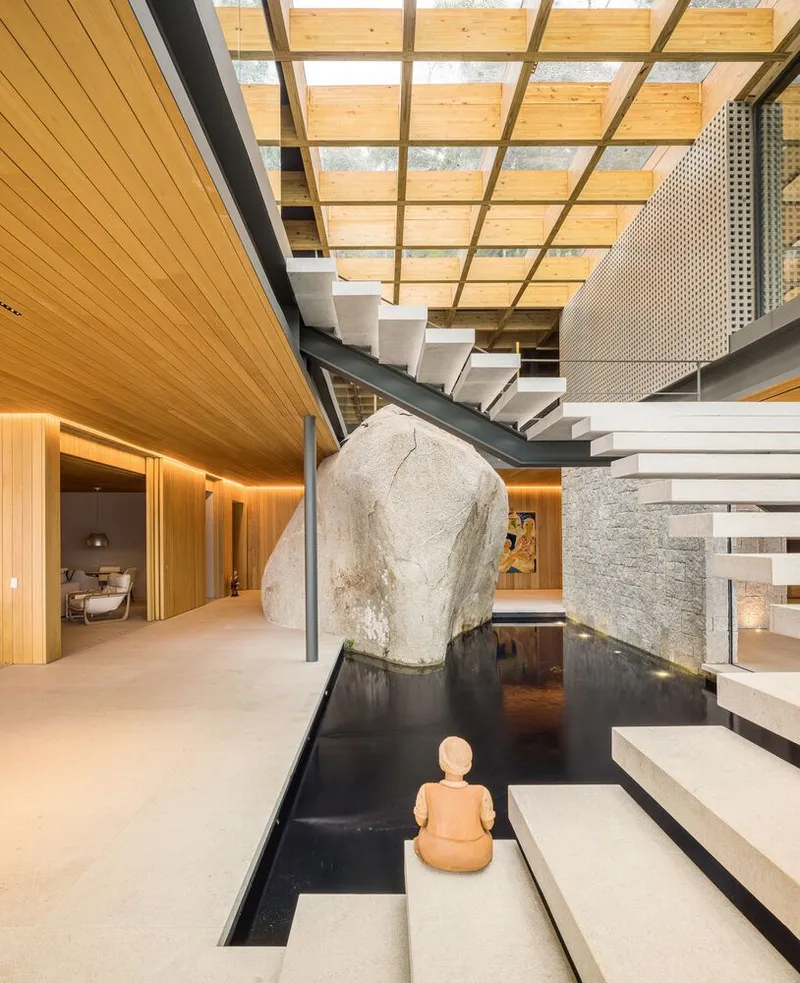
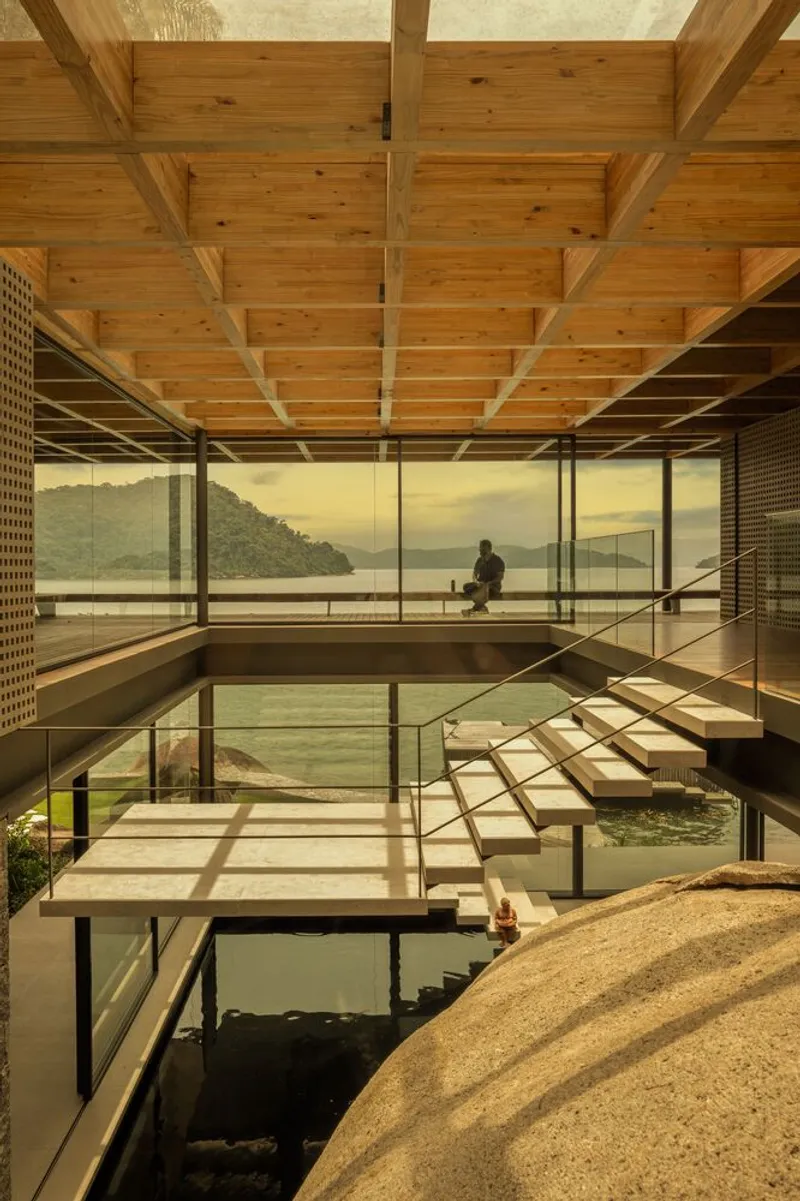
While the plan spreads horizontally, the interior courtyard introduces a sharp vertical moment. A floating steel staircase rises through a double-height void alongside a reflecting pool, framed on both sides by timber-clad walls and capped by a glazed skylight. The water at the base catches light from above and bounces it onto the timber surfaces, creating a constantly shifting pattern that changes with the sun's angle.
From the upper level, this courtyard opens outward through floor-to-ceiling glass toward the lake, establishing a visual axis that connects sky, water at roof level, courtyard pool, and distant bay in a single telescoping view. It is the one moment in the house where Jacobsen allows drama to override quietude, and it works precisely because the rest of the architecture is so deliberately horizontal and understated.
Timber, Brick, and the Art of Screening
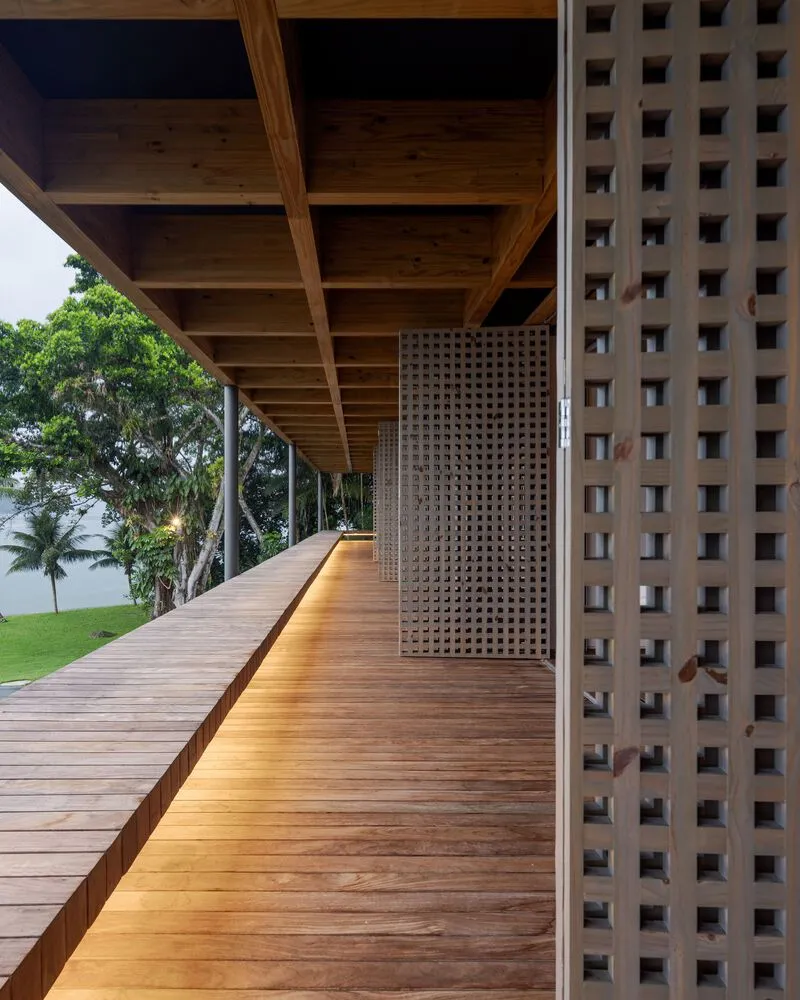
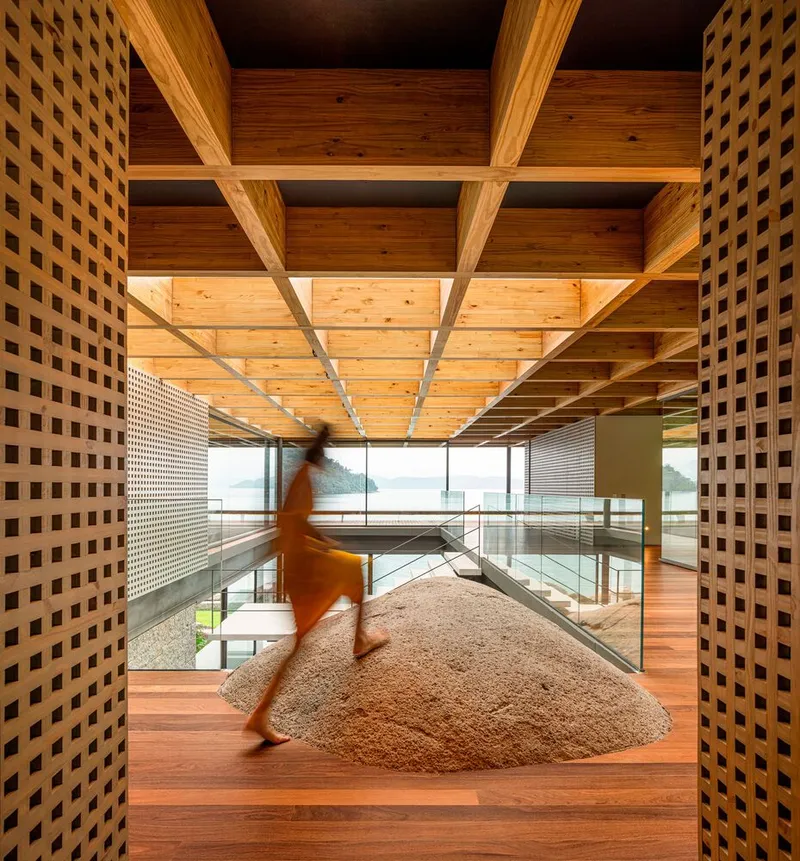
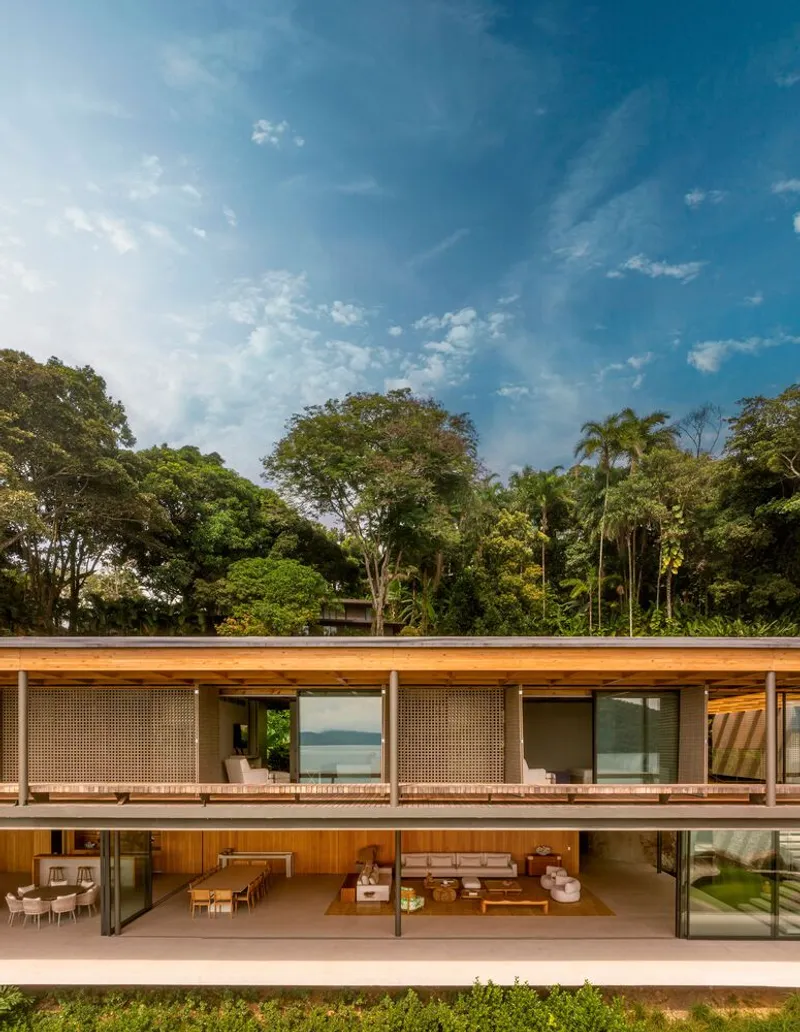
The material language is narrow and disciplined. Timber dominates: coffered wood ceilings, exposed rafters, and cladding panels give every space warmth and acoustic softness. But the perforated brick screens are the real protagonists of the facade. They filter light into dappled patterns, provide privacy without closing off views entirely, and create a visual texture that shifts depending on the time of day and your angle of approach.
An interior bridge with latticed timber screens and a coffered ceiling connects two wings of the house, functioning as a transitional space between private and social zones. The two-story facade reveals the logic: open living areas on the ground floor sit below screened bedrooms on the upper level. It is a straightforward tropical section, ventilated and shaded, but executed with unusual refinement in the detailing of joints, reveals, and screen patterns.
Living at the Edge of Water
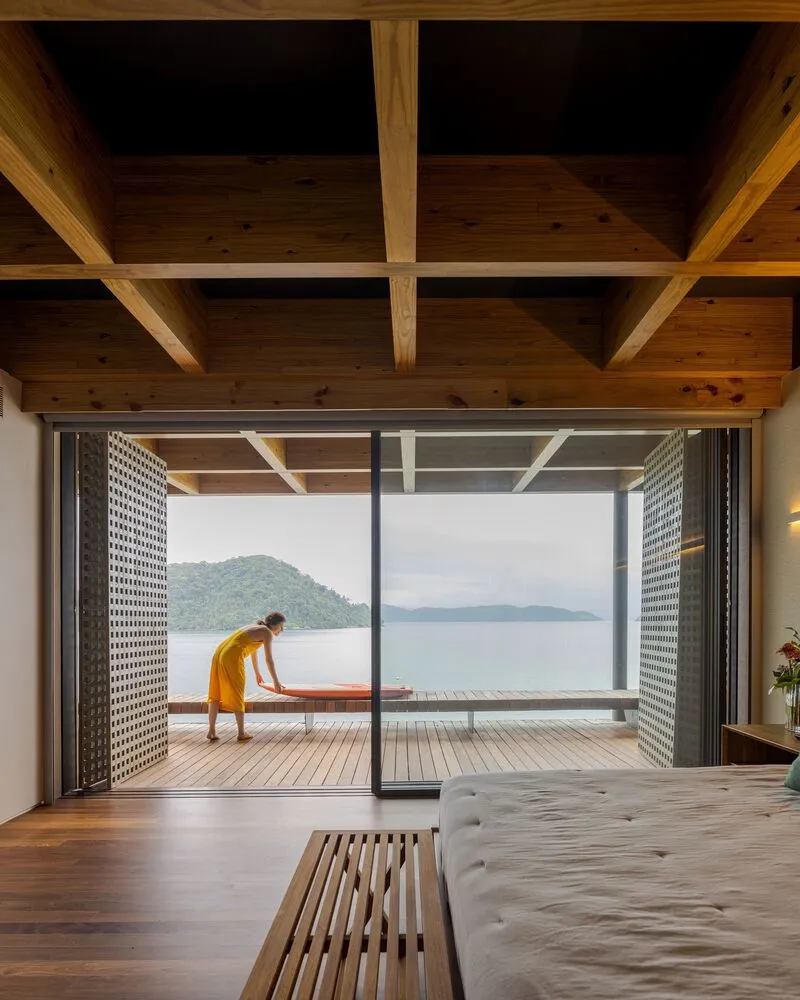
The bedrooms open directly onto wooden decks through full-height glazing, with perforated metal screens providing shade and a sense of enclosure without blocking the panorama of lake and mountains beyond. It is a generous way to wake up: the screens act as a translucent veil, letting in breeze and diffused light while keeping the room comfortable.
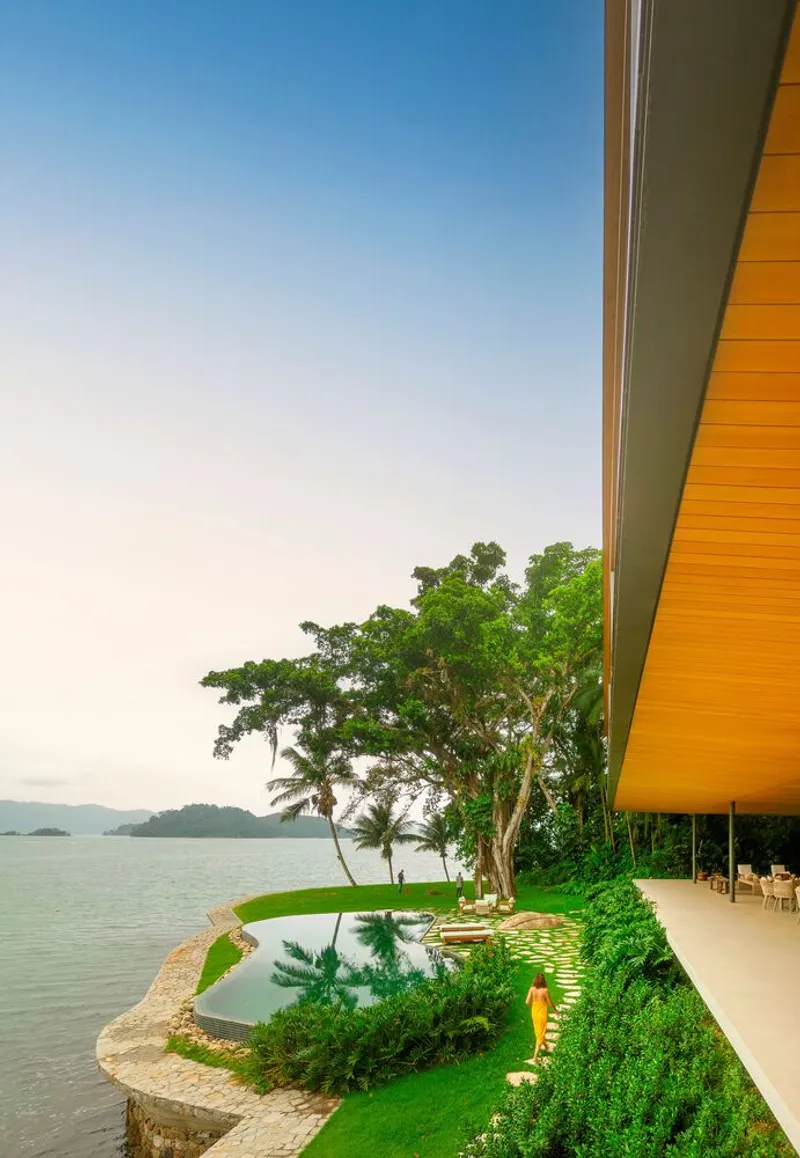
At the other end of the house, cantilevered roof edges float above a reflecting pool that terminates at a manicured lawn overlooking the bay. The evening shot captures the precision of this composition: a razor-thin roof line, a sheet of still water, and a distant horizon. There is nothing incidental about this framing. Below the clean geometry, the timber-framed structure rests among palms and tropical foliage, the exposed rafters casting rhythmic shadows in the evening light.
Green Roof as Fifth Facade
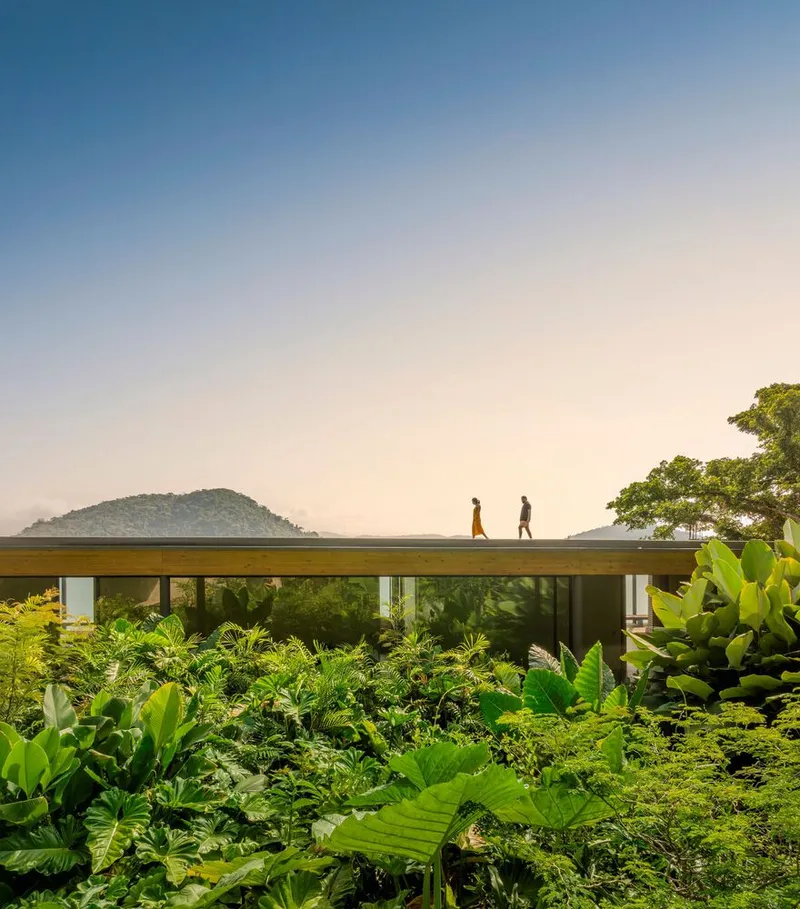
Given that the house is experienced from above by anyone on the higher terrain, the planted roof terrace is not an afterthought. Tropical vegetation covers much of the roof surface, blurring the line between architecture and hillside when seen from the road or neighboring properties. Two figures walking across the green roof at dawn convey its scale: this is a habitable landscape, not a token sustainability gesture.
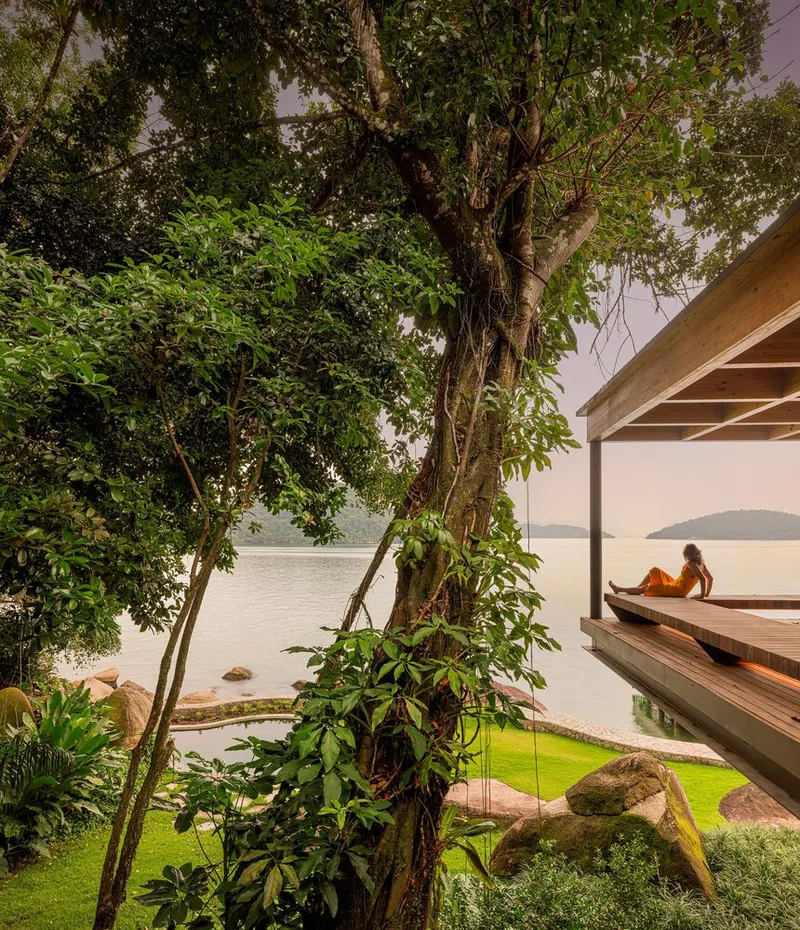
At ground level, the relationship between constructed and natural surfaces is equally considered. A cantilevered timber deck reaches out over a reflecting pool, brushing past a moss-covered boulder and shaded by mature trees. The palette of weathered stone, still water, and warm wood achieves something that few luxury houses manage: it feels settled, as though the house has been here for decades rather than years.
Plans and Drawings
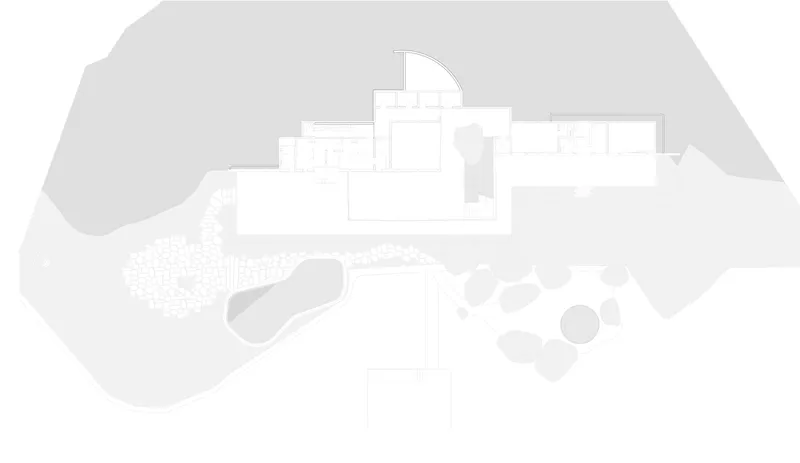
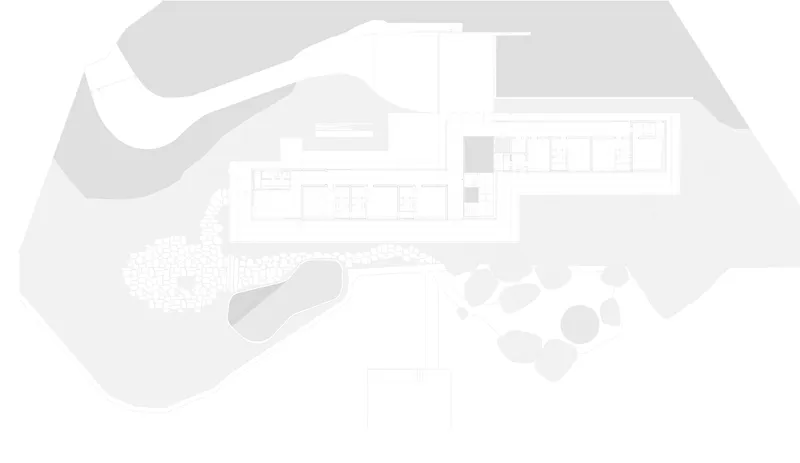

The site plan confirms what the aerial photographs suggest: the residence follows a linear logic bent to conform to the peninsula's contours, with a curved organic pool anchoring the composition on the downhill side. Rooms peel off a central spine and open laterally toward the water, maximizing cross-ventilation and view lines. The roof plan reveals generous terraces adjacent to the pool, demonstrating how much of the house's program is exterior rather than enclosed.
What the drawings make particularly clear is the interplay between rigid structural bays and the organic edge conditions of landscape and pool. The architecture is orthogonal where it needs to be for construction efficiency, and curvilinear where it meets the ground. It is a plan that respects both the logic of building and the logic of terrain, without letting either dominate.
Why This Project Matters
AEA House belongs to a lineage of Brazilian houses that treat the tropics not as a backdrop for imported modernist forms but as a generator of architectural decisions. The coffered timber ceilings, the perforated screens, the horizontal spread across terrain, the incorporation of boulders and water: all of these moves descend from a tradition running through Lina Bo Bardi, Paulo Mendes da Rocha, and the Campinas school. Jacobsen Arquitetura operates within that lineage with fluency and, importantly, with restraint.
In a moment when high-end residential architecture often defaults to spectacle, AEA House argues for the opposite. Its most powerful gestures are the ones you almost miss: a boulder allowed to stay, a roof kept below the trees, a screen that softens light rather than blocking it. The house earns its place on the peninsula not by announcing itself but by listening to what was already there.
AEA House by Jacobsen Arquitetura. Located on a forested lakeside peninsula, Brazil.
About the Studio
Share Your Own Work on uni.xyz
If projects like this are the kind of work you want to make, uni.xyz is a place to publish your own, find collaborators, and enter design competitions.




Popular Articles
Popular articles from the community


The Ocean Hive: Sustainable Architecture for a Self-Sufficient Civilization at Sea
The Ocean Hive imagines sustainable architecture at sea, where modular habitats, algae, wave power and ocean waste sustain a growing colony.

The Earth Pod: 3D Printed Homes for Resilient Refugee Communities
The Earth Pod reimagines refugee housing through 3D printed homes made from clay, combining resilience, self-sufficiency, and rapid shelter.

Hill & Cross Opera: Sculptural Opera House Architecture Shaped by Tallinn’s Landscape and Identity
Hill & Cross Opera reimagines opera house architecture in Tallinn through its sculptural hill, civic plaza, glass wave and a luminous cross.

Co-life: Sustainable Architecture for Age-Friendly Community Living
Co-life reimagines sustainable architecture for seniors through courtyards, rammed earth, shared gardens, and spaces designed for belonging.


Similar Reads
You might also enjoy these articles

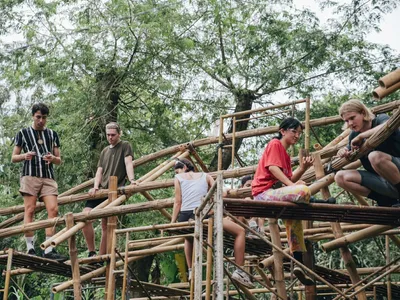
Bamboo Housing Challenge 2026: Design Affordable, Sustainable Homes Using Bamboo
An international design competition by Bamboo U and IBUKU inviting architects and designers to reimagine affordable housing using bamboo — with the winning design built full-scale in Bali.

Computational Design & Education: Beegraphy Design Awards Introduces 7th Category (Featuring Jiyun's Innovative Approach)
Dive into Beegraphy’s 7th Design Awards category, where computational design meets education to create immersive, interactive learning tools, inspired by Jiyun’s work.

From Parametric Lighting to Urban Furniture: Join the 2nd Workshop in Beegraphy’s Computational Design Series
Dive into Cutting-Edge Design Techniques and Practical Applications with Industry Experts

Last Call: Unleash Your Architectural Genius in SHAK's Kindergarten Design Competition
Urgent call for architects to join SHAK's kindergarten design competition before the looming deadline


Explore Architecture Competitions
Discover active competitions in this discipline



Challenge to reimagine the Iron Throne


Photograph architecture without architects


Illustrate the lost glory of Angkor Wat - Render Challenge


Design challenge to reuse E-waste
Comments (0)
Please login or sign up to add comments
No comments yet. Be the first to comment!