
AfA Design Builds Its Own Office from Craft Village Materials on the 20th Floor of a Hanoi Tower
An 81-square-meter workspace on a high-rise floor in Hanoi uses ceramic brick, bamboo, and dó paper to resist the city's erasure of craft traditions.


Hanoi is building fast. Concrete towers climb over former rice paddies and the suburban craft villages that once supplied the city with handmade brick, woven bamboo, and traditional dó paper are shrinking by the year. On the 20th floor of one of those towers, AfA Design has done something quietly radical: it built its own office out of the very materials that rapid urbanization threatens to make obsolete. Led by Nguyen Van Sinh and Pham Ngoc Son, the studio compressed an entire workplace, a garden terrace, and a material manifesto into just 81 square meters.
What makes the project worth studying is not its size but its method. Rather than treating craft materials as decorative veneers, AfA uses them structurally and spatially: folding bamboo screens replace fixed walls, ceramic bricks from nearby villages form the floor plane, and a sloped roof system derived from traditional Vietnamese architecture manages solar gain and airflow without mechanical intervention. The office is both a functional workspace and a working argument that Hanoi's building boom does not have to mean the death of its material heritage.
Craft Materials in a Concrete Shell
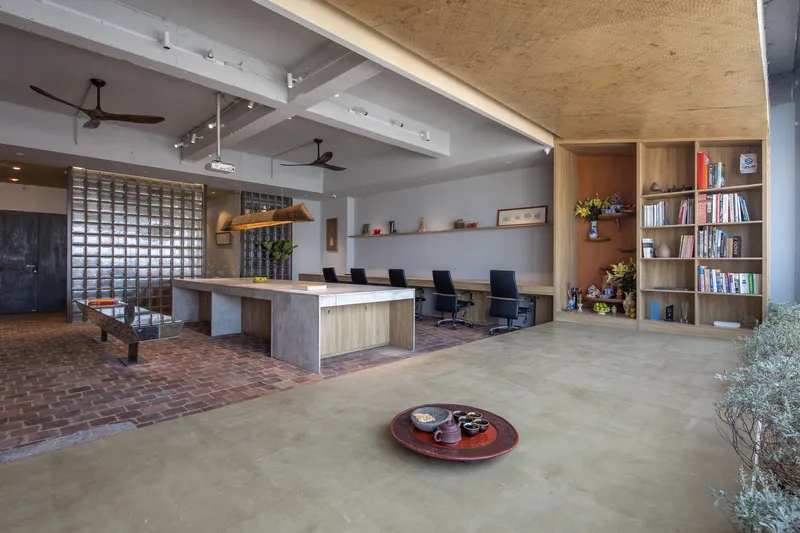
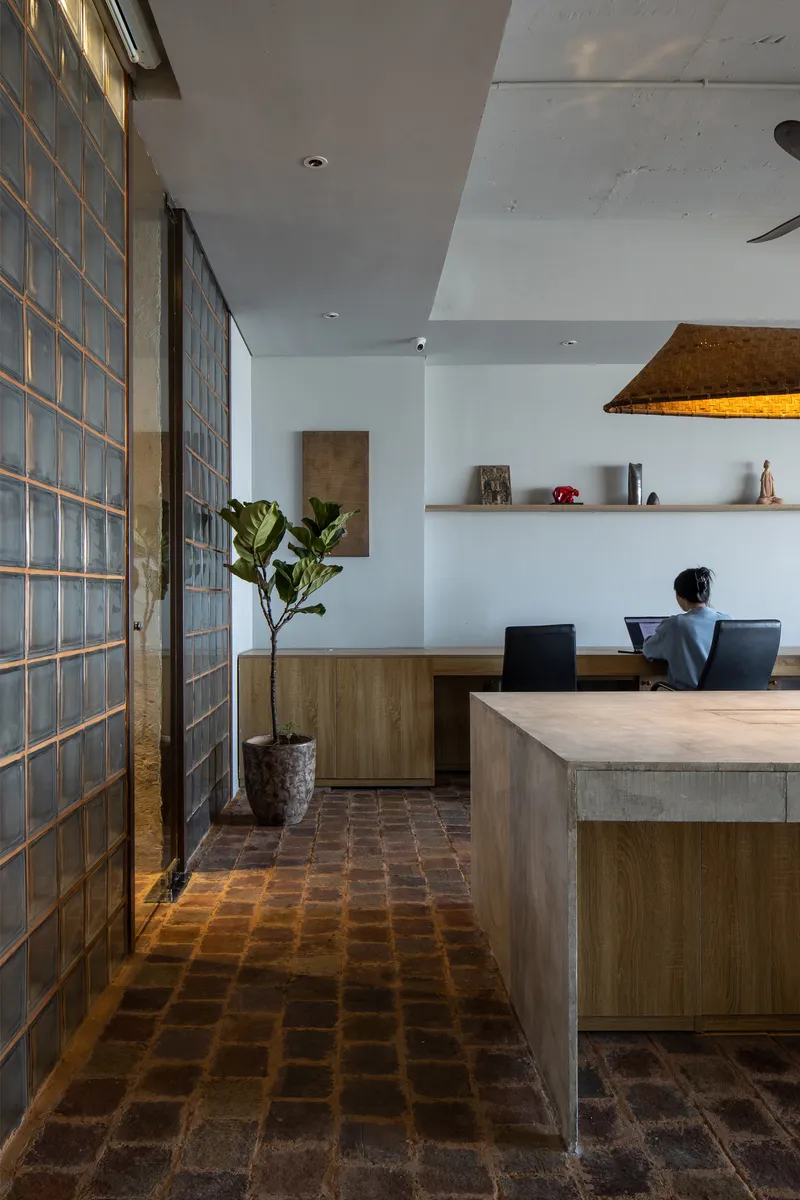

The raw concrete frame of the high-rise floor acts as a neutral container. Into it, AfA layers a kit of parts sourced almost entirely from the suburban craft villages ringing Hanoi: reclaimed ceramic bricks line the floor, woven rattan panels form partition walls, and glass blocks filter light between zones. The contrast between the exposed concrete beams overhead and the warm, textured brick underfoot is immediate and deliberate. It reads as a confrontation between the city Hanoi is becoming and the one it has been.
The glass block partition wall is particularly effective. It divides the open plan without killing sightlines, letting daylight pass through as a soft, diffused glow while still providing acoustic separation between the dining area and the working zone. It is a simple move, but it keeps the 81 square meters from feeling like a corridor.
Folding Screens and Flexible Boundaries


Hard walls are almost entirely eliminated. In their place, AfA deploys folding bamboo screens that can open to reveal private alcoves or close to create enclosed meeting rooms. The screens are not decorative afterthoughts; they are the primary spatial mechanism. When open, the office is a single continuous room. When closed, it fragments into distinct zones for focused work, client meetings, or informal gathering.
The woven texture of these screens gives them a visual density that solid walls would not achieve. Light passes through the weave in thin lines, animating the floor with shifting patterns throughout the day. It is a solution born from material logic rather than aesthetic preference: bamboo is light enough to fold, strong enough to stand, and porous enough to let air circulate.
The Garden as Climate Buffer

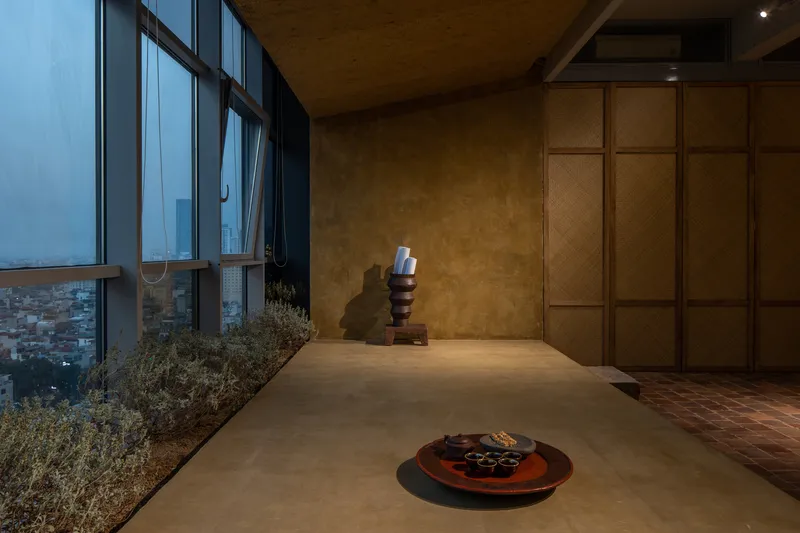
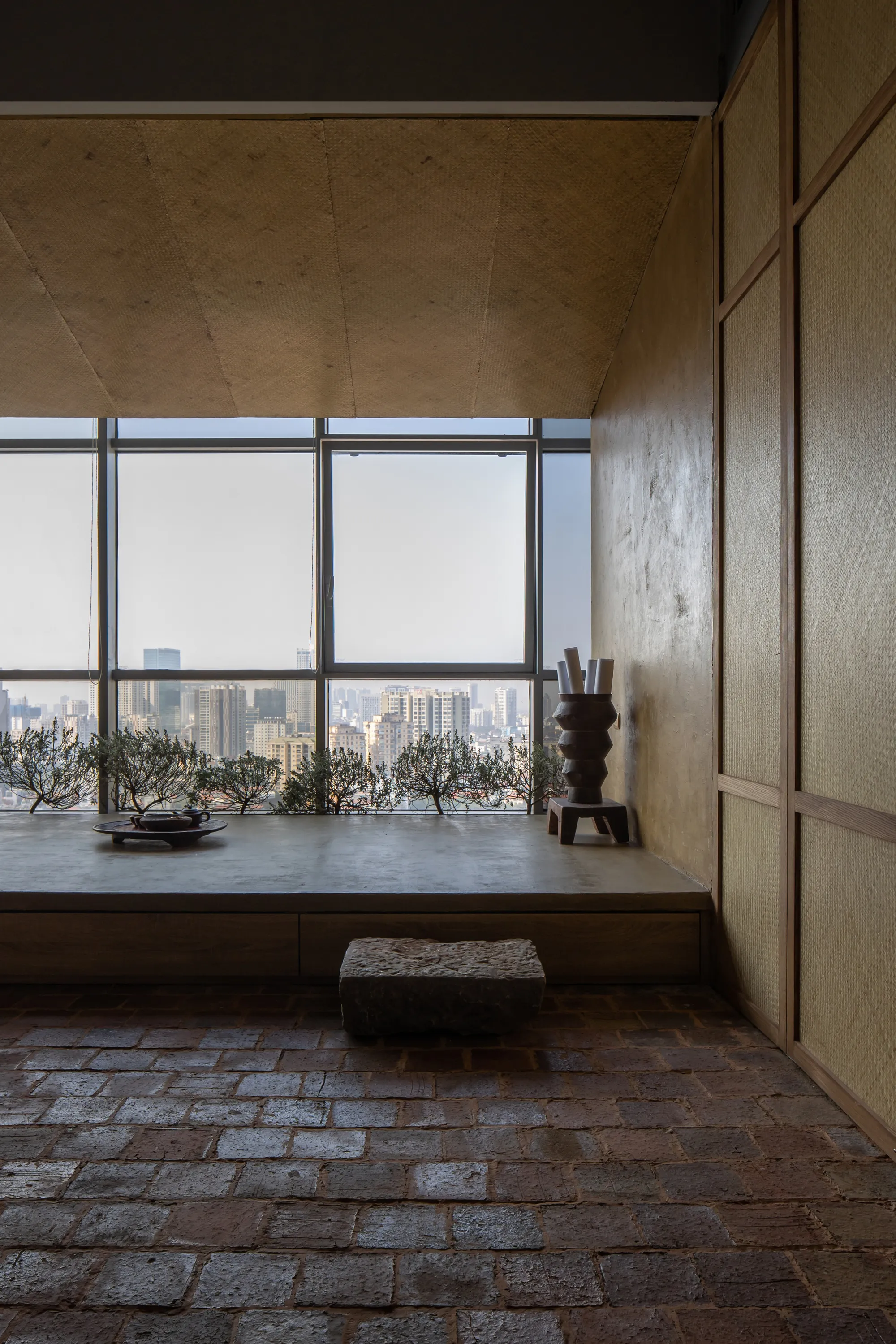
The northwest-facing windows are a liability in a tropical climate. Afternoon sun drives significant heat radiation into the space during summer months. AfA's response is a planted terrace zone positioned along the window wall, functioning simultaneously as a garden, a relaxation space with city views, and a thermal buffer between the conditioned interior and the glazed facade. Potted bonsai trees and planted sills absorb and soften the incoming light before it reaches the work surfaces deeper in the plan.
A raised timber platform at the terrace edge creates a contemplative perch. Floor cushions replace office chairs; the hazy Hanoi skyline replaces a screensaver. It is a space designed for pause, and in an 81-square-meter office, dedicating this much area to something other than desks is a genuine commitment. The studio is betting that employee well-being, measured in proximity to plants and natural light, is worth more than an extra workstation.
Light, Depth, and the View Out
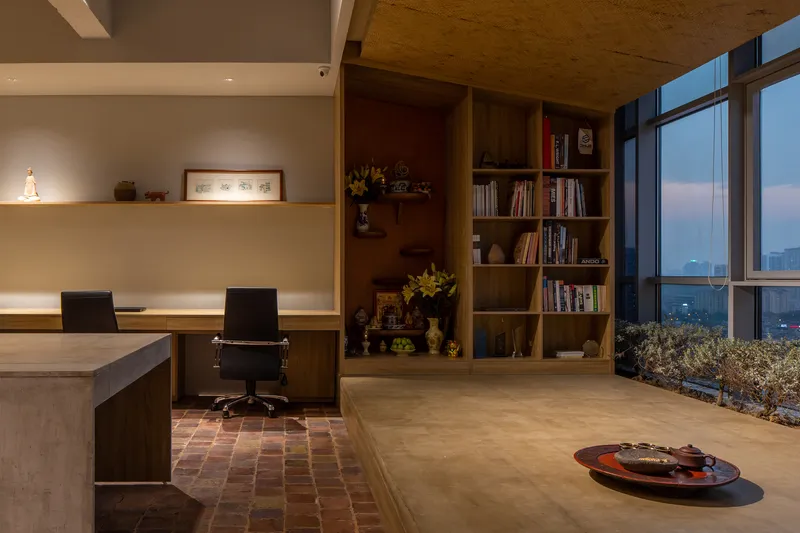


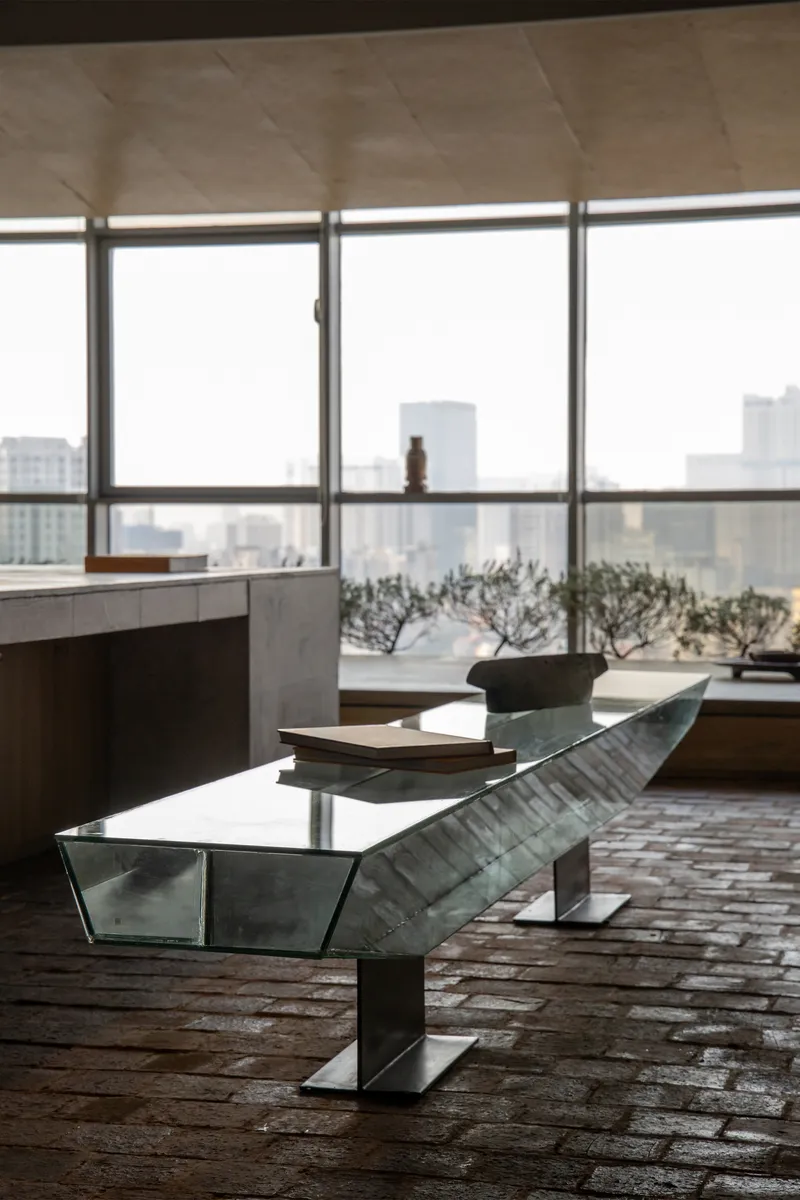
At dusk, the office reveals its most compelling spatial quality. The deep plan, which could easily feel like a tunnel, is organized so that every work position has a visual connection to the floor-to-ceiling glazing and the city beyond. Bookshelf niches and planted window sills create intermediate layers between the desk and the glass, so the eye moves through several depths before reaching the skyline. The effect is one of compression and release, a rhythm that keeps the compact space from feeling claustrophobic.
The sloping ceiling system, inspired by traditional Vietnamese roof forms, plays a key role here. It catches and redirects daylight deeper into the plan while blocking the most punishing solar angles. Natural light transitions smoothly from the bright window edge to the more intimate interior zones, eliminating the abrupt dark-to-bright contrast that plagues most open-plan offices with perimeter glazing.
Gathering and Working Under One Roof
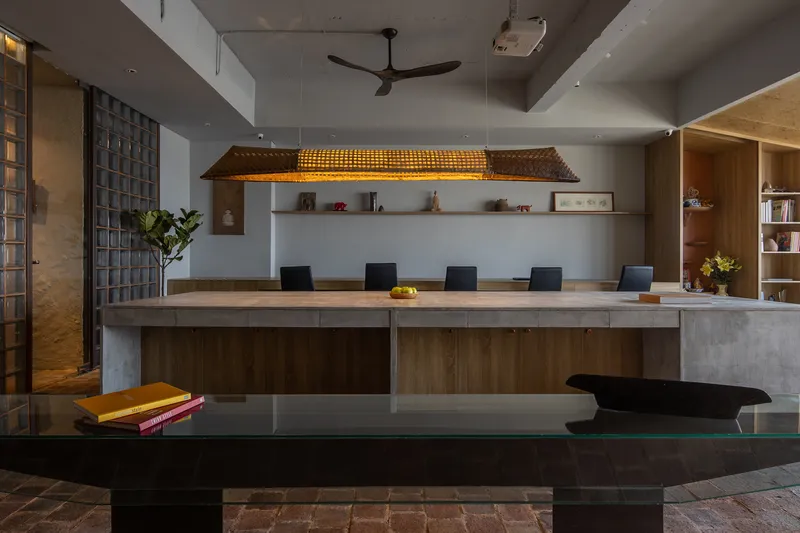

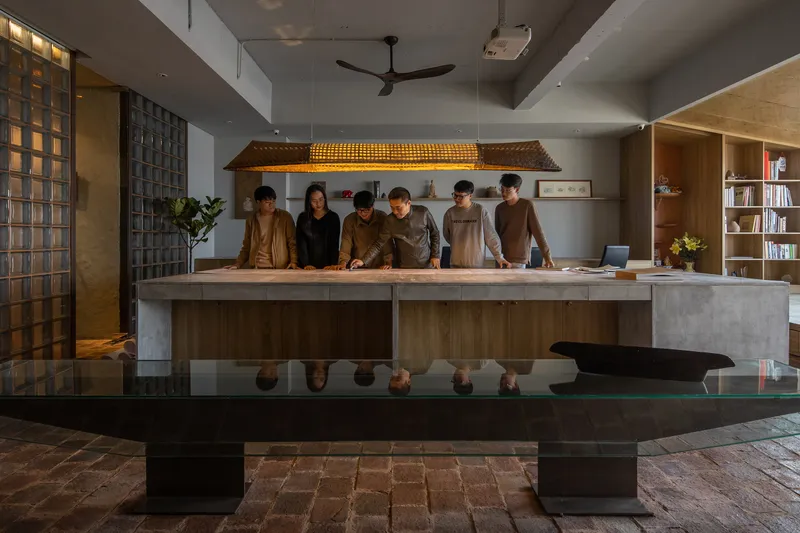
The dining and meeting zone occupies the center of the plan, anchored by a long timber table beneath a woven pendant light. It serves triple duty: communal meals, informal meetings, and overflow workspace. The terracotta brick floor continues unbroken from the entrance through this zone, reinforcing the sense that the entire office is a single material surface rather than a collection of discrete rooms.
A ceiling fan and pendant light mark the gathering point without enclosing it. The stepped concrete ceiling overhead provides just enough spatial definition to distinguish this area from the adjacent work zone. It is an economy of means that 81 square meters demands: every element does at least two jobs.
Conference Rooms Framed by Material


The conference spaces demonstrate how material choice can substitute for architectural volume. A woven pendant light hangs low over the meeting table, creating an intimate cone of light that psychologically defines the room even when the folding screens are open to the rest of the office. At evening, the exposed concrete beams become visible overhead, their raw finish contrasting with the warm timber and brick below.
Folding timber screens with integrated shelving double as both room dividers and storage walls. Clerestory windows above the screens let borrowed light spill between zones, maintaining the visual continuity that keeps the small floor plate feeling generous. The result is a conference room that can be sealed for a client presentation or opened to become part of the communal space within seconds.
Plans and Drawings
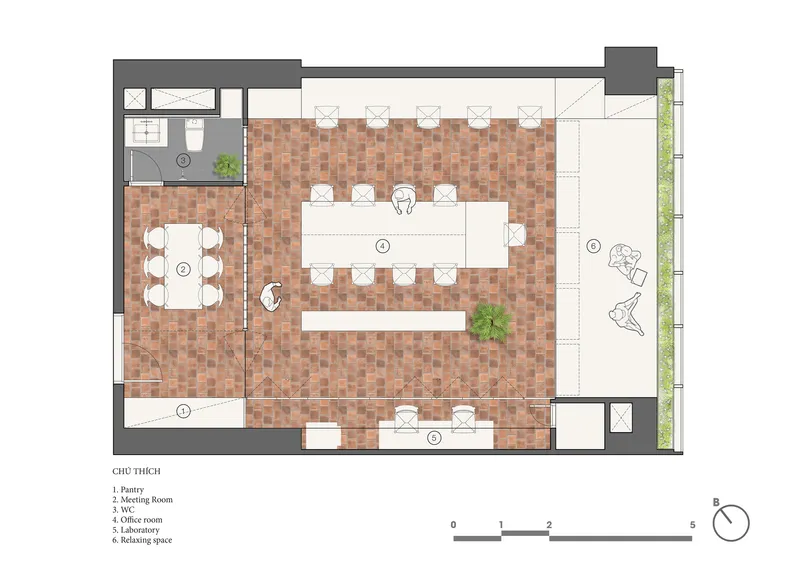


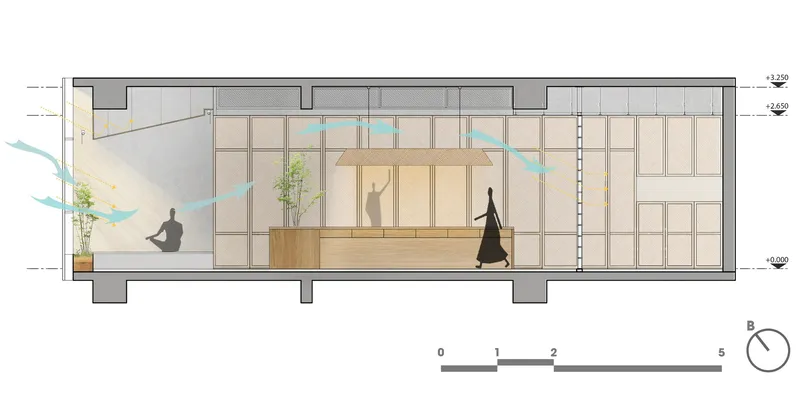


The floor plans reveal just how little of the 81 square meters is given over to fixed partitions. The central meeting table, the planted terrace, and the folding screen positions are the only strong spatial anchors; everything else is open or negotiable. The axonometric drawing showing the exploded assembly of bamboo ceiling, folding doors, glass panels, ceramic bricks, and earthen floor is especially telling. It reads like a recipe card for a craft-based office: each material layer is distinct, removable, and replaceable without demolishing anything else.
The section drawings illustrate the passive climate strategy most clearly. Natural light enters from the northwest, is filtered through the planted terrace zone, and penetrates deep into the plan via the sloped ceiling and clerestory gaps. The section perspective, with its planted foreground and glass-walled workspace behind, shows how the garden buffer mediates between the raw exposure of a 20th-floor facade and the sheltered interiority of the work zones.
Why This Project Matters
The AfA Office is not a protest against urbanization. It occupies a high-rise tower, after all. But it is a pointed demonstration that the materials and techniques of Hanoi's disappearing craft villages can function at altitude, inside the very buildings that are displacing those villages. By sourcing ceramic brick, bamboo, dó paper, and pressed papyrus from nearby artisans, AfA routes construction spending back toward communities that the building boom is otherwise draining. That is not nostalgia. That is supply chain design.
At 81 square meters, the project also offers a replicable model for the tens of thousands of Hanoi businesses crammed into lightless, plantless offices. The folding screens, the planted buffer zone, and the passive light strategy are all transferable to similarly tight floor plates. The lesson is specific: you do not need more space to work well; you need better materials, fewer fixed walls, and the discipline to give some of your square meters back to the sky.
AfA Office by AfA Design (lead architects: Nguyen Van Sinh and Pham Ngoc Son), Hanoi, Vietnam. 81 m², completed 2022. Photography by Hoang Le.
About the Studio
Share Your Own Work on uni.xyz
If projects like this are the kind of work you want to make, uni.xyz is a place to publish your own, find collaborators, and enter design competitions.



Popular Articles
Popular articles from the community


Co-life: Sustainable Architecture for Age-Friendly Community Living
Co-life reimagines sustainable architecture for seniors through courtyards, rammed earth, shared gardens, and spaces designed for belonging.

AL-JANNAH: Sustainable Architecture and Permaculture for Afghan Widows
AL-JANNAH uses sustainable architecture and permaculture to create resilient oasis of housing, learning, work and renewal for Afghan widows.
EW PARK: Sustainable Architecture Reimagines the Future of Urban Parking
EW PARK reimagines city parking as a modular wooden tower combining automation, solar energy, electric mobility, and adaptable urban design.

The Ocean Hive: Sustainable Architecture for a Self-Sufficient Civilization at Sea
The Ocean Hive imagines sustainable architecture at sea, where modular habitats, algae, wave power and ocean waste sustain a growing colony.

Similar Reads
You might also enjoy these articles

Bao Huynh Watercolor Atelier: A Serene Art Retreat in Hội An
Bao Huynh Watercolor Atelier in Hội An blends multifunctional art spaces, sustainable design, local materials, and family-friendly living in a serene environment.

Atelier Macri Concept Store Interior Design by CASE-REAL
Atelier Macri store features a "ko" counter, walnut wood details, cork displays, blending retail, gallery, and seamless customer experiences.

Manuel Vargas Izquierdo Stadium and High-Performance Sports Center: Architectural Excellence in Jalpa de Méndez
The Manuel Vargas Izquierdo Stadium blends sustainable design, inclusive sports facilities, and cultural-inspired architecture, revitalizing Jalpa de Méndez’s public spaces.
KAKR Buluh Awar Hall: Revitalizing Community and Ecology Through Bamboo Architecture
Community built bamboo hall revitalizes Buluh Awar village, empowering youth, restoring ecology, celebrating vernacular craftsmanship through sustainable architecture and culture.


Explore Office Building Competitions
Discover active competitions in this discipline



Challenge to reimagine the Iron Throne


Photograph architecture without architects


Illustrate the lost glory of Angkor Wat - Render Challenge


Design challenge to reuse E-waste
Comments (0)
Please login or sign up to add comments
No comments yet. Be the first to comment!