
AFF Architekten Folds a Sculptural Roofscape over a Berlin Language and Movement Center
A galvanized steel building on the Efeuweg campus in Neukölln mediates between Gropiusstadt's bold scale and its quieter residential edges.


Berlin's Neukölln district is a patchwork of postwar housing slabs, community infrastructure, and improvised social spaces. On the Efeuweg campus promenade, a school campus that doubles as a neighborhood spine, AFF architekten has inserted a 2,100 square meter building that refuses to behave like a typical civic box. The Center for Language and Movement is exactly what its name promises: a place where adult education, music instruction, and physical activity converge under one roof. But the roof itself is the story. A series of gabled forms, folded and rotated into a sculptural silhouette, translates the program's dual identity into built geometry. Language is precision; movement is flow. The architecture tries to hold both.
What makes the project genuinely interesting is how it negotiates scale. Gropiusstadt, the vast housing estate designed in the 1960s under Walter Gropius's guidance, looms nearby with its long blocks and towers. The surrounding residential fabric is much finer grained. AFF's polygonal floor plan breaks the building's mass into distinct volumes that face four different outdoor spaces, each calibrated to a different social condition: a southern city square that anchors the campus entrance, a western schoolyard, a northern sports courtyard, and an eastern promenade for recreation. The building does not sit in its context so much as it negotiates with it on four fronts.
A Galvanized Envelope That Earns Its Severity
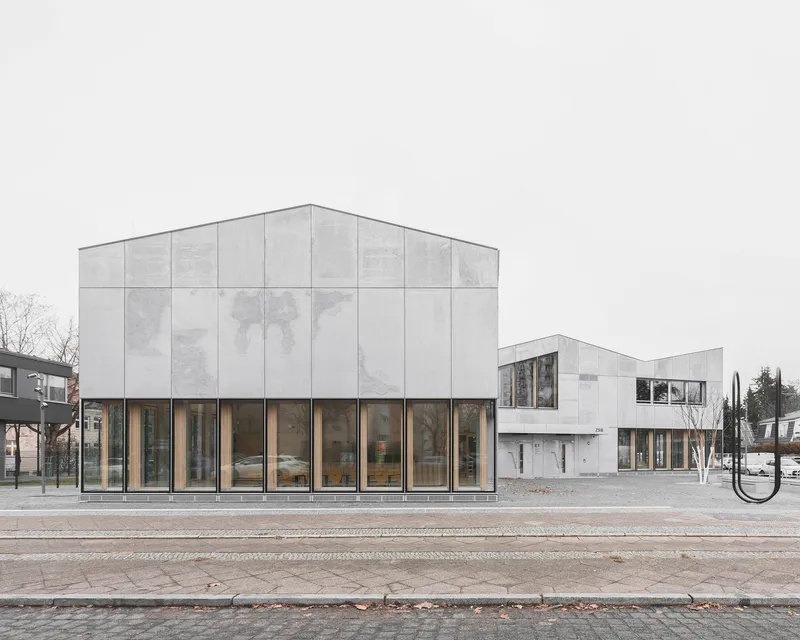
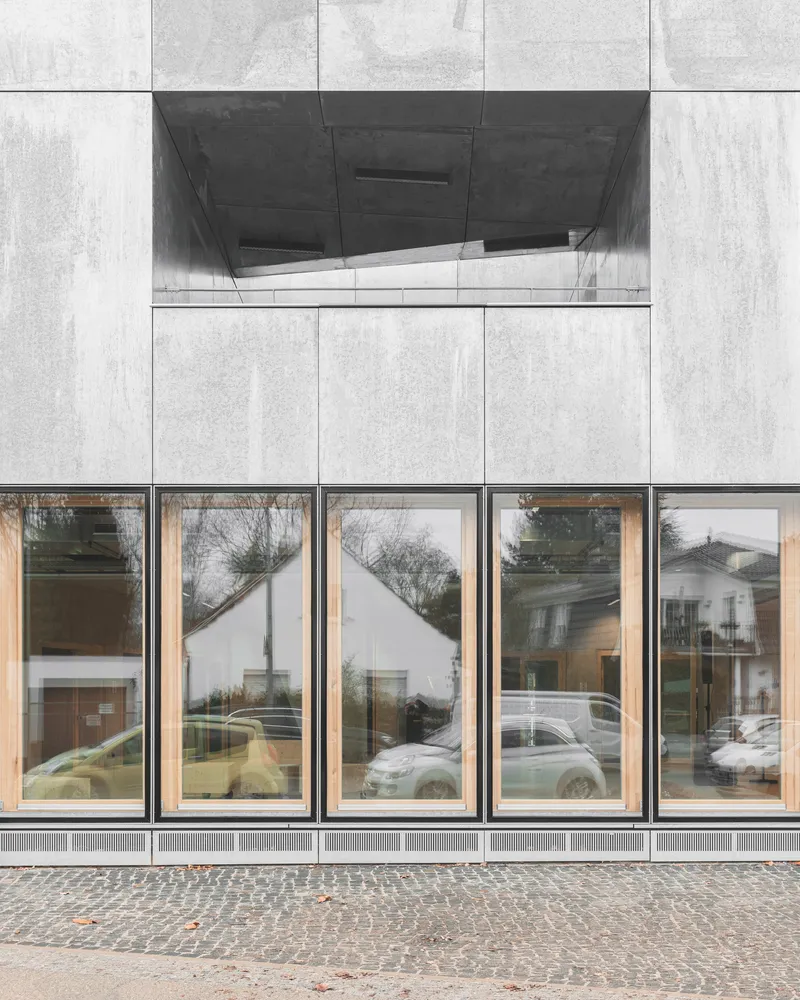
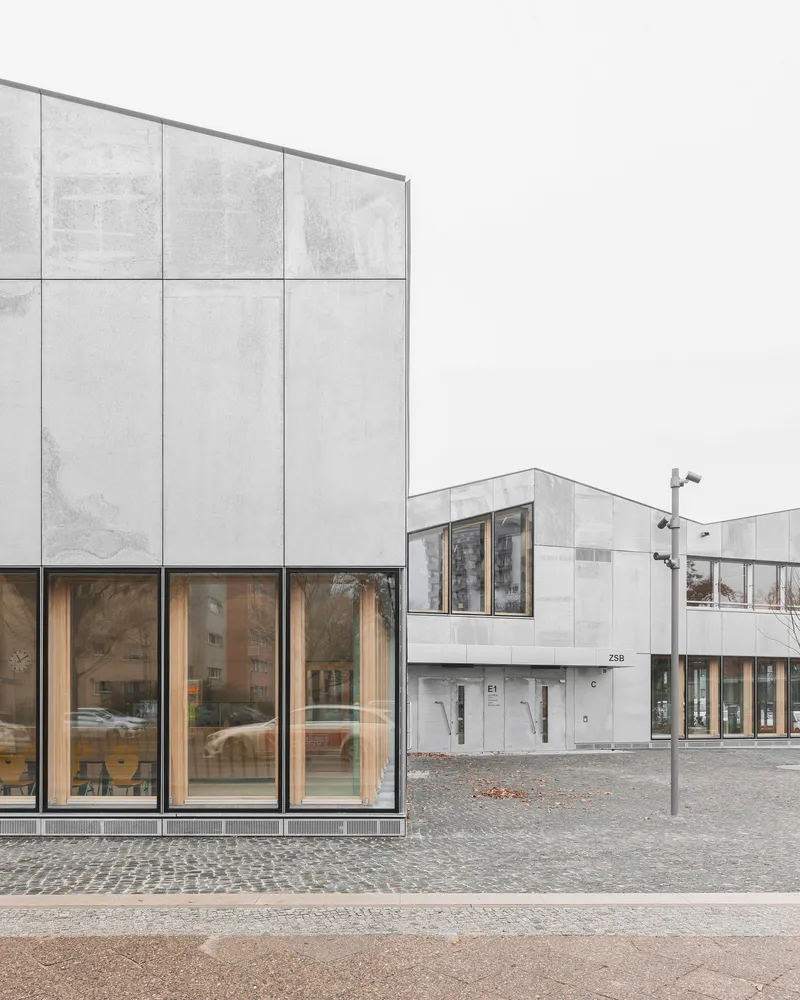
The facade is clad in full-height galvanized steel panels with concealed fastening and a continuous grid of narrow joints. It is uncompromising, maybe even a little cold, and that is the point. On a campus that serves school-age children and adult learners in a neighborhood that gets heavy use, the envelope needs to be robust. The galvanized steel will weather without deterioration, its surface shifting in tone over decades rather than degrading. Against this metallic grid, tall ground-floor glazing opens the interior to the street, framed in timber that softens the threshold between the industrial-feeling panels and the warm spaces inside.
A double facade system layers a protective glass front over an insulating window plane. The result filters daylight while significantly attenuating traffic noise from the adjacent road. Reflections of parked cars, street lamps, and neighboring buildings animate the facade's surface throughout the day, giving the building a responsiveness that its material palette might not initially suggest.
The Central Atrium and Circulation Spine
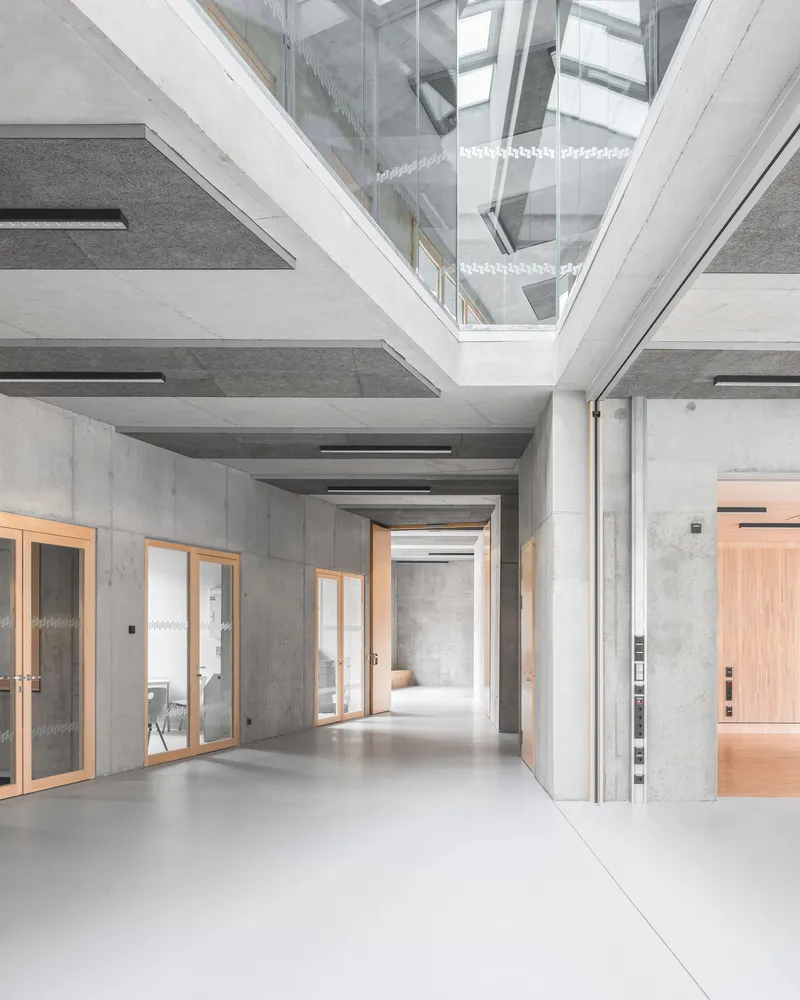
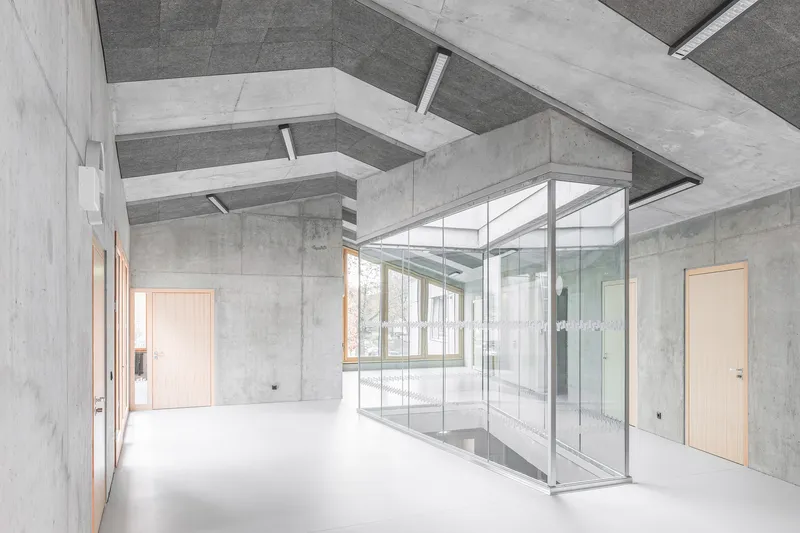
The heart of the building is a central atrium that draws light down through the zigzag roofscape and visually connects the floors. A corridor running beneath a long skylight gives the interior its primary orientation: polished floors catch reflected daylight, and timber-framed doorways punctuate the concrete walls with a domestic rhythm that keeps the institutional scale in check. The effect is not unlike a covered street, which is fitting for a building that extends a campus promenade.
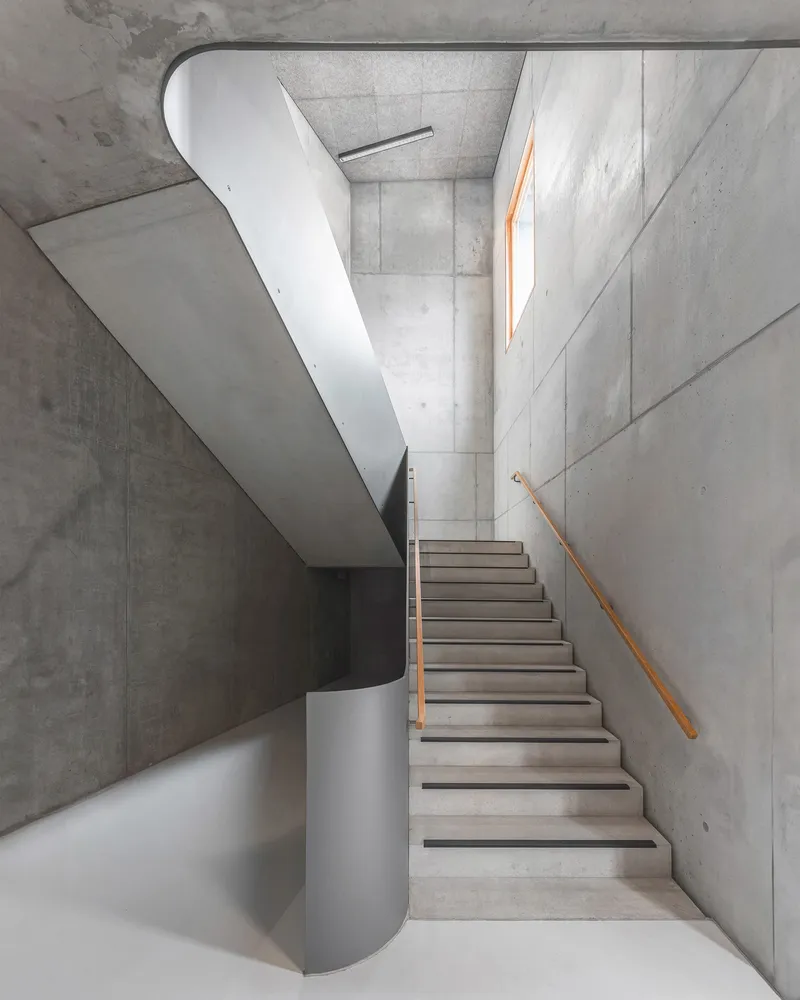
A concrete stairwell with a curving white balustrade and timber handrail serves as the vertical counterpoint, pulling natural light from a roof opening into what could otherwise be a dark core. The stair's sculptural quality is earned, not applied. The curve of the balustrade resolves a tight geometry with a fluidity that references the building's movement program without being literal about it.
Material Logic: Robust Where It Matters, Soft Where It Counts
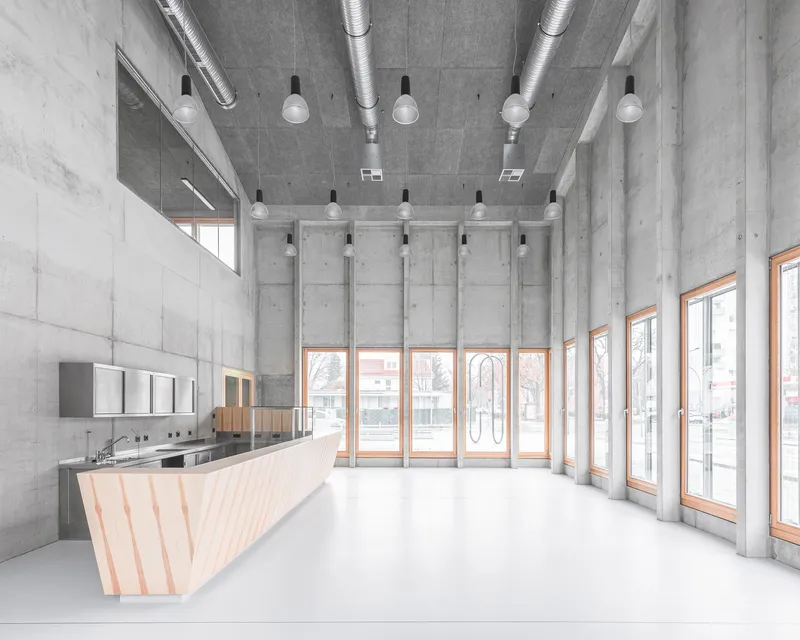
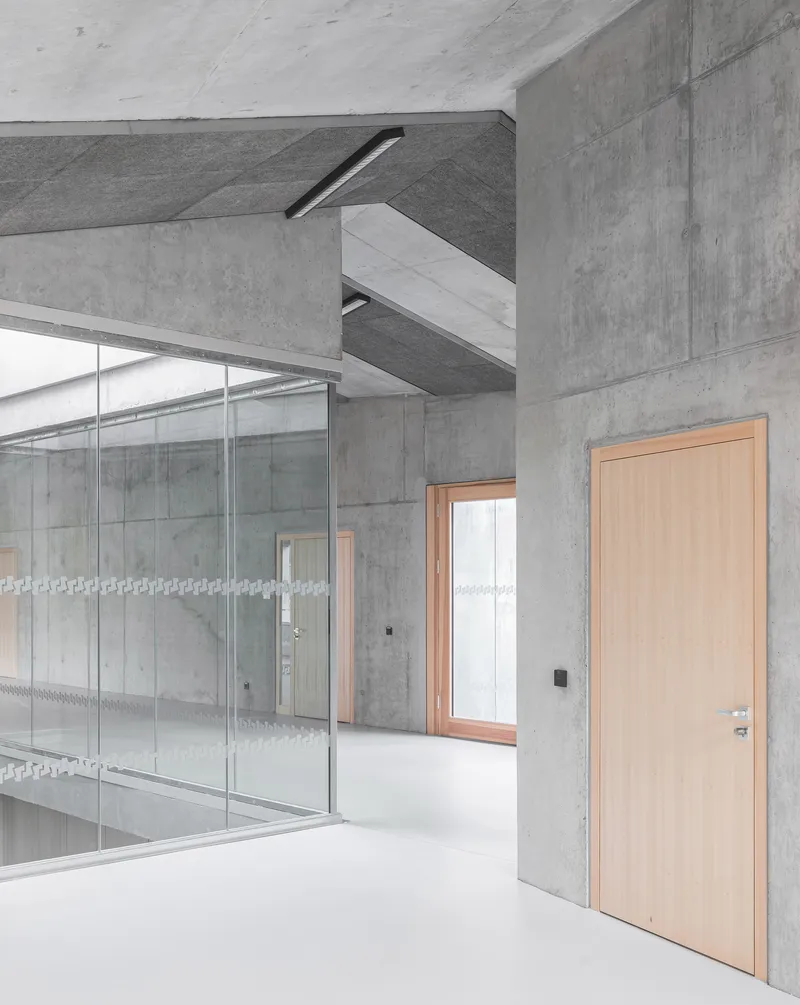
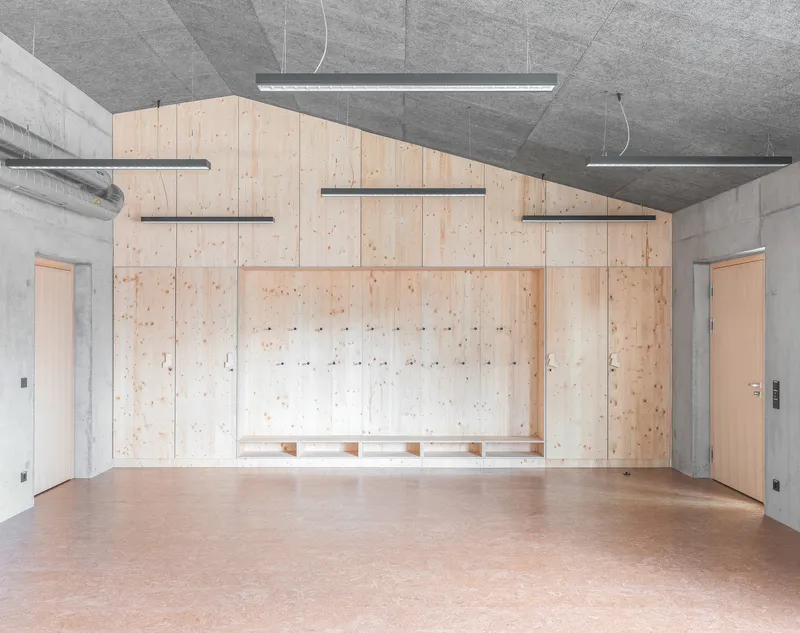
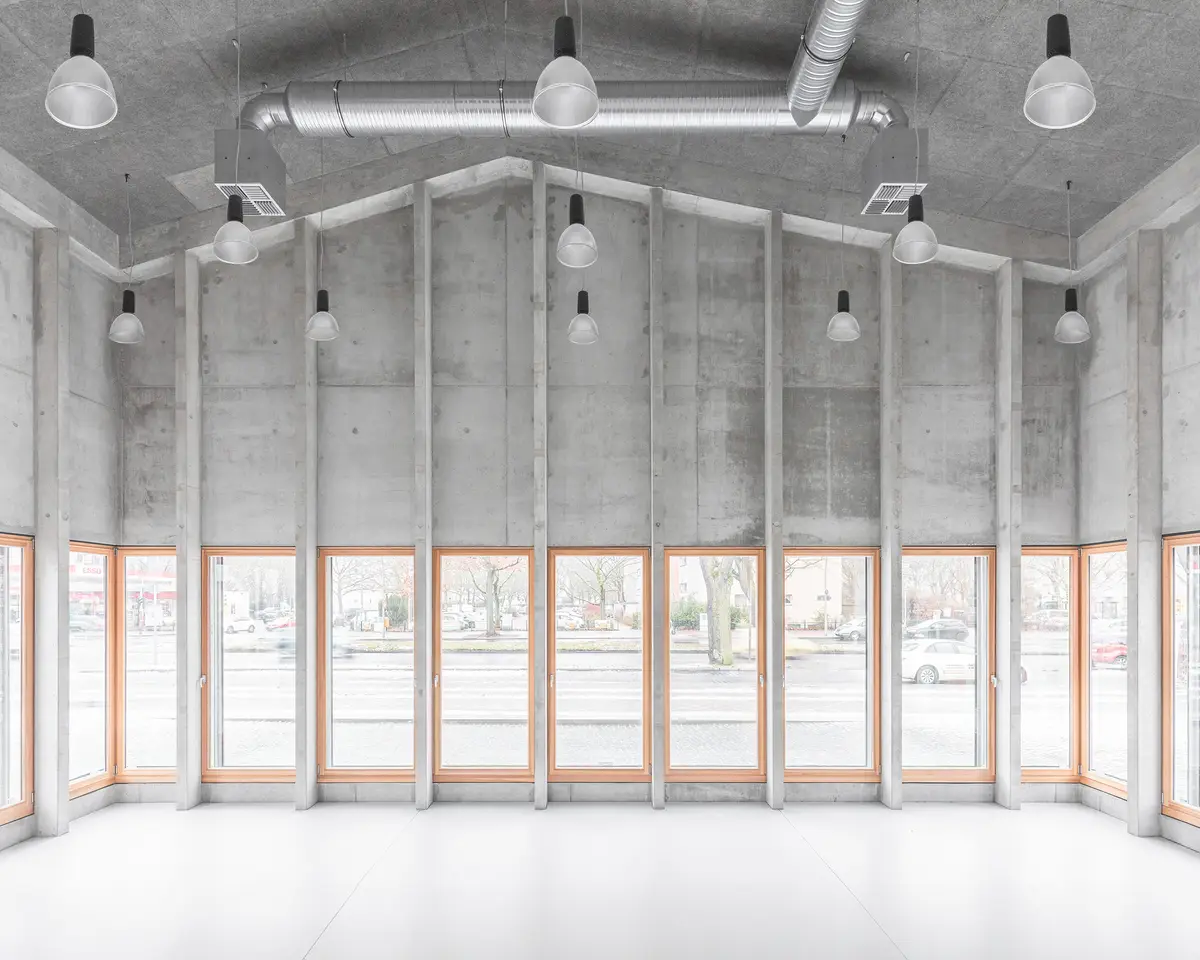
AFF architekten deploy a clear material hierarchy. High-traffic zones get exposed concrete walls, polished floors, and visible ductwork. These spaces are designed to absorb punishment: the faceted timber reception desk in the lobby sits against raw concrete that will look better, not worse, with a few scuffs. Ceiling ducts and pendant lights remain exposed, making maintenance legible rather than hidden.
Where acoustics and comfort are the priority, the palette shifts. Plywood storage walls with integrated coat hooks, translucent glass partitions, and timber door frames create a quieter register. The transition between rough and refined is handled without fuss, often within a single room. A concrete beam junction meets a translucent glass partition and a timber door, and the three materials are simply allowed to be themselves.
Rooms for Sound and Silence
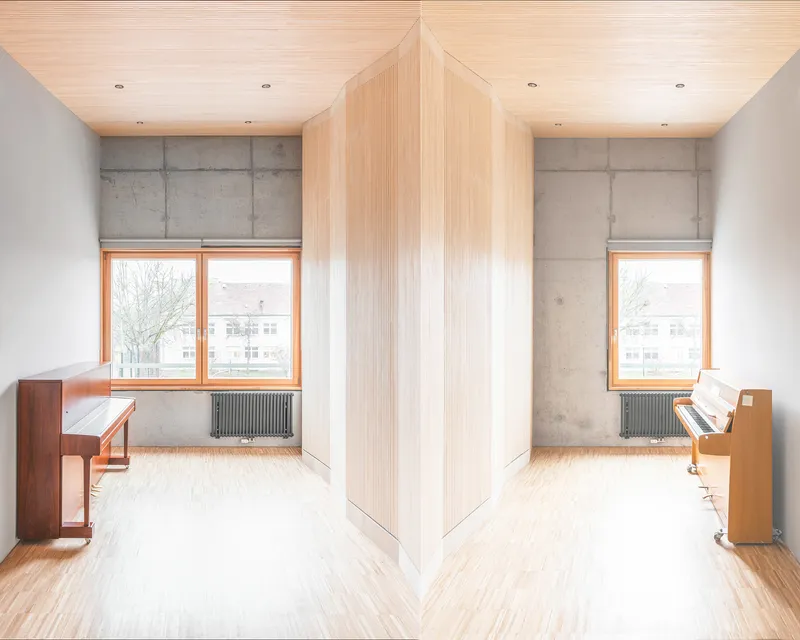
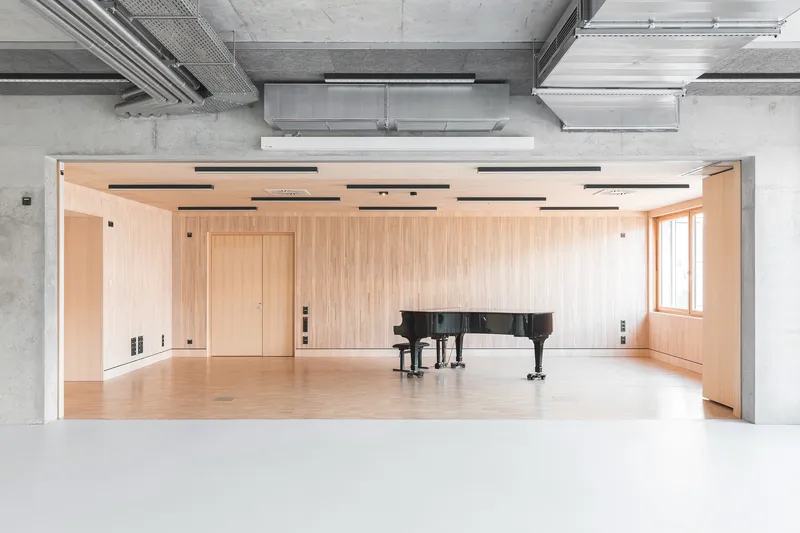
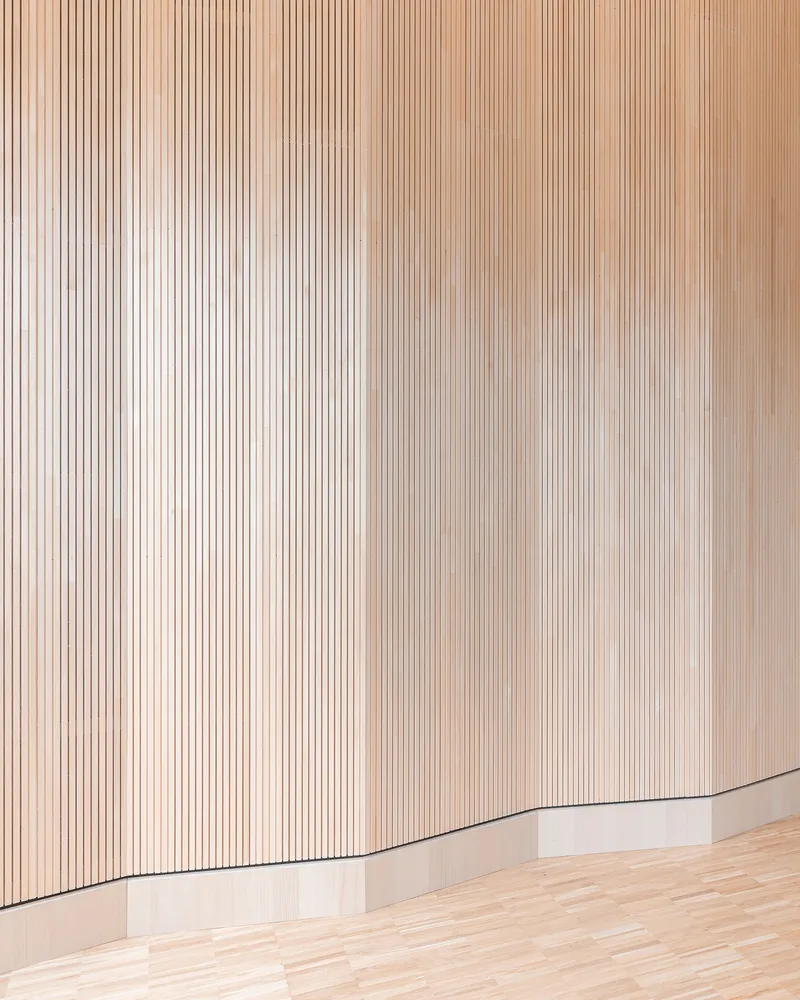
The music rooms are where the building's acoustic ambition becomes most visible. Two mirrored practice rooms, clad floor to ceiling in vertical timber slats beneath wood ceilings, flank a shared wall. The symmetry is deliberate: each room contains a piano, and the timber surfaces control reverberation while lending the spaces a visual warmth that distinguishes them from the concrete corridors outside. A practice room housing a grand piano is enclosed in pale timber panels beneath an exposed concrete ceiling, a combination that balances absorption and reflection to create a tuned acoustic environment.
The curved timber-slat corners, where vertical battens meet pale wood flooring in a gentle radius, are a small detail that speaks to the care embedded in these rooms. Hard right angles would trap sound; the curves disperse it. For a building that serves a music school alongside other programs, this level of acoustic attention in the detailing is not optional.
Flexible Teaching Spaces and Learning Loggias
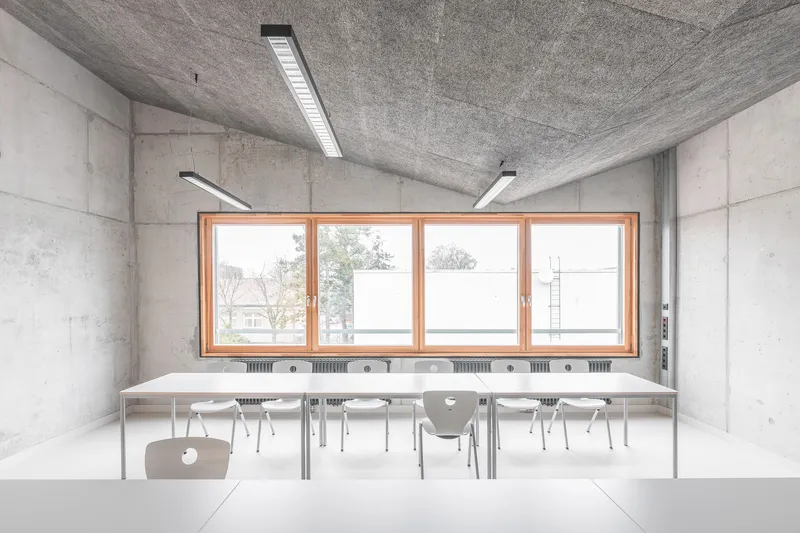
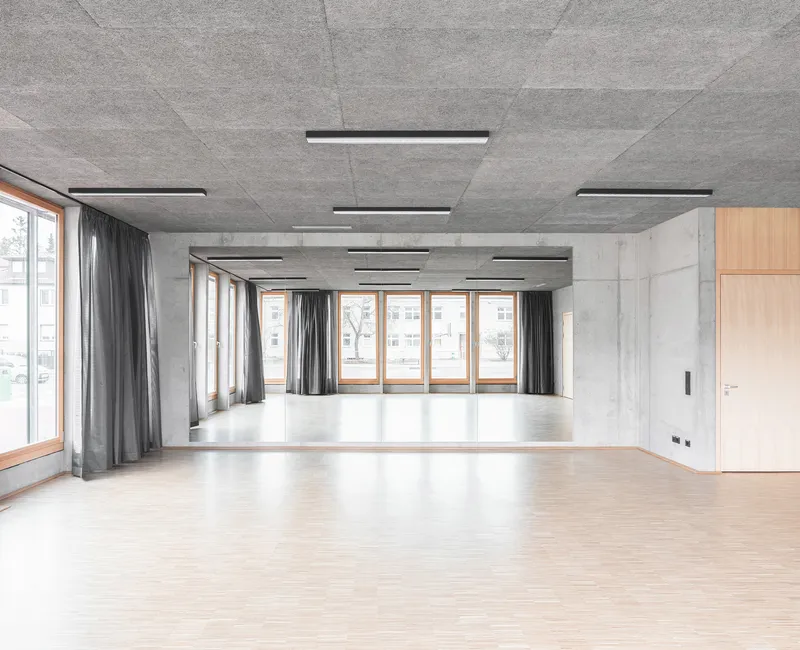
Classrooms are straightforward: paired tables and chairs face continuous windows with radiators tucked below the sill. The rooms are sized and furnished for language instruction, where face-to-face engagement and clear sightlines matter. Multipurpose rooms gain flexibility through grey curtains that can subdivide the space along timber window walls. East- and west-facing learning loggias, open to daylight through precise roof openings above, extend the usable teaching area into semi-outdoor zones.
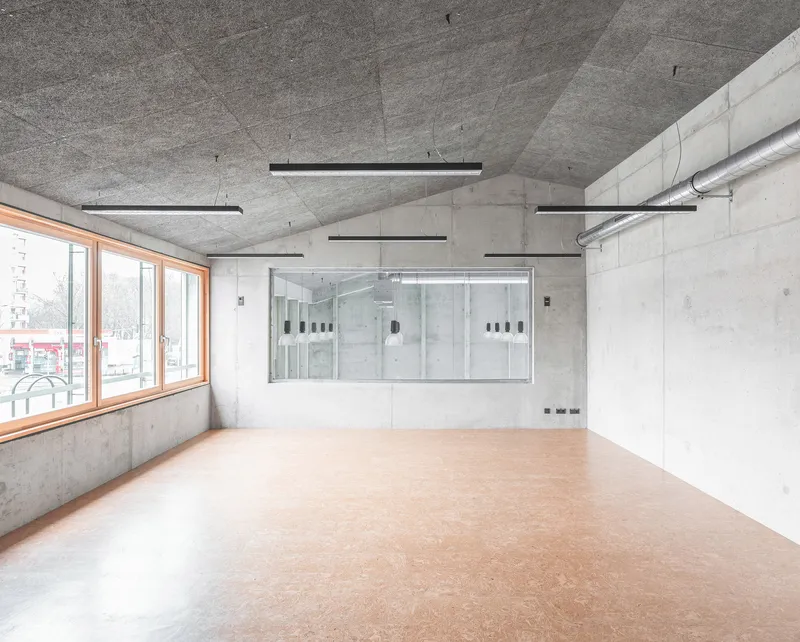
A corner room with linoleum flooring and a glazed interior partition offers a visual connection to an adjacent space, reinforcing the building's ethic of transparency and communication. Nothing is sealed off entirely. Even the most enclosed rooms maintain at least one visual link to the rest of the building, encouraging the kind of informal interaction that rigid institutional plans tend to suppress.
Rhythmic Concrete and the In-Between Spaces
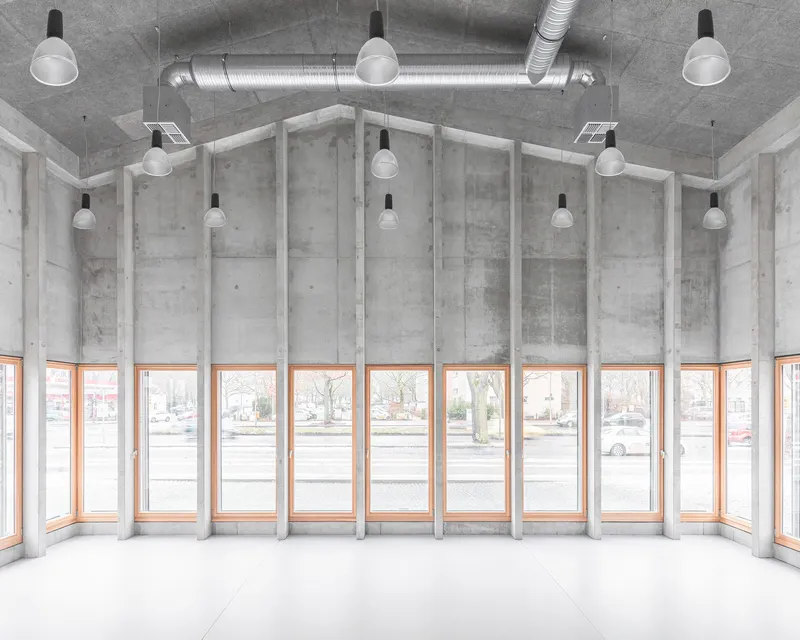
One of the building's most compelling moments occurs at a curved interior corner where rhythmic concrete fins separate timber-framed windows. The fins modulate light and views, creating a slow reveal as you move along the perimeter. Exposed ductwork and pendant lights above reinforce the honest, unfinished quality that runs through the project. Nearby, a glass-walled enclosure sits beside concrete walls beneath stepped ceiling beams, creating an interior room that is simultaneously contained and connected. These in-between conditions, spaces that are neither fully open nor fully closed, are where the architecture does its most interesting work.
Plans and Drawings
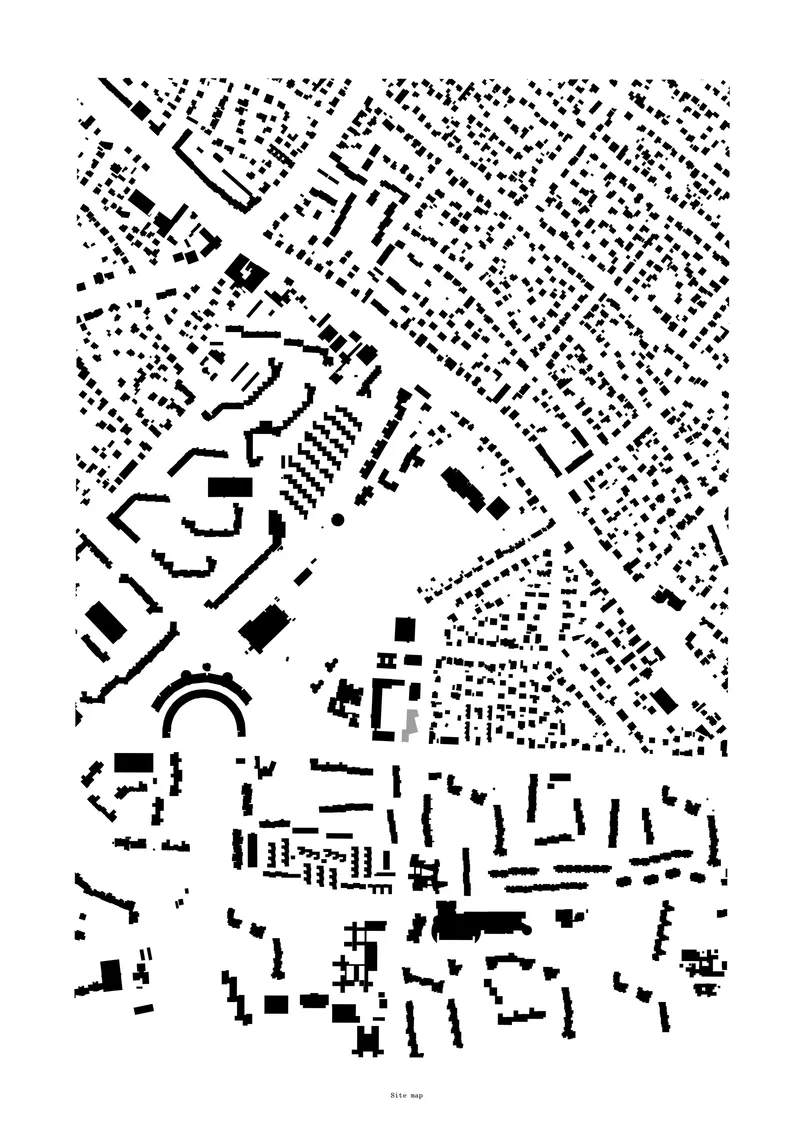
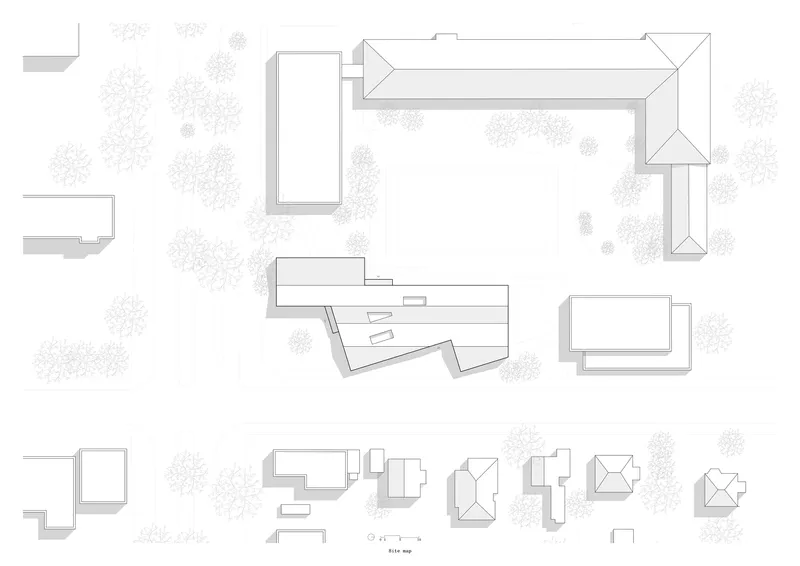
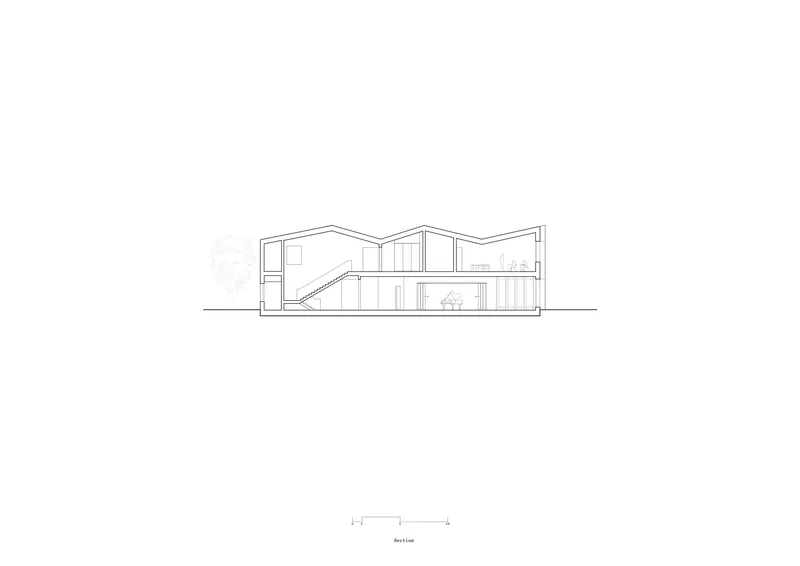
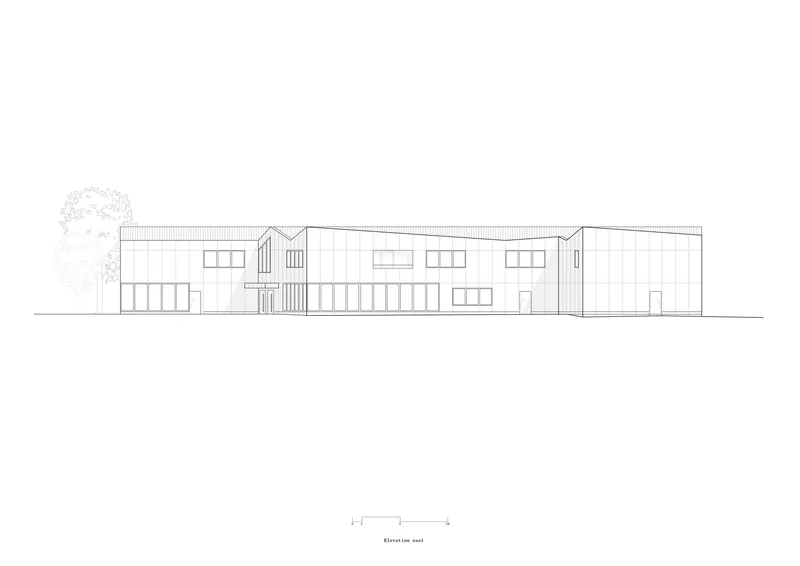
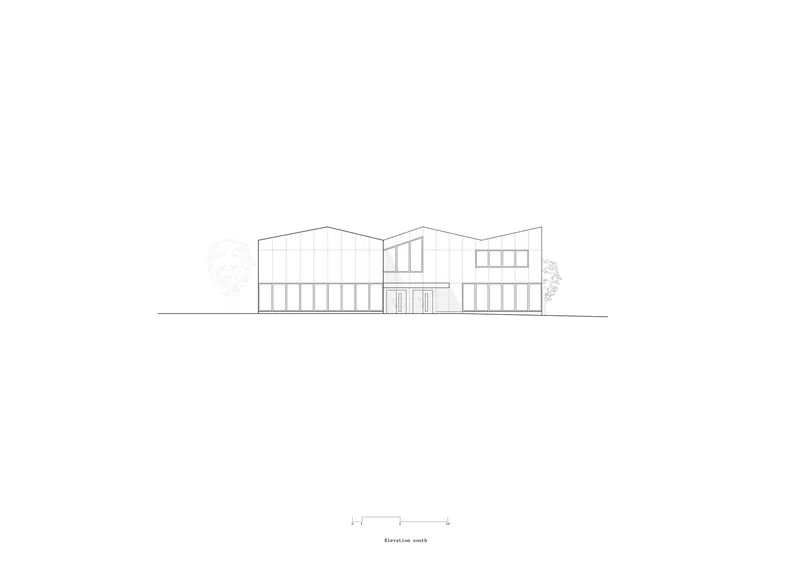
The site plan reveals the polygonal logic most clearly: the building's angular footprint carves out four distinct outdoor spaces from the surrounding urban fabric, each oriented to a different edge condition. The roof plan shows how the L-shaped volumes wrap around a central courtyard, with scattered trees softening the ground plane. In section, the zigzag roofline appears not as arbitrary expression but as a functional device: each peak and valley corresponds to a light well, a stair volume, or a shift in ceiling height that distinguishes one program from the next. The east elevation demonstrates how varied window openings and angled roof peaks break the facade into legible episodes, while the south elevation presents the most symmetrical face, two gabled volumes flanked by trees, as a civic gesture toward the campus entrance.
Why This Project Matters
Community buildings in Berlin's outer districts rarely get this level of architectural attention. Neukölln's Efeuweg area, caught between Gropiusstadt's monumental housing and a tighter residential grain, has long needed infrastructure that serves as more than a functional container. AFF architekten's design does something specific: it treats the roof as a narrative device, the facade as an environmental filter, and the floor plan as a negotiation between four outdoor conditions. None of these moves are flashy in isolation, but together they produce a building that has genuine spatial intelligence.
The project also demonstrates that robust, cost-conscious materials, galvanized steel, exposed concrete, plywood, can produce architecture with real character when the detailing is rigorous and the spatial organization is clear. In a moment when community buildings are too often reduced to generic flexible halls with colored panels, the Center for Language and Movement takes its program literally and finds architecture in the encounter between precision and fluidity, between the spoken word and the body in motion.
Center for Language and Movement, designed by AFF architekten. Located in Berlin, Germany. 2,100 m². Completed in 2025. Photography by Tjark Spille.
About the Studio
Share Your Own Work on uni.xyz
If projects like this are the kind of work you want to make, uni.xyz is a place to publish your own, find collaborators, and enter design competitions.


Popular Articles
Popular articles from the community


Opera on the Sea: Driftwood Logic Shapes a Timber Opera House on Estonia's Coast
Trevor Orgill's opera house translates the entangled drift of floating timber into a civic building where wood, water, and music converge.


Cube Design Draws an Ecological Corridor Between Two Shenzhen Hills with the Nankai Building
Beside Shenzhen's container docks, the Nankai Building pairs stacked balconies with a climbing green screen to connect two hillsides across its height.

Aquadapt: An Underwater Habitat That Rewrites Its Rooms by the Hour
Curved modules ring the seabed while one shell shifts from breakfast room to cinema, farm and football pitch as residents' needs change.

Singing Woman: An Opera House That Performs Before the Curtain Rises
Ovidiu Cristian Pavel's conceptual opera house translates Estonia's choral identity into a sculpted waterfront landmark facing the Baltic Sea.

Similar Reads
You might also enjoy these articles

LAVA Architecten Gives Vocational Education a Sawtooth-Roofed Face on a Mechelen School Campus
In Mechelen, Belgium, a 2,053 m² STEM school on a 6×6 m grid turns workshops and classrooms into rooms that can be rearranged as teaching changes.

KEMA Studio Turns a Derelict Marvila Attic into a 60 m² Lighthouse Apartment Above Lisbon
In Lisbon's Marvila district, a rebuilt roof, four skylights and two plywood volumes turn an unlivable attic into a bright home facing the Tagus.

Pixel Gardens: One Repeated Module Stacked Into a Terraced Social Housing Tower for Famagusta
Salem Bader's shortlisted housing tower builds a vertical neighbourhood from one repeated module, offsetting units to carve terraces, light and air.

Bao Huynh Watercolor Atelier: A Serene Art Retreat in Hội An
Bao Huynh Watercolor Atelier in Hội An blends multifunctional art spaces, sustainable design, local materials, and family-friendly living in a serene environment.


Comments (0)
Please login or sign up to add comments
No comments yet. Be the first to comment!