

A.H Architects Wraps a Near-Perfect Circle Around Ocean Views and Mount Fuji in Yokosuka
Perched on a hilltop in Kanagawa, the 365° House reimagines domestic life through a pandemic-era lens of circular, panoramic living.


Most houses face one direction. They pick a view, orient the living room toward it, and call it done. The 365° House by A.H Architects refuses that premise entirely. Sitting at the top of a small hill in Yokosuka, Kanagawa, the 256-square-meter residence is shaped as a near-perfect circle, opening outward to the sea and Mount Fuji in every direction and inward to a planted courtyard at its center. The name is a portmanteau: 360 degrees of panoramic sightlines fused with 365 days of continuous domestic life, a nod to the pandemic era that reshaped how its occupants think about home.
Designed by lead architect Andrea Held Hikone and completed in 2022, the project takes the changed conditions of remote work seriously, not as a temporary disruption but as a permanent recalibration of what a house needs to be. The circular plan is not just a formal gesture. It is a spatial strategy that allows family members to move between togetherness and solitude along a continuous loop, with concealed doors in oak-lined walls dissolving the boundary between communal space and private retreat. The result is a house that feels simultaneously open and sheltered, vast and intimate.
A Circle on a Hilltop
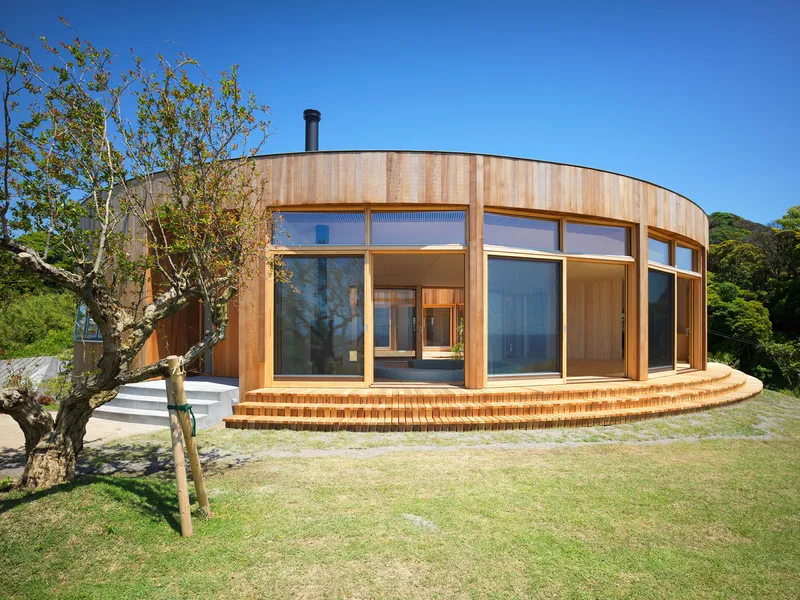
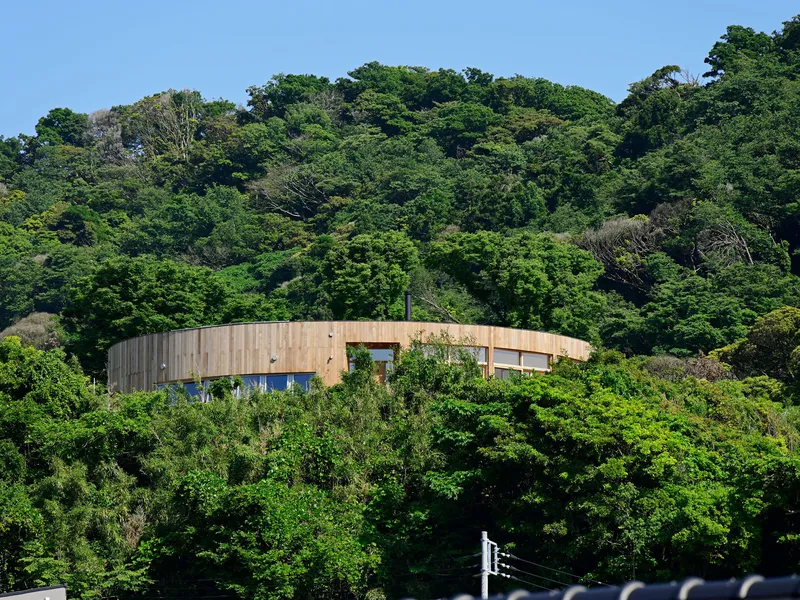
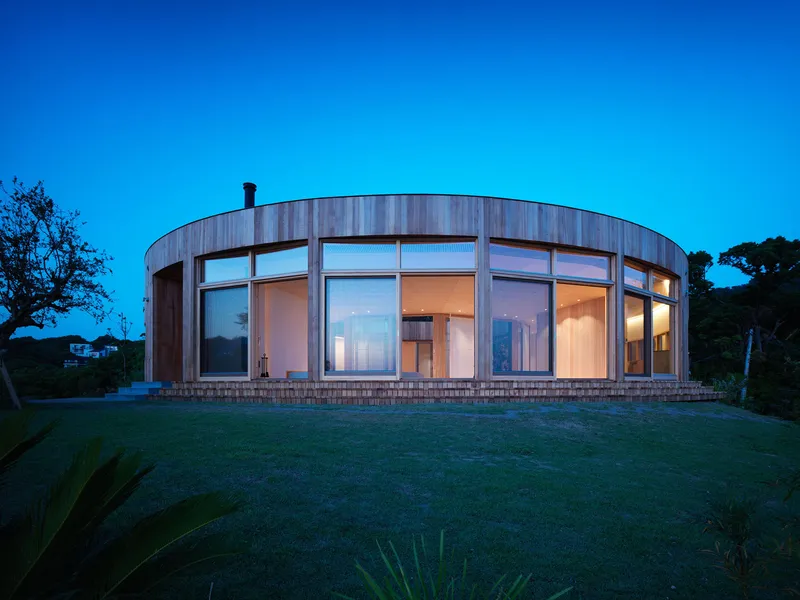
From the outside, the house reads as a weathered timber cylinder nestled into dense hillside vegetation. The curved facade is clad in wood that will age alongside the landscape, its patina deepening over seasons. Full-height glazing wraps the entire perimeter, turning the structure into something closer to a lantern at dusk, glowing against the deep blue of Yokosuka's coastal sky. There is no front or back, no hierarchy of facades. The circle treats every compass point with equal architectural attention.
The siting is precise. At the crest of the hill, the house commands unobstructed sightlines without dominating the terrain. The landscaping, designed by Daishizen Inc. and Yuta Itagaki, keeps mature trees close, so the building appears to emerge from the canopy rather than clear-cut its way onto the summit.
Arriving at the Threshold
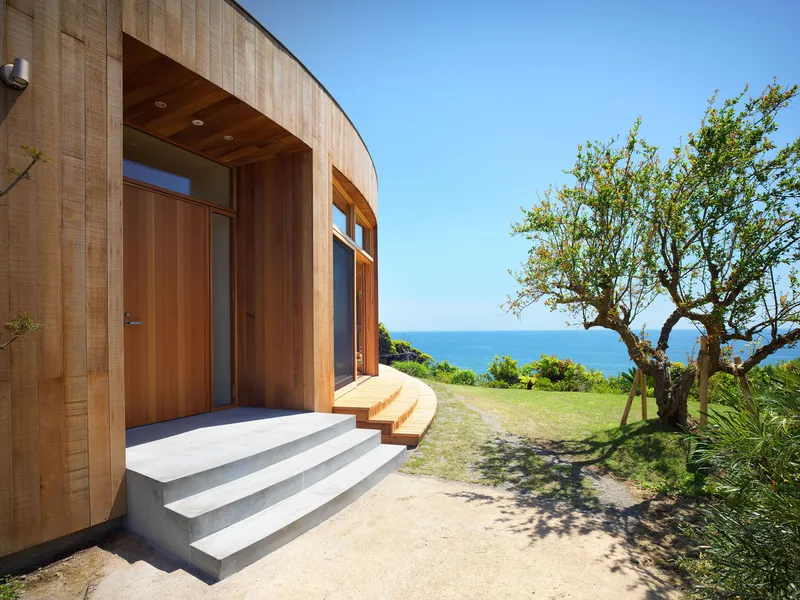
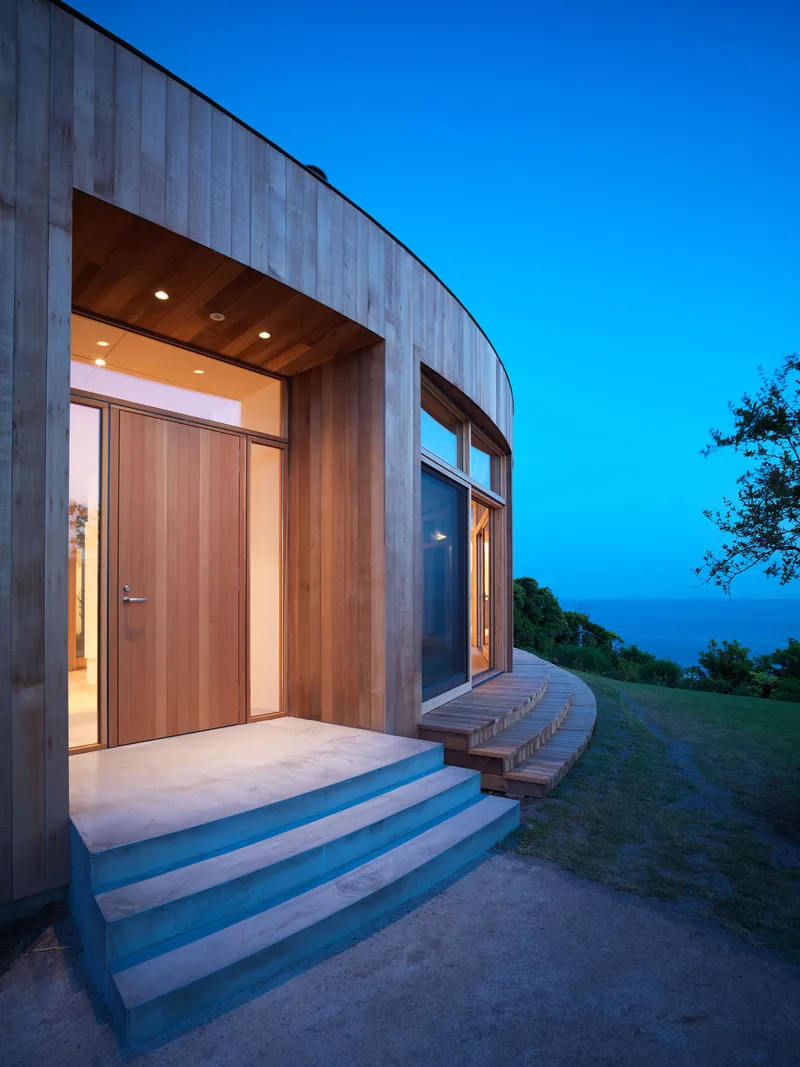
Entry is deliberate. Concrete steps descend to a recessed timber-lined entrance tucked under the curve of the soffit, with the ocean visible beyond the doorway. The approach compresses space before releasing it: a classic architectural sequence executed here with restraint. A curved bench at the entry threshold at dusk suggests that the boundary between inside and outside is negotiable from the very first step. The soffit wraps overhead like the underside of a ship's hull, reinforcing the building's maritime context without resorting to nautical pastiche.
The Courtyard as Anchor
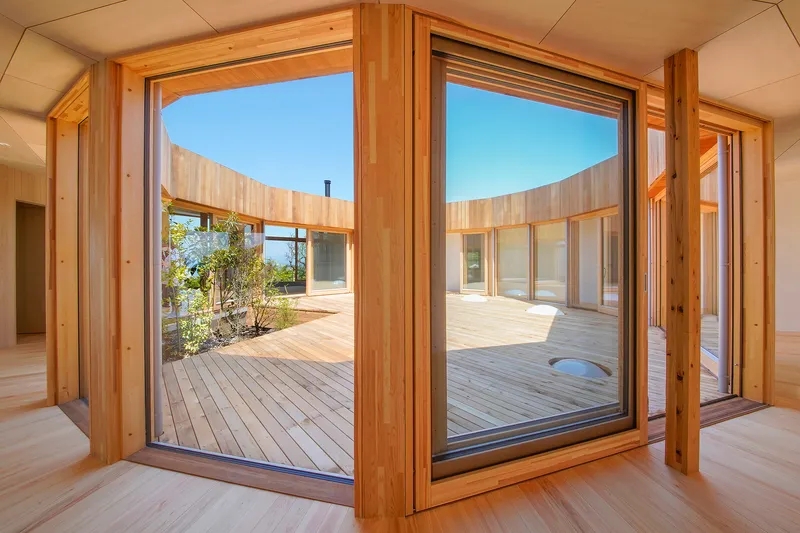
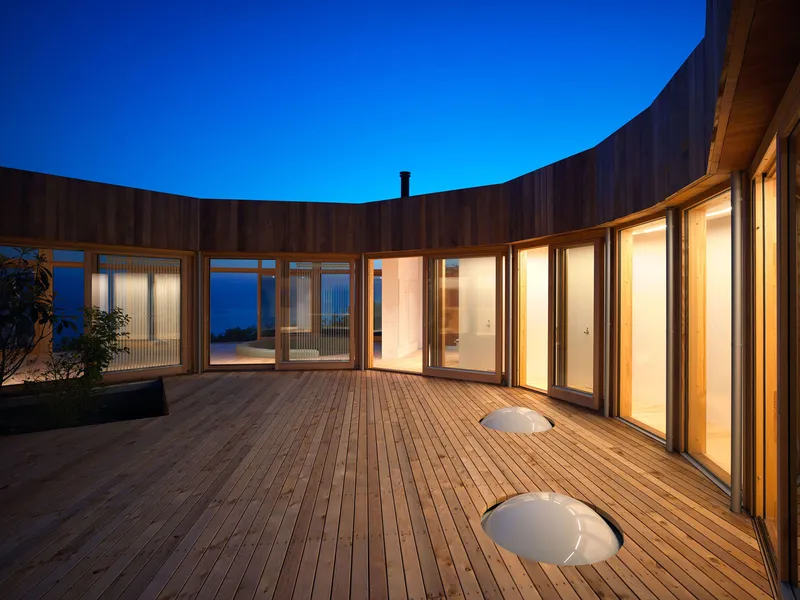
At the heart of the circle sits an open courtyard, a void that gives the plan its logic. Timber decking extends outward from the glazed interior walls, and circular skylights punctuate the surrounding ceiling, casting controlled pools of light into the corridors below. At dusk, the courtyard becomes a second living room, one with no roof and no walls, framed only by the building's own curvature.
The courtyard also solves a practical problem that circular plans often create: orientation. In a house without corners, the planted center provides a constant reference point. You always know where you are relative to the garden, even as you move along the curved corridors. Planted greenery softens the geometry and filters light entering the bedrooms, offering privacy without curtains.
Living Along the Curve
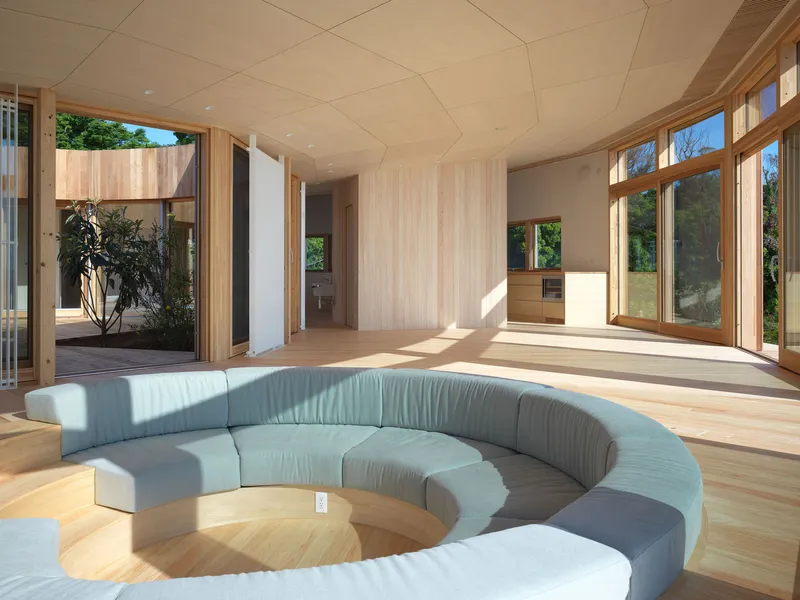
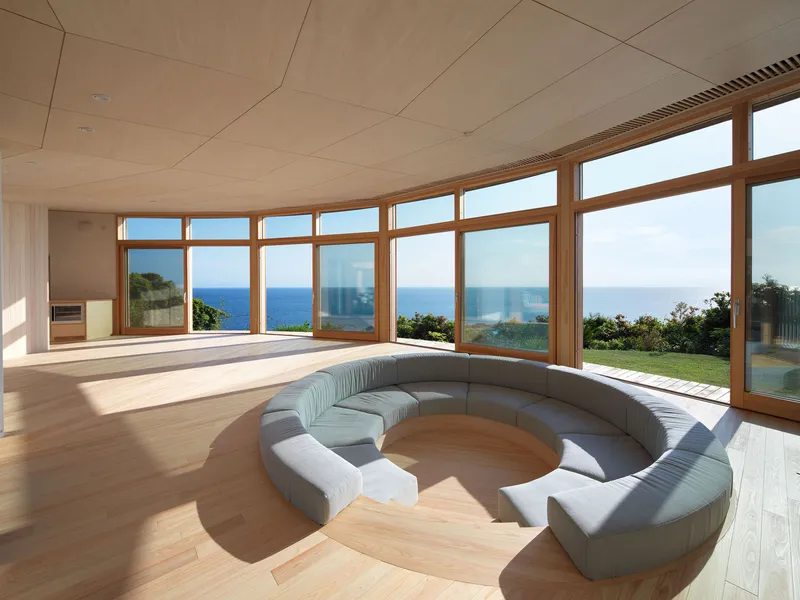
The main living spaces occupy the ocean-facing arc of the circle, where continuous timber-framed windows stretch toward the horizon. A sunken circular seating area anchors the living room, its geometry echoing the plan at a smaller scale. Plywood ceiling panels follow the curve overhead, their warm grain catching afternoon sunlight in shifting patterns.
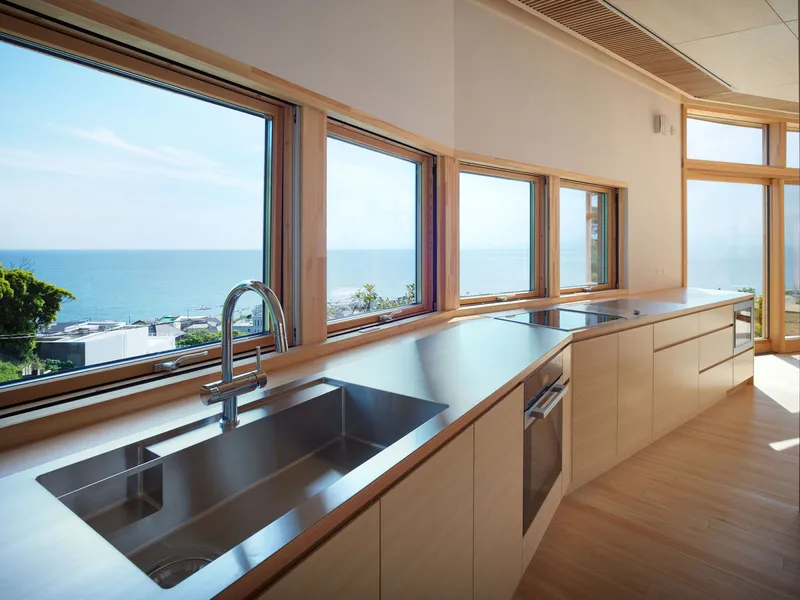
The kitchen occupies a quieter segment of the arc, with a stainless steel countertop reflecting the seascape through its windows. It is not a separate room but a bend in the continuum, a shift in material that signals a change in function without breaking the spatial flow. Working from home in this house means choosing your view: ocean from the kitchen counter, garden from the corridor, sky from the courtyard.
Private Rooms and Hidden Doors
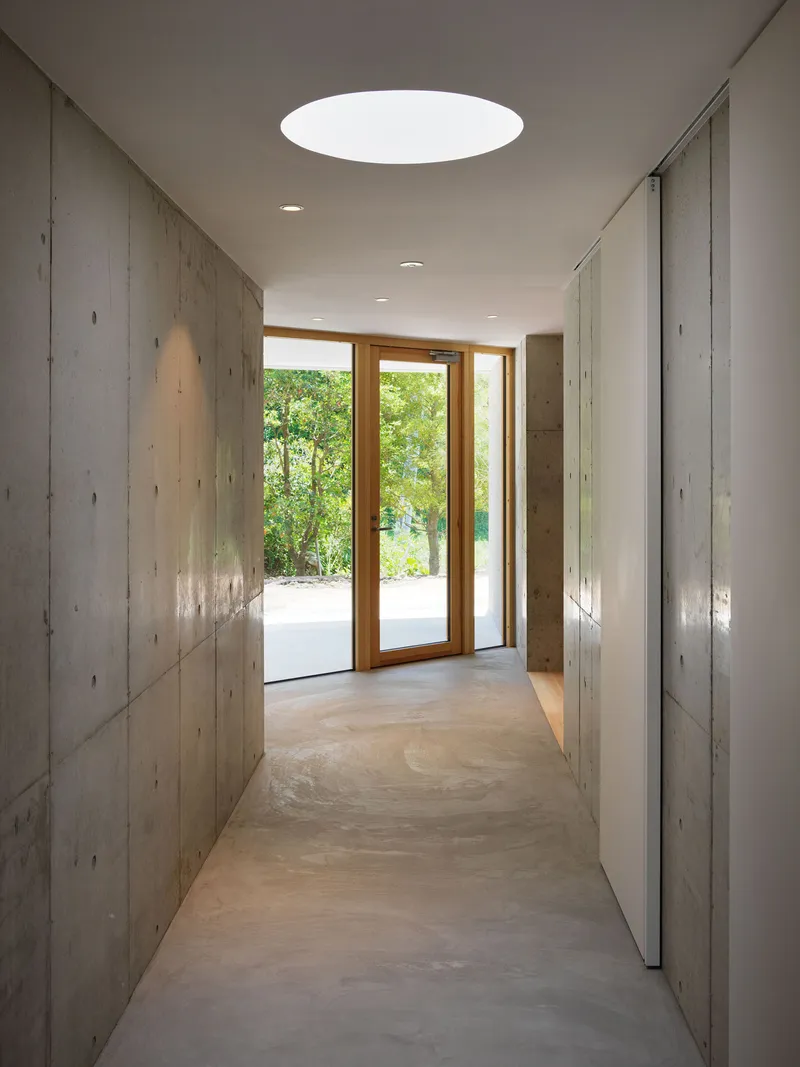
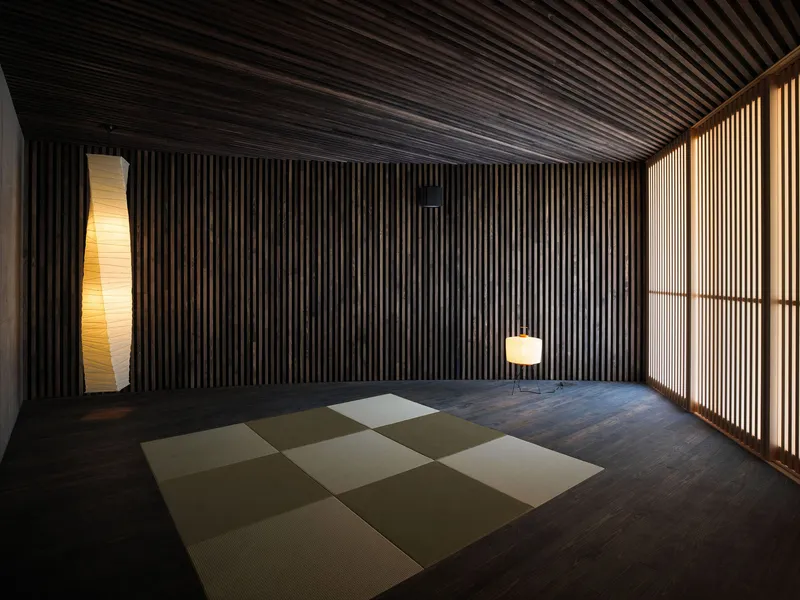
The rounded oak-lined volume conceals more than it reveals. Doors to bedrooms and private spaces are flush with the wood paneling, invisible when closed. One room features vertical timber battens on walls and ceiling with backlit screen panels and chequered tatami mats, a deliberate shift from the house's otherwise continuous material palette. The room announces itself as something apart: a place for stillness, separated from the domestic loop.
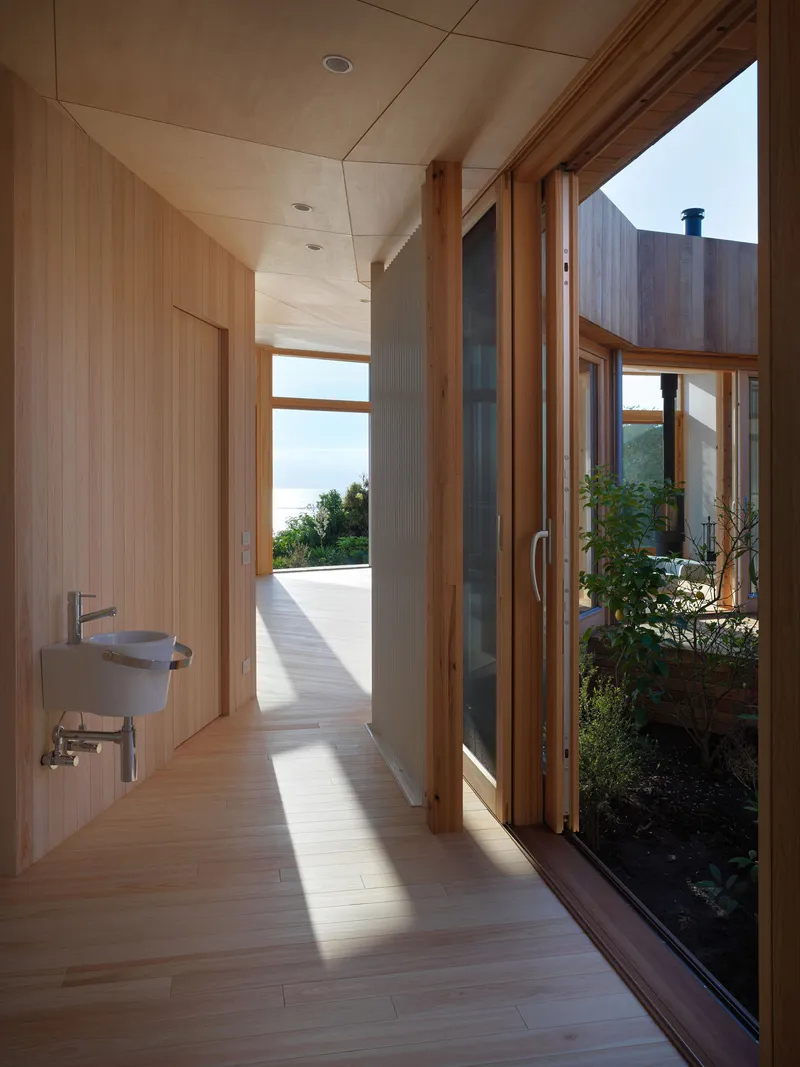
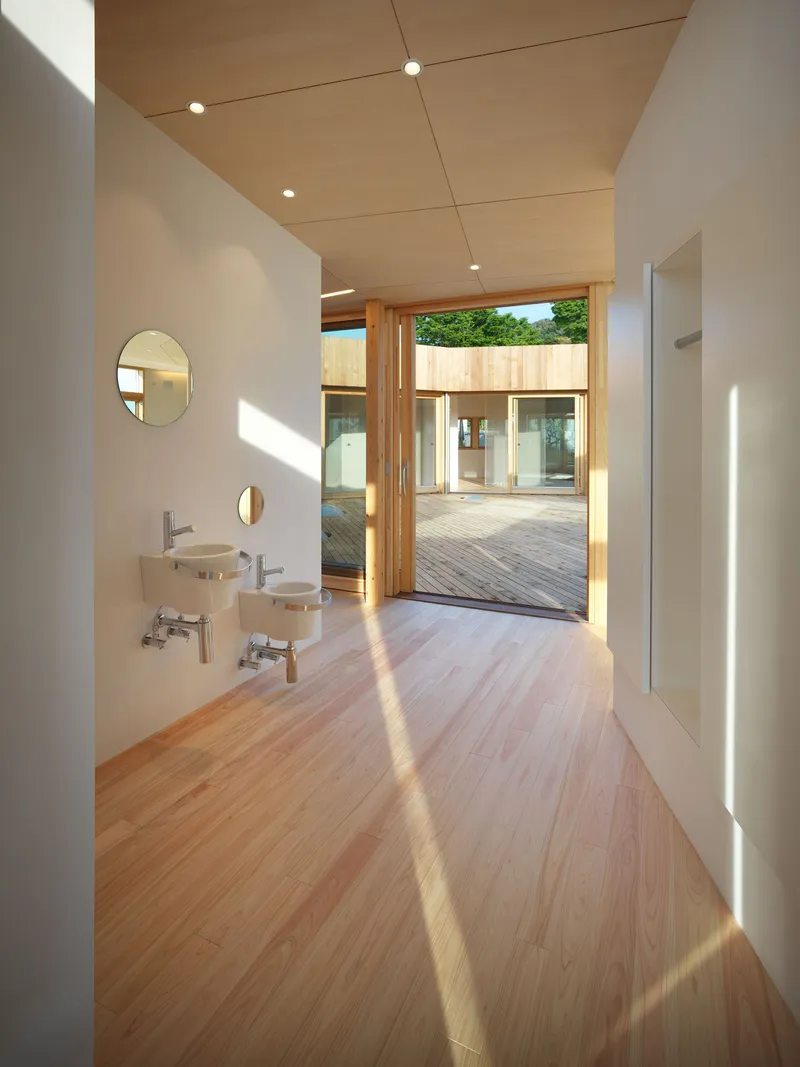
Corridors double as functional zones. Wall-mounted sinks line one passage, lit by views through timber doors to the courtyard. A concrete corridor receives a single circular skylight that punches a cone of light onto the floor. These are not leftover spaces between rooms. They are designed as sequences, transitions calibrated to slow movement and frame views.
Light, Water, Openness
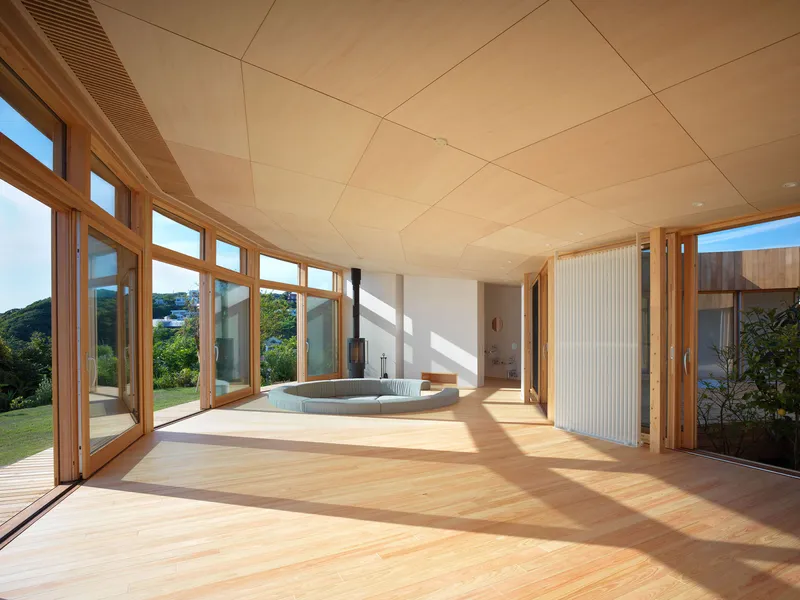
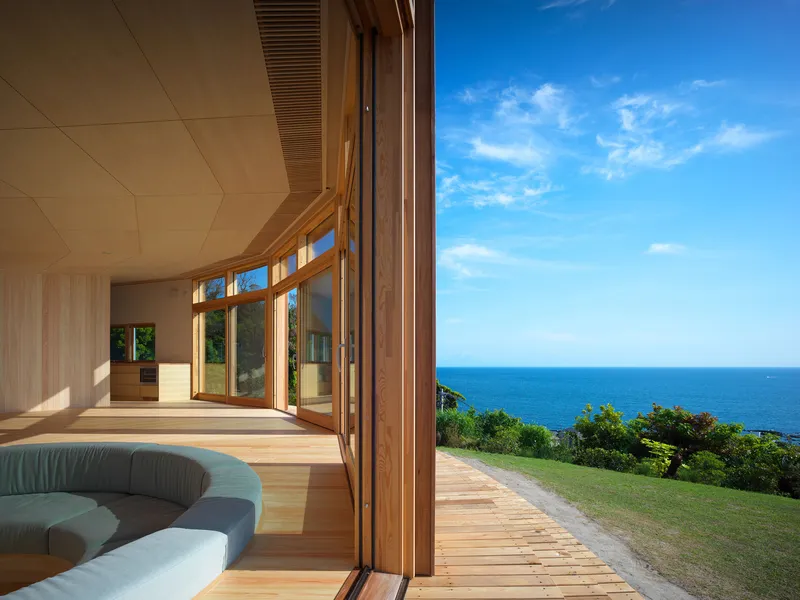
A sunken bath sits behind curved glazing, flooded with afternoon light and facing the ocean. It is one of the most uninhibited rooms in the house, a place where the glass boundary between interior comfort and coastal landscape nearly vanishes. Nearby, open timber-framed doors lead directly onto a coastal lawn, reinforcing the 365° premise: that the entire perimeter is habitable, not just the rooms with furniture.
The large glass expanses are not merely aesthetic. They are the house's primary passive strategy, drawing natural light deep into the plan and connecting every room to the outside air when opened. On a hilltop with 360-degree exposure, the circle captures cross-ventilation from any wind direction, a functional advantage that a rectangular plan on the same site would struggle to match.
Plans and Drawings
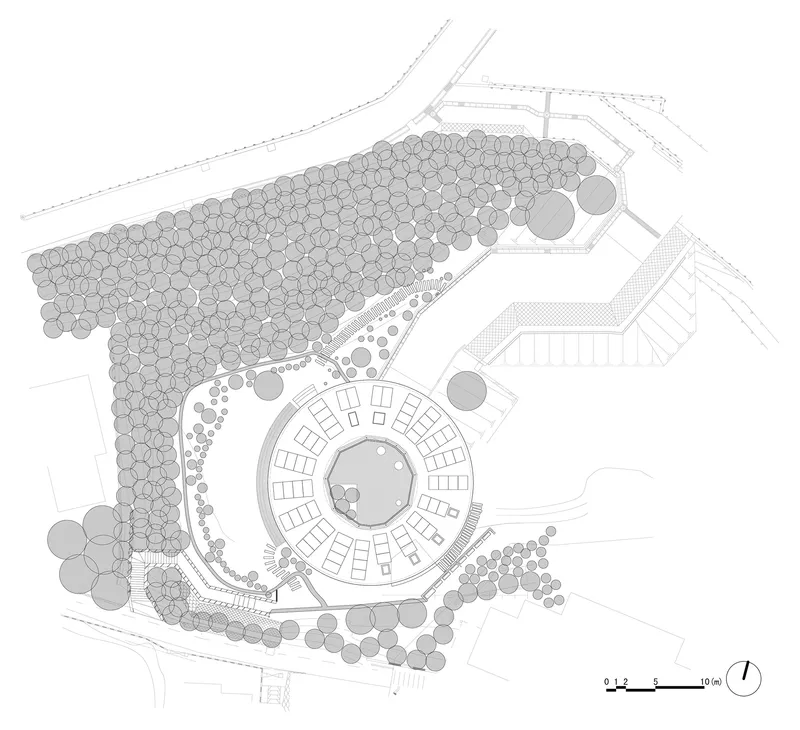
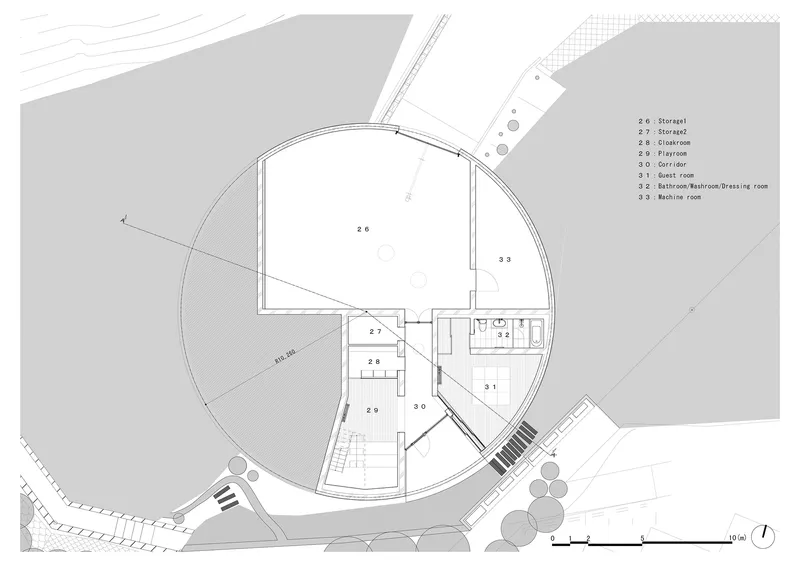
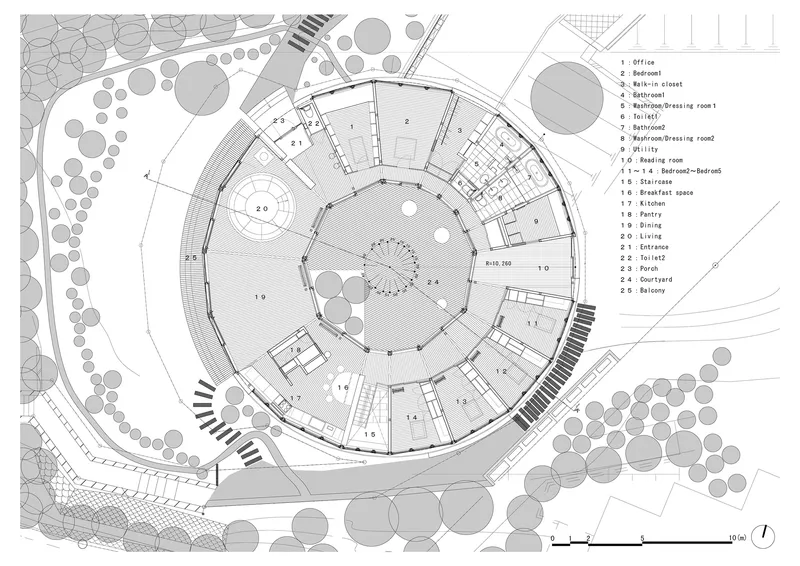

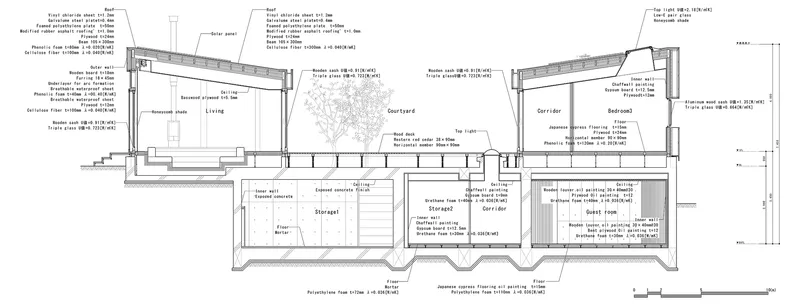
The site plans confirm what the photographs suggest: the house is a nearly complete ring, with a central courtyard open to the sky and a single tree rooted at its center. Radiating interior partitions divide the circle into wedge-shaped rooms of varying widths, allowing larger communal zones and narrower private ones to coexist within the same geometry. The section drawing reveals subterranean levels below the main living spaces, adding program area without expanding the building's footprint on the hill.
The elevation shows the house as a low horizontal band with rhythmic circular elements along the roofline, likely the skylights visible from inside the courtyard corridors. The structural engineering, handled by Hashigotaka and Ladderup Architects under Takashi Takamizawa, had to resolve the challenge of curving timber framing at this scale while maintaining the seismic resilience required in Japan. The drawings suggest a disciplined structure that achieves its formal ambition through repetition rather than heroic spans.
Why This Project Matters
The pandemic produced a lot of rhetoric about rethinking domestic space and very few buildings that actually did it. The 365° House is one of the few. Its circular plan is not a formal indulgence but a direct response to the question of how a family can live, work, play, and retreat under one roof without anyone feeling trapped. The continuous loop eliminates dead-end corridors and hierarchical room sequences. Instead, every room connects to every other room through the curve, offering multiple paths and multiple degrees of engagement with the household.
Beyond its plan strategy, the house demonstrates what happens when a strong geometric idea is carried through with material consistency and site sensitivity. The timber ages, the glass opens, the courtyard breathes. It sits on its hill not as an object dropped from above but as a clearing carved into the canopy, a place where the view of Mount Fuji and the sound of the sea are not amenities but the organizing principles of architecture itself.
365° House by A.H Architects (Lead Architect: Andrea Held Hikone). Yokosuka, Kanagawa, Japan. 256 m². Completed 2022. Structural Engineering: Hashigotaka, Ladderup Architects (Takashi Takamizawa). Landscape: Daishizen Inc., Yuta Itagaki. Construction: Wada Koumuten, Yuiti Hakozaki. Photography by Nacasa & Partners.
About the Studio
Share Your Own Work on uni.xyz
If projects like this are the kind of work you want to make, uni.xyz is a place to publish your own, find collaborators, and enter design competitions.


Popular Articles
Popular articles from the community


Temporary Home for Dogs: A Reversed Zoo Rethinks Animal Shelter Architecture
In Bucharest, a sinuous corridor and freed landscape flip the logic of containment, designing a shelter that works to make itself unnecessary.

The Amber Palace Opera: A Geological Fiction Surfaces on Tallinn's Baltic Waterfront
Pierre Brillard reimagines a Baltic legend as a public landscape, opera house, and waterfront promenade rooted in Tallinn's coastal identity.
Cloaked Colonization: A Mobile Underwater Habitat That Moves Like a Fish
Micah Abaya's shortlisted EHC Pacific entry reimagines ocean settlement as a dispersed network of self-sustaining architectural organisms.

Opera on the Sea: Driftwood Logic Shapes a Timber Opera House on Estonia's Coast
Trevor Orgill's opera house translates the entangled drift of floating timber into a civic building where wood, water, and music converge.

Similar Reads
You might also enjoy these articles

Bao Huynh Watercolor Atelier: A Serene Art Retreat in Hội An
Bao Huynh Watercolor Atelier in Hội An blends multifunctional art spaces, sustainable design, local materials, and family-friendly living in a serene environment.

Atelier Macri Concept Store Interior Design by CASE-REAL
Atelier Macri store features a "ko" counter, walnut wood details, cork displays, blending retail, gallery, and seamless customer experiences.

Manuel Vargas Izquierdo Stadium and High-Performance Sports Center: Architectural Excellence in Jalpa de Méndez
The Manuel Vargas Izquierdo Stadium blends sustainable design, inclusive sports facilities, and cultural-inspired architecture, revitalizing Jalpa de Méndez’s public spaces.

KAKR Buluh Awar Hall: Revitalizing Community and Ecology Through Bamboo Architecture
Community built bamboo hall revitalizes Buluh Awar village, empowering youth, restoring ecology, celebrating vernacular craftsmanship through sustainable architecture and culture.


Comments (0)
Please login or sign up to add comments
No comments yet. Be the first to comment!