
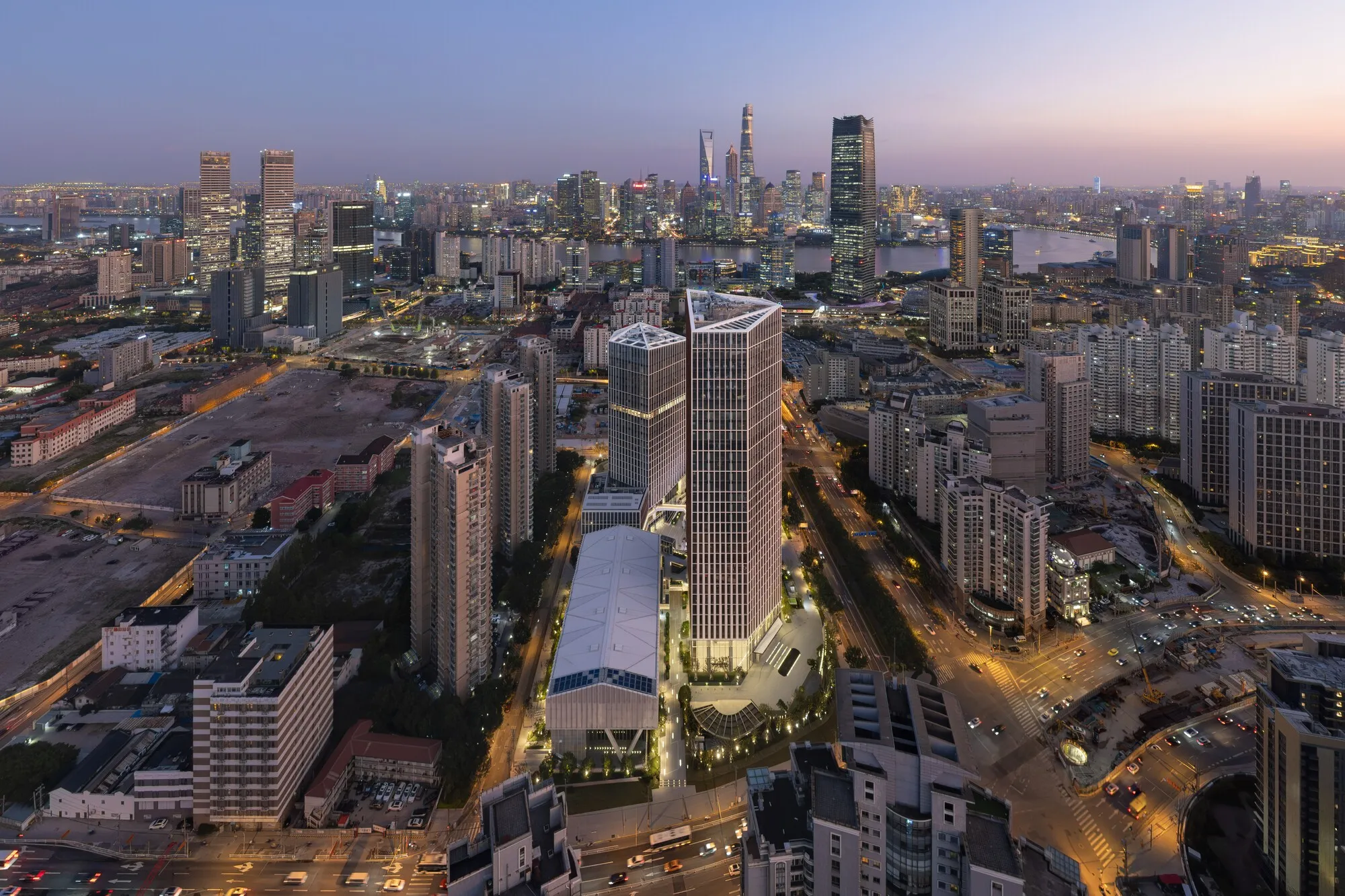
AI Planetworks Carves a Solar Envelope into Twin Towers on Shanghai's North Bund
Guohua Finance Center uses generative design to shape 190,000 square meters of office, retail, and community space in Hongkou District.


Shanghai's North Bund is one of the most contested waterfronts in the world, a strip of land staring across the Huangpu at Lujiazui's supertall skyline while sitting directly atop some of the city's oldest residential fabric. Building a twin-tower commercial complex here is, by definition, an act of negotiation. AI Planetworks Limited took on that negotiation with computational rigor: the Guohua Finance Center, completed in 2023, is a 190,000-square-meter mixed-use development whose angular massing was generated not from a sculptural impulse but from a strict solar envelope analysis, fitting two towers of 32 and 21 stories into a dense parcel without casting unacceptable shadow on neighbors.
What makes the project genuinely interesting is that this performance-driven approach did not produce a pair of generic glass boxes. The towers are faceted, clad in off-white embossed aluminum and copper-toned fluorocarbon-sprayed profiles that reference the "Shanghai render" walls and oxidized rooftops of the surrounding historic quarter. A gradated facade system deploys ten different window widths, from 600 mm to 1,950 mm, responding to orientation and solar load rather than repeating a single module. The result is a project that looks like it belongs to its neighborhood while operating on principles its neighbors never imagined.
Massing That Earns Its Geometry
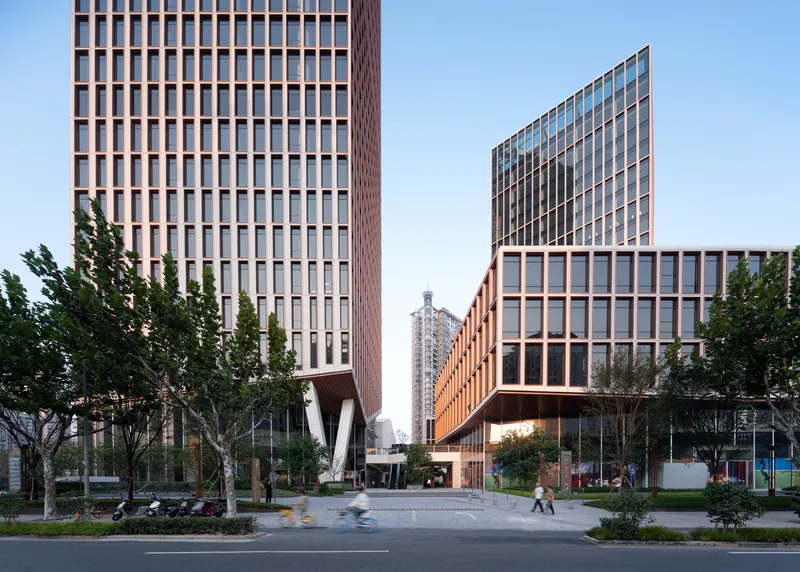
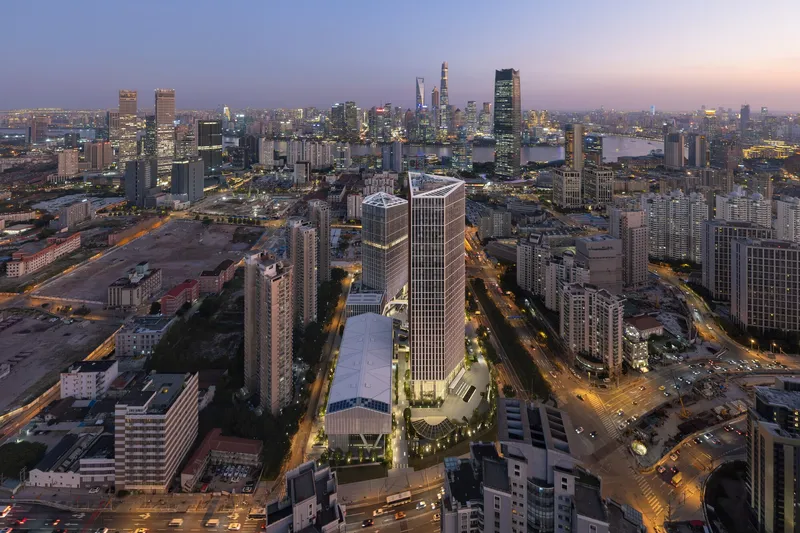
The two towers, 155 meters and 110 meters respectively, are pushed to opposite edges of the site. This is a simple move with enormous consequences: it opens a central void that becomes genuinely public space rather than a leftover gap between podiums. Seen from the air at twilight, the complex reads as two crystalline volumes bracketing a curved podium, their angular profiles interlocking with the dense residential blocks surrounding them. The geometry is not arbitrary. Each facet is a response to the solar envelope, angling the facades to minimize shadow on adjacent buildings and reduce glare on the streets below.
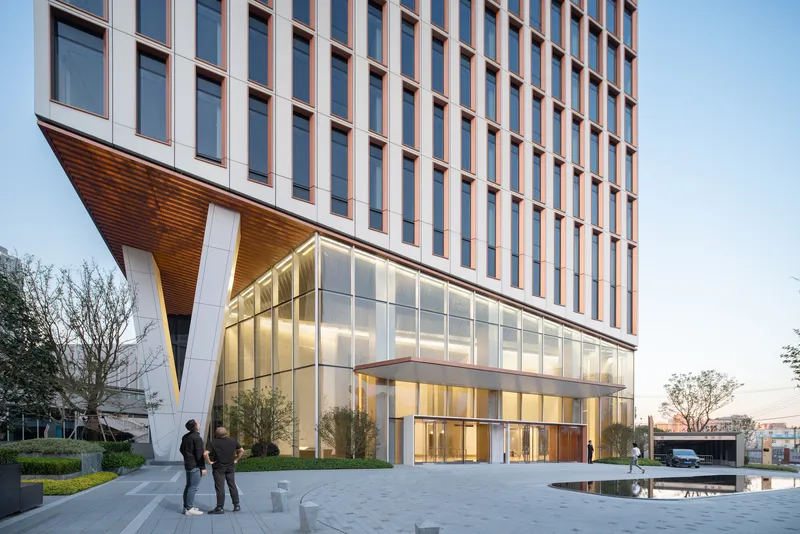
From street level, the effect is different. The white V-shaped columns at the base dematerialize the towers' footprints, pulling the ground plane open and inviting passage through the site. It is the kind of urban generosity that developers in Shanghai rarely volunteer, and it works precisely because the structural system, an all-steel frame, allows column spacing that a concrete core-and-slab building could not.
A Facade That Counts Its Windows
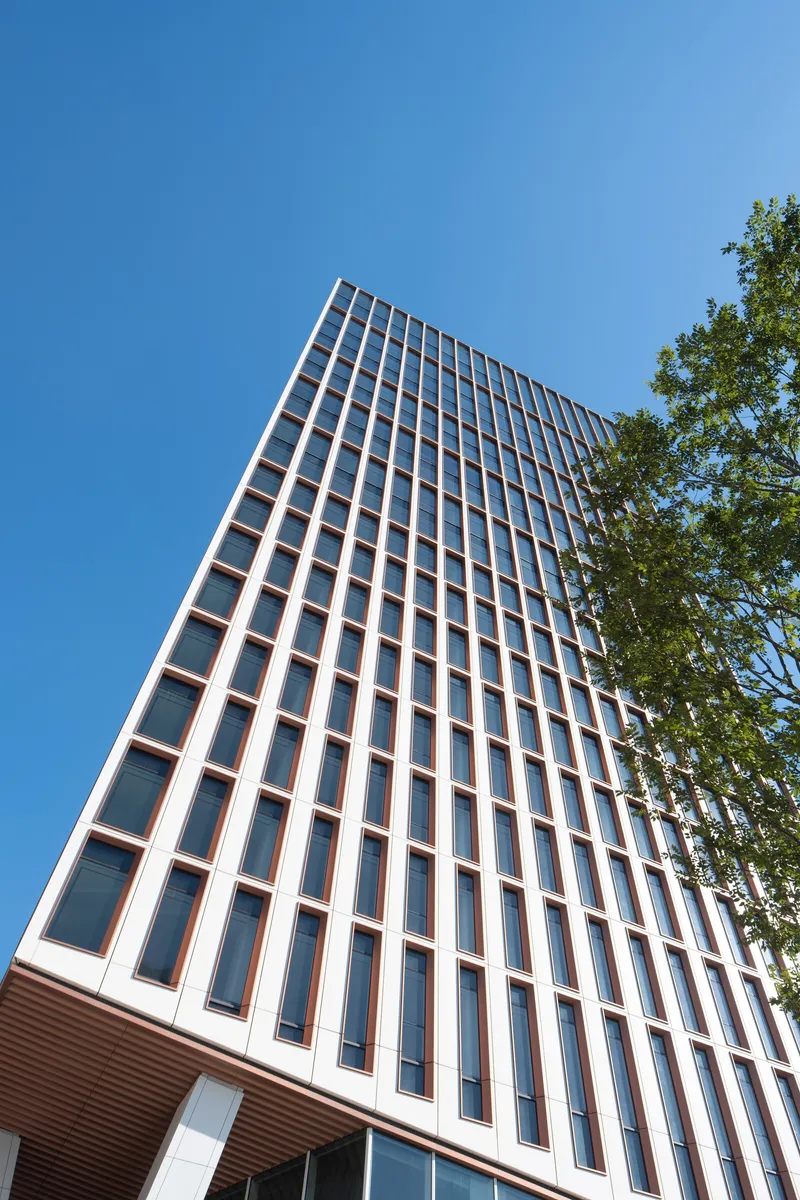
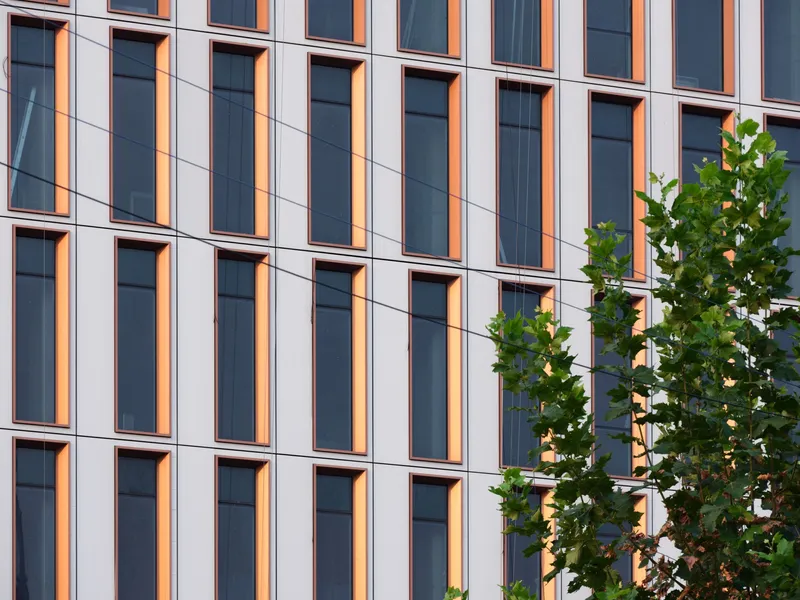
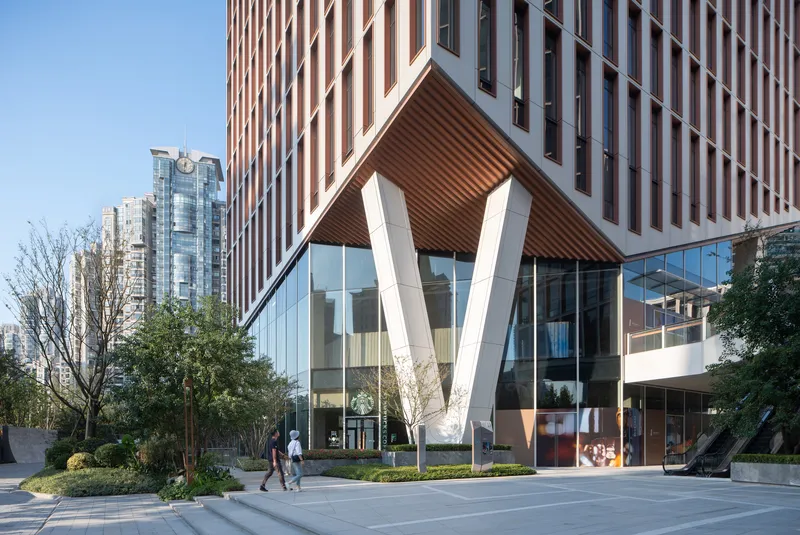
The gradated facade is the project's most legible innovation. Ten distinct window sizes are distributed across the elevation according to solar exposure, floor function, and view angle. Looking up, you see the white aluminum panels as a continuous field interrupted by bronze-framed openings of varying proportion. The effect is rhythmic but not repetitive: a controlled syncopation that recalls the punched-window facades of Shanghai's prewar commercial buildings without mimicking them.
Material selection reinforces this contextual ambition. The off-white panels echo the lime-rendered walls common in Hongkou's older neighborhoods, while the copper and red-brick tones of the aluminum profiles pick up the color of terracotta tile roofs visible from the upper floors. At dusk, when the tower base glows under artificial light, the diagonal columns and ribbed soffits create a lantern-like presence at the street edge that is inviting without being theatrical.
The Ground Plane as Civic Infrastructure
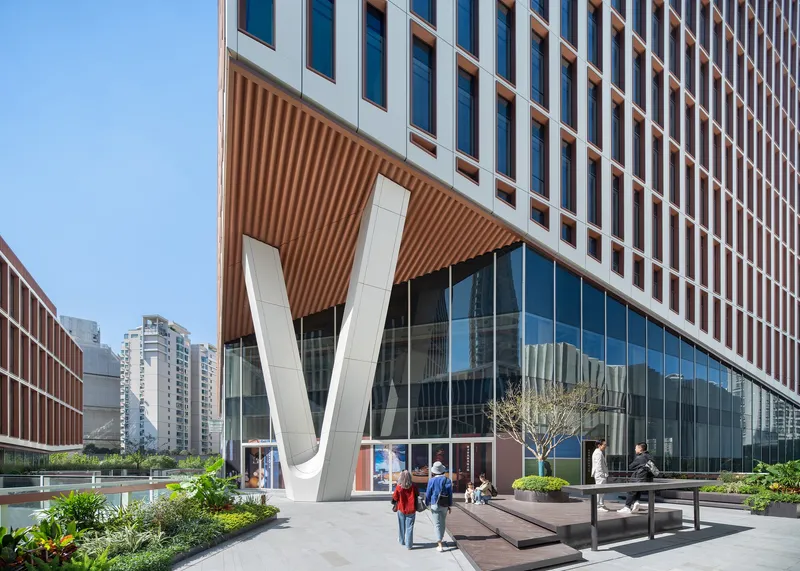
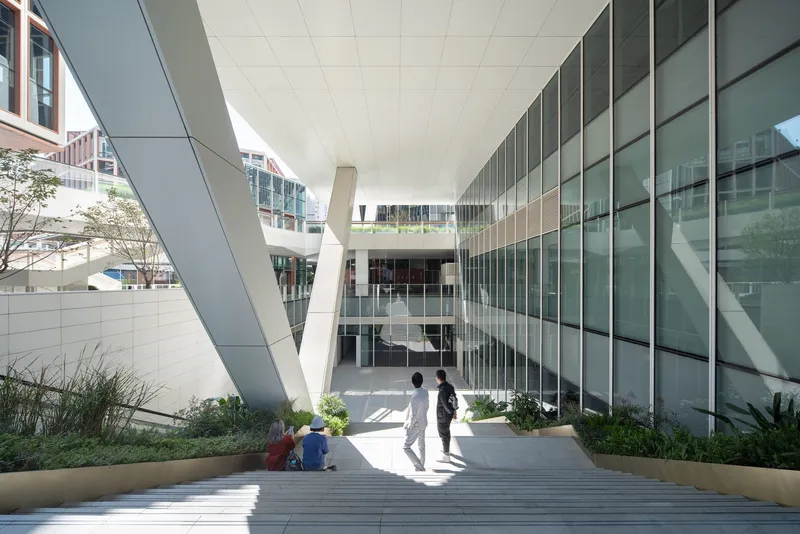
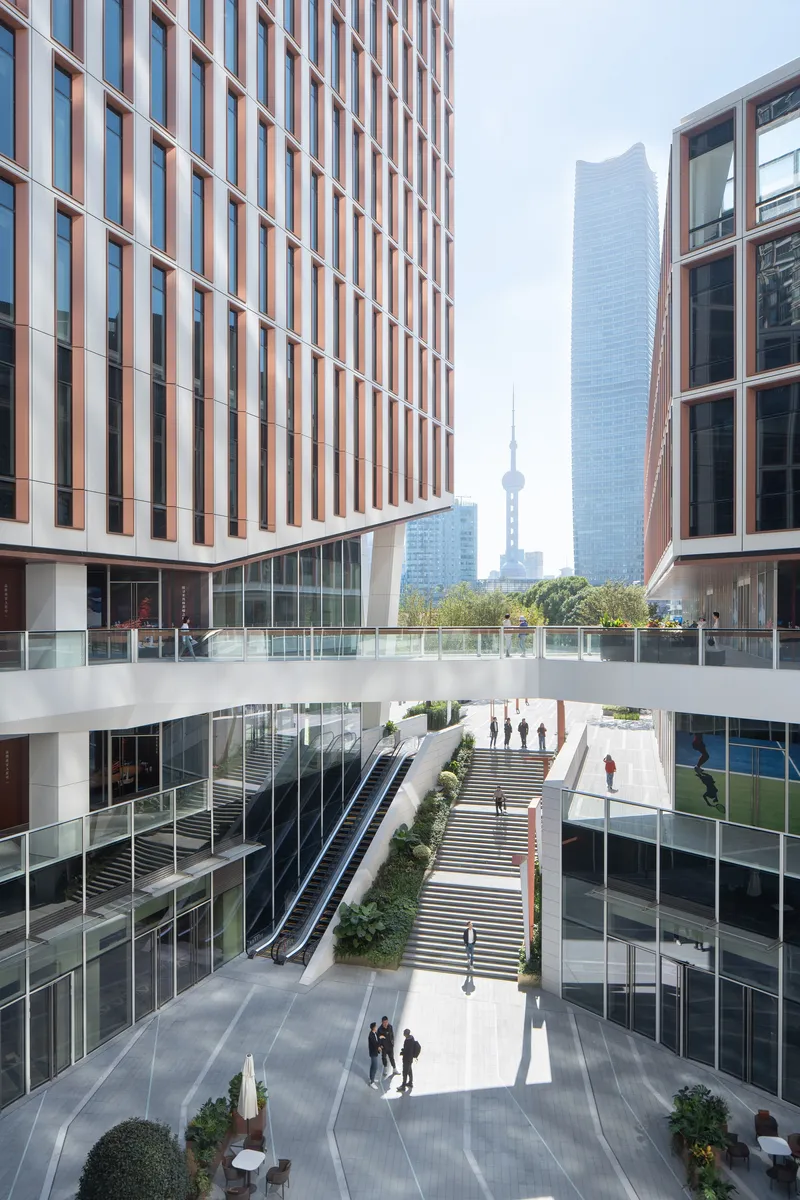
Between the towers, AI Planetworks has layered the ground plane into a sequence of public and semi-public spaces. A sunken courtyard with escalator access draws pedestrians down into the retail podium, while stepped seating areas beneath angled white columns offer shade and pause points. The design treats the ground level not as a lobby approach but as an extension of the sidewalk, a decision that reflects the density and foot traffic of the Hongkou neighborhood.
Planted beds and tree lines soften the hardscape without disguising the structural logic. The V-columns that carry the tower loads to grade are left exposed and white, asserting their presence as both engineering and placemaking elements. Pedestrians move through and beneath them as they would through a colonnade, and the ribbed soffit overhead reinforces the sense of shelter without enclosure.
Connections Above Grade
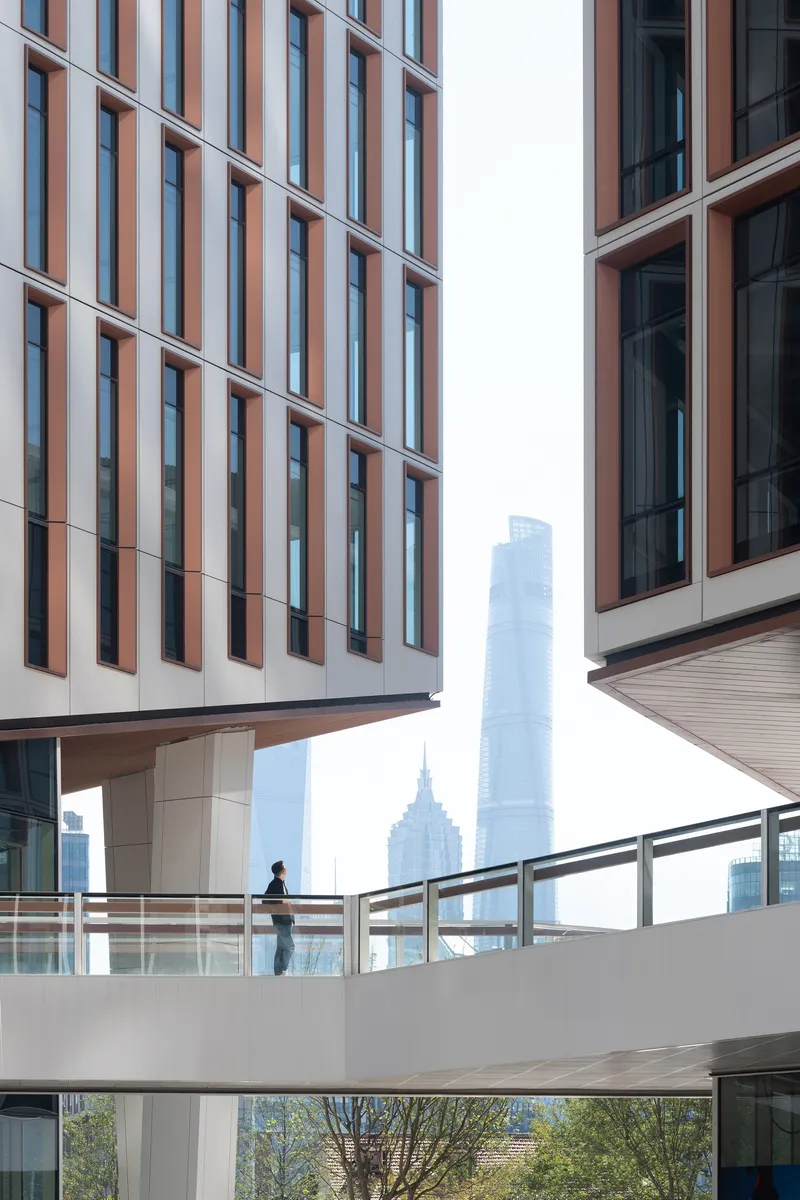
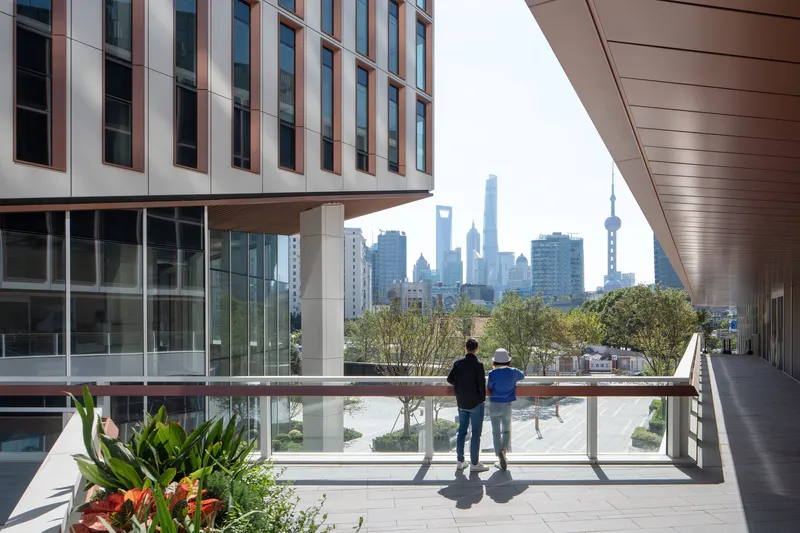
An elevated pedestrian bridge links the two towers at podium level, framed by the vertical terracotta and white facade panels that define the complex's material identity. From this bridge and the elevated terraces, users get their first clear sightline to Lujiazui and the broader Pudong skyline, a view that the street-level density of Hongkou otherwise obscures. The terraces are planted with low shrubs and function as pause spaces, not circulation connectors, a distinction that matters in a city where sky bridges are often little more than enclosed corridors.
Interiors That Breathe
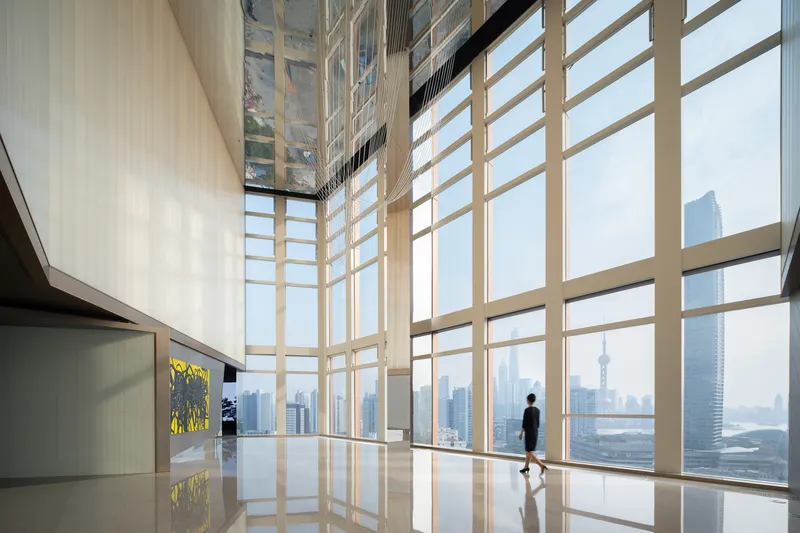
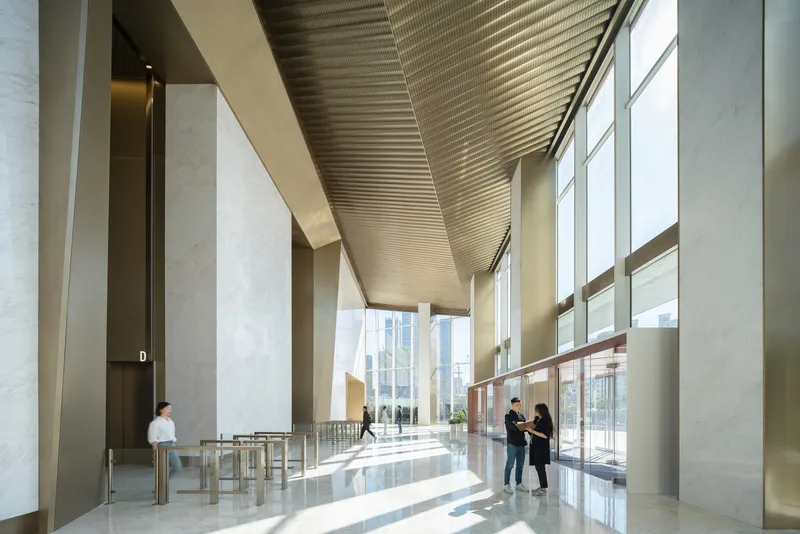
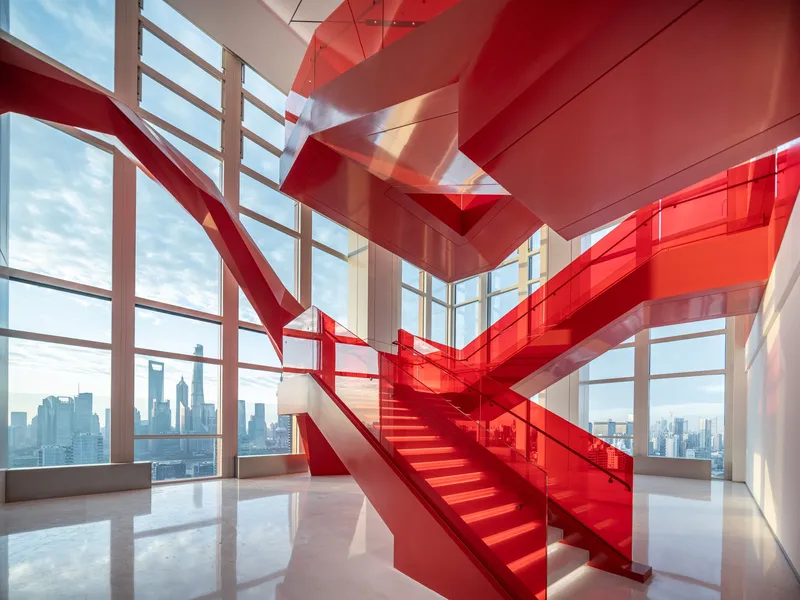
Inside, the towers deliver double-height lobbies flooded with daylight through floor-to-ceiling curtain walls. Stone-clad columns and ribbed metal ceiling soffits give the spaces a material weight that balances the transparency of the glass. The silhouette of a figure against the skyline in one of these lobbies tells you everything about the scale: these are rooms designed to make the city legible from within the building, not to shut it out.
A translucent red glass staircase in one of the lobbies adds a jolt of color that references Shanghai's traditional lacquer tones. It is a bold gesture in an otherwise restrained palette, and it works because it is singular. One red staircase is a statement; a building full of red accents would be a theme park.
Community Center and Pool
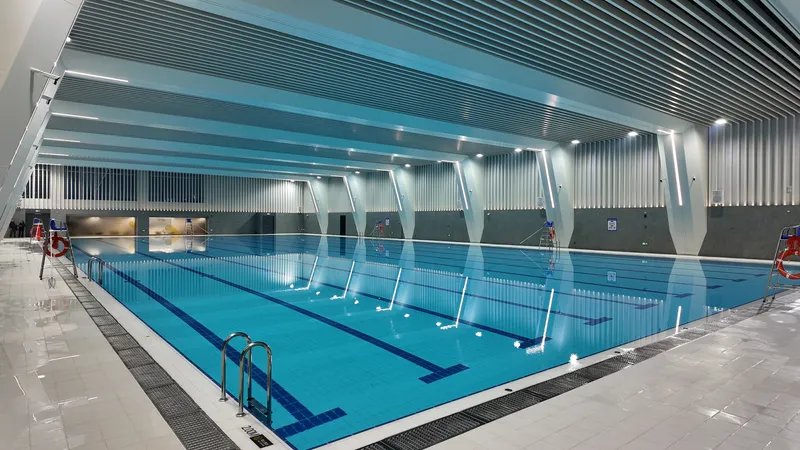
The approximately 8,000-square-meter sports center, tucked into the podium, includes an indoor swimming pool whose ribbed ceiling panels and angled white columns create a compressed, luminous volume. The pool surface reflects the structural rhythm overhead, doubling the geometry and amplifying the sense of space in what is, by floor area, a modest facility. This is not the kind of amenity that makes the marketing brochure and then gets neglected; it is a carefully detailed room that justifies its own visit.
At the glazed lobby entrance to the community facilities, a cantilevered timber soffit signals a shift in program and material warmth. The transition from the towers' aluminum-and-stone language to wood marks the threshold between commercial and civic use, a subtle cue that orients users without signage.
Plans and Drawings
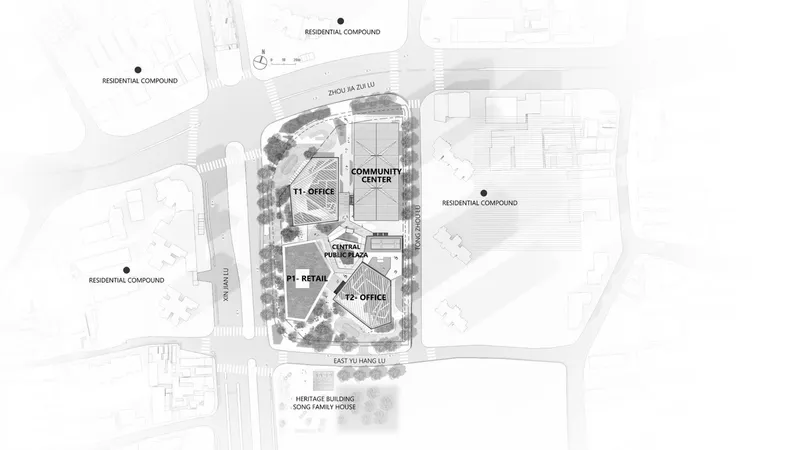
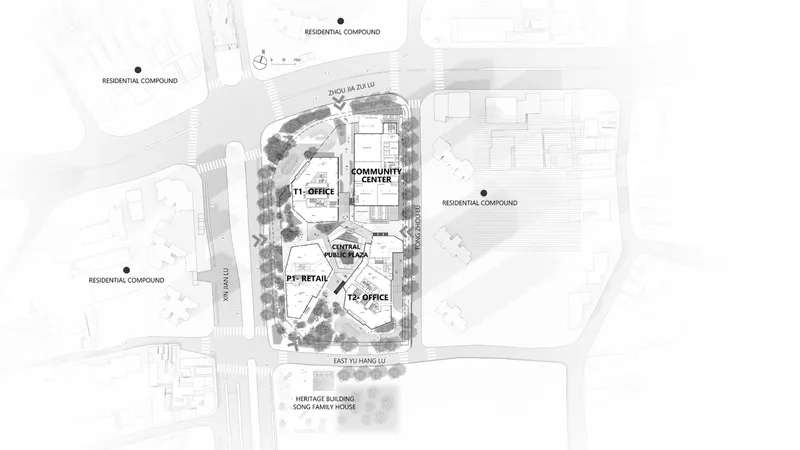
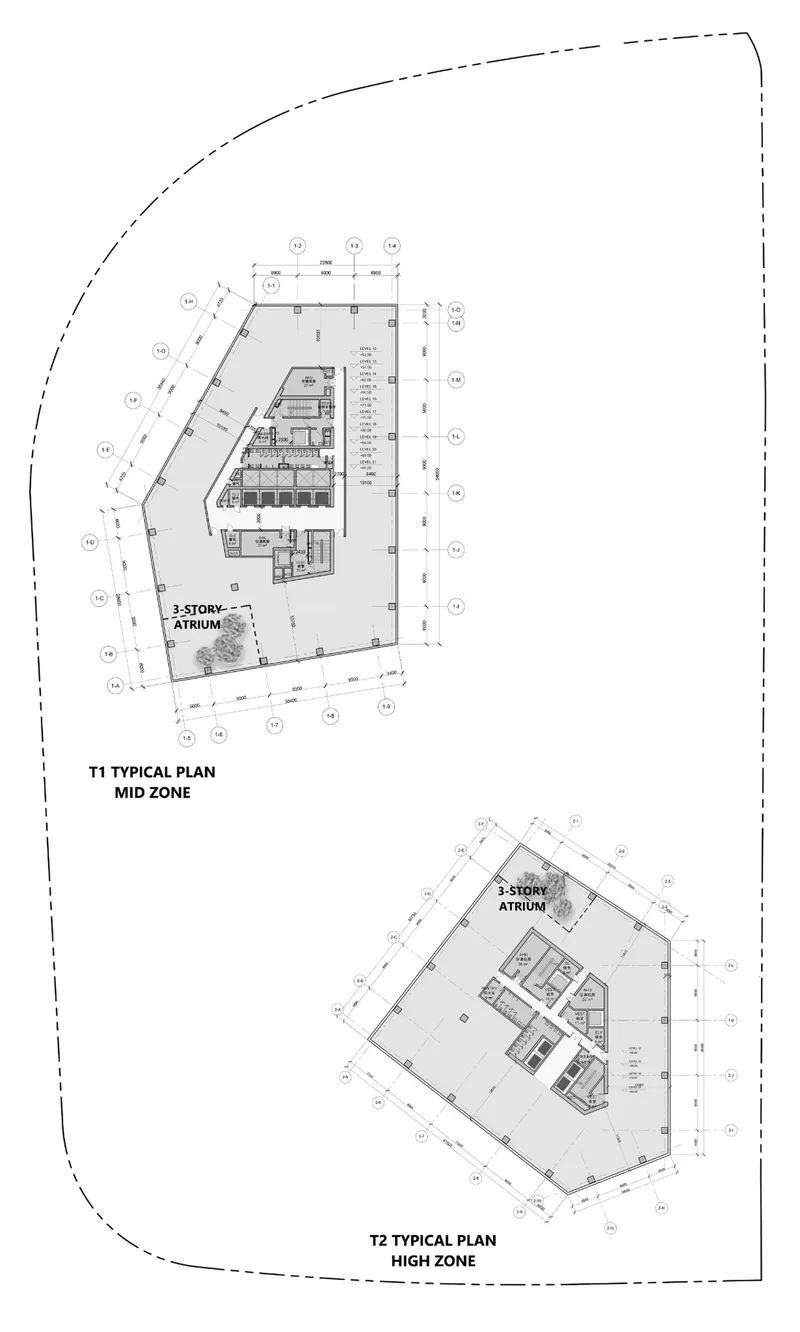
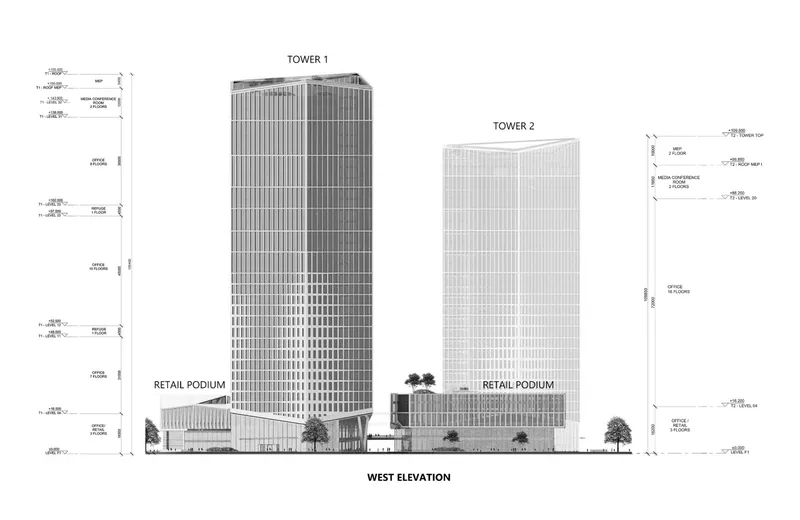
The site plans reveal the logic that the photographs confirm: two towers at the perimeter, a community center and sports block at grade, and a central public space threaded with tree-lined paths that connect to the surrounding residential compounds. The typical floor plans show perimeter offices wrapping atrium voids, a strategy that maximizes daylight penetration and reduces reliance on artificial lighting in a climate where energy performance matters for certification and for operating cost.
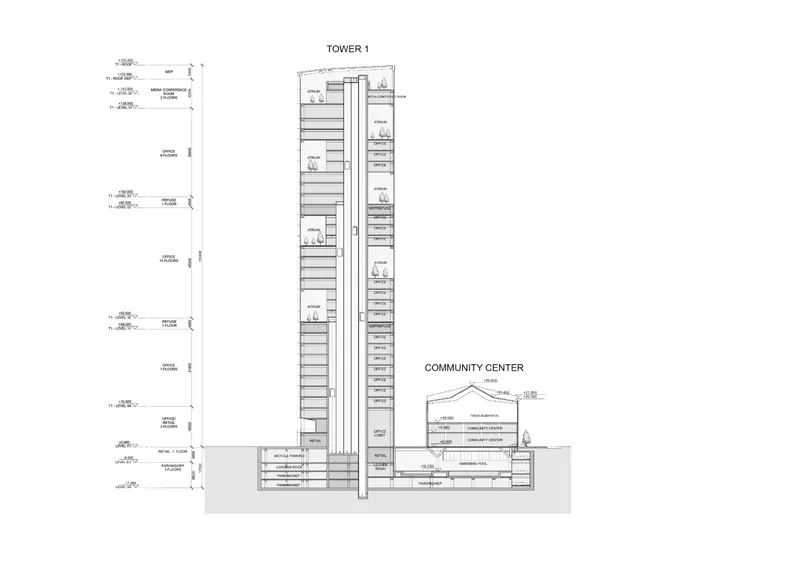
The section drawing is particularly revealing. The south tower rises above a low-rise community center, and the annotated floor levels show how the building steps back to respect the solar envelope. The west elevation confirms the facade's graduated window pattern: larger openings at the lower floors where depth and shade mitigate solar gain, smaller punched windows at the upper levels where exposure increases. Every decision in these drawings is traceable to a performance criterion, and that discipline is what gives the project its coherence.
Why This Project Matters
Performance-driven design is often invoked as a justification for buildings that look optimized but feel generic. Guohua Finance Center pushes back against that tendency. By feeding solar analysis, wind data, and urban context into a generative design process, AI Planetworks produced a complex whose faceted massing and variable facade are not decorative choices but direct outputs of environmental and urban constraints. The fact that these outputs also create a building that reads as contextual, referencing Shanghai's material traditions in color and texture, suggests that computation and cultural sensitivity are not opposing impulses but collaborators.
The project also matters because it takes the civic obligations of a commercial development seriously. Pushing the towers to the site edges to create a public center, embedding a community pool and sports facility into the podium, and treating the ground plane as a permeable urban room rather than a privatized forecourt are decisions that benefit the neighborhood, not just the tenants. In a district where every square meter of land is under pressure, that generosity is the most significant design move of all.
Shanghai Guohua Finance Center by AI Planetworks Limited. Located in Hongkou District, Shanghai, China. 190,030 square meters. Completed in 2023. Photography by TAL, Runzi, and Kunmao.
About the Studio
Share Your Own Work on uni.xyz
If projects like this are the kind of work you want to make, uni.xyz is a place to publish your own, find collaborators, and enter design competitions.



Popular Articles
Popular articles from the community


The Earth Pod: 3D Printed Homes for Resilient Refugee Communities
The Earth Pod reimagines refugee housing through 3D printed homes made from clay, combining resilience, self-sufficiency, and rapid shelter.

Co-Life: Senior Housing Design That Reconnects Older Adults With the City
Co-Life reimagines senior housing design through healing gardens, shared streets, workshops, and a sustainable community across generations.

Hill & Cross Opera: Sculptural Opera House Architecture Shaped by Tallinn’s Landscape and Identity
Hill & Cross Opera reimagines opera house architecture in Tallinn through its sculptural hill, civic plaza, glass wave and a luminous cross.

Play: Fragments of Their World
Familiar architecture becomes modular playground design, creating safe spaces where displaced children can learn, connect, imagine and play.

Similar Reads
You might also enjoy these articles

Bao Huynh Watercolor Atelier: A Serene Art Retreat in Hội An
Bao Huynh Watercolor Atelier in Hội An blends multifunctional art spaces, sustainable design, local materials, and family-friendly living in a serene environment.

Atelier Macri Concept Store Interior Design by CASE-REAL
Atelier Macri store features a "ko" counter, walnut wood details, cork displays, blending retail, gallery, and seamless customer experiences.

Manuel Vargas Izquierdo Stadium and High-Performance Sports Center: Architectural Excellence in Jalpa de Méndez
The Manuel Vargas Izquierdo Stadium blends sustainable design, inclusive sports facilities, and cultural-inspired architecture, revitalizing Jalpa de Méndez’s public spaces.

KAKR Buluh Awar Hall: Revitalizing Community and Ecology Through Bamboo Architecture
Community built bamboo hall revitalizes Buluh Awar village, empowering youth, restoring ecology, celebrating vernacular craftsmanship through sustainable architecture and culture.


Explore Architecture Competitions
Discover active competitions in this discipline



Challenge to reimagine the Iron Throne


Photograph architecture without architects


Illustrate the lost glory of Angkor Wat - Render Challenge


Design challenge to reuse E-waste
Comments (0)
Please login or sign up to add comments
No comments yet. Be the first to comment!