
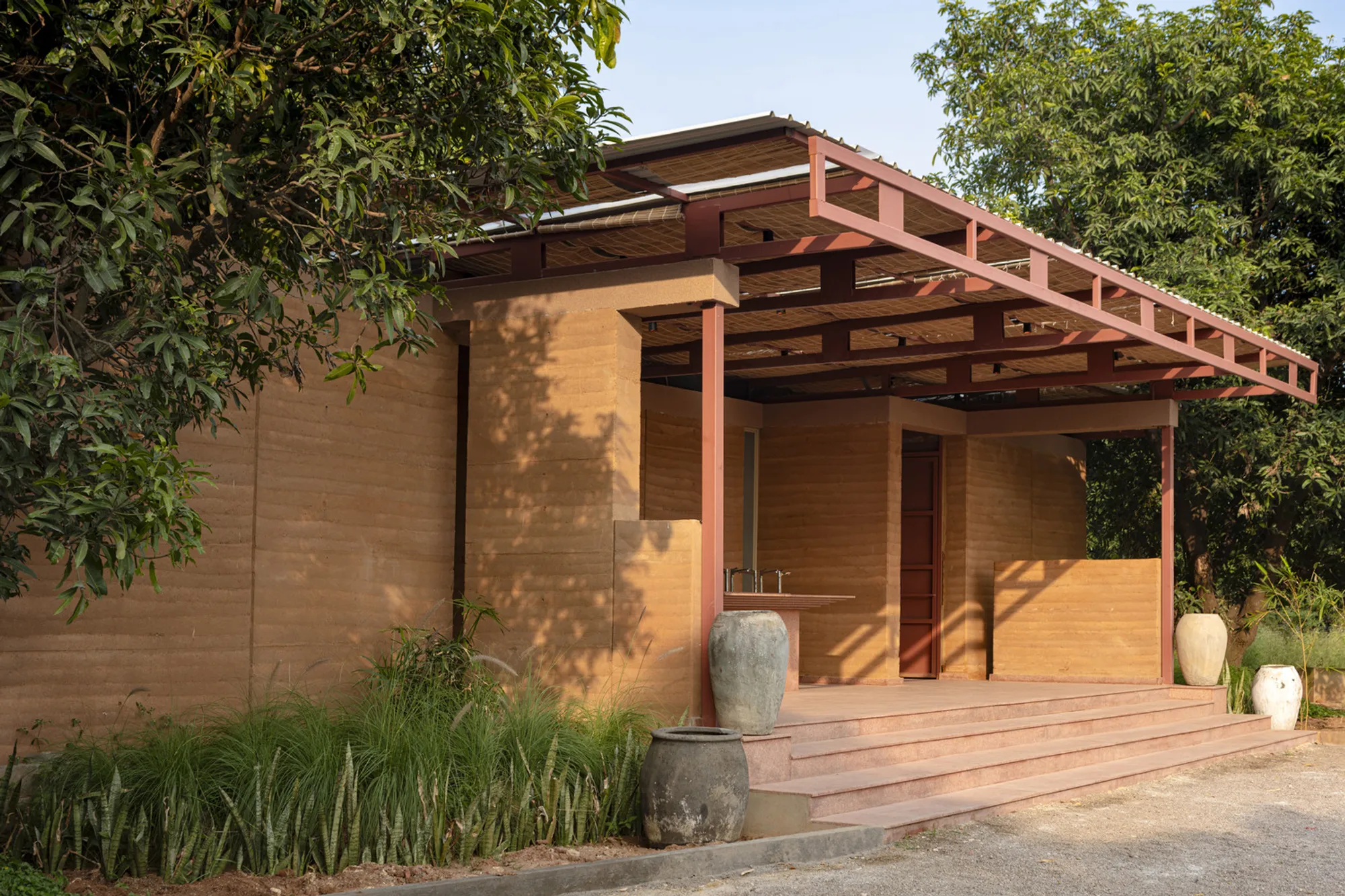
NaaV Studio Builds a Rammed Earth Restroom That Disappears into a Hyderabad Mango Grove
At Aina Retreat in Hyderabad, site-excavated soil and handwoven bamboo transform a communal restroom into a lesson in vanishing architecture.


A public restroom is rarely the building anyone talks about. It sits at the bottom of the architectural hierarchy, a utilitarian box to be tolerated, never celebrated. NaaV Studio, led by designers Varsha Reddy and Niharika Didige, saw an opportunity to flip that assumption at Aina Retreat, an eco-conscious event venue on the outskirts of Hyderabad. Their community restroom, completed in 2024, is a 1,100 square foot cuboidal volume constructed almost entirely from soil pulled out of the ground it sits on. It does not announce itself. It settles into its grove of mango trees as though it grew there, and that is precisely the point.
What makes the project genuinely interesting is not merely its material palette, which is compelling on its own, but the hierarchy of decisions behind it. Existing trees dictated the building's footprint and orientation. A central mango tree was preserved and framed through an open window rather than felled for a cleaner plan. The communal sink, carved from a single block of rust-hued granite, references the cascading geometry of Hyderabad's historic baolis, or stepwells. Each choice reveals a design philosophy where landscape comes first and architecture follows, quietly.
Settling Into the Grove
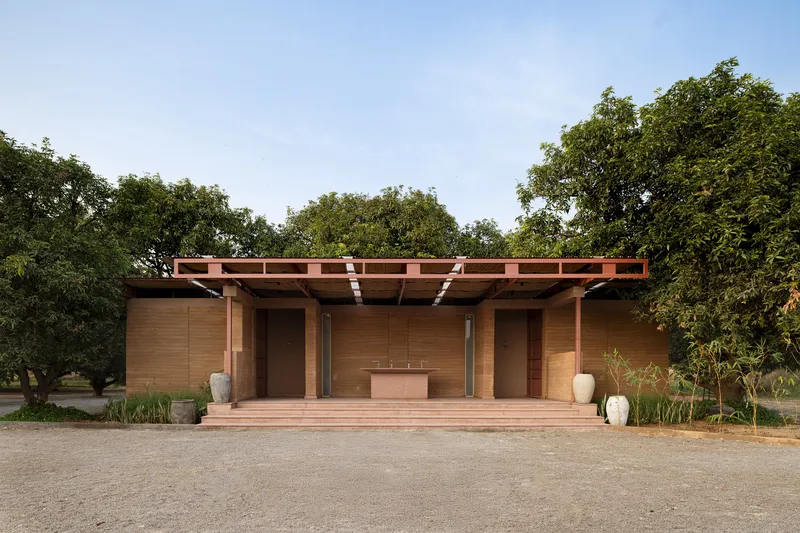
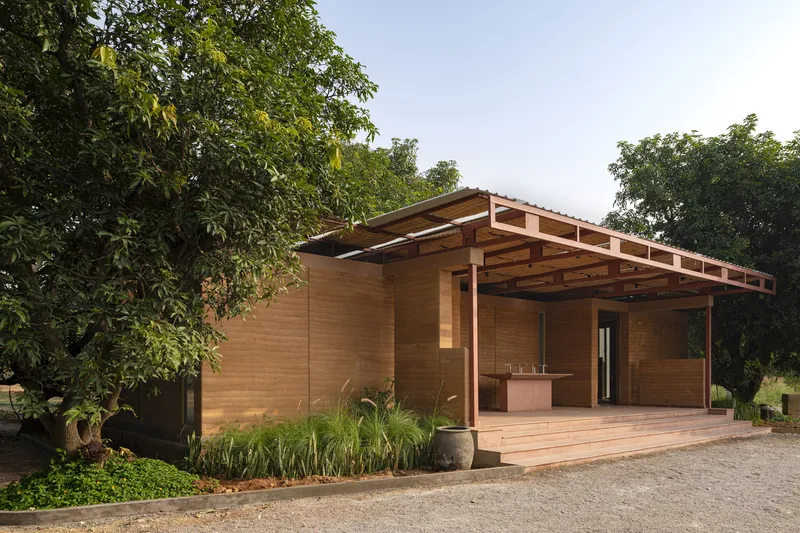
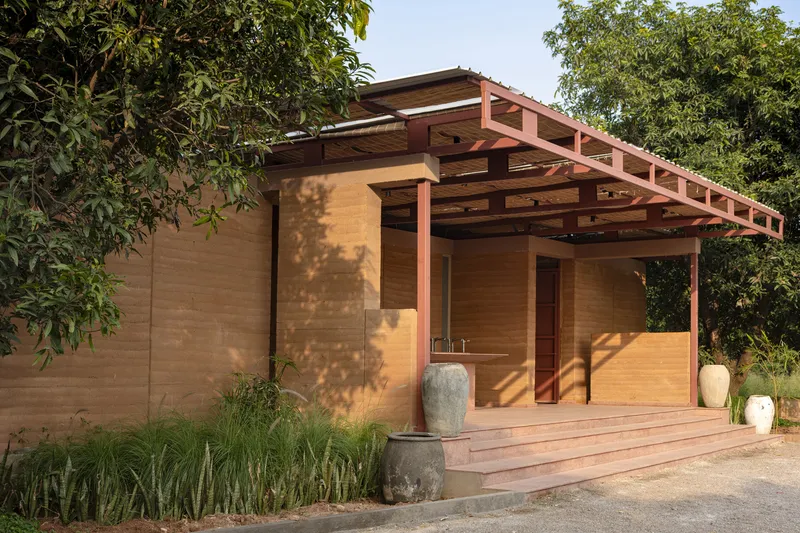
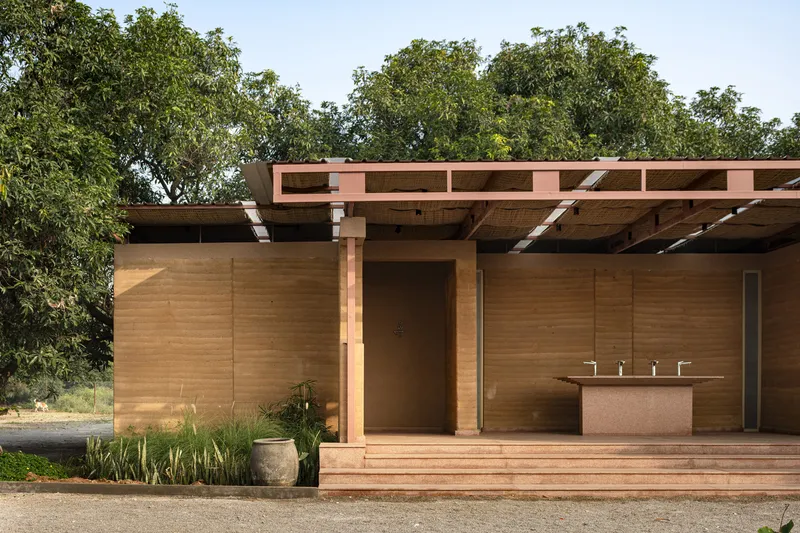
From the outside, the restroom reads as a low pavilion shaded by a canopy of mature mango trees. Dappled light falls across the rammed earth facade, blurring the line between wall and ground. The timber-clad pergola and cantilevered roof extend past the building envelope to create transitional zones, part shade structure, part threshold. Pink-painted steel roof trusses peek through the foliage, adding a single calibrated moment of color that prevents the building from tipping into earnest rusticity.
The landscape strategy, developed with landscape architect Rohit Mirdoddi, wraps planted beds tightly against the structure. Grasses and ground cover grow right up to the base of the walls, softening any hard distinction between building and terrain. The effect is deliberate: the restroom does not occupy its site so much as participate in it.
Rammed Earth as Load-Bearing Identity
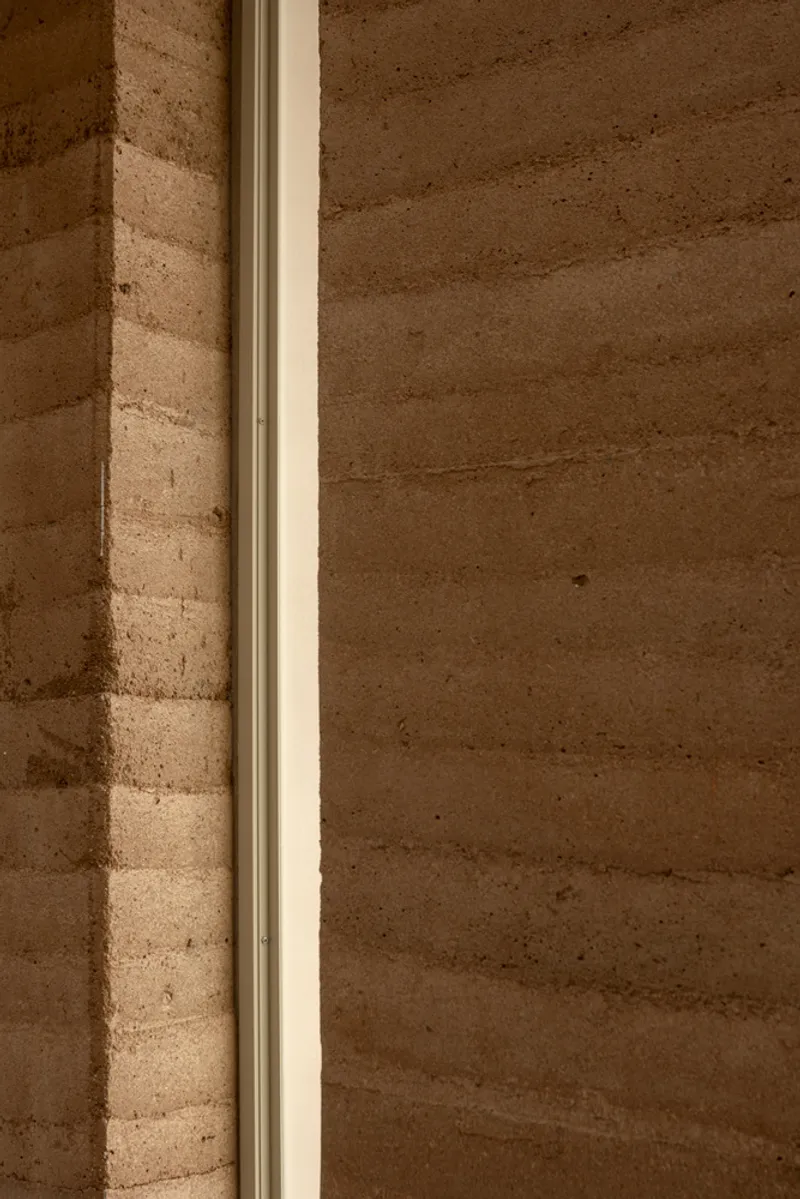
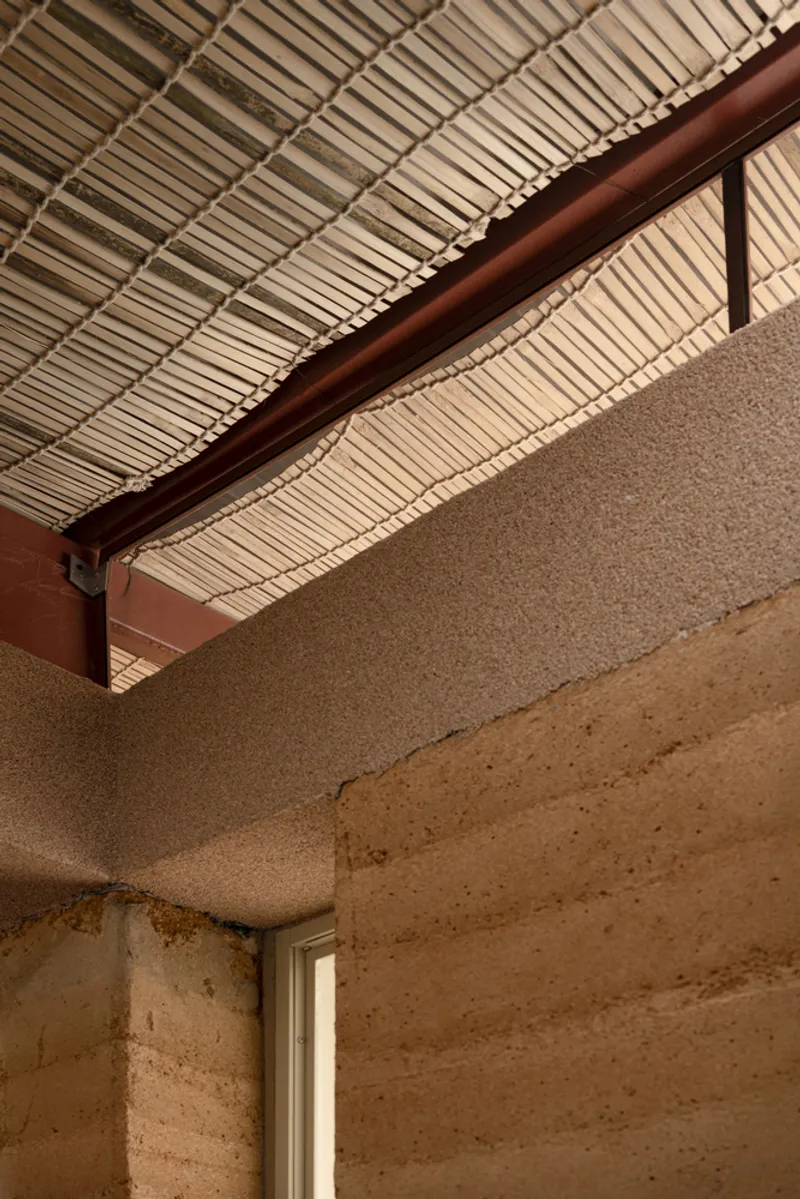
The walls are rammed earth, load-bearing, and constructed from soil excavated directly on site. That last detail matters. Trucking in earth from elsewhere would have undermined the project's ecological logic. Instead, the material carries the literal geology of the place, visible in the horizontal striations where each compacted layer records its own mineral composition. A metal window frame set into one of these walls makes the construction technique legible: you can count the lifts, read the aggregate density, and understand how the wall was built without any explanatory signage.
The decision to keep rammed earth as the sole structural system simplifies the building immensely. There is no secondary frame hiding behind a veneer. The walls do the work, hold the roof, and define the spatial character all at once. Execution was handled in collaboration with Kalakutumbh, who served as technical consultant and construction partner, ensuring the earthen walls met structural performance requirements while retaining their handmade texture.
Bamboo Ceiling and the Calibration of Light
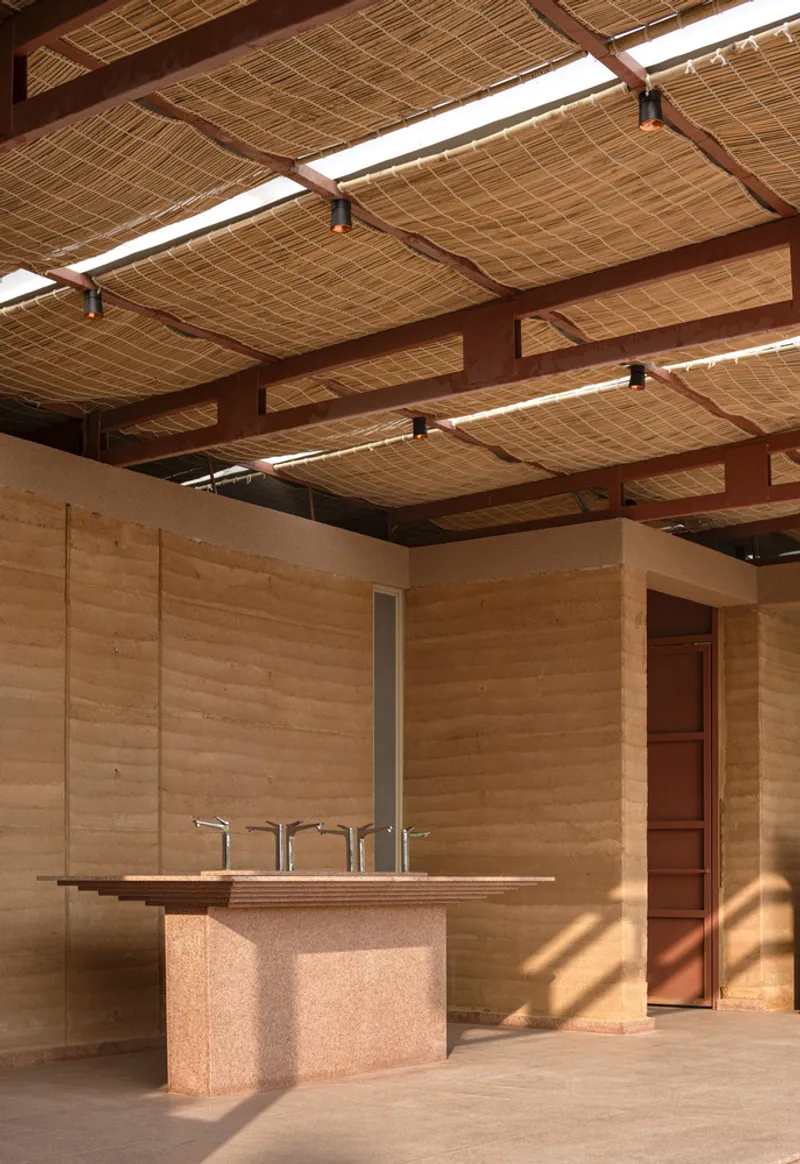
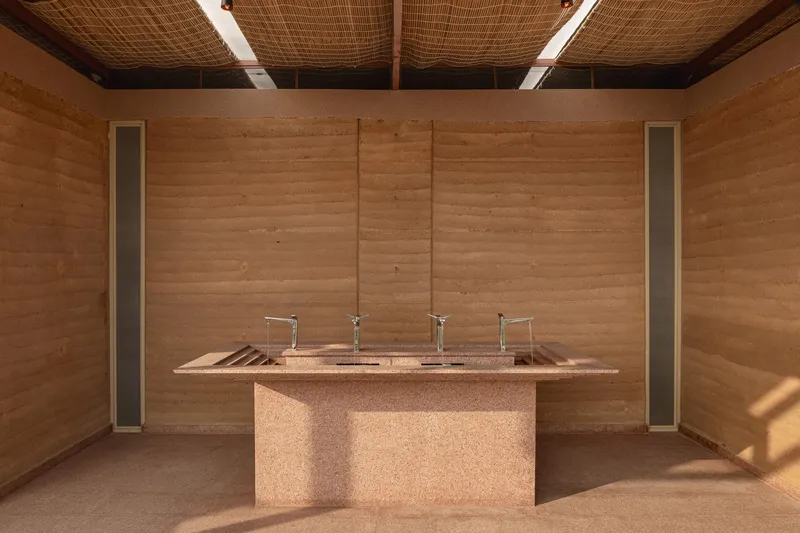
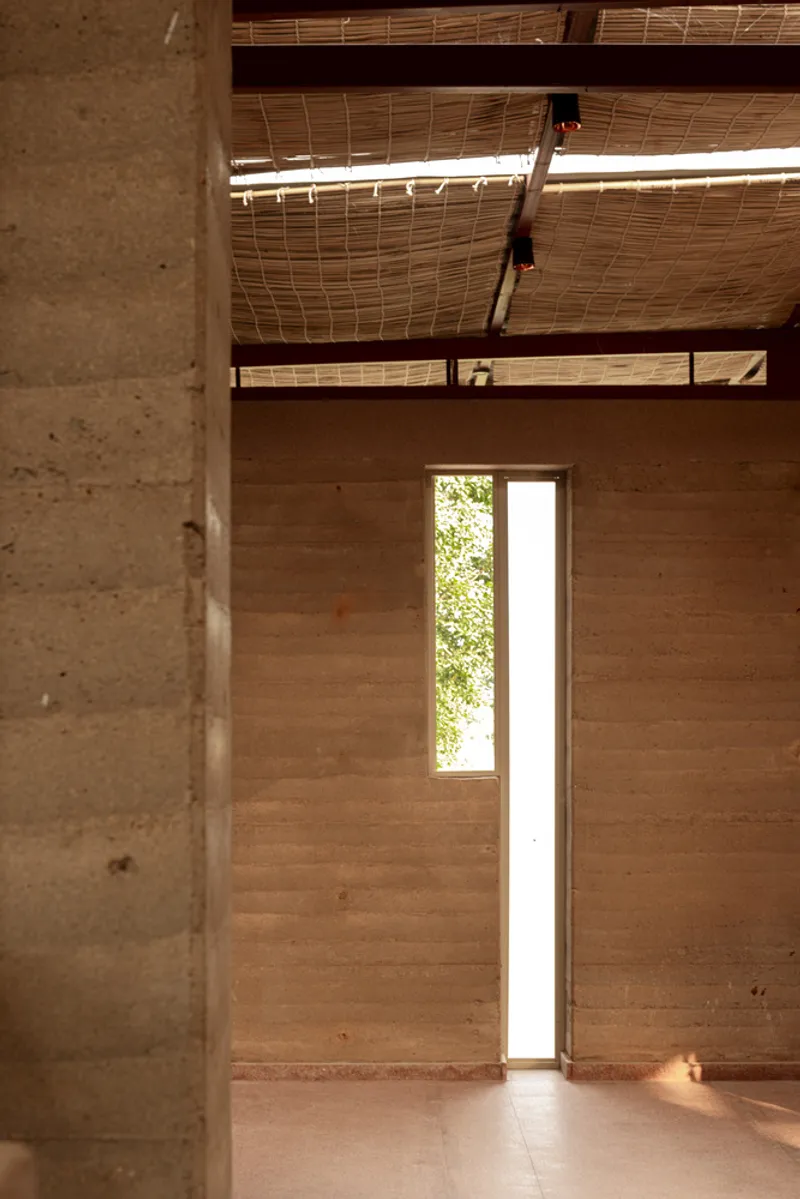
Look up inside and you find handwoven bamboo mats stretched across the entire ceiling, sourced locally and installed by regional artisans. The mats serve a double function. First, they soften the visual weight of the mild steel and tin sheet roof above, transforming an industrial assembly into something warm and tactile. Second, their weave acts as a light filter. As the sun moves through the day, shadows shift across the rammed earth walls in constantly changing patterns, turning what could be a static interior into a space that is never quite the same twice.
Pink steel beams run exposed beneath the bamboo, creating a layered ceiling section that is honestly legible. Steel, bamboo, and tin each remain visible, and each plays a distinct role. There is no attempt to conceal the construction hierarchy, and the result is richer for it.
The Granite Sink as Communal Centerpiece
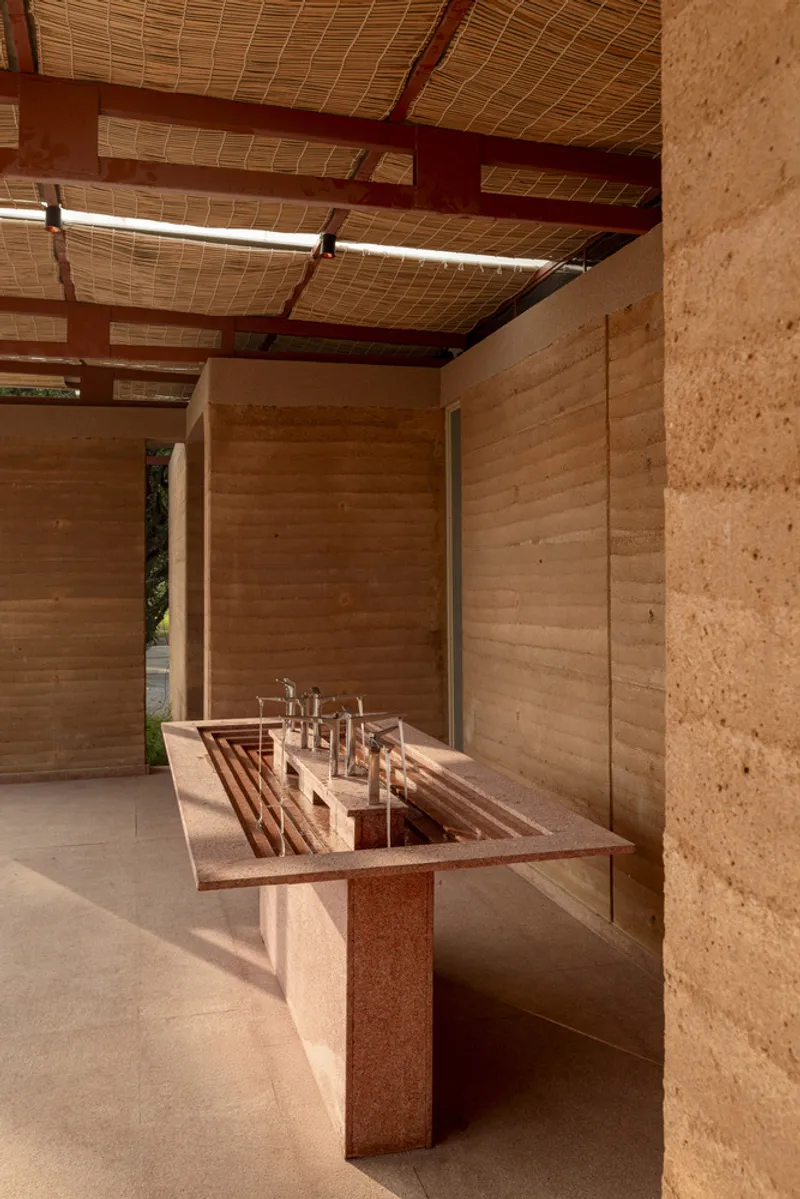
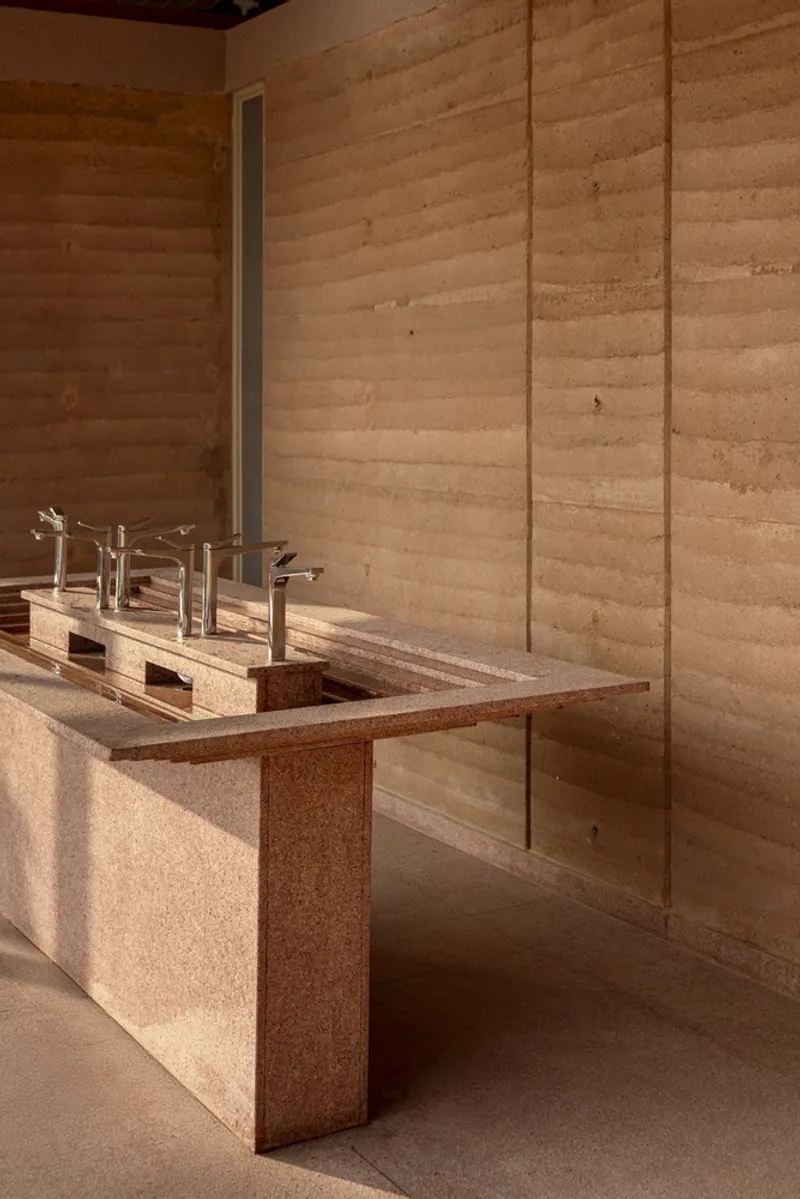
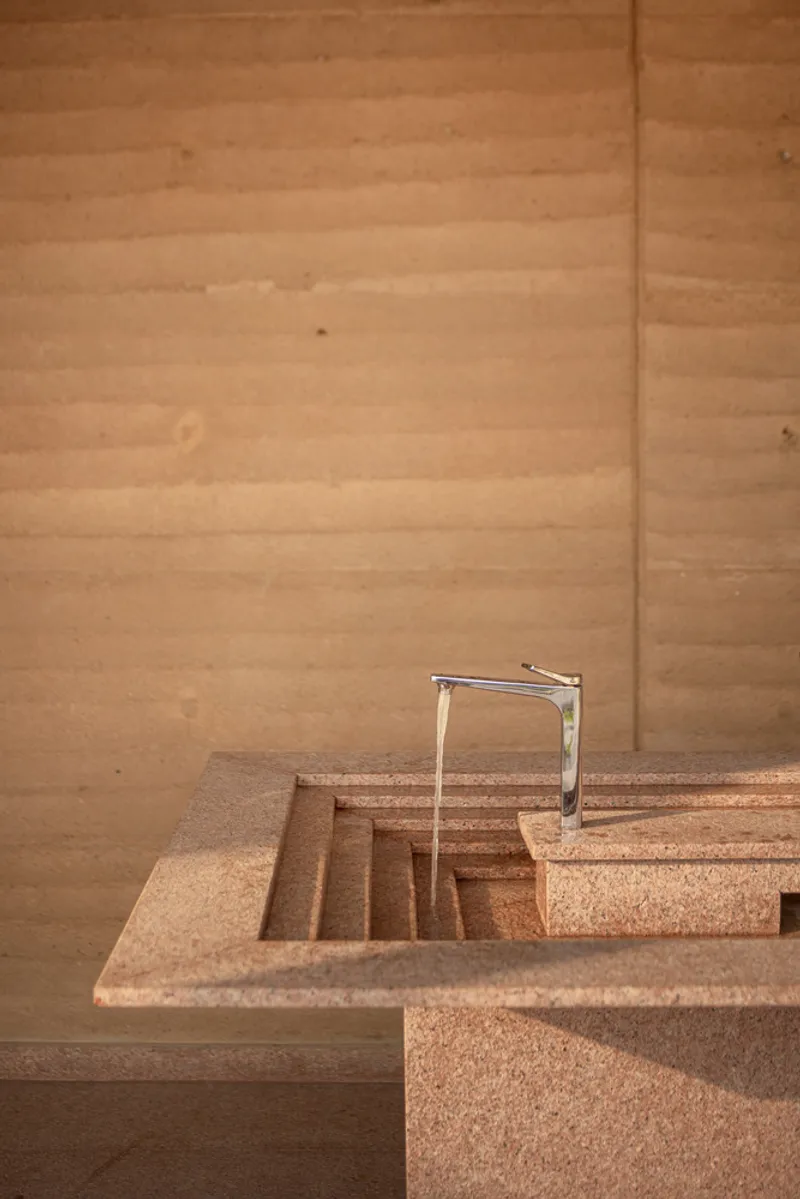
The plan is organized symmetrically around a central communal sink that divides the facility into male and female sections. This sink is not a standard counter with basins dropped in. It is a monolithic piece of rust-hued granite, shaped and balanced by local artisans into a cascading form that intentionally echoes the stepped profiles of Hyderabad's baoli stepwell architecture. The reference is subtle but specific: the stepped geometry, the sense of water descending through stone, the tactile weight of the material.
Chrome fixtures sit cleanly on the aggregate edge, their polished surfaces drawing a sharp contrast against the rough stone. Granite continues onto the floor, establishing a material continuity that grounds the entire interior. There is no tile, no laminate, no composite surface to break the connection between wall and floor. Everything reads as earth and stone.
Privacy Through Geometry, Not Opacity
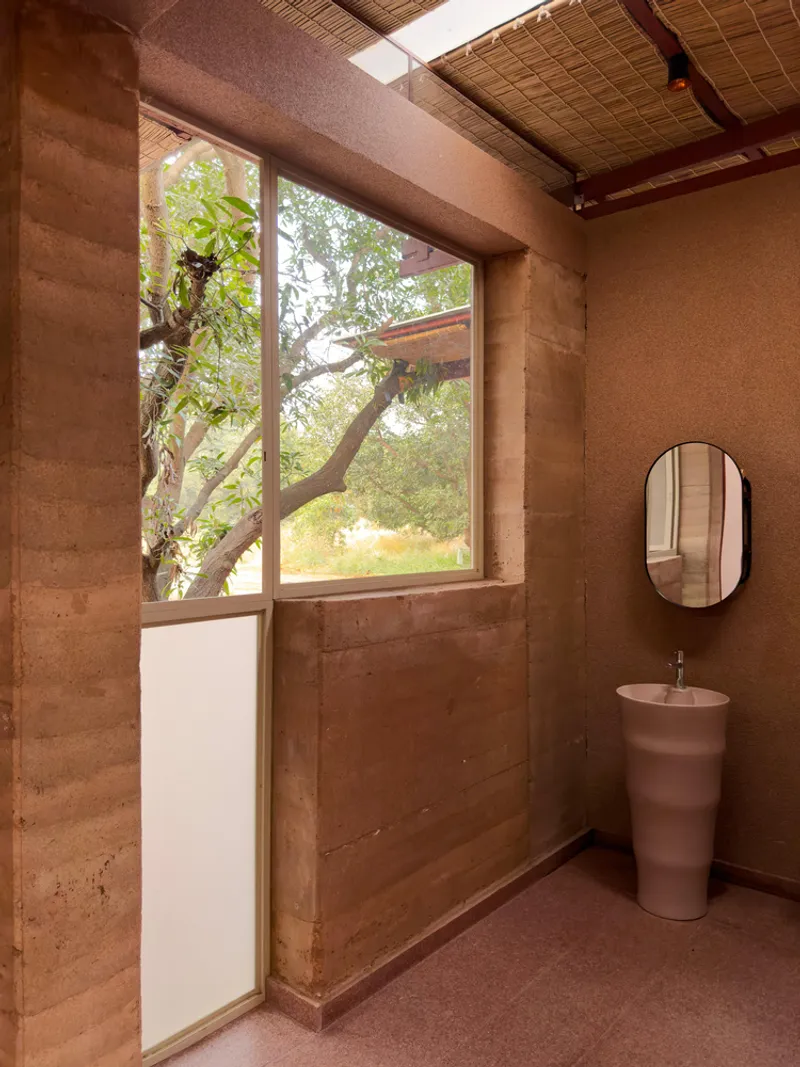
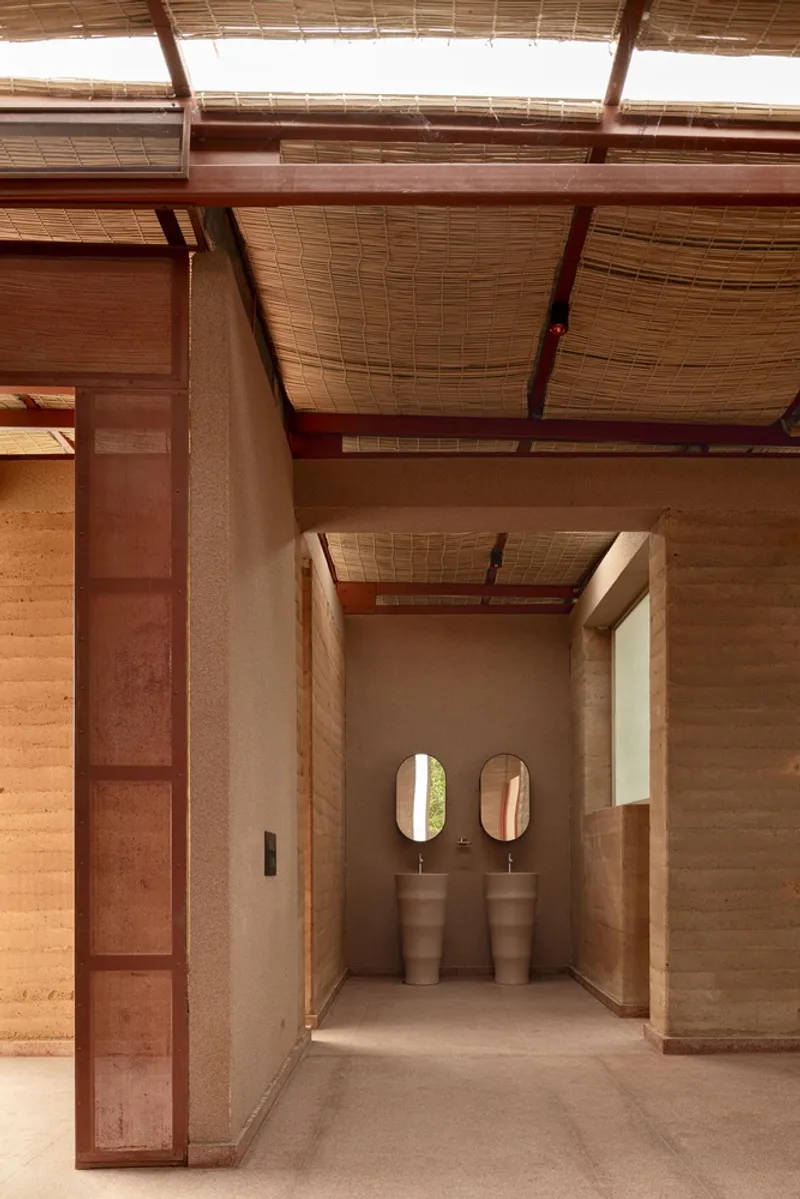
Public restrooms typically solve the privacy problem by sealing themselves off from the outside. NaaV Studio took the opposite approach. Tall, narrow slit windows punctuate the rammed earth walls, allowing daylight and airflow to enter while maintaining visual privacy through geometry rather than curtains or frosted glass. One tall window frames a tree trunk and canopy outside, turning a restroom stall into a space with a view that feels almost meditative.
The corridor leading to the individual stalls is lined with oval mirrors and freestanding sinks beneath the bamboo ceiling, establishing a generous, almost hospitality-grade sequence. Deep-toned doors provide the only opaque barrier between public and private zones. The atmosphere inside is calm, well-lit, and ventilated naturally. It works as passive design, but more importantly, it works as an experience that treats the user with a level of care rarely extended to utilitarian programs.
Plans and Drawings
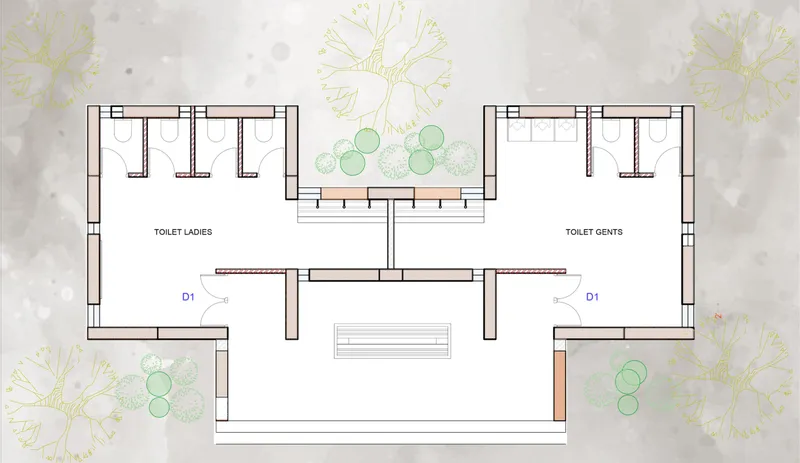
The floor plan confirms the project's organizing logic. Two symmetrical banks of toilet facilities flank a central courtyard, with existing trees preserved within the plan boundary. The communal sink sits on the axis between the two wings, serving as both a spatial divider and a shared social element. The courtyard, open to the sky, allows the mango tree to remain rooted where it was long before any building was imagined. It is a plan driven by what was already there.
Why This Project Matters
The Aina Community Restroom matters because it applies real architectural ambition to a building type that almost never receives it. Restrooms are dismissed as infrastructure, not architecture. NaaV Studio's response is to treat the program with the same rigor and attention they would bring to a house, a gallery, or a pavilion. Rammed earth walls carry loads and carry meaning. A granite sink references regional water architecture. Bamboo ceilings modulate light and honor craft traditions. Nothing here is decorative for the sake of decoration; every material decision is structural, climatic, or cultural.
More broadly, the project demonstrates that sustainability is not a technology to be bolted on but a design posture that begins with the site. By building from the ground beneath its own footprint, preserving the trees that were already growing, and relying on passive ventilation instead of mechanical systems, this small building makes a large argument. Architecture does not need to conquer a landscape to exist within it. Sometimes the most powerful move is to let the mango trees win.
Aina Community Restroom by NaaV Studio (Varsha Reddy and Niharika Didige). Aina Retreat, Hyderabad, India. 1,100 sq ft. Completed 2024. Landscape Architecture: Rohit Mirdoddi. Technical Consultant and Execution Partner: Kalakutumbh. Photography by Vivek Eadara.
About the Studio
Share Your Own Work on uni.xyz
If projects like this are the kind of work you want to make, uni.xyz is a place to publish your own, find collaborators, and enter design competitions.



Popular Articles
Popular articles from the community


Co-life: Sustainable Architecture for Age-Friendly Community Living
Co-life reimagines sustainable architecture for seniors through courtyards, rammed earth, shared gardens, and spaces designed for belonging.

The Ocean Hive: Sustainable Architecture for a Self-Sufficient Civilization at Sea
The Ocean Hive imagines sustainable architecture at sea, where modular habitats, algae, wave power and ocean waste sustain a growing colony.

AL-JANNAH: Sustainable Architecture and Permaculture for Afghan Widows
AL-JANNAH uses sustainable architecture and permaculture to create resilient oasis of housing, learning, work and renewal for Afghan widows.

Co-Life: Senior Housing Design That Reconnects Older Adults With the City
Co-Life reimagines senior housing design through healing gardens, shared streets, workshops, and a sustainable community across generations.

Similar Reads
You might also enjoy these articles

Bamboo Housing Challenge 2026: Design Affordable, Sustainable Homes Using Bamboo
An international design competition by Bamboo U and IBUKU inviting architects and designers to reimagine affordable housing using bamboo — with the winning design built full-scale in Bali.

Computational Design & Education: Beegraphy Design Awards Introduces 7th Category (Featuring Jiyun's Innovative Approach)
Dive into Beegraphy’s 7th Design Awards category, where computational design meets education to create immersive, interactive learning tools, inspired by Jiyun’s work.

From Parametric Lighting to Urban Furniture: Join the 2nd Workshop in Beegraphy’s Computational Design Series
Dive into Cutting-Edge Design Techniques and Practical Applications with Industry Experts

Last Call: Unleash Your Architectural Genius in SHAK's Kindergarten Design Competition
Urgent call for architects to join SHAK's kindergarten design competition before the looming deadline


Explore Architecture Competitions
Discover active competitions in this discipline



Challenge to reimagine the Iron Throne


Photograph architecture without architects


Illustrate the lost glory of Angkor Wat - Render Challenge


Design challenge to reuse E-waste
Comments (0)
Please login or sign up to add comments
No comments yet. Be the first to comment!