

Al Gharra Mosque in Medina Redefining Contemporary Islamic Architecture
Minimalist Medina mosque using concrete, light, and landscape to reinterpret Islamic worship spaces through symbolic spiritual transitions and contemporary architecture.


The Al Gharra Mosque in Medina, Saudi Arabia, designed by Mohammed Ibrahim Shafee Architectural Office, represents a contemporary reinterpretation of Islamic religious architecture. Completed in 2020, the mosque covers an area of approximately 1,500 square meters and challenges traditional mosque design approaches that often replicate the architectural language of the Prophet’s Mosque.
Instead of relying on historical ornamentation or elaborate geometric decoration, the project seeks to abstract the fundamental spiritual essence of a mosque. The architects explored the idea of the mosque as a simple house of worship, reflecting the humility and purity that characterized early Islamic prayer spaces during the time of Prophet Muhammad.


Contextual Design and Landscape Integration
Al Gharra Mosque sits atop an elevated rocky terrain in Medina, carefully oriented toward Makkah, ensuring correct alignment with the Qiblah. The surrounding landscape plays a significant role in shaping the visitor’s journey to the mosque. The site contains level differences of up to seven meters, which the architects used to create a series of curved, stepped pathways that guide visitors through the terrain.
These pathways gradually lead to the Sahan (mosque courtyard), offering two distinct routes: a direct path into the prayer hall and an indirect route leading toward the ablution area. This spatial sequence encourages visitors to experience a transition from the external world into a sacred spiritual environment.
The design blends the architecture with the natural landscape while maintaining a subtle contrast between the rocky terrain, garden trees, and the mosque’s concrete structure. This relationship reinforces the mosque’s spiritual narrative through spatial and environmental experiences.

Symbolic Spatial Narrative: Al Zahir, Taharah, and Al Batin
The mosque’s design philosophy revolves around three symbolic spiritual states that represent the worshipper’s journey toward prayer.
Al Zahir represents the external world and the connection between the call to prayer and the movement toward worship. This stage is reflected in the garden paths and intersecting walkways that cut through trees and landscape elements, creating moments of reflection as visitors approach the mosque.
Taharah symbolizes purification. The ablution area serves as a transitional space where worshippers cleanse themselves physically and spiritually. The architecture emphasizes silence and minimalism, allowing subtle sounds such as dripping water to enhance the contemplative atmosphere.
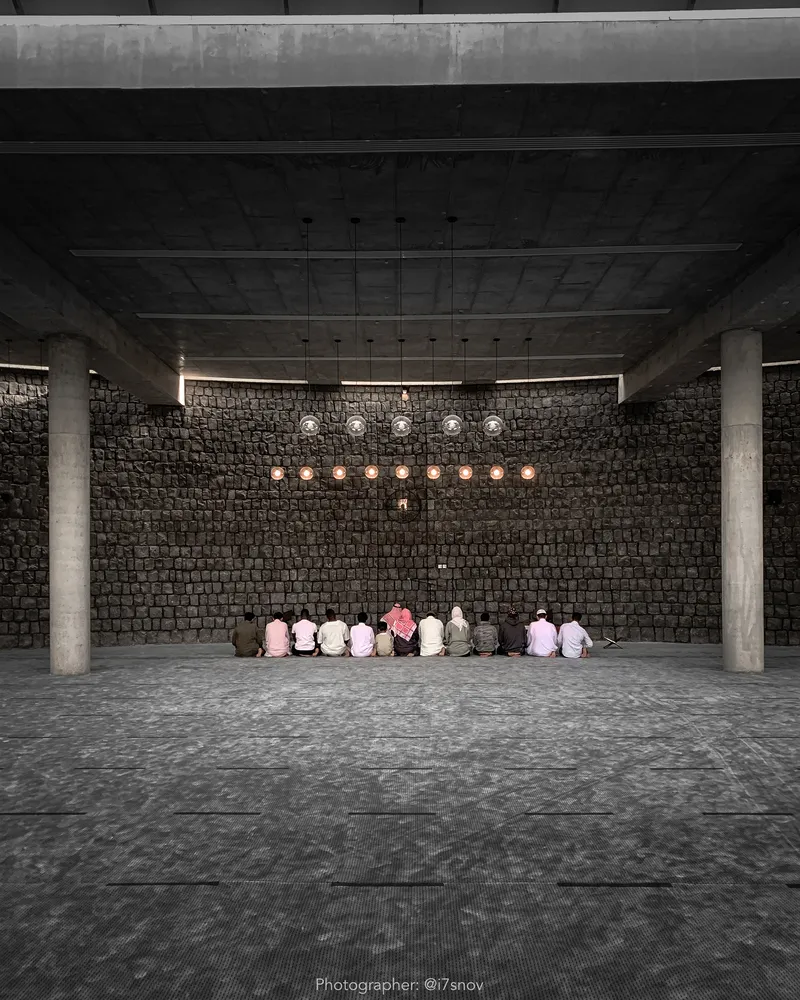
Al Batin represents the internal spiritual state experienced during prayer. The prayer hall embodies this concept through carefully controlled natural light, heavy stone surfaces, and a strong relationship between light, shadow, and the Qiblah wall.


Architectural Form, Materials, and Light
The mosque’s architecture is defined by an asymmetrical geometric composition, moving away from traditional domes and minarets. Instead, the design uses raw concrete forms, dark stone surfaces, and light-toned brick elements to create a minimal yet powerful architectural presence.
Natural light plays a central role in shaping the spatial experience. Thin beams of sunlight penetrate the interior, forming linear patterns that move across the prayer space throughout the day. These shifting light lines evoke a sense of rhythm and spiritual calm, symbolizing the passage of time between daily prayers.
The interplay between sunlight, lunar reflections on black stone surfaces, and the textured Qiblah wall enhances the contemplative character of the interior space. The architecture becomes an instrument for guiding spiritual focus rather than relying on decorative elements.


Contemporary Mosque Architecture and Spiritual Minimalism
Al Gharra Mosque demonstrates how modern mosque architecture can reinterpret Islamic spiritual values without repeating historical forms. By focusing on light, landscape, and spatial transitions, the project redefines how sacred spaces can be experienced in contemporary contexts.
Rather than emphasizing visual grandeur, the mosque prioritizes silence, simplicity, and spiritual introspection. The architectural language reflects a deeper understanding of religious rituals and transforms them into spatial experiences that resonate with worshippers.


All photographs are works of
Saleh Al Hawasawy Photography, Mohammed Ibrahim Shafee Architectural Office, Hasan Ahmad, Abdulrahem Shafea


Popular Articles
Popular articles from the community


Singing Woman: An Opera House That Performs Before the Curtain Rises
Ovidiu Cristian Pavel's conceptual opera house translates Estonia's choral identity into a sculpted waterfront landmark facing the Baltic Sea.

Aquadapt: An Underwater Habitat That Rewrites Its Rooms by the Hour
Curved modules ring the seabed while one shell shifts from breakfast room to cinema, farm and football pitch as residents' needs change.


ETEH Reworks the Shared Spaces of São Domingos School in Brazil Around Timber, Color and Hanging Plants
At São Domingos School in Brazil, 436 m² of hall, refectory and library are recast with timber joinery, a yellow and blue code and trailing greenery.

Manzana Morphosis: Stretching Barcelona's Grid into a Living Landscape for 2050
A radical reworking of the Eixample manzana turns density into a tool for generous public space, vertical ecology, and environmental performance.

Similar Reads
You might also enjoy these articles

Bamboo Housing Challenge 2026: Design Affordable, Sustainable Homes Using Bamboo
An international design competition by Bamboo U and IBUKU inviting architects and designers to reimagine affordable housing using bamboo — with the winning design built full-scale in Bali.

Computational Design & Education: Beegraphy Design Awards Introduces 7th Category (Featuring Jiyun's Innovative Approach)
Dive into Beegraphy’s 7th Design Awards category, where computational design meets education to create immersive, interactive learning tools, inspired by Jiyun’s work.
From Parametric Lighting to Urban Furniture: Join the 2nd Workshop in Beegraphy’s Computational Design Series
Dive into Cutting-Edge Design Techniques and Practical Applications with Industry Experts

Last Call: Unleash Your Architectural Genius in SHAK's Kindergarten Design Competition
Urgent call for architects to join SHAK's kindergarten design competition before the looming deadline

Explore Architecture Competitions
Discover active competitions in this discipline

Design Challenge - Contemporary interpretation of a religious complex

Challenge to reimagine the Iron Throne

Photograph architecture without architects

Illustrate the lost glory of Angkor Wat - Render Challenge
Comments (0)
Please login or sign up to add comments
No comments yet. Be the first to comment!